Roughly 1 in 5 single adults in the United States has participated in a consensually open relationship, according to a 2017 study by Haupert and colleagues. If you searched for open relationship rules, you are probably not looking for judgment. You are looking for clear boundaries, honest communication, and a framework that actually works.
The best open relationship rules are not rigid restrictions imposed by one partner on the other. They are co-created agreements that evolve as you do. The couples who thrive in ethical non-monogamy don’t rely on a rulebook. They rely on a system: boundaries they both understand, check-ins that actually happen, and a shared understanding of what to do when something goes wrong.
The 9 rules below start with the foundations: how to reframe your thinking and start the conversation. From there we get into practical frameworks: the 5W1H boundary system, monthly RADAR check-ins, and digital agreements most couples never think to make. The last group covers the emotional skills: managing jealousy, navigating new relationship energy, setting boundaries when one partner dates and the other does not, and repairing trust after a violation.
These are real-world open relationship rules that work, with actual scripts, expert research, and scenarios you will recognize.
Rule 1: Start With Agreements, Not Prohibitions
Most couples start by writing a list of prohibitions: no sleepovers, no catching feelings, no friends or coworkers. Within weeks, that list becomes a source of conflict, not clarity. The word you use changes the brain you bring to the conversation.

Dr. Tammy Nelson, a relationship therapist and author, advises couples to replace “rules” with “boundaries” and “agreements” from the very first conversation. Rules are externally imposed and rigid. Someone made them, and now someone else has to follow them. That dynamic is parent-to-child, not partner-to-partner.
Agreements are co-created and evolve as you evolve. Rules signal “I do not trust you.” Agreements signal “we are building something together.” Same outcome you want, structure and clarity, but a completely different emotional experience getting there.
Before any logistics, identify your shared core values. Dr. Nelson calls this finding your “true north.” Ask each other: what are the standards crucial to our connection? Write them down. If you both land on “honesty,” the agreement becomes specific: “we tell each other about new partners within 24 hours.” If you both land on “safety,” the agreement becomes “we use condoms with all outside partners and test every three months.”
When an agreement gets tested, and it will, return to the value, not the restriction. The value is your compass. The agreement is just the current route.
Attachment style shapes which agreements actually work for the two of you. Research by Amy C. Moors at Chapman University shows that secure individuals navigate consensual non-monogamy with greater ease. They experience more comfort with both closeness and independence.
Anxious partners need more reassurance and check-in frequency written into the agreements. Avoidant partners need designated space but must commit to showing up for scheduled conversations. This is not pathologizing anyone. It is designing agreements for the actual humans in the relationship, not hypothetical ideal partners.
Here is what happens when you skip this reframe. A couple we encountered in the research used a rule: “no catching feelings.” That rule collapsed because feelings are not controllable by decree.
An agreement-based version would say: “if feelings develop for someone else, we tell each other within 48 hours and discuss what to do together.”
The first version created a violation with no repair path. The second created a conversation with a timeline and a teammate. The difference is not in how much you restrict. It is in how much you leave room to be human.
If you have tried rigid rules and watched them fail, this section is for you. If you are brand new and still wrapping your head around basic definitions, start with the intro then the conversation section next, and circle back here.
Rule 2: Begin the Conversation With Curiosity, Not a Demand
This might be the hardest conversation you ever have with your partner. That is okay. Hard conversations, done well, are where intimacy lives.

The fear that your partner will hear “you are not enough” or “I want to cheat with permission” is real. Without the right words, even well-intentioned discussions about opening up can backfire spectacularly.
Choose your moment with intention: a calm, neutral time. Never during or after sex. Never during an argument. Never when either of you is hungry, exhausted, or distracted.
A Saturday morning over coffee works better than a Wednesday night after a fight about dishes. This sounds obvious, but couples consistently violate this timing principle and then wonder why the conversation went badly.
Dr. Tammy Nelson recommends the “what-if” entry point. Instead of “I want an open relationship,” lead with curiosity. Try: “I have been curious about something and I want to explore it with you because you are my person. What if we learned about different relationship styles together, just to understand them?”
This frames it as shared discovery, not a demand. It puts you on the same team, looking at the same question, instead of on opposite sides of a negotiation.
A few things you should absolutely not lead with. “I have needs you cannot meet” will land as an accusation. “All my friends are doing it” will land as peer pressure. “Our sex life is boring” will land as a grenade. If any of these are true for you, they belong in a different conversation, not the opener. Deal with your relationship’s fundamentals before you add complexity.
Three scripts for three different moments. The gentle opener: “I love what we have. I have been reading about how some couples structure their relationships differently, and it made me curious. Could we talk about it sometime, with no pressure to decide anything?”
If your partner reacts with hurt: “I hear that this feels threatening. That makes total sense. I am not asking for anything today. I just did not want to have a whole thought process without you, because you are my partner.”
The follow-up after a difficult first talk: “Can we agree to read one article together and check in again in two weeks? Just learning, no decisions.”
Shock, insecurity, anger, and sadness are all normal first reactions. A bad first reaction is not a permanent no. Expect an emotional response and prioritize listening over persuading. Leave the door open for a second conversation.
If your partner ultimately says no, sex and couples therapist Nicolle Dirksen advises: “You may have to do some soul searching to determine how you want your future sex life and love life to look.” That soul searching belongs to you, not to a negotiation with your partner. A no is not a starting bid. It is a boundary.
Bottom line: if you bring curiosity instead of a demand, and patience instead of a timeline, the conversation becomes the first brick in your open relationship foundation rather than the first crack.
Rule 3: Define Every Boundary Using the 5W1H Framework
Most open relationship violations do not happen because someone is reckless. They happen because two people said yes to the same word and meant completely different things. You agree to “be open” but your partner assumes kissing only while you assume intercourse. Neither of you is wrong or dishonest. You just never specified what “open” actually means.
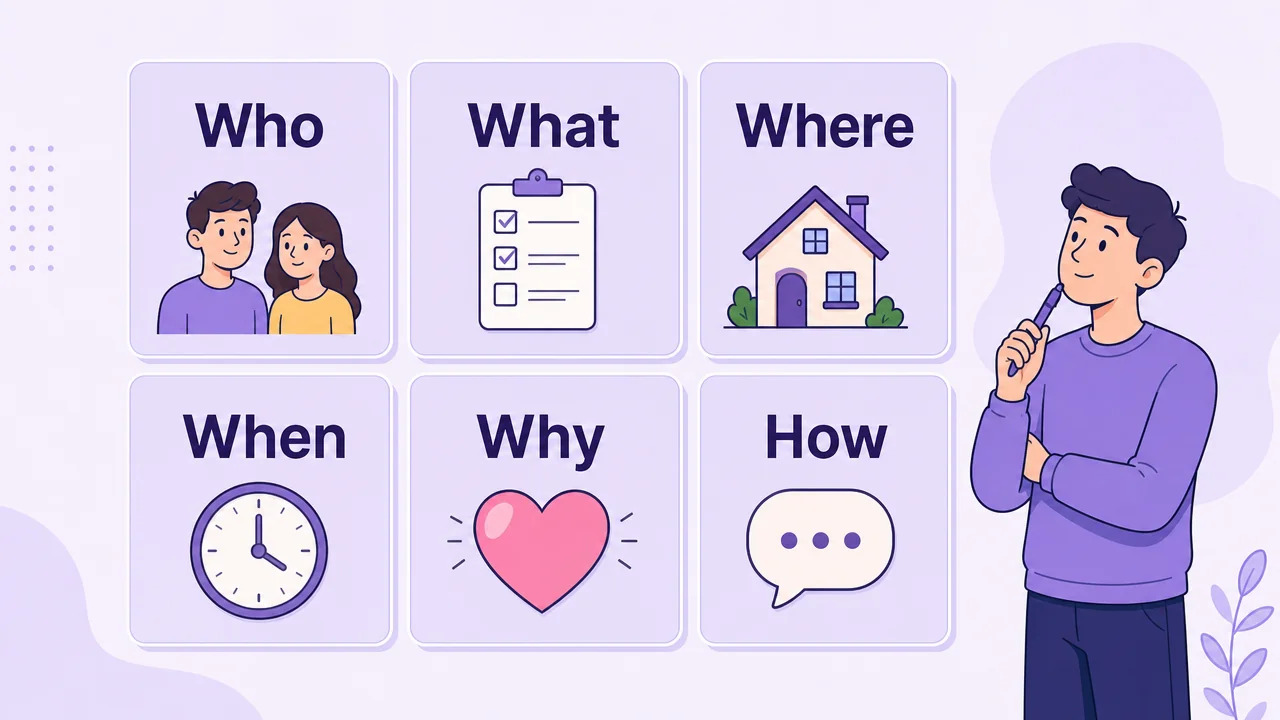
This is where the 5W1H framework, developed by sex and relationship coaches, becomes your best tool. It gives you a complete checklist so nothing gets left to dangerous assumptions.
Who: Are friends off-limits? Coworkers? Exes? Strangers only? Other ethically non-monogamous people? Age range, gender, singles versus other couples?
What: Kissing? Oral sex? Intercourse? Overnight stays? Emotional connection? Romance? Specific acts or kinks?
Where: Is your home off-limits? Your bed? Your neighborhood? Out of town only? Some couples use the “500-mile rule,” where outside connections only happen when traveling.
When: How many dates per week? Are weekends reserved for the two of you? Curfews? How much advance notice is required?
Why: What is the purpose? Sexual variety? Emotional expansion? Bisexual exploration? Kink needs your partner does not share? Mismatched libidos?
How: Full disclosure after encounters? Don’t ask don’t tell? Permission required before each date? A debrief conversation after?
Layer these questions through the five boundary categories identified by Thriveworks counselor Alexandra Cromer, LPC. Physical intimacy covers what sexual activities are allowed and off-limits. Emotional connection defines how much romantic attachment is acceptable and what happens if feelings develop. Health protocols cover condoms, dental dams, STI testing schedules, and disclosure of new partners. Time and space governs scheduling, shared spaces, sleeping arrangements, and holidays.
Ongoing consent is the fifth category, and it is the one most couples skip: agreements must be continuously revisited, not set once and frozen.
Here is what a specified agreement looks like versus a vague one. Vague: “We are open, but be safe.”
Specified: “We can each date up to two other people at a time. We use condoms with all outside partners and test every three months. We do not bring anyone to our home. We tell each other about new partners within 24 hours. We reserve Friday nights and Sunday mornings for us. We check in on the first of every month to review how it is going.”
These are comfort zones, not restrictions. The language matters. You are not limiting each other. You are designing a shared container that makes exploration feel safe for both of you.
If you have never opened up before, this is your starting template. If you have been open for over a year and already have working agreements, use this as an audit tool. Run through the 5W1H together and see what still lines up.
Rule 4: Schedule a RADAR Check-In Every Month
The difference between couples who thrive in open relationships and those who crash is not less jealousy or better agreements. A 2025 study in The Journal of Sex Research confirmed that relationship satisfaction in consensually non-monogamous relationships is similar to monogamous ones. What determines longevity is trust, reciprocity, and compromise.
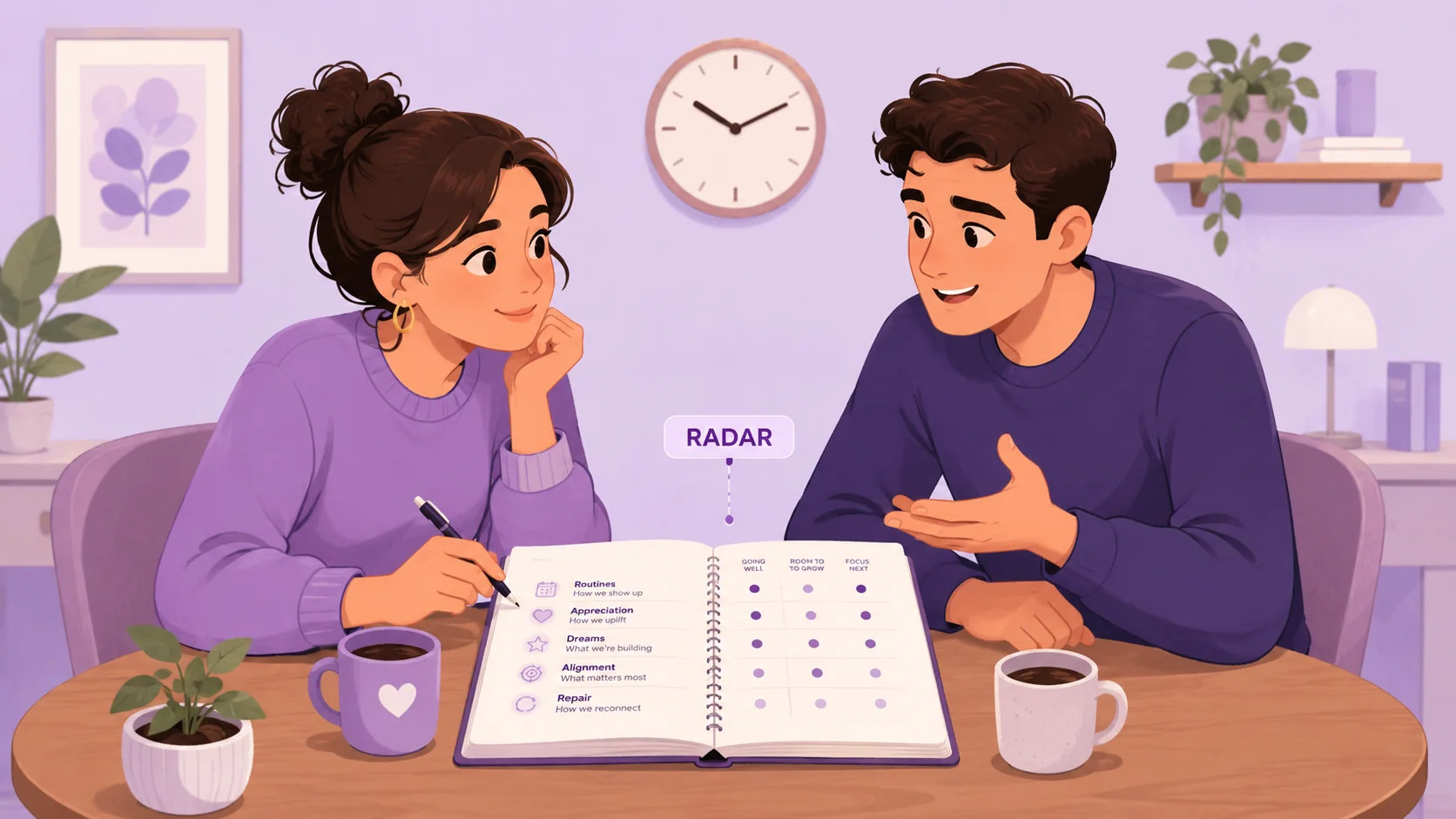
Those three things require a scheduled, structured way to talk about how things are actually going. Not the panicked 11 p.m. conversation after someone comes home late. A real container you both show up for.
RADAR is a structured monthly check-in adapted from the polyamory community and the Multiamory podcast. It works equally well for open relationships. The acronym breaks down into five segments that create a reliable container for the conversations every open couple needs to have.
Review: What has happened since our last check-in? Any new partners, dates, or experiences? Appreciate: What is going well? What did your partner do that made you feel secure or loved?
Discuss: What feels challenging? Any jealousy spikes, scheduling conflicts, or comfort zone questions? Agreements: Do any of our current agreements need adjustment? Are any being consistently tested? Reconnect: What can we do in the next week to prioritize us? A date, a ritual, a specific act of care?
Logistics matter. Schedule monthly RADAR check-ins for most couples. Go weekly for couples in the first three months of opening up, when emotions run high and you are still discovering what your comfort zones actually are. Set a timer for 45 to 60 minutes with no phones. Neutral location, not the bedroom. Start and end with physical connection: holding hands, a long hug.
Take notes so both of you have the same record of what was agreed. This prevents the “I thought we said something different” arguments that fracture trust over time.
A real five-minute RADAR excerpt sounds like this. “For Review, I went on two dates with Alex since our last check-in. For Appreciate, you handled the overnight really gracefully and I felt your support. For Discuss, I have been feeling a little disconnected from us this week and I want to talk about that.”
“For Agreements, I think our current frequency comfort zone is working but I want to revisit the overnight policy. For Reconnect, can we do Sunday brunch just us, no phones?”
Is this deliberate? Yes. Awkward at first? Probably. But five minutes of structured conversation prevents five hours of argument two months later. You get used to it fast.
If you implement exactly one framework from this article, make it RADAR. Everything else, every boundary decision and jealousy conversation, depends on having a reliable communication container. Schedule your first one for two weeks from today.
Rule 5: Set Digital Boundaries Before You Need Them
You can spend months crafting perfect emotional agreements and still blow everything up because a notification popped up on the wrong screen at the wrong moment. Digital boundaries are not an afterthought. They are the surface area where most open relationships touch the outside world.
Dating app profiles require several decisions that most couples never discuss before creating them. Joint couple profile versus separate individual profiles: joint signals unity but limits individual autonomy. Separate requires more trust but lets each of you present authentically. Face photos versus no face photos is a privacy-versus-authenticity tradeoff that people with public-facing careers need to weigh especially carefully.
Relationship status disclosure in your bio matters. “Ethically non-monogamous, partnered” signals integrity and filters out people who would not consent to the arrangement. Some apps, built specifically for couples exploring together, let you link accounts so both of you can navigate as a team without giving up individual presence.
Notification and device boundaries prevent the small resentments that accumulate into big ones. Are dating app notifications silenced during couple time? What happens if a message arrives during dinner or in bed?
One straightforward agreement: notifications off during designated couple time, phones face-down at meals, no scrolling dating apps while lying next to your partner. Set app-specific notification schedules on your phone so dating apps go silent automatically during your protected hours. These are not rules designed to control. They are agreements designed to protect the space that belongs to the two of you.
Location sharing deserves its own conversation. Do you share live location during dates for safety, only for first dates, always, or never? Frame this as a safety and trust decision, not a surveillance tool.
If one of you wants location sharing and the other resists, explore what fear sits underneath each position. The partner who wants to share location might be anxious about safety. The partner who resists might feel monitored. Neither position is wrong. Both deserve curiosity, not judgment.
Social media introduces a whole other layer most couples never think to discuss. Are outside partners tagged in posts? Do you follow each other’s outside connections? What happens if an outside partner posts about your date?
Picture this: your outside partner posts a photo from your date night and tags the restaurant. Your primary partner sees it in their feed before you mentioned the date. Now you are managing hurt feelings instead of calibrating your agreements. Decide early: who knows what, and through which channels.
If you use dating apps as part of your arrangement, this section is mandatory reading. If you meet outside partners exclusively through in-person community and do not use apps, you can skip the profile stuff but still read the notification and social media sections. Those apply to everyone.
Rule 6: Treat Jealousy as a Dashboard Light, Not a Stop Sign
About 53 percent of people in open relationships report experiencing compersion: genuine joy in their partner’s happiness with someone else. The other 47 percent are not failing. They just have not learned the skill yet.

Compersion is cultivable, not innate. Before you can get there, you need to stop treating jealousy as evidence that you are not cut out for this.
When your check-engine light comes on, you do not abandon the car on the highway. You look under the hood. Jealousy works the same way. It is a signal that something needs attention, not proof the entire relationship model is broken.
Jealousy in consensual non-monogamy is almost always an attachment activation response: your nervous system detecting a potential threat and sounding an alarm. The alarm is real. The threat might not be.
Therapist Ellecia Paine explains that jealousy signals unmet needs, not incompatibility with non-monogamy. A five-step framework from Psychology Today, published in September 2025, walks through exactly what to do when jealousy hits.
Step one: pause and name it. Simply saying “I feel jealous” aloud to yourself begins to release its grip on your nervous system.
Step two: identify the specific fear underneath. What am I really afraid of right now? Abandonment, inadequacy, losing time together?
Step three: communicate vulnerably using “I feel X, I need Y” without blame.
Step four: request specific, actionable reassurance. “Can you tell me one thing you love about us right now?” works better than “Make me feel better.”
Step five: build self-soothing skills. Grounding techniques like holding ice or walking barefoot. Soothing practices like a warm bath or weighted blanket. Expressive outlets like journaling or exercise.
Compersion is the long game. Define it for yourself: the experience of feeling warmth or happiness because your partner is experiencing pleasure or connection with another person. Start small.
Ask your partner to share one thing they enjoyed about a date, if your disclosure agreement allows it. Notice the feeling in your body when they smile telling the story. That flicker of warmth is the beginning of compersion. It grows with practice, not pressure.
There is a case from the research that shows what happens when jealousy gets treated as a stop sign. A 37-year-old woman’s boyfriend suggested opening their relationship to pursue a coworker. She reluctantly agreed and got over 500 likes on dating apps within days. When the coworker rejected him and she started dating, he became furious and demanded they close everything.
His jealousy was predictable and normal. What failed was his response to it. He treated the jealousy as a command instead of investigating what it was actually telling him: fear of losing her, not anger at her success. Any sustainable set of agreements must leave room for jealousy to speak without dictating the outcome.
The goal is not zero jealousy. It is a relationship where jealousy is safe to admit, quick to investigate, and consistently met with curiosity instead of punishment.
Rule 7: Name New Relationship Energy Before It Names You
There is a neurochemical reason your partner seems obsessed with someone new, and it is not because they love you less. It is called New Relationship Energy, and understanding it changes everything about how your agreements hold up under real-world pressure.
NRE is the intoxicating cocktail that floods your brain during the early stage of any new connection: dopamine, norepinephrine, and oxytocin. These are the same chemicals responsible for the honeymoon phase of any relationship. They produce obsessive thinking, idealization of the new person, and an intense craving for contact.
NRE is not love and it is not a threat to your primary bond. It is biochemistry, typically lasting 6 to 18 months. Naming it removes its power to shame either of you.
The primary neglect pattern is one of the most painful dynamics in open relationships. Research documents the case of a husband who began prioritizing his new girlfriend with expensive gifts, choosing her birthday over his wedding anniversary, and staying up late texting her in bed while his wife lay next to him.
This did not happen because he stopped loving his wife. It happened because NRE hijacked his attention and he had no framework for recognizing or managing it. Without a framework, NRE does not feel like biochemistry. It feels like betrayal.
Four NRE-specific agreements can prevent this pattern. First, the NRE disclosure agreement: “If I notice I am thinking about someone else constantly, I will tell you.” The actual script: “Hey, I want to name something. I am feeling that NRE rush with someone new. I am telling you because we agreed to be transparent about this.” That honesty prevents the isolating secrecy that makes NRE dangerous.
Second, the primary protection agreement: “During intense NRE phases, we maintain our scheduled quality time no matter what. No cancellations for new connections.”
Third, the reality-check agreement: both of you agree to wait at least 3 months before making any major decisions about a new connection. NRE distorts judgment. A waiting period lets the neurochemical fog clear.
Fourth, the NRE debrief: the partner experiencing NRE can share the excitement, if your disclosure agreements allow, while both of you acknowledge the NRE for what it is. Not a threat, not a rival. Just brain chemistry doing what brain chemistry does. Use your RADAR check-ins as the dedicated container for these conversations.
If you are the partner in NRE, over-invest in your primary relationship during this phase, not under-invest. Double down on date nights, affirmations, and presence. Your partner needs to see and feel that the new connection has not displaced them.
If you are the partner watching NRE unfold from the outside, ask for what you need without punishing your partner for normal biochemistry. “I miss you and I need a full weekend just us” is a request. “You clearly care more about them than me” is an accusation. Only one of those gets you what you actually want.
Agree on the NRE disclosure agreement before anyone meets anyone else. Once NRE hits, the window for calm, rational agreement-making narrows dramatically.
Rule 8: Customize Your Agreements for Asymmetric Dating
Open does not mean equal. It means agreed. The couple where one person dates three times a week and the other has not been on a date in six months is not broken. They just need a different blueprint.
This configuration is more common than most people realize. Common reasons one partner does not date include mismatched libidos where the lower-libido partner is often relieved rather than deprived, asexual or graysexual identity, career or health focus that leaves no bandwidth for additional relationships, compersion as genuine joy from witnessing a partner’s experiences without needing to replicate them, or simply not meeting anyone interesting yet.
Real example. One partner travels frequently for work and uses those trips for outside connections. The home partner values the quiet evenings alone. Their arrangement works because both are getting something they want: variety during trips, decompression at home. Neither is losing.
Asymmetric couples need agreements that symmetrical couples can skip. First, the guilt-dumping prevention agreement: the dating partner agrees not to overshare about their success as a way of processing guilt. Saying “I feel bad you are not dating” is not sharing. It asks the non-dating partner to manage your emotions. Process that guilt with a friend or therapist instead.
Second, the quality-time floor: outside connections should not reduce primary relationship time below a mutually agreed minimum. If you currently spend four evenings a week together, that number stays at four regardless of how many other dates happen. The dating partner’s schedule adapts around the primary relationship, not the other way around.
Third, the right-to-close agreement: the non-dating partner’s voice carries equal weight even if they are not actively participating. They can call for a pause or closure on the same terms as the dating partner. Fourth, the optionality agreement: the non-dating partner can change their mind and begin dating without renegotiating the entire arrangement. Their choice not to date today is not a permanent decision.
Friends and family may pathologize the asymmetry. Give yourself language to respond: “Our arrangement works for both of us. What looks like inequality from the outside is a carefully designed agreement that meets both our needs.”
If you are the non-dating partner, identify what you ARE getting from the arrangement. Compersion, alone time, reduced pressure, seeing your partner happier. Name it explicitly. If you cannot identify anything positive, the asymmetry needs renegotiation, not continuation.
Rule 9: Have a Repair Process Ready Before a Boundary Gets Crossed
A boundary will get crossed. Not because one of you is terrible, but because you are two humans running an emotionally complex system with incomplete information. The question is not whether something will go wrong. It is whether you have a repair process or a blame spiral.

First, distinguish between types of violations. An accidental violation happens when the agreement was unclear, the situation was ambiguous, or both of you had different interpretations of the same words. Example: the agreement said “no overnight stays” but one partner assumed that meant “not sleeping over” while the other assumed it also meant “not staying until 3am.” Both acted in good faith. The agreement was simply underdefined.
A deliberate violation happens when a partner knew the boundary and crossed it anyway, hid it, or minimized it. Different violations require different responses.
An accidental violation is a systems failure. Fix the agreement. A deliberate violation is a trust failure. Fix the accountability. Conflating the two either lets serious breaches off too easily or punishes honest confusion as betrayal.
Relationship therapist Thais Gibson from the Personal Development School recommends a five-step repair framework grounded in the “I feel, I need, I propose” structure. Step one: acknowledge together without blame. The violating partner says: “I crossed an agreement we made. I am sorry. I want to understand how this affected you and what we do next.”
The violated partner says: “I feel [emotion] because [specific impact].” No character indictments, no “you always” or “you never.” Just specific actions and specific feelings.
Step two: determine if the agreement was unclear, unrealistic, or deliberately broken. This is diagnostic, not accusatory. If the agreement said “no overnight stays” but never defined what “overnight” means, that is a definition problem, not a trust problem.
Step three: the violating partner takes accountability without defensiveness. No “but you also,” no “I did not mean to,” no minimizing. Just: “I did this. It was a violation. I am accountable for it.”
Step four: use the “I feel, I need, I propose” structure to rebuild. The violated partner expresses feeling and need. The violating partner proposes concrete steps to rebuild trust. Both negotiate until there is a new, clearer agreement.
Step five: implement a repair ritual. Extra quality time, a focused check-in, a shared experience that reaffirms the primary bond. Something tangible that says “we are still us.”
When to seek professional help: if the same boundary is violated repeatedly, if the violation involved deliberate deception over time, or if repair conversations keep cycling without resolution. A consensually non-monogamy-informed couples therapist is not optional at that point. It is necessary. Counselors like Ashera DeRosa, LMFT, and Alexandra Cromer, LPC, specialize in exactly this work. They exist for a reason.
A boundary violation is a terrible thing to waste. Handled well, it forces a level of honesty and clarity that most couples never reach. The couples whose agreements survive violations are not the ones with perfect compliance. They are the ones with a working repair process.
FAQ: Open Relationship Rules and Agreements
What is the difference between an open relationship and polyamory?
Open relationships center a primary couple with outside sexual or romantic connections. Polyamory involves multiple loving relationships without ranking them hierarchically. Open relationship agreements prioritize protecting the primary bond. Learn more about differences between open relationship and polyamory >>
Can you cheat in an open relationship?
Yes. Cheating is violating agreed-upon boundaries. Common forms include emotional breaches when the agreement was strictly physical, safety protocol violations like skipping protection, and hiding interactions or lying about encounters.
How do you close an open relationship gracefully?
Closing is not failure, it is adaptation. Start with “I” statements, end outside connections honestly, and rebuild intimacy intentionally. If your partner disagrees, suggest a trial period such as three months of monogamy.
What is kitchen table versus parallel poly?
Kitchen table means partners and metamours interact comfortably. Parallel means outside connections stay entirely separate. Neither is better. Many couples start parallel and shift toward kitchen table as trust builds.
What about the third partner’s perspective?
The people you date are full humans with their own feelings. Disclose your relationship structure before the first date. Do not make promises you cannot keep. Give honest closure if things end.
Does “Don’t Ask Don’t Tell” work?
DADT works for some couples but carries risk. Withheld information can curdle into suspicion. Many experienced practitioners recommend against it. If you choose DADT, schedule meta-check-ins about whether the policy still serves you.
How do you come out about being in an open relationship?
Assess safety first. Not everyone deserves to know. Start with one or two trusted people. Lead with confidence: “Our relationship structure works for us, and I wanted you to hear it from me.” Set boundaries about what questions you will answer.
How does attachment style affect agreements?
Secure individuals navigate agreements with trust. Anxious partners need more reassurance written in. Avoidant partners need space but must show up for check-ins. Adapt agreements to your actual profiles, not a template.
What if one partner wants to close and the other does not?
This requires honest conversation, possibly with a CNM-informed therapist. Options include a trial period of monogamy, renegotiating boundaries, or acknowledging a fundamental incompatibility. Neither partner should pressure the other.
Do open relationship agreements prevent problems?
They reduce ambiguity and create a shared reference point. The real value is not the agreement itself but the process of creating and revising it. The couples who succeed are the ones most willing to keep talking when agreements get tested.