
In a study of 673 people, 45.9 percent said they were excited by their partner’s submission or their own. In a separate study, 20.5 percent of women chose a dominant partner. Wanting to take the lead in bed is not a niche thing, and it is not a broken thing.
Here is what learning how to be dominant in bed means in practice: taking the lead with confidence, presence, and clear consent. It is a skill, not a personality you are born with. Either role fits a person of any gender, and roles in bed are a choice, not a script. You can trade them back and forth across a single night.
If you are shy, quiet, or small, this still applies to you. Dominance is learnable, step by step, and it draws on your presence more than your physique.
These eight steps take you from the first conversation to the final aftercare check-in: talk, presence, pace, words, escalation, reading signals, recovery, and care. Each builds on the last, and the consent-first framing is what keeps it adventurous instead of anxious. The result is a version of dominance that makes your partner feel safe enough to fully let go.
Step 1: Talk About It Before You Try It

The conversation is the foundation, and it comes before the door closes. Learning how to be dominant in bed starts here, and skipping this step makes everything after it wobble. A dominant leads the scene, and a submissive surrenders within it. Agree on both roles out loud before either one exists in bed.
Start with your own why. Are you curious, or is this a core desire? What turns you on about taking the lead? You cannot share it until you have named it for yourself.
Desire doesn’t require an apology, but it does require clarity.
Then choose the moment. Pick a calm, non-sexual time. Never mid-intimacy, never at bedtime when one of you is running on fumes.
🛠️ The Conversation Starter
Read these lines aloud, in your own words:
“There’s something I’ve been wanting to share with you. It’s important to me. Can we talk about it?”
“I’ve been curious about trying something new in our intimate life.”
“I think I’m curious what it would feel like to take the lead more.”
“If it’s not your thing, that’s okay. I care more about us being on the same page.”
“You don’t have to answer right now. I just wanted to start the conversation.”
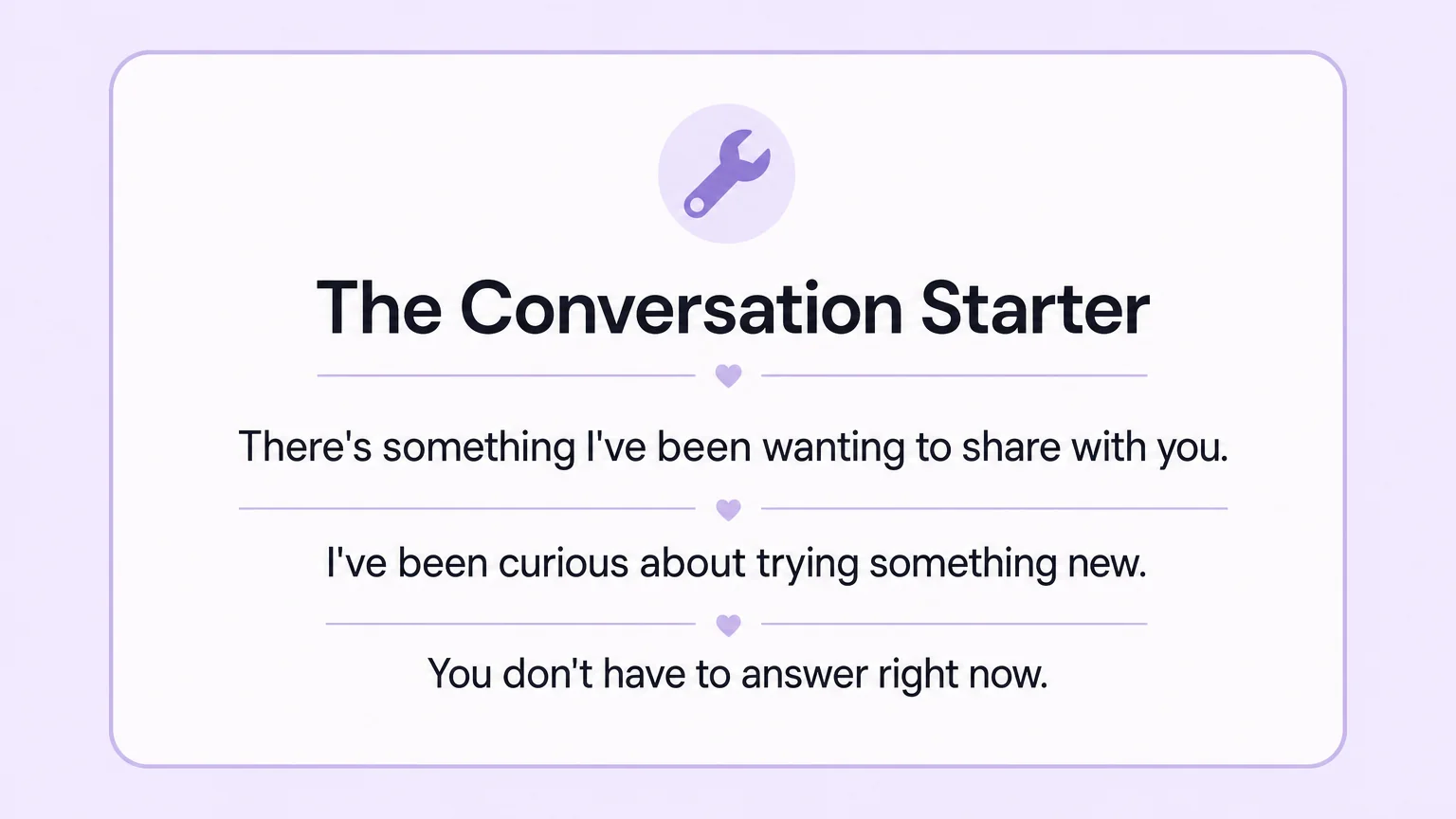
Notice the shape of those lines: vulnerability first, the feeling second, the mechanics never. You are offering an invitation, not issuing a demand. If your partner declines, thank them for their honesty and look for a middle path: a lighter version still plays the power exchange, and most couples find one they both want.
A Yes/No/Maybe list does the awkward work for you. Fill it out together: what excites you, what is open under the right conditions, and what is off the table.
Agree on a safeword before anything else. The traffic-light system is the standard: green means continue, yellow means slow down and check in, red means stop immediately. Add a non-verbal signal for when speech is restricted, like tapping out or dropping an object. Keep safewords outside the scene’s vocabulary: when struggling is part of the game, “no” and “stop” stop meaning what they usually do.
You will know it landed when you have agreed on one thing to try, one thing that is off the table, and a safeword, and neither of you feels pushed.
If that conversation is the hard part, it helps to practice it somewhere the ground rules are already normal. On 3Fun, couples and singles negotiate what they want before the door closes, every day, in plain words. The script above runs on the same lines.
Step 2: Lead With Your Body and Voice
Presence comes before technique, and it costs nothing. Learning how to be dominant in bed starts here: your power lives in how you occupy a room, not in what you can lift. Presence is the fastest lever available, and it works for any gender and any body type.
Stand and sit taller. Open your posture and take up space instead of shrinking into it. Hold eye contact without staring, and move slowly.
Deliberate motion reads as calm confidence, while speed reads as nervousness. Slowness, in every form, is a dominant’s native language.
Your voice follows the same rules. Lower your pitch slightly, slow your pace, and speak in full sentences. Pause before you speak, and let a quiet instruction carry more weight than a shouted one.
Never fake a command voice that is not yours. Uncertainty breaks the immersion faster than a shaky line does.
Use your hands as guides rather than grabs. A hand on the lower back, a gentle steer of the hips, a repositioning of your partner’s body. Let contrast do the rest of the work. Staying dressed while your partner undresses, or holding them in position while you move, creates a power imbalance with no force behind it.
None of this requires upper-body strength, which is why it works exactly the same for a dominant woman or a smaller-bodied dominant man. Anticipation, subtle gestures, and confident stillness are where the power lives, not muscle.
Your milestone is simple: the moment you can move your partner’s body with a single touch or a single word, and they respond, you are leading. You do not have to feel dominant yet. You already are.
Step 3: Take Control of the Pace
The single most reliable dominant move is also the simplest: slow down. The person setting the tempo is the person leading, no matter who is on top. That one idea is how to be more dominant in bed, and it requires nothing but self-control.
Slow your movements. Pause deliberately at the transition points, the moments where your partner expects you to keep going. Make them wait. Anticipation does more arousal work than speed ever will, and it costs you nothing.
Narrate where your touch is going so the wait itself becomes the turn-on. “Open your legs. I’m going to go between your legs.” Control depth and speed from a position where you set the rhythm. In the Amazon position, the person on top is in the power position, steering depth, pace, and stimulation.
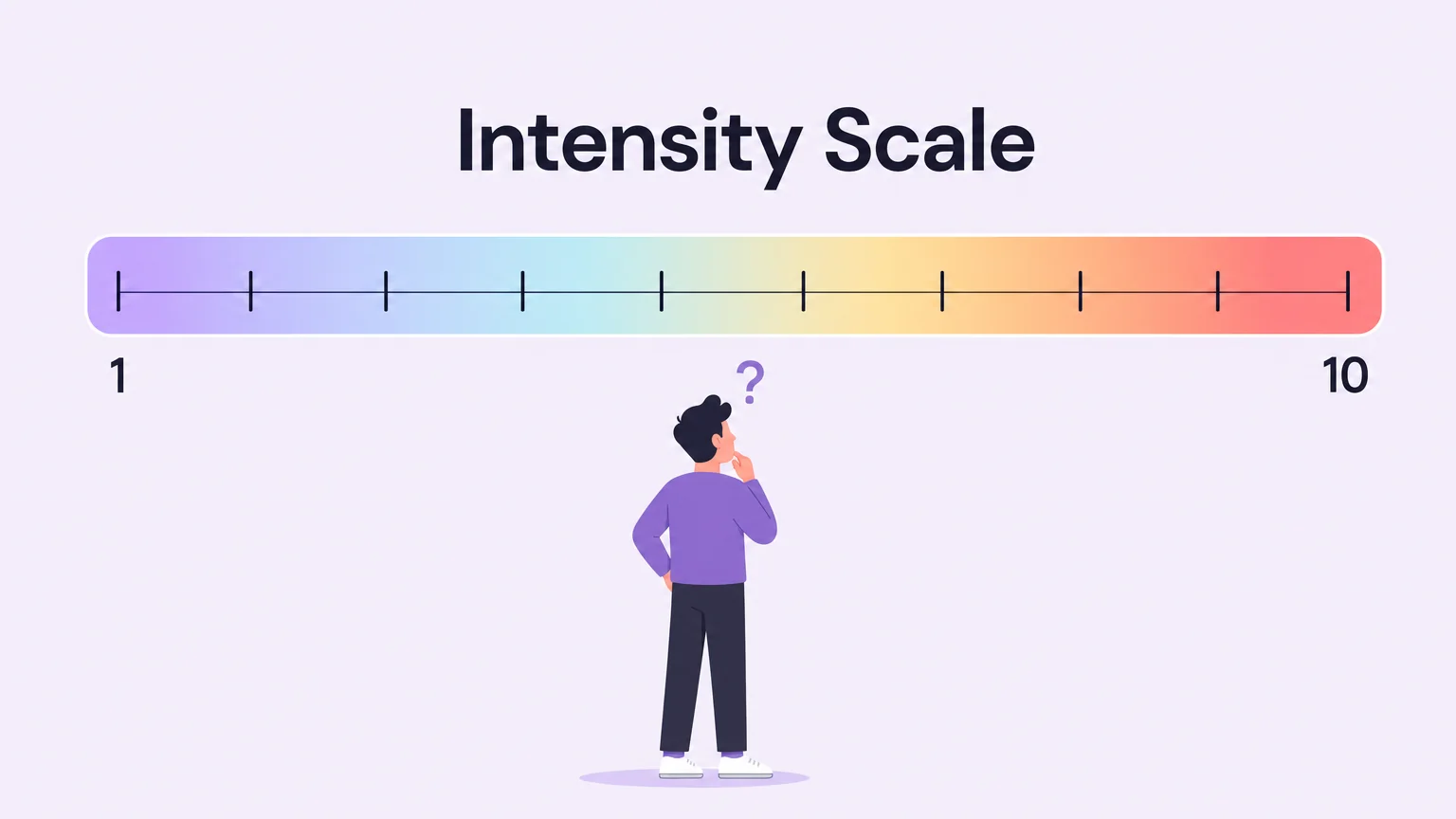
Bring in the intensity scale before you escalate. Agree that every activity has a level from one to ten, move up in small increments, and introduce one new thing per scene. Rehearse any sensation on yourself before you apply it to your partner. You should be able to name the level you are at, and so should they.
Novelty does part of the work here. New activities carry an edge that raises arousal on their own, and consent is part of the turn-on, not a speed bump. If it’s not an enthusiastic yes from everyone in the room, it’s a hard no. A body that does not feel safe tenses up and shuts down, and no amount of technique survives that.
You are pacing well when your partner matches your rhythm and asks for more. That is the signal that you are leading from the right place, and that the waiting is working.
Step 4: Use Commands and Dirty Talk That Land
Most of us go blank because we do not know what we want, let alone how to say it. We rehearse one line, deliver it, and then stand at the edge of the cliff with nowhere to go. Learning how to be dominant in bed is mostly learning the words, and the fix is preparation, not talent.
Build the skill outside the bedroom first. Practice asking for what you want in clear, confident language in everyday settings. Learn what your own body actually likes through solo exploration, so you know what you are asking for. Then practice the words themselves: sexting, describing what you liked after the fact, and voicing a banked line from a daydream so you always have one ready.
When the moment comes, keep it low, slow, and firm. Do not force a command voice that is not yours. If you are new, prefer direction-giving to full scenes.
“Go harder. Go left. Go right.” Short instructions are easier to say and easier to obey, and obedience is what builds the dynamic. Give one direction at a time; a list reads as a lecture.
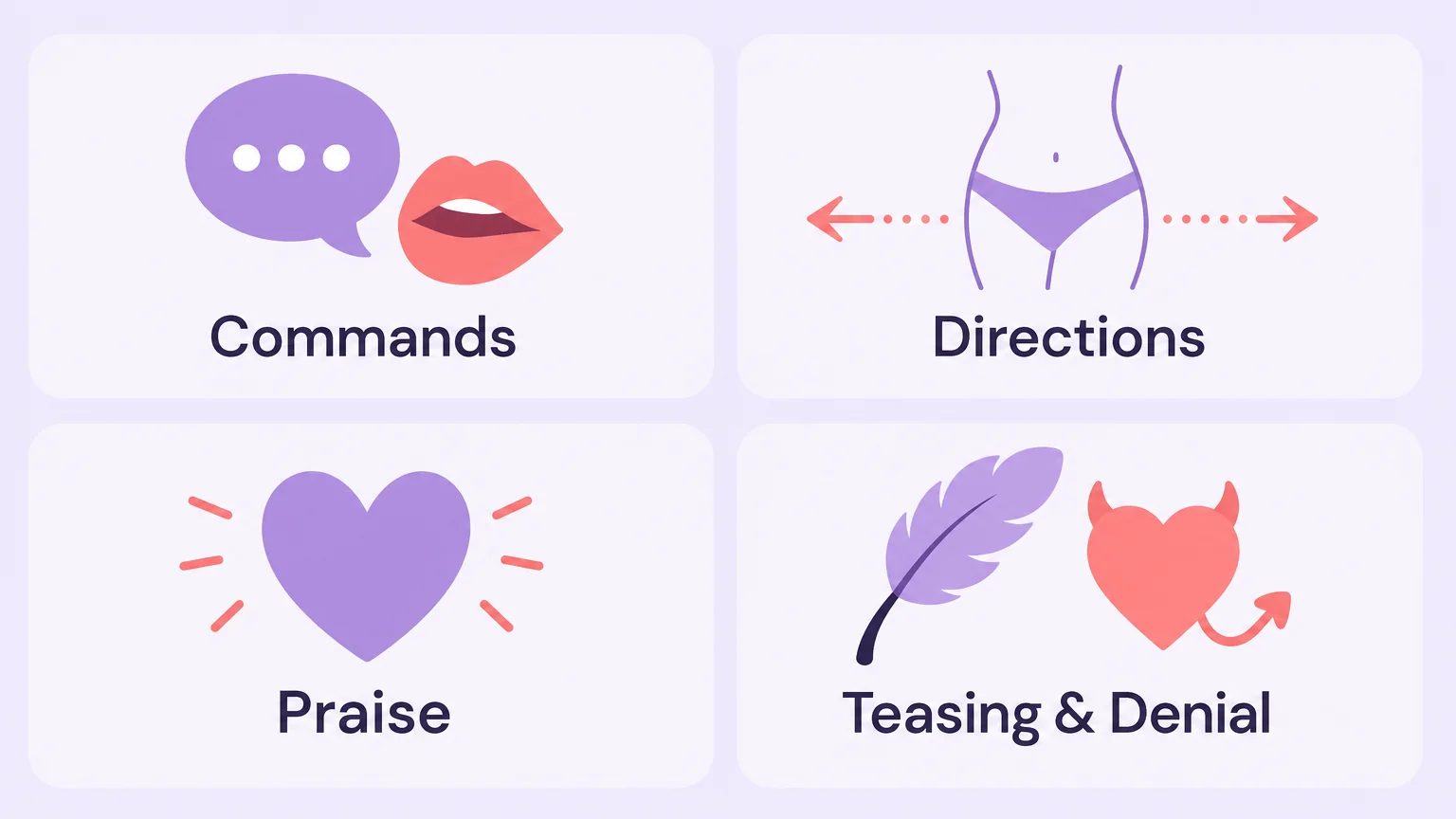
Keep a few lines in your pocket, organized by job.
Commands: “Look at me. Kiss me. Get on your knees.” Directions: “Slower. Stop, that’s mine.” Praise: “Good girl. Good boy. You’re doing so well.” Teasing and denial: “Not yet. Ask me nicely.”
The bank is gender-neutral by design. Praise and direction from a dominant woman to a man land the same way they do in reverse, so swap “good girl” for “good boy” as needed. The warmth and the certainty carry the meaning, not the label.
One rule before you use any of it: never ask for something modeled on porn that you have not verified you actually like. The fantasy and the reality are often different, and you will find out in the worst possible moment.
You will know the words are landing when your partner responds to a single instruction. And you will know you are prepared when you have a banked line ready for the moment you would otherwise freeze.
When the bank runs out, our guide to dominant dirty talk has 90+ phrases organized by scenario, from praise and possession to running a scene over text.
Step 5: Escalate Gently – Restraint, Sensory Play, and Impact
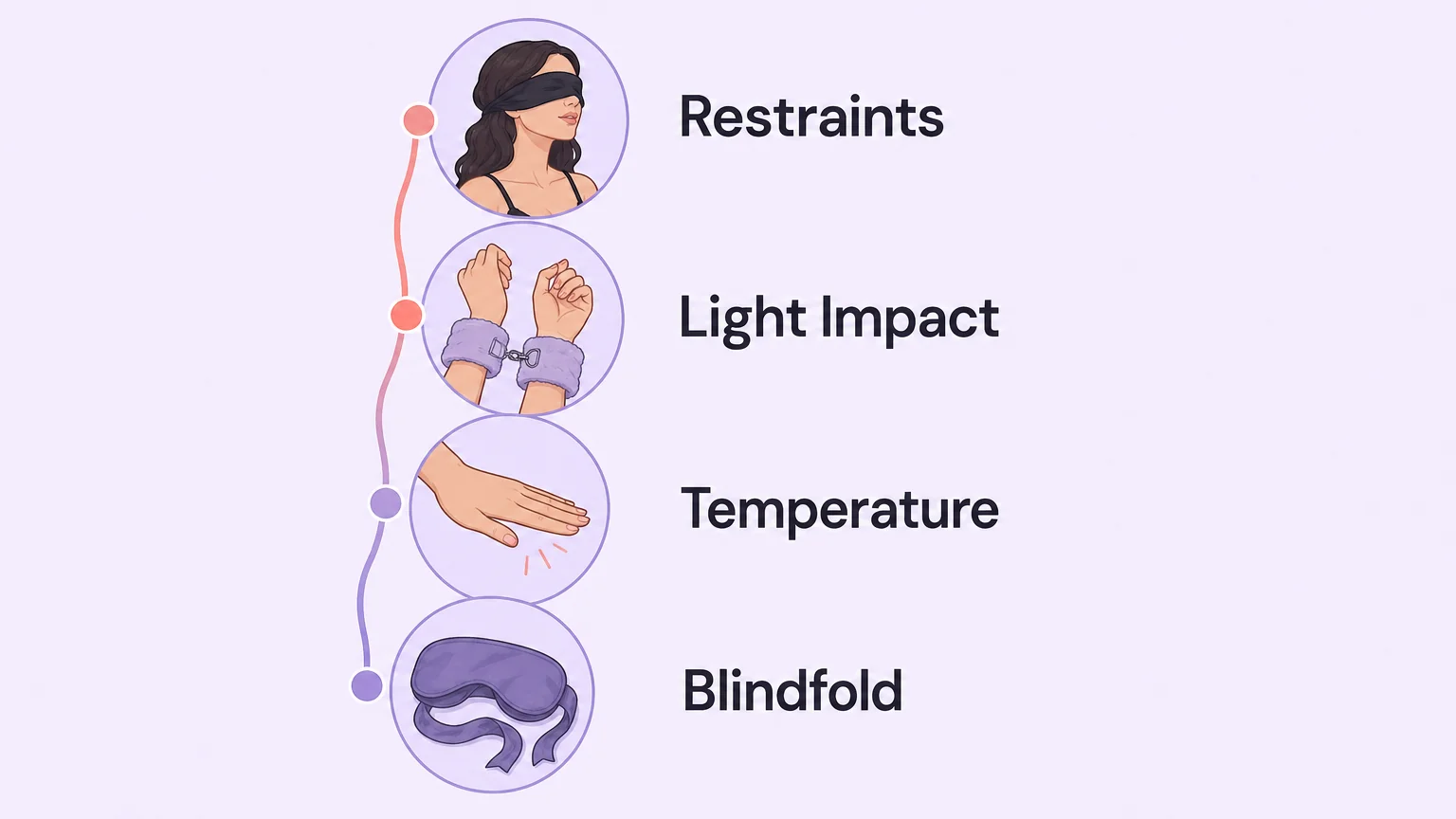
The safe version of how to be dominant in bed is a ladder, and you climb one rung at a time. Move up only when the current rung feels comfortable for both of you, and never stack new sensations in a single night.
Start with the blindfold. Removing sight builds anticipation and lets you control what your partner perceives. Narrate where your touch is going the whole time, because your voice becomes the map when the eyes go dark.
At level three, your hand moves slowly and your words guide every step. At level six, the pace quickens and the anticipation itself is part of the game.
Next comes temperature play. An ice cube traced along the skin, or a body-safe massage candle poured as warm oil. A regular household candle is never body-safe for wax, no matter how careful you think you are. Test the warmth on your own wrist first.
Light impact comes after. Use your hand or a soft paddle on the meaty part of the buttocks, and build intensity slowly. Start around a level two and move up a point at a time. The goal is sensation, never injury, and the body will tell you the difference.
Restraints come last, and only when the trust is already there. Choose sex-shop cuffs you can actually escape, because the ability to escape is the safety feature. Start seated or standing with arms behind the back, not lying bound. If you are reaching for scissors to free your partner, you have gone too tight.
The safety rules hold across every rung. Practice any sensation on yourself first. Keep the safeword and a non-verbal signal live the whole time. Add one new activity per scene, never a stack of them.
Care is not the opposite of intensity; it is the container that makes intensity safe.
One boundary for the curious: choking is an advanced practice, not a beginner one. If it is ever explored, it means pressing gently on the sides of the neck, never the front of the windpipe, and stopping at any pain.
You have escalated well when your partner stays relaxed and responsive. Any hesitation is a signal to dial back one rung and rebuild. The ladder will still be there tomorrow.
Step 6: Read Your Partner’s Signals and Check In Without Breaking the Mood

The body speaks before the words do, and a dominant reads both. Watch for the signals: muscles tightening, a partner going quiet or shutting down, eyes drifting distant, or the faraway look of someone starting to disassociate. These are the moments to slow down, even before anyone says a word. Slow the pace, soften the touch, and name what you see out loud.
Learn the positive signals too. Leaning in, breath catching, hips moving to meet you, a hand gripping you closer. Enthusiasm is often silent as well, and a dominant knows the difference between a body that wants more and a body that is just getting through it.
Check-ins are part of the scene, not interruptions of it. A good dominant checks in at the start, the middle, and the end. And it can be delivered as an instruction, which keeps the mood intact: “I’m not going to do anything more until you tell me what you want.”
The traffic-light system exists for exactly this. Yellow means adjust without stopping. Green means keep going. Red means stop immediately. Keep a non-verbal signal live for when speech is restricted, a dropped object or a tap-out.
If a trigger surfaces, you have tools that do not require ending the scene. Pause. Use a timer as an anchor to breathe and self-regulate. Let gratitude from your partner re-center you.
Keep a unique code word for each specific trigger, so communication can continue without breaking character.
The skill, in its final form: you have read the room correctly when you notice a shift in your partner before they have to say anything. That is the quiet difference between leading and reacting.
Step 7: What to Do When It Goes Wrong

Your first scenes are practice, and everyone fumbles. Plan for a stumble the way you plan for a good ending, because recovery is part of the skill.
The common beginner mistakes are predictable: going too hard too fast, skipping the conversation about what you do and do not want, copying a scene from porn without debriefing it after, and breaking character to panic-check in the middle of the scene.
When anything feels off in the moment, stop and check in. A trigger does not have to end the scene. It asks for a pause, a breath, and a readjustment, and then you can continue from where you are.
If your partner laughs, treat it as common and recoverable. Normalize it instead of freezing. A slightly cringe moment is expected in a first attempt, not a failure. Use a humor cue to get back in sync, and laugh with them. The laughter itself can become part of the connection.
If the scene does end, de-scene properly. Talk in everyday time, not in role. Role-voice only works inside the scene, so let it go the moment the scene does.
Then debrief: what was hot, what fell flat, what worked, and what needs rebuilding. Rebuild boundaries before you rebuild momentum. Do aftercare even after a short or failed scene. It is not a reward for a good scene; it is the closing of a safe one.
Name the guilt now, because quiet good people feel it: dominants often struggle with guilt about “hurting” someone. The distinction is consent. The activity is consensual and desired by both of you, and that is exactly what separates it from violence.
The red line sits in the same place. Dominance becomes abuse the moment consent is not informed and free. The warning signs are mocking a safeword, pressuring a limit, demanding instant submission, and keeping the dynamic secret.
You will know you handled a stumble well when you have talked it through, the laughter is behind you, and you are both comfortable enough to try again.
The right partners make the difference between a good scene and a risky one. On 3Fun, consent-first is the culture, not the exception, so you explore with people who already speak this language.
Step 8: Master Aftercare – For Both of You
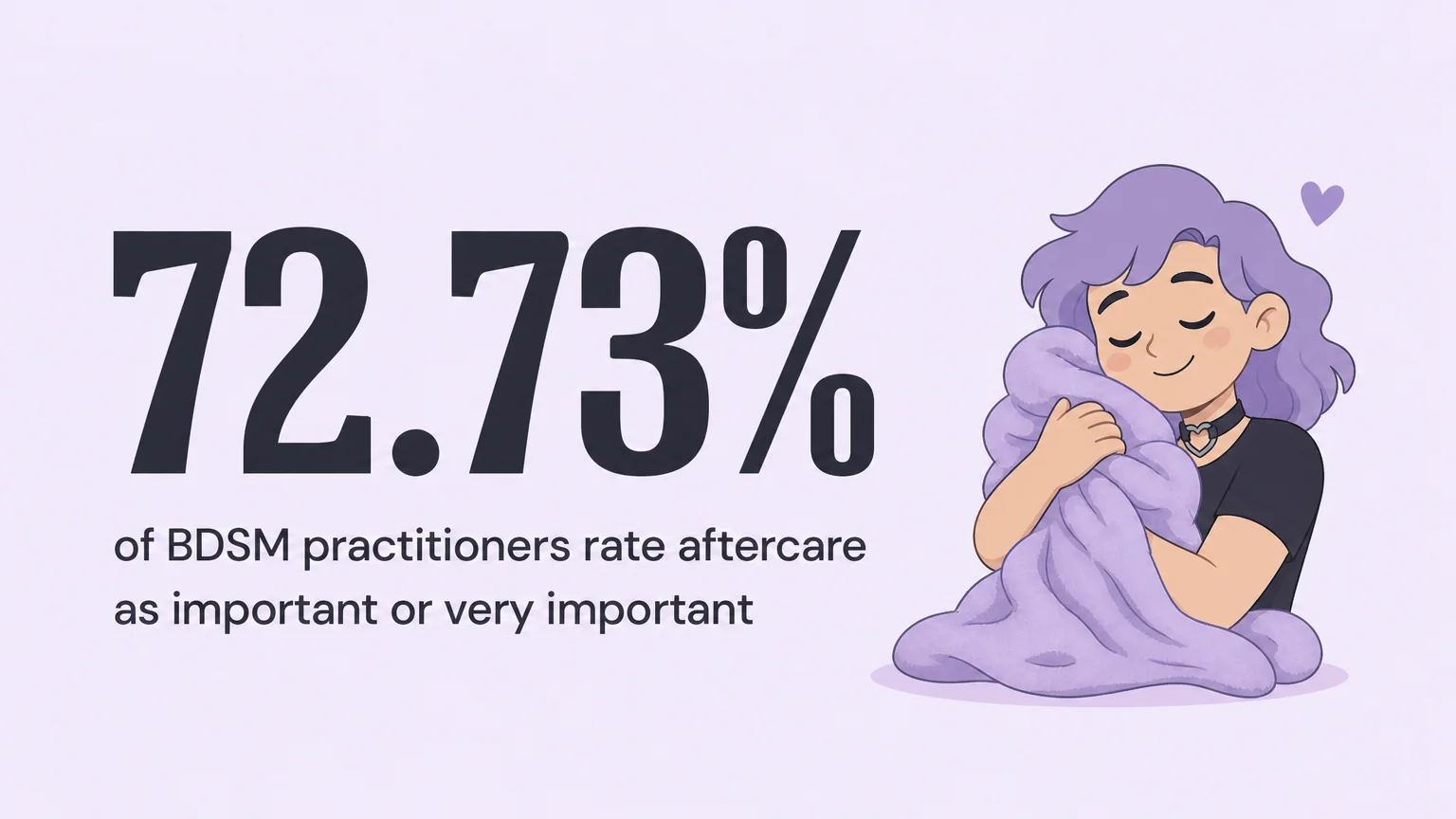
The scene ends before aftercare does. Aftercare is the care ritual that returns you both to a sense of normalcy after the intensity of surrender and control, and it is not optional. In research on BDSM practitioners, 72.73 percent rate aftercare as important or very important, and it matters for both sides of the dynamic, not just the submissive.
It starts before the scene does. Prepare water, food, and a soft blanket in advance, because decisions feel impossible during the comedown. You will not want to hunt for a glass of water at the moment you most need it.
In the first minutes after, do the physical care. Hydrate. Eat something to restore blood sugar. Stay warm, and tend any marks. Bodies that have been pushed need fuel and comfort before they need conversation.
Then the emotional layer. Reassure your partner that the dynamic is over and you are both yourselves again. Offer gratitude that names something specific from the scene, not a generic “that was fun.” Specific is what lands.
Add cuddle time or quiet time. This is the oxytocin bridge back to normal, and it matters for both of you, not just the one who surrendered.
Debrief together: what was hot, what was not, what to keep. Then plan delayed care. The drop can hit hours or days later, so check in again the next day with a simple “How are you feeling about last night?”
The dominant needs care too, and it is the part that usually goes unspoken. Top drop is the guilt, self-doubt, and numbness a dominant can crash into after a scene, and it is a normal physiological response. The myth that real dominants do not need care is exactly what causes the most damage. The worst stories in this world come from dominants who skipped aftercare.
If you need reassurance the day after, ask for it. Top drop makes you want care, then tells you you are not allowed to want it. You are.
The ritual as a timeline. Minute one: hydrate, eat, blanket. Minute twenty: reassurance and specific gratitude. Minute sixty: cuddle or quiet time.
Later that day: debrief. The next day: a check-in. That is the whole arc.
Hold one line above all the rest: the scene is not over until aftercare has happened. When you protect the landing, your partner can trust the flight.
Ready to take the next step? If this guide sparked a conversation you want to keep having, 3Fun is where adventurous couples and singles find each other. Join 3Fun and meet a team that’s ready when you are.
FAQ: Your Questions About Being Dominant in Bed, Answered
What Is Considered Dominant in Bed?
Taking the lead with confidence, presence, and desire. You control the pace, give verbal direction, and guide physically, all within agreed consent. Learning how to be dominant in bed is not force or aggression; it is certainty, and the certainty comes from what you both agreed to.
Why Is Dominance a Turn-On, and Is It Normal?
Almost half of a general-population sample was aroused by their own or their partner’s submission. Power exchange matters more than pain, and play can raise stress hormones while lowering self-reported stress. Wanting this is normal, and it has a physiological payoff.
Does Liking This Make Me Submissive or Dominant in Real Life?
No. Roles in bed do not define your personality, and many people who lead all day crave the opposite at night. Surrendering, or taking control, is a scene you share, not an identity you carry. You can be decisive at work and soft in bed.
Is BDSM the Same as Abuse?
No. The line is informed consent. The red flags that separate kink from abuse are mocking a safeword, pressuring a limit, demanding instant submission, and keeping the dynamic secret. Play is negotiated and mutual. Abuse is not. The safeword is absolute.
I’m Naturally Shy. Can I Still Do This?
Yes. Dominance is a learnable skill built on attitude and communication, not personality type or anatomy. Start with a few well-learned activities, practice the words outside the bedroom, and treat nerves before a scene as normal. Overconfidence is more dangerous than nervousness.
What If My Partner Thinks It’s Weird?
Raise it as an invitation, and share the feeling behind it rather than just the act. Allow the first attempt to feel slightly awkward. A cringe moment does not mean the conversation went badly, and most partners will talk it through rather than shut it down.
Do I Need Aftercare After a Light Scene?
Yes. In research, 72.73 percent of practitioners say aftercare matters, even after light play. Hydrate, eat, reassure each other, and check in the next day. The scene is not over until aftercare has happened, however light it was. The nervous system needs the landing either way.
What’s the Difference Between a Dominant and Someone Controlling or Abusive?
The difference is informed, freely given consent. A controlling partner pressures, mocks limits, and demands submission without negotiation. A dominant negotiates first and honors the safeword absolutely. One is a shared game. The other is not a game at all.