
The phrase BDSM terms crossed your mind and stayed there. That takes a certain kind of courage. Or curiosity. Probably both. You might be sitting with excitement and a little “is this weird?” and the first thing to know is that neither feeling needs fixing.
This glossary is a map for two people exploring together. Not a permission slip. A map. The difference matters. You are an adventurous team gathering information before a trip, not a guilty couple asking for approval. Read it together. Compare notes. Let the terms do the awkward opener work for you.
If you are already navigating non-monogamy or swinging, you will notice the overlap: negotiation protocols, explicit boundary-setting, check-in rituals. BDSM vocabulary sharpens tools you may already be using, even if you never identify as kink practitioners.
Start at the core pillars if you are brand new. Jump to Scene and Aftercare if you want to understand the emotional arc before memorizing terms. Everything in between builds from foundation to practice.
1. The Foundation: Terms That Define the Territory
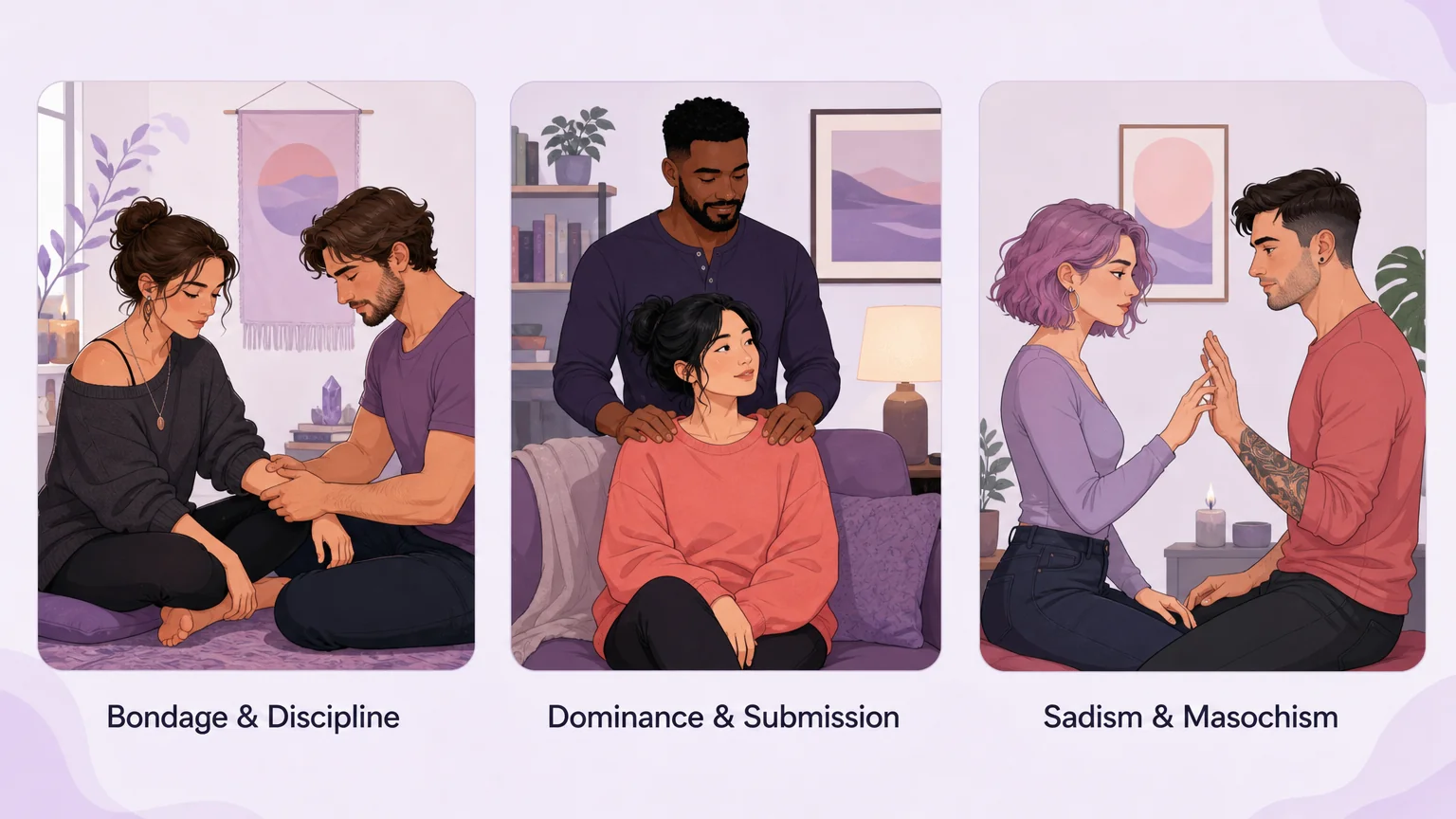
These are the terms you will meet in every conversation about kink. Master these and the rest of the glossary clicks into place.
BDSM combines Bondage and Discipline, Dominance and Submission, Sadism and Masochism. Each pillar is distinct; you do not need all of them. Think of the acronym as a menu, not a prix fixe. Many couples practice D/s with zero pain play.
Kink is any sexual preference or practice outside conventional norms, the umbrella under which BDSM sits. A couple enjoying blindfold play is exploring kink just as much as someone in a 24/7 dynamic. The word carries no intensity requirement.
Vanilla describes conventional, non-kink sexual activity. It is not an insult; it is a descriptor. Most kinky couples also have vanilla sex. The two are different rooms in the same house.
Scene is a negotiated period of time where people intentionally engage in kink, power exchange, or sensation play. Luna, creator of Submissive Guide, puts it plainly: a scene is “not a test. It is not about proving your submission, your pain tolerance, or your ability to get everything right. It is an experience meant to be explored.” For couples, a first scene is an experiment, not an exam.
Play is the act of engaging in BDSM activities within a scene. In kink, play is structured and negotiated: intentional in the way a jazz musician’s improvisation is intentional, freedom inside a form you both agreed on.
Dynamic is the ongoing power-exchange relationship between partners, existing only during scenes or extending into daily life. Every couple’s dynamic is custom-built; there is no certification that makes yours “real.”
Power Exchange is the consensual transfer of authority from one partner to another within agreed boundaries, the foundation of D/s. Power is given, not taken, and can be withdrawn at any time.
Consent is freely given, reversible, informed, enthusiastic, and specific agreement to participate. It is the single non-negotiable thread running through every term in this glossary. Without it, it is not BDSM.
Fetish is sexual arousal focused on a specific object, body part, or situation, distinct from kink in specificity. A kink might be “I enjoy rope”; a fetish might be “rope is necessary for my arousal.” Both are valid.
Lifestyle is shorthand for living within a BDSM dynamic or non-monogamously as an identity rather than occasional activity. Context determines whether it means swinging, kink, or both. If you hear it at a munch, ask.
Protocol is the rules, rituals, and behavioral expectations within a D/s dynamic, from “kneel when I enter the room” to “text me when you arrive home safely.” Protocol is the grammar your relationship speaks when the dynamic is active.
2. Safety and Consent: The Terms that Make Everything Else Possible
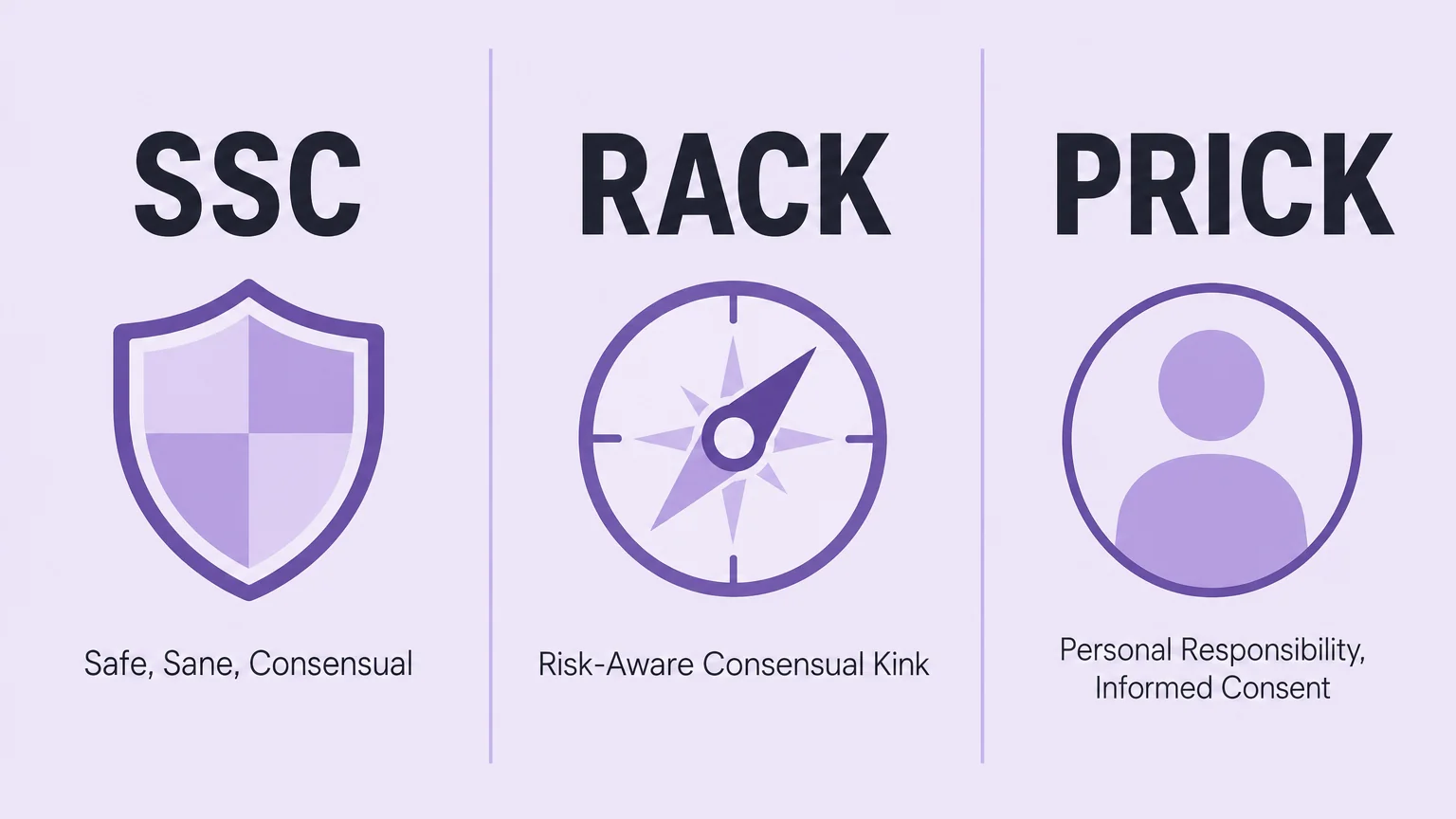
Safety vocabulary is not the dry paperwork before the fun. It is what makes the fun possible. Every term here turns “I trust you” from a feeling into a working system.
Safeword is a pre-agreed word that means “stop immediately, this is real,” existing outside the scene because “no” or “stop” may be part of roleplay. A safeword is not a sign of distrust; it is the safety net that makes the tightrope walk possible.
Traffic Light System: Green means keep going. Yellow means slow down, check in, ease up. Red means full stop, begin aftercare. “Yellow” is not failure; it says “I want to stay in this with you, just not at this intensity.” For couples starting out, this is the system to adopt.
SSC (Safe, Sane, Consensual), established in 1983, is the original consent framework: simple and memorable. Its limitation is that “safe” and “sane” are subjective; what feels safe to one couple may not to another.
RACK (Risk-Aware Consensual Kink) evolves SSC by acknowledging all BDSM carries inherent risk and shifting focus to honestly assessing that risk with full information. If your partner wants to try something at the edge of your comfort zone, RACK says: let us both understand the real risks first.
PRICK (Personal Responsibility, Informed Consent, and Communication/Kink) is the individualist’s framework: maximum personal accountability. You do your own research. You communicate your own boundaries. For couples, it is a reminder that your partner cannot read your mind.
Hard Limit is a strictly off-limits, non-negotiable boundary requiring no explanation or justification. Hard limits are walls that keep the playground safe, not obstacles to overcome.
Soft Limit is something you are hesitant about but might consider with more education or as trust deepens. Soft limits create room for growth without pressure. Limits can and do change over time.
Negotiation is the pre-scene conversation where partners discuss desires, limits, safewords, aftercare needs, and whether sex is part of the scene. It is not a buzzkill; it is the foreplay of trust.
Informed Consent is agreement given with full understanding of risks, activities, and expected intensity. You cannot consent to something you do not understand. For couples, this means doing the homework together before trying something new.
Enthusiastic Consent is an active, excited “yes” rather than a reluctant “okay.” If it is not an enthusiastic yes from everyone in the room, it is a hard no.
Non-Verbal Signals are hand signals, three taps on a partner’s body, or dropping a held object, essential when a partner is gagged or unable to form words. Agree on the signals before the scene starts.
Check-in is a deliberate pause during or after a scene to ask “how are you doing, really?” The simplest safety tool is also one of the most important. For couples, the check-in habit will improve every other part of your relationship.
Vetting is evaluating a potential play partner’s experience, references, and reputation before playing, especially important for couples inviting a third. A safe partner welcomes vetting; someone who resists it or rushes past it is showing you exactly who they are.
3. Roles and Identities: Who is Who in the Dynamic
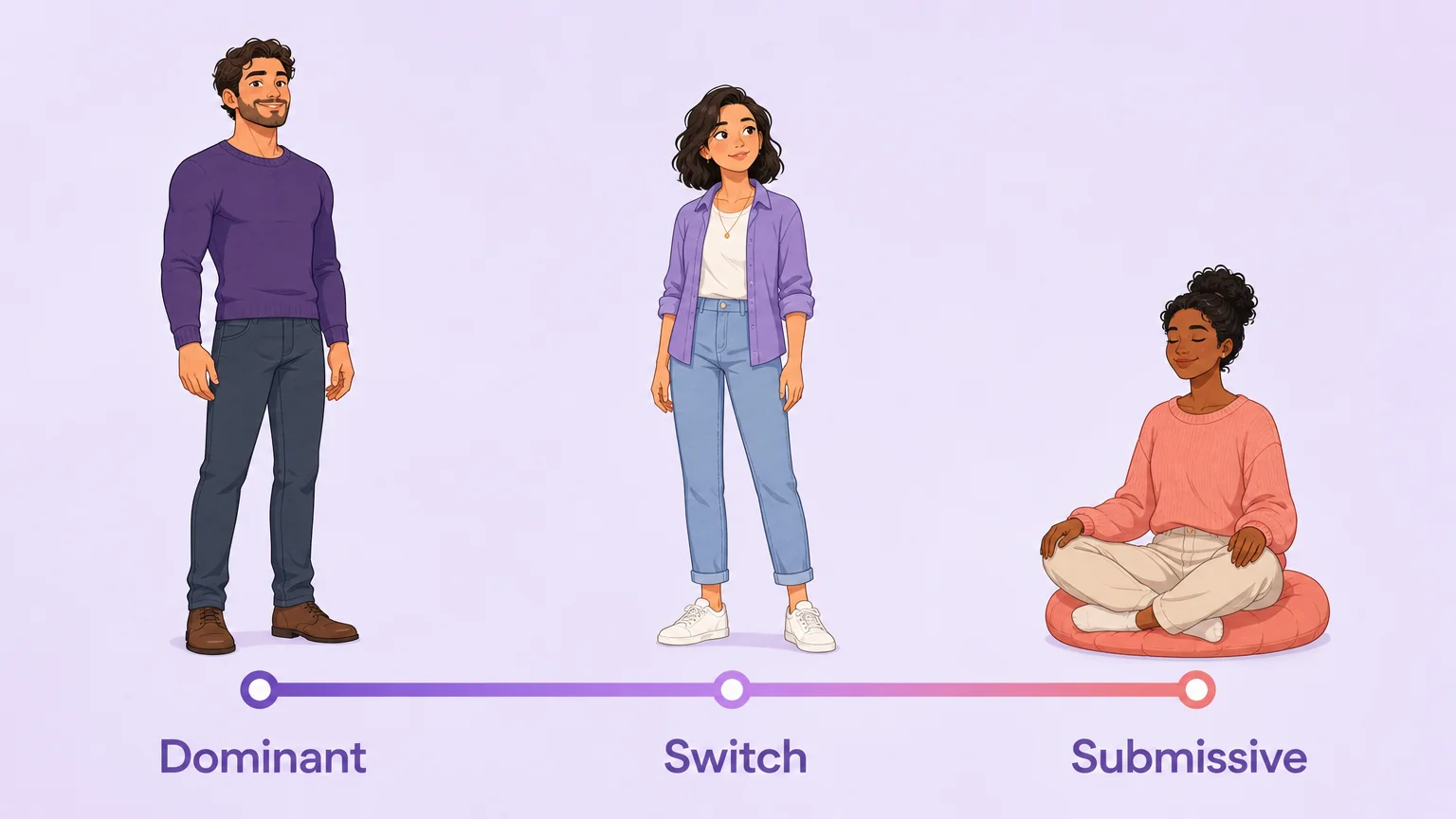
The roles people play in kink are starting points for exploration, not permanent identities. You get to try them on, see what fits, and change your answer. You and your partner might discover you both lean the same direction. That finding is useful too.
Dominant (Dom/Domme) is the partner who exercises consensual control within a scene or dynamic. A Dominant’s authority is given by the submissive, never taken. Dr. Gloria Brame puts it clearly: “Dominants are diverse individuals with different ethics, skills, knowledge, and styles.” For couples, this means you define what dominance looks like in your relationship rather than importing a stereotype.
Submissive (sub) is the partner who consensually yields control within agreed boundaries. Submission is an active, ongoing choice, not passivity. The submissive holds foundational power: they set the boundaries, the limits, the scope. For couples, this reframes submission as something your partner does with you, not to you.
Switch is someone who enjoys both Dominant and submissive roles, not necessarily with the same partner or scene. Two switches in a relationship have built-in flexibility to trade roles based on mood. Do not confuse “switch” with “verse,” a sexual-position term from a different community.
Top describes the partner who gives physical sensation or performs an action: ties the ropes, wields the flogger. It describes a physical role, not psychological authority. A top can be dominant, submissive, or neither.
Bottom describes the partner who receives physical sensation or action, a physical role rather than psychological submission. For couples, separating Top/bottom from Dominant/submissive prevents the most common role confusion newcomers face.
Rigger is the person who ties the rope in bondage and shibari: creating the patterns, managing the tension, and holding responsibility for the tied partner’s physical safety. A rigger fills a physical role like a Top, not necessarily a Dominant one; some riggers tie at their partner’s command. The word comes from sailing, where rigging refers to rope systems on ships.
Rope Bunny (or rope bottom) is the person being tied. The term is affectionate slang embraced by many in the community, though some prefer “rope bottom” or “model” in performance settings. A rope bunny is not passive: they actively communicate, co-create the scene, and hold ultimate veto power. The community mantra applies here too: if you have a body, it is a rope body.
Power Bottom is a bottom who directs the action from below: psychologically submissive while actively guiding what happens physically. For couples where one partner knows exactly what they want but craves the feeling of yielding, this role bridges the gap.
Service Top is a top who performs acts at the bottom’s direction: psychologically dominant but physically following their partner’s script. For couples, the service top and power bottom pairing is one of the most elegant role configurations available.
Brat is a submissive who resists, teases, or challenges authority as negotiated roleplay, not genuine defiance. For couples, bratting requires clear boundaries around what is playful resistance and what is a genuine limit violation.
Brat Tamer is a Dominant who enjoys handling a brat’s resistance through playful confrontation, not punishment. A brat tamer earns submission through wit and presence rather than demanding it. If your partner sasses you during play and you enjoy the chase, this may be your dynamic.
Master/Mistress is a Dominant in an established, often long-term or 24/7 dynamic, carrying more weight than “Dom/Domme.” It is not a title to claim lightly or demand from strangers. Titles are earned inside your relationship.
Slave is a submissive in a high-protocol, often 24/7 dynamic with extensive authority exchange, distinct from “submissive” in degree, not kind. This is advanced territory. Most couples will never go here, and that is not a shortcoming.
Daddy Dom is a Dominant whose style is nurturing, protective, caregiving rather than stern or punishing. The authority is parental-warm, not militaristic-cold. For couples, this role creates a container of safety where vulnerability is met with care, not judgment.
Dommy Mommy is the female counterpart to Daddy Dom: nurturing authority, soft power, maternal care wrapped in dominance. Growing in visibility as the community expands beyond rigid gender archetypes. If your partner’s dominance feels like warm leadership, this language might fit.
Little is someone who adopts a younger headspace during play, often within a Daddy Dom/Little or Dommy Mommy/Little dynamic. The appeal is in care, protection, and the freedom to be vulnerable. It is not inherently sexual. For couples, the entry point is the caregiving, not the roleplay.
Middle is similar to a little but identifies with an older age range: adolescent or teen headspace with more independence. The dynamic is about being held in a younger version of yourself and met with warmth.
4. Scenes and Experience: What Happens During Play and After

A scene is not just what happens between “let us start” and “we are done.” It has a before, a during, and an after. The after matters just as much as the main event.
Subspace is an altered psychological state during submission, driven by endorphins and dopamine, feeling floaty and disconnected from time. Not every submissive experiences it. For couples, subspace is one reason aftercare exists: coming down without support is why the next terms matter.
Topspace is the Dominant’s counterpart to subspace: hyper-focus on the submissive, intensity, sometimes isolation. Less discussed but equally real. If your partner tops you, check on them after. They were holding the emotional container the entire time.
Subdrop is the emotional and physical crash hours or days after a scene, the neurochemical comedown from adrenaline and endorphins. It is not regret or a mistake; it is your nervous system asking for care. It can hit 24 to 72 hours later.
Topdrop is the Dominant’s version of drop: guilt, self-doubt, emotional flatness. “Did I go too far? What kind of person enjoys doing this?” These thoughts are normal, not evidence of wrongdoing. Both partners are allowed to need care.
Aftercare is the care following a scene: warmth (blankets), hydration, nutrition (chocolate restores blood sugar), verbal reassurance (“You did so well, I have got you”), gentle touch, and holding space for whatever emotions surface. Research confirms what the kink community has long known: 46 percent of women and 41 percent of men have reported post-sex dysphoria at least once. Aftercare is not a reward; it is part of the scene. Both partners need it. Plan before you play.
Edgeplay describes BDSM activities with higher physical or psychological risk: breath play, knife play, blood play, fire play, CNC. It is not beginner territory. The term “edge” is deliberate: you are playing near the edge of what bodies and minds can safely handle.
Sensation Play is BDSM focused on sensory experience: temperature, texture, light scratching, teasing. Low physical risk, high emotional connection. For couples new to all of this, sensation play is the recommended starting line. You can do it tonight.
Impact Play is BDSM involving striking the body: spanking, flogging, paddling, caning. Technique matters more than force. Learn safe striking zones before picking up an implement. For couples, start with your hand; there is nothing between you and your partner’s response.
Bondage is physically restraining a partner using rope, cuffs, or tape. The appeal is in the surrender of physical autonomy and the trust it requires. Never leave a bound person alone, keep EMT shears within reach, and start with Velcro cuffs before rope.
Shibari or Rope Bondage is the Japanese art of decorative rope tying: beautiful, intimate, and genuinely dangerous. Nerve compression can cause permanent damage. In-person workshops are the safest way to learn. Never attempt suspension as a beginner.
CNC or Consensual Non-Consent describes scenes that roleplay non-consent within a negotiated container. It requires extensive pre-negotiation, an unambiguous safeword system, and deep trust built over time. Not beginner territory. For couples considering CNC, the question is “have we built the container strong enough to hold it?”
5. Activities and Practices: The Menu From Light Exploration to Experienced Play
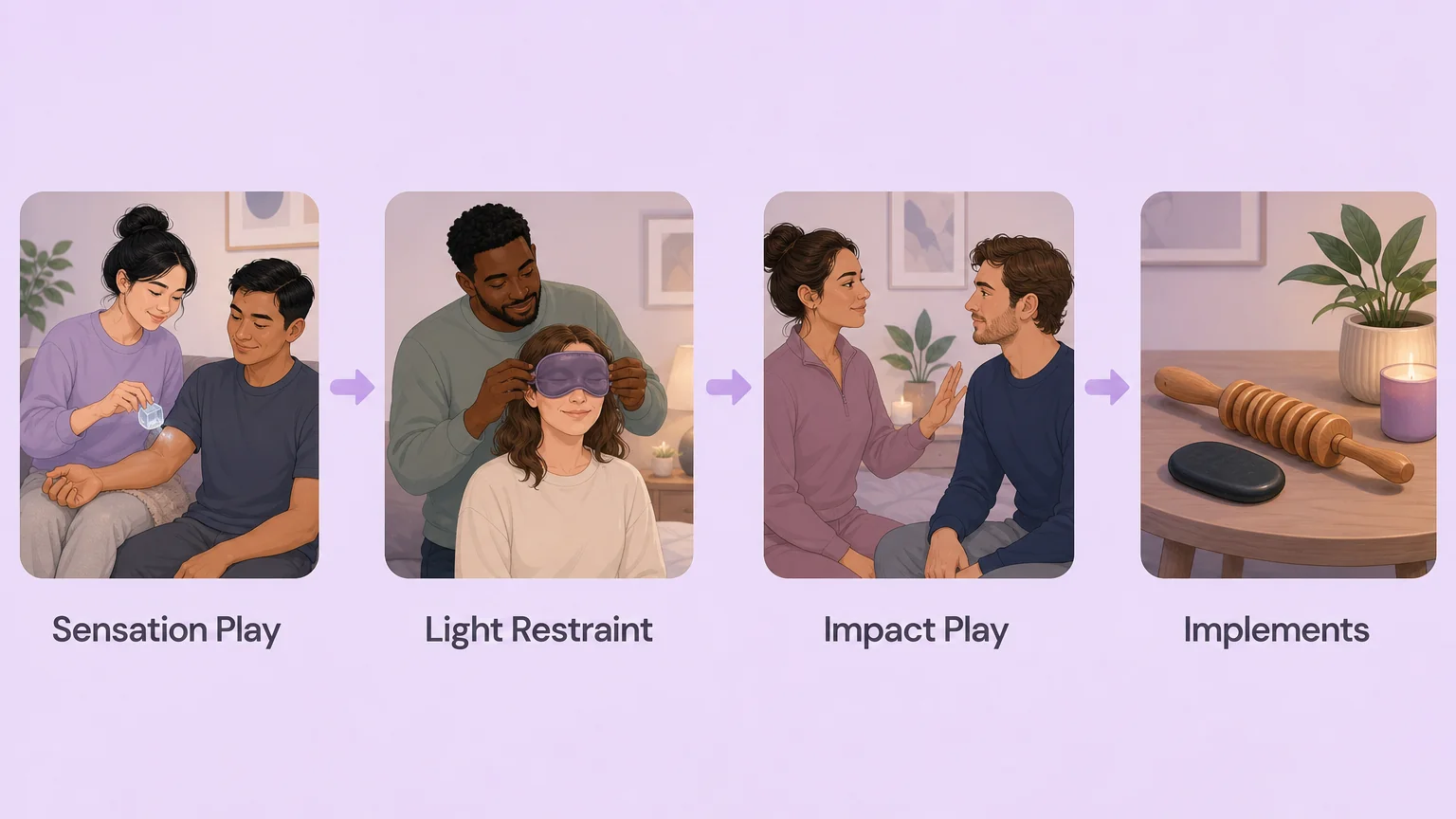
BDSM activities range from “we could try this tonight” to “this requires training and months of trust-building.” Browse together. Start light. The only wrong pace is one that feels rushed.
Flogging is striking with a multi-tailed flogger; sensation ranges from light thud to sharp sting depending on material. Deerskin is warm and thuddy; rubber is sharp and stingy. Learn safe striking zones first. Practice on a pillow.
Spanking is striking the buttocks with an open hand or implement, the most common entry point to impact play because your hand gives direct feedback. Master hand-spanking before graduating to paddles.
Paddling uses a paddle (wood, leather, silicone) delivering a broader, thuddier sensation than a crop or cane. The wider surface spreads impact, intense but less stingy than narrower implements. The natural next step after hand-spanking.
Wax Play involves dripping melted wax onto a partner’s skin using body-safe, low-temperature candles specifically made for this purpose. Regular household candles cause serious burns. Test on your inner wrist first; use a drop cloth.
Temperature Play uses hot or cold sensations (ice cubes, chilled glass, warmed oil) to heighten skin sensitivity through contrast. Ice on warm skin after impact play is an especially intense combination. One of the lowest-barrier entries into sensation exploration.
Sensory Deprivation removes one or more senses to heighten the others. A blindfold is the most common form: removing sight makes every touch, sound, and word land harder. For couples, start with a sleep mask and ten minutes. That is the entire scene.
Blindfold is the simplest first piece of BDSM equipment: a sleep mask or scarf. The brain compensates for lost sight by amplifying every other sensation. For couples, this is the “try it tonight” entry point; an entire scene can be built around a blindfold alone.
Gag is a device covering the mouth and restricting speech. Gags make verbal safewords impossible, so non-verbal signals must be agreed beforehand. Never leave a gagged person unattended.
Restraint is any method of limiting physical movement: cuffs, rope, spreader bars, bondage tape. Start with soft Velcro cuffs; they are comfortable, quick-release, and impossible to tighten accidentally. Rope is advanced; nerve damage is real.
Chastity is consensually restricting a partner’s sexual release via device or behavioral agreement, often part of a D/s dynamic. The appeal is in surrendering autonomy over a deeply personal function. You set the scope.
Pegging is a person wearing a strap-on dildo penetrating their partner anally, with zero correlation to sexual orientation. The appeal is in role reversal, vulnerability, and the prostate as a pleasure center. For couples, pegging is about trust and exploration, not identity.
Fisting is inserting an entire hand into a partner’s vagina or anus, requiring significant lubrication, patience, and communication. This is advanced, not an escalation of fingering. Go slower than you think is slow. Something to work toward over months.
6. Relationships and Dynamics: Structures Beyond the Bedroom
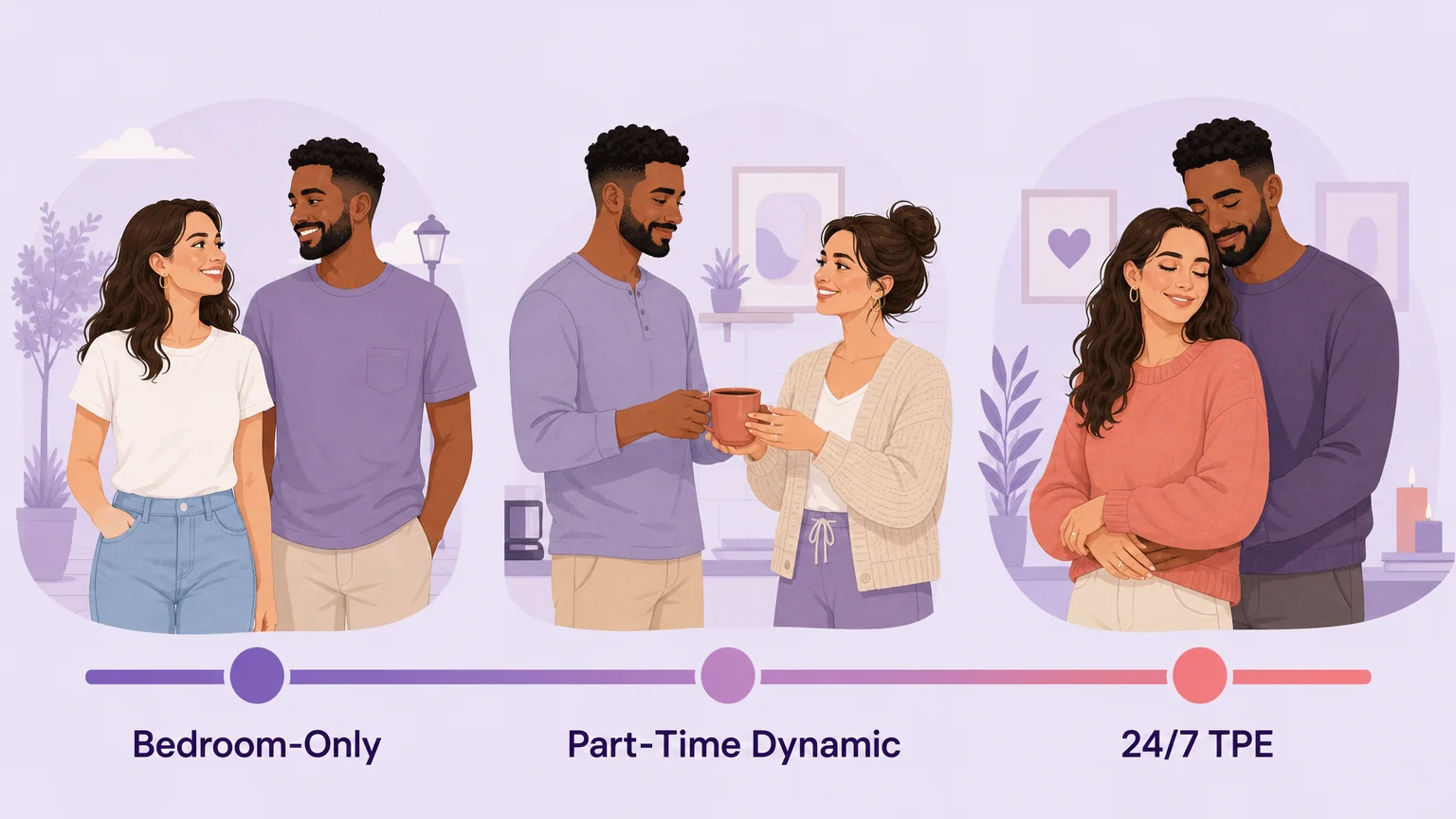
How much of your life does the dynamic touch? An hour in the bedroom? A weekend? Every decision? All of those answers are valid. None is “more real” than another.
24/7 describes a dynamic where D/s authority extends across all domains of life, all the time. It is advanced, not the default. Most practitioners do not live this way. For couples, 24/7 is a structure to understand, not a goal to chase.
TPE or Total Power Exchange is the most extensive form of D/s: the submissive has relinquished authority over most life decisions. It requires deep trust and emotional bandwidth most couples do not have and do not need. TPE is not aspirational; it is one option among many.
FLR or Female-Led Relationship is a relationship where the woman is the primary authority, ranging from bedroom-only to full TPE. A structure, not a political statement, growing in visibility as rigid gender expectations loosen.
Bedroom-Only is the most common structure: D/s exists only during negotiated, intentional play. Most practitioners live here happily for years. It is not “less real” than 24/7. This is where the vast majority of satisfying dynamics live.
Part-Time Dynamic means D/s extends into certain daily-life domains (household decisions, specific routines) but not others. You pick the rooms the dynamic lives in. Your dynamic might run the kitchen and the bedroom but stay out of the office and the family group chat.
Contract is a written agreement outlining the terms of a D/s dynamic: limits, protocols, duration, exit conditions. Not legally binding; morally structuring. The act of writing one clarifies what each partner actually wants. The document matters less than the conversation it forces.
Collaring is giving or receiving a collar, symbolizing a D/s commitment. Meaning varies from “we are playing tonight” to a commitment as serious as a wedding ring. Context is everything. Never assume what someone’s collar means; ask.
Service describes acts performed by the submissive for the Dominant’s benefit, often non-sexual: preparing meals, errands, household tasks. Service submission is its own orientation; the satisfaction comes from usefulness, not necessarily physical sensation.
Ownership is the concept that a Dominant “owns” their submissive within the negotiated container. It is symbolic, not literal. The power to end it always remains with both parties. Ownership without the ability to leave is not kink; it is captivity.
Training is teaching a submissive specific protocols or behaviors, which must be negotiated and transparent. “Training” without clear goals and consent is a red flag. A genuine Dominant trains with patience; someone who leads with training before earning trust is someone to walk away from.
7. Community and Culture: Munches, Play Parties, and Finding Your People
The BDSM community is accessible, welcoming, and entirely optional. You can learn everything from books and private practice. If you want mentors and people who get it, here is the vocabulary.
Munch is a casual, non-play social gathering at a restaurant or bar: vanilla clothing, zero play, just conversation. The recommended entry point for beginners. Message the organizer beforehand; they expect newcomers. For couples, a munch is the lowest-pressure way to see that kinky people look like everyone else.
Play Party is a gathering where BDSM play occurs, from intimate private-house events to large organized gatherings with dungeon monitors. Not a first-date activity. Observe before participating. Attend together after you have established your own dynamic, not before.
Dungeon is a dedicated play space, public or private, equipped with BDSM furniture: St. Andrew’s crosses, spanking benches, suspension points. Public dungeons have rules, monitors, and an expectation of respectful observation. Visiting one is like visiting a gym: you can just watch and learn.
Dungeon Monitor (DM) is a volunteer who watches for safety issues and consent violations during play parties or public dungeons. They are not participants. Find them when you arrive and ask about the house rules. For couples new to public spaces, the DM is your first ally.
FetLife is the largest kink social network, with over 5.7 million members. Not a dating app; think Facebook for kink: event listings, discussion groups, community connection, free. For couples, the most practical tool for finding local munches and workshops.
Old Guard is a traditional, hierarchical BDSM subculture rooted in post-WWII gay leather communities, emphasizing formal protocols, mentorship, and earned status. Less common today, but the emphasis on earning trust rather than demanding it flows from their legacy.
Leather is a BDSM subculture and identity deeply rooted in gay men’s history, with its own flag, contests, and traditions. A cultural identity as much as a kink preference. Respect the history; it built the infrastructure modern kink communities stand on.
Primal is a kink identity based on raw, animalistic instinct: growling, chasing, wrestling, biting. The dynamic is predator/prey or pack hierarchy, not Dom/sub. For couples who find formal protocol stiff, primal play offers a more instinctive path.
Pet Play is roleplay where one partner adopts the headspace of an animal (puppy, kitten, fox), often with accessories like ears and tails. The appeal is simplified communication and freedom from social complexity. For couples, it is about shedding adult pressure.
Pony Play is a specialized form of pet play centered on equestrian roleplay: pulling carts, harnesses, gait training. More niche and equipment-intensive, with its own subculture and events. A “learn about it” term, not a “try this weekend” activity.
8. Tools and Equipment: What is in the Toy Bag
A beginner’s toy bag is a blindfold, maybe soft cuffs, and your own hands. Everything else is optional. Here is what the tools are, what they feel like, and what you need to know before using them on someone you love.
Flogger is a multi-tailed impact tool, typically leather, suede, or silicone. Sensation varies by material: deerskin is thuddy and warm; rubber is sharp and stingy. Practice on a pillow first. For couples, the flogger is forgiving: a light stroke is almost no impact.
Paddle is a flat striking implement (wood, leather, silicone) delivering a broad, thuddy impact. Wider paddles disperse impact; narrow paddles sting more. Start light; you can always add force, but you cannot take it back.
Crop is a short rigid shaft with a small folded-leather tip delivering a sharp, focused sting. A precision tool: the tip lands exactly where you aim. Easy to use too hard by accident. For couples, the crop is about precision, not power.
Wartenberg Wheel is a small handheld wheel with sharp spikes, creating sharp sensation without breaking skin. It looks intimidating; it feels like a focused scratch. Do not press. For couples, it is theater: looks extreme, feels manageable.
Ball Gag is a sphere attached to a strap holding it in the mouth, muffling speech and making verbal safewords impossible. Non-verbal signals are mandatory. Never leave a gagged person unattended. For couples, the gag is about the symbolism of silence.
Spreader Bar is a rigid bar with cuffs at each end, holding ankles or wrists apart. Creates exposure and physical restriction without the complexity of rope. For couples, a spreader bar says “stay open for me” without requiring a single knot.
St. Andrew’s Cross is a large X-shaped piece of furniture with attachment points for wrists and ankles, common in dungeons. Not beginner home equipment: large, conspicuous, expensive. Dungeon vocabulary, not a home shopping list item.
EMT Shears are trauma scissors that cut through clothing, leather, and light rope without cutting skin. The single most important safety tool in bondage play. Keep within arm’s reach whenever restraints are involved. About ten dollars. For couples, EMT shears are the seatbelt: you hope you never need them, but they are right there if you do.
9. Advanced and Niche: Terms for When You Are Ready to Go Deeper
Some practices here require years of experience and specialized training. Others are less common but accessible with the right education. The distinction matters. Read with curiosity, not a checklist.
Blood Play intentionally draws blood and carries significant health risks including bloodborne pathogens. Requires medical knowledge, sterile equipment, and pre-scene STI disclosure. Advanced, not casual. Lives firmly in the “understand it, do not try it without in-person training” category.
Knife Play uses a knife or blade for sensation and psychological intensity, not to cut. The appeal is the contrast between fear and trust. As Cleveland Sex Therapy emphasizes: “This is advanced play. This is not beginner territory.” Even dull blades demand respect.
Needle Play involves inserting sterile, single-use medical needles through the skin, requiring anatomical knowledge and non-negotiable sterile technique. Learn from an experienced practitioner, not the internet. Medical-grade edgeplay; do not attempt without direct mentorship.
Breath Play restricts a partner’s airflow for intensity and control. One of the riskiest forms of BDSM; brain damage and death are possible even with experienced practitioners. No safe level exists, only risk reduction. Not beginner territory under any circumstances.
Fear Play uses psychological fear as the primary sensation: implied threats, suspense, vulnerability, with no physical harm required. The trust required is extreme because the bottom experiences genuine fear, not roleplay. For couples, it is about creating a container where your partner feels genuinely scared and genuinely safe at the same time.
Fire Play uses fire on or near the body via alcohol-soaked cotton, fire wands, or flash paper. Extreme risk of burns. Requires fire safety training, a fire extinguisher, and a spotter. Learn in person from someone qualified.
Electroplay uses electrical stimulation devices (violet wands, TENS units) for sensation from light tingle to sharp muscle contraction. Never above the waist with certain devices, never on anyone with a pacemaker. Safety rules are non-negotiable.
Sounding involves inserting a sterile, lubricated metal or silicone rod (a “sound”) into the urethra. The appeal is in the intense internal sensation and vulnerability. Strict sterile technique is mandatory; infections are dangerous. Not for beginners.
FAQ
Is BDSM just about pain?
No. Pain (sadism/masochism) is one pillar and absent from many dynamics. BDSM can be about power exchange, sensation play, bondage, or psychological intensity with zero pain. Many practice sensual domination: nurturing, guiding, protective, with no impact play at all. Your dynamic, your menu.
Does the submissive have any real power?
Yes, and it is foundational. The submissive sets boundaries, limits, and scope. Without their ongoing consent, there is no dynamic. The Dominant’s authority is given, never taken, and can be withdrawn via safeword. Submission is a display of agency, not a surrender of it.
Do I have to be submissive 24/7 if I am into it?
No. Most practitioners are bedroom-only or scene-only. 24/7 TPE exists but is advanced, not the default, and often too intense for people with jobs, kids, and lives. You define the scope. Bedroom-only is not “less real”; it is the most common structure.
What makes a safeword different from just saying “no”?
In many scenes, “no” or “stop” may be part of the roleplay, especially in CNC scenes. A safeword is a pre-agreed, unmistakable word that exists outside the scene and halts everything. The traffic light system (Green/Yellow/Red) lets you adjust without fully stopping.
Is it normal to feel shame about what I am into?
Extremely normal. Discovering your desires is healthy, not shameful. What feels unusual may be quite common: cuckolding ranked approximately number three in Justin Lehmiller’s survey of over 4,000 people. Distinguish erotic shame (part of the appeal) from non-erotic shame (distress without pleasure). The latter is worth working through.
How do I know someone is a safe partner versus an abuser using BDSM as cover?
Red flags: demanding titles immediately, using pet names without consent, jumping to degradation, refusing to discuss limits or aftercare, dismissing safewords, claiming “trainer” status without references. A safe partner negotiates thoroughly, respects limits, encourages safeword use, and treats your submission as something to earn. Trust your gut.
Do we have to go to dungeons or join the scene?
No. Many couples, probably most, explore BDSM entirely privately. The community is optional. If you want to learn from experienced practitioners, munches (casual restaurant hangouts, zero play) are the recommended entry point. Your bedroom is a perfectly valid dungeon.
What if my partner reacts badly when I bring up kink?
Their immediate reaction is often not their final conclusion. Give them processing time; you have been thinking about this for months or years, they just learned about it. Heather Shannon advises a softened startup: “I want us to be able to talk openly about fantasies.” Treat it as a series of conversations, not a one-time confession.
Can you do BDSM without sex?
Yes. Many scenes involve no sexual touch, intercourse, or orgasm. BDSM is often more about power dynamics, sensation, and connection than about sex. Whether sex is part of a scene is negotiated beforehand. Arousal during a scene does not obligate performance.
What is the difference between Top/bottom and Dominant/submissive?
Top/bottom describe physical roles: who gives versus who receives sensation. Dominant/submissive describe psychological roles: who controls versus who yields. They often align but do not have to. A power bottom directs the action while submitting psychologically; a service top performs acts at their submissive’s direction while remaining dominant. Understanding these as separate dimensions prevents confusion.