If you have ever paused on a word and thought, Is this a kink, or just a thing I like?, you are very much not alone. Nearly half of adults report at least one kink interest. Most of them started exactly where you are right now: curious, a little uncertain, and unsure whether the word includes them or belongs to someone else.
Understanding what a kink actually means, beyond the caricatures and clickbait, is the difference between carrying quiet shame and knowing yourself well enough to share what you want. This article gives you the words to name what you are curious about and the confidence to share it. Here is what we will cover: what a kink is, why people have them, whether yours is normal (yes), how to talk about it, and where to start.
You do not need to become someone else to be curious. You just need a map. Here it is.
What a Kink Is: The Definition and the Distinction
The word “kink” gets thrown around so loosely that it has become a catch-all for anything sexually interesting. That looseness is useful in conversation but useless when you are trying to figure out whether the word applies to you. Let us clean it up.
Samuel Hughes, one of the leading academic researchers on kink identity, defines kink as “consensual, non-traditional sexual, sensual, and intimate behaviors such as sadomasochism, domination and submission, erotic roleplaying, fetishism, and erotic forms of discipline.” That definition does two things at once: it names the specific activities that fall under the umbrella, and it anchors the entire category in consent. Without consent, it is not kink. It is something else entirely.
In plain language: a kink is anything consensual that falls outside the narrowest definition of standard sex. And “standard” is a much smaller box than most people assume. Think about what “standard” actually covers: two people, typically missionary position, no props, no roles, no deliberate power dynamics. If your sexual imagination has ever wandered beyond that tight perimeter, you have already crossed the blurry line between conventional and curious.
Kink vs. Fetish: The Distinction That Matters
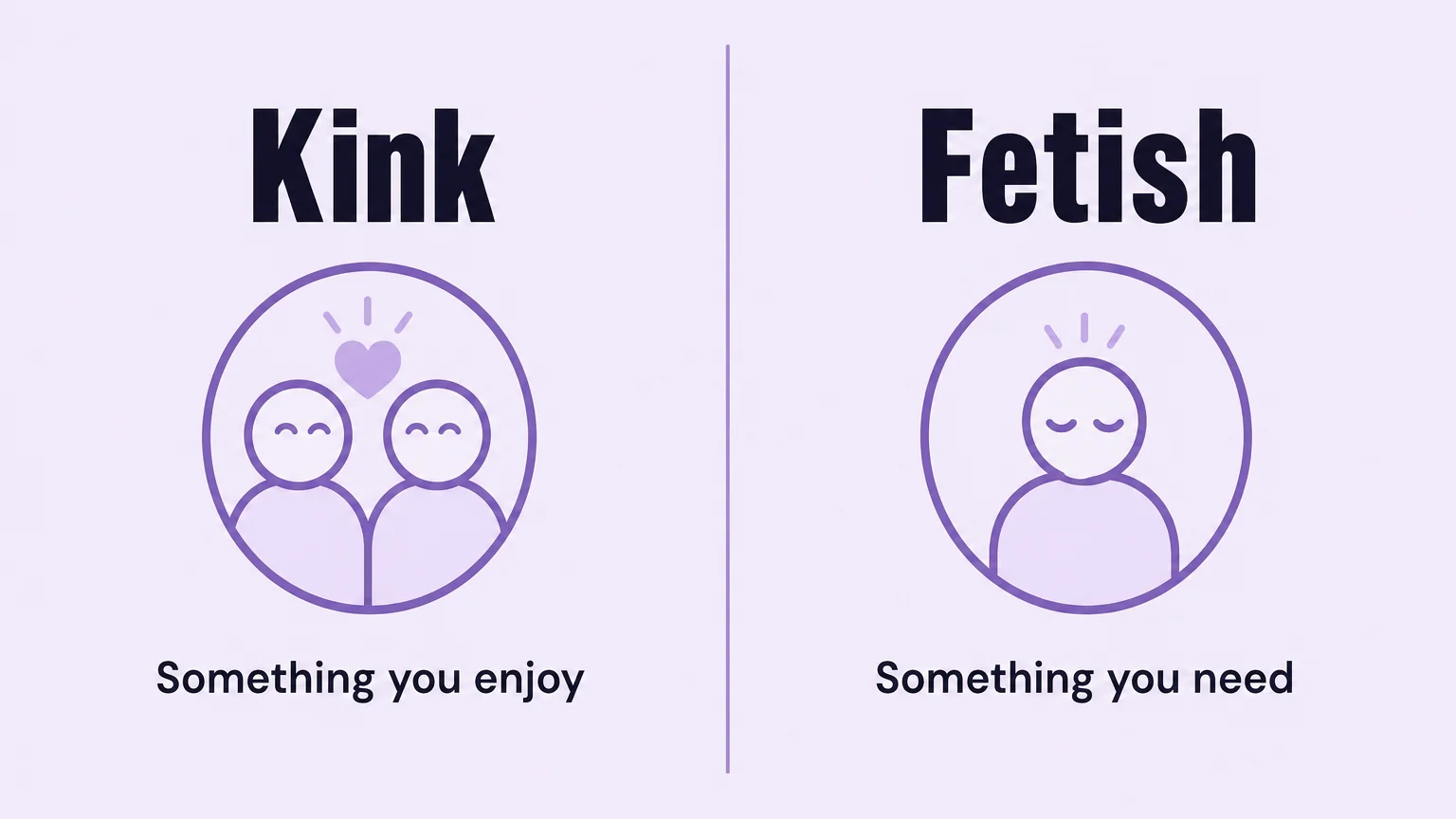
A kink is a broad non-normative sexual interest. You enjoy it; you do not necessarily need it. Think of someone who finds light bondage exciting but has perfectly satisfying sex without it. A fetish is a specific, intense fixation on an object, body part, or act that is typically required for arousal. Think of someone who cannot reach orgasm without a particular material, scenario, or body part in play. In everyday language, “kink” functions as the umbrella term, and that is how most people use it.
The distinction is useful but not something to stress over. A more useful question: Where am I on the gradient, and does it matter to me?
That reframe matters because the binary is a lie. Pop culture talks about vanilla and kinky like they are two separate planets. They are not. They are addresses on the same street, and most people live somewhere in the middle. You do not need to pick a team. You just need to know your own coordinates.
If you would like to find more about the differences between them, you can jump to this article: Fetish vs Kink: The Distinction Nobody Explains Clearly.
No, There Is Nothing Wrong With You
If you have ever wondered whether having a kink means something went wrong in your development, you are asking the question almost every curious person asks first. The fear underneath the curiosity is blunt: Does wanting this mean I am broken?
The answer is no. Here is why.
Myth 1: Kink Means Something Is Wrong With You
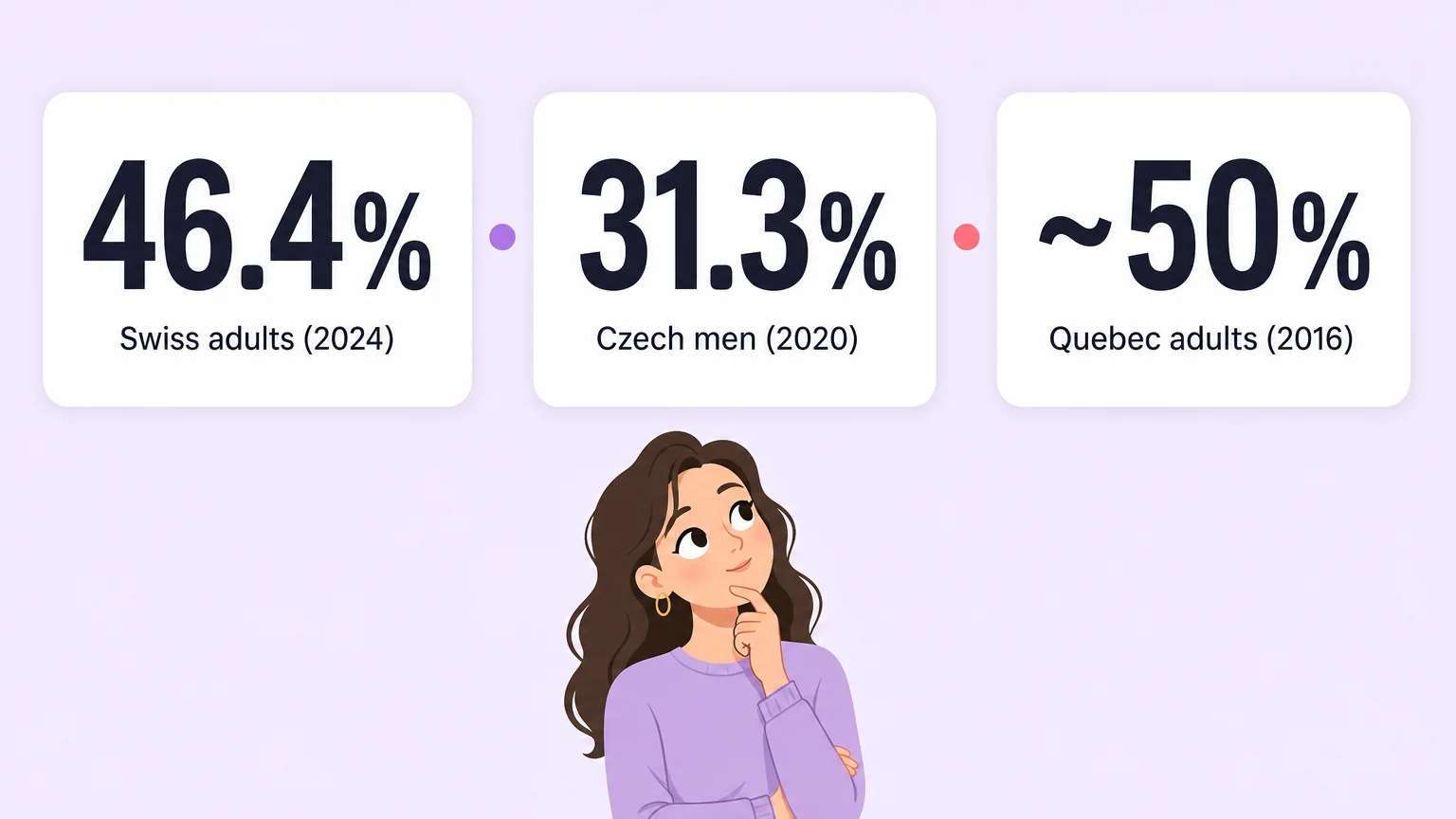
Research consistently shows kink interests are common across all demographics. A 2024 Swiss survey of 1,236 adults found 46.4% reported at least one paraphilic interest. A 2020 Czech study of over 10,000 adults found 31.3% of men and 13.6% of women reported kink interests. A 2016 Quebec study found roughly 50% of adults were interested in at least one kink behavior, with about a third having practiced one.
A 2021 Maastricht University study identified clustered patterns across thousands of participants. They are predictable, common patterns in human sexuality, not random pathologies. Your curiosity is part of a well-documented landscape, not a statistical anomaly.
Myth 2: Kinky People Were Abused or Traumatized
No causal link exists. Research indicates kink participants have slightly lower rates of childhood abuse than the general population. Samuel Hughes is explicit: kink identity development is a natural variation in human sexuality, not a trauma response.
Myth 3: BDSM Is a Form of Self-Harm
Michael Aaron, a leading researcher and therapist, has shown the opposite. In BDSM, motivation is desire and eagerness. People feel excitement and connection during play, and satisfied, empowered, and loved afterward. Many individuals who previously engaged in self-harm stopped after finding that need met through consensual BDSM. The two experiences are opposites with opposite outcomes.
Myth 4: Fifty Shades of Grey Represents Real Kink
BDSM practitioners widely criticize it for depicting kink without proper consent frameworks. The book is fantasy. Real kink communities operate on negotiation, boundaries, and aftercare. The difference is the difference between a movie car chase and getting behind the wheel.
Beyond the Myths
The DSM-5 distinguished paraphilia (the interest) from paraphilic disorder (when that interest causes distress or harm) in 2013. The ICD-11 removed kink from disease classifications entirely in 2018. Six countries have formally depathologized kink, starting with Denmark in 1995 and most recently Iceland in 2015.
Hughes notes that internalized shame about kink causes real harm: anxiety, depression, and suicidal ideation. Normalizing kink early is not a cultural nicety. It is a mental health intervention.
Your curiosity is not a symptom. It is data about who you are. The better question is What do I do with what I now know?
Where Kinks Come From: The Psychology Behind the Curiosity
Okay, so it is not wrong. But why? Why do you have these interests?
There is no single answer, and that uncertainty is itself liberating. You do not need an origin story to validate your desires. But understanding the patterns helps.
Note: If you want the deeper science — what neuroscience, genetics, and decades of conditioning research actually tell us about where kinks come from — we went down that rabbit hole in Are Kinks Hereditary? What Science Says About the Origins of Desire.
The Five-Stage Identity Model
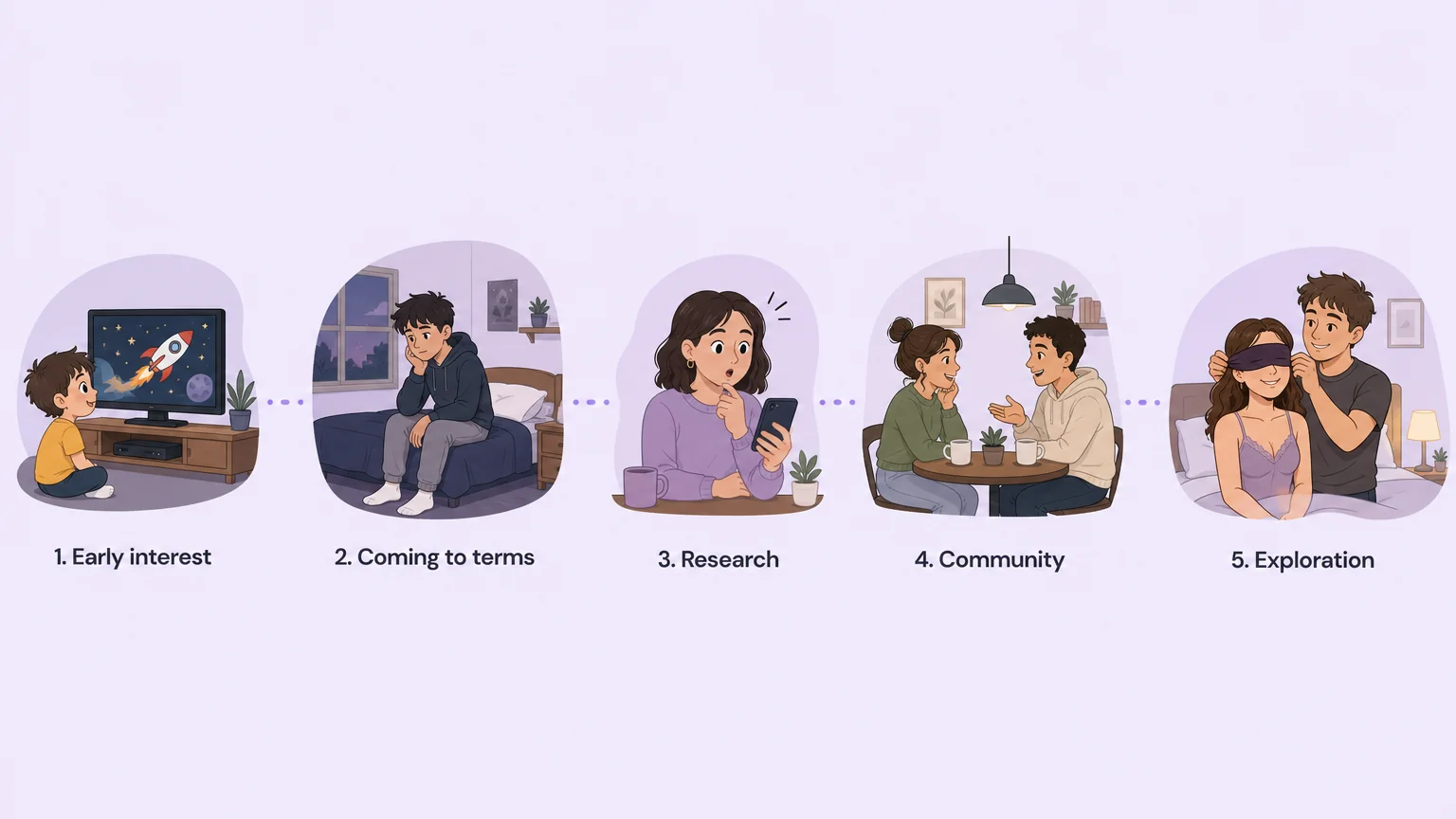
Samuel Hughes mapped a five-stage identity development path that many kinky people walk. It looks remarkably similar to other identity development models, including queer identity formation:
- Early interest (before age 10): A fascination with certain themes in media, play, or imagination. Bondage scenes in cartoons. Power dynamics in stories. Something catches your attention before you have words for it.
- Coming to terms (ages 11 to 14): You start to realize your interests are not universal. This is the stage where shame often gets installed, not because anything is wrong, but because nobody names what you are experiencing.
- Self-labeling and research: You find the vocabulary. You read. You realize you are not the only one.
- Finding community: You connect with others who share your interests, online or in person.
- Engaging with others (after 18): You begin practicing, exploring, and integrating kink into your relationships.
Disrupted by stigma, these stages produce shame. Supported by information, they produce self-knowledge.
Your Core Kink: The Feeling, Not the Act
Sex educator Princess Callie introduced the “core kink” concept. Your core kink is not the specific activity you are drawn to. It is the feeling you are seeking through that activity.
Someone into bondage might be seeking the feeling of being held. Someone into power exchange might be seeking relief from decision-making. Someone into sensory play might be chasing presence, the moment when nothing exists except sensation.
This reorients kink around emotions and mental states rather than equipment and techniques. You are not shopping for gear. You are learning what you need to feel.
What Tops and Bottoms Are Actually Seeking
Dr. Petra Zebroff’s research challenges stereotypes: tops and dominants are motivated by independence and feeling cherished; bottoms and submissives by focused attention, safety, and relief from decision-making. Both prioritize trustworthiness, communication, and humor in partners, far above technical skill.
Aella’s large-scale surveys found some kinks are “deep” and stable across a lifetime; others are more malleable. Your kinks may shift over time. The point is self-understanding, not self-diagnosis.
The Kink Spectrum: Vanilla, Spicy, and Everything Between
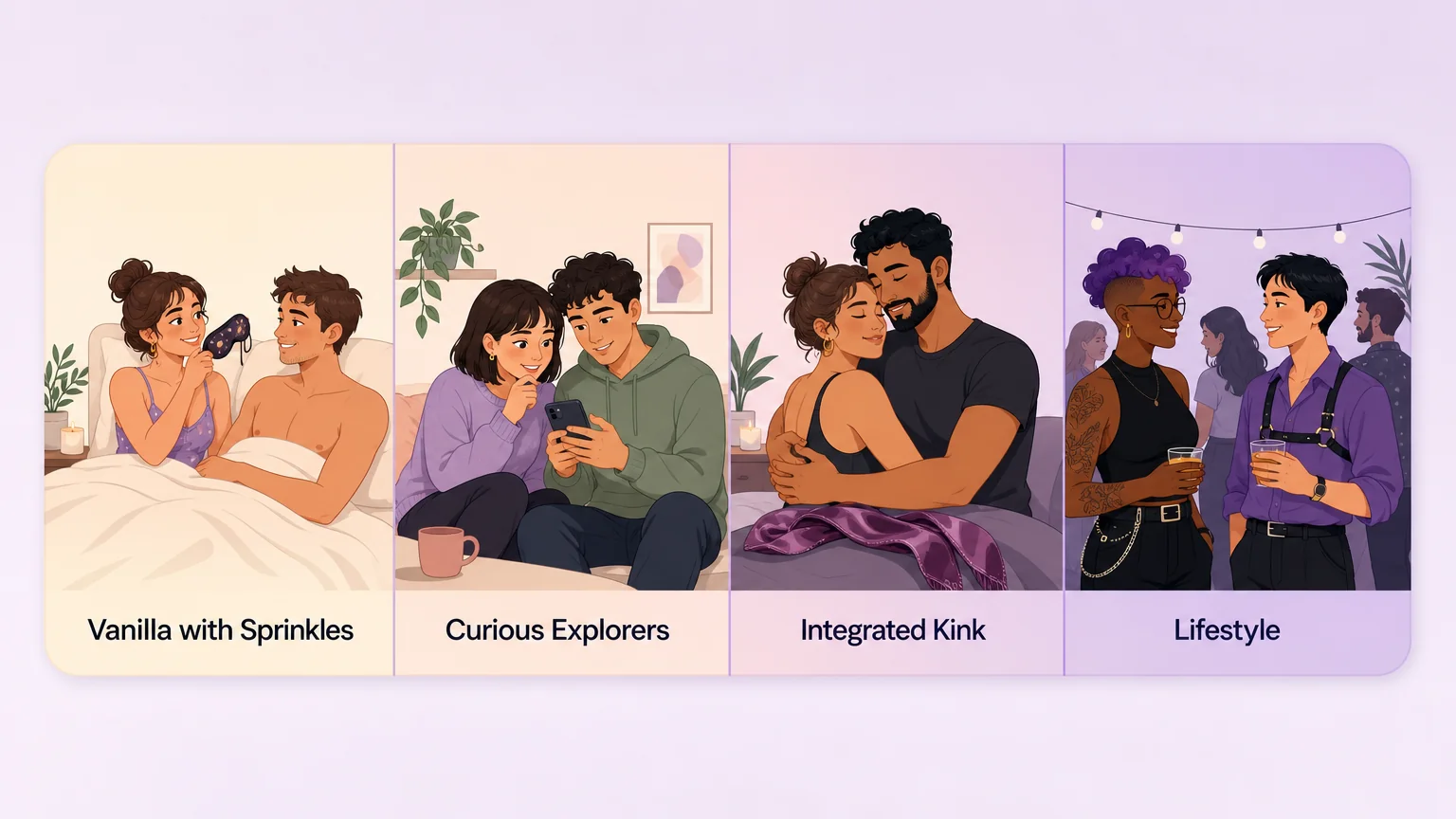
The binary of “vanilla or kinky” collapses the moment you look at it. Reality is a gradient, and most people occupy a comfortable middle zone that neither label captures well.
Vanilla With Sprinkles
At one end of the spectrum are people whose sex life is broadly conventional but who enjoy occasional novelty: a blindfold, a new position, a bit of dirty talk. They are people who have found their preferred temperature and stay there, not “beginners” on a journey toward something more advanced. That is a complete position, not a staging ground.
Curious Explorers
In the middle are people with specific interests they want to try, interests that go beyond standard but are not central to their identity. They might be curious about light bondage or power dynamics. They might try something once and decide it is not for them. They might try it and discover a door they did not know existed. They might circle back to the same curiosity months later, when the timing feels right. Curiosity is the operating mode here, not commitment.
Integrated Kink
Further along, kink becomes a regular, meaningful part of sexual expression, woven into relationships rather than added as an occasional spice. These are people who have found that certain dynamics, sensations, or roles enhance their connection. Kink is part of how they relate, not just what they do.
Lifestyle
At the far end, kink is a core identity. Some people live in 24/7 power exchange dynamics. Some are active in community spaces, events, and education. This is not “extreme.” It is simply further along the same gradient everyone else is on.
The Critical Move: Do Not Rank These
No “leveling up” language belongs here. Each position is complete and valid. Someone at “vanilla with sprinkles” isn’t behind. Someone at lifestyle isn’t ahead. They are in different neighborhoods on the same map.
There is also a temporal dimension. Where you are at 25 might not be where you are at 35, and that shift is not regression or escalation. It is just you, changing, like you do. The spectrum is a map, not a scorecard.
Common Kinks and What People Actually Get From Them
When you map thousands of people’s kink interests, they do not scatter randomly. They cluster. Aella’s research describes it as a tree: BDSM is the first and biggest branch, and other interests branch off from there in predictable patterns. The 2021 Maastricht University study identified five major clusters.
Submission and Masochism
The most common cluster. This includes light bondage, sensory play, impact play, and being told what to do. What people actually get from it: release from control, the intensity of sensation translating into presence, the relief of not being in charge for a while. For someone who makes decisions all day, surrendering them for an hour can feel like the deepest exhale.
Dominance and Sadism
The complementary cluster. Taking the lead, giving commands, light impact play from the giving side. What people get: feeling trusted, admired, responsible for someone else’s experience. The appeal is not cruelty. It is being handed something precious and being told, “I trust you with this.”
Fetishism
Fetishism means being attracted to specific non-personal objects or body parts. Materials like leather or latex. Body parts like feet or hair. What people get: a focused, almost meditative intensity. The object or body part becomes a shortcut to arousal, a key that reliably opens the same door.
Mysophilia
Interest in activities typically considered unhygienic, from sweat and saliva to more involved scenarios. What people get: transgression, vulnerability, and trust. The appeal is often the taboo itself, the shared secret, the knowledge that someone trusts you enough to be messy with you.
Forbidden Sexual Activities
Interest in acts that carry social or legal prohibition. What people get: the charge of the forbidden held safely inside a consensual container. The thrill is the boundary, not the danger.
The Permission Statement
You do not need to identify with any cluster. You do not need to try anything. Knowing the landscape is enough. If you see yourself in one of these descriptions, you are part of a large, well-documented group of people who share that interest. You are not a statistical anomaly. You are a person with a type.
How to Talk to Your Partner About Kink: Without It Feeling Like a Confession

Talking about kink with a partner can feel like handing them a grenade and hoping they do not pull the pin. Vanessa and Xander Marin, licensed sex therapists, offer the core insight: the energy you bring matters more than the exact words you use. Come in nervous and apologetic, your partner picks up on the shame. Come in excited and curious, they are much more likely to be curious with you.
Step 1: Self-Reflection First
Before you say a word, ask yourself: how important is this to you? Core need or passing curiosity? The answer shapes everything that follows. You do not need certainty. You need enough clarity to be honest.
Step 2: Pick the Right Moment
Calm. Private. Non-sexual. Never during sex, right after, or when either of you is stressed or running out the door. The setting communicates safety before you open your mouth.
Step 3: Lead With the Positive
“I really love what we have, and I get excited thinking about new things we could try together.” You are not reporting a deficit. You are proposing an adventure.
Step 4: Use Curiosity Framing, Not Demands
“I read about X and it made me curious. What do you think?” is a door you open together. “I want you to do X” is a door you push someone through.
Step 5: Describe the Feeling, Not Just the Act
“I think I would feel really held if we tried this” lands differently than “I want you to tie me up.” The feeling is relatable. Lead with what connects.
Step 6: Choose Your Words Carefully
Moushumi Ghose, MFT, offers a practical tip: if “kink” or “kinky” might trigger a reaction, say “sharing and exploring together some things I find arousing.” Sometimes the framing is the whole game.
Step 7: Give Them Time
“Take whatever time you need. There is no rush.” Your partner might need days or weeks. Silence is not rejection. It is processing.
Step 8: Make It Two-Way
“Is there anything you have been curious about trying?” This transforms the conversation from “I have a secret” to “let us compare maps.” Your partner might have been waiting for you to go first.
A reality check: your partner might say no. That is their right. Consent goes both ways. A no does not mean you are wrong for asking. It means your partner has different boundaries. The sections that follow address what comes next.
Your First Step Into Kink: Smaller Than You Think
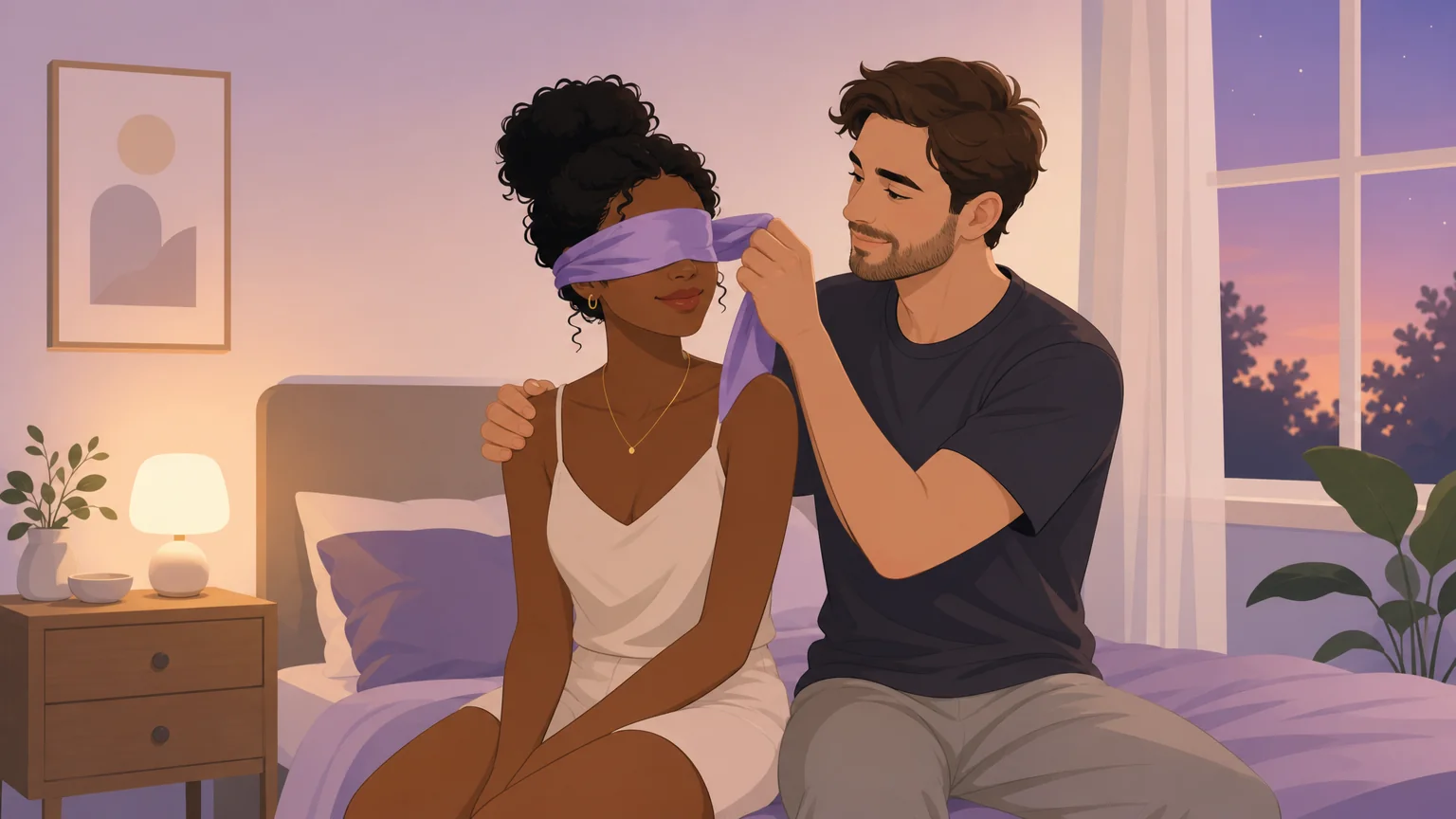
You do not need a dungeon. You do not need costumes. You probably already own everything you need for your first exploration.
Dr. Tara, a clinical sexologist, outlines a beginner framework using household items and zero prior experience. Here are five first steps.
Sensory Play
A silk scarf over the eyes. An ice cube down the arm. A feather, a brush, a piece of velvet. Heighten one sense by dampening another. When you cannot see, a fingertip becomes electric. No equipment, no risk. Just attention.
Dirty Talk
Describe what you are feeling. What you want done next. Start with one sentence. The voice is the most underrated tool. The only skill is honesty, and you get better with practice.
Light Restraint
A soft scarf loosely around the wrists. Nothing that cannot be slipped. The point is psychological: being held, being still. It is the permission to stop moving.
Power Dynamics in Conversation
“What if tonight, you are in charge?” Said before anything physical happens. The dynamic lives in the agreement, not the equipment. You can spend an evening in role without touching anything that was not already in your bedroom.
The Safeword
Introduce the traffic light system. Green: good, keep going. Yellow: pause, check in. Red: stop immediately, no questions. This is not BDSM ritual. It is a communication upgrade. Having a word that means stop makes everything safer and, counterintuitively, more freeing. You can relax into the unknown when you know exactly how to exit it.
The Fantasy-Practice Distinction
You do not have to act on anything. A 2009 Canadian study found 62% of men had bondage fantasies; only 14% to 23% had ever done it. The gap between imagination and action is not failure. It is normal.
Fantasy is a complete experience. You can be deeply interested in something as a mental space without ever bringing it into the physical world. Curiosity without action is self-knowledge. The line between fantasy and practice is yours to draw, and you get to redraw it whenever you want.
You do not need to do anything tonight. Knowing the first step exists is enough. You decide if and when to take it.
What Kink Can Do for Your Relationship
Mainstream advice treats wanting something new in bed as a symptom of a broken relationship. The reality is closer to the opposite: wanting to explore together is a sign that your relationship is secure enough to hold the conversation.
Trust
Negotiating boundaries requires trust and builds it. You cannot do kink without saying, explicitly, what you want and what you do not. That act of naming accelerates trust. Research shows both tops and bottoms in BDSM relationships prioritize trustworthiness, communication, and warmth. The negotiation is the bonding agent.
Communication
The skills you build talking about kink do not stay in the bedroom. They upgrade how you talk about money, family, the hard things. When you have practiced saying “here is what I want, what I do not want, and what I am unsure about” in one domain, you have the muscle for every other domain.
Vulnerability
Telling a partner “here is something I am curious about, and I am nervous to say it” is vulnerability. When met with curiosity rather than judgment, the relationship strengthens, regardless of whether you ever act on the kink. Being seen without being rejected is the whole point.
Agency and Empowerment
Samuel Hughes notes sexual assault survivors can use consensual roleplay to transform powerlessness into agency within a trusted container. This is not “kink as therapy.” It is consensual exploration as empowerment.
Identity Validation
Psychotherapist Laura Jacobs notes kink communities offer trans and gender-nonconforming people structured language and respect for boundaries they may not find elsewhere. When a community practices naming boundaries, pronouns, and roles explicitly, it becomes a natural home for people whose identities require that same explicitness.
The Bottom Line
This is not about what is missing from your relationship. It is about what you are choosing to build together: a shared language for desire, a practice of telling each other the truth, and a bedroom where curiosity is met with curiosity back. That is not a symptom of a broken marriage. That is a celebration of a secure one.
Your Kink Questions, Answered
What is the difference between a kink and a fetish?
A kink is a broad non-normative sexual interest, something you enjoy but do not necessarily need. A fetish is a specific, intense fixation on an object, body part, or act typically required for arousal. In everyday language, “kink” functions as the umbrella term.
Is having a kink normal?
Yes. A 2024 Swiss survey found 46.4% of adults reported at least one paraphilic interest. BDSM-related kinks are the most common cluster. Normal is a much wider range than most people assume.
Does having a kink mean something is wrong with me?
No. Kink interests are a natural variation in human sexuality, not a sign of trauma, mental illness, or moral failure. The DSM-5 and ICD-11 have both depathologized kink. The shame comes from social stigma, not from the interest itself.
Do I have to act on my kinks?
No. Fantasy is a complete experience. A 2009 Canadian study found 62% of men had bondage fantasies; only 14% to 23% ever practiced them. You can be deeply interested in something without ever bringing it into the physical world. The line between fantasy and practice is yours to draw.
How do I tell my partner I am interested in kink?
Choose a calm, private, non-sexual moment. Lead with what you love about your current sex life. Frame your interest as shared exploration. Describe the feeling you are seeking, not just the act. Give them time. Ask about their curiosities too. The full framework is above.
Where do kinks come from?
No single answer. For some, interests emerge in early childhood through play or media. For others, they develop later. It appears to be a mix of personality, early experiences, and individual psychology. What researchers agree on: kink is not caused by trauma.
What if my partner is not into it?
That is their right. Consent goes both ways. Options: find middle ground (they participate because they enjoy your enjoyment), explore solo through fantasy or erotica, or negotiate ethical non-monogamy. If you agree to explore with others, kink dating apps and sites are where partners who already share your interests gather. If the mismatch causes distress, a kink-affirming sex therapist can help. Never pressure. Never punish a no.
You showed up curious. That is the only prerequisite.