In 2024, a TikTok video claimed that are kinks hereditary had a simple answer: yes, you inherit them from your opposite-sex parent. It racked up 5.4 million views. The reactions poured in, from “that explains everything” to “I do not want to know.”
The claim traced back to a satirical article from a Rutgers University humor publication. It was never real science.
But here is why it went viral anyway: millions of people genuinely want to understand where their desires come from. The question beneath the trend was not “did I inherit this kink from my dad.” It was “why am I like this, and is there something wrong with me?”
You and your partner may have had some version of this conversation. Late at night, after a scene, or in the quiet moment when curiosity overtakes inhibition. Where did this come from? Is it weird? Does it mean something about me?
This article walks through what kinky people themselves say about their origins, what neuroscience and genetics tell us, how conditioning shapes desire, and why the search for an origin story matters as much as the answer. No shame, no judgment. Just the best science we have, and a clear look at what we still do not know.
What 260 Kinky Adults Revealed About Their Own Desires
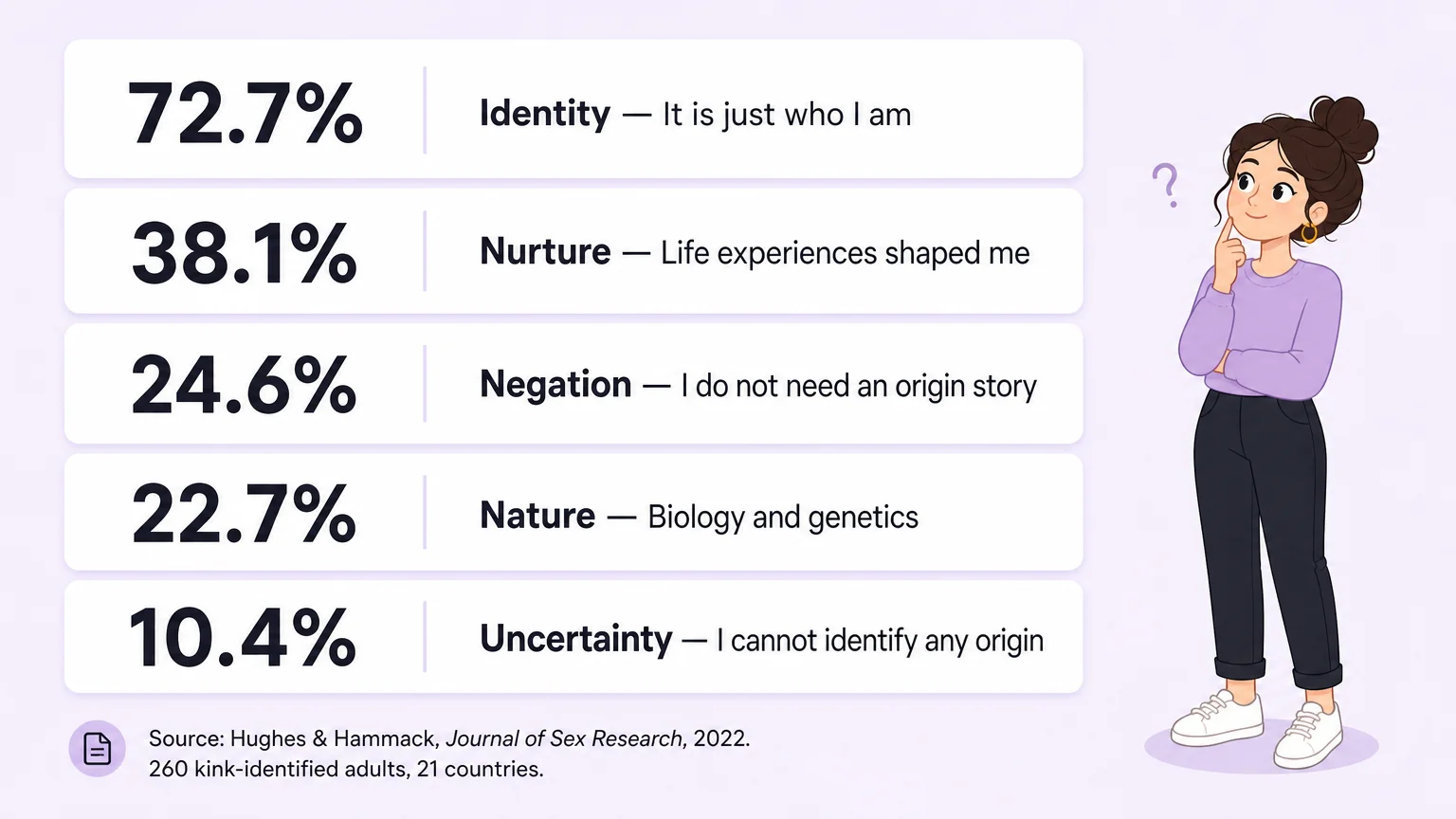
Fewer than 19% of kinky adults link their desires to trauma. That single finding directly contradicts the most persistent cultural assumption about where kink comes from.
The data comes from Hughes and Hammack’s 2022 study, published in the Journal of Sex Research. They recruited 260 kink-identified adults from 21 countries through FetLife and asked a simple question: where do you believe your kinks came from? The geographic spread is significant. With respondents spanning North America, Europe, Australia, and parts of Asia, the findings are not limited to any single cultural attitude toward sex or kink.
The responses fell into five categories. Identity led by a wide margin at 72.7%, capturing statements like “it is just who I am.” One participant put it this way: “I knew I was drawn to power exchange dynamics long before I had words for it. It was never something I learned. It was something I recognized.”
Nurture followed at 38.1%, covering life experiences including both traumatic and non-traumatic events. Non-traumatic nurture included early relationships that introduced new dynamics, partners who suggested exploration, and curiosity-driven experimentation that unlocked something unexpected. Negation came next at 24.6%: people actively rejecting the premise that their desires need an origin story at all. As one respondent put it, “I don’t need to know why I like chocolate ice cream. I just do.” Nature, meaning biology and genetics, sat at 22.7%. Uncertainty rounded out the list at 10.4%, representing those who could not identify any origin.
The percentages overlap because participants could endorse more than one explanation. Someone might say “I was born this way” and also “my early relationships shaped me.” Both can be true.
The Identity finding connects to a deeper data point from a separate study: 95% of kink-identified people said being kinky was their nature. Not a phase. Not a symptom. Their nature.
What this data does not tell us is biological mechanism. These are beliefs about origin, not scans of neural circuitry. But they matter because they tell us how kinky people understand themselves. That understanding is overwhelmingly not rooted in damage, pathology, or brokenness.
Your Brain on Kink: The Neurochemistry Behind Desire
Subspace. The floating, time-blurred altered state many submissives describe during an intense scene. It is not mystical. It has a name and a mechanism.
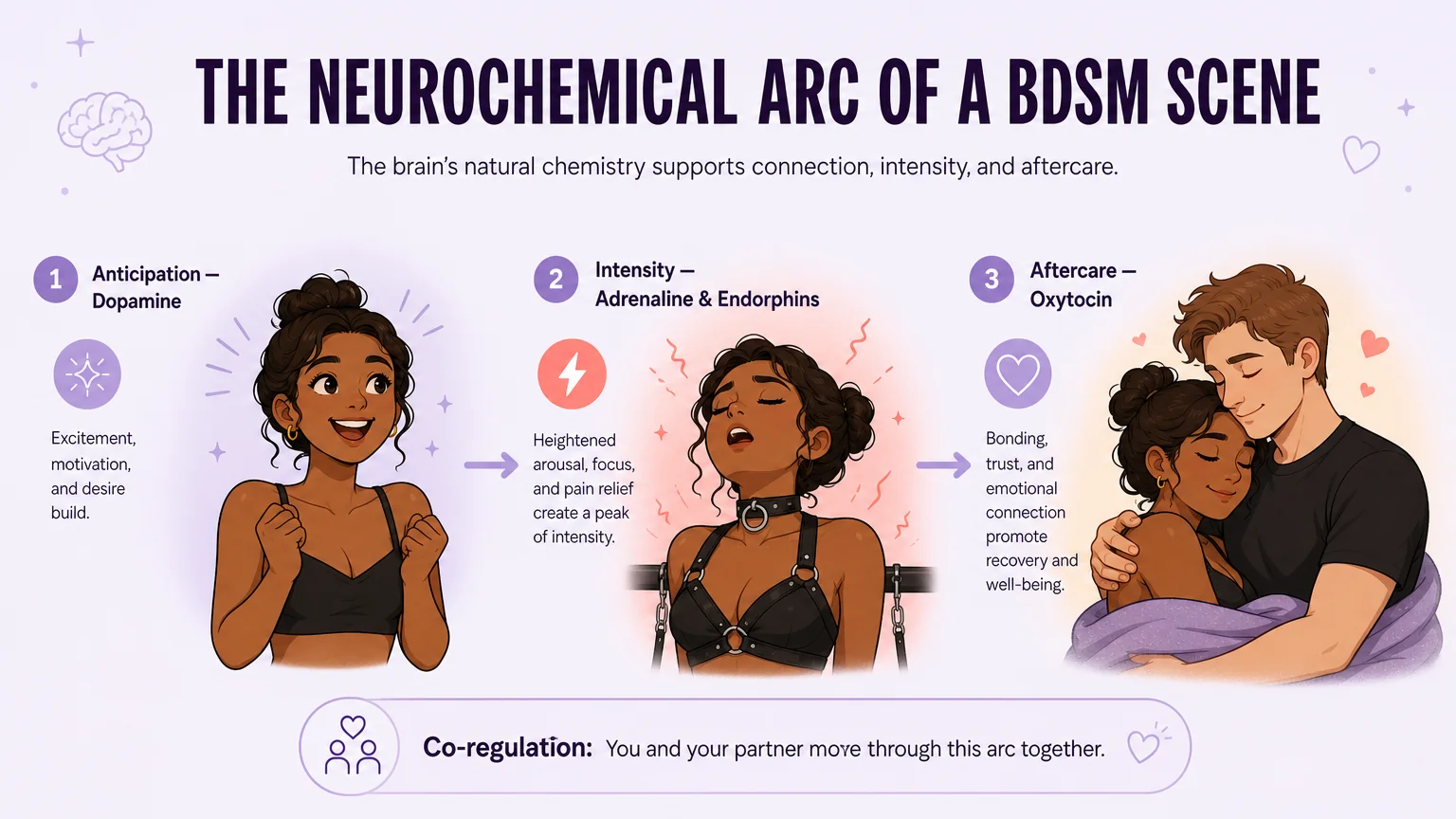
The Biology of BDSM systematic review maps the key neurochemical players. Endorphins produce euphoria and pain relief through the body’s natural opioid system. Adrenaline and noradrenaline drive sympathetic nervous system activation, the physiological rush that makes a scene feel electric. Dopamine creates reward anticipation, the wanting that pulls you toward an experience before it even begins.
Endocannabinoids bridge pain and pleasure at the molecular level. Oxytocin floods the system during aftercare and bonding, deepening the connection between partners.
Together, these chemicals form a predictable arc. Anticipation triggers dopamine before the scene even starts. Adrenaline and endorphins peak during the intensity of play. Oxytocin surges in the calm that follows. When you and your partner move through that arc together, you are not just sharing an activity. You are co-regulating each other’s nervous systems. This is why aftercare is not optional. It is the neurochemical close of a loop the scene left open.
There is a cortisol asymmetry worth noting: cortisol rises significantly in submissives during scenes but not in dominants. The same activity, the same room, two different physiological profiles. This asymmetry has a practical implication. The drop after a scene matters as much as the peak during it. When the scene ends, the submissive’s elevated cortisol needs time to return to baseline. Aftercare is not just emotional reassurance. It is the physiological bridge from high-alert back to safety.
The safety mechanism here is critical. fMRI research shows that when pain is self-chosen and consensual, the prefrontal cortex signals the amygdala that the perceived threat is desired. This shifts the body’s response from stress hormones toward opioids and bonding hormones. Without the safety container of consent, the identical neurobiological pathway defaults to a trauma response.
The same nerve bundles carry both signals. Pain and sexual pleasure share neurological infrastructure through the spinothalamic tract. The hardware is shared. What determines the experience is context.
This explains the capacity for kink experience, the biological machinery that makes it possible. But it does not explain specific content. Why boots and not balloons? Why rope and not silk scarves? For that, we turn to conditioning.
How Desire Gets Wired: The Science of Sexual Conditioning
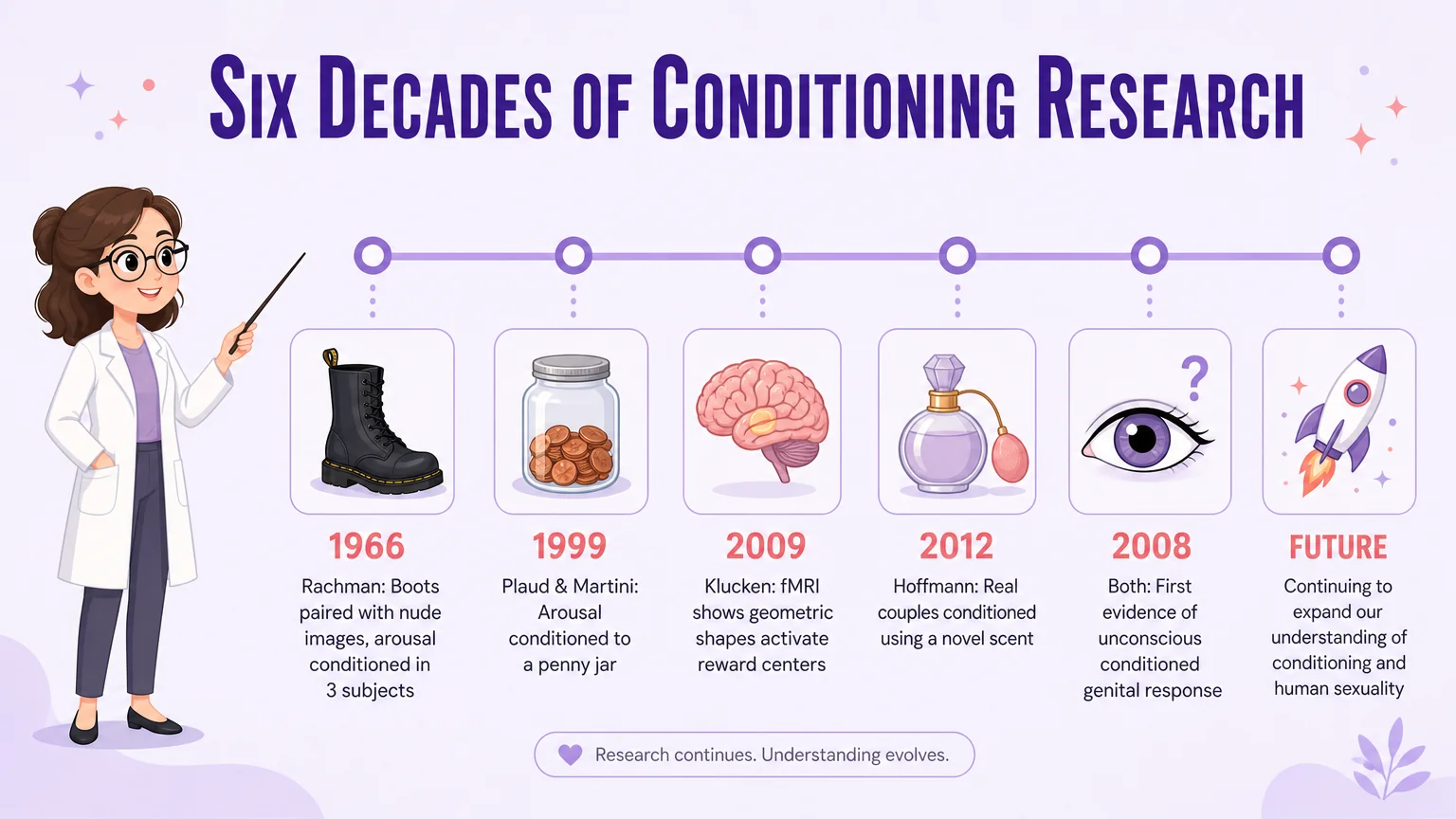
In 1966, researcher S. Rachman paired images of black knee-length boots with slides of nude women for three male subjects. All three developed measurable sexual arousal to the boots alone. That was the first laboratory demonstration that fetishes can be conditioned.
The evidence has accumulated across decades and species. Pfaus and colleagues conditioned male rats to prefer sex while wearing little jackets. Japanese quail were conditioned to terrycloth objects.
Human studies followed. Klucken and colleagues used fMRI in 2009 to show that geometric shapes paired with erotic pictures activated reward structures in the human brain. Hoffmann and colleagues demonstrated real-world conditioning in actual couples in 2012, using a novel scent during sex. Both and colleagues provided the first evidence of conditioned genital response using both conscious and subliminally presented erotic pictures. Conditioning can happen below conscious awareness. Your brain can learn an association you never knew it was making.
At the molecular level, Delta FosB accumulates in the nucleus accumbens with repetitive sexual rewards, causing sensitization. Each time the association fires, the brain lays down more track. Orexin facilitates long-term potentiation in VTA dopamine neurons. Once a fetish forms, the brain physically reinforces it. This is why conditioned sexual responses are highly resistant to extinction. The neural architecture gets built, and the brain does not dismantle it easily.
Preparedness theory adds another layer: certain classes of stimuli may be more easily associated with sexual reward because they share properties with biological sexual cues. Pink, black, smooth, silky, shiny. These features may be primed for erotic association in a way that corrugated cardboard is not. This helps explain why certain textures, colors, and materials show up repeatedly across different people’s kinks. The brain has a head start on some associations.
For couples exploring together, conditioning is both a map and a permission slip. The associations you build with each other, a particular playlist, a specific fabric, the way your partner says your name in a certain tone, are not random. They are the architecture of shared desire, built the same way any conditioned response is built: through exposure, association, and repetition. The brain learns what you teach it.
Consider the examples. Plushophilia from operant conditioning: a child rubbing genitals on a stuffed animal, positive reinforcement, no trauma involved. A foot fetish traced to childhood wrestling. Scent association with a specific partner. Conditioning explains how neutral stimuli become erotic triggers. It does not require trauma, abuse, or pathology. It requires exposure, association, and repetition.
Is There a Kink Gene? What Genetics Actually Tells Us
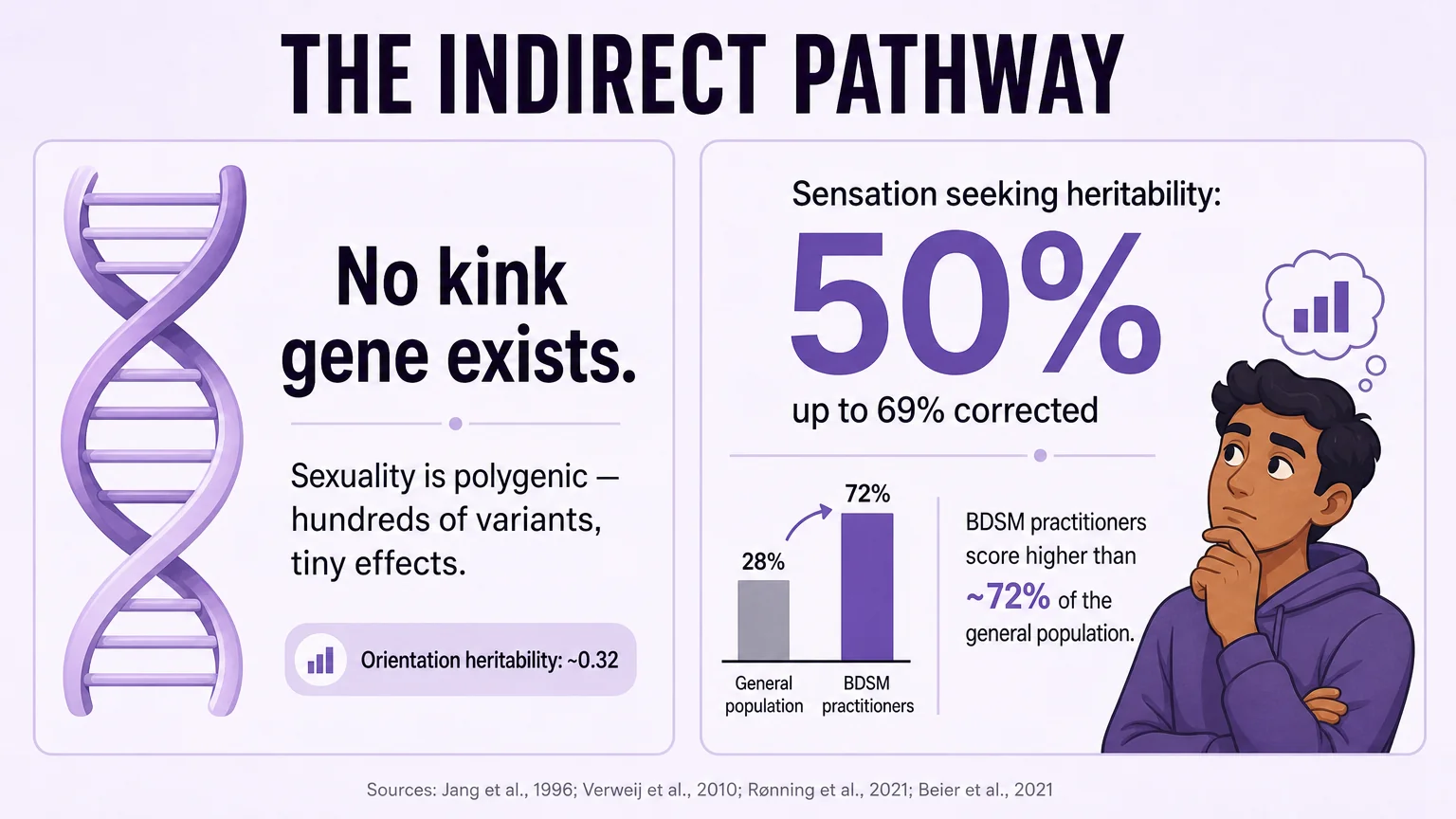
No specific kink gene or BDSM gene has been identified. The scientific consensus is that one does not exist.
Sexuality is polygenic. Hundreds or thousands of genetic variants influence it, each with tiny effects, all interacting with environment. The heritability of sexual orientation overall is estimated at approximately 0.32, meaning environment is roughly twice as influential as genetics.
But there is an indirect pathway.
Sensation seeking has a heritability coefficient of approximately 0.50 in twin studies, possibly as high as 0.69 when corrected. Multiple studies confirm that BDSM practitioners score significantly higher on sensation seeking than non-practitioners. The largest study, a Polish sample of 892 community members, found a Cohen’s d of -0.586, a medium-to-large effect size. In practice, this means the average BDSM practitioner scores higher on traits like novelty-craving, intensity-preference, and risk-tolerance than roughly 72% of the general population.
The chain works like this: genes influence sensation-seeking personality, and that personality trait makes someone more likely to explore and develop kink interests.
The relationship is not clean, though. Findings conflict on whether dominants or submissives score higher. And the only twin study directly examining fetishism and sadomasochism is very small: 14 monozygotic pairs and 14 dizygotic pairs. Sadomasochism showed a concordance of 0.36 for identical twins versus 0.13 for fraternal. Fetishism showed 0.37 for identical versus 0.50 for fraternal. Mixed results, tiny sample. The authors themselves note that a proper classical twin study for these traits has yet to be carried out.
Dr. Justin Lehmiller’s synthesis pulls it together: two people can develop the same kink for completely different reasons. One person’s foot fetish traces to childhood wrestling. Another’s traces to an early romantic partner who painted her nails a particular shade of red. Genetic predisposition may nudge someone toward sensation seeking, or it may not. There is no single path to any single desire.
Why You Search for an Origin Story (and How to Make Peace Without One)
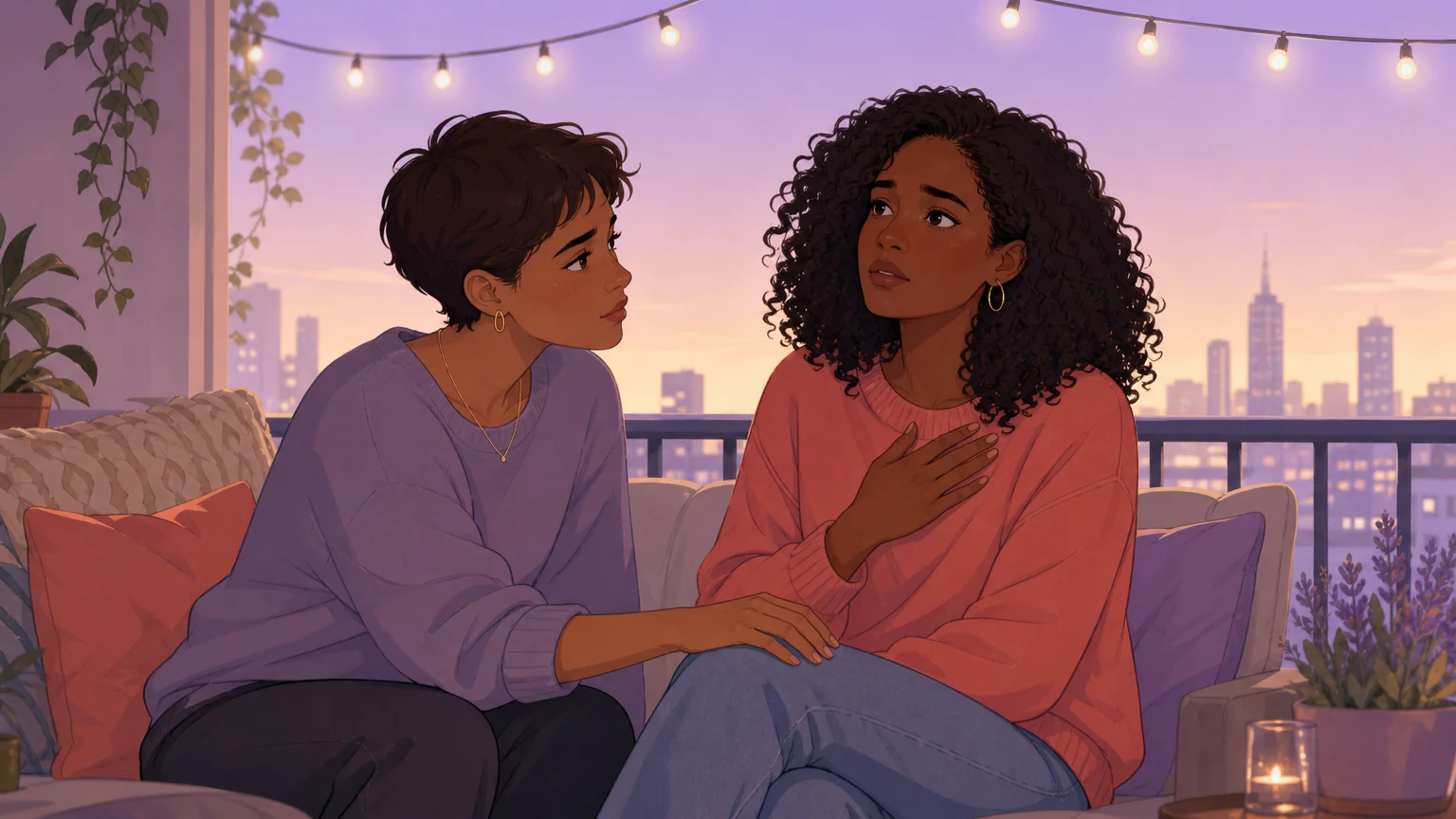
Evie Lupine, a kink educator, put it plainly: “Wouldn’t it be nice to go ‘oh I like this thing because it runs in my family the way eye colour does’ and call it a day rather than agonising over the shame you feel about your kinks?”
She is naming something precise. The drive to find a genetic origin for kink is fundamentally about legitimacy-seeking. If kink is born this way, it becomes unchangeable and therefore exempt from moral judgment. The logic is seductive: biology as permission slip.
But it carries a trap. If you need a genetic origin to feel legitimate and one does not exist, you are left in the same shame you started with. The search itself becomes the wound.
Nearly a quarter of kink-identified adults in the Hughes and Hammack study actively rejected the premise that origins need explaining. They are not dodging the question. They are questioning the question.
Dr. Christian Joyal offers a developmental framework that replaces the single-origin fixation with something more useful. His research suggests a three-tier timeline. Fundamental sexual interests begin in childhood as pre-sexual emotional reactions, what researchers call the Tintin phenomenon after multiple BDSM practitioners independently cited Tintin comics with characters bound and restrained. Secondary preferences develop in early adulthood. Tertiary preferences emerge with partners around age 30.
Desire is not a fixed point. It is a trajectory.
Here is the practical ground to stand on. Notice when your feelings first appeared, but be skeptical of single-cause narratives. Recognize that kink can be a healing framework if trauma is part of your story: consent, safewords, and aftercare create a neurological safety container that the original experience lacked. And if you have no origin story at all, 10.4% of kinky people could not identify any origin either. They are no less valid.
The reframe is this: the question is not “where did this come from” but “what do I want to do with it, and who do I want to be?” Desire does not require an apology.
FAQ: Your Questions About Kink Origins, Answered
Are kinks directly inherited from parents?
No. No kink gene exists, and no evidence supports direct genetic inheritance of specific desires. The only twin study on the topic was too small to draw conclusions. Sensation seeking, a personality trait with partial genetic roots, may increase openness to kink exploration. But what you are into, the boots rather than balloons, comes from experience and conditioning, not DNA.
Are kinks caused by childhood trauma?
Not in the way most people assume. Fewer than 19% of kinky adults connect their desires to trauma. The majority describe their kinks as innate. Conditioning can create fetishes through neutral experiences with no trauma involved. If trauma is part of your story, kink practiced with consent, safewords, and aftercare can be a healing framework. But trauma is not a requirement.
Can classical conditioning really create a fetish?
Yes. Rachman demonstrated it in 1966. Klucken confirmed it with fMRI in 2009. Hoffmann replicated it with real couples in 2012. Both and colleagues showed it can happen below conscious awareness. At the molecular level, Delta FosB physically reinforces these associations with repetition. The science is replicated across species, methods, and decades.
What do twin studies tell us about kink heritability?
Very little, and the researchers who ran the only study would tell you the same thing. With 14 identical and 14 fraternal twin pairs, the sample is too small to generalize. Results were mixed. A proper twin study for fetishism and sadomasochism has never been conducted.
If I can trace my kink to a specific childhood memory, does that mean it was caused by it?
Possibly, but not necessarily. Self-attribution of causality is unreliable. You may have already been predisposed toward that interest, and the memory marks when you noticed it rather than when it began. Millions of children saw the same media without developing kinks. The predisposition may have come first.
Why do I feel like I need to know where my kinks came from?
Because shame demands an explanation, and a genetic origin feels like a way out. If you were born this way, the desire was never a choice, and that feels like permission. The harder alternative is more honest: your desires do not need an origin story to be valid. Nearly a quarter of kinky adults reject the premise that origins need explaining. What you do with your desires matters more than where they came from.