Nearly every person on the planet has sexual fantasies. When social psychologist Dr. Justin Lehmiller surveyed 4,175 Americans between the ages of 18 and 87, he found that 97% admitted to having them. The remaining 3% were probably just not in the mood to fill out a survey.
What Lehmiller discovered next upended decades of cultural assumption. Women’s top sexual fantasies were far more adventurous than the stereotype allowed. Men’s fantasies, meanwhile, contained more emotional content than anyone expected. The gap between what we assume about each other and what is happening inside our heads is wider than anyone guessed.
This article draws on Lehmiller’s landmark survey, the 2024 Bloom audio erotica study, Gillian Anderson’s collection of 174 real women’s anonymous fantasies in her book Want, clinical perspectives from Esther Perel, and more. The 10 categories below are organized by prevalence, starting with what the data shows is most common.
Fantasy is not desire. Many of the things women fantasize about are things they would never want to do in real life. That gap is not a contradiction. It is how the erotic mind works.
1. BDSM, Dominance, and Submission: Women’s Most Common Fantasy Category
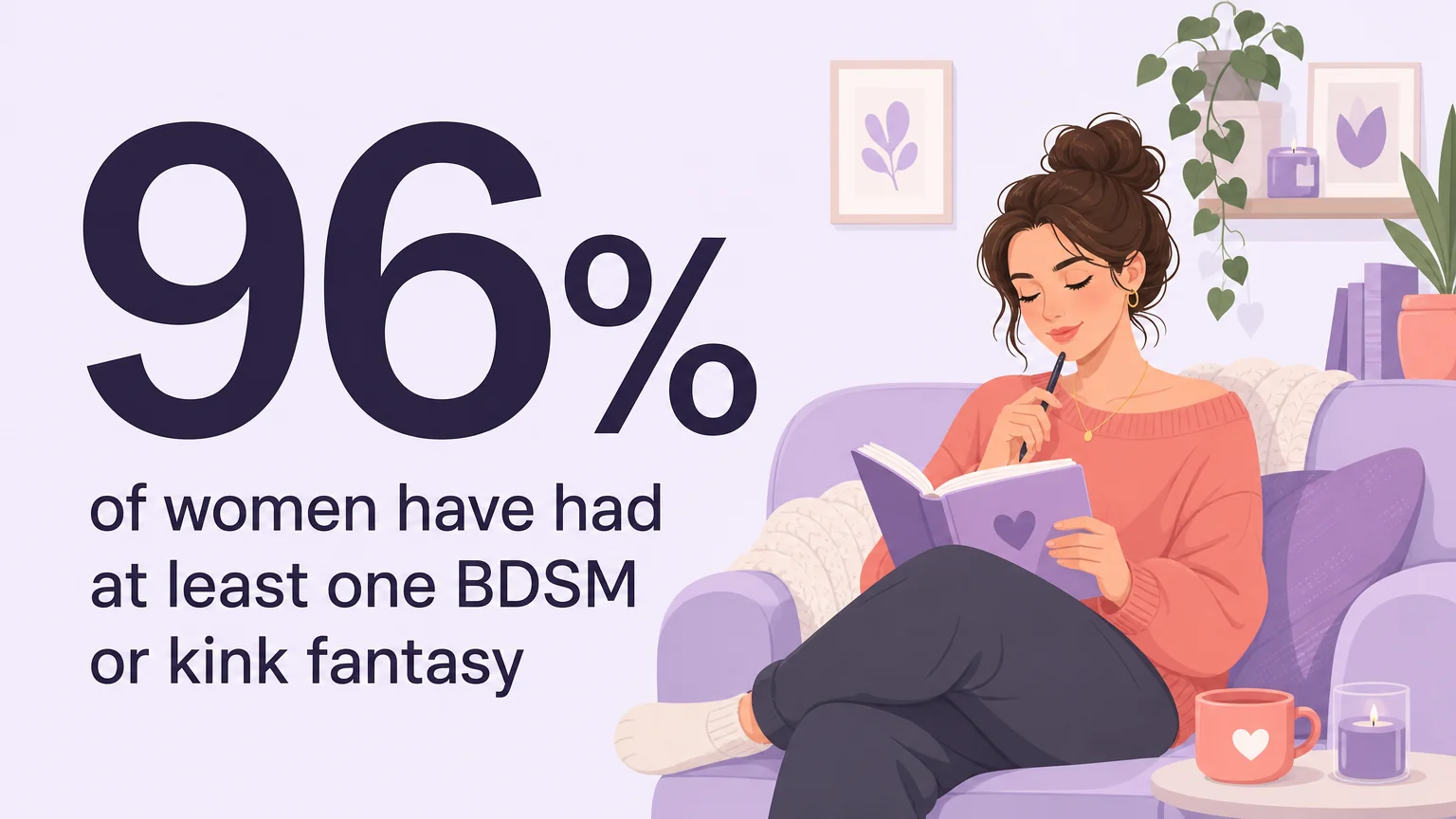
96% of women have had at least one BDSM or kink fantasy. That is not a niche interest. It is the statistical norm, and it is higher than the male number.
BDSM fantasy is not one thing. It ranges from light spanking and blindfolds to full power-exchange scenarios. Most women’s fantasies sit on the milder end. Conley and Satz-Kojis, publishing in the Archives of Sexual Behavior in 2024, found 65% of women reported submissive sex as a favorite fantasy and over 52% were interested in bondage variants. A 2025 Spanish population study of 4,683 people found women think about and desire sadomasochistic fantasies more than men but engage in them less.
The neuroscience explains why. The brain’s fear and arousal systems share neural pathways. The sympathetic activation that comes with a controlled threat, like being restrained, amplifies rather than inhibits arousal. Scenarios involving tension or power imbalance feel erotic because the circuitry for fear and desire are neighbors that borrow each other’s electricity.
This is where many women hit the feminist-values wall. If you believe in equality, in agency, in never being told what to do, what do you do with a fantasy about being dominated?
Bivona and Critelli offer a distinction that matters. The erotic versions of submission fantasy involved known, attractive partners with symbolic non-consent. The aversive versions, involving strangers and negative emotions, were the minority. Most women imagine controlled surrender with someone they trust. In fantasy, the woman retains ultimate control. She is the author of the scenario, even when the content involves being “taken.”
The paradox at the center: these fantasies are about psychological safety within danger, not about wanting real harm. The controlled environment makes surrender safe, and that is exactly what makes it arousing.
2. Threesomes and Group Sex: The Single Most Popular Fantasy Across All Genders
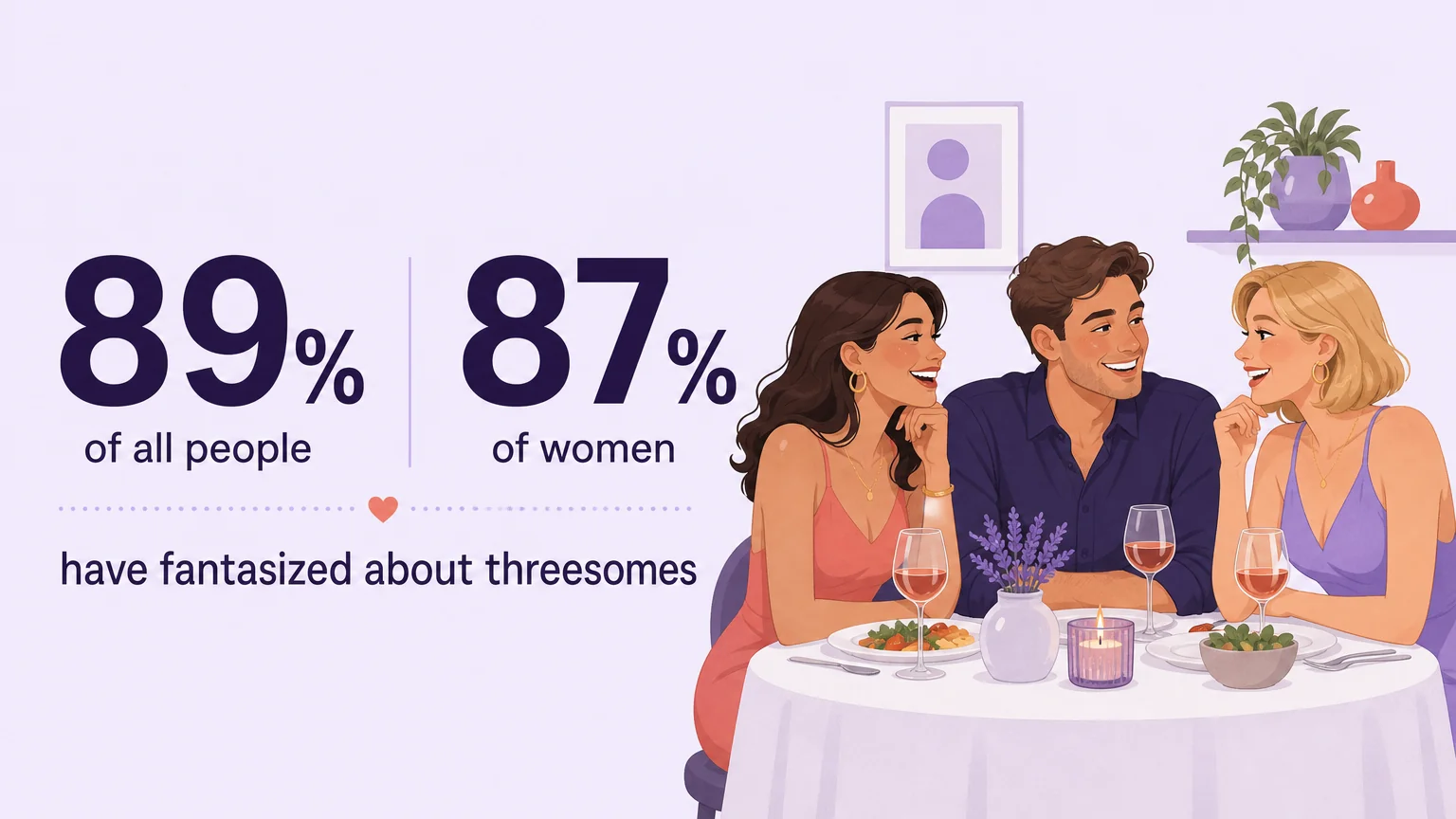
The threesome is the statistical champion of sexual fantasy. Eighty-nine percent of all people in Lehmiller’s survey had fantasized about group sex. Eighty-seven percent of women. This fantasy is so common it barely qualifies as a “kink.”
The near-universality hides an interesting gender detail. Straight women in Lehmiller’s study did not show a strong preference for the gender of the third participant. What mattered more was the dynamic. Women’s ideal threesome often included their current partner. This is not about escape. It is about expanding a shared experience with someone they already trust.
The 2024 Bloom survey of 300 female audio erotica users found threesomes topped the list at 77% when women were asked what they wanted more of in erotic content. Rounding out the top five: receiving oral sex at 54%, romantic sex at 52%, rough sex at 52%, and domination at 50%.
Evolutionary psychologists have their hypotheses about why multi-partner fantasies are so common, but social learning, novelty-seeking, and simple curiosity are equally plausible drivers. The evolutionary lens is one framework among many.
A real woman, quoted in a Mamamia survey, put it plainly: “To have multiple partners pleasure me and I don’t need to do anything.” That is the anti-mental-load fantasy in its purest form. For some women, the group fantasy is less about the number of bodies in the room and more about being the absolute center of attention and pleasure, with zero pressure to perform, manage, or reciprocate.
Many women find the fantasy intensely arousing and have zero interest in the emotional complexity, scheduling demands, and communication overhead of actual group sex. Fantasy gives you the highlight reel without the awkward logistics. That gap is normal and worth naming.
For the couples who do want to close the gap, those awkward logistics are exactly what 3Fun removes: one synced couple account, a shared three-way chat, no coordinating across two phones. Fantasy gives you the highlight reel. 3Fun is where the highlight reel becomes a plan.
3. Romantic and Emotionally Connected Sex: The Fantasy Stereotypes Get Wrong

The image of fantasy as purely physical, all strangers and anonymity and emotionless heat, is mostly a male-porn stereotype. The data tells a different story. Seventy percent of people rarely or never fantasize about emotionless sex. The majority want context, connection, and someone who knows them.
Lehmiller’s survey found that nine out of ten people fantasize about their current partner. People are not using fantasy to escape their relationship. They are bringing their partner into the fantasy. The emotional content is not the exception. It is the foundation.
Gormezano and colleagues, publishing in the Archives of Sexual Behavior in 2026, mapped a distinction that sharpens the picture. During solitary masturbation, about 56% of women’s fantasies focused on people outside the relationship. During partnered sex, about 35% focused solely on their partner, with significantly higher nurturance and emotional content. Fantasy serves different functions in different contexts.
Gillian Anderson’s collection Want contains a fantasy that captures the emotional core better than any statistic. An exhausted wife writes: “To have my husband say he’s hired a cleaner. To have my husband say he’s done the grocery shopping. To have my husband say your face is beautiful and not mention my forming jowls at 38 years old.” This is romantic fantasy reframed: being seen, appreciated, and relieved of burden is the erotic core.
Lehmiller’s own summary: “Men’s fantasies had far more in the way of emotional content than previous research had led us to believe, and women’s fantasies were far more adventurous than research suggested.” The stereotypes cut both ways, and neither holds up under the data.
4. Sex in Public and Risky Locations: Why 84% of Women Fantasize About Getting Caught
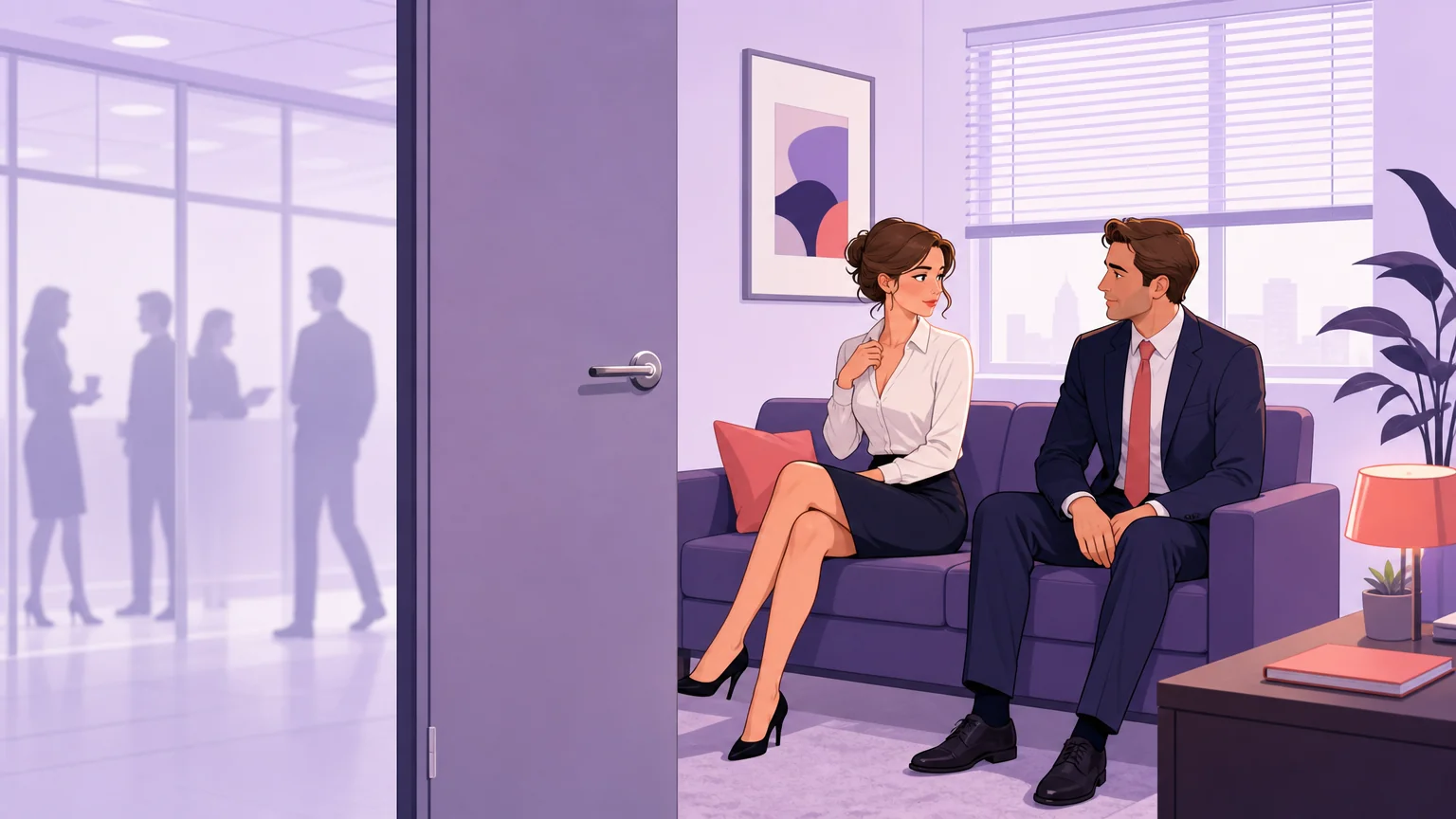
Eighty-four percent of women have fantasized about sex in a place where they might be seen. The office. A park. An elevator. A car in a public lot. A balcony overlooking a street. The settings vary, but the mechanism underneath them is the same.
Risk activates the sympathetic nervous system. Elevated heart rate, rapid breathing, heightened awareness. Those are the same physiological signals as sexual arousal. The brain, in a phenomenon called misattribution of arousal, can interpret risk-induced activation as erotic charge. The possibility of being seen or caught functions not as a deterrent but as an amplifier. You are not aroused despite the risk. You are aroused partly because of it.
Jack Morin’s paradox of eroticism explains why. The tension between “we should not be doing this” and “we are doing this” is itself the erotic fuel. The forbidden nature of the location creates the charge. Remove the risk, and a lot of the heat goes with it.
The office fantasy appears consistently across surveys and collections. A closed door. A desk. Colleagues on the other side of the wall. The scenario is specific enough to be relatable and universal enough that almost any reader can map their own version onto it. The power is in the proximity to normal life, with desire happening one wall away from the everyday.
This category also represents one of the largest gaps between fantasy and behavior. Most women who fantasize about public sex would never actually do it. The risk calculus in real life is too high. The consequences are too real. Fantasy gives you the thrill without the HR investigation. That is exactly what fantasy is for.
5. Same-Sex Fantasies: Why 59% of Straight Women Have Them

59% of straight-identified women report having same-sex fantasies. For straight men, the figure is 26%. Something different is happening in female sexual psychology, and it is not about “secret bisexuality.” It is about how female desire operates.
The research and first-person accounts point to a common narrative arc. A friend. A glass of wine. A moment that crosses a line gradually and organically. One anonymous woman in Anderson’s Want describes it this way: “My fantasy starts with me and a friend sitting around catching up having a glass of wine. She leans across me a little too close. She leans in and kisses me. I’m stunned but return the kiss.” The fantasy is grounded in safety, familiarity, and emotional context. It is not anonymous hookup energy. It is curiosity unfolding inside a relationship that already exists.
The evolutionary alloparenting hypothesis offers one framework: female same-sex behavior may have strengthened cooperative child-rearing bonds through oxytocin-releasing physical intimacy. This is a hypothesis, not settled science, but it provides a plausible lens for why female sexuality shows more fluidity than male sexuality across cultures.
Research by Binter and colleagues points to a broader finding: female sexual arousal patterns are more context-responsive and less category-rigid than male patterns. Women can be aroused by stimuli that do not match their stated orientation. The body and the identity do not always align, and that misalignment is itself normal.
The cleanest takeaway is also the simplest: fantasy is not identity. Arousal is not orientation. You can enjoy same-sex fantasies and remain straight-identified. You can enjoy them and decide you are bisexual. You can enjoy them and not label it at all. The fantasy itself does not demand a conclusion. It only asks to be felt.
6. Non-Monogamy and Open Relationship Fantasies Peak in Your 40s
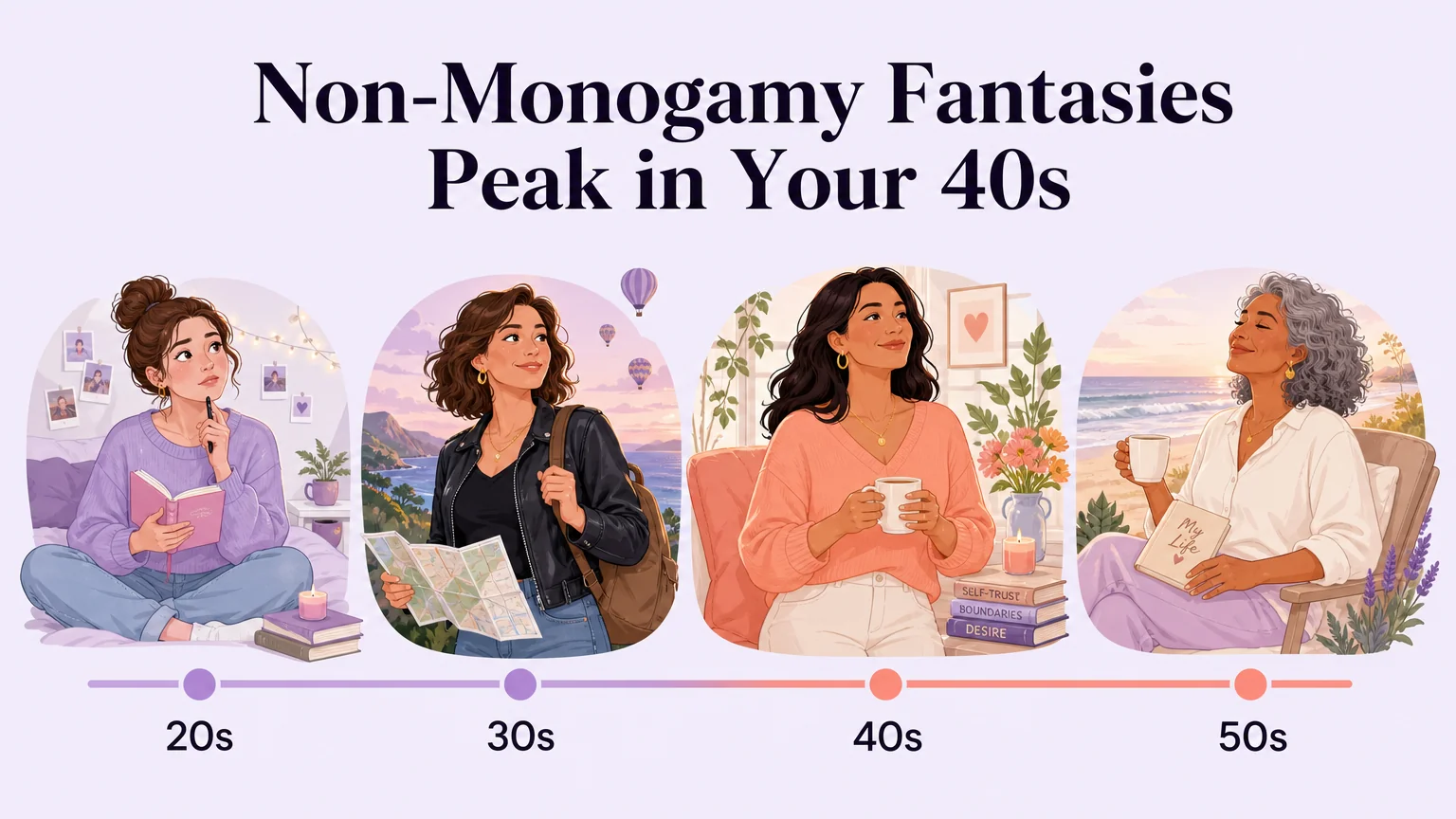
The stereotype is that non-monogamy fantasies belong to restless twenty-somethings who have not settled down yet. The data says the opposite. Sixty-two percent of women have fantasized about open relationships, and these fantasies do not peak in your 20s. They rise through the 30s, peak around age 40, and stay elevated through the 50s.
Lehmiller, writing in Psychology Today in 2024, offers a personality-maturation framework that makes sense of the pattern. As people age, neuroticism typically declines while openness to experience and extraversion rise. These personality shifts, rather than age itself, appear to drive the increase in non-monogamy fantasies. People become more comfortable with themselves. They grow more curious. They care less about what others think. Fantasy content follows personality development.
Distinguish this from the threesome fantasy. Non-monogamy fantasies are typically about ongoing arrangements with partner knowledge and consent, not one-time encounters. The fantasy often includes the partner’s approval. “With my partner’s blessing” is a recurring frame. This is not about secret escape. It is about variety and autonomy within security.
The question this category raises: does fantasizing about non-monogamy mean something is wrong with my relationship? The data does not support that reading. Lehmiller’s research does not show that non-monogamy fantasies correlate with relationship dissatisfaction. People in happy relationships have these fantasies too. Wanting the adventure does not mean you want to lose the anchor.
The midlife surge in non-monogamy fantasy is not a crisis. It is a developmental phase. Your personality is becoming more open and less fearful at exactly the stage when you have the self-knowledge to explore what you actually want. That is not a breakdown. It is a predictable trajectory.
7. Sex with a Stranger: The Psychology of Anonymous Encounter Fantasies

A woman in a happy, committed relationship fantasizes about sex with someone she has never met. This is not a contradiction. It is a specific psychological mechanism at work.
Esther Perel frames fantasy as “a staging ground for action and escape.” The stranger represents everything the familiar partner cannot: mystery, unpredictability, the version of yourself that exists before anyone knows your flaws. The stranger fantasy is often less about the stranger and more about who you get to be in that scenario. Unknown. Unburdened. Seen only in your desirability. No history. No baggage. Just the moment.
Morin’s paradox of eroticism applies here too. The hottest fantasies often involve tension, taboo, or something just out of reach. The stranger is definitionally out of reach. You do not know them. You cannot have them. That impossibility is precisely what gives the fantasy its charge. The gap between the imagined and the real is the engine.
These fantasies follow a recognizable script. Mutual recognition of desire without the weight of biography. Eye contact across a room. A wordless understanding. That script works because it strips away everything complicated about real intimacy and leaves only the moment of wanting and being wanted.
The distinction from real-world risk matters. The fantasy version involves a safe, attractive, respectful stranger who reads your signals perfectly and wants exactly what you want. Real strangers do not come with that guarantee. This is fantasy as the curated, risk-free version of danger, and that is exactly why it works.
Fantasizing about a stranger does not mean you want to leave your relationship. It means your brain is drawn to novelty, and fantasy is the safest possible way to explore it. The fantasy and the relationship are not competitors. They operate in different lanes.
8. Being Desired and Worshipped: The Emotional Core of Female Sexual Fantasy
Psychologist Marta Meana identified something that cuts across virtually every fantasy category on this list: the desire to be desired. In these fantasies, the woman positions herself as the focus of intense, undeniable want. Everyone gravitates toward her. All activity revolves around her desirability. This is the thread that runs through BDSM (“I am so desirable he cannot control himself”), threesomes (“multiple people want me at once”), and romantic fantasies (“he sees me completely and still burns for me”).
One woman in Anderson’s Want puts it in its most explicit form: “My deepest sexual desire is in dominance and worship. I want to be revered, feared and worshipped as an all-powerful goddess. There is nothing that turns me on more than a pathetic, whimpering man bowing to my every whim.” This is the desire-to-be-desired at full volume: active command of another’s devotion.
The mental-load theme returns. When you are being adored, you do not have to manage anything. You do not have to worry about the other person’s pleasure. Their pleasure is you. The fantasy of being worshipped is the anti-mental-load fantasy in its most concentrated form. No decisions. No responsibility. Just being wanted so completely that nothing else is required of you.
This is not vanity. Being desired is a fundamental human need. Fantasy is where that need gets expressed without the filters of real relationships. In fantasy, you can be wanted exactly as you are, with no qualifications.
The pattern spans the entire list. The BDSM fantasy: someone wants you enough to lose control. The threesome: multiple people want you simultaneously. The stranger: someone wants you without knowing anything about you. Being desired is the emotional architecture underneath the physical scenarios.
9. Role-Play, Costumes, and Becoming Someone Else for the Night
Of all the fantasy categories in this list, role-play is the most actionable. Unlike anonymous strangers or impossible scenarios, this is something you can try this weekend. The barrier is mostly psychological, not logistical.
Role-play works through psychological distance. When you are “playing a character,” the usual rules and self-judgments do not apply. The shy woman can be bold. The responsible one can be reckless. The feminist can be submissive. The costume or scenario acts as a permission slip. It is not “you” doing these things; it is the character. That distance is what makes the exploration safe.
Common scenarios that appear across the research and first-person accounts: strangers meeting at a bar, doctor and patient, professor and student, boss and employee, historical or fantasy characters. The power differential scenarios tap into the same dominance and submission psychology as BDSM, but through narrative rather than explicit kink framing. For some women, the story frame makes the power dynamic accessible in a way that direct BDSM language does not.
The broader culture supports this. The rise of audio erotica platforms like Quinn and Dipsea, alongside BookTok’s normalization of scenario-based arousal, means women are increasingly comfortable with narrative-driven desire. Role-play is the partnered version of what audio erotica provides solo: a permission structure to explore arousal through story.
Role-play does not require costumes, scripts, or acting ability. It requires agreement between partners that for the next hour, you are these people. The awkwardness of the first attempt is part of it. Treat it as play, not performance. Laugh when it gets weird. That is allowed.
Of all the fantasies on this list, role-play translates most easily from imagination to reality. It is the gateway fantasy. Start here, see how it feels, and let that experience inform what you explore next.
10. Novelty, Celebrity Crushes, and the Fantasies That Could Never Happen
One in four people have fantasized about a cartoon character. A third about mythical creatures like vampires and werewolves. One in six about sex with an alien. More than half about a fictional character from a book, show, or film. These are not fringe outliers. Impossible fantasies are mainstream.
The appeal is straightforward: impossible fantasy is the purest form, unconstrained by reality, logistics, or consequence. You cannot actually have sex with a vampire, so there is nothing to negotiate, no partner to disappoint, no morning-after awkwardness. The impossibility is the safety feature. The fantasy stays perfect because it can never collide with reality.
Celebrity fantasies sit in the adjacent-real category. Women in Anderson’s Want describe passionate encounters with Harry Styles and Pedro Pascal. One woman practices lucid dreaming specifically to have sex with the actor. The celebrity crush fantasy is safe for the same reason the vampire fantasy is safe: it can never actually happen, so the fantasy stays perfect.
Novelty fantasies shift with age. In your 20s, they tend toward sensory experimentation and variety of partners. By your 40s and beyond, they often shift toward scenarios, settings, and emotional novelty. The need for novelty does not diminish. It is a constant driver of sexual imagination across the lifespan.
BookTok and the romance novel explosion on TikTok have normalized elaborate fantasy scenarios for a generation of young women. The fantasy economy of audio erotica, romance novels, and fan fiction exists because women want narrative-driven arousal, and the market supplies it.
From BDSM to vampires, the 10 categories share a common thread: fantasy is your brain’s way of exploring desire without real-world cost. Whatever you fantasize about, the data says you are in good company.
FAQ
What is the difference between a sexual fantasy and a sexual desire?
A fantasy is any sexually arousing thought or mental picture. It generates arousal but does not mean you want to do it in real life. A desire is something you actually want to do. About four out of five people say their favorite fantasy is something they would try, but the remaining one in five explicitly do not want to act on it. Women distinguish fantasy from desire more clearly than men do, and most non-favorite fantasies never cross into desire territory.
Why do women have submission fantasies?
They are extremely common. Sixty-two percent of women report some form of submission fantasy. The erotic versions almost always involve known, attractive partners with symbolic or feigned non-consent, not strangers and not actual danger. These fantasies are about controlled surrender and release from responsibility, not about wanting real assault. Fantasy is authored by the dreamer. The control belongs to her even when the content involves being “taken.”
Is it normal to fantasize about someone else during sex with my partner?
Yes. Gormezano and colleagues found in 2026 that about 38% of people fantasize about someone other than their partner during partnered sex. Higher sexual satisfaction correlates with fantasizing about the partner, but fantasizing about others is not inherently a sign of relationship trouble. It can simply be a way to enhance arousal or explore novelty within a committed context. The fantasy itself is not the problem. Distress about it might be worth discussing with a therapist.
How do I talk to my partner about my sexual fantasies?
Start by normalizing. Share that 97% of people have sexual fantasies, so this is not about revealing something unusual. Choose a relaxed, non-sexual moment, not right after sex and not during an argument. Begin with a milder fantasy or frame it as curiosity rather than a request. Use “I” statements: “I have been curious about…” rather than “I want you to…” Clarify whether this is something you want to try, something you just enjoy thinking about, or something you are unsure about. If you decide to explore together, establish boundaries and safewords beforehand. The goal of the conversation is connection, not negotiation.