Roughly one in five American adults has tried some form of consensual non-monogamy. About 5% of the country, some 10 million people, are doing it right now. Your coworkers. Your neighbors. The person next to you at the coffee shop.
You are not the only one searching monogamy vs polygamy at 11 p.m. on a Tuesday.
The question underneath the search is not really “what do these words mean.” It is “is there something wrong with me for wondering about this, and is there a version of it that does not blow up my life?”
This article answers both. It defines monogamy and polygamy without the sugarcoating, walks through what the research actually says about happiness and jealousy (spoiler: not what the internet assumes), and maps the full stretch of options between “one person forever” and religious polygyny that most people never knew existed. At the end, you get a framework for figuring out what fits you. Nobody is going to tell you which answer is right.
The answer belongs to you. Here is the map.
What These Words Actually Mean (And What They Do Not)
Monogamy is one partner at a time. Polygamy is multiple spouses at once, most commonly one husband with multiple wives. Those are the dictionary definitions. They are also where most people stop reading, which is why so many people stay confused.
Polygamy is a marriage structure, mostly religious or cultural, and often institutionally unequal. The most common form, polygyny, concentrates power with one man and assigns women into the arrangement, frequently without meaningful choice. Ethical non-monogamy, or ENM, is a relationship philosophy built on consent. The two share almost no cultural DNA. Using them interchangeably is like confusing a legal contract with a conversation between equals.
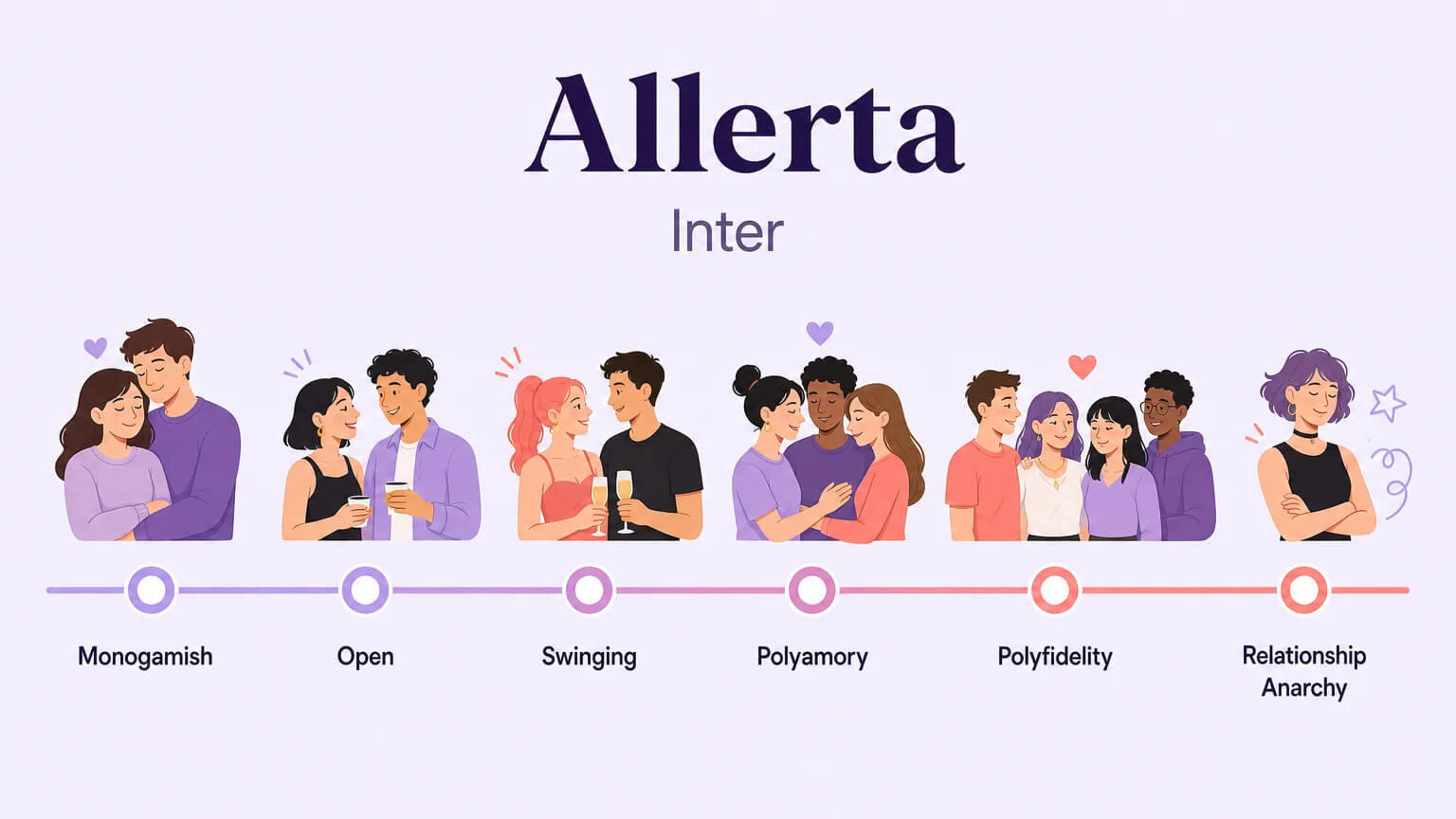
Between strict lifelong monogamy and religious polygyny sits an entire landscape most people have never seen mapped. The non-monogamy spectrum includes monogamish arrangements (mostly closed, occasional exceptions), open relationships (sexual connections only, primary couple intact), swinging (recreational, couple-based, often in social settings), polyamory (multiple romantic relationships, consent-driven), polyfidelity (a closed group of three or more), and relationship anarchy (no hierarchies, each relationship custom-built from scratch). None of these require a temple, a compound, or a legal challenge. They are relationship designs, not marriage structures.
You do not need to memorize the labels. You need to know that the space between “one person forever” and “patriarchal plural marriage” is vast, populated, and increasingly normal. Polygamy is about marriage and is largely illegal in the West under Reynolds v. United States (1879). ENM is about relationship design and is not criminalized. These are not subtle differences. They are different categories of thing.
1. 82% of Human Societies Practiced Polygyny. Here Is Why That Number Misleads You
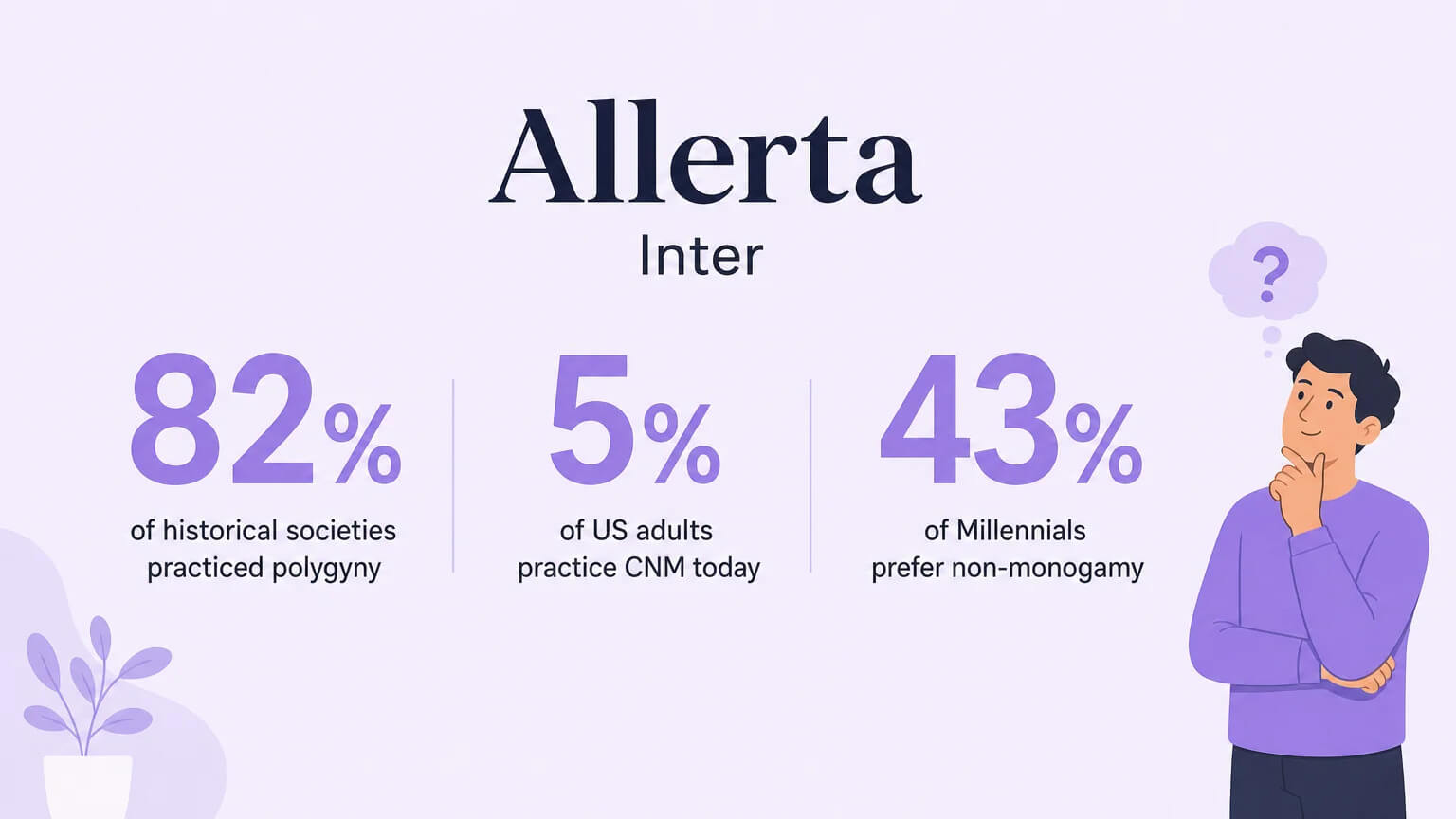
Across 186 societies in the Standard Cross-Cultural Sample, 82% were polygynous (Murdock and White, 1969). That statistic gets deployed in every online argument about monogamy as if it settles something. It does not.
Polygyny in those societies typically meant elite men with resources could support multiple wives. The average person in most of those societies was still in a de facto monogamous pairing. Prevalence at the societal level does not equal prevalence at the individual level, and historical frequency is not the same thing as natural destiny.
The biology is messier than either side wants to admit. Social monogamy, pairing to raise offspring, is not the same as sexual monogamy, mating exclusively with that partner. In socially monogamous bird species, up to 40% of offspring are not fathered by the social partner. Sexual monogamy is rare in nature. Humans are neither obligately monogamous nor obligately polygynous. We are flexible, and culture does most of the heavy lifting.
The number that reframes the entire conversation for a modern reader: 82% of historical societies may have been polygynous, but today about 5% of US adults practice some form of consensual non-monogamy, and 43% of Millennials say they would prefer something other than strict monogamy. The past is not the future. The future is already arriving, and it looks less like a compound and more like three adults trying to sync their Google Calendars.
2. The One Difference That Changes Everything: Consent
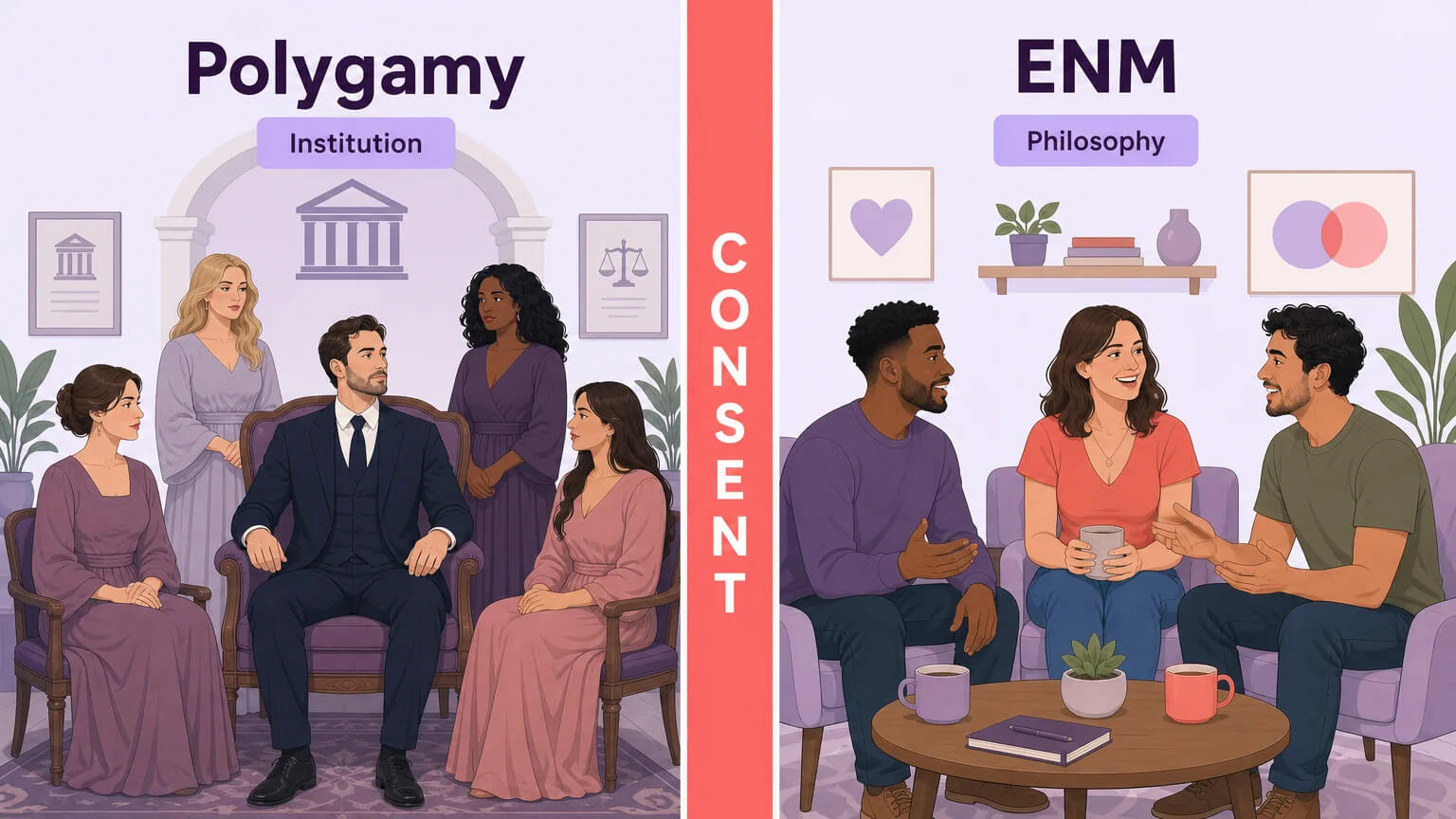
Ethical non-monogamy requires informed, voluntary, and ongoing consent from every person involved. That is not a vibe. It is the structural difference between ENM and the polygamy of religious patriarchies, where women and girls are often assigned rather than choosing.
Dr. Elisabeth Sheff, a sociologist who spent 15 years studying polyamorous families, draws the line directly. In polygyny, women frequently enter arranged marriages as adolescents without being consulted about their wishes. In polyamory, women choose the relationship style as adults with equal access to multiple partners. The impact on women is fundamentally different. The dividing line is not the number of partners. It is who gets to choose.
The legal dimension reinforces the distinction. Polygamy, meaning marriage to multiple people, is illegal throughout the West under Reynolds v. United States (1879). ENM, meaning dating, loving, and living with multiple people without marrying them, is generally not criminalized. Some US cities, including Somerville, Cambridge, and Berkeley, now recognize multi-partner domestic partnerships. The legal architecture is shifting, but polygamy the crime and polyamory the lifestyle remain legally distinct categories. You can date three people in Berkeley without a lawyer. You cannot marry them.
If you hear “polygamy” and picture a fundamentalist compound, you are thinking of one thing. If you hear “ENM” and picture three adults negotiating boundaries over coffee, you are thinking of another. Consent is the bright line between them. Everything that matters flows from that line.
3. Do Non-Monogamous People End Up Happier? The Research Has an Answer That Surprises Everyone
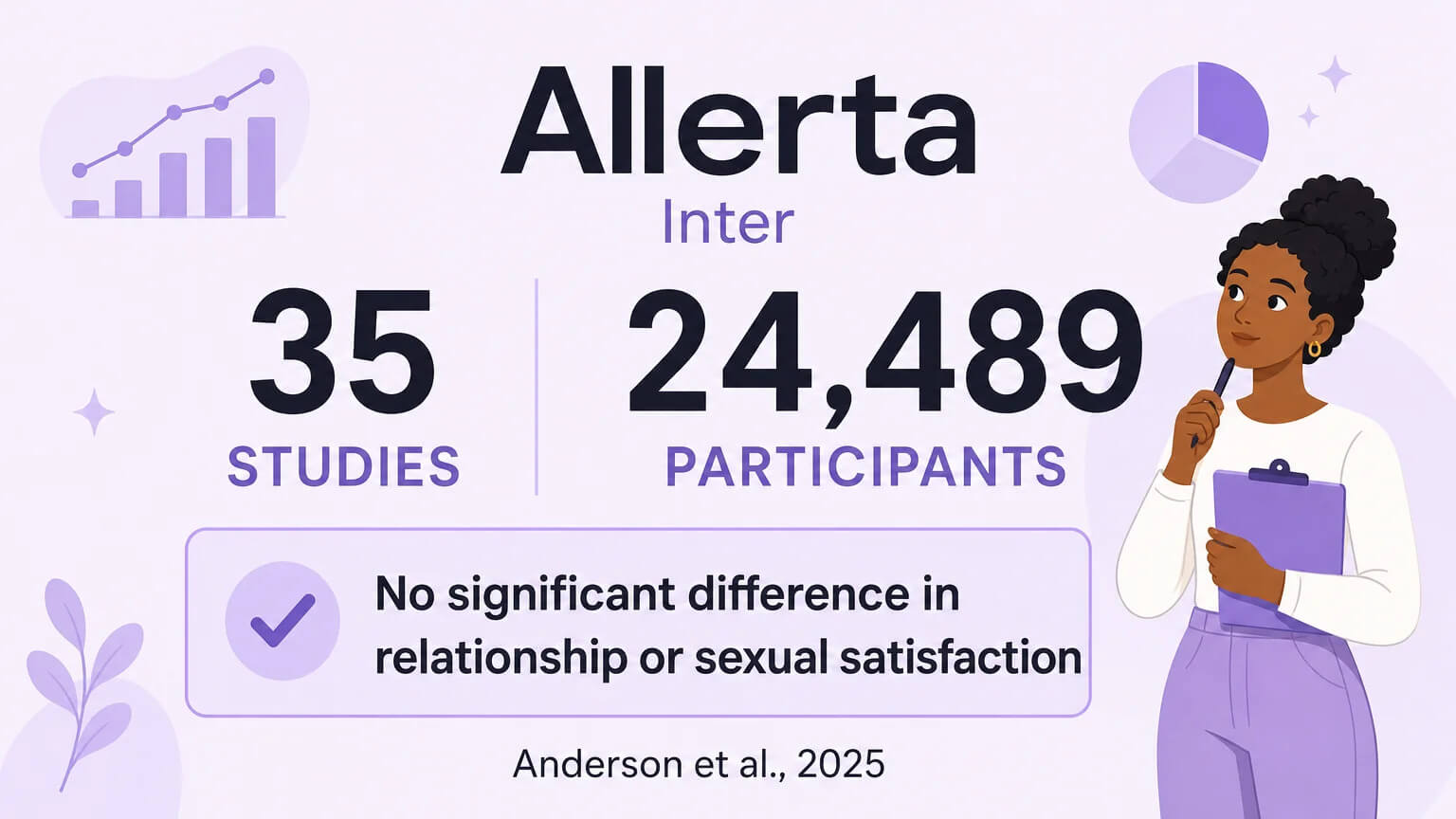
A 2025 meta-analysis published in the Journal of Sex Research examined 35 studies and 24,489 participants. The finding: no significant difference in relationship satisfaction or sexual satisfaction between monogamous and consensually non-monogamous individuals. The researchers coined a term for the assumption they debunked. They called it the “monogamy-superiority myth” (Anderson et al., 2025).
The finding sharpens once you add context. CNM individuals achieve equivalent satisfaction despite facing stigma, discrimination, healthcare bias, and the absence of legal recognition. One in five report stigmatization in healthcare settings. Thirty-seven percent hide their relationship status from providers entirely. That is parity earned the hard way, against structural headwinds that monogamous couples never face.
A second 2025 study, by Morar-Bolba and colleagues, added texture. Among LGBQ individuals, monogamous participants were slightly less satisfied than polyamorous ones. Among heterosexuals, the monogamous group reported lower sexual satisfaction than all CNM groups. The real predictor of satisfaction across every group was not relationship structure. It was communication quality and need fulfillment.
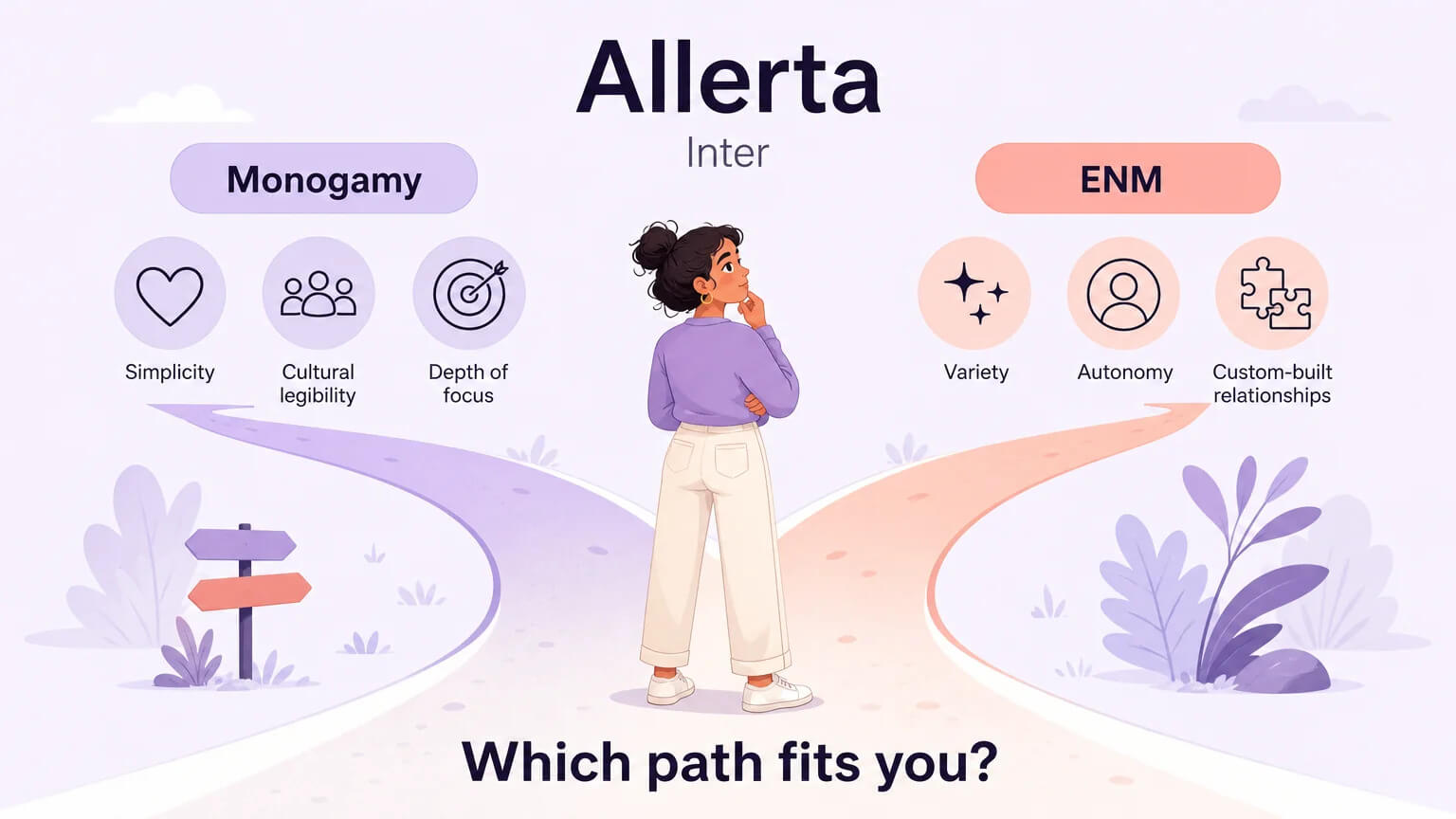
Monogamy offers simplicity, social legibility, legal protection, and the cultural default. CNM offers diverse need fulfillment, sexual variety, and relationships custom-built rather than inherited. The research says neither produces happier people on average. What produces happier people is doing the structure you chose with honesty and skill.
The question worth sitting with is not “which structure is better.” It is “which structure lets you show up as your full self, and are you willing to do the work that structure requires.”
4. Jealousy Happens in Every Relationship. What Changes Is Who Talks About It

“What if they like them more than me?” That exact fear appears in forums, in therapy sessions, and in the 3 a.m. texts people send their partners. It is a fair fear. It deserves a straight answer.
The Morar-Bolba study (2025) delivered an unexpected finding. Monogamous individuals experience fewer jealousy episodes, but when jealousy does hit, they find it more emotionally destabilizing than CNM individuals do. CNM requires building jealousy literacy as a survival skill. You cannot avoid the conversation, so you get better at having it.
Kathy Labriola, author of The Jealousy Workbook, frames jealousy as an emotional signal, not a pathology. Her protocol: pause without acting, name it, explore the root fear, communicate vulnerably, ask for what you need.
Sarah Stroh, a 10-year non-monogamy veteran and author of Monogamaybe?, offers the warning most guides skip: “Jealousy does not just go away even after years. It is a lifelong practice to manage.”
Compersion, the joy of seeing your partner happy with someone else, is a learnable skill, not a personality trait. It does not replace jealousy. It sits alongside it.
In monogamy, you can sometimes avoid the jealousy conversation by avoiding the situations that trigger it. In CNM, you cannot. That is harder. It also means CNM people get more practice at the emotional skills that make any relationship stronger. Jealousy you learn to navigate is jealousy you stop being ruled by.
5. The World Was Designed for Two. Here Is What That Costs

Three people walk into a hotel and are told the room has one king bed. A funeral where your second partner cannot sit with you because “immediate family only.” A work holiday party where you bring one partner and the other waits at home because the invitation said “plus one.”
The world assumes two. Every institution, from hospitals to HR departments to car rental counters, is designed around the couple as the atomic unit of adult life. This is not philosophical. It is practical exhaustion.
The numbers are blunt. One in five CNM individuals face healthcare stigmatization. Thirty-seven percent hide their relationship status from providers entirely. CNM people lack inheritance rights, hospital visitation rights, and parental recognition for multiple partners.
Monogamy gives you a world that understands you without explanation. Your relationship is legible to your grandmother, your boss, and the IRS. That simplicity has genuine value. It is not shallow to want it.
For readers exploring CNM, the practical toolkit includes selective disclosure strategies (tell trusted friends, not conservative family), neutral language for public settings (“close friend” rather than “partner”), separate dating profiles with limited personal info, and private online communities for support.
The tradeoff is stark. Monogamy buys you a world that gets it. Non-monogamy buys you a relationship you actually designed. Neither path is free. The question is which bill you would rather pay.
6. How to Know Which Path Is Yours (Without Blowing Up Your Relationship)
Two different readers land on this section. One is single, wondering if they are polyamorous. The other is coupled, wondering how to bring this up without traumatizing their partner.
For the single reader, Stephanie Sigler, author of The Clinician’s Guide to Ethical Non-Monogamous Relationships, offers one question that cuts through the noise: would you still want non-monogamy even if all your needs were being met in a monogamous relationship? If the answer is yes, you are not just restless. You are oriented differently.
For the coupled reader, UK psychotherapist Katherine Cavallo names the red flags first. Opening up after an affair to “fix” things. Using ENM to avoid ending a relationship. Feeling pressured because “monogamy is too vanilla.” These motivations are, in her words, “bound to be problematic.” Green flags: genuine curiosity, strong existing communication, both partners able to say no comfortably.
The conversation starts with “I” statements: “I have been curious about exploring ethical non-monogamy.” Invite dialogue rather than announce a decision. Plan for multiple conversations over weeks. The ENM community flags the step most couples skip: disentangling. Before adding other partners, build independent hobbies, separate friend groups, and evenings apart. You are adding partners to a full life, not outsourcing your emotional needs.
Therapist Sarah Stuteville warns against rules like “do not fall in love.” When falling in love is framed as a betrayal, it causes more damage than it has to. Build agreements, not cages.
Before you do anything, sit with one question for five minutes. If every relationship structure came with equal social approval, which one would you actually want?
No Structure Wins. But One Structure Wins for You
The 35-study meta-analysis says satisfaction does not depend on structure. The 82% anthropological stat says humans have done every version of this. Every expert from Elisabeth Sheff to Jessica Fern to Kathy Labriola says the same thing in different language: the quality of your communication, the clarity of your consent, and the honesty of your self-awareness matter more than how many people are in the relationship.
Each structure is good at different things. Monogamy excels at simplicity, depth of focus, cultural legibility, and the particular intimacy of one person knowing you completely. ENM excels at diverse need fulfillment, sexual variety, autonomy, and relationships custom-built rather than inherited. One is not better than the other. They solve different problems.
Psychologist Meg-John Barker uses the term “post-monogamy” to describe a world where people choose relationship structures based on what actually works for them, not what they inherited. It sounds radical. It is also, increasingly, what people under 30 already believe. Fifty-one percent view open marriages as morally acceptable, per Pew Research (2023).
You are allowed to want monogamy. You are allowed to want something else. You are allowed to try one thing and discover it is not for you, then try something different. The only wrong answer is the one you never asked yourself honestly.
Desire does not require an apology. It requires the courage to name it, the skill to pursue it ethically, and the honesty to course-correct when something is not working. Those are the same requirements in every relationship structure. What changes is only the shape of the agreement.
FAQs
What is the actual difference between polygamy and polyamory?
Polygamy is a marriage structure, usually religious and patriarchal. Polyamory is a relationship philosophy built on consent, usually egalitarian. The difference is consent and marriage, not partner count.
Is non-monogamy just cheating with nicer language?
No. The defining difference is informed, voluntary consent. Deception and broken agreements make infidelity. ENM is built on transparency and honoring agreements.
Are non-monogamous relationships less satisfying?
No. The 2025 Anderson meta-analysis of 35 studies and 24,489 people found no significant difference in satisfaction. Communication quality predicts outcomes better than relationship structure.
How do I know if non-monogamy is right for me?
Ask yourself: would I still want this if all my needs were being met in a monogamous relationship? Red flags: wanting ENM to fix a broken relationship or after an affair. Green flags: genuine curiosity, strong communication, willingness to do the work.
How do you actually deal with jealousy?
Pause without acting. Name the feeling. Explore the root fear. Communicate vulnerably. Compersion, joy at your partner’s happiness with others, is a learnable skill.
Can a relationship survive when one partner wants non-monogamy and the other does not?
It can when both freely choose without coercion, with excellent communication and slow pacing. If the monogamous partner agrees only from fear of losing the relationship, resentment follows.
What is the difference between swinging, open relationships, and polyamory?
Swinging is recreational and couple-based. Open relationships allow outside sex but not romance. Polyamory involves multiple romantic relationships. Monogamish is mostly monogamous with occasional exceptions.
How do non-monogamous people handle privacy?
Selective disclosure, neutral language in public, separate dating profiles, and clear agreements with all partners about what to share with whom. There is no single right way.