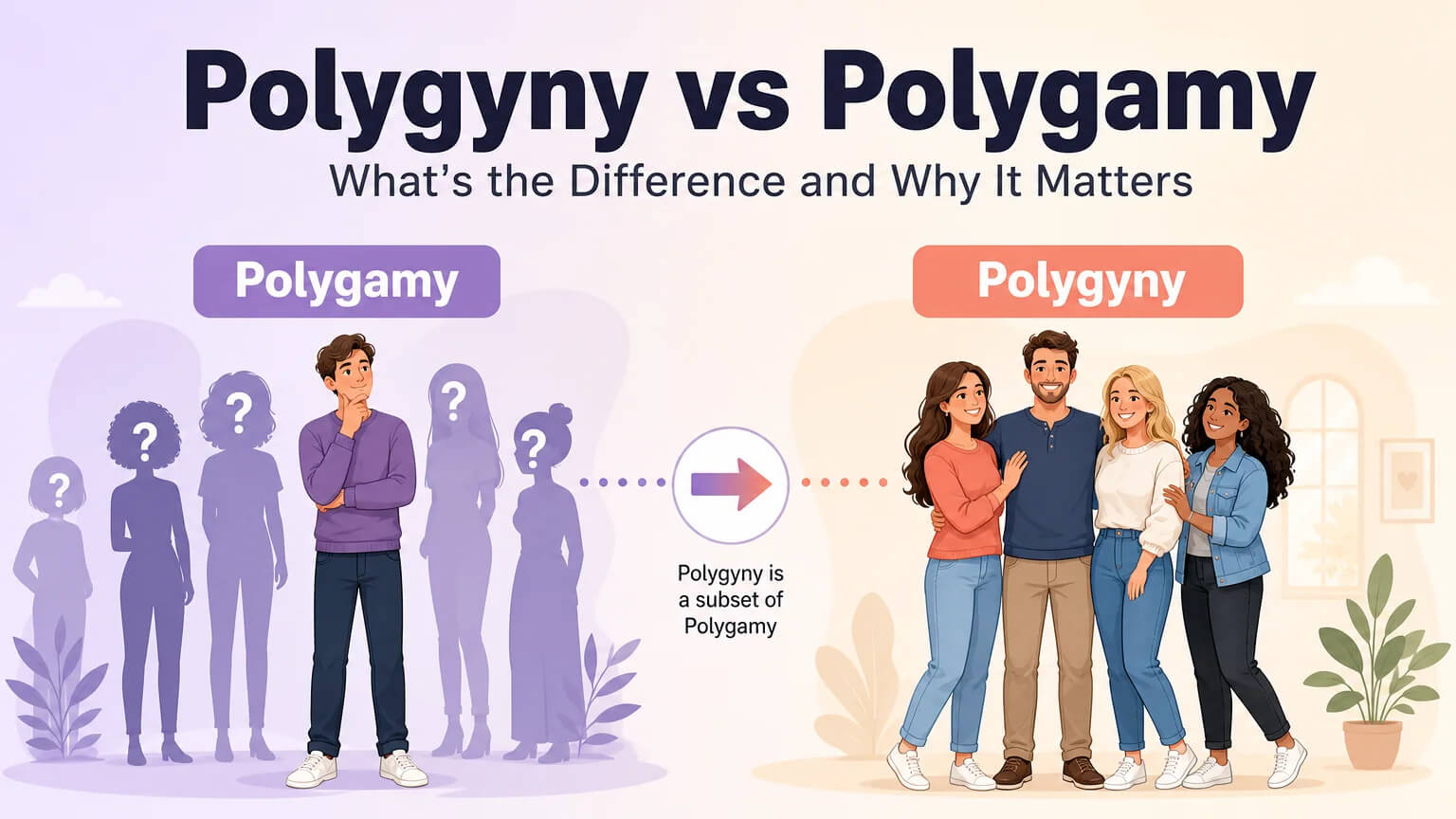
If you have ever called a man with multiple wives a polygamist, you were not wrong. But you were not precise either. The gap between “not wrong” and “precise” is where the confusion starts and where this article ends.
Polygyny vs polygamy is not a debate between two equal competitors. It is a distinction between a category and its most dominant member. Polygamy is the umbrella. Polygyny sits under it, accounting for roughly 85% of every polygamous society ever documented.
When the news reports on a “polygamous sect,” when a documentary profiles a family with one husband and three wives, when religious debates flare about plural marriage, the word everyone reaches for is “polygamy.” Almost every time, they are describing polygyny. Collapsing the two terms erases polyandry, group marriage, and the real diversity of how humans have organized family life across millennia.
What follows is the full terminology hierarchy, then a side-by-side look at polygyny and polygamy across definitions, types, history, religious traditions, legal status, and measured social impact.
The Terminology Hierarchy: Where Polygyny Fits Under Polygamy
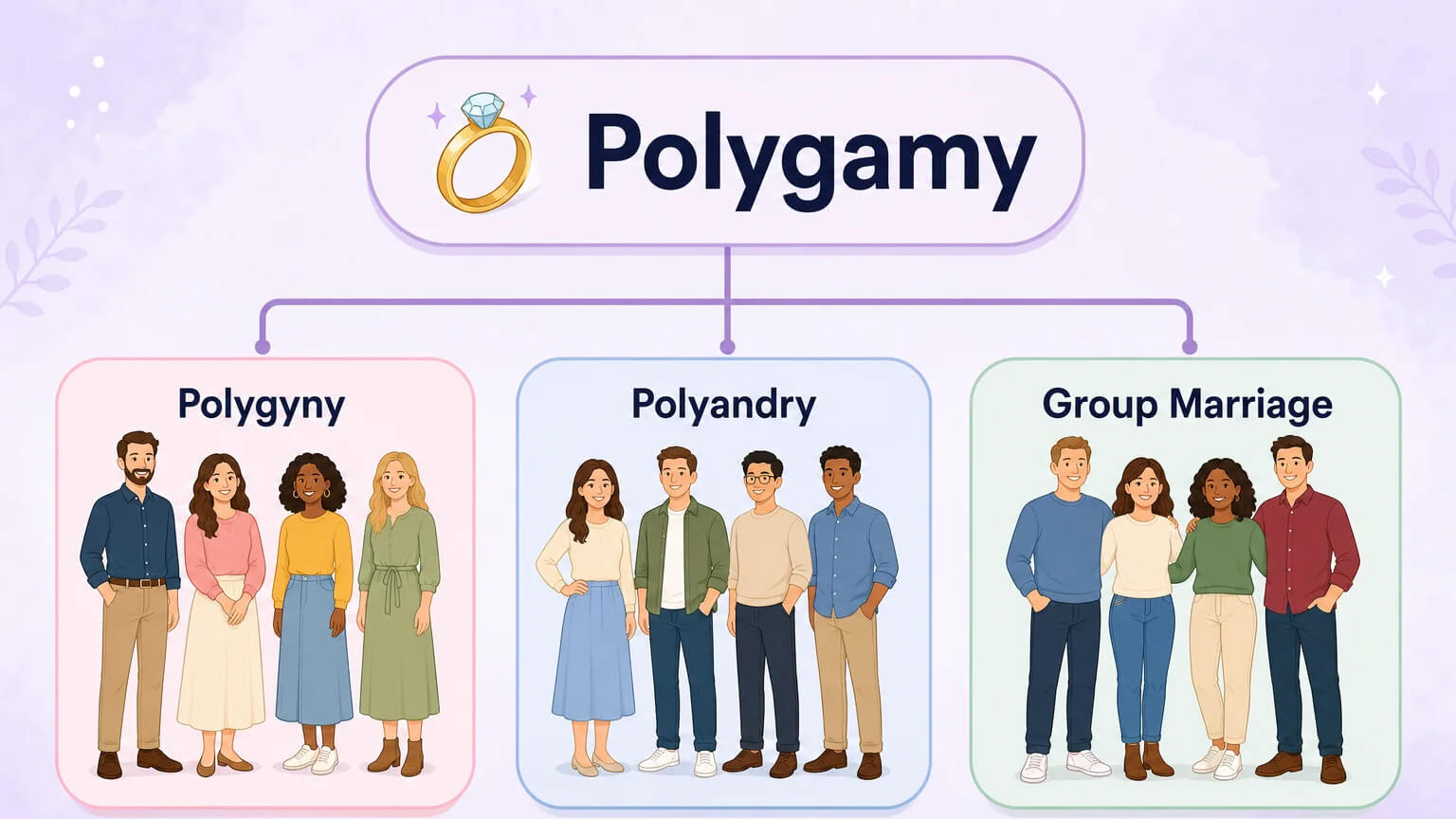
Think of polygamy as the category “vehicle.” Polygyny is a sedan, by far the most common type on the road. Polyandry is a motorcycle with a sidecar: rare, but real. Group marriage is a bus where everyone is in it together. Most people say “vehicle” when they mean “sedan,” and that is exactly how “polygamy” gets used for “polygyny” in everyday speech.
The Greek Roots
The etymology is a memory device. Polygamy comes from polys (many) plus gamos (marriage). It is gender-neutral: it tells you a marriage involves more than two people and nothing about who those people are.
Polygyny comes from polys (many) plus gyne (woman): one man, multiple women. Polyandry comes from polys (many) plus aner or andros (man): one woman, multiple men. Group marriage, sometimes called polygynandry, combines both. If you remember that gyne equals woman, you will never confuse polygyny again.
The Hierarchy in Practice
Why does polygyny dominate the umbrella so thoroughly? The Ethnographic Atlas, George Peter Murdock’s survey of 1,231 societies between 1960 and 1980, provides the answer. Of those societies, 588 practiced frequent polygyny. Another 453 practiced occasional polygyny. Only 186 were strictly monogamous. Just 4 practiced polyandry.
That puts polygyny acceptance at roughly 85% of documented human societies. A 1988 review by anthropologists White and Burton of 849 pre-imperialism societies found 83% accepted polygyny. Polygyny has been the statistical human norm in societies that permit it, not the exception.
Why the Confusion Persists
Because polygyny is so overwhelmingly dominant, the broader term “polygamy” has functionally collapsed into it. News articles about “polygamous sects” are virtually always about polygynous groups, whether Mormon fundamentalists in Utah or Muslim communities in West Africa. Polygyny is a form of polygamy, so this is not incorrect. It is imprecise, and the imprecision erases the other branches of the tree.
1. Definition: What Each Term Actually Means
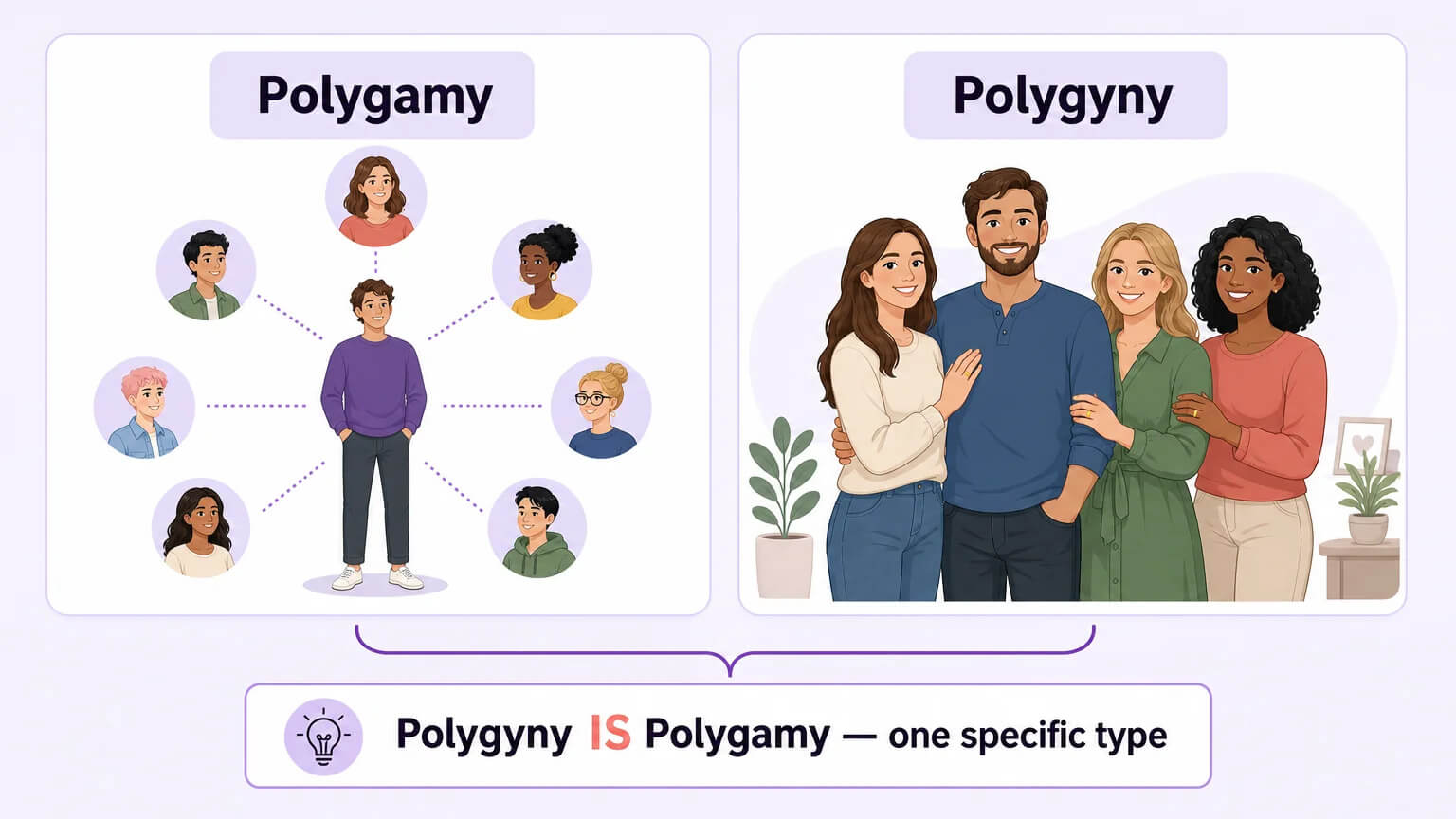
Polygamy: The Umbrella. Polygamy refers to any marriage system where a person has more than one spouse simultaneously. It is gender-neutral. Saying “polygamy” tells you that multiple spouses are involved. It tells you nothing about whether the person with multiple spouses is male, female, or whether everyone is married to everyone else.
Polygamy contains three subtypes: polygyny (one man, multiple women), polyandry (one woman, multiple men), and group marriage (multiple husbands and multiple wives forming a single marital unit). When you use the word polygamy, you name the broader phenomenon without specifying which configuration is at play.
Polygyny: The Specific. Polygyny is the specific form of polygamy where one man is married to multiple women simultaneously. It is the overwhelmingly dominant subtype, practiced in roughly 85% of societies that have ever permitted polygamy, per the Ethnographic Atlas. When someone describes a “polygamous family” with one husband and multiple wives, they are describing polygyny. The word itself gives you the signal: gyne means woman.
The Common Error. In everyday English, people use “polygamy” to mean “polygyny” so consistently that the distinction has nearly collapsed in casual speech. A news report about a “polygamous sect” is virtually always reporting on polygyny specifically. This is not technically incorrect: polygyny is polygamy. But it is like calling every four-door vehicle a “car” when some are trucks. Precision matters when you are trying to understand how different societies organize marriage, inheritance, and family life.
2. Types and Subtypes: The Full Taxonomy of Multiple Marriage
If polygamy were a tree, polygyny would be its thickest branch. Understanding the full taxonomy sharpens the polygyny vs polygamy distinction and reveals why it is not quite the right framing: one is a subset of the other.
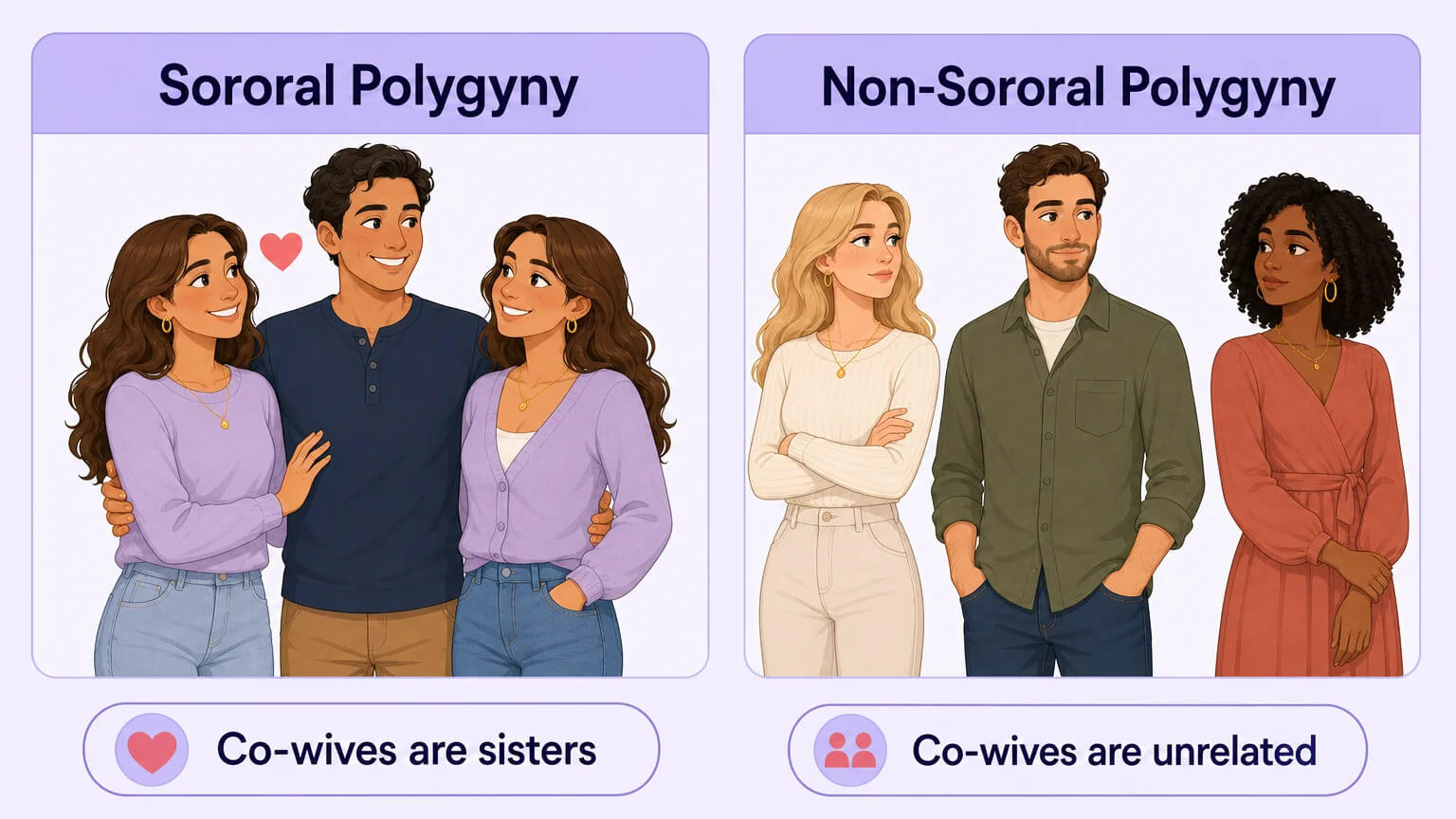
Polygamy’s Three Branches. Polygyny (one man, multiple wives) splits into two critical subtypes: sororal polygyny, where co-wives are sisters, and non-sororal polygyny, where co-wives are unrelated. Polyandry (one woman, multiple husbands) is extremely rare, documented in only about 53 communities worldwide according to Starkweather and Hames’s 2012 research. It is most often fraternal, with brothers sharing a wife, concentrated in Tibet, Nepal, and parts of northern India. Group marriage (multiple husbands and multiple wives) is the rarest form, with few documented historical cases outside small intentional communities.
Sororal vs. Non-Sororal Polygyny. This distinction matters for understanding outcomes. Sororal polygyny has a clear economic logic: property stays consolidated, labor is pooled, and sisters already trust each other. The husband is, as one documentary put it, “pre-screened by blood.” The second sister has watched him treat the first for years before she enters the marriage.
This practice appeared across continents: the Crow of North America, the Nuer of South Sudan, the Maasai of Kenya and Tanzania, Yoruba families in Nigeria, and Fijian and Tongan clans in Polynesia. The Bible records the most famous example: Jacob married sisters Leah and Rachel in Genesis 29 and 30.
Non-sororal polygyny, where co-wives enter as strangers, is far more common today and carries significantly higher conflict risk. Co-wife jealousy is one of the most consistently documented negative outcomes in the research literature.
Why Polyandry Is So Rare. Genetic evidence from the 1000 Genomes Project (Musharoff et al., 2019) classifies humans as “mildly polygynous.” The average prehistoric man with modern descendants had children with 1.5 to 3.3 women, depending on the era. Polyandry runs against this pattern and typically only emerges under extreme ecological pressure: severe land scarcity and high-altitude environments where inheritance fragmentation would be catastrophic.
Polygamy is the whole tree. Polygyny is one branch. The next question is how common each branch actually is.
3. Historical and Cultural Prevalence: By the Numbers
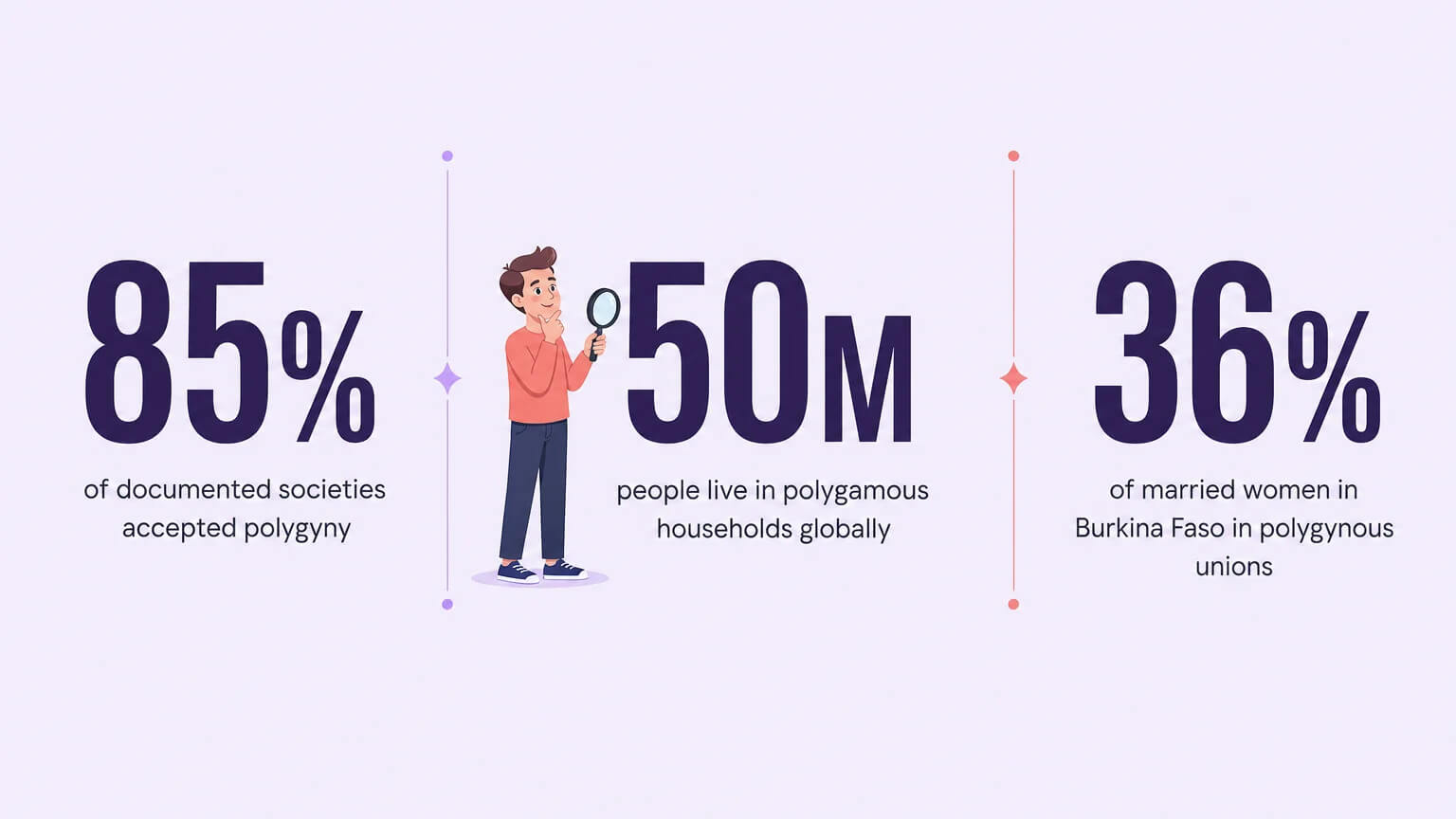
When anthropologists looked at 1,231 societies across human history, one pattern was clear. Polygyny was not the exception. It was close to the rule.
The Big Numbers. Murdock’s Ethnographic Atlas remains the reference dataset. Of 1,231 societies surveyed between 1960 and 1980, 588 practiced frequent polygyny and 453 practiced occasional polygyny. Only 186 were monogamous. Just 4 were polyandrous. That means roughly 85% of documented societies accepted some form of polygyny. White and Burton’s 1988 review of 849 pre-imperialism societies confirmed the pattern, finding 83% accepted polygyny. Among societies that permit it, polygyny has been the statistical human norm. Monogamy is the historical outlier.
The Polygamy Belt. Polygyny concentrates in what researchers call the “polygamy belt” stretching across West and Central Africa. Pew Research Center data from 2019 shows 11% of sub-Saharan Africa’s population lives in polygamous households. Country-level rates: Burkina Faso at 36% of married women in polygynous unions, Mali at 34%, Senegal at 35.3%, Nigeria at 28%, Gambia at 30%.
Religion stratifies these numbers. Within the region, 25% of Muslims live in polygamous arrangements versus only 3% of Christians, though historian Habeeb Akande notes a striking exception: in Chad, Christians at 21% outpace Muslims at 10%. An estimated 50 million people globally live in polygamous households (2020 UN Population Division).
The Genetic Record and Decline. Musharoff and colleagues, analyzing the 1000 Genomes Project in 2019, found that the average prehistoric man with modern descendants had children with 1.5 women roughly 70,000 years ago, rising to 3.3 women about 45,000 years ago. Reproductive monogamy increased only in the last 5,000 to 10,000 years, coinciding with the Neolithic agricultural revolution and settled property systems.
The trend line is now unmistakably downward. Urbanization, female education, and legal reforms all correlate with lower polygyny rates. Morocco’s 2004 reforms requiring court permission reduced polygyny by roughly 50%. In Nigeria, 37% of uneducated women are in polygynous marriages versus significantly lower rates among educated women. The practice persists in rural areas and conservative religious communities, but the direction is clear.
The numbers answer “how common.” They do not answer “why.”
4. Religious Frameworks: Permission, Regulation, and Prohibition
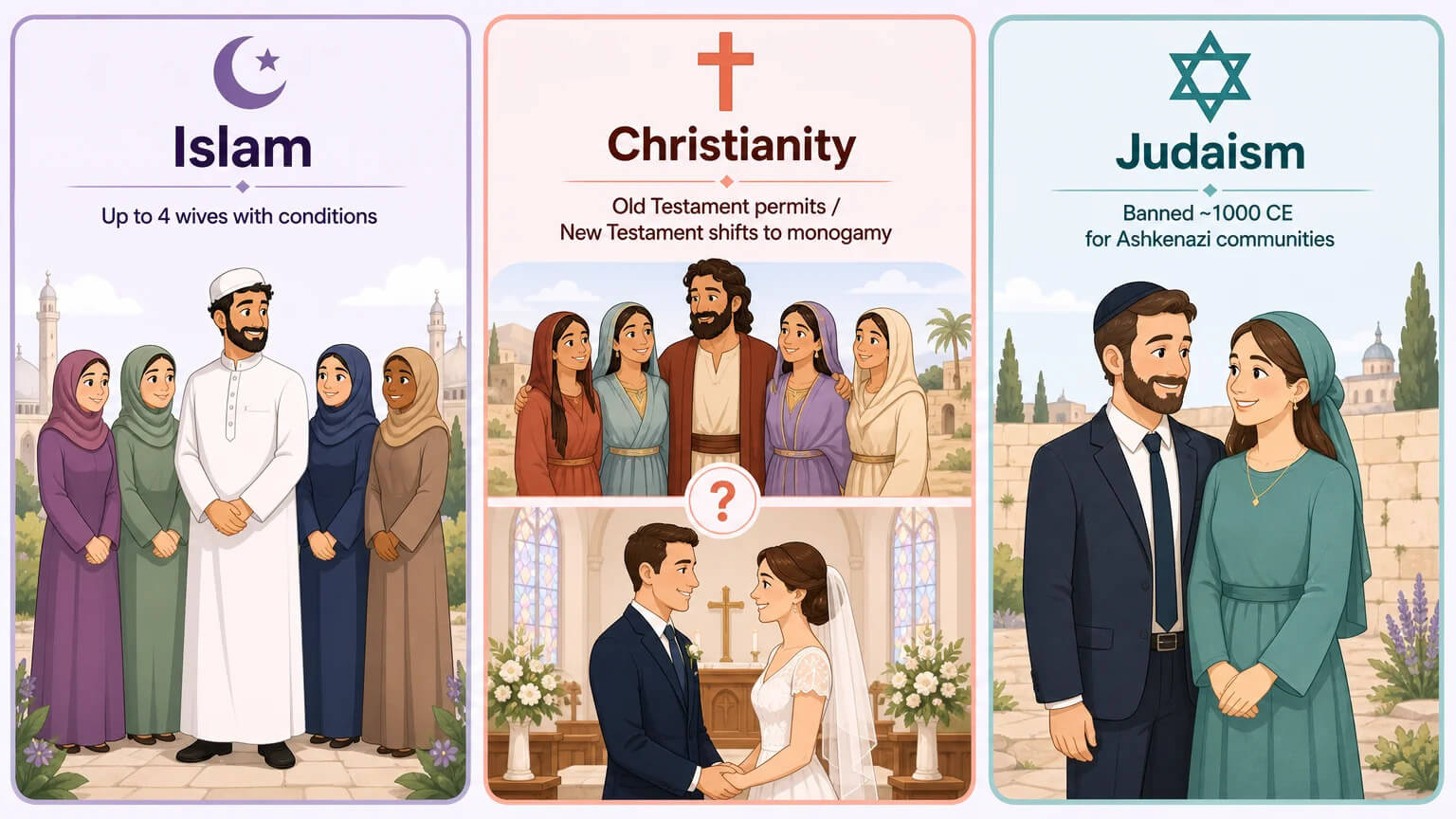
If you want to start an argument in a theology classroom, ask whether the Bible permits polygamy. The answer depends entirely on which chapter you are reading and which century you are in.
Islam: Permission, Not Command. The Quran, Surah An-Nisa 4:3, permits a Muslim man up to four wives, provided he treats them justly. Quran 4:129 then acknowledges that perfect justice between wives is impossible in matters of the heart.
The conditions: financial capability to support multiple wives and all resulting children, equal material provision including food, clothing, and lodging, and equal division of time with rotating nights. In many modern Muslim-majority countries, consent from the existing wife and court permission are required on top of the religious conditions.
Islam regulated and confined pre-existing Arabian polygyny; it did not create it. Converts with more than four wives were instructed to keep four and divorce the rest. Polyandry is explicitly forbidden for Muslim women. Several Muslim-majority countries ban polygyny entirely: Turkey since 1926, Tunisia since 1956, Albania, Kosovo, Azerbaijan, and multiple Central Asian republics. Kuwait stands alone with no legal limits on polygyny.
Christianity: A House Divided. The Old Testament describes polygynous patriarchs without explicit condemnation. Abraham, Jacob, David, and Solomon all had multiple wives. Exodus 21:10 and Deuteronomy 21:15-17 regulate polygynous households without prohibiting them.
The New Testament shifts the frame. Genesis 2:24, “the two shall become one flesh,” is cited by Jesus in Matthew 19 as God’s original design. First Timothy 3:2 and Titus 1:6 require church leaders to be “husbands of one wife.” Ephesians 5 frames marriage as Christ, one groom, and the church, one bride.
Modern Christianity spans the full spectrum. Most denominations teach monogamy. Some African Anglican churches, per the 1988 Lambeth Conference, allow polygynous converts to retain existing wives. Mormon fundamentalists, estimated at 30,000 to 50,000 in the United States, continue plural marriage based on 19th-century teachings, though the mainstream LDS Church abandoned the practice between 1890 and 1910.
The internal Christian conflict surfaced vividly in a public debate between Pastor Rich Tidwell of Canton, Missouri, who has two wives and argues polygyny is biblically permitted because “God never prohibited it,” and commentator Chad Prather, who counters that Old Testament polygamy is “a record of what happened, not a record of what was right.” Prather notes every biblical polygamous household descended into chaos: Abraham and Hagar produced centuries of conflict, Jacob’s wives were locked in bitter rivalry, David’s household erupted in political chaos, and Solomon’s thousand wives led him into idolatry.
Other Traditions. Hinduism has been traditionally monogamous, though polygyny existed among royalty. Judaism permitted polygyny in the Torah but banned it by Rabbinic decree around 1000 CE for Ashkenazi communities. African traditional religions are often polygyny-accepting, with Pew data showing 45% polygyny rates among folk religion practitioners in Burkina Faso.
5. Legal Status: Where Polygyny Is Permitted, Banned, and Practiced Anyway
Polygyny is legal in over 50 countries. It is practiced in many more where it is not.
The Global Legal Map. Polygyny is permitted in more than 50 countries, overwhelmingly Muslim-majority states operating under Sharia law frameworks. It is illegal in over 165 countries. Where legal, conditions typically apply: consent from the existing wife, proof of financial capacity, and court permission. Kuwait stands alone among Muslim-majority countries with no legal limits. The counter-trend: Turkey banned polygyny in 1926, Tunisia in 1956, and Morocco’s 2004 Moudawana reforms reduced polygyny rates by 50%.
The United States: Illegal but Practiced. Polygamy is unlawful in all 50 states. Bigamy is a felony in 49. The Supreme Court upheld polygamy bans in Reynolds v. United States in 1878, ruling religious freedom does not protect the practice. The Edmunds Act of 1882 further criminalized it. Utah reduced penalties for consensual adult polygamy from a felony to an infraction in 2020, following the 2013 Brown v. Buhman decision. It remains unlawful.
Despite this, an estimated 30,000 to 50,000 fundamentalist Mormons practice polygyny through religious-only ceremonies without civil marriage licenses, concentrated in Utah, Arizona, and surrounding states.
Britain: The Nikah Loophole. An estimated 20,000 polygamous Muslim families live in Britain despite civil illegality. The mechanism: a man legally marries one wife under British law, then conducts additional religious-only nikah ceremonies. Secondary wives have zero legal protections, no inheritance rights, no benefits, no custody standing.
One East London marriage bureau documented in a British television investigation has over 50,000 clients. An estimated 15,000 to 20,000 are divorced women in their 30s and 40s increasingly considering co-wife status as a solution to the “marriage squeeze.” The bureau operator, Mizan Raja, estimates that 80% of men seeking polygyny are driven by sexual motivation rather than religious duty.
The Gray Zone. Commentator Michael Katide frames it plainly: “Divorce is more expensive than polygyny. In any case, divorce and remarriage is serial polygamy.” Societies that formally ban simultaneous polygyny often permit successive polygyny through divorce and remarriage, blurring the legal bright line.
6. Real-World Impact: What the Data Says About Outcomes

“Out of 10 years, I could honestly say, being very generous, I’ve probably had 6 months of time with me and him.”
Shaheen Qureshi, a co-wife profiled in a British documentary, said that in a single sentence. Her daughter added: “For my mom, being a co-wife is really really hard, especially when the husband doesn’t support her.” That is not theory. But the full picture is more complex than any single story.
When Polygyny Works. In societies where women have limited economic opportunities, polygyny provides widows, divorced women, and orphans with husbands and financial support. This is the explicit Islamic rationale: the four-wife limit is historically linked to the aftermath of the Battle of Uhud, which left many Muslim widows and orphans without provision.
Sororal polygyny carries built-in stability. When co-wives are sisters, trust is pre-existing, childcare is shared, and property stays consolidated. One documentary frames it directly: “Who would you rather share your house with every day? A stranger who might hate you, or your own sister who thinks like you do?”
In the minority of polygynous households where fathers maintain genuine fairness, children can benefit from larger support networks. A 2025 study in the Journal of Development and Social Sciences found a small subset of respondents reporting positive experiences when fairness was consistently maintained.
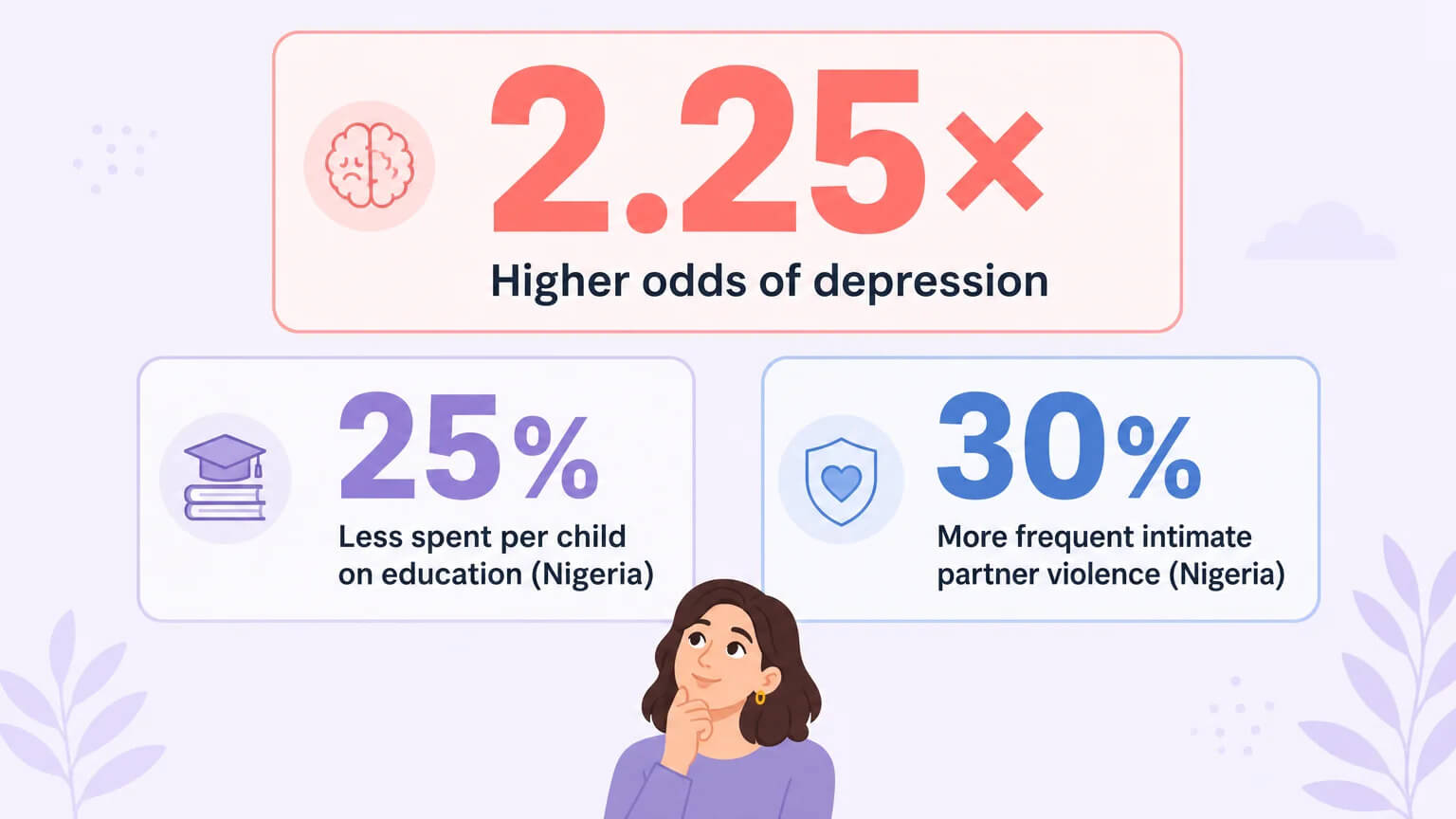
The Measured Costs. The evidence against polygyny is substantial. A meta-analysis of 24 studies with roughly 7,500 participants, published in BMC Pregnancy and Childbirth, found women in polygynous marriages face 2.25 times higher odds of depression, plus elevated anxiety, hostility, somatization, paranoia, and low self-esteem.
A 2024 qualitative study from Pakistan documented the texture behind the statistics: women reported “jealousy and insecurity among co-wives,” “depression and low self-esteem, deep sadness, hopelessness, and emotional distress,” and “social withdrawal and loneliness.”
Children carry their own burden. The JDSS 2025 study found children describing fathers as “distant, absent, or favoring the second family,” with communication “infrequent and mostly motivated by need.” Some children were forced to work. Education was cut short.
Economic and health data reinforce the pattern. DHS surveys across Africa show 25% less spent per child on education in Nigeria, 15% lower household savings in Mali, 20% higher poverty in Senegal, and 18% higher food insecurity in Uganda. Health outcomes track the same direction: HIV prevalence 2.5 times higher in Ugandan polygynous households (12% versus 5%), under-five child mortality 25% higher in Burkina Faso, intimate partner violence 30% more frequent in Nigeria, and maternal mortality 1.5 times higher in Chad.
Hassan Phillips, a British man with three wives, describes the emotional logistics: “You can’t just relax. You have to kind of be very careful. Don’t joke too much with her without joking with her. Don’t over show your emotion to one of them.” He calls it “spinning plates. You cannot let one topple and fall off.”
The Moderation Factor. The JDSS 2025 study found that when fathers maintain genuine fairness and harmony, both maternal and child outcomes improve significantly. This does not erase the structural tensions. Anthropologist Jack Goody’s 1973 framing captures the root issue: “The reasons behind polygyny are sexual and reproductive rather than economic and productive.” Fairness can ease the friction. It cannot remove it.
The Bottom Line: Polygyny vs Polygamy and When Precision Matters
Polygamy is the umbrella: any marriage with more than two spouses. Polygyny is the specific: one husband, multiple wives. About 85% of societies that have ever practiced polygamy practiced polygyny specifically, which is why the terms collapsed in everyday use. That collapse erases real diversity: polyandry in the Himalayas, group marriage in rare intentional communities, and the important distinction between sororal and non-sororal polygyny.
Three contexts need the precision of “polygyny” over “polygamy.”
First, academic or research writing. The distinction is not optional. Second, legal and policy discussions. Laws banning “polygamy” almost always target polygyny specifically, and imprecise language can create unintended consequences for other relationship structures. Third, religious and cultural debate. Islamic polygyny, Mormon polygyny, and African customary polygyny operate under fundamentally different frameworks and produce different outcomes. Calling all three “polygamy” flattens those differences.
In casual conversation, saying “polygamy” to mean “polygyny” is normal and generally understood. You are not wrong, just imprecise. The person who corrects you at a dinner party probably needs the dinner party more than you do.
Polygyny rates are declining globally. Urbanization, female education, and legal reform drive the trend. Morocco cut rates in half with court-permission requirements. Turkey and Tunisia banned the practice outright. Even in high-prevalence countries, younger, urban, educated populations show significantly lower rates. The practice persists where poverty, tradition, and religious interpretation intersect.
The distinction between polygamy and polygyny matters because it is the first step toward understanding one of the most fundamental ways human societies have organized family life. Now you know the difference.
FAQ
What is the difference between polygamy and polygyny?
Polygamy is the umbrella term for any marriage involving more than two spouses. It is gender-neutral. Polygyny is the specific subtype where one man is married to multiple women. Since roughly 85% of polygamous societies practice polygyny, people often say “polygamy” when they mean “polygyny.” Think of it as “vehicle” versus “sedan”: one is the category, the other is the most common type.
How many wives can a Muslim man have?
Up to four wives simultaneously, based on Quran 4:3. This is a conditional permission, not a command. The man must treat all wives equally in financial support, housing, and time allocation. Quran 4:129 acknowledges that perfect emotional equality is impossible. If a man fears he cannot be just, the Quran instructs him to marry only one. Most Muslim-majority countries add legal conditions such as first-wife consent and court permission.
What is the difference between polygyny and polyandry?
Polygyny is one man married to multiple women, the most common form, practiced in roughly 85% of polygamous societies. Polyandry is one woman married to multiple men, extremely rare, documented in only about 53 communities worldwide (Starkweather and Hames, 2012). Polyandry is most often fraternal, with brothers sharing a wife, found in Tibet, Nepal, and northern India where severe land scarcity makes inheritance fragmentation impossible.
Where is polygyny most common today?
The polygamy belt across West and Central Africa holds the highest prevalence: Burkina Faso at 36% of married women, Mali at 34%, Senegal at 35.3%, Nigeria at 28%, Gambia at 30%. Sub-Saharan Africa overall sits at 11% of the population. Outside Africa, lower rates exist in parts of the Middle East, South Asia, and among Mormon fundamentalist communities in North America. Globally, roughly 50 million people live in polygamous households.
Is polygyny legal in the United States?
No. Polygamy, including polygyny, is illegal in all 50 states. Bigamy is a felony in 49 states. The Supreme Court upheld these bans in Reynolds v. United States in 1878, ruling religious freedom does not protect the practice. Utah reduced penalties for consensual adult polygamy to an infraction in 2020. Despite this, an estimated 30,000 to 50,000 people, mostly Mormon fundamentalists, practice polygyny through religious-only ceremonies.
What does the Bible say about polygamy?
The Old Testament describes polygynous figures like Abraham, Jacob, David, and Solomon without explicit condemnation and provides regulations for polygynous households. The New Testament sets monogamy as the standard for church leaders in 1 Timothy 3:2 and Titus 1:6. Jesus references Genesis 2:24, “the two shall become one flesh,” as God’s original design. Most Christian denominations teach monogamy. A minority of African churches and Mormon fundamentalist groups permit or practice polygyny.
What are the effects of polygyny on women and children?
Women in polygynous marriages face 2.25 times higher odds of depression, based on a meta-analysis of 24 studies with roughly 7,500 participants. They also report higher anxiety, hostility, and low self-esteem. Children report strained father relationships, lower academic achievement, and higher anxiety. Economic data shows 25% less spent per child on education in Nigeria and 15% lower household savings in Mali. Outcomes improve significantly when fathers maintain genuine fairness.
Is polygyny declining worldwide?
Yes. Urbanization, female education, legal reforms, and economic development all correlate with lower polygyny rates. Morocco’s 2004 reforms requiring court permission reduced rates by roughly 50%. Turkey and Tunisia banned it entirely. Even in high-prevalence countries, younger, urban, and more educated populations show significantly lower rates. The trend is unmistakably downward, though polygyny persists in rural areas and conservative religious communities.