Roughly 58 countries legally recognize polygamous marriage, covering about 2% of the global population. In the rest of the world, asking is polygamy legal returns a straightforward no. It is a crime in the United States, Canada, and nearly all of Europe.
What the statutes say and what actually happens are different things. Religious tradition sustains polygamy across West and Central Africa, where 11% of households practice it and rates pass 25% in parts of the Sahel. It is banned across the Western world, yet prosecutions are vanishingly rare. The gap between written law and enforced law is wide enough to live in.
Polygamy means multiple marriages, typically one man, multiple wives. Polyamory means multiple romantic relationships without marriage. This article covers the legal status of polygamy.
This piece walks through where polygamy is legal, where it is banned, the religious and colonial forces behind those laws, what enforcement looks like on the ground, and where the trend lines point.
1. The Short Answer: Where Polygamy Is Illegal
Polygamy is illegal in the United States, Canada, the United Kingdom, Australia, and all of Europe. The prohibition traces to 19th-century statutes, a landmark Supreme Court case, and a recent carve-out in Utah.
The ban covers all 50 states. Its origin is the Morrill Anti-Bigamy Act of 1862, which targeted Mormon plural marriage in the Utah Territory. The Edmunds Act of 1882 made it a felony and stripped polygamists of voting rights and eligibility for public office. In Reynolds v. United States (1879), the Supreme Court ruled that religious duty is no defense against prosecution. Marriage is a civil contract, not a free exercise of religion.
Canada’s Criminal Code Section 293 makes polygamy an indictable offense punishable by up to five years. The most famous conviction came in 2017: Winston Blackmore, a leader in the fundamentalist Mormon community of Bountiful, British Columbia. His sentence was house arrest. Even where the law is unambiguous, the punishment rarely involves a jail cell.
The United Kingdom presents a wrinkle. Polygamy is illegal within the UK, but the country may recognize foreign polygamous marriages for welfare and pension purposes. The Home Office will not grant spouse visas to more than one partner. Australia codified its ban in the Marriage Act of 1961. Across continental Europe, the answer is uniform: prohibited.
One distinction worth keeping straight: polygamy is the practice. Bigamy is the criminal offense of marrying while already legally married. Bigamy laws are what prosecutors actually charge. In 2020, Utah blurred the line. SB 102 reclassified polygamy among consenting adults from a felony to an infraction, roughly equivalent to a traffic ticket. It is still technically illegal, but the state will not prosecute consenting adults. For a country that once sent federal marshals after Mormon polygamists, that is a sharp reversal.
2. The World Map: Where Polygamy IS Legal
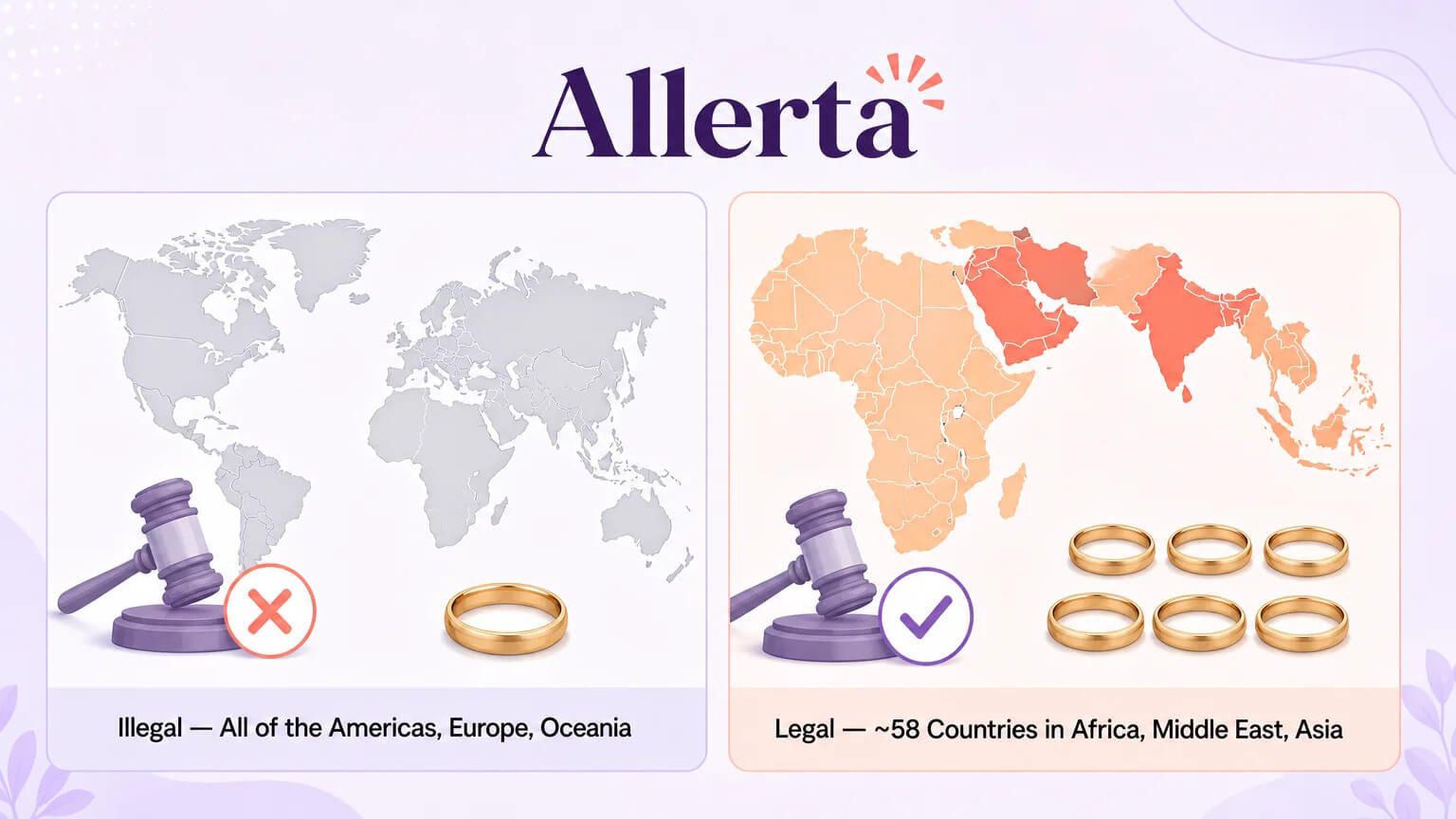
Roughly 58 countries permit polygamous marriage, concentrated in three regions: sub-Saharan Africa, the Middle East and North Africa, and parts of South and Southeast Asia. The distribution follows religious tradition and the survival of customary law through the colonial era.
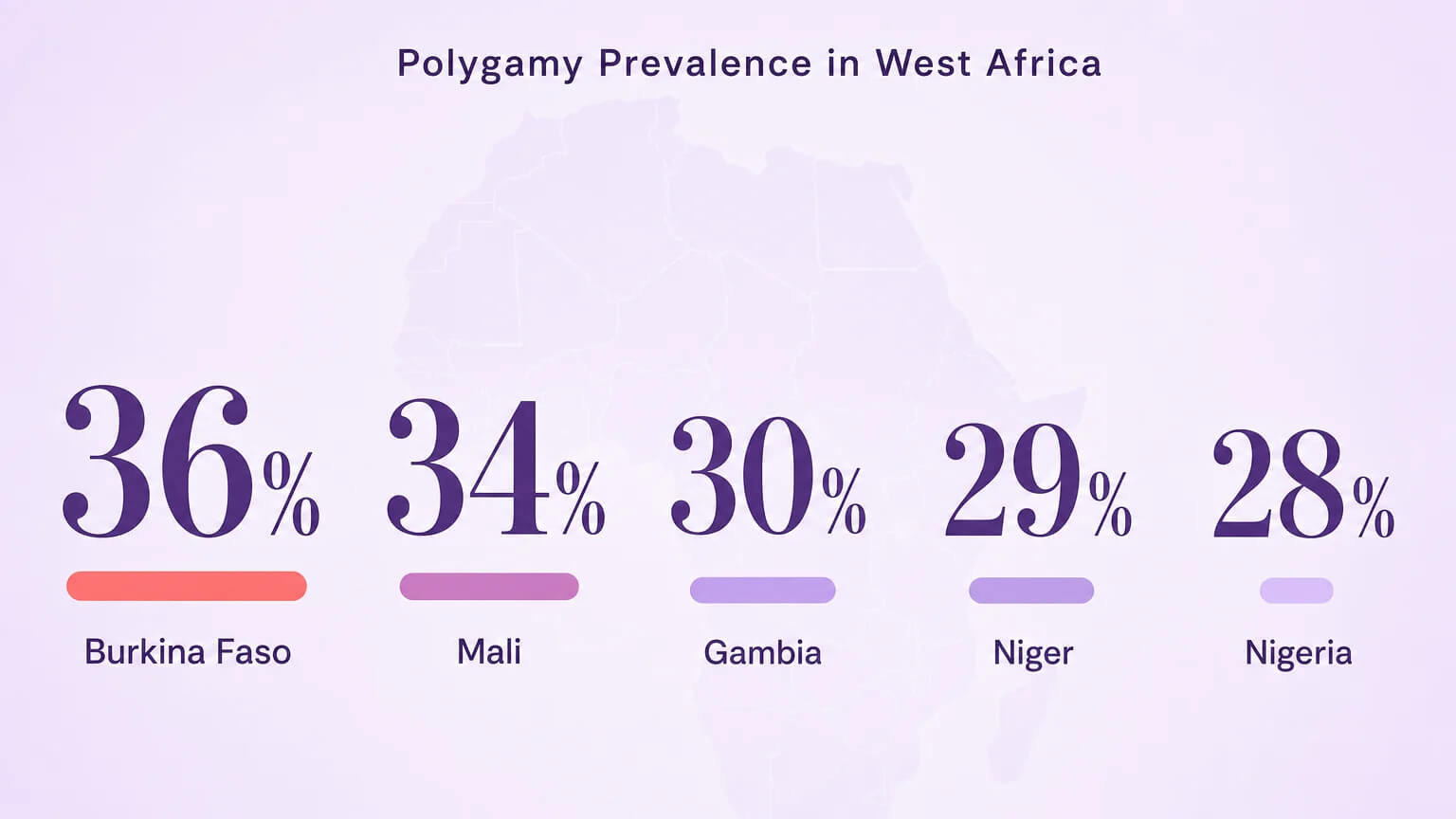
Africa is the global center. Burkina Faso leads at 36% of households. Mali follows at 34%. Gambia sits at 30%, Niger at 29%, and Nigeria at 28%. In parts of West Africa, more than a quarter of married women are in polygynous unions. Prevalence climbs higher in rural areas and among older generations.
Across the Middle East, polygamy is legal in Saudi Arabia, the UAE, Qatar, Oman, and Kuwait. These countries ground family law in Islamic jurisprudence, which permits a man up to four wives under an equal-treatment requirement. Enforcement varies.
In Asia, the picture fragments. Indonesia permits polygamy for its Muslim majority (roughly 87% of the population), with court approval and the existing wife’s consent. Malaysia follows a similar model under Syariah courts. Pakistan and Bangladesh also permit the practice under Islamic personal law.
Two countries stand out. Turkey banned polygamy outright in 1926 under Ataturk’s secularization campaign, replacing Islamic family law with a Swiss-style civil code. Tunisia followed in 1956. They remain the only two Muslim-majority countries to prohibit polygamy entirely.
Many African countries operate a dual legal system. Civil law recognizes only monogamous marriage. Customary law permits polygamy. A man may legally marry one wife under civil law while taking additional wives under customary law. Both are valid within their respective frameworks. Colonial administrations created this duality by codifying customary law while imposing European civil codes, producing parallel tracks that persist today.
3. The Religious Factor: How Faith Shapes Polygamy Law
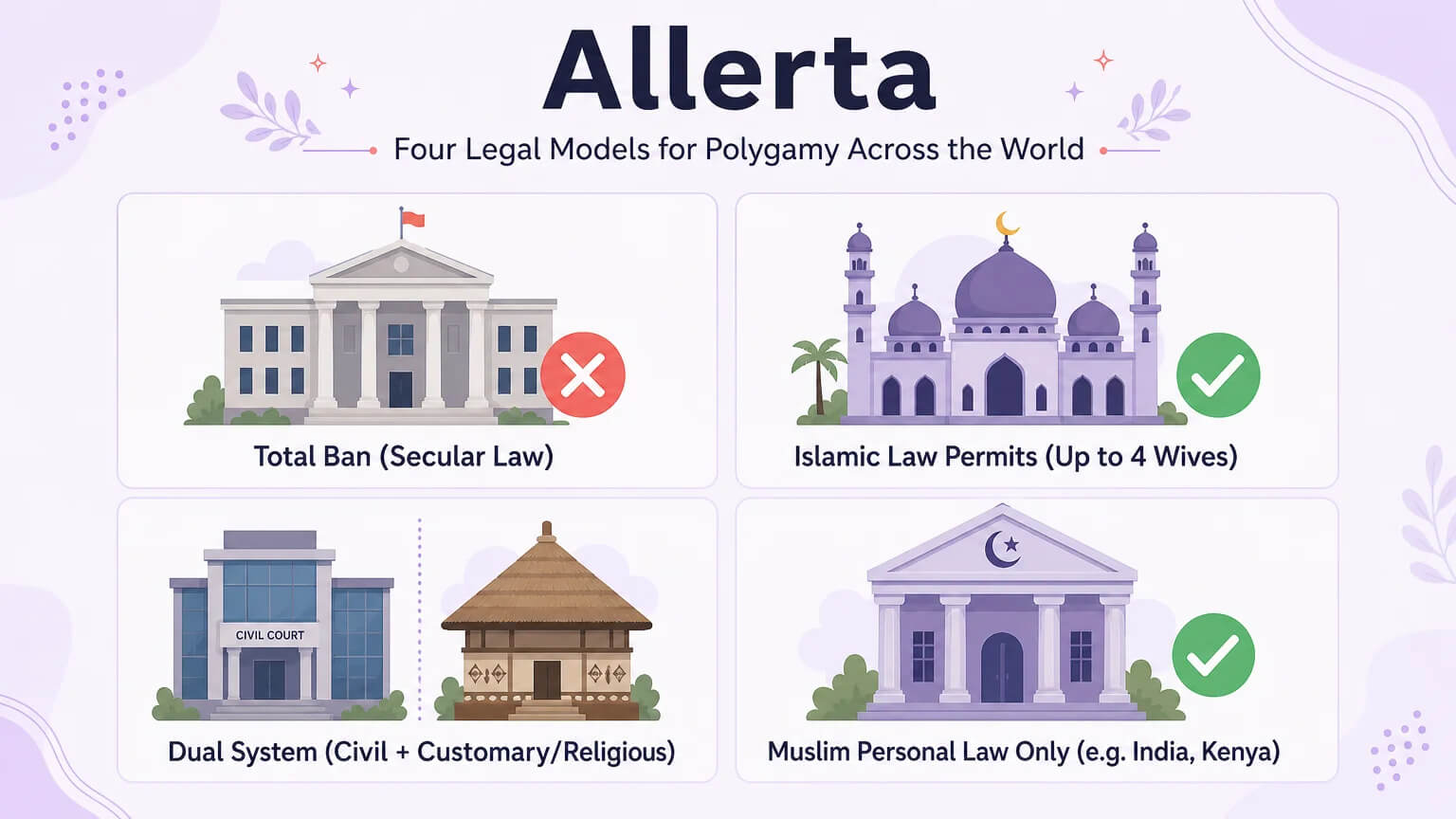
The strongest predictor of polygamy’s legal status is the dominant religion’s stance and whether religious law survived colonialism. Where Islam is the majority religion and Islamic personal law holds authority, polygamy is generally permitted. Where Christianity became dominant and the state absorbed European civil codes, it is banned.
Islamic law provides the most structured framework. The Quran permits up to four wives, conditioned on equal treatment in finances, time, and living arrangements. Most Muslim-majority countries embed this directly in family law. Saudi Arabia leaves enforcement to family dynamics. Morocco’s 2004 reforms made polygamy legally possible but practically difficult through judicial oversight.
India’s legal landscape is fragmented along religious lines. For Hindus, Buddhists, Jains, and Sikhs, polygamy is criminal under the Hindu Marriage Act of 1955. For Muslims, up to four wives are permitted under the 1937 Muslim Personal Law. This dual system is under pressure: Uttarakhand implemented a Uniform Civil Code in 2024, Assam followed in 2025, both replacing religion-specific personal laws with a single civil framework.
Kenya offers another model: Article 170 of its 2010 Constitution establishes Kadhi courts with jurisdiction over Muslim personal law, including marriage. They operate alongside civil courts. The arrangement draws criticism but functions. Israel bans polygamy for the Jewish majority but rarely enforces the law against the Bedouin Muslim minority.
Mormonism occupies a unique place. The LDS Church abandoned polygamy in 1890 as a condition of Utah’s statehood and excommunicates practitioners today. Fundamentalist sects continue the practice in isolated communities across Utah, Arizona, and British Columbia. Buddhism varies by country: Thailand and Sri Lanka prohibit it; Bhutan and Myanmar permit it. Hinduism historically permitted polygamy among elites, but virtually all Hindu-majority countries now ban it.
The pattern is consistent. Where religion and state separated, or European civil codes took hold, polygamy is banned. Where religious law survived colonization, it is generally permitted.
4. Why the West Banned Polygamy: A History in Two Acts
Polygamy was not always illegal in the West. In fact, 93% of societies in the anthropological record have recognized polygyny. The Western prohibition is a historical outlier, and its origin is traceable.
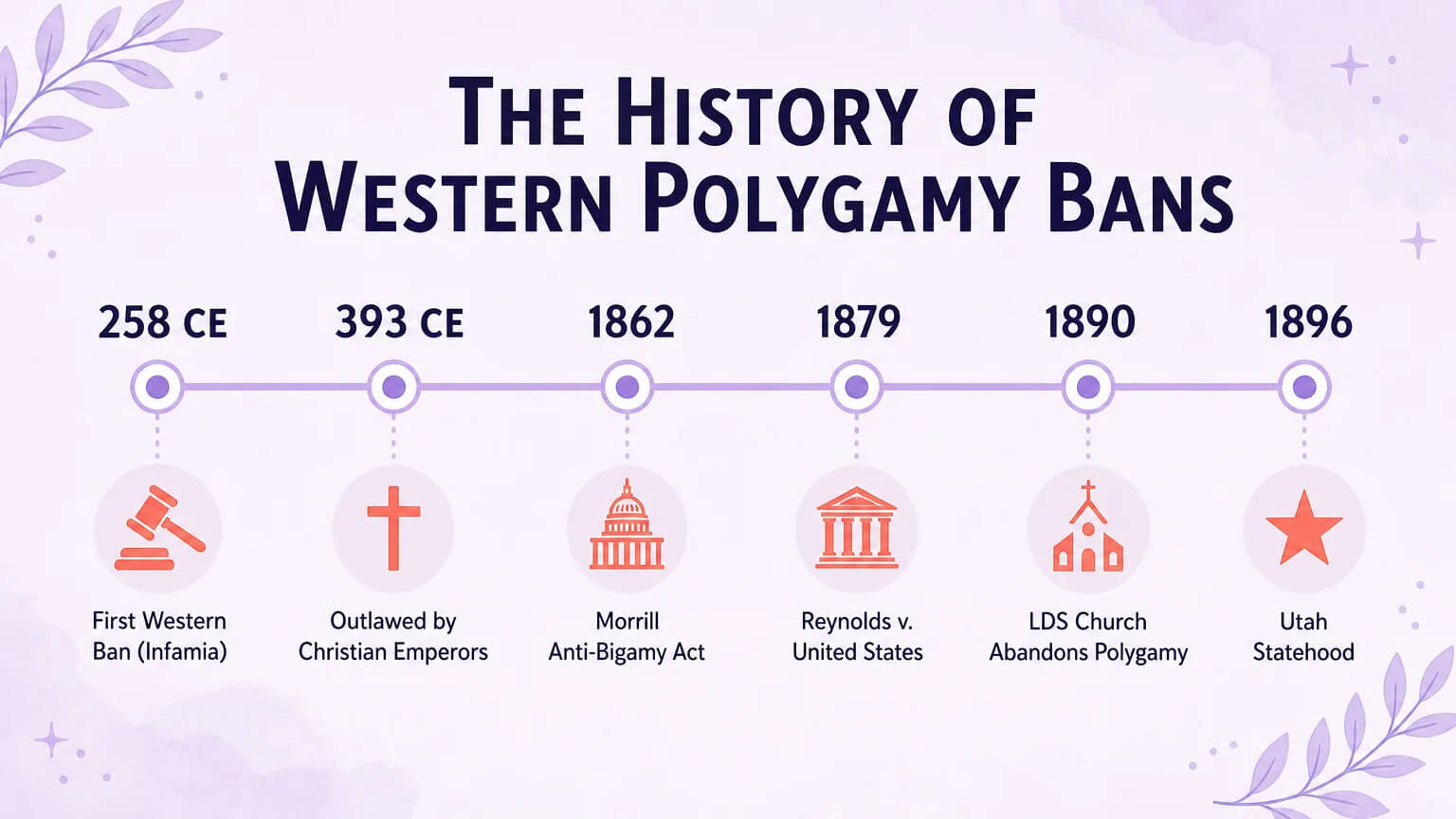
The first recorded Western ban came in 258 CE, when Emperor Valerian and Gallienus declared polygamy an act of infamia, barring practitioners from public office. In 393 CE, Emperor Theodosius made it illegal by express law. By the 9th century, it had become a capital offense. Rome and Greece imposed Socially Imposed Universal Monogamy: one spouse for everyone, enforced by law. Most ancient societies practiced elite polygyny. Rome went the other way, and when Roman law became the foundation of European civil codes, the monogamy norm was baked into Western legal systems.
The second chapter is the United States and the Mormon question. By the mid-1800s, the LDS Church had built a thriving community in the Utah Territory, with plural marriage at its core. The Morrill Anti-Bigamy Act of 1862 was a direct political attack on Mormon territorial power. Criminalize the defining practice of the Mormon elite, and you break the church’s political control.
The Edmunds Act of 1882 escalated: polygamy became a felony, and a test oath barred polygamists from jury service and public office. In Reynolds v. United States (1879), the Supreme Court upheld the Morrill Act with reasoning that still structures American religious liberty law: belief is absolutely protected, but action is not.
The resolution came in 1890. LDS President Wilford Woodruff issued the Manifesto, ending plural marriage. The reason was not theology but political survival. Utah wanted statehood, and Washington had made the price clear. The church abandoned polygamy, and Utah became a state in 1896.
Western polygamy law has barely changed since the 19th century. The statutes were written for a specific target at a specific moment, and they remain largely untouched.
5. What Actually Happens: Enforcement Reality vs. the Law on the Books
Polygamy is technically a crime across the Western world. The statutes are clear, and the penalties on paper are real. But in practice, almost nothing happens.
The last major US federal polygamy prosecution was in 2001: Tom Green, convicted in Utah for bigamy and criminal nonsupport, served five years. Federal prosecutors have shown no interest in consenting adults since. Canada’s only conviction in decades, Winston Blackmore in 2017, resulted in house arrest for a crime carrying up to five years.
Prosecutors almost never pursue consenting adults absent other crimes: child marriage, sexual abuse, welfare fraud, or domestic violence. Polygamy alone is not worth the resources, political capital, or legal challenges. The state has effectively decided that criminalizing multi-partner families is not in the public interest.
Utah’s 2020 reform formalized de facto policy. SB 102 reclassified polygamy among consenting adults from a felony to an infraction. Polygamous families can now report crimes, access services, and interact with the state without fear that acknowledging their family structure invites prosecution. It is decriminalization in everything but name.
The UN Human Rights Committee declared in 2000 that polygamy violates the ICCPR and “should be definitely abolished.” Its declarations carry moral weight and zero enforcement power.
Denmark illustrates the gap between legal text and state purpose. A 2025 University of Copenhagen study documented how the country’s dormant bigamy clause has been repurposed for immigration control: used to deny residency, not to prosecute. The law was written for one purpose and deployed for another.
Joe Darger, a polygamist from Utah who advocates for decriminalization, testified that the criminal status of his family was “used as a license to discriminate.” Landlords denied housing. Employers denied jobs. Banks denied loans. The law does not need to be enforced in a courtroom to be enforced in a leasing office.

6. The Trend Line: Is Polygamy Becoming More or Less Restricted?
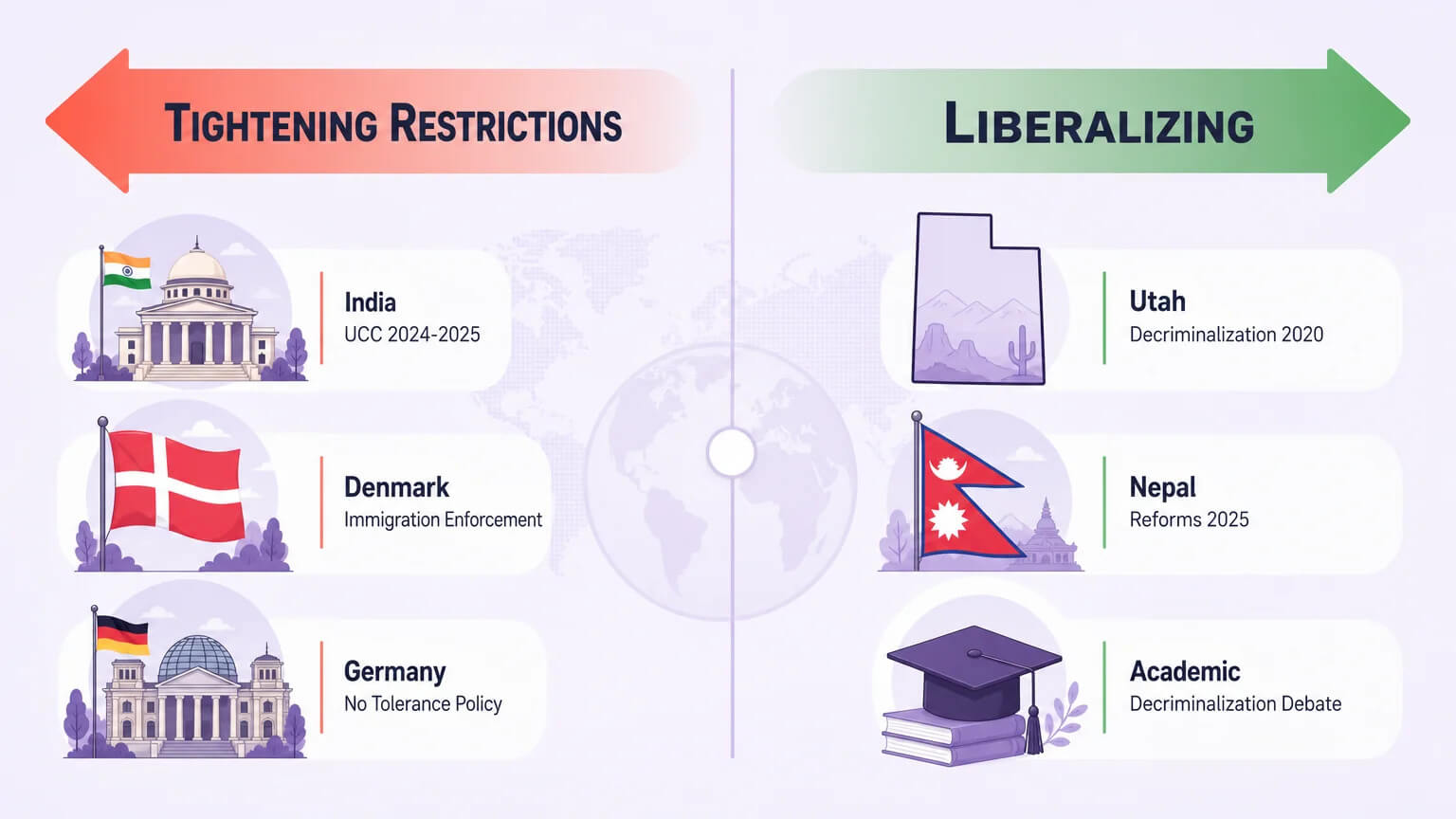
The global trend moves in two directions at once. Some jurisdictions tighten restrictions. Others loosen them.
India’s Uniform Civil Code movement leads the tightening. Uttarakhand adopted its UCC in 2024, Assam in 2025. More states adopting similar codes could replace the dual system permitting Muslim polygamy since 1937 across much of the country. Germany declared “no tolerance” for polygamous marriages contracted abroad. Denmark and several African countries have also tightened.
Utah’s 2020 decriminalization is the most visible liberalizing move. Nepal’s 2025 reforms followed. A 2024 Philosophia paper proposed decriminalization under three conditions: free entry and exit, equal rights, and protections against coercion. The framework gains ground by sidestepping recognition and targeting harm reduction.
Practical tools outpace the law. Cohabitation agreements define property rights. Estate planning (wills, trusts, powers of attorney, healthcare directives) approximates marriage’s protections. LLCs hold shared property. None of these tools replicate marriage. For families needing legal infrastructure, they are increasingly accessible.
Somerville, Cambridge, and Arlington, Massachusetts, now recognize polyamorous domestic partnerships. Canada goes further: Ontario permits birth certificates with up to four legal parents, British Columbia up to three, Saskatchewan up to four. These are parentage laws, not polygamy laws. But they acknowledge what traditional marriage law does not: families with more than two adults exist, and the state has an interest in protecting children born into them.
Demographic data complicates the narrative. Polygyny declines across almost all Sub-Saharan Africa as education and urbanization rise. The practice now concentrates among rural, less educated, predominantly Muslim populations. It is shrinking, not disappearing.
Legalization is not on the table. No Western country seriously considers recognizing polygamous marriage. The Utah model sets the template: decriminalization without recognition. Outside marriage, people build multi-partner families using contracts, estate planning, and municipal recognition to create legal scaffolding where none officially exists. The law changes slower than the families it governs.

FAQ
Is polygamy legal in the United States?
No. Polygamy is illegal in all 50 states under statutes dating back to the Morrill Anti-Bigamy Act of 1862. The Supreme Court upheld the ban in Reynolds v. United States (1879). Utah reclassified polygamy among consenting adults from a felony to an infraction in 2020, effectively decriminalizing the practice at the state level while keeping it technically illegal. Federal law remains unchanged, and immigration consequences for polygamous marriages are severe.
What is the difference between polygamy and polyamory legally?
Polygamy is the practice of multiple simultaneous marriages and is regulated by marriage law. Polyamory is the practice of multiple consensual romantic relationships without marriage and has no specific legal status. Polygamy triggers bigamy statutes, immigration restrictions, and benefits implications. Polyamory exists largely outside the law, though polyamorous families face challenges around parentage, property, and hospital visitation that marriage automatically resolves.
Where is polygamy legal in the world?
Roughly 58 countries permit polygamous marriage, concentrated in sub-Saharan Africa, the Middle East and North Africa, and parts of South and Southeast Asia. Major countries include Nigeria, Indonesia, Pakistan, Saudi Arabia, the UAE, and Malaysia. The highest prevalence is in West Africa: Burkina Faso (36%), Mali (34%), Gambia (30%), Niger (29%), and Nigeria (28%). Turkey and Tunisia are the only Muslim-majority countries that ban polygamy entirely.
Can a polygamous family immigrate to a Western country?
Generally, no. Western immigration systems recognize only one legal spouse. The UK, US, Canada, Australia, and virtually all European countries will not grant spouse visas to more than one partner. Some countries, including the UK, may recognize a foreign polygamous marriage for limited purposes like pension benefits, but not for immigration.
Are people actually prosecuted for polygamy?
Rarely, and typically only when other crimes are involved. The last major US federal prosecution was in 2001 (Tom Green, Utah). Canada’s only conviction in decades was in 2017 (Winston Blackmore, house arrest). Prosecutors across the Western world have largely stopped pursuing consenting adults absent child marriage, fraud, abuse, or other aggravating factors. Utah’s 2020 reform formalized this de facto policy.
What are the legal alternatives for multi-partner families?
Several tools are available, though none replicate marriage. Cohabitation agreements define property rights and financial obligations between unmarried partners. Estate planning (wills, trusts, powers of attorney, healthcare directives) approximates many protections marriage provides. Some families use LLCs to hold shared property. Somerville, Cambridge, and Arlington, Massachusetts, recognize polyamorous domestic partnerships. Canadian provinces permit multi-parent birth certificates: Ontario up to four, British Columbia up to three, Saskatchewan up to four.