You landed here because you have a question you might not have said out loud yet. Not just “what is a throuple,” but something closer to: is this thing I am curious about real, sustainable, and not a fast track to blowing up my relationship? The answer matters because the question cost you something to ask.
Most relationship advice treats wanting to explore beyond the two of you as a symptom — a problem to manage, a crack in the foundation. That framing is wrong. Wanting to explore as a team is not lack. It is abundance. It is what secure relationships do when they have built something strong enough to hold more.
This article treats you like neither a case study nor a fantasy customer. What follows is the honest mechanics of how does a throuple work: the four ways these relationships are built, what they actually feel like month by month, how three people share a bed and a budget, what the law protects and what it ignores, how kids grow up inside them, and what happens when they end. For couples wondering if this is possible, and for singles wondering what they would be walking into, this is the map.
What a Throuple Actually Is (and the Four Ways They Are Built)
A throuple is not a threesome with feelings attached. A threesome is an event. A throuple is a committed, integrated romantic relationship among three people who share daily life, often cohabit, and are emotionally invested in each other. The daily-life integration is what separates it from purely sexual non-monogamy.
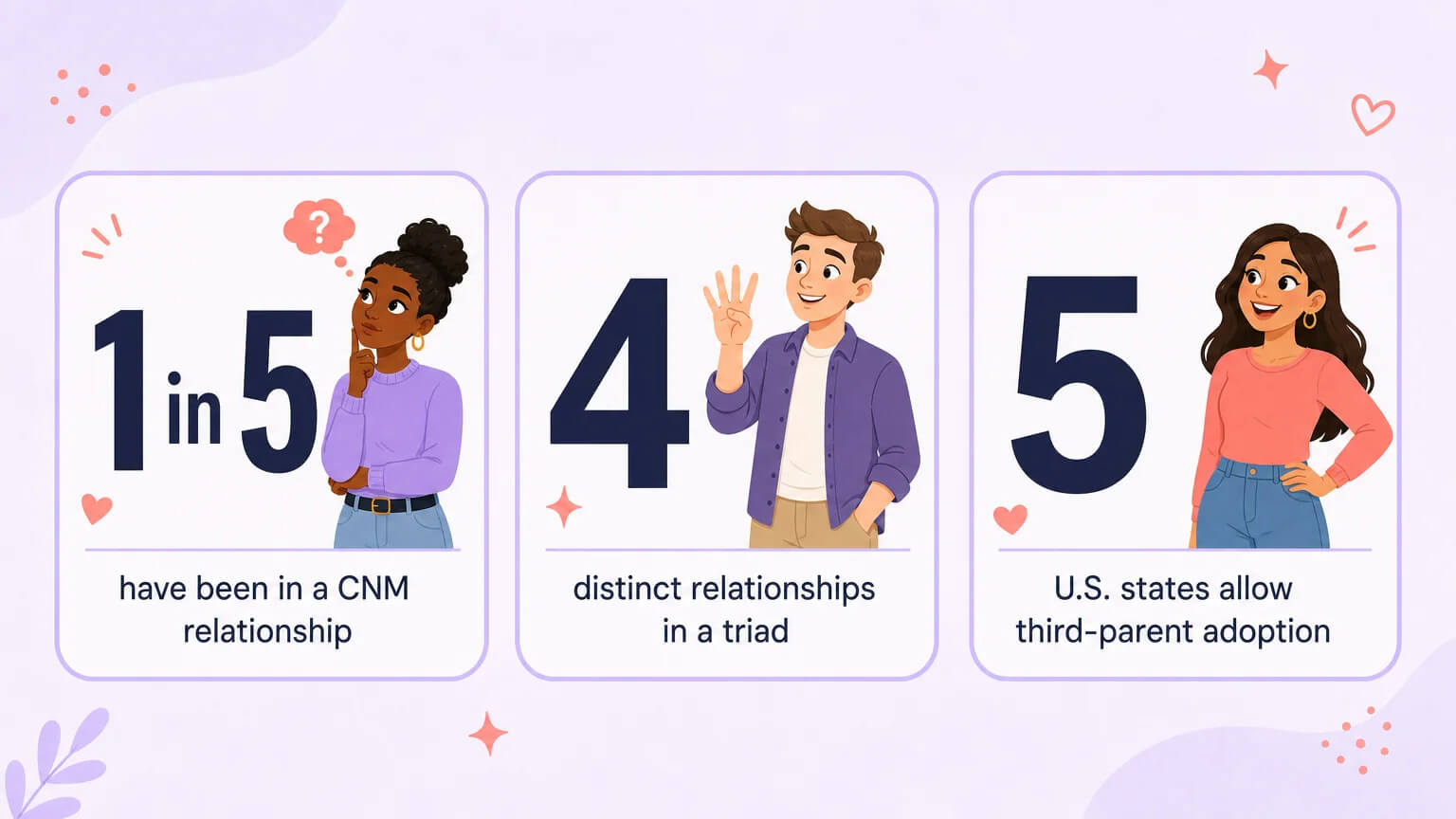
Roughly 1 in 5 people have been in a consensually non-monogamous relationship at some point, and an estimated 4 to 5 percent of the population currently practices CNM. Throuples are one of the most common forms, but not all triads work the same way. There are four structural types, and knowing which one you are building toward changes everything.
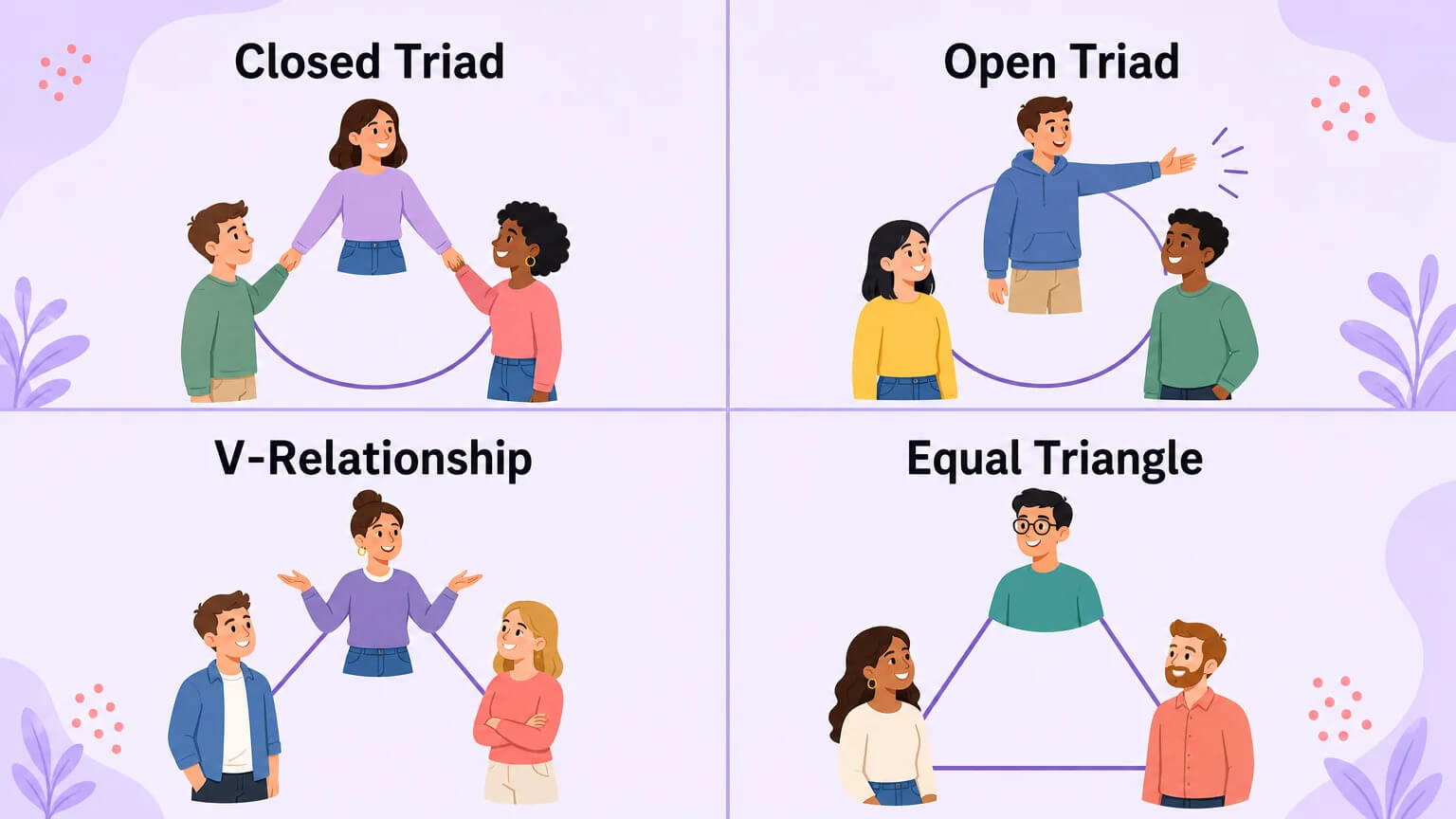
Closed Triad (polyfidelity). All three are exclusive to each other. No outside dating. This is what most people picture when they hear “throuple.”
Open Triad. The three are committed to each other but remain open to outside dating or sex, individually or together.
V-Relationship (vee). One person, the hinge, is involved with two others who are not romantically or sexually involved with each other. Those two are metamours. They may be friends, cordial, or distant. This is the most common structure.
Equal Triangle Triad. All three are mutually and equally involved with each other. Every dyad (A and B, B and C, A and C) has a direct romantic and sexual connection. This is what most people mean by “throuple,” and it is the rarest and hardest form to sustain.
The relationship math explains why. A triad contains four distinct relationships to maintain: three dyads plus the group. Adding a fourth person creates eleven. Each pairing needs deliberate attention, and the group dynamic adds its own layer. Triads are common in aspiration and demanding in practice.
One more thing the stereotype gets wrong. The most common and stable triad form, documented in Dr. Elizabeth Sheff’s longitudinal research, is one woman with two men (MFM), not the male-fantasy FMF. The bond between the two male metamours, what Sheff calls “polyaffective relationships,” is central to stability.
The mechanics that follow apply no matter which structure you are building.
The Emotional Engine: Jealousy, Compersion, and What You Will Actually Feel
Jealousy is not a stop sign. It is a dashboard light. The question is not “how do we eliminate jealousy.” That is not how human emotions work. The question is “what is this jealousy telling us, and how do we address it together?”
Every source that has actually studied this — academic researchers, therapists, people inside long-running throuples — confirms the same thing: jealousy is near-universal. What separates stable triads from unstable ones is not the absence of jealousy. It is the protocol for handling it.

Compersion is the word for feeling joy in your partner’s happiness with someone else. It is a skill that develops with practice, not a personality trait. Abigaiil Morris, who has been in a closed triad for over six years, put it this way: “I know that my girlfriend can sleep with whoever. And at the end of the day, she either wants to be with me or she does not. And if she is with me, it is because she wants to be.” That is earned security.
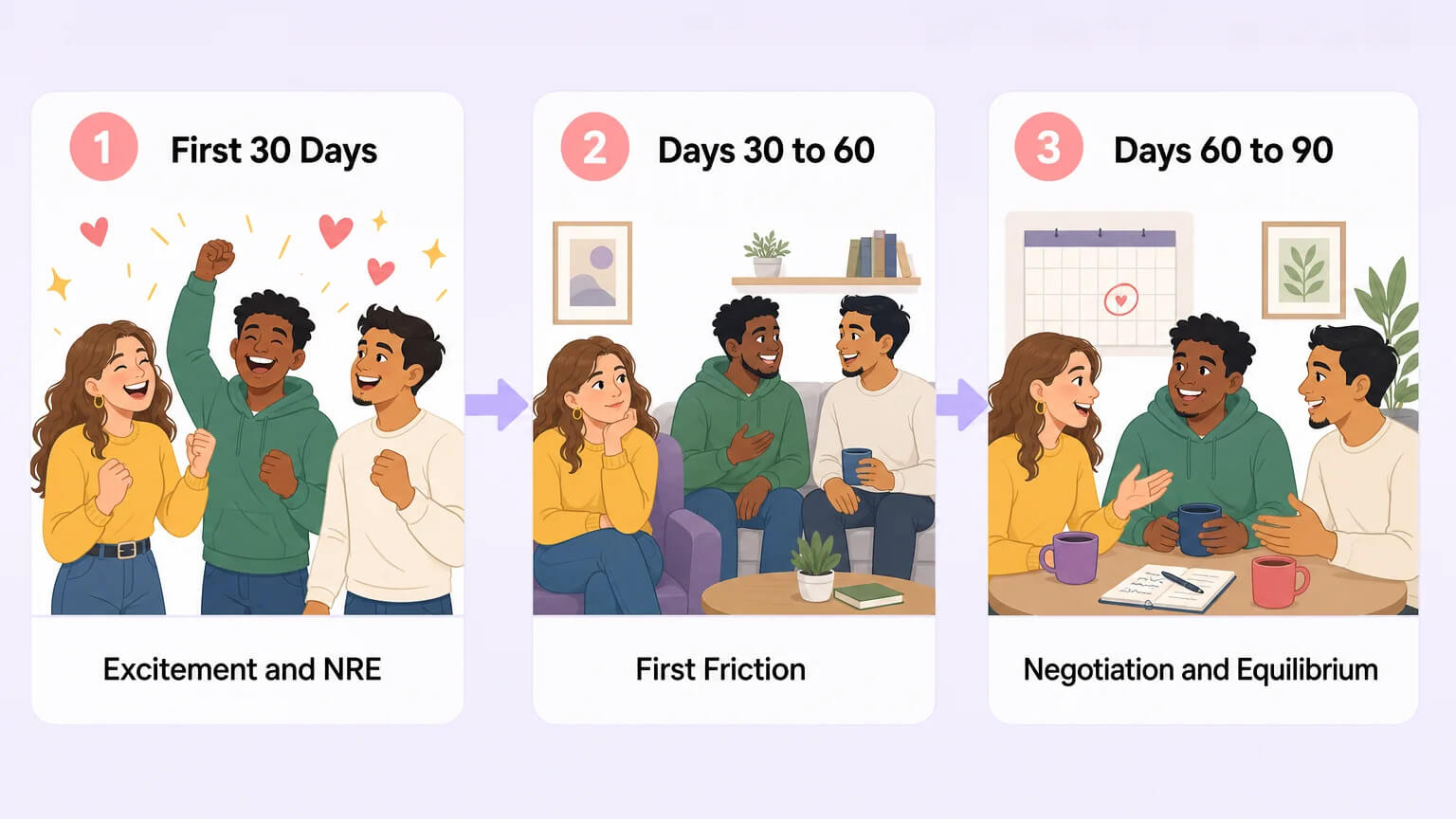
The emotional timeline of a forming triad tends to follow a pattern. Knowing it ahead of time keeps you from mistaking normal friction for failure.
First 30 days. Excitement, novelty, new relationship energy that can feel intoxicating for two people and isolating for the third. The established couple’s dynamic shifts. That shift is disorienting even when it is welcome.
Days 30 to 60. First friction. Someone feels left out. An old jealousy trigger fires. The third realizes they are, in fact, the third — not equal yet. This is normal. This is not a sign the whole thing is doomed.
Days 60 to 90. Negotiation. Boundaries get revisited. Communication rhythms form. The triad either finds its equilibrium or realizes the structure does not fit.
Therapist Rafaella Smith-Fiallo, who specializes in ethical non-monogamy, insists on weekly scheduled check-ins. “How have we all felt this week? What can we do better?” It is not romantic. It is essential.
Camp Throuple’s method is equally practical: recognize and face insecurities, communicate, practice active listening, shower each other with love, repeat positive affirmations. It is unglamorous and repetitive, and that is exactly the point.
There is good news from the research. A 2024 international study of 558 people across 33 countries found that passion remains stable over time in consensually non-monogamous relationships, contrary to the monogamous pattern where passion typically fades. The researchers identified a “virtuous effect”: intimacy, passion, and commitment in one relationship were positively correlated with those same dimensions in the person’s other relationships. Happy relationships feed each other rather than competing.
How Real Throuples Live: Sleeping Arrangements, Schedules, and Daily Rhythms

What does Tuesday night actually look like in a three-person household? Almost no article answers this question, and it is the one every curious person asks. Here is the mundane reality, drawn from people living it.
Sleeping arrangements. Get a king bed. Minimum. Abigail Moss, who spent two and a half years in an MFF throuple, calls separate duvets “a very important polyamory life hack.” The middle person overheats otherwise and becomes, in her words, “human lava.” Rotate who sleeps in the middle. Camp Throuple calls this the Mac n Cheese method and used it even when they shared a 600-square-foot, one-bedroom apartment with a queen bed pushed against an air mattress before upgrading.
Morning rhythms. In the San Diego triad of Eric, Tatyana, and Lexi, Tatyana handles school runs and cooking, Lexi manages the garden, Eric does heavy maintenance. Division of labor is explicit and negotiated, never assumed. Three adults under one roof means three sets of preferences about how the coffee gets made and who takes out the trash. Someone always lacks a nightstand in a three-person bedroom — a small friction that captures the larger reality: the physical world was not designed for three.
Alone time is non-negotiable. Each person needs solo time built into the weekly schedule. It is not rejection. It is maintenance. The InsideHook throuple emphasizes this as one of their hardest-learned lessons.
One-on-one dates. Each dyad needs deliberate care. The lesbian throuple of Kaylie, Ness, and Katie structure their time around all four relationships: each one-on-one pairing plus the group. The Throuple Talk Podcast is blunt about it: “The dyads will make or break the relationship.”
The world-is-built-for-two friction. Hotels enforce two-person occupancy limits. Restaurant reservations default to tables for two or four. Only two wedding rings fit in a standard ring box. Abigail Moss describes emailing hotels ahead of time to explain her relationship structure before booking. Three-way kissing is, by multiple accounts, “weird and funny” rather than cinematic. Airlines, ironically, have three-seat rows — one of the few things accidentally built for throuples.
Conflict resolution advantage. Democracy. Two outnumbers one. Having a built-in mediator during disagreements is a genuine structural advantage of triads, reported by the six-year MMM triad featured in Them.us. But watch the risk: two-against-one can become a pattern, not just a tiebreaker.
The throuples that work are not the ones with the most passionate chemistry. They are the ones that figured out who does the dishes and how to rotate the middle spot in the bed.
The Legal Reality: What the Law Protects and What It Does Not
No jurisdiction in the United States or any Western country permits legal marriage between more than two people. The third partner in a triad has no automatic inheritance rights, no spousal health insurance access, no default hospital visitation, and no spousal privilege in court.
This is not a philosophical problem. It is a practical one. If your partner is in a hospital, you may be barred from their room while their estranged biological family makes medical decisions. If they die without a will, their assets go to legal next-of-kin — never to you, no matter how long you shared a life.
A workaround toolkit exists, built by attorneys like Diana Adams who specialize in LGBTQ and polyamorous family law.
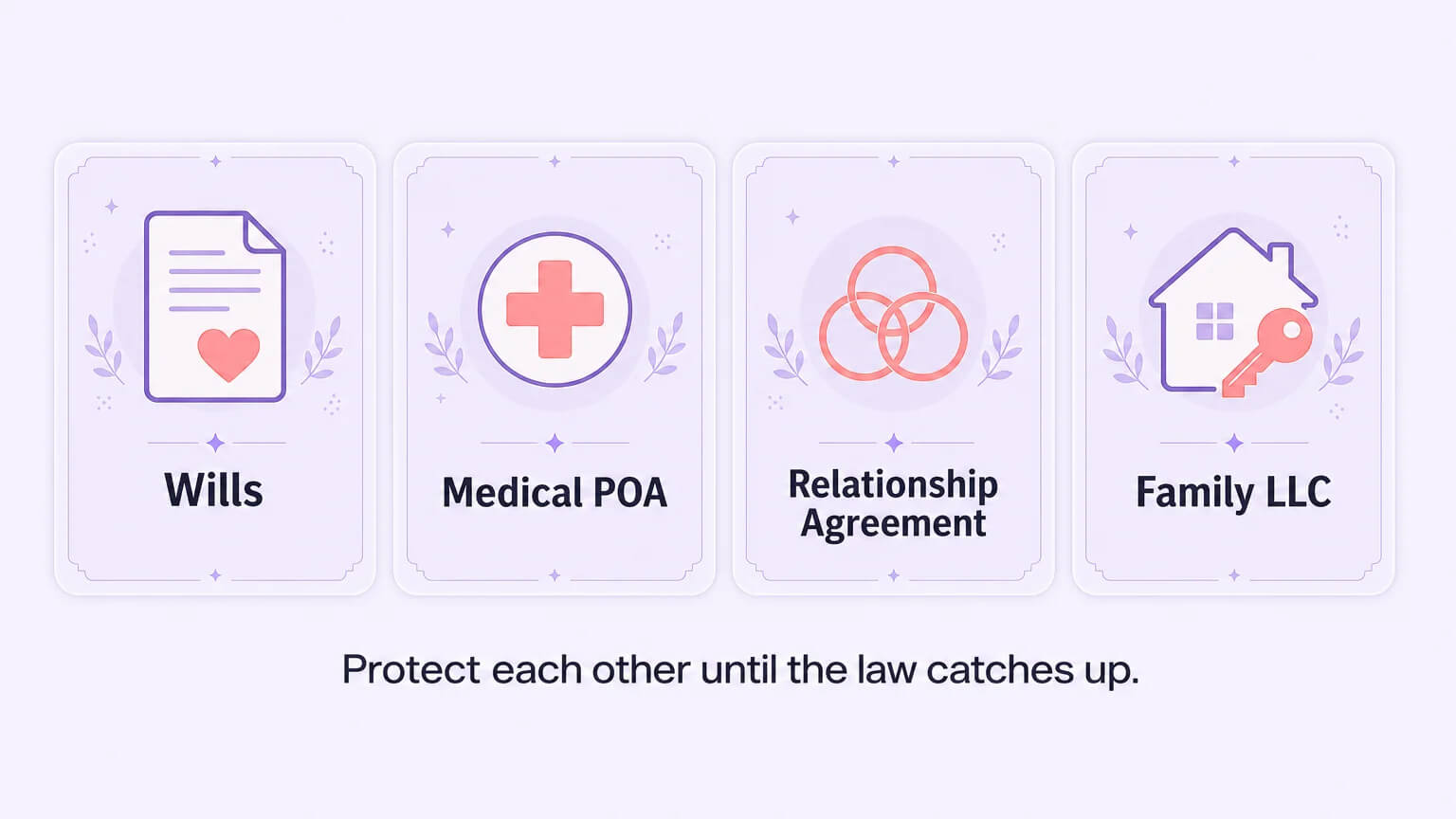
Wills naming all partners as beneficiaries override intestacy laws that default to biological family. Medical powers of attorney and advance healthcare directives naming all partners secure hospital access and decision-making authority. Polyamorous Relationship Agreements serve as custom legal contracts defining asset division, decision-making protocols, and dissolution terms for three or more people. Family LLCs allow joint property ownership since three people cannot co-own real estate as spouses. Co-parenting agreements specify each adult’s role, decision-making authority, and financial obligations. None of these replicate marriage. Together, they form a functional substitute.
The parenting frontier is where the legal gaps become most dangerous. Only five U.S. states explicitly allow a child to have more than two legal parents: California, Maine, Rhode Island, Vermont, and Washington. Third-parent adoption is the strongest legal protection available for a non-biological parent, and it is unavailable in 45 states.
One jurisdiction stands apart. New Zealand’s Supreme Court ruled in 2023 that property division laws can apply to polyamorous relationships by breaking the triad into pairwise qualifying de facto relationships. A 2025 Family Court case awarded equal one-third shares of relationship property, including a rural property worth approximately $1.85 million, to three former partners. New Zealand is the only country to have systematically addressed triad property division.
The real cost of legal recognition is staggering. Ian Jenkins, Alan Mayfield, and Jeremy Hodges, the first family in California to list three fathers on a birth certificate, spent over $120,000 in legal and medical fees plus more than twenty contracts to secure recognition. Their daughter told a classmate: “You have two parents. I have three parents.”
The global picture is uneven. Brazil, home to the world’s largest Catholic population, is seeing rising polyamory visibility alongside institutional pushback, including a stalled 2026 bill to ban registering unions of more than two people. The law is decades behind the reality of how people actually love, everywhere. Protect each other until it catches up.
Building a Shared Life: Money, Housing, and Financial Planning for Three
Every financial system you will touch — joint bank accounts, mortgage applications, tax forms, health insurance plans — was designed for exactly two people. Navigating three through those systems is a design problem, not a relationship problem. And it has solutions.
The standard financial architecture, drawn from real throuples who have built it, works like this.
Three separate personal accounts for individual spending. “No questions asked” money reduces resentment and preserves autonomy. One shared account for joint expenses: rent or mortgage, utilities, groceries, household supplies. Contributions are either equal thirds or proportional to income, depending on what feels fair to all three. There is no right answer, only the answer all three agree on. Weekly financial meetings — Sunday morning over breakfast is the recurring pattern — to review shared expenses, upcoming costs, and any shifts in income or obligation. One person is designated as money manager, tracking shared expenses and ensuring bills are paid, with the other two reimbursing via Venmo or Splitwise.
The tools that make this practical: Splitwise for tracking who owes what across any number of people, handling unequal splits like proportional-to-income naturally. YNAB with YNAB Together for shared household budgeting, a single subscription covers the entire household. Venmo for reimbursements.
The house problem is the hardest financial nut to crack. Three unrelated adults cannot get a joint mortgage as spouses. The workaround is forming a family LLC to purchase and own property jointly. This costs $2,000 to $5,000 or more to set up with an attorney and carries annual maintenance costs, but it creates a legal framework courts can enforce. Some use joint tenancy with right of survivorship where allowed. Do not rely on informal arrangements. They disintegrate under legal pressure.
Insurance and estate planning round out the architecture. Set up life insurance policies with all partners as beneficiaries where possible. Draft wills. Execute medical powers of attorney. These are not romantic gestures. They are the structural equivalent of saying: I will not let the legal system erase you if something happens to me.
One throuple member put the bottom line plainly: “It is a lot more work than just splitting everything down the middle like a couple would.” But the work is the point. Building equitable financial architecture for three people is an act of care, and it is non-negotiable if you want the relationship to have a foundation that outlasts good intentions.
Raising Kids in a Three-Parent Household
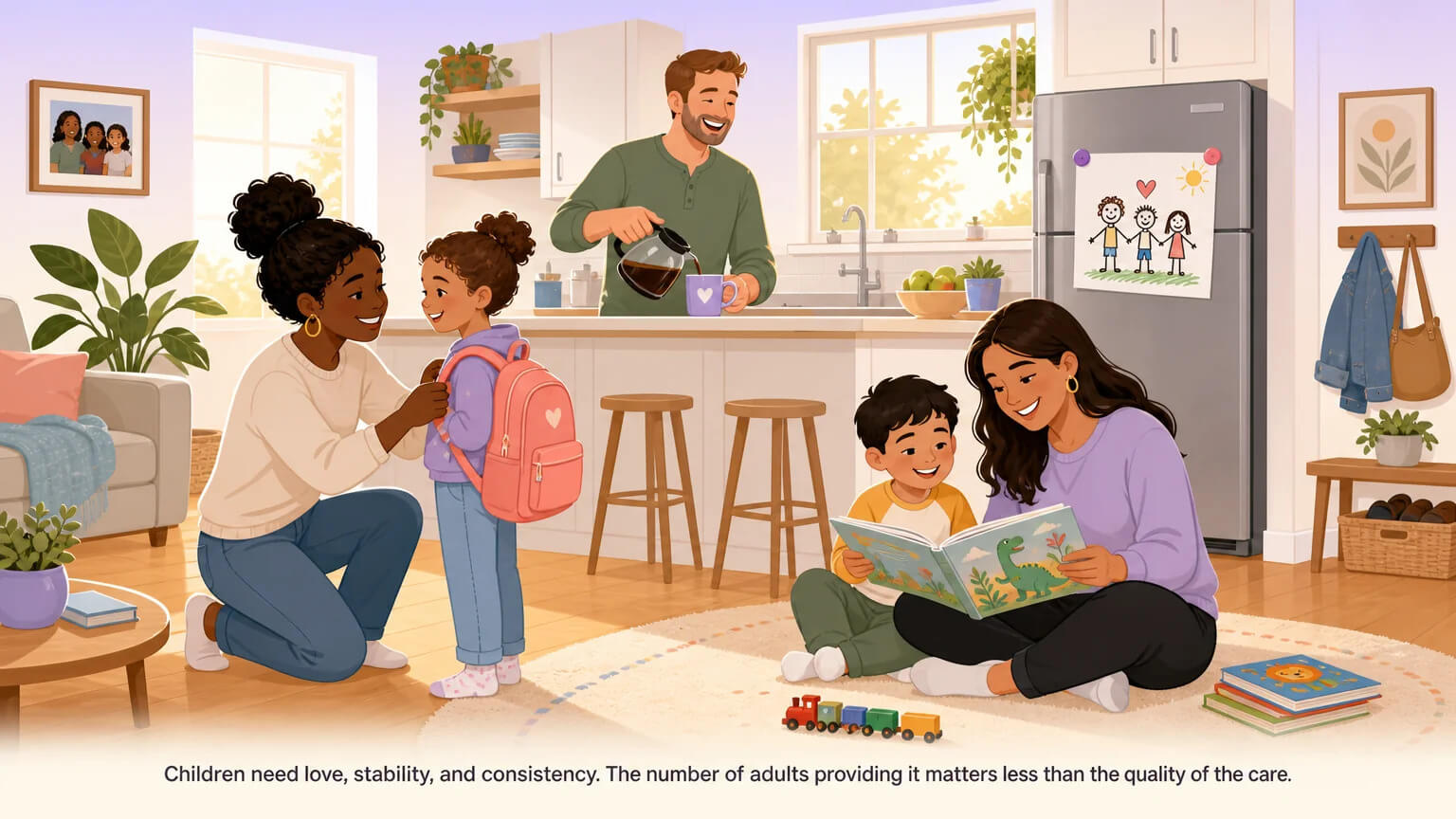
Multiple documented three-parent families are raising children right now, and the kids are fine.
Eric, Tatyana, and Lexi in San Diego are raising three kids, ages 13, 7, and 5. Tatyana cooks and does school runs, Lexi manages the garden, Eric handles maintenance. Lexi was introduced gradually without a big announcement. Tatyana says being in a polyamorous relationship forced her to become more emotionally accountable rather than sitting in her feelings quietly.
Victoria, Nick, and Christian have two children under one roof. Christian handles mornings, Nick does bedtime. They maintain a united front on parenting decisions: if one parent says no, the others honor it. Their four-year-old draws family portraits with all three parents hand in hand.
Cheyenne, James, and Joelle in the UK are raising five children. The kids call the women “Mummy Cheyenne” or “Mummy Joelle.” Family votes resolve disagreements.
Ian Jenkins, Alan Mayfield, and Jeremy Hodges became the first family in California to list three fathers on a birth certificate. Their daughter told a classmate: “You have two parents. I have three parents.”
What the grown children say matters more than what outsiders speculate. A twenty-year-old raised by a throuple — Mom, Dad, and Mama — put it simply: “All they see is three people who love each other, and love them.” A host on the Wives Not Sisters podcast has a cousin in a throuple marriage raising children for over a decade: “It is very healthy and very normal and they are just like this is just how we are.”
Here is the part you cannot afford to miss. In most U.S. states, only two people can be legal parents. A third parent who has raised a child for years may have zero custody or visitation rights if the relationship ends. Custody defaults to biological or legal adoptive parents. This is the single most dangerous gap in the legal landscape for throuples.
Protections that exist: third-parent adoption in California, Maine, Rhode Island, Vermont, and Washington. Co-parenting agreements — not guaranteed enforceable but they demonstrate intent. The “psychological parent” doctrine: courts occasionally recognize a non-biological, non-adoptive parent who has functioned as a parent. A 2016 New York tri-custody case stands as precedent.
The custody weaponization risk is real. Research from SUNY Albany documents one participant whose sister-in-law used their polyamory as a weapon in a custody fight. Other parents reported hiding their relationship structure from courts entirely, fearing it would cost them their children. This requires legal counsel before it becomes a crisis, not after.
Children need love, stability, and consistency. Three parents who communicate well, share the load, and love the kids are not a threat to children. But the legal system was not built for them. The adults have to build the protections themselves.
When Throuples End: How to Uncouple Ethically as a Triad
Every article about starting a throuple. Zero articles about ending one. That silence makes endings feel catastrophic when they are, in reality, a normal outcome of any relationship structure. Naming how they end makes them less frightening to begin.
Triads dissolve in four common patterns. First, all three agree it is not working and separate amicably — rare, though it does happen. Second, and most common, two stay together and one leaves. This is the most painful for the person leaving, who loses two partners at once. Third, the original couple stays together and the third is excluded. This is the endgame ethical non-monogamy tries to prevent, but it happens anyway when couple privilege was never genuinely addressed. Fourth, unexpected reconfiguration: Rebecca Grossman and Karla Moreno married Dave in the UK in a three-person wedding. Less than a year later, Dave left both wives. Rebecca and Karla stayed together as a couple and are now, in their words, “happier than ever as wife and wife.” Dissolution does not always mean total collapse.
The grief of triad breakups is unique and socially invisible. Ashley Ashborn was kicked out of her throuple with her husband and girlfriend after they divorced: “Losing two people rather than just one, so it can kind of feel really lonely.” She was navigating joint custody of two children at the same time. Polyamory educator Chanee Jackson Kendall names the double isolation: “You have to contend with monogamous friends and family members not understanding your grieving process.” The relationship was never socially legitimized, so the grief is never socially recognized.
Leanne Yau of Polyphilia Blog points out that in a polyamorous breakup, “you cannot quite fall apart in the same way” when you have other partners. Either you have support or the entire polycule is affected. Breakups are rarely contained to just two people.
How to uncouple ethically as a triad: Have the dissolution conversation with all three present. No breakup by proxy. If two are staying together, the leaving partner deserves a clean exit, not months of ambiguous lingering. A Polyamorous Relationship Agreement should include dissolution terms — think of it as a prenup for three. Unromantic, but essential. If children are involved, the legal parentage question becomes urgent. The non-legal parent may lose all access. Legal protections must be in place before the relationship deepens, not after it fractures. Therapy is not failure. Licensed psychologist Manijeh Badiee confirms that breakups in polyamorous and monogamous relationships are more similar than different. The core grief process is the same. What differs is the compounding and the lack of social recognition.
The ability to end well is a sign of relationship health, not failure. A triad that can dissolve with dignity for all three people was a triad built on respect. That respect was real, even if the relationship was not permanent.
FAQ
How is a throuple different from an open relationship or swinging?
A throuple is a committed, integrated romantic relationship among three people: daily life, cohabitation, emotional investment. An open relationship is typically a couple with outside sexual partners but no romantic attachment to them. Swinging is recreational sex without emotional involvement. A throuple is a relationship, not a sexual arrangement. The daily-life integration is what separates it from other forms of non-monogamy.
Can three people legally get married?
No. No Western jurisdiction permits legal marriage between more than two people. Workarounds include symbolic commitment ceremonies, LLC formation for joint property, wills and powers of attorney naming all partners, and, in limited jurisdictions, third-parent adoption for children. New Zealand now allows three-way property division upon separation. The law is slowly evolving, but legislation remains decades behind social reality.
How long do throuples actually last?
No large-scale longitudinal data exists. Anecdotal evidence spans the full spectrum: some dissolve within months; others have lasted six to ten-plus years with children. The decade-plus triad referenced in the Wives Not Sisters podcast and the six-year MMM triad in Them.us demonstrate longevity is possible. Main sustainability factors: non-hierarchical structure, strong dyad bonds, excellent communication, low external stress. Many triads do not survive the first year. The complexity and societal pressure are significant filters.
How do I know if a throuple is right for me and not just a fantasy?
Therapist-recommended readiness check: your existing relationships are genuinely secure, not just fine. You communicate well under stress. You have done genuine self-work on jealousy and attachment. You are not using polyamory as an exit strategy. You can handle social stigma without it destroying your mental health. You are genuinely excited about your partners being happy with someone else — not just tolerating it. Start with reading: Polysecure, The Ethical Slut, More Than Two — before any action.
Do people in throuples actually get jealous?
Yes, jealousy is normal and near-universal. Successful throuples acknowledge it openly, trace it to its root cause, and work through it with communication. Compersion — joy in your partner’s happiness with someone else — is a learned skill, not an innate trait. Some long-term throuple members report jealousy fading significantly over years as security builds, but it rarely disappears entirely.
How do throuples handle holidays and extended family?
This is one of the most commonly cited challenges. Strategies include rotating which partner’s family to visit, hosting jointly so all three participate, or accepting that some family relationships may be permanently strained. Kevin Jankay’s mother did not speak to him for two years. Other families fully embrace all three partners. Each triad negotiates based on their specific family dynamics.
What is the actual difference between a V-shaped triad and a triangle triad?
In a triangle triad, all three people are romantically and sexually involved with each other. Every pairing has a direct connection. In a V-triad, one person — the hinge — is involved with two others who are not involved with each other. Vees are more common and often transitional. Triangle triads require all three dyads to work simultaneously, which is rarer and harder to sustain. Neither structure is better than the other. They serve different needs.