Why is Palm Springs so gay? Three unrelated forces landed on the same patch of desert, and none of them was a decision to be welcoming.
Hollywood came first. Studio morality clauses made being outed a career risk, so a small town two hours from Los Angeles, walled and private, was worth the drive. Money came second. When Palm Springs declined in the 1970s, thousands of unfashionable modernist houses sat cheap at the moment gay buyers were leaving Los Angeles, San Francisco, and West Hollywood. Land came third. The Agua Caliente Band of Cahuilla Indians own every other square mile of the city, and the 99-year leases that made downtown buildable decided what could exist.
A resort does not become a gay capital by accident or by virtue. It happens when privacy, price, and land line up.
What the postcard leaves out: a neighborhood the city destroyed, an operation its police ran, and the venues women lost.
Palm Springs Gay History: The Studio Era Refuge
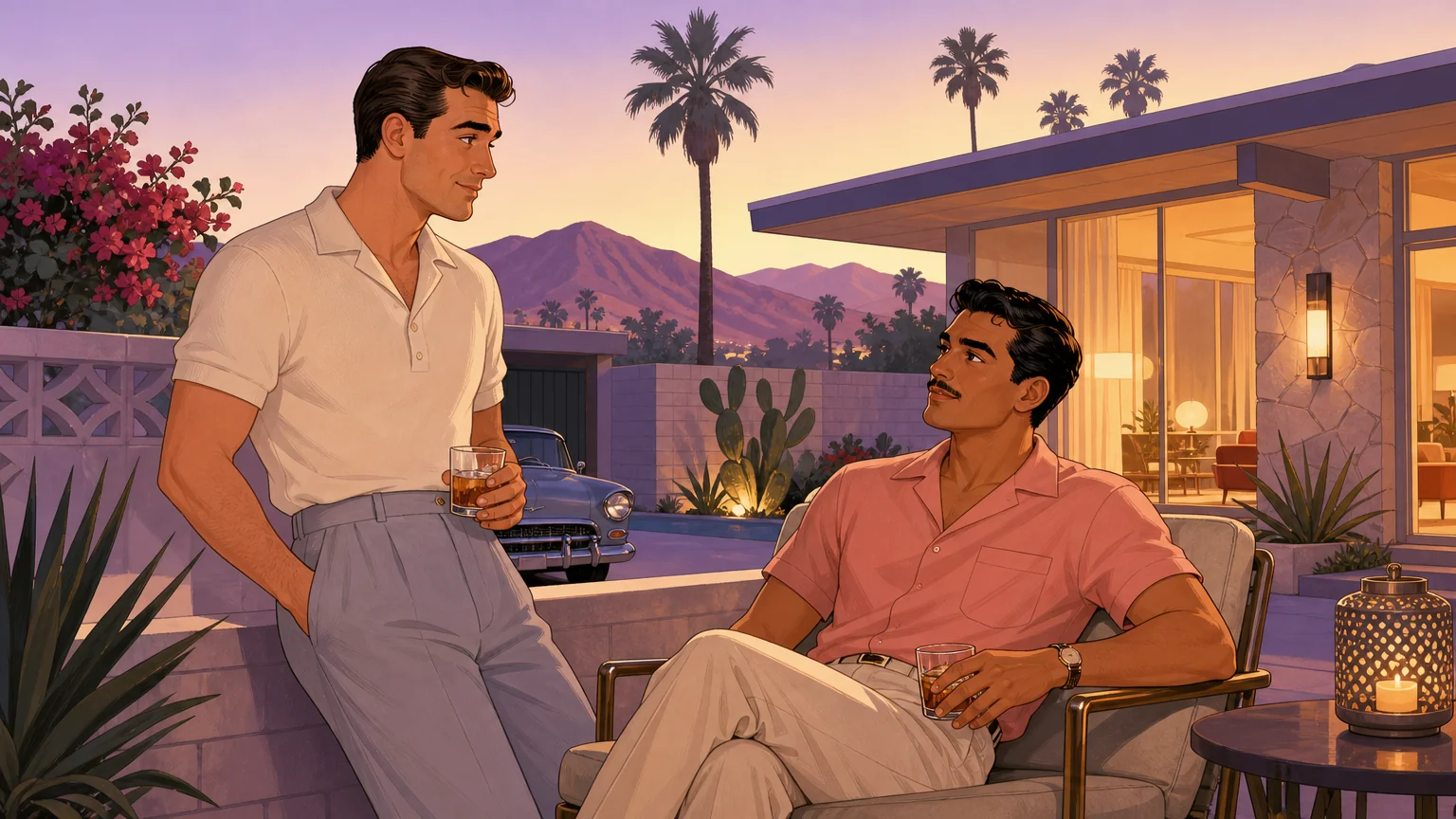
Palm Springs’ first gay population was not a community. It was a clientele.
Studio contracts carried morality clauses, and the Hays Code governed what could appear on screen. Being outed ended a career. So the town sold what Los Angeles could not: two hours of road and a wall. The famous houses clustered in the Movie Colony, and their purpose was simple. You were seen only when you chose to be, and the town was paid to make that choice reliable.
The scale did the rest. Los Angeles was close enough for a weekend and far enough that a gossip columnist would not see you twice in the same month. Palm Springs was small enough that a familiar face was a decision rather than a coincidence, and quiet enough that a man could bring someone to dinner and let the room guess.
The walls and courtyards were a kind of architecture of survival. They were also good business.
The same privacy protected straight stars, and that is the tell: privacy was the product, sold to anyone who could pay for a wall. Most of the buyers were not gay, and that is what made the arrangement stable. A town selling privacy has no reason to sort its customers by what they do behind it.
This was refuge, not liberation. Palm Springs stayed politically conservative through the whole period, and the arrangement depended on no one asking questions. A place that is safe because no one asks is safe on someone else’s terms. It offered no street, no district, and no politics. Those came later, for reasons that had nothing to do with a studio contract.
The studios lost the power to end a career decades ago. Gay people kept arriving anyway, in numbers, long after there was any career left to protect. So why is Palm Springs so gay? The answer starts with a house price.
The Housing Bust That Built Gay Palm Springs
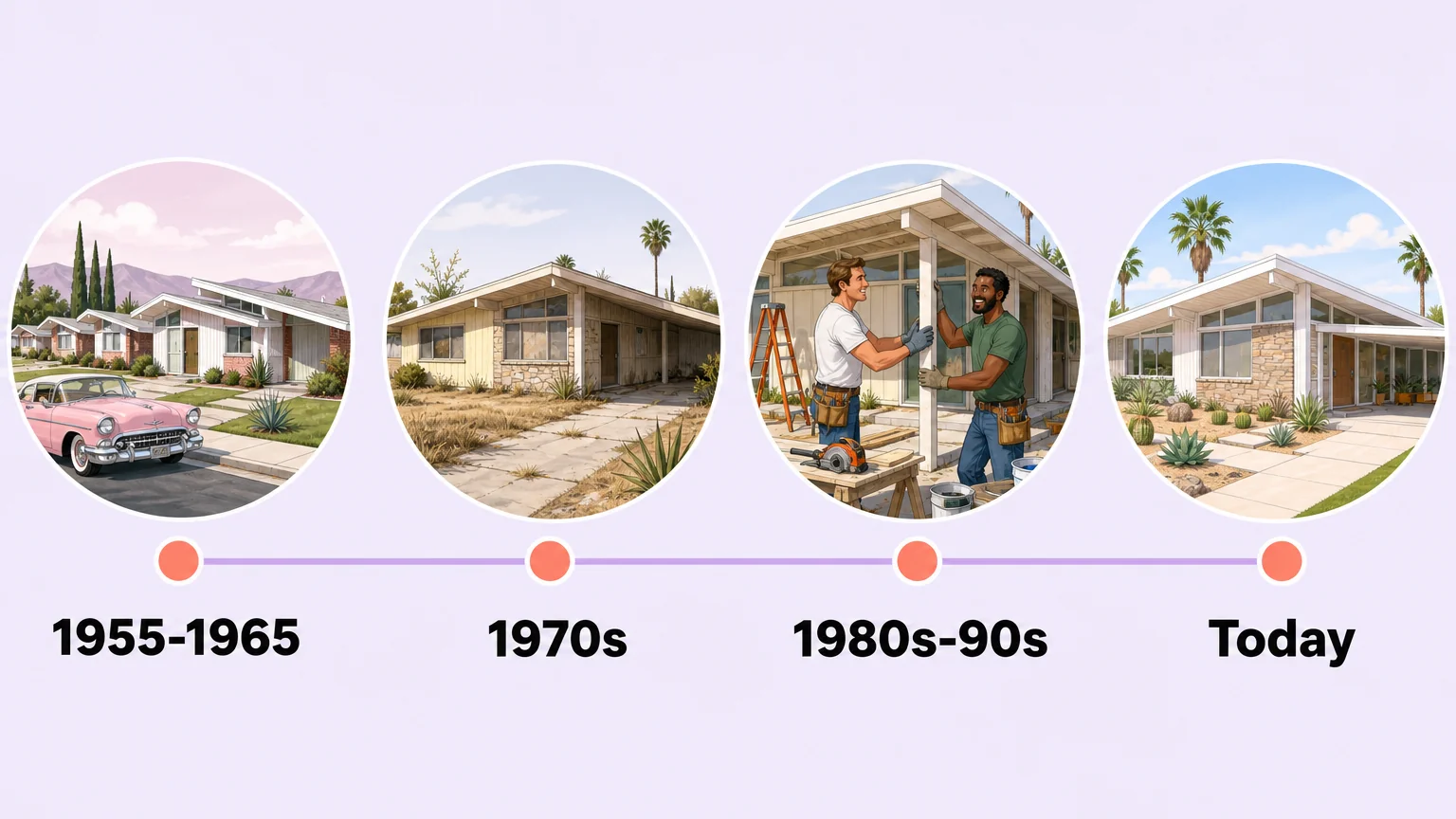
Start with the houses, because the price is the argument. The Alexander Construction Company built in Palm Springs from 1955 to 1965 from designs by William Krisel, and the homes were priced from $16,950 to the low $50,000s. These were tract houses for middle-class buyers, not architecture anyone coveted. Flat roofs, exposed beams, glass walls facing a patio. The desert was the amenity, and it came free with the house.
By the 1970s the city was in severe decline and losing population. The Alexanders went unfashionable and cheap. Because almost nobody was buying or rebuilding, much of the stock sat physically untouched for two decades. That neglect is the only reason so many of them survived to be fought over.
Then follow the buyers. Gay men from Los Angeles, and later from San Francisco and West Hollywood, bought the same houses for little money and restored them, often improving on their modest bones. The pattern had a logic to it: sell in a city you have already gentrified, buy a house with a pool in the desert.
They did not only fix roofs. They joined boards, ran preservation campaigns, and brought coastal expectations about how a city should look and be governed. The restoration turned into Modernism Week and a design-tourism economy that now sells the architecture as the reason to come.
David Wallace, author of A City Comes Out, dates the buying wave to the same decades: older same-sex couples flocked to the area in the 1970s and 1980s for homes now treated as architectural gems.
AIDS belongs in this wave, not in a separate chapter. People came to the desert for care, for climate, and for a town that asked less of them. Some came to party, some came to recover, some came because their friends were sick. Many died. Many stayed. A private network became organized, visible, and eventually political.
The irony is arithmetic. A refurbished Alexander now sells from $400,000 to well over $1 million, and the citywide median home value is $604,000. The price that built the community is now the price that closes it.
Agua Caliente: The Land Under Gay Palm Springs
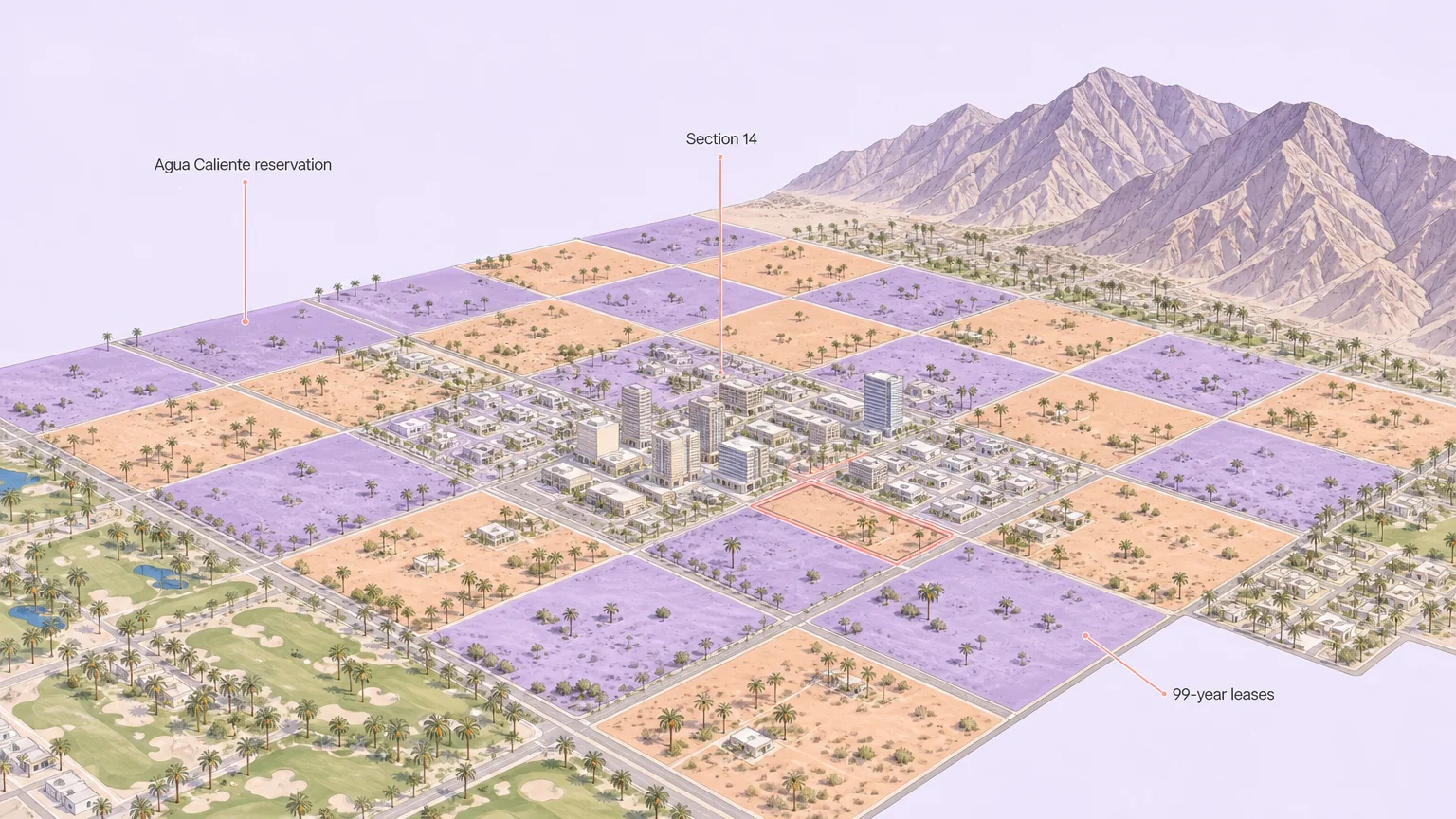
The map is the surprise. In 1876, President Grant designated the even-numbered one-square-mile sections of the federal survey as reservation land for the Agua Caliente Band of Cahuilla Indians, about 900 acres. President Hayes expanded it in 1877 to roughly 31,000 acres. The railroad had already taken the odd sections. The result is a checkerboard: the tribe owns every other square mile inside Palm Springs, including much of the commercial core.
That fact explains the city’s shape. A large share of downtown sits on leased land, and the lease terms determined what could be built.
Federal law capped Indian land leases at five years until 1955. The Indian Long-Term Leasing Act of 1955 stretched terms to 25 years. The Indian Leasing Act of 1959 allowed up to 99. No bank finances a hotel against a five-year lease. With 99, the hotels, the subdivisions, and the convention center became possible.
One square mile of that land carries the story the city has not settled. Section 14 sits next to downtown. In the 1940s, tribal members leased lots there to Black, Mexican, and Filipino workers who were barred from housing elsewhere. The city refused utilities and zoning. In 1959 it began evictions. In 1965 and 1966, at least 235 buildings were demolished or burned.
A 1968 investigation by Loren Miller Jr. ended the program. He wrote that the city had ignored that the residents of Section 14 were human beings. In 2000, former residents and the NAACP asked for an apology. Mayor Will Kleindienst sent an acknowledgment letter, and no formal apology followed.
Water came next. In 2017 the Ninth Circuit held that federal reserved water rights extend to groundwater beneath the reservation, and the Supreme Court declined to hear the appeals that November. The phase quantifying the tribe’s share is unresolved.
Chairman Jeff L. Grubbe called the rulings settled law. The Native American Rights Fund, which represented the tribe, said the case is far from over. Both statements are true at once.
The casino, the hotels, and the convention center that anchor the tourism economy stand on that cleared square mile, on leased land, above groundwater whose ownership is still being counted.
Warm Sands, Cathedral City, and the 2009 Police Sting
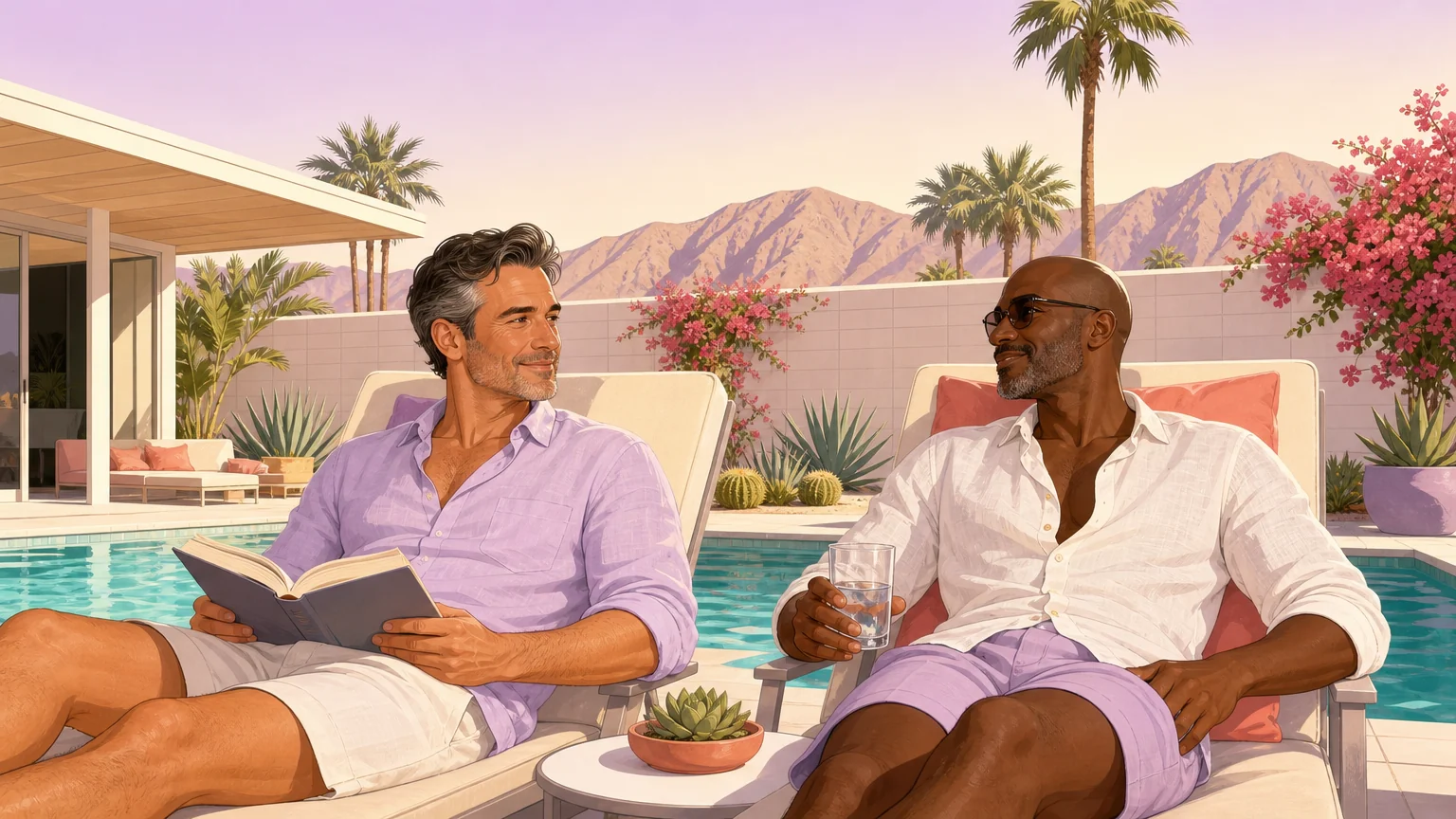
The physical fact of gay Palm Springs is a residential block. Warm Sands holds 11 clothing-optional gay resorts, mostly refurbished 1920s ranches and retro apartments, and the cluster brings in hundreds of thousands of dollars a year in hotel taxes. The walls and the quiet are the product. Some properties sell day passes, and visitors not staying at a resort can find each other on 3Fun before they arrive.
Visible gay nightlife did not start there, or anywhere in Palm Springs. Police pressure and licensing patterns pushed it into Cathedral City, where clubs, leather bars, and drag nights carried the scene through the 1970s and 1980s. CC Construction Company anchored that displaced world. That era’s gay Palm Springs was in the next city. The shift back began in 1991, when Streetbar opened on Arenas Road and the block became the Arenas District.
In June 2009, Palm Springs police ran an undercover decoy operation in Warm Sands. A shirtless officer in tight jeans worked a parking lot, urged men to expose themselves, and used the phrase “Uncle Willy would like that” to signal arresting officers. Nineteen men were arrested on public indecent exposure charges carrying lifetime sex-offender registration.
Police said the operation followed neighborhood complaints. The public defender for six of the men said he found no complaints, not one anyone could show him, and that no comparable operation had ever targeted heterosexuals. A police advisory board member said the reaction was blown out of proportion and the town was now scared to act against gay people.
Squad-car audio in 2010 captured officers using anti-gay slurs. Chief David Dominguez announced his retirement in January 2011 after acknowledging an inappropriate comment of his own. The department dropped decoys from sex stings, and the city ordered sensitivity training. The gay-majority council had defended him first, and one councilwoman said the episode exposed hidden racism and hidden homophobia. On land adjoining the reservation, tribal police reportedly transferred public-sex enforcement to city police.
The privacy that made the town a refuge is the same privacy that made what happened inside it easy to ignore. That is not a paradox. It is the bill.
How Palm Springs Elected Its All-LGBTQ Council
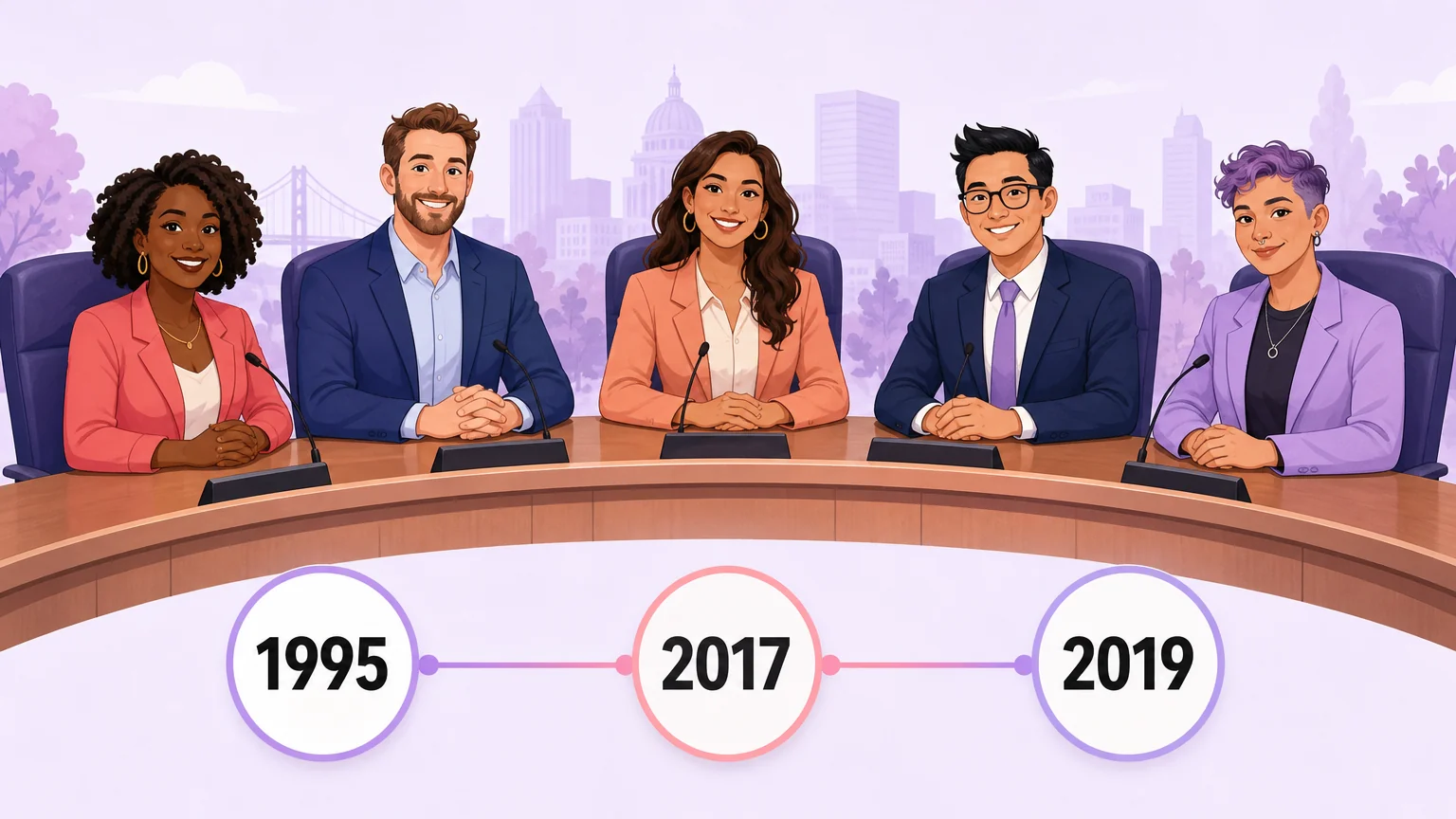
In November 2017, Lisa Middleton and Christy Holstege each won about 30 percent of the citywide vote for two vacant council seats, joining three gay men on a five-member body. That produced what is believed to be the first entirely LGBTQ city council in the country. The council was seated in December 2017 and took office in January 2018, so either year is defensible.
Palm Springs LGBTQ politics did not begin with that election. Ron Oden became the first gay person elected to the council in 1995 and the city’s first gay mayor in 2003, which also gave the council its first gay majority. He was the first African American elected to the council too.
He described that first race plainly: he faced discrimination the entire time, he said. It was not overt, but it was there. That distinction does more than any rainbow crosswalk, because it punctures the idea that the city was welcoming by nature.
Middleton’s own distinction: the first openly transgender person elected to nonjudicial office in California. Her summary of the job: there is no gender associated with potholes. Geoff Kors made the argument that candidates won with barely a mention of sexual orientation and that voters were arguing about policing, homelessness, and roads. Mayor Robert Moon said he did not think about the milestone until after the election.
That council was all white in a city that is 25.7 percent Hispanic or Latino. A California Voting Rights Act challenge followed, and the city moved to district elections in 2019, ending the at-large system that had produced the all-LGBTQ body. The Human Rights Campaign did not track council composition nationally at the time, so first in the country rests on the absence of a contrary example.
Representation here was procedural before it was symbolic. A gay-majority council had already defended a police chief in 2011, when much of the community wanted the opposite. The all-LGBTQ body that followed was a different five people. A mirror is not a guarantee.
What the “Gayest City in America” Numbers Count
The number everyone repeats about Palm Springs does not have a source. At least a third. About 40 percent. Nearly half of 47,000 residents, as of 2011. More than 50 percent. All four circulate, and none of them traces to a survey with a published sample. There is no city-level Gallup figure either, so an attribution to Gallup is an error.
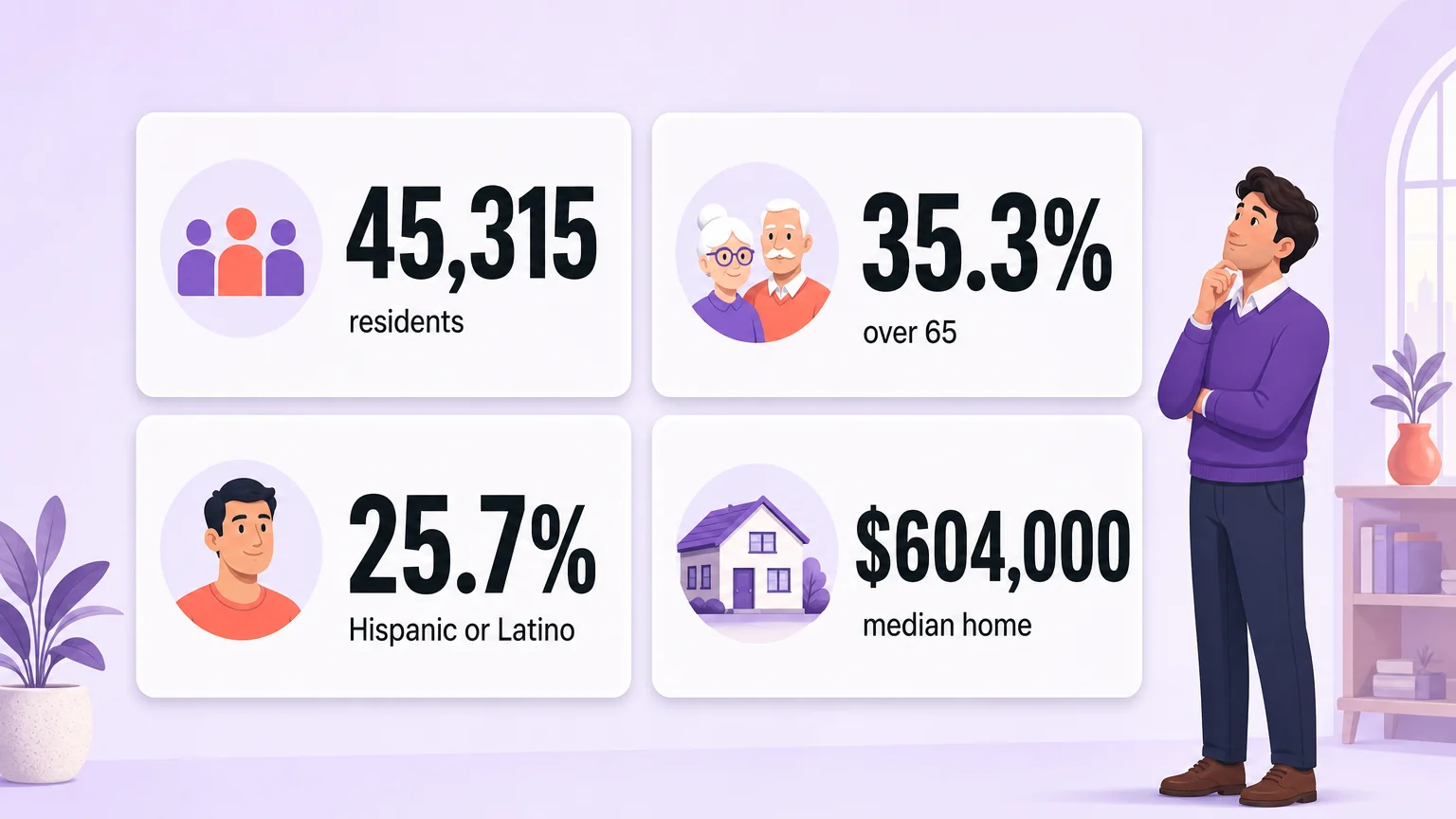
What is measured comes from the Census. The population was 45,315 on July 1, 2025, up 1.7 percent from 44,575 in 2020 and about 750 people above the 2010 count. That is close to flat.
Of those residents, 35.3 percent are 65 or older and 7.9 percent are under 18. 25.7 percent are Hispanic or Latino, and 61.4 percent are white alone and not Hispanic. 19.1 percent are foreign-born, and 27.4 percent speak a language other than English at home. Median home value is $604,000, median gross rent is $1,562, median household income is $73,119, and 11.8 percent of residents are in poverty.
One coincidence to keep straight. Men are 61.4 percent of the population, the same figure as the white non-Hispanic share. Those are two separate measurements landing on the same number, not a cross-tabulation.
The ranking with a published method behind it is a Williams Institute analysis of 2010 Census data, which placed Palm Springs first in California and third nationally. Read what it counts: same-sex couples per 1,000 households, not LGBTQ individuals. It is also more than a decade old, and the report itself no longer resolves. One more mismatch: the Census publishes 65 and over, which is not the same measurement as half the residents being over 55.
So the answer to the percentage question is that nobody has measured it. And a city that added about 750 people in fifteen years is not absorbing a mass migration. The wave that made this the gayest city in America came ashore decades ago.
Where the Women Went: Lesbian Palm Springs Today
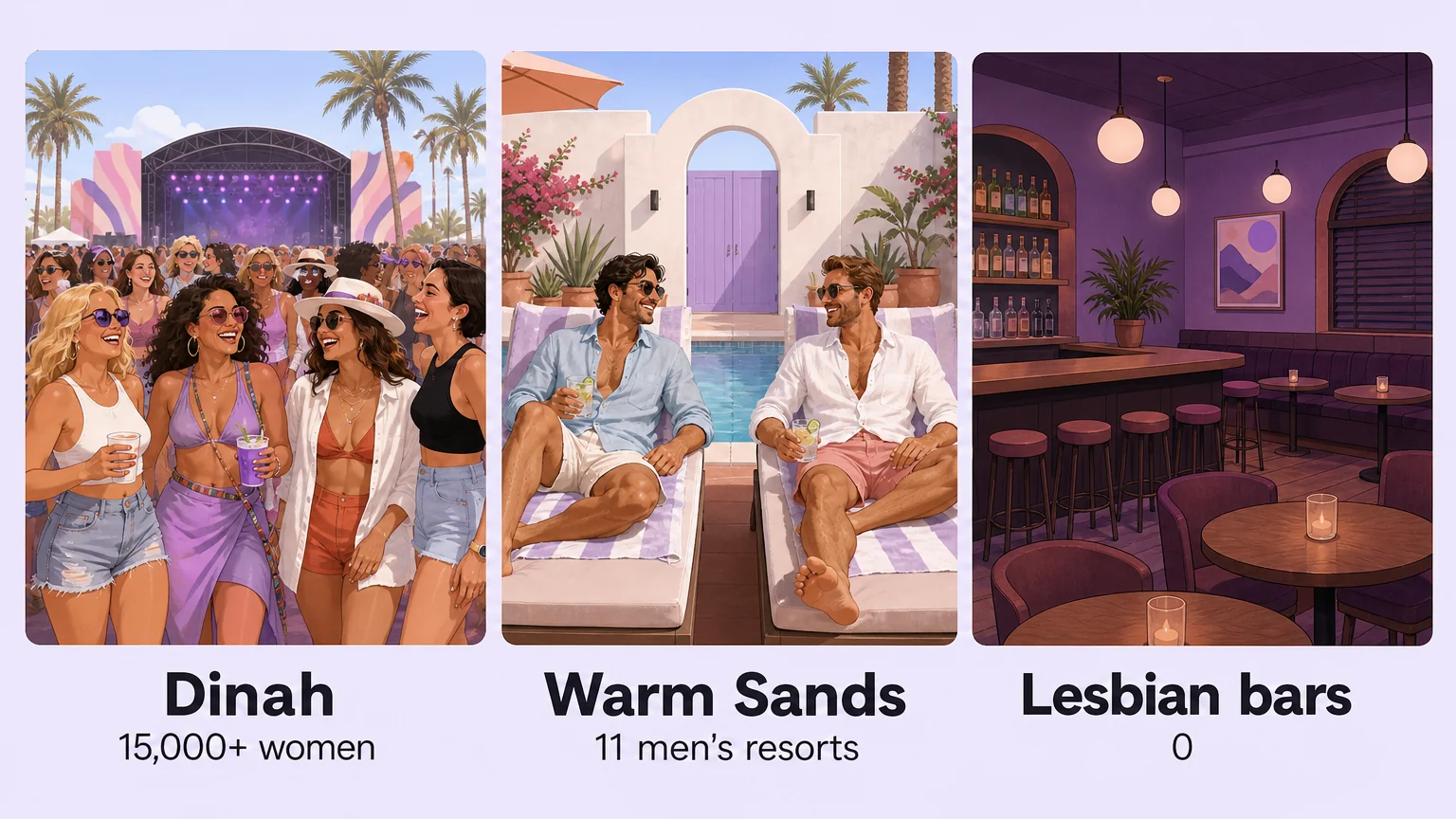
In 1991, Mariah Hanson booked a museum space in Palm Springs during the LPGA Dinah Shore tournament weekend and threw a party for women who were already coming to the golf. It grew into a five-day festival drawing well over 15,000 attendees and billing itself as the largest annual gathering of queer women. Her framing was competitive rather than sentimental: she wanted to build something that rivaled the look of the men’s festivals. Palm Springs handed her a key to the city. That is infrastructure, and it runs for five days a year.
The gap is the other 51 weeks. Casitas Laquita, a 15-casita women-only resort that opened in 1998, is described in a 2022 travel column as having closed. Delilah’s, described as the area’s last lesbian bar, closed in 2007. Both come from reporting rather than from a public record, so hold them as reported rather than as settled. What is not in dispute is the shape of the inventory. The 11 Warm Sands resorts are men’s properties, most of them clothing-optional, and the city is 38.6 percent female.
Ask women who live here and you get two answers. One is that the town works for a week and not for a life, that an event calendar is standing in for a community, and that the difference shows up in the quiet months. The other is that the loss is overstated, that the Dinah, Cinema Diverse, and a layer of women-owned businesses amount to a network that exists all year, and that a town does not have to be built for you to be yours.
Both readings are held by people who live there, and neither is a mood. What explains the gap is not hostility. The people who bought into this housing market in the 1970s and 1980s built the institutions that survived, and that wave was overwhelmingly men. A gap produced by who could buy a house is not the same thing as a door held shut. It is also not nothing.
What Gay Palm Springs Costs Now: Housing, Heat, Water
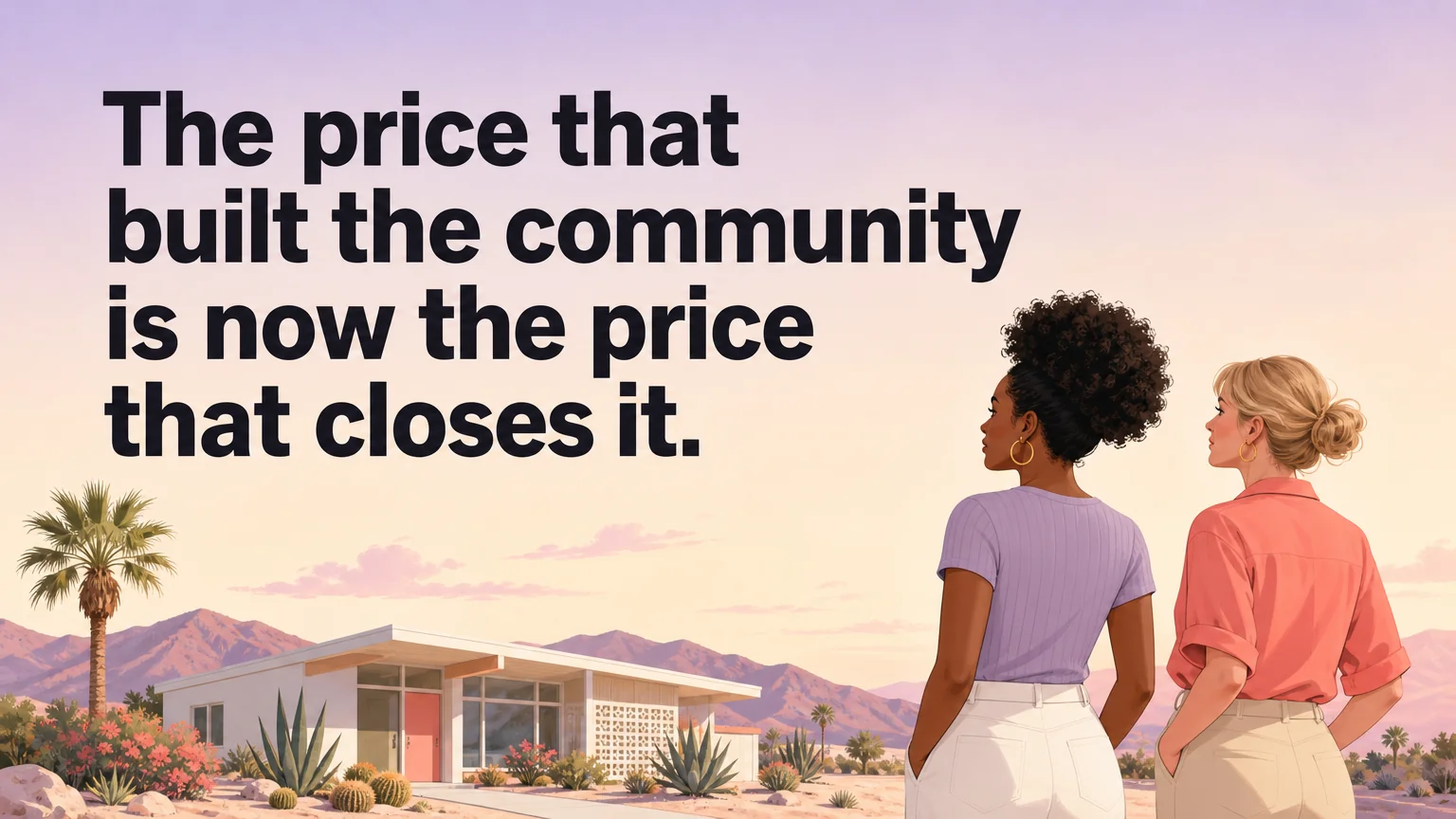
The arithmetic decides who can still arrive. Median home value is $604,000 against a median household income of $73,119. Median gross rent is $1,562, and 11.8 percent of residents are in poverty. Put plainly: a household earning the local median cannot buy the local median house.
Age is a cost of its own. With 35.3 percent of residents at 65 or older and only 7.9 percent under 18, schools and young-adult services are thin, and the peer group a younger mover is looking for may be a small one. Aging in place has a market answer, and the market answer is expensive. Living Out, the 55-and-over LGBTQ+ rental community that opened downtown in 2023, runs from about $5,000 to close to $8,000 a month, with a health concierge, housekeeping, a dog park, an art studio, and a resident restaurant.
It is market-rate rental housing, not assisted living, so it does not solve a need for care. Jan Zivic, 83, moved there after breaking her arm in a three-story house. Her verdict on communal life: not everybody likes her, and she does not like everybody.
Heat is the cost people underestimate. Residents structure their days around it, doing outdoor things early and socializing after sunset. A visitor who considered a six-month house share said he could not live there year round because of the heat, and he was not talking about July. A room in peak season starts around $150 to $250 and goes up.
Water is the unresolved line. The Ninth Circuit held in 2017 that the tribe’s reserved right extends to groundwater beneath the reservation, and the Supreme Court declined the appeals that November. The phase quantifying the tribe’s share is still open, which means the number that matters most to a desert city has not been set.
The city is still the thing it was built to be: a place where privacy and distance are purchasable, and purchasable by fewer people each decade. If you are weighing a move, spend one August there before you buy the story.
Gay Palm Springs FAQ
Is Palm Springs actually the gayest city in America?
It is the most defensible claimant, not a proven one. A Williams Institute analysis of 2010 Census data ranked Palm Springs first in California and third nationally for same-sex couples per 1,000 households, not individuals. The report no longer resolves, and the percentages have no published sample.
What percentage of Palm Springs is LGBTQ+?
Nobody has measured it. Estimates run from about a third to more than half, none of them a survey. What is measured: 45,315 residents in 2025, 35.3 percent aged 65 and over, 25.7 percent Hispanic or Latino. The over-55 claim is not the Census 65-and-over figure.
When did Palm Springs become gay?
In layers, not at a moment. The studio era made it a discreet refuge. The 1970s decline left cheap housing that gay buyers restored. AIDS organizing made it a community. Streetbar opened in 1991, Oden won a seat in 1995, the all-LGBTQ council arrived in 2017. The 2009 sting shows the line never straightened.
Why was the gay nightlife in Cathedral City instead of Palm Springs?
Because Palm Springs pushed it there. Police pressure and licensing kept visible gay nightlife out of the city, so clubs, leather bars, and drag nights clustered in Cathedral City through the 1970s and 1980s. Streetbar’s 1991 opening on Arenas Road shifted it downtown.
Is Palm Springs a good place for lesbians and queer women?
For one week a year, emphatically. The Dinah draws well over 15,000 women across five days. Year round it is thinner: the Warm Sands resorts are men’s, the women-only resorts and the last lesbian bar have closed, as reported. Whether that is a good town, they answer differently.
Is Palm Springs expensive?
Yes, by local and increasingly coastal standards. Median home value is $604,000 against a median household income of $73,119, median gross rent is $1,562, and 11.8 percent of residents live in poverty. A peak-season room runs $150 to $250 and up.
When should I visit?
Not in summer. Pride runs from late October into November, the Dinah falls in spring, and Modernism Week lands in February. Locals do outdoor things early and socialize after sunset, because the midday sun is punishing. Pack for heat anyway.