DL stands for down low, and in LGBTQ slang it names a man who presents publicly as straight, often with a girlfriend or wife, while having sex with men on the side. That is the full answer to what is DL. If that was your only question, you can stop here and be correct.
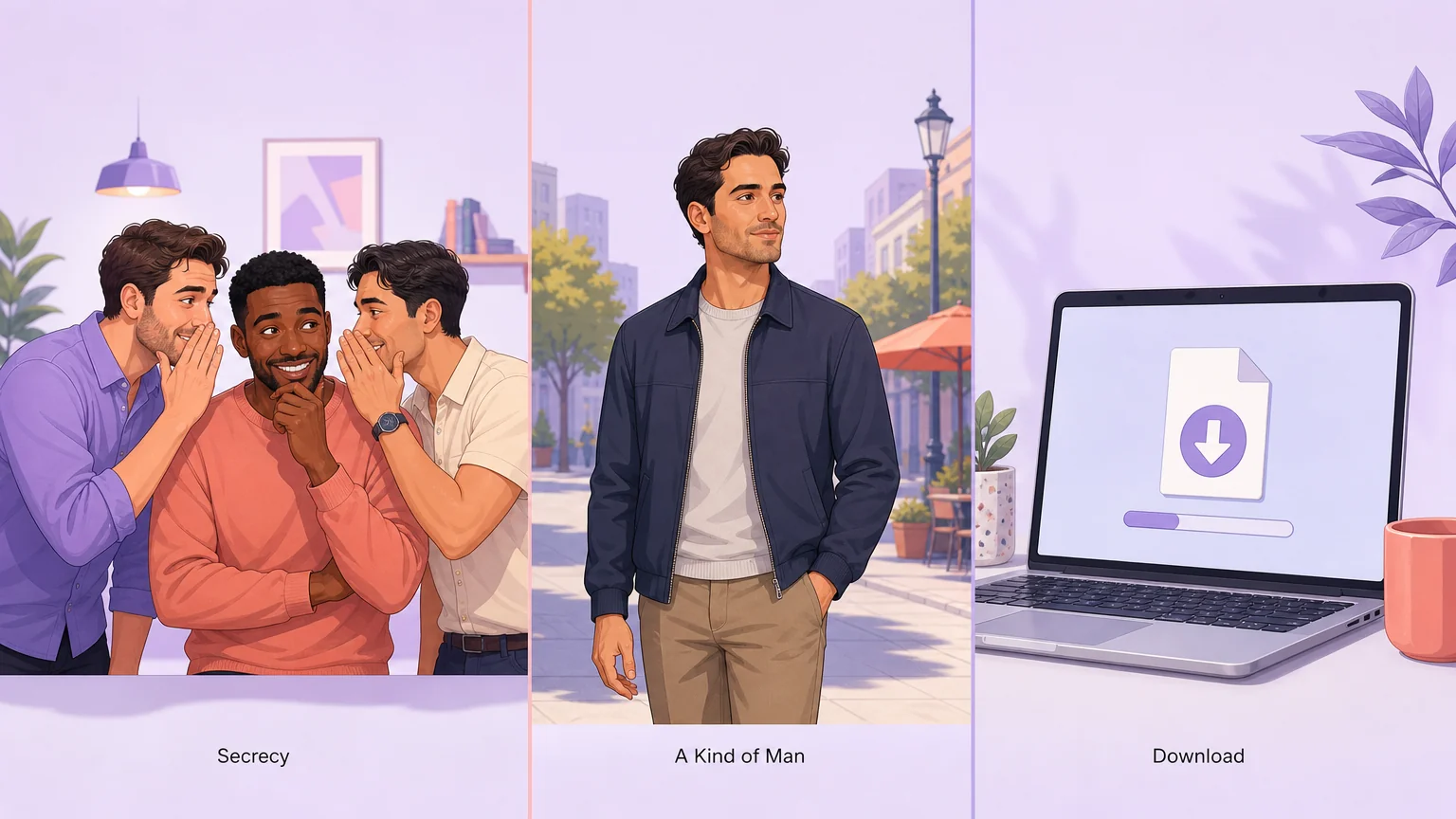
The same two letters do two other jobs, which is why the word confuses so many people. Keep it on the DL means keep it secret and has nothing to do with sex. DL in a message about a file means download. Only the sentence tells you which one is meant. Take the three uses in turn, then the history and the argument that follows the word.
One boundary holds throughout. In LGBTQ, DL is not a synonym for gay, and it is not a synonym for closeted. It is a specific arrangement: a public heterosexual life, plus sex with men kept separate from it.
A man can be gay and not DL. A man can be closeted and not DL. The label describes a configuration, not a degree of openness, and losing that distinction is how conversations about it go wrong.
What DL Means, Sense by Sense
The sentence you have probably heard is “keep this on the DL.” That is the oldest use of the letters, and it is not about sex at all.
Green’s Dictionary of Slang gives the first sense as “a state of secrecy” and traces “on the down low” to a 1992 UGK lyric. Campus slang collections recorded “the d.l.” as meaning secret by 1996, and “keep it on the DL” was logged from hip-hop usage by 2000. A 2000 Ebonics Primer defined it as subversive, in the sense that no one will know.
The everyday examples have no sexual content. You keep a surprise party on the DL so the person it is for does not hear about it. You keep a job search on the DL until the offer is signed. You keep a friend’s news on the DL because it is theirs to tell.
The phrase is a request. Someone told you something, and you agree not to pass it on.
The letters are older than the man they now describe, and this is still what they mean in a message with no other context.
The person sense is newer. Green’s gives the second sense as “ostensibly heterosexual, married men who enjoy sex with homosexual men.” A 2002 American Dialect Society note recorded “an African-American male who has sex with other men on the side,” plus the variant “DL Brotha.” Both definitions describe behavior and public presentation, not a self-adopted identity.
A man can be called DL without ever using the word about himself. The label describes him from the outside, and it does not require his agreement.
Then there is download. DL is an initialism for download as a noun and as a verb, written dl, d/l or D/L, with UL as its opposite. A DL is the file, and to DL is to fetch it. Neither has anything to do with any of the above.
The practical test is two questions: who is talking, and what is the sentence about? Keep it on the DL is a state of secrecy. He is DL is a kind of man. DL the file is a verb.
Run a sentence through the test and the meaning usually falls out. The dating-profile use is a fourth thing, and it does not sit neatly inside those three.
DL vs. Closeted vs. Discreet vs. Bisexual
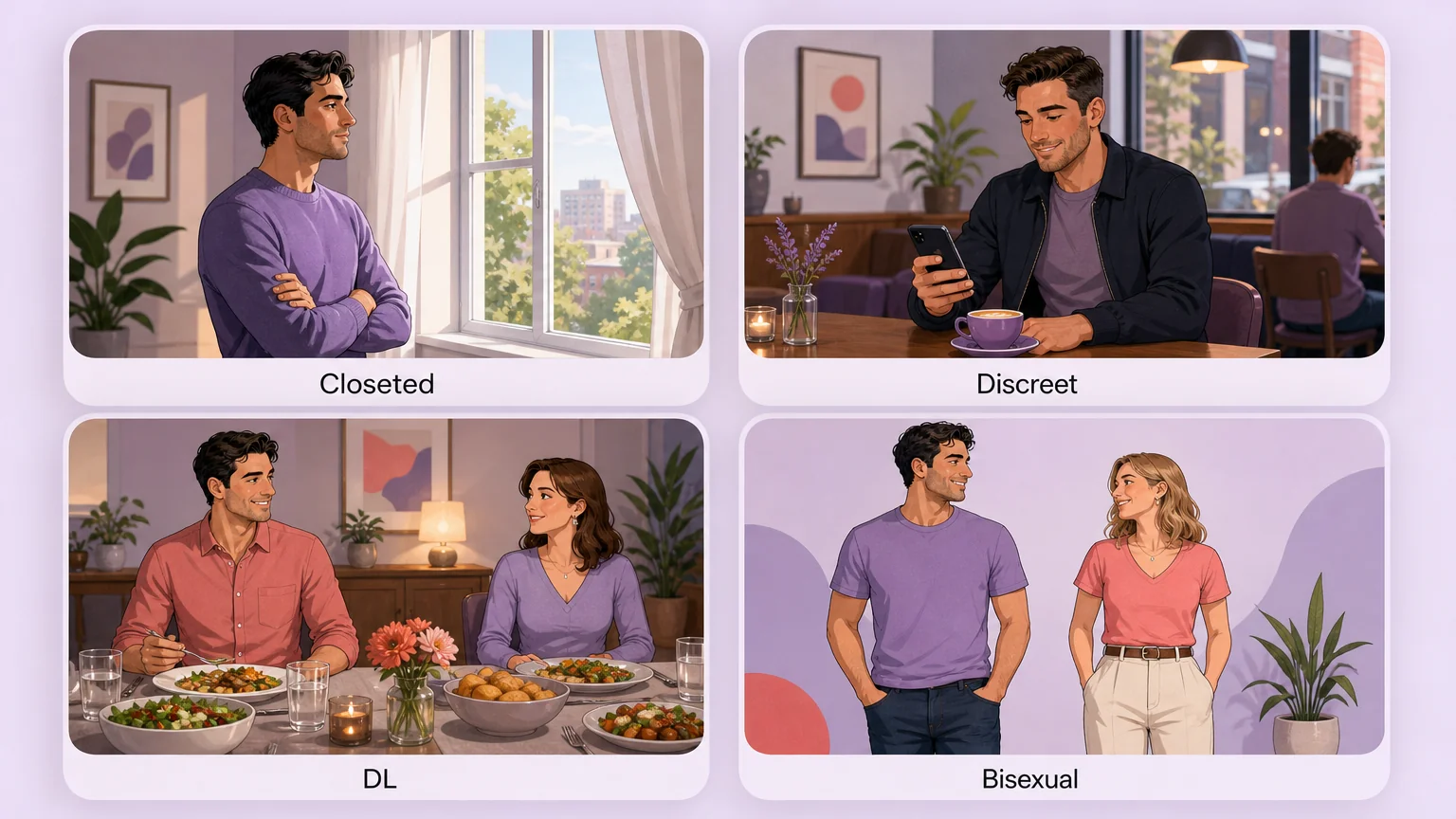
Four words get used as if they were one word, and the difference is usually the whole point.
- Closeted. Not out. That is the whole content of the word, and fear is usually the reason. He may be out to friends and not to family, or to no one at all, and either way the word still applies.
- Discreet. The word men put on profiles. It means private, does not advertise, and would not necessarily deny anything if someone found out.
- DL. A specific configuration: a public heterosexual life, often with a girlfriend or wife, plus sex with men kept separate from it. The woman in that picture is part of the public story, and she may know none of the rest.
- Bisexual. An identity rather than a concealment strategy. About 2% of the total Black male population reports current bisexual activity, according to Millett and colleagues in the Journal of the National Medical Association in 2005.
The community has not agreed on the edges. Men who use the apps push back when any closeted man gets called DL, because a man who is not out has not built the second public life that the term describes. Others use DL as a flat synonym for closeted and get corrected for it. Both usages are live, and a ruling here would not end the disagreement.
What DL means on a profile is usually the part you need. DL reads as a limit on what is available rather than a description of his orientation, because he will not be seen with you. Discreet reads as privacy rather than denial. In Houston, by one account, men who are visible in gay spaces still adopt the DL title so they will not be read as promiscuous, which means the word can signal the opposite of what it literally says.
If you are dating a man who describes himself this way, the useful question is not what he is but what he is offering. You are agreeing to a set of limits, and the limits are worth hearing stated out loud: whether you will ever meet anyone in his life, what happens if someone sees the two of you, and whether he tells you the truth about the rest.
You are allowed to decide those limits do not work for you, and you are allowed to decide they do. Ask early. The answer tells you more than the label does.
Where the Word Came From
The dated record is thinner than the stories told about it, so start where the evidence does.
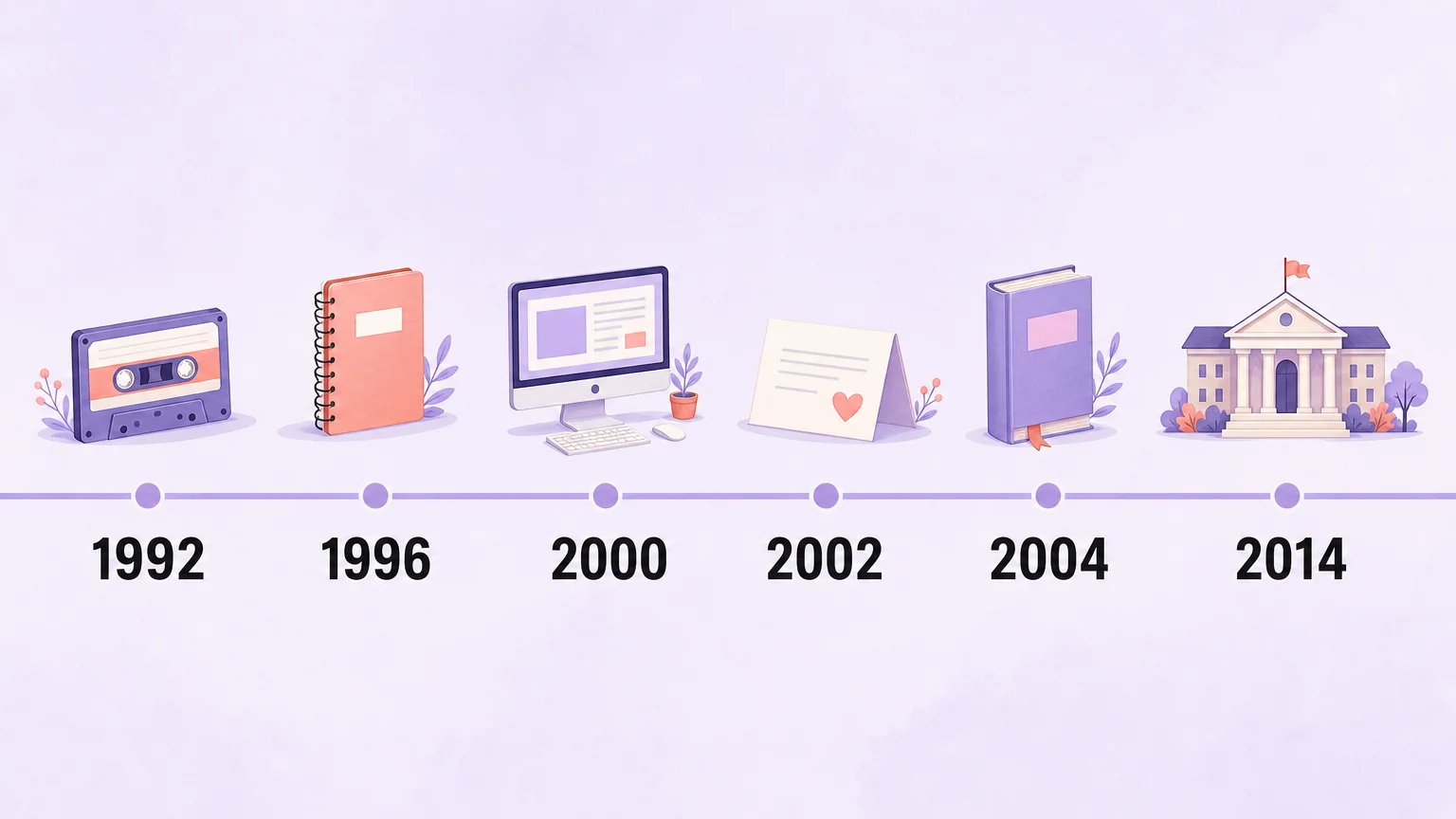
Green’s Dictionary of Slang traces “on the down low” to a 1992 UGK lyric. By 1996, campus slang collections had recorded “the d.l.” as a word for secret. By 2000, Green’s had logged “keep it on the DL” from hip-hop usage.
That is where the written evidence begins. Songs and campus slang collections are where American vernacular often reaches print first.
A dictionary can date the first written use. It cannot date the first spoken one, which came earlier and left no trace. Nothing in those citations supports a precise coinage date, and a confident date is a guess.
The order matters, because the sexual sense is a specialization of the secrecy sense rather than a separate invention. The meaning “a married man who has sex with men” is documented only from the 2000s, including that 2002 American Dialect Society note. The general phrase is older and more common, which is why “keep it on the DL” still sounds ordinary while “he is DL” sounds loaded.
One is a request to be quiet. The other is a claim about how a man lives.
The crossover into mass-market English came through J.L. King’s On the Down Low, published in 2004, and the television appearances that followed. The publisher described the book as exposing “a closeted culture of sex between black men who lead ‘straight’ lives” and promised “the warning signs African American women need to know.” The book was packaged for women as a threat assessment, and that packaging is where the danger framing came from.
King was a man writing about his own past, not a symbol and not the villain of the story.
Academic work on the term took a different route. Jeffrey Q. McCune Jr.’s Sexual Discretion: Black Masculinity and the Politics of Passing, from the University of Chicago Press in 2014, treats the DL as a negotiation with what Black masculinity is expected to be rather than as a pathology. McCune argues that the underground settings were less policed than open gay life, and that they let men keep their public standing as “properly masculine.” His subject is not the scandal but the strategy: men who found a way to keep the life they had while having the sex they wanted.
Read that way, discretion is a strategy rather than a lie, and the men using it are managing a set of expectations that were handed to them long before they decided anything. The word is Black vernacular first, which is why the scholarship starts there.
The HIV Question, Answered With Evidence
The allegation, in blunt form: men on the DL were a transmission engine, carrying HIV into Black women through a bisexual bridge, and secrecy was the mechanism.
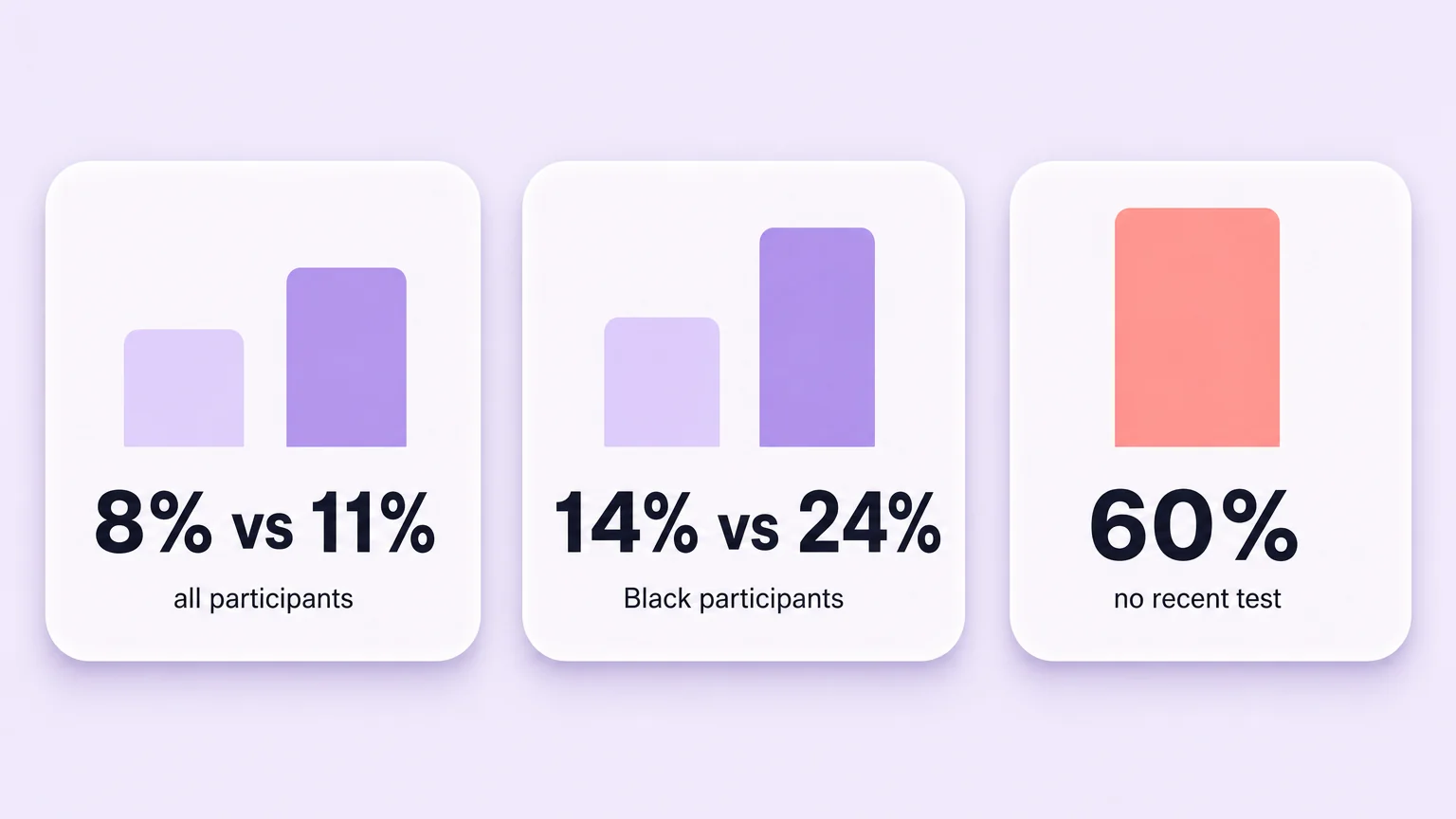
The federal data does not support it. The CDC’s Young Men’s Survey, published in MMWR on Feb. 7, 2003, looked at 5,589 men who have sex with men aged 15 to 29 in six US cities. Of those, 637, or 11%, had not disclosed their sexual orientation. HIV prevalence was 8% among the men who had not disclosed and 11% among the men who had.
Among Black participants, the same gap appeared: 14% against 24%. Men who did not disclose had less HIV, not more, which is the opposite of what the allegation predicts.
The same report contains the findings that do matter. Twenty-seven percent of the men who had not disclosed reported unprotected sex with women in the previous six months. Among men who were HIV-positive, 35% of the nondisclosers had a female partner in that period, against 10% of the disclosers. And 60% of the nondisclosing men had never tested for HIV or had not tested in more than a year.
Read together, those three figures describe a testing gap and a disclosure gap. They do not describe a distinct engine of transmission.
The largest study of the question to that point reached the same place. Bond, Wheeler, Millett, LaPollo, Carson and Liau, writing in the American Journal of Public Health in 2009, studied 1,151 Black men who have sex with men. DL identification was not associated with unprotected anal or vaginal sex with male or female partners. Their recommendation followed from the result: target behavior, not identity.
The label predicted nothing about what a man was doing, and what he was doing is the thing that can be changed.
Two more pieces set the scale. Millett, Malebranche, Mason and Spikes reported in the Journal of the National Medical Association in 2005 that about 2% of the total Black male population reports current bisexual activity. That is a small share of the population to carry a national narrative. In 2008, David Malebranche argued in Archives of Sexual Behavior, in a commentary titled “Bisexually active Black men in the United States and HIV: acknowledging more than the ‘down low’,” that the category was too narrow to carry the epidemic narrative built on it, and that the research agenda had left most bisexually active Black men unexamined.
The takeaway is narrower than either the alarm or the rebuttal. A label is not a behavior. Testing is the part that changes outcomes, and a man who is not out may be years behind on it for reasons that have nothing to do with how many partners he has. Disclosure to a partner is its own obligation, and a separate question from using protection.
The evidence says the word on a profile tells you very little about risk, and nothing at all about any one man.
Is DL an Insult?

The word is descriptive in origin and is not a slur in the way the worst words are. But it is routinely used as an accusation, and the accusation is what makes it land as an insult.
The harm has a shape. People describe the word being thrown at them during arguments with no evidence behind it, as a way to win the argument rather than describe anything. Then the suspicion became content.
DL hunting videos built a genre around spotting a man, complete with checklists, and a checklist turns any behavior into proof. The word stops being a description of a life and becomes a charge that has to be answered.
The people making those videos say they are naming a pattern and warning women, and some of them mean it. The creator behind “He’s Not DL, You’re Just Homophobic” argues the format started fine and well-intentioned and is now largely problematic, because it relabels any bad behavior by a man as secret homosexuality and asks why gay is being used as an insult again. Both readings are held by people who care about the outcome, and there is no consensus yet on which one wins.
Whether the word has been reclaimed is unsettled in the same way. Some men use it about themselves, with humor or with history attached. Some refuse it, and that refusal is ordinary too. In at least one city it has drifted into a status marker, worn on purpose by men who are not hiding at all.
If the word describes your life, the costs are specific and mostly social. They run through family, through church, through the people you came up around, and through what you expect those people to do if they find out.
Some men describe the attraction itself as unwanted rather than liberating, something to pray away or wait out, and that is a different experience from the one where the only problem is other people. Rights do not dissolve any of this. A law can protect your job and still leave you sitting in a car outside your mother’s house, deciding what to say.
What men tend to say afterward is that the rejection they braced for did not arrive. The person they were most afraid of already knew, or took it better than the script in their head allowed.
That does not make the fear irrational, and it does not mean every family reacts well. It means the calculation is usually made with worse information than the situation deserves. What you do with that is yours.
If you are looking for a place to meet people on your own terms, 3Fun is the right place to start.
Frequently Asked Questions About DL
What does DL mean in a text message?
Usually download. DL is an initialism for download as both a noun and a verb, written dl, d/l or D/L, with UL as the opposite. Only the context tells you when the secrecy sense is meant instead: who is texting, and what the message is about.
What does DL mean in gay slang?
A man who presents publicly as straight, often with a girlfriend or wife, while having sex with men. Green’s Dictionary of Slang defines it as “ostensibly heterosexual, married men who enjoy sex with homosexual men.” The word can describe the situation as well as the man inside it.
Is DL the same thing as closeted?
No. A closeted man is not out, and that is the whole of it. A DL man often lives openly as a straight man and hides only the sex, which is a different arrangement with different limits. Discreet is a third word, usually meaning private rather than in denial.
Is calling someone DL an insult?
The word is descriptive in origin, but it is frequently used as an accusation, and that use is what makes it sting. The sharpest criticism comes from inside the community: treating any bad behavior by a man as evidence of secret homosexuality ends up recycling homophobia rather than exposing anything.
What does it mean if a dating profile says DL?
It means he has a public heterosexual life and does not intend to be seen with you inside it. Read it as a limit on what is available, not as a statement about his orientation. It is not the same as discreet, which usually means private.
Are DL men responsible for high HIV rates among Black women?
The federal survey data does not support that. Among 5,589 men who have sex with men in the CDC study, those who had not disclosed had lower HIV prevalence than those who had: 8% against 11%, and 14% against 24% among Black participants. The data does show less testing: 60% of nondisclosers had never tested or had not tested in the past year.
Why do men stay on the DL if being gay is more accepted now?
Because legal acceptance does not change what a man expects from his family, his church or his peers. Some men describe the attraction itself as unwanted and do not see themselves as gay even while having sex with men. Being read as gay still costs men more than it costs women.
Where does the term come from?
From the general Black vernacular phrase for keeping something secret. “On the down low” is recorded from a 1992 UGK lyric, and campus slang collections had “the d.l.” as secret by 1996. The meaning of a married man who has sex with men is a later development, documented in the 2000s. The sexual sense grew out of the secrecy sense rather than arriving separately.