It arrives in a quiet moment: the walk to the car after a service, a family dinner where someone quoted a verse, a question carried since childhood. What does the Bible say about LGBTQ people gets asked by people hurt by an answer and by people trying to understand someone they love.
The disputed material is small. The Center for LGBTQ and Gender Studies in Religion counts three or four clear references to male same-sex love and one possible reference to female same-sex love, a count from an affirming center that traditional scholars do not seriously dispute. What divides readers is how to read them.
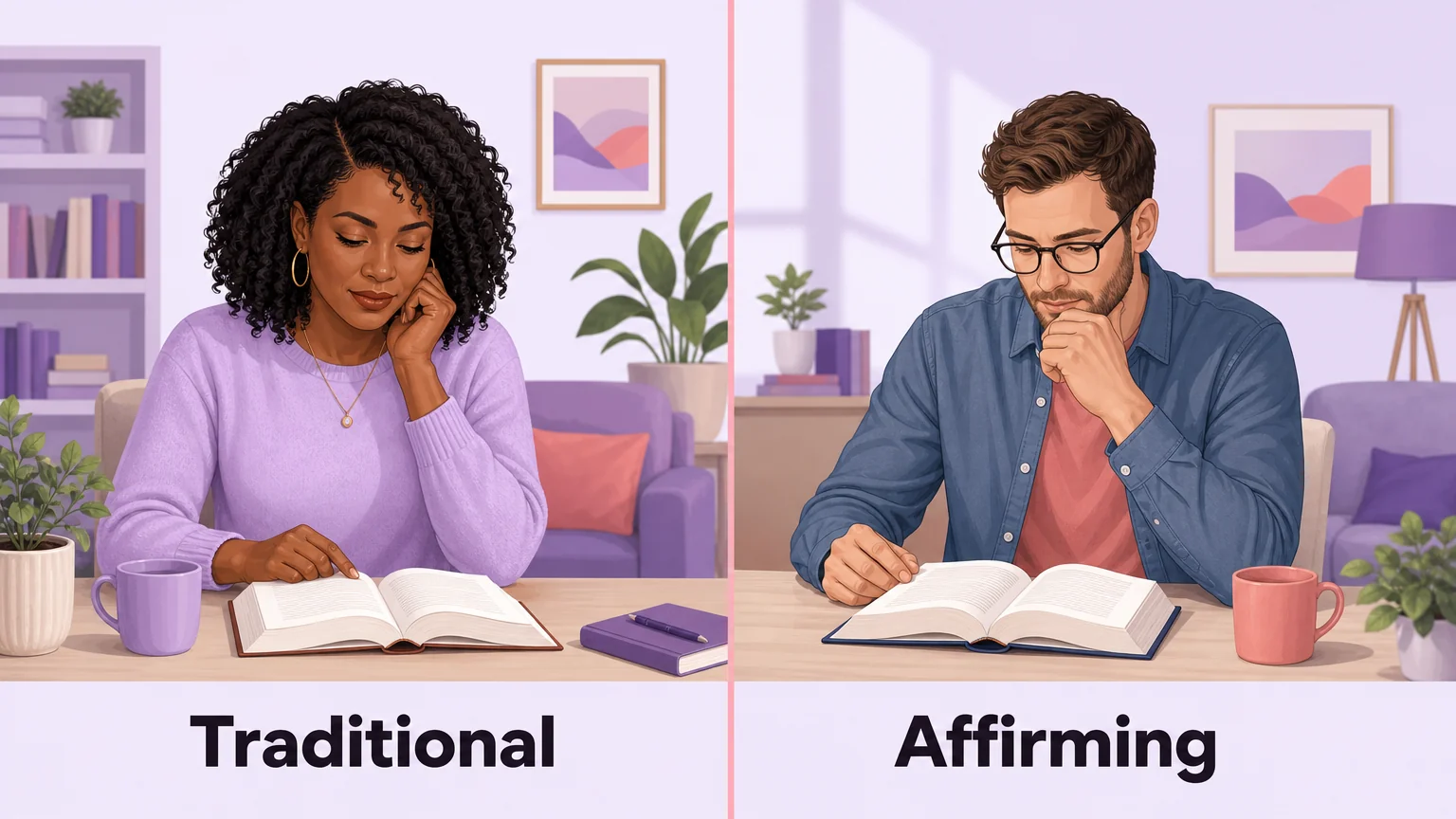
Two terms carry the rest. Affirming readers treat the prohibitions as culturally bounded and bless same-sex marriage. Traditional readers hold the prohibitions binding. Below, every contested passage gets both readings and the names of who holds them, then where the churches stand and what this means for a life.
Is Being LGBTQ a Sin? Orientation, Behavior, and the Question Behind the Question
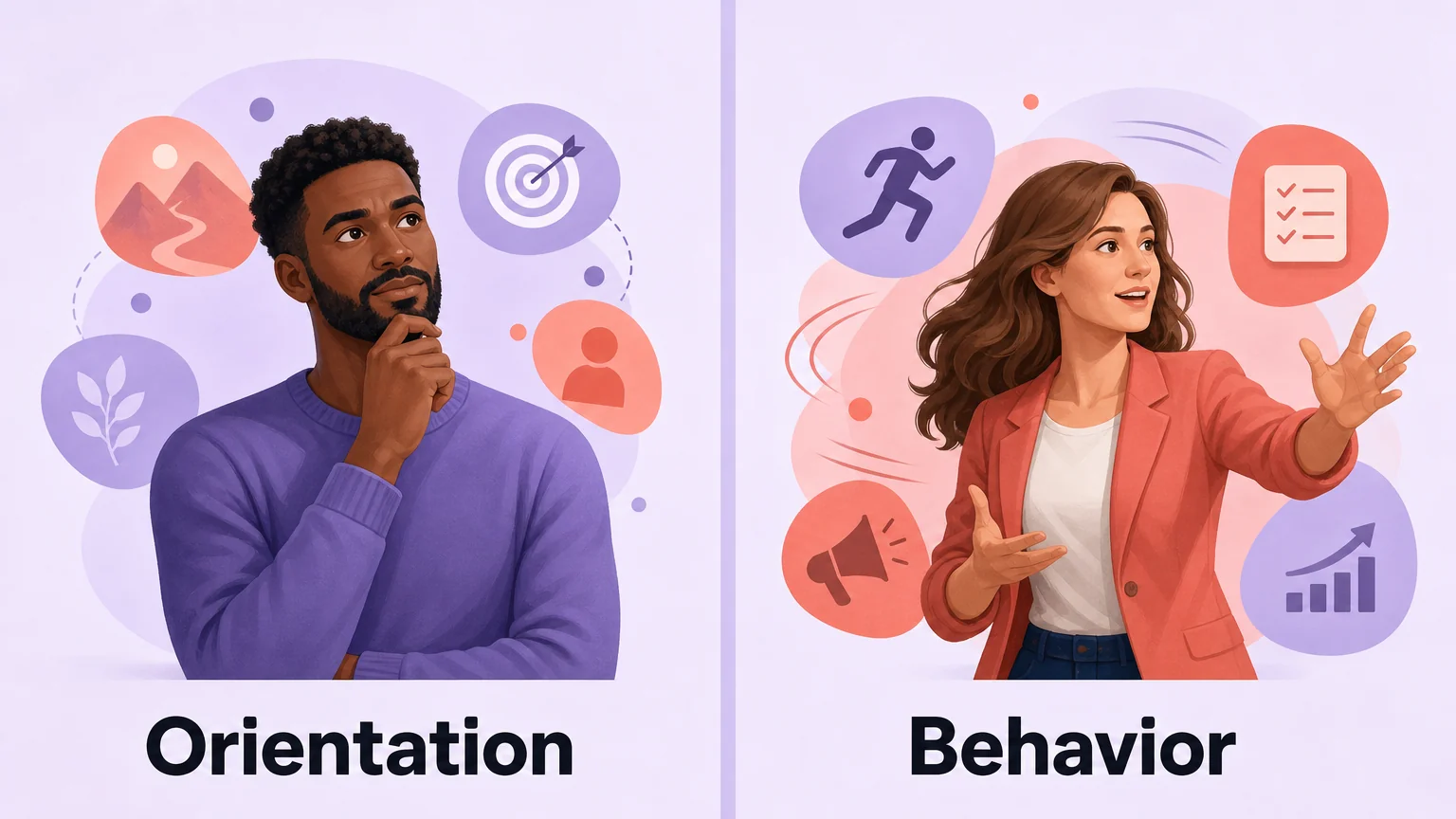
The question carries two different things inside it, and they come apart under pressure. Being LGBTQ is not the same question as having same-sex sex. No biblical passage addresses sexual orientation as a category, because the ancient world had no such category. Every word translated homosexual in a modern English Bible names an act or a role, never a durable orientation.
That matters most for the reader asking whether they are condemned for existing. The texts do not directly address that question, and someone answering it with a verse about an act has quietly swapped in a different one. The mismatch is felt long before it can be named.
Three positions exist, and each has serious holders.
Affirming readers, often called side A, treat the prohibitions as culturally bounded and bless same-sex marriage. Most mainline Protestant bodies hold this reading.
Side B treats the orientation as real and not sinful while reserving sexual expression for male-female marriage. Wesley Hill, David Bennett, Sam Allberry and Pieter Valk write from inside it, and their books are less about rules than about friendship, singleness and belonging.
Side X holds that the orientation itself should be resisted or changed. Conservative bodies increasingly reject it, as does every affirming one, and it is named here because it is the position many queer readers were raised on. The rhetoric it produced has done damage that traditional advocates such as Christopher Yuan now concede.
The lexical gap is not a debating trick. Dan McClellan notes that arsenokoitai names the insertive partner in male same-sex intercourse, while malakoi names the receptive partner. Neither word touches orientation. Neither covers women.
Then there is Richard Hays. His 1996 chapter in The Moral Vision of the New Testament called homosexuality “one among many tragic signs that we are a broken people,” and for nearly three decades it supplied conservative evangelicals with their strongest academic citation. In 2024, at 75, he reversed himself in The Widening of God’s Mercy, written with his son Christopher.
Robert Gagnon said the two were “now swimming in the sea of heresy.” Denny Burk said he was “deeply grieved.” The fight happened inside the traditional camp, which locates the dispute inside the tradition rather than between camps.
This article will not answer yes or no on its own authority. Traditions answer differently. A reader who wants a single verdict will have to choose a tradition rather than a verse.
Genesis 19, Judges 19, and Jude 7: What the Sodom Story Says and Does Not Say
Start with the detail most readers have never heard. The Bible comments on Sodom itself, and it names a different sin. Ezekiel 16:49 gives the city’s iniquity as pride, fullness of bread, abundance of idleness, and a failure to strengthen the hand of the poor and needy.
The narrative in Genesis 19:1-11 describes a crowd surrounding Lot’s house and demanding that he bring out his two visitors so they may know them. It is an attempted gang rape of guests. The men of the city press the demand, Lot offers his daughters in their place, and the visitors pull him back inside and strike the crowd blind.
Judges 19:22-30 gives a near-parallel at Gibeah, where a Levite’s concubine is gang-raped through the night and dies, and he cuts her body into pieces. That second story almost never enters the debate, which is itself information about which texts the argument keeps.
Jude 7 is the strangest of the three. It says Sodom and Gomorrah gave themselves over to fornication and went after strange flesh, sarkos heteras in Greek. Interpreters divide over whether strange flesh means same-sex flesh or the non-human flesh of angels, a division that runs back to the earliest commentaries.
Both readings have serious holders. The traditional reading, argued at length by Robert Gagnon, treats the narrative as confirming the prohibition, with the violence as a symptom of a disordered city, and notes that the whole city arrives rather than a fringe. The affirming reading, given its standard scholarly form by John Boswell, argues from the prophets more than from the narrative: the sin is a violation of hospitality, violence against guests, and social injustice, and Ezekiel is the canon interpreting its own story.
One historical correction cuts against the popular version of both readings. Philo of Alexandria and Josephus were the first recorded writers to identify Sodom’s sin as homosexual practice, in the first century, and by the end of that century the association was common.
The sexual reading is ancient. So is the injustice reading. Neither camp invented its position in the last fifty years.
So each side concedes something. The traditional reading grants that the city’s own prophet named injustice. The affirming reading grants that the sexual association is as old as Philo.
What remains is genre. Narrative shows rather than legislates, so both sides argue from this story instead of citing it, and the same text carries both readings without either being dishonest.
Leviticus 18:22 and 20:13: The Holiness Code and the Two Readings
The shellfish question is already in your mouth, so take it first. Robert Gagnon distinguishes symbolic regulations, such as the food laws, from the sexual ethics of Leviticus 18 and 20, which he reads as moral. His reason is the company those verses keep: the incest prohibitions sit in the same chapters, and everyone treats them as moral, including the readers who want the food laws released. Nobody reads the ban on sleeping with your own flesh as a ceremonial rule.
The affirming answer deserves the same care. Loren Johns reads the whole Holiness Code as a purity system separating Israel from Canaan, a system Jesus rejected as a whole. On that reading, the shellfish comparison is the argument itself. James Brownson supplies the method underneath it: separate what a text says from what it means, identify the moral logic the command served, and apply the logic rather than the wording when the setting has changed.
The Hebrew rewards attention. Leviticus 18:22 reads w’eth-zakhar lo’ tishkav mishkeve ‘ishsha, literally and with a male you shall not lie the lyings-down of a woman. The noun mishkeve appears only here, at 20:13, and at Genesis 49:4, where Reuben sleeps with his father’s concubine. K. Renato Lings and Saul Olyan build an incest reading on that parallel: the phrase may name a specific prohibited relation rather than a general category, and English translations supply prepositions the Hebrew does not have.
Gagnon’s larger framework explains why he thinks the incest parallel cuts his way. Sex, he argues, is ordered to a union of difference, and same-sex intercourse consummates a union of too much likeness, in the same family of reasoning that forbids incest. Affirming readers reply that the text states the prohibition without stating its reason, so the logic comes from the reader rather than the page.
Genre does more work than any single word. This is legal material inside the Holiness Code, Leviticus 17 through 26, addressed to Israel rather than to everyone. Leviticus 20:13 prescribes death for both parties, the detail readers feel aimed at them, and no major Christian body applies it. Rabbinic interpretation in the Mishnah and Talmud extended the prohibition to women even though the Hebrew Bible never mentions female same-sex relations, a point Michael Coogan makes plainly.
So name what each reading has to carry. The traditional reading has to defend a judgment call about which laws bind, because the text never labels its own laws ceremonial or moral. The affirming reading has to explain why Paul would cite a law he considered fulfilled. Neither burden is fatal, and neither is small.
Romans 1:26-27: An Argument, Not a Proof Text
Romans is different from everything before it. It is the only biblical passage that may describe female same-sex relations. It is a sustained argument rather than a lone prohibition. And it comes from the same author whose letters get quoted on both sides of nearly every other question, which is why it carries so much weight.
The plain reading was not uniform, even early. Clement of Alexandria and John Chrysostom took the passage as female and male same-sex intercourse. Augustine read it as anal sex in both heterosexual and homosexual acts, which is a different referent again.
The precise meaning of verse 26 was contested from the start. That does not settle anything, but it does discipline any claim that one reading is simply obvious.
Read the grammar before the reputation. Romans 1 describes a group exchanging something for something else, which presupposes a prior state, and Paul is writing to a congregation he has not yet met. Who he means in verse 26, and whether he means anyone in the room, are separate questions from what the words say.
The traditional case, at its strongest, is Robert Gagnon’s: the passage is Paul’s own theological argument about creation, exchange and the ordering of desire, not a borrowed polemic. Wesley Hill, drawing on Simon Gathercole, describes idolatry and same-sex sex as sharing a structure of turning from the other to the same, which is why the passage sits where it does in Paul’s argument. Hill also charges Brownson with skipping Bernadette Brooten’s Love Between Women, the major study of verse 26, and says skipping a book is not the same as answering it.
The affirming case, at its strongest, reads Romans 1:18-32 as a summary of Hellenistic Jewish moral rhetoric that Paul turns against the Roman readers themselves in Romans 2, making the passage a setup rather than a settled teaching. That reading leans on vocabulary found nowhere else in his letters. James Brownson reads the passage as describing an excess of desire, a craving that consumes, rather than a faithful partnership, and applies his say/mean method to the moral logic rather than the wording.
Be precise about standing. The rhetorical reading remains a minority position, though a serious one argued in mainstream scholarship rather than at the margins.
So each side carries a burden. The traditional reading has to hold that an argument about creation binds a category of person Paul had no word for. The affirming reading has to say what the passage describes if not a faithful partnership, and why a setup reads so much like a verdict.
Malakoi and Arsenokoitai: The Words Behind the Vice Lists
Two Greek words carry most of the weight in 1 Corinthians 6:9-11 and 1 Timothy 1:10, and both are stranger than the English suggests.
Malakoi means soft. In Matthew 11:8 and Luke 7:25 it describes soft clothing. Applied to men it was a pejorative for effeminacy, and in the pairing it is usually taken as the receptive partner.
Arsenokoitai compounds arsen, male, and koite, bed, with a sexual connotation. Its first recorded use is by Paul. It is unattested in contemporaneous Greek, and most scholars think he coined it from the Septuagint of Leviticus 20:13. If he did, he is pointing at that prohibition, and the argument becomes about what the prohibition meant rather than what the word means.
Dan McClellan is precise about the reach. The word names the insertive partner only, makes no reference to female same-sex intercourse, and therefore does not mean homosexual as a category. John Boswell built the countercase: later uses clearly do not mean homosexuality, including John the Faster applying the word to men with their wives, which is why some scholars read the vice list as targeting pederasty and cultic prostitution, the practices the ancient world knew. Traditional readers answer that the list names the act and that the paired words cover both parties.
The stakes are concrete. If the two words name an act-role pair the ancient world recognized, a modern couple is not obviously what they describe. If they name the act itself, as traditional readers hold, the reach is wider than any role. Neither side disputes the Greek; they dispute what to do with the gap between it and the English word.
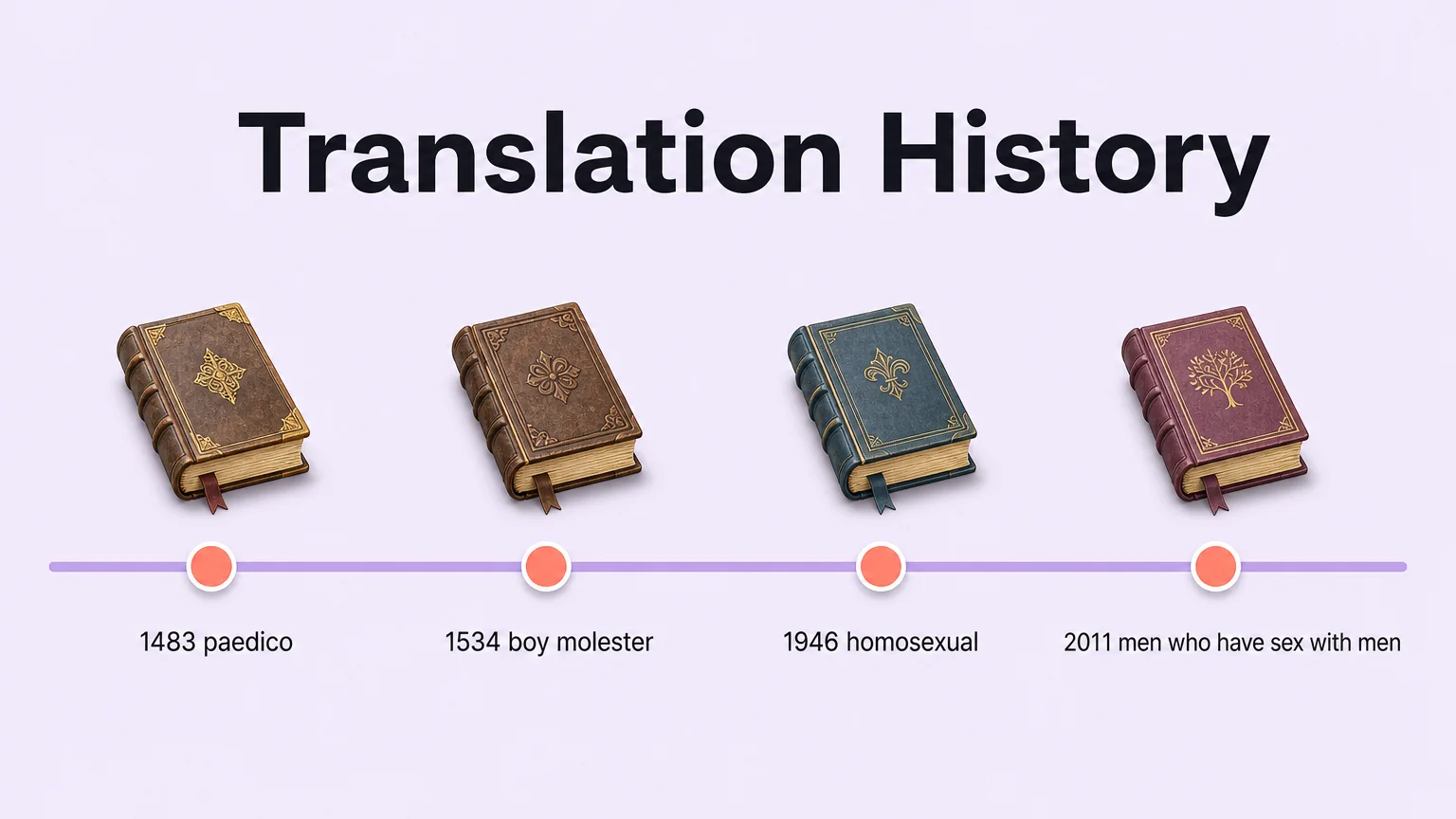
The translation history is checkable, and it is stranger than the slogan. The King James has abusers of themselves with mankind. Luther’s 1534 German has knabenschander, boy molester, and that rendering carried through centuries of German Bibles; the first German Bible to use homosexual appeared in 1983.
Swedish Bibles of 1674 and Norwegian Bibles of 1830 have boy molesters. A 1483 Latin lexicon has paedico. The 1946 RSV is the first English Bible to use homosexual, at 1 Corinthians 6:9. The NRSV has sodomites, the 2011 NIV men who have sex with men, the NET practicing homosexuals.
Ed Oxford, whose archival work produced this history, calls the RSV committee’s decision “an honest mistake.” The concession matters, because it turns a plot into an error. The error still matters.
The passage ends on a hinge both camps read differently: and such were some of you. One reading hears cleansing. The other hears a list of past identities that says nothing about a faithful relationship.
What Jesus Said, and What He Didn’t
Nothing is recorded in the gospels about same-sex acts or orientation. It is a real absence, not a trick of translation, and it holds across all four gospels. For a reader raised in church, that is the loudest fact here. Bart Ehrman puts it bluntly: Jesus “says nothing about same-sex acts or sexual orientation. Nothing. Nada.”
The standard traditional reply holds that silence is not absence. Denny Burk points out that Jesus was silent on many ethical questions, including ones his readers care about, and that silence does not make his teaching irrelevant. Burk adds that Jesus did speak about sexual immorality in general, in Matthew 5:28 and 15:19, and about marriage in particular.
That second claim rests on one exchange. In Matthew 19:4-6 and Mark 10:6-8, Jesus quotes Genesis 1:27 and 2:24 while answering a question about divorce. Robert Gagnon argues the back-to-back citation presupposes a two-sex requirement for marriage, and that Jesus is doing more than quoting precedent. Ehrman argues he is answering a divorce question, not defining marriage, and that reading a sexual-orientation ethic into the exchange is inference rather than citation.
Burk frames the dispute this way: the argument is about what the citation does, not about whether it happened. He also names the “Jesus versus Paul” framing a “hermeneutical cage match” that makes the black letters subordinate to the red ones.
Then there is Matthew 19:12, which names three kinds of eunuchs: those born that way, those made eunuchs by others, and those who make themselves eunuchs for the kingdom of heaven. John J. McNeill calls the first category the closest description in the Bible of what we understand today as homosexual. Clement of Alexandria, in Stromata, cites Basilides making a similar point about men naturally averse to women, an argument older than the modern debate.
The limit matters. The saying concerns celibacy rather than partnership, which is why side-B readers use it as readily as affirming ones, and why it cannot settle the question by itself.
Traditional readers hear the silence as silence rather than permission, and the citation as a reaffirmation of the male-female pattern. Affirming readers treat the silence as the plain fact it looks like, the citation as an answer to a divorce question, and the eunuch saying as closer to their lives than the prohibitions are. The disagreement runs on inference the whole way down, and neither reader has to be dishonest to land where they do.
The Passages That Point the Other Way
The Bible contains more than prohibitions. The texts cited in the other direction are real, and they are messy in ways that matter.
David and Jonathan first. In 1 Samuel 18 and 20 they make a covenant, and Jonathan strips off his robe and armor and gives it to David. In 2 Samuel 1:26 David says Jonathan’s love was passing the love of women. That line arrives inside a funeral song for Saul and Jonathan, which is part of why the emotional register runs so high.
Theodore Jennings reads erotic desire in the relationship. Michael Coogan rejects the romantic reading outright: the text never describes a sexual act, and the emotional language of ancient Near Eastern covenant friendship is not modern romance. Most scholars read it as intense platonic friendship.
The text is emotionally extravagant and never sexual, and both are true at once. That is why the passage keeps getting claimed.
Ruth and Naomi second. Ruth 1:14 says Ruth clung to Naomi, dabaq in Hebrew, the same verb used in Genesis 2:24 for a man being united to his wife and in Genesis 34:3 for Shechem being drawn to Dinah. Ruth 1:16-17, where you go I will go, is used in Jewish heterosexual wedding ceremonies to this day.
The book is a story about two widows and a loyalty that outlasts both their husbands. Thomas Horner puts it precisely: whether there was physical love between them cannot be demonstrated, but the right words are there. Coogan adds the correction that cuts the other way: the Hebrew Bible never mentions lesbianism at all, so any claim that it condemns or celebrates it overstates the text.
These passages support a mood rather than a proof, and both sides use them that way, which is why they are worth naming and not worth building a case on. A reader who has been told the Bible has nothing to say about love between people of the same sex has been told something too simple.
Do Christians Support LGBTQ People? Where the Churches Actually Stand
Whether God supports LGBTQ people is not a question a survey can answer. Whether churches do is, and the numbers move faster than most readers expect.
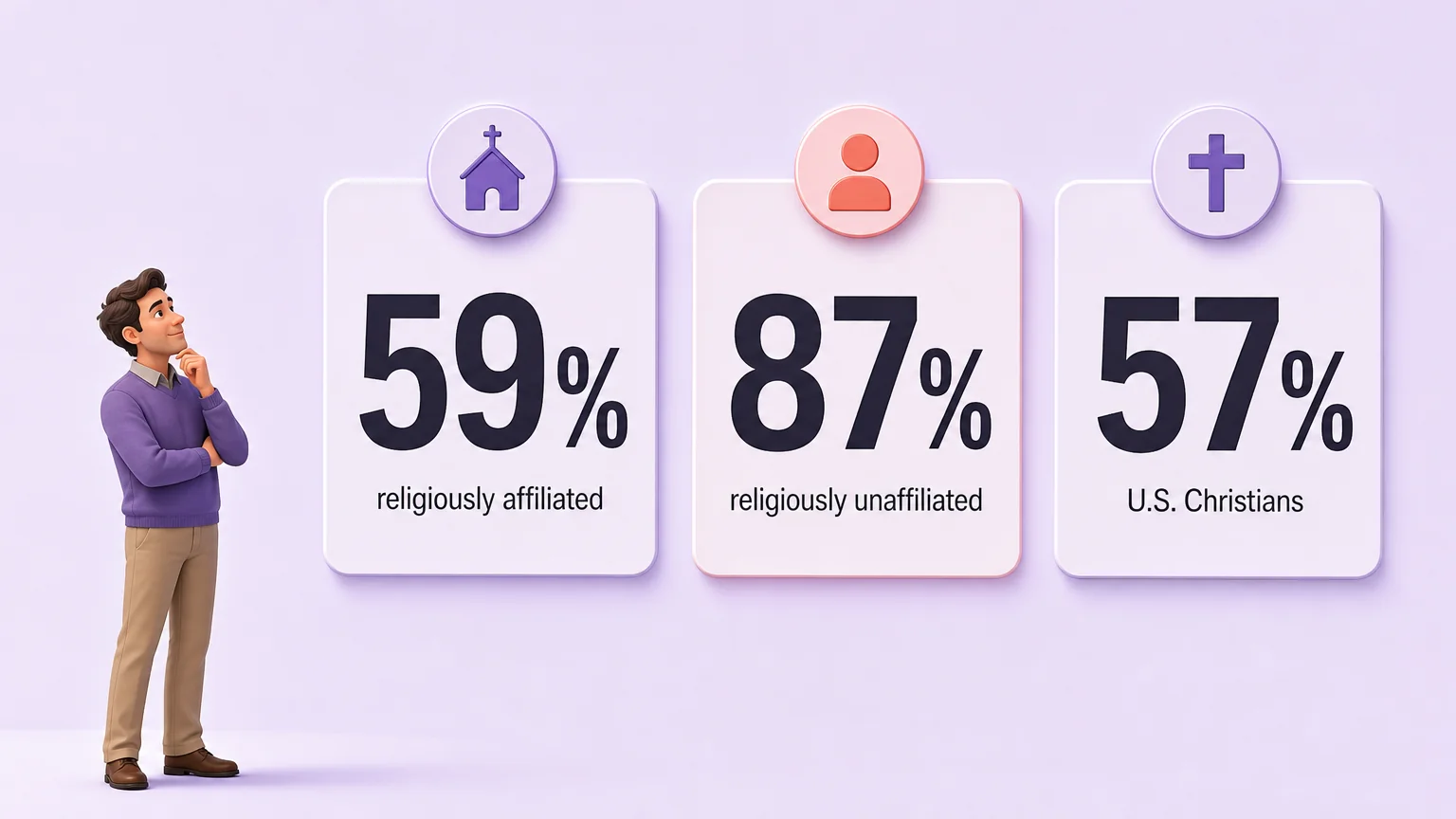
In Pew Research Center’s 2023-24 Religious Landscape Study, 59% of religiously affiliated U.S. adults say homosexuality should be accepted by society, up from 55% in 2014 and 46% in 2007. Among the religiously unaffiliated the figure is 87%, and among U.S. Christians overall it is 57%.
Most evangelical Protestants say homosexuality should be discouraged. Most Catholics, mainline Protestants and historically Black Protestants say it should be accepted.
The institutional timeline is short. The United Church of Christ ordained openly gay minister William R. Johnson in 1972 and affirmed marriage rights in 2005. The ELCA allowed partnered gay and lesbian pastors in 2009.
The Presbyterian Church (U.S.A.) opened ordination in 2011 and redefined marriage in 2015, and the Episcopal Church authorized marriage rites for any couple the same year. The United Methodist Church removed its bans on same-sex marriage and gay clergy at its General Conference in April and May 2024.
Every move produced a breakaway. The Anglican Church in North America formed in 2009, the North American Lutheran Church in 2010, the Evangelical Covenant Order of Presbyterians in 2012, the Global Methodist Church in 2022. The Roman Catholic Church, the Southern Baptist Convention, the Lutheran Church Missouri Synod and the Presbyterian Church in America have kept the traditional reading.
Globally the picture differs sharply from the American one, and that difference keeps producing fractures inside denominations that voted the other way at home. The answer is a map, not a verdict.
If You Are the One Asking: Family, Faith, and What Comes Next

Start with a mother rather than a statistic. David Bennett, an Oxford-trained ethicist who is gay and celibate, describes telling his mother and being asked whether he had got someone pregnant or was on drugs. Then she wept, because she realized the suffering ahead of him. That is a truer picture of many families than the rejection narrative alone, and it gives a reader somewhere to stand.
The evidence here is unusually specific. A 2009 study in Pediatrics by Ryan, Huebner, Diaz and Sanchez followed 224 white and Latino LGB young adults aged 21 to 25. Higher family rejection in adolescence predicted suicide attempts at 8.4 times the rate, high depression at 5.9 times, illegal drug use at 3.4 times and unprotected sex at 3.4 times, with Latino men reporting the most negative family reactions. A Cornell University review of 42 peer-reviewed studies found 25 linking parental acceptance of a child’s orientation specifically to health and wellbeing, and its summary judgment is blunt: rejecting behavior raises the risk of significant harm.
Ryan’s recommendations are behavioral rather than theological, which is the useful part for a parent. Assess what a family actually does, teach which behaviors cause harm, prepare parents before disclosure where possible, and refer the family for counseling.
Four voices show how far the human stakes outrun the argument. Christopher Yuan, speaking from inside the traditional camp, describes his years as a gay man, when he felt Christians were telling him that gays and lesbians deserved a hotter place in hell, and he uses Proverbs 6 to argue that abomination is not a word reserved for this sin.
Jimmy Hoke answered that Richard Hays had profited off queer bodies like his for decades. Leaving is not an unreasonable outcome, and you may already have left. Wesley Hill concedes that no exegetical defense will persuade until there are communities where gay Christians are visibly loved and supported in celibacy. Bennett finds sacred space in the pub and on the dance floor as well as in church.
So what do you do this week, whether you stay, leave, or are still deciding? Find one person you can say the whole thing to. Read one passage with both readings in front of you rather than one.
If you are the parent, change what you do before you change what you believe. And when you want company rather than argument, 3Fun is a place to meet people.
FAQ
Is being LGBTQ a sin?
No biblical passage addresses sexual orientation as a category. The ancient world had none, and every word translated homosexual in a modern Bible names an act or a role. Traditions that read the act prohibitions as binding say the acts are sin and the orientation is not. Traditions that read them as culturally bounded say neither is.
Can you be gay and a Christian?
Yes, though what that means differs sharply. Side A affirms same-sex relationships and marriage. Side B affirms the identity and holds to celibacy. Side X treats the orientation as something to resist, a position increasingly rejected by conservative bodies and by all affirming ones.
Did Jesus say anything about homosexuality?
Nothing is recorded. He quotes Genesis 1:27 and 2:24 while answering a question about divorce in Matthew 19:4-6 and Mark 10:6-8. Robert Gagnon reads that as a two-sex requirement for marriage. Bart Ehrman reads it as an answer about divorce, and both halves are real.
Why do Christians quote Leviticus 18:22 but eat shellfish?
Because they sort biblical law into categories, and the sorting is the argument. Robert Gagnon treats the food laws as symbolic and the sexual prohibitions beside them as moral, since nobody reads the incest bans as ceremonial. Loren Johns reads the whole Holiness Code as a purity system Jesus rejected.
Was the word homosexual added to the Bible in 1946?
In English, yes. The 1946 RSV is the first English Bible to use it, at 1 Corinthians 6:9, where older translations said boy molesters or abusers of themselves with mankind. Ed Oxford, who did the archival work, calls the decision an honest mistake rather than a plot. Translation choices, not the Greek alone, produced the wording.
Do most Christians actually accept LGBTQ people?
In the United States, 59% of religiously affiliated adults say homosexuality should be accepted by society, and 57% of Christians overall, according to Pew Research Center’s 2023-24 Religious Landscape Study. Most Catholics, mainline Protestants and historically Black Protestants say accepted. Most evangelical Protestants say discouraged. The global picture differs sharply from the American one.