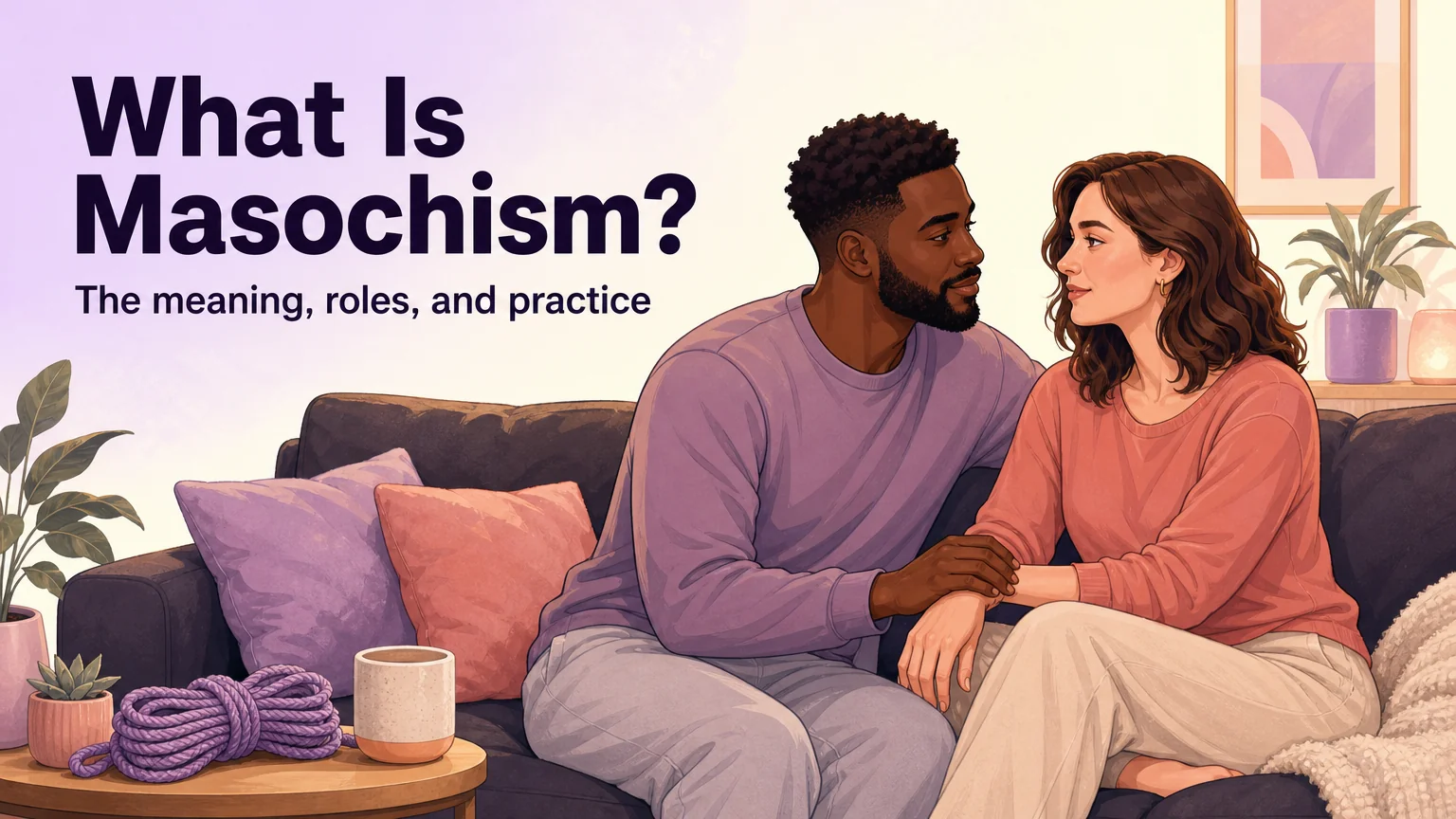
Masochism is the practice of getting pleasure, relief, or deep satisfaction from receiving pain, restraint, humiliation, or other intense sensation. In BDSM it happens inside a scene that both people agreed to, and that agreement is what changes how to read everything else.
The masochist meaning is narrower than the word’s reputation. Strip it down and a masochist is someone who likes receiving. If the question is what is a masochist, the answer is not a person with a high pain tolerance.
Ask people who practice it and you rarely hear about endurance. You hear about a change of state: a way to stop thinking for an hour, a door out of your own head.
Three things get tangled here. The word is not a synonym for submissive. It is not the everyday word for self-sabotage or martyrdom. And it is not a diagnosis.
What follows is what masochists get from it, how they negotiate before a scene, how the body and the mood recover afterward, and how to say it out loud to a partner.
What Masochism Means in BDSM, and What It Doesn’t
The DSM-5-TR, psychiatry’s diagnostic manual, defines sexual masochism as recurrent, intense sexual arousal from being humiliated, beaten, bound, or otherwise made to suffer, expressed through fantasy, urge, or behavior. Read that closely and notice what it does not contain. It does not name an act. It names a direction: arousal that comes from receiving.
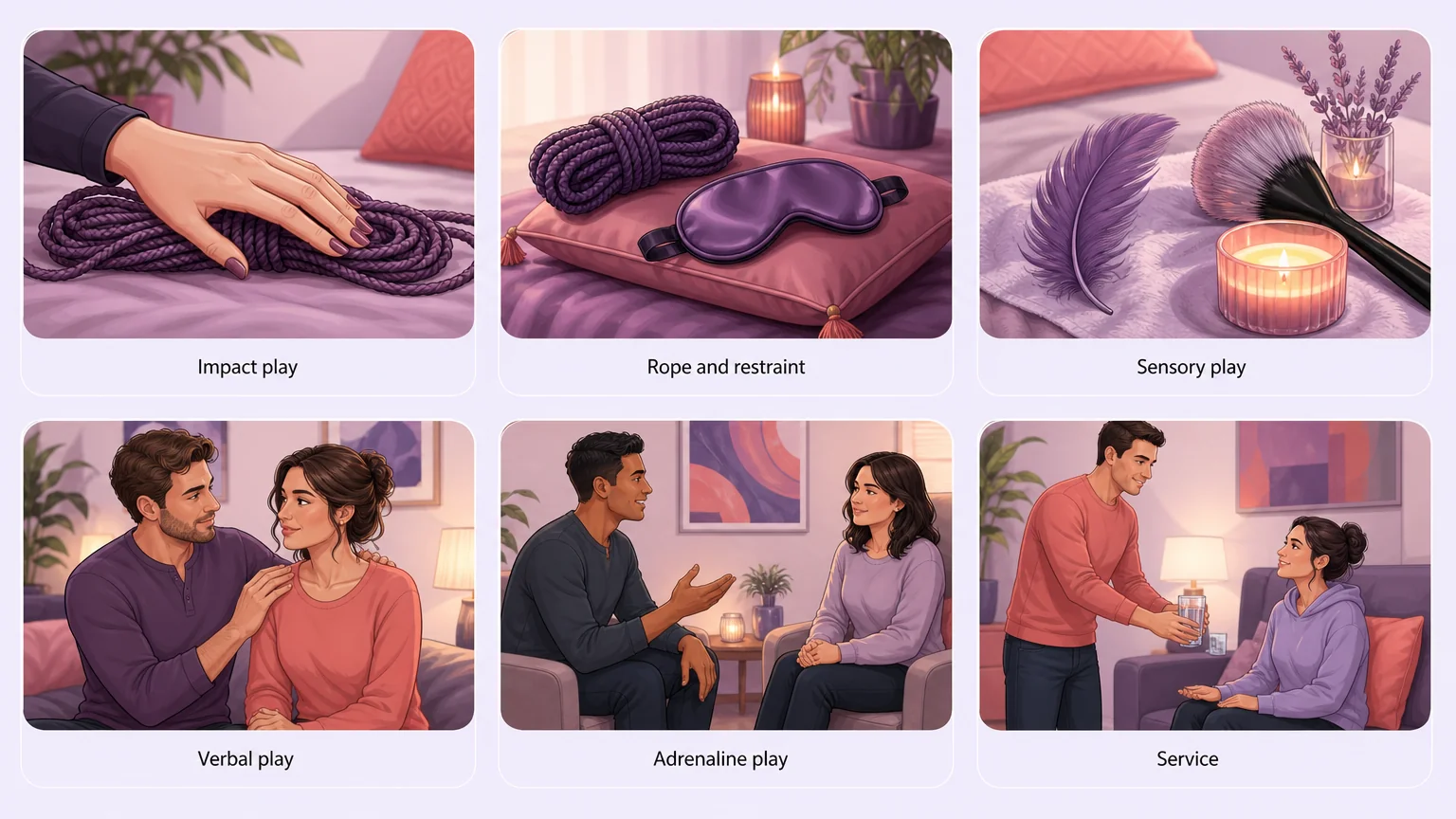
In a room, that direction can look like several different evenings. Impact play with a hand, a paddle, or a flogger. Rope and restraint. Humiliation and degradation, which are verbal and leave no marks. Fear play, where the charge is adrenaline rather than pain. Sensory overload, or deliberate deprivation. Service, where the intensity is in the effort rather than the sensation. Two masochists can want scenes that share nothing but the direction of travel.
The everyday use of the word is a different thing wearing the same coat. People call themselves masochists for staying in a job they hate, sabotaging a good relationship, or treating self-denial as a personality. That is a metaphor about self-defeat. The kink version is chosen, eroticized, and shared, and mixing the two is how a preference gets mistaken for a problem.
The numbers are shakier than they look. Survey results can differ by more than an order of magnitude depending on the question. Fantasy, interest, and activity in the past year are three different measurements, and they get reported as if they were one.
A single headline figure tells you more about the question than about the people who answered it. You do not need a percentage to know whether a word describes you.
Masochist, Submissive, Bottom, Switch: What the Labels Mean
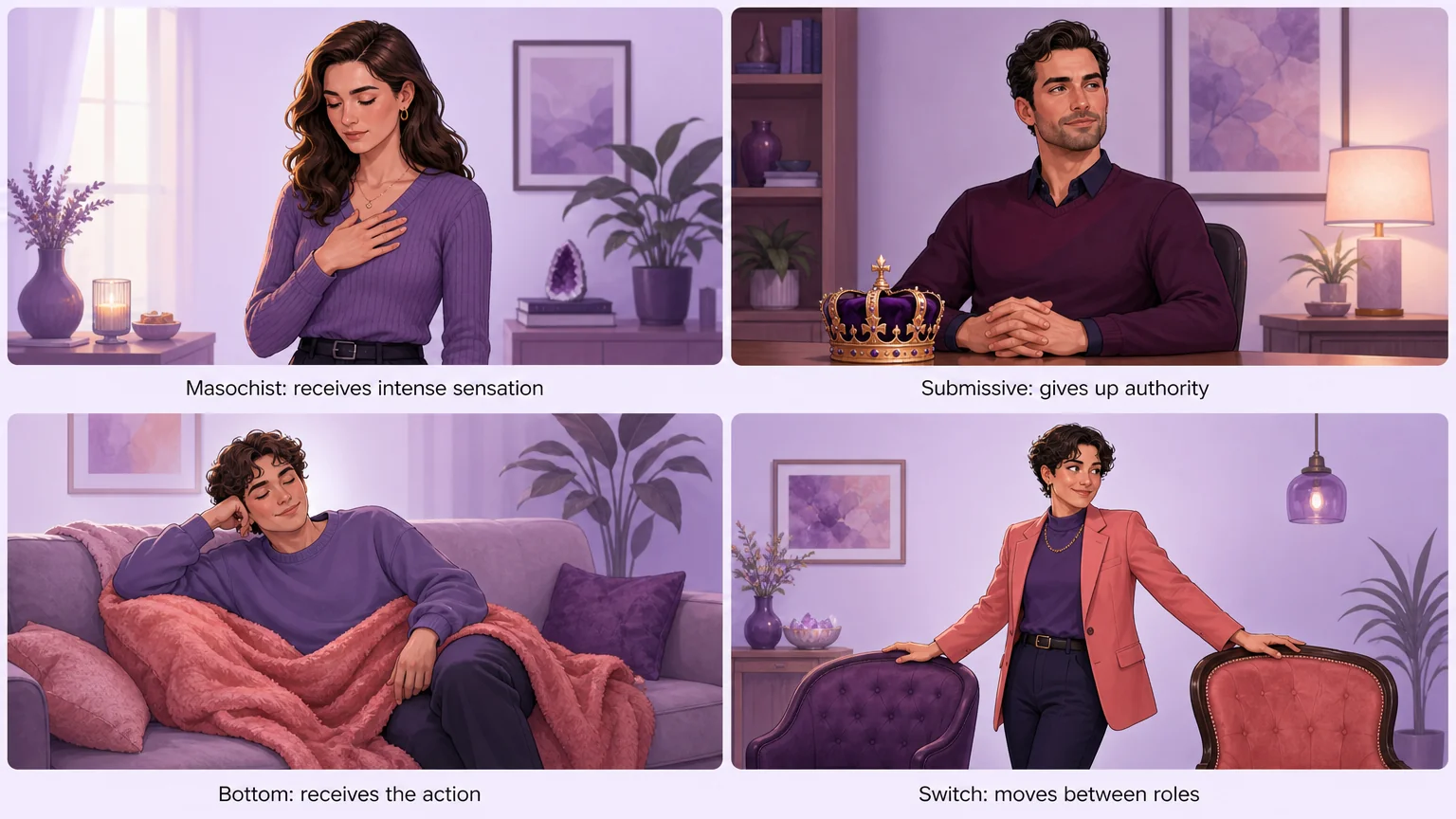
The sentence masochists hear most often is the one they like least: so you’re submissive. It sounds like a summary. It is a category error.
Two axes sit underneath that sentence, and they answer different questions.
The first is sensation and action. Top or bottom: who gives the intensity and who receives it. Sadist or masochist sits on the same axis, naming who enjoys inflicting intense sensation and who enjoys receiving it. This axis says nothing about who is in charge.
The second is authority. Dominant or submissive: who holds the power and who follows. This axis says nothing about who likes pain.
They are independent, and the community has a shorthand for the split. Janet Miles, a longtime kink writer, put it in a line that stuck: “I’ll count strokes but I won’t say ‘Sir’.” She is a masochist who does not do power exchange.
The labels are common enough to matter. Surveys of practitioners usually put the bottom side ahead of the top, and switches are a substantial minority rather than an edge case. A switch moves between roles with the partner and the context, and it is not indecision.
The labels earn their keep in practice. A pain limit is not an obedience limit. A partner who assumes one implies the other will negotiate the wrong scene, then feel betrayed by a limit that was never about them. You are allowed to want intensity with no protocol at all, or the protocol without much pain, or both with the same person.
What Masochists Get From It, and Why Pain Can Feel Good

The appeal is not toughness. That is the thing outsiders get wrong most often.
A 2021 study in the Journal of Sex Research drew on accounts from 227 people who practice sexual masochism or submission. It found 16 themes: eight about origins, eight about reasons for engaging. The origins split between intrinsic and extrinsic, and many described the interest arriving early in life. The reasons clustered into three: interpersonal power, the experience of physical pain, and a change in state of mind.
The third is the one people underestimate. Ask a masochist to describe a good scene and you often hear about a place rather than a sensation. Focused. Floaty. Quiet in a way ordinary life is not. The researchers read that as a preferred way of changing how you feel.
The biology is suggestive rather than settled. In a small pilot study, 35 couples were tested around a scene. The submissive partners showed rises in cortisol, a stress hormone, and in endocannabinoids, the body’s own cannabis-like chemicals. The dominant partners showed the endocannabinoid rise only when the play involved power play.
The authors read the pattern as a positive stress response. It was a small, self-selected group, so treat the chemistry as a sketch. Clinical educators with AASECT, the professional body for sex therapists, warn that popular nervous-system explanations are usually oversimplified.
There is a paradox in the middle of it. The person receiving is the one who set the limits and can stop the scene. Surrender that is chosen reads as safe rather than helpless, which is why it can land as relief.
One distinction matters. Some bottoms endure intensity as an act of devotion to a partner rather than for their own pleasure. Kink educator Evie Lupine points out that those people are not masochists at all, and the difference matters when you work out what you want.
Negotiation, Limits, and Safewords: How Consent Works in Practice
The conversation is the skill. Not the flogging or the rope. People who do this well talk about it clearly, and they do it before anyone is undressed.
Do it early. Negotiation can happen an hour before play, a day before, or a week before, which leaves the scene free to be spontaneous. Brandon the Dom, a BDSM educator, frames the job as consent and safety, not atmosphere, and anchors on expressed, informed consent rather than implied consent read from body language. Implied consent is guessing from enthusiasm, and it is where most trouble starts.
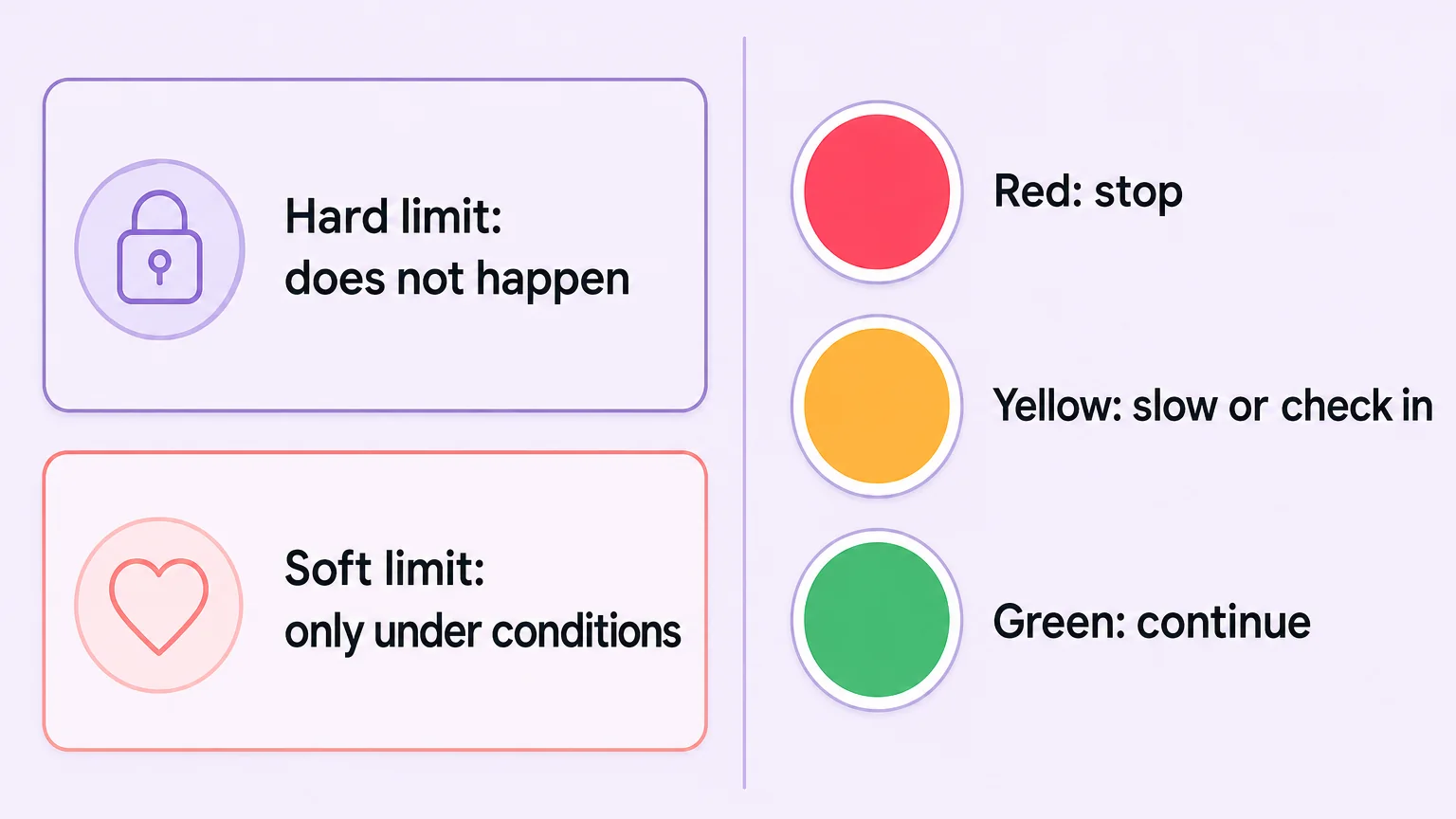
Limits come next. A hard limit does not happen: no breath play, nothing on the neck, no marks above the collar. A soft limit happens only under conditions: fine with a partner you trust, fine at lower intensity, not on a night you have been drinking. Name both out loud.
A casual partner who says they have no limits is not offering freedom. Outside an established total power exchange, that answer is treated as edge play, and in casual kink it usually reads as a reason to slow down.
Two frameworks circulate, and each needs only a clause. SSC stands for safe, sane, consensual. RACK stands for risk-aware consensual kink, which accepts that some play is risky and puts the weight on informed acceptance.
The signal matters as much as the limits. The traffic light convention is standard enough that a new partner likely knows it: red to stop, yellow to slow or check in, green to continue. Yellow matters because it lets a proud masochist flag struggle without ending the scene. Add a physical signal for when speech is not available, a hand tap or a dropped object, because deep subspace makes words unreliable.
Agree the stop conditions that are not words: skin breaking, a tool failing, numbness, a limb going cold. Agree a time limit. Evie Lupine notes that heavy masochists can miss their own physical limits under adrenaline, so a clock is more reliable than a promise. And say out loud that the top can call it too.
For a limit that feels like a wall, try: I can’t do X, because of Y. How would you like to handle it? The reason turns a refusal into something you solve together.
Agree aftercare in the same conversation. Talking about it is what makes the intensity safe enough to enjoy.
What Can Go Wrong: Physical Risk in Pain Play
Intensity carries risks that pain tolerance does not prepare you for, and they are specific enough to learn once.
Impact belongs on fleshy areas: the buttocks, the thighs, the shoulders. It stays away from the head, the neck, the spine, the kidneys, and the genitals, where the same force can cause serious injury. Marks are expected. Broken skin, numbness, and loss of mobility are stop conditions, not badges.
Breath play is in a category of its own. It can kill, and not only in scenes that look extreme. The MSD Manual, a standard medical reference, estimates that autoerotic asphyxiation alone causes roughly 250 to 1,000 deaths a year in the United States. Many experienced practitioners treat breath play as a hard limit rather than a skill to build, and that is a defensible place to stand.
Plan around the scene as well as inside it. Agree in advance what happens if someone needs medical help and who gets called, and keep a phone within reach. Keep alcohol and drugs out of anything intense, because both distort the feedback that keeps a scene safe.
Do not let a first scene double as a test of nerve with a new partner. Let the first scene be the boring one.
Screening is the practical payoff. A partner who will not discuss limits, who pushes after a no, or who wants to skip negotiation has told you something about themselves that no amount of experience offsets.
Risk literacy, not pain tolerance, is what separates intensity from injury. A high threshold, years of experience, and visible enthusiasm are not safety credentials, and a first scene is not the place to test any of them.
Sub Space, Sub Drop, and Aftercare: What the Come-Down Looks Like

Subspace comes first, because it explains the rest. It is an altered, floaty, less verbal state that can arrive during an intense scene, and it is why time limits and visual checks matter more than a safeword alone. A person deep in subspace may not reliably use a word.
The come-down follows. Practitioners describe drop arriving anywhere from an hour or two after a scene to two days later, with effects that can run up to two weeks in some people.
It usually feels like a hangover plus sadness: irritable, insecure, flat, sometimes ashamed. It is a rebound, not a verdict. Nothing about it means the scene was wrong or the relationship is in trouble.
Tops get it too. Brandon the Dom has described an early scene where his partner left happy and he was left with “guilt, fatigue, maybe even a little panic. Did I take it too far? Is she okay? Am I a monster?” He had run the scene, and he was the one who felt used afterward.
Aftercare is the answer, and it is a protocol rather than a cuddle. Negotiate it: touch or deliberate no-touch, since cuddling can be overstimulating for some people. Water with electrolytes. Protein rather than only sugar. Warmth, quiet, sleep, daylight. A debrief once both people can talk. And days rather than minutes for the whole thing to finish.
Aftercare is consensual too. Nobody owes it if they did not agree to provide it, and assuming otherwise is a good way to end up alone with a drop.
If it has not lifted in about a week, stop treating it as drop and look for other causes, physical or psychological. A kink-aware therapist can help with that work. The distinction to hold: drop is tied to a scene and lifts, while a low mood that predates it needs different attention.
One debrief question does more work than most: what did you notice that you did not say out loud?
How to Tell a Partner You’re a Masochist

Saying it out loud is its own skill, and it goes better as a sequence than a confession.
Start with the setting. Calm, clothed, sober, somewhere ordinary: a walk, a drive, a quiet evening on the couch. Not the bedroom, where the setting itself implies pressure.
Open with the smallest true version. Something like: there’s something I’ve been curious about, and I’d rather explore it with you than keep it to myself. That is smaller than an identity announcement and just as true.
Add a release valve right away: I’m not asking you to do anything. I’m asking whether we can talk about it. It gives them room to breathe before deciding anything.
Ask for their reaction before their participation. Then ask whether there is something they have been curious about. That question turns a confession into a conversation, not a verdict.
Drip rather than flood, and no ultimatums.
Whatever they say, here is how to hear it. A maybe is a door left open. A no tells you about their preferences, not about your worth, and it does not make the desire wrong.
If it goes well enough to plan, screen for fit rather than a matching list. Ask what they want out of a scene, not just which acts they like. Someone who wants you visibly suffering and someone who wants you enjoying intense sensation need different things from the same evening, and that mismatch causes more disappointment than a mismatched list of acts.
Normalize the mismatch. Masochists often want to go harder than their partners do, and a top is allowed to say no to that. A partner with limits is not a disappointment. A partner without them is a warning.
Measure the conversation by whether it happened, not by whether they said yes.
Kink, Abuse, or Disorder: How to Tell the Difference
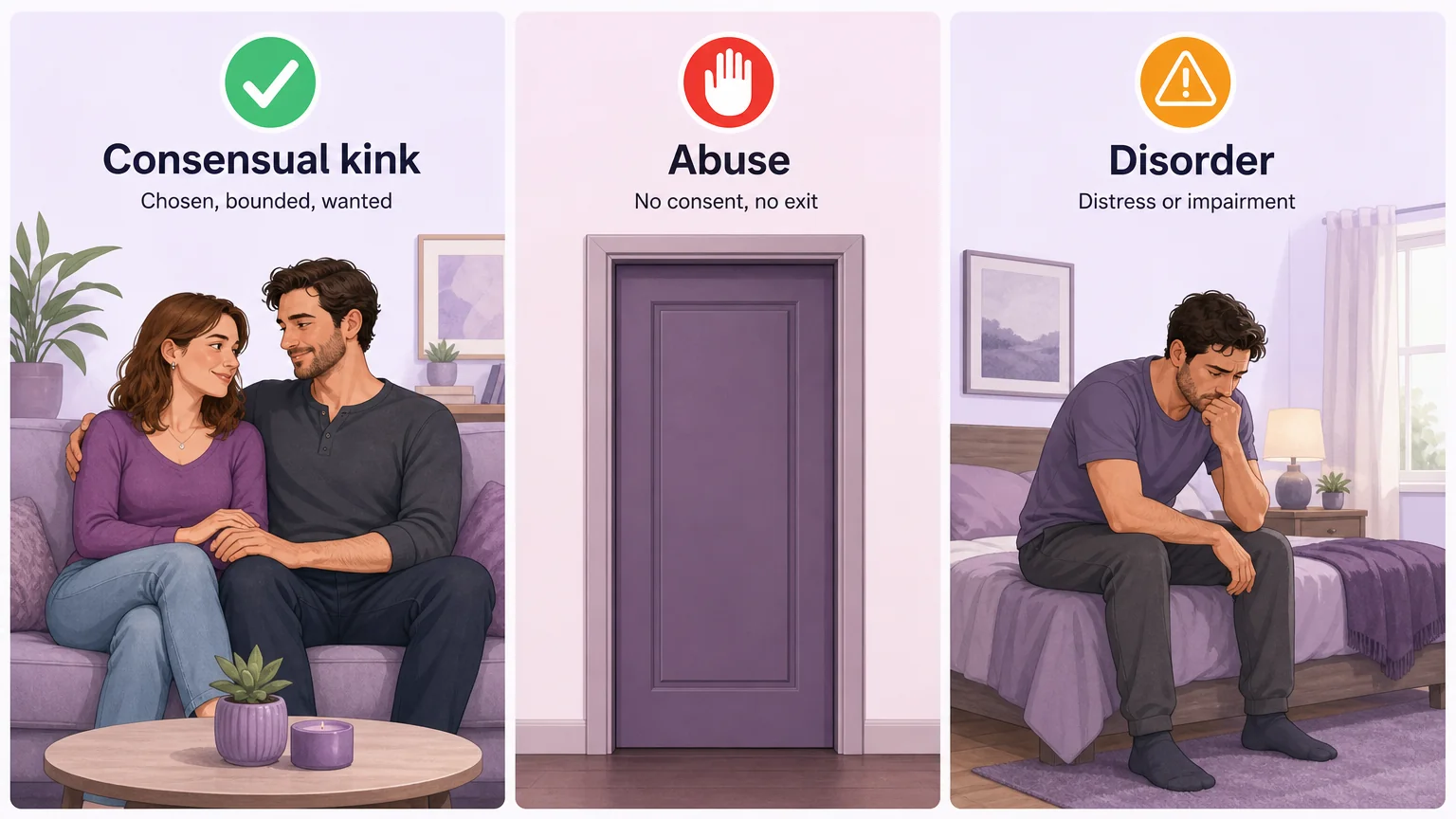
Three different things get collapsed into one anxiety here, and separating them takes a minute.
Abuse needs the flat answer first. It looks like ignoring a safeword, overriding a hard limit, removing your ability to stop, or pressuring you after a no until the no stops mattering. The line is consent, agreed limits, and an exit that works. No intensity level moves it.
Disorder is a different question. The DSM-5-TR sets the bar for sexual masochism disorder at arousal that causes significant distress or impairment in work, social, or other important areas, or serious harm, present for at least six months. That bar is high by design, and most people with masochistic interests never come close to it.
Dr. Kirk Honda, a therapist, points out that studies assessing BDSM practitioners for depression, anxiety, and personality disorders do not find higher rates than in the general population. If the interest were a symptom, you would expect it to cluster with other diagnoses. It does not.
Self-harm deserves its own clean line. Chosen, eroticized, time-bounded, and shared with someone who agreed is not the same as secret, compulsive, or pain nobody consented to. The difference is not the amount of pain but consent, control, and whether you come out worse.
Telling a clinician about any of this is not always easy. Kink-aware therapists exist, and if you want one, ask.
The calm test: if it is consensual, bounded, and wanted, it is not a problem to fix. If it is compulsive, or you cannot stop, that is worth professional help.
If saying what you want, and what you will not do, before anything happens sounds like a better start, try 3Fun.
FAQ
Is masochism a mental illness?
No. It is a pattern of sexual interest. The diagnostic manual sets the bar for sexual masochism disorder at arousal that causes significant distress or impairment in work, social, or other important areas, or serious harm, lasting six months or more. Most people with masochistic interests never meet it.
Do masochists need a sadist to enjoy sex?
No. Some masochists play with partners who are not sadists, some explore alone, and some keep the interest as fantasy. What matters is that whoever is present has agreed to what is happening. Some bottoms also endure intensity as devotion rather than pleasure, which is a different thing from masochism.
What is sub drop and how long does it last?
A post-scene crash that feels like a hangover plus sadness, irritability, or shame. Onset runs from an hour after a scene to two days later, and it usually clears within hours to a day, though some report longer. Tops get it too. If it has not lifted in a week, look for other causes.
Is negotiating everything unromantic?
Only if it happens at the wrong moment. Negotiate an hour, a day, or a week ahead and let the scene itself be spontaneous. The alternative is implied consent, which means reading body language and hoping you got it right, and that is where most consent problems start.
Is masochism always about sex?
Not strictly. The reasons practitioners give cluster around power, physical sensation, and altered states of mind, and some scenes are about headspace or devotion rather than about orgasm. This is the BDSM sense of the word, though, not the everyday sense for self-sabotage or martyrdom.