Is being gay hereditary? The short answer is no, and the longer answer is stranger than either side of the argument usually admits. There is no single “gay gene,” and orientation does not run down a family line the way height or eye color does.
But the opposite talking point is wrong too. Being gay is not a choice, and it is not something a parent causes.
What the evidence supports sits between those poles: a genuine but modest genetic influence, scattered across thousands of small positions in the genome, working alongside biology that shapes development before birth. Genes are part of the story, never in charge of it.
If you are asking about yourself, or about someone you love, the science on whether being gay is genetic is worth understanding, and it is incomplete in ways that matter. It was also never the thing that made anyone legitimate. Nobody’s orientation needs a biological alibi.
So let us take the question apart, from what heritability really measures to the one thing the science cannot do.
What ‘Heritable’ Actually Means (and Why It’s Not a Personal Blueprint)
Before a single number lands on the page, one idea needs repair. Almost every misunderstanding about this topic starts with the same error, and it is worth clearing before the evidence arrives.
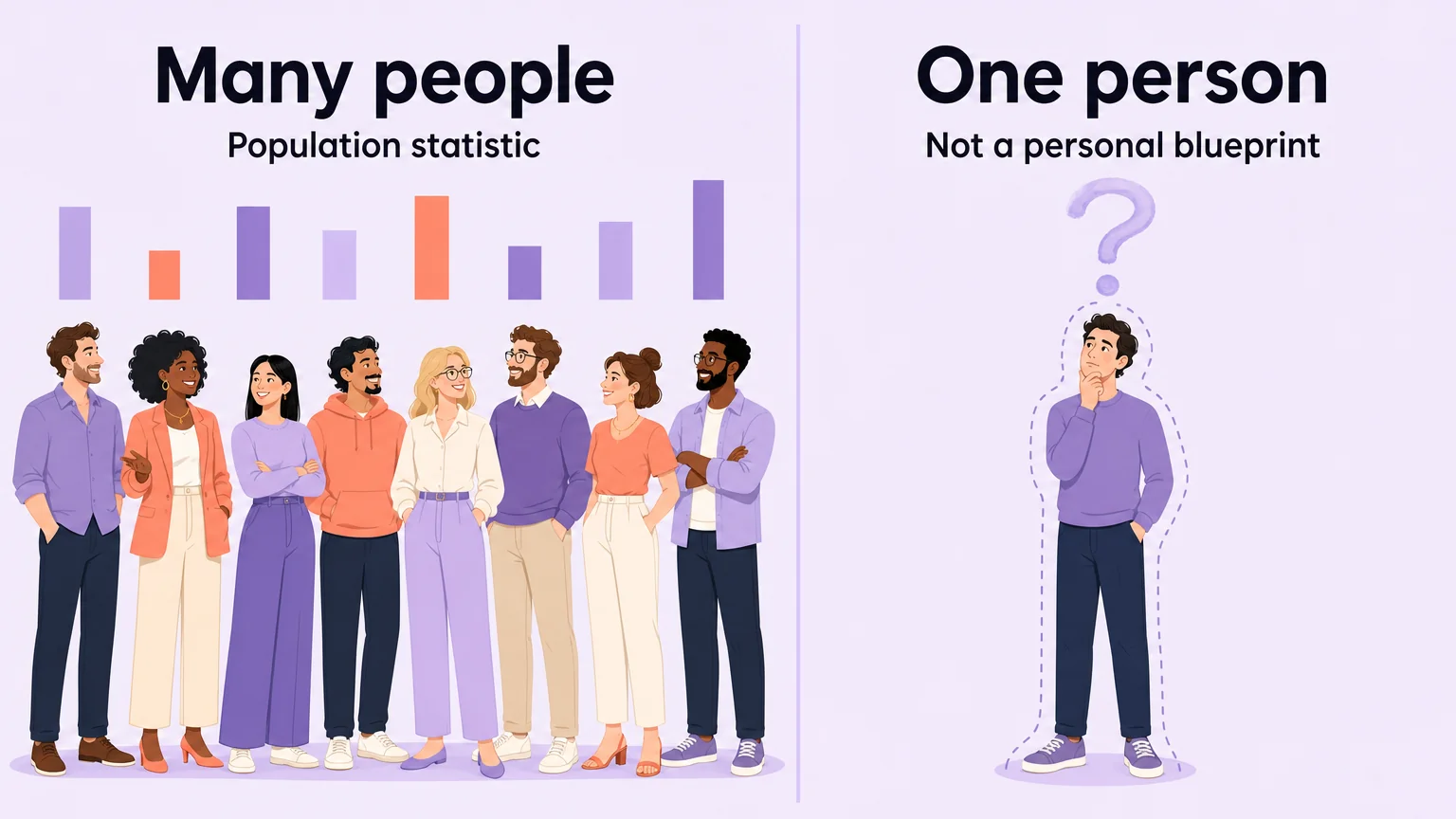
Heritability is a population statistic about variation. It measures the share of the differences between people, within one group at one point in time, that tracks with genetic differences. It runs from 0 to 1, and it is not a personal percentage.
So here is the misreading to drop. A heritability of 0.5 does not mean half of you is genetic and the other half is choice or upbringing. It means that in the group studied, half of the variation between people lined up with genetic variation. Those two sentences describe completely different things.
Two more properties matter. A heritability estimate belongs to a specific population and its environment, and it can change when circumstances change. It also does not name any gene or any environmental factor on its own.
And it is not the same as “runs in families.” A trait can cluster in a family for purely cultural reasons and still have zero heritability.
Now apply it. When the largest study of sexual behavior reported that common genetic variants accounted for somewhere between 8 and 25 percent of the variation at the population level, that figure describes a group, not a person. It is not “8 to 25 percent of you.”
Heritability also says nothing about how changeable something is. It says nothing about any individual, including you. Keep that in mind, because the same distinction decides how the biggest study’s second and much smaller number gets read.
The ‘Gay Gene’ That Never Was
The “gay gene” arrived before the evidence did.
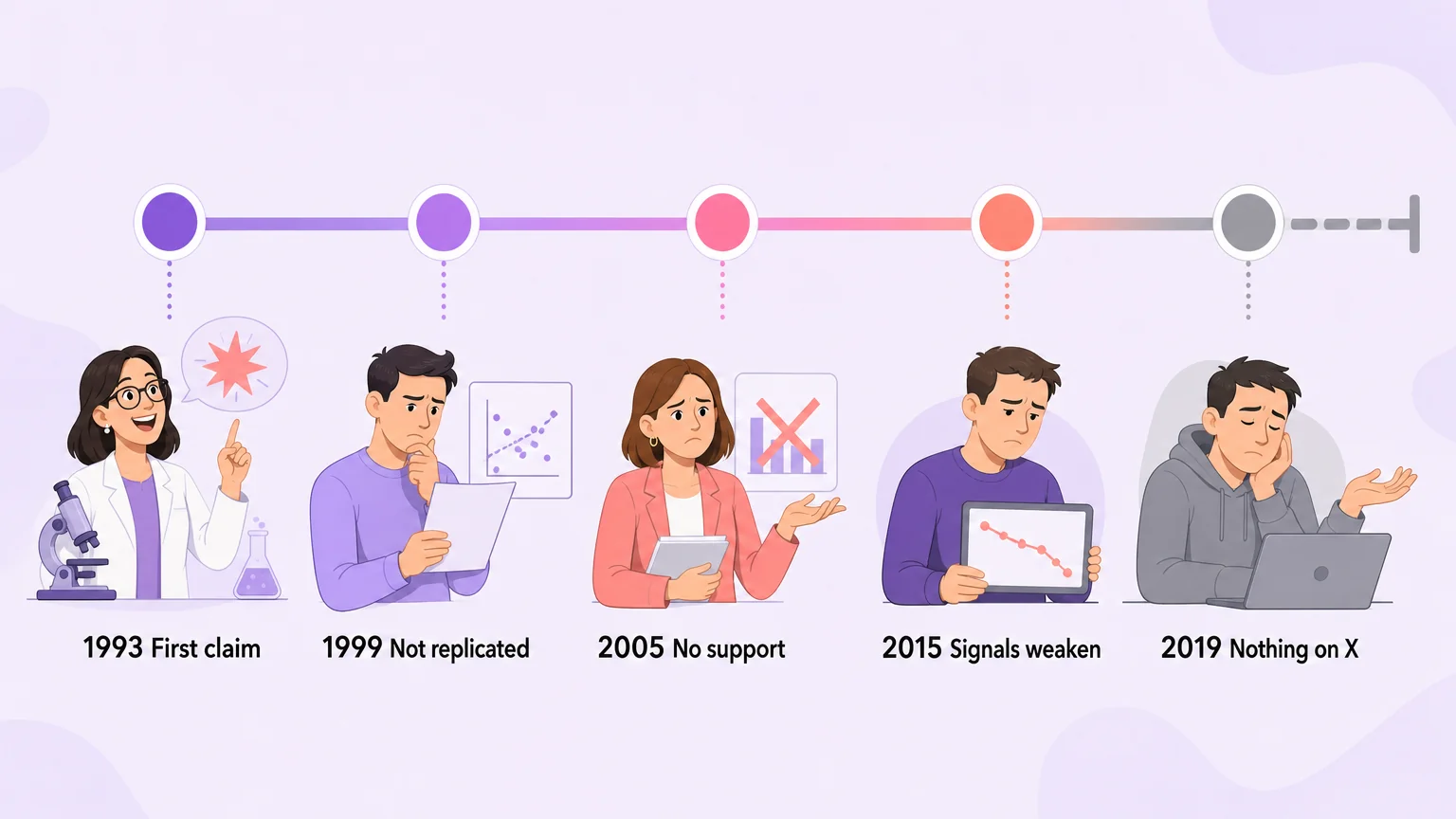
In 1993, Dean Hamer’s team reported a statistical link between markers on the X chromosome, in a region called Xq28, and male sexual orientation. The sample was small, roughly 38 to 40 pairs of gay brothers. Hamer never claimed a single gene. He claimed a linked region.
The press did the rest, and “the gay gene” reached headlines, textbooks and courtrooms long before anyone tested whether it held up.
It did not hold up. A 1999 study of 52 pairs of gay brothers concluded that its results “do not support an X-linked gene underlying male homosexuality.” A 2005 genome-wide scan found no support in its full sample.
The largest later attempt, a 2015 scan of 409 pairs of brothers, found linkage signals on chromosome 8 and at Xq28, though the Xq28 peak on its own did not clear the significance threshold.
Then the decisive ending arrived. When the largest genomic study landed in 2019, it found no association with the X chromosome at all. The region that launched the myth is a stretch of DNA, not a gene, and the best current data does not point there.
A 2021 meta-analysis pooling the linkage studies still pointed to chromosome 8 and Xq28 as its strongest regions. It also found nothing that reached genome-wide significance, which is a quieter way of saying the same thing.
Which raises the better question. If not one gene, what did half a million genomes find?
Half a Million Genomes Later: What the Largest Study Found
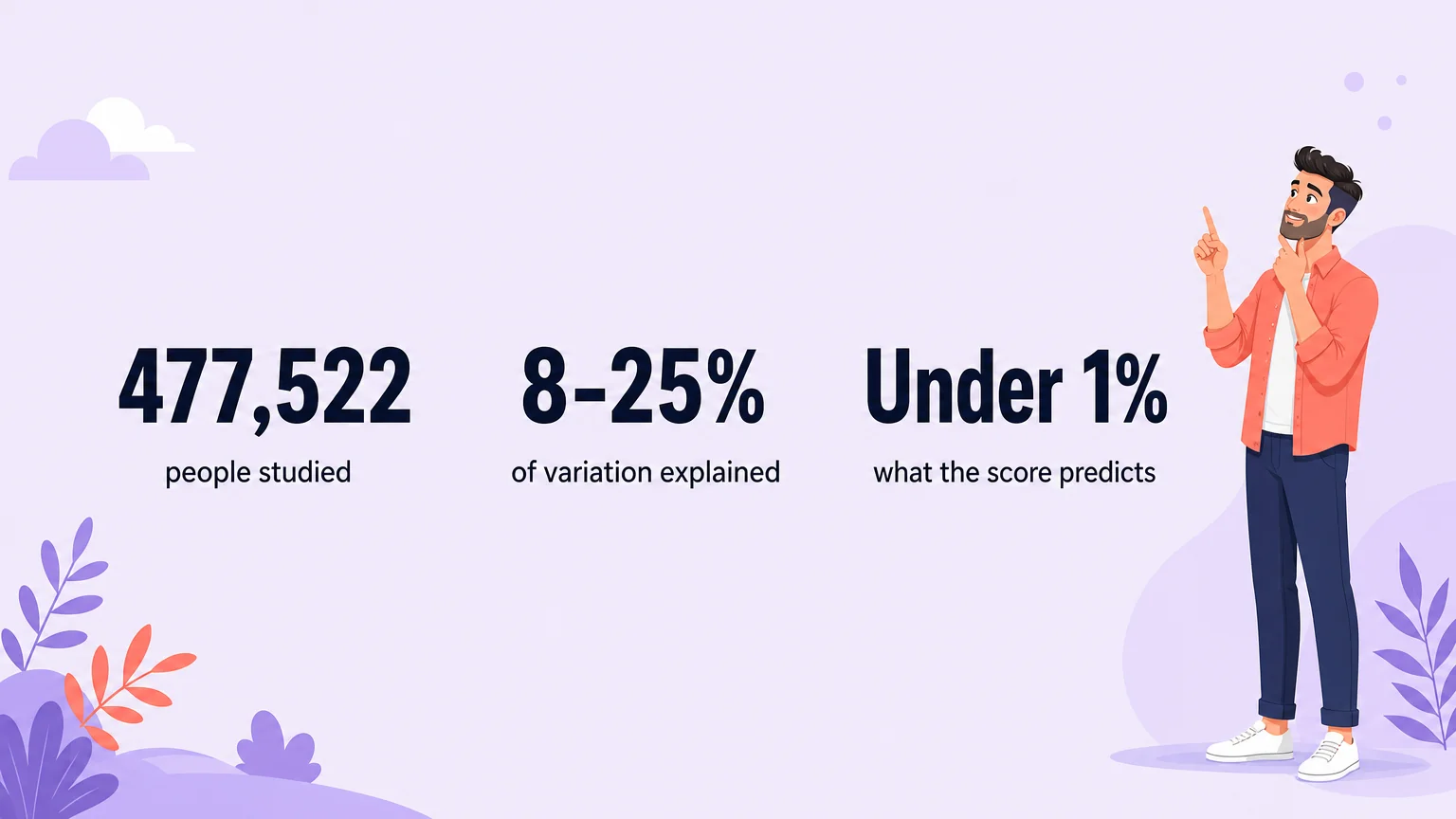
In 2019, a team led by Andrea Ganna screened 477,522 people, drawing on the UK Biobank and 23andMe, then replicated the work in 15,142 more people from the United States and Sweden. It remains the largest study of its kind, and any serious answer to whether being gay is hereditary has to start here.
The results were not a discovery of “the gene.” They were five positions in the genome that cleared the bar for statistical significance: two that showed up in both sexes, two specific to men, one specific to women. Each one carries an effect so small that knowing a person’s version of it tells you essentially nothing about them. And on the X chromosome, where the old headline lived, the study found nothing.
Here is where two numbers blur together, and the blur matters. All the measured common variants added up explained somewhere between 8 and 25 percent of the variation in behavior at the population level. But when the researchers combined those variants into a single score and tested it on a fresh group, it explained under 1 percent. The authors put the conclusion plainly: the variants “do not allow meaningful prediction of an individual’s sexual behavior.”
That result comes with two limits. The trait being measured was behavior, captured by a single survey question about whether a person had ever had a same-sex partner. It was not identity. It was not attraction.
And the sample skewed old and European: the 23andMe group averaged about 51 years old and reported same-sex partners at an unusually high 19 percent, while the UK Biobank group was aged 40 to 70 and the study noted reported same-sex behavior rising steadily across birth cohorts. The genetic correlations the study found with depression, loneliness and risk-taking may say more about discrimination and the stress of being a sexual minority than about shared biology.
One detail answers the worry underneath the question. Before publishing, Ganna’s team ran workshops with LGBTQ advocacy groups and released plain-language materials warning that the findings must not be used for prediction or intervention. The researchers built the guardrails themselves.
Twins, Families, and the Number Nobody Can Explain
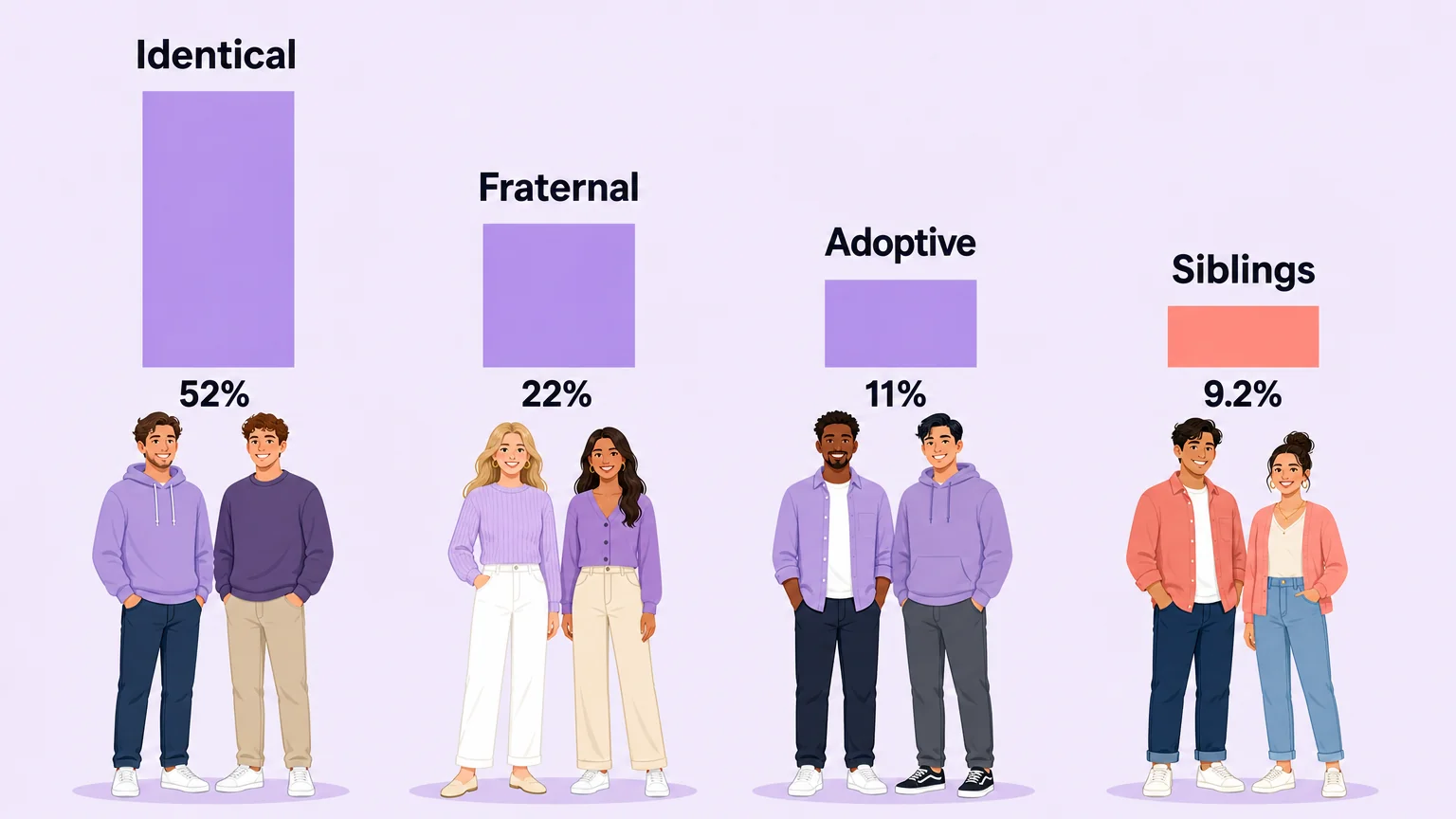
The twin numbers are the ones people quote most, and explain least.
In 1991, Michael Bailey and Richard Pillard reported concordance rates for homosexuality of 52 percent in identical twins, 22 percent in fraternal twins, and 11 percent in adoptive brothers. A companion study of women in 1993 gave a matching shape: 48, 16 and 6.
Read them carefully, because they carry two messages. The gradient matters: identical twins share essentially all their DNA, fraternal twins share about half, and adoptive brothers, raised in the same homes, share none by descent. A pattern that descends in that order points toward biology.
Then the second message arrives. Identical twins share their whole genome. If orientation were purely genetic, their concordance would sit near 100 percent.
It does not come close, hovering well under half. That gap is the strongest evidence that genes are not destiny, and it is why the next sections exist.
There is also an anomaly. Nontwin biological brothers came in at just 9.2 percent, lower than the 11 percent for adoptive brothers. A plain genetic model has no obvious way to predict that. It is one of the field’s most interesting open details, and it is strange rather than embarrassing.
The caveats matter too. These early samples were recruited through homophile publications, which likely pushed heritability estimates upward. Across the literature, estimates range from roughly 31 to 74 percent in men and 27 to 76 percent in women. As samples grow larger and more representative, the trend has been downward.
Family clustering without a family prediction is the last piece. About 22 percent of gay men reported a gay or bisexual brother, compared with 4 percent of heterosexual men. The clustering is documented, and it is not a forecast for any single child.
What ‘Environment’ Means in This Research (It’s Not Your Parenting)
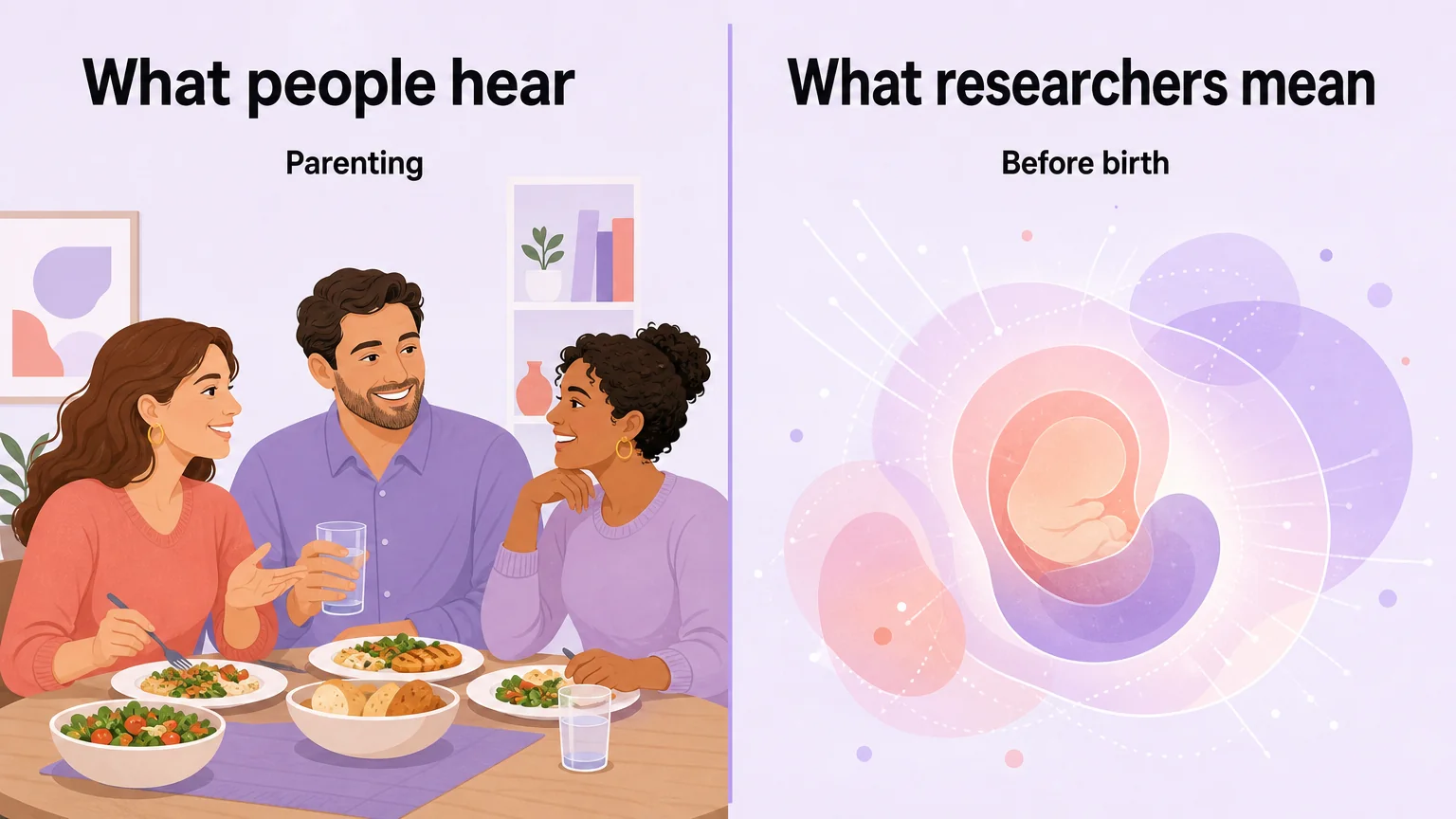
When researchers describe orientation as a mix of biological and environmental factors, the word environment does not mean upbringing, culture or parenting. It means everything that is not genetic, and a large share of it happens before birth.
The clearest example is the fraternal birth order effect. Men with more older biological brothers are more likely to be gay. A meta-analysis pooling 26 studies, covering 7,140 gay and 12,837 straight men, put the increase at an odds ratio of about 1.47 for each older brother. A boy with no older brothers sits near a 2 percent chance, and each additional brother raises those odds by roughly half.
Specificity matters. It holds for older brothers born from the same mother, not older sisters, not adopted brothers, not boys merely raised alongside him.
Whatever is happening is happening in the womb, not at the dinner table.
The leading mechanism is a hypothesis, not a settled fact. Anthony Bogaert’s team measured antibodies in mothers to a Y-linked protein called NLGN4Y and found levels climbing in a clear order: lowest in women with no sons, then mothers of straight sons, then mothers of gay sons, and highest in mothers of gay sons with older brothers. It is small and preliminary, and it needs replication.
The pattern has critics. A 2023 paper argued the birth order effect may be a statistical artifact of how these samples get assembled, and that challenge remains open.
Prenatal hormones round out the picture, and they contribute without deciding. The evidence comes from girls exposed to high testosterone before birth, from digit ratios, and from the faint sounds newborn ears produce. The caution matters just as much: gay men overall do not differ from straight men on digit ratio, and plenty of people fit no pattern at all. Hormones are part of the story, not the switch.
For a parent asking what causes someone to be gay, the answer is direct. Parenting style, single-parent homes and absent-parent roles are not shown to cause orientation.
Epigenetics: The Hypothesis That Would Explain Identical Twins
Identical twins share their DNA, and they do not always match. Something beyond the sequence has to differ, and epigenetics is the natural candidate. It studies the chemical marks that switch genes on and off without altering the code beneath them. The evidence so far is thin.
The best-known attempt came from a UCLA team led by Sven Bocklandt, which profiled DNA methylation in 34 pairs of identical twins discordant for orientation, across roughly 27,000 sites in saliva. No peer-reviewed paper ever reported an orientation finding from it.
A 2015 follow-up scanned about 4 million sites and found five that classified 37 twin pairs at only 67 percent accuracy. It was conference-presented, not peer-reviewed, and Dean Hamer cautioned it did not amount to a sexual-orientation test and would likely fail in unrelated people.
Two mathematical models keep it alive, and both are hypotheses, not findings. William Rice proposed that sex-specific epigenetic marks, inherited from an opposite-sex parent, sometimes escape the usual erasure and shape development. Sergey Gavrilets proposed that the same developmental factors also produce broadly useful traits. Reviews are blunt: direct evidence for an epigenetic link remains sparse and unproven.
Two cautions close the loop. The work used blood and saliva for a brain trait, and one researcher left the field over fears of misuse.
Bisexuality Is Not a Footnote
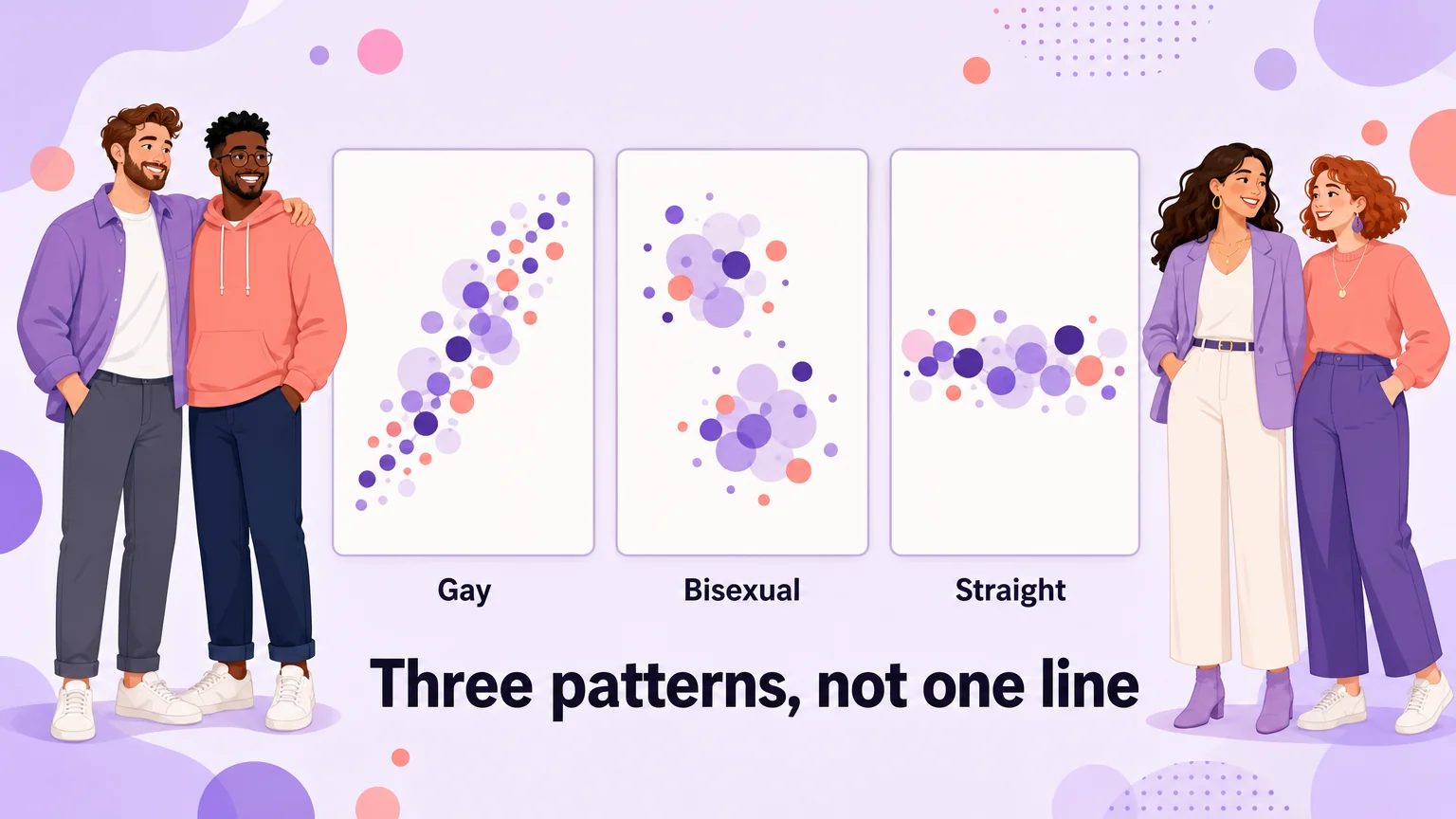
Bisexuality gets treated as a stopover, a phase, or a softer version of being gay. The science does not support that reading, and it deserves its own corner rather than a clause.
In 2024, a University of Michigan team analyzed roughly 450,000 UK Biobank participants and claimed that male bisexual behavior is genetically distinct from exclusive same-sex behavior. It shares some variants with it, but carries its own signature, and it linked to risk-taking and slightly more children. The self-reported offspring averages were about 1.9 for exclusively heterosexual participants, 1.3 for bisexual behavior, and 0.5 for exclusively homosexual.
The criticism arrived in the same breath, and it belongs there. A co-author of the 2019 study called the stronger claims weakly supported and overhyped. Another critic described the paper as a lot of storytelling around not a lot of data.
The sample was white, older and European by ancestry. “Risk-taking” rested on a single survey question. The study measured sexual history and behavior, not identity or feeling, and critics warned it could be turned against bisexual people. The authors themselves said the results must not be used to support discrimination.
So treat it as a contested 2024 finding, not a settled one.
What it does not do is make bisexuality a midpoint. Early 1990s work already found that bisexual people often resembled neither heterosexuals nor homosexuals on the measures being studied, and twin studies report heritability under 50 percent in nearly every case, across every orientation. The reason bisexuality keeps reading as “complex” in the data is that it is its own pattern, not a blurry version of someone else’s.
Your orientation does not need a study to be real. That was true before the paper and it stays true after it.
Why Didn’t Evolution Remove It?
Here is the puzzle.
Same-sex behavior is partly heritable, and men who report exclusively same-sex behavior have far fewer children on average. By ordinary selection logic, an influence that lowers reproduction should have thinned from the population long ago. Instead it shows up at broadly similar rates on every continent, in every era.
People imagine a single switch. The reality is closer to thousands of tiny dials, nudged in different directions, most doing other jobs too. Evolution behaves more like a gambler than an engineer, preserving variation because variation is often what keeps a species alive.
Three explanations lead the field, each a hypothesis. The first is antagonistic pleiotropy, the idea that the same variants might raise reproductive success in people who do not express the trait. A 2021 analysis found results consistent with this. The paper’s title itself says “consistent with,” not “proves,” and it has since been corrected.
The second is the fertile-relatives idea. A 2004 study found that women on the mother’s side of a gay man’s family had more children on average, an effect absent on the father’s side. It has replicated in some samples, not others.
The third is kin selection, the “gay uncle” idea. It found its strongest test among Samoa’s fa’afafine, who showed elevated caregiving toward nieces and nephews. Its lead researcher, Paul Vasey, is careful about it: the support comes mainly from Samoa and has repeatedly failed to appear in industrialized societies, and he concluded they would have to be “super uncles” to offset not reproducing.
Step back, and the question changes. Same-sex behavior is documented across hundreds of animal species, from bonobos to albatrosses, and reported across many more. The popular “1,500 species” figure is an estimate, not a hard count, and the better question may be why nature keeps producing it at all.
These explanations are not rivals. Any could be partly right, or none could be, and not every trait needs an adaptive story.
What the Science Cannot Do, and What Was Never the Question
There is no validated genetic test, biomarker or prenatal determination of sexual orientation. That is not a gap waiting to be closed. It is the shape of the result.
Thousands of tiny effects do not combine into a usable test, and the polygenic score explains under 1 percent. Ganna’s team ran workshops with LGBTQ groups before publishing to head off screening, prediction and intervention, and bioethicists warn that better scores could still be misused in repressive settings. The restraint is deliberate, not accidental.
The reflex to argue “born this way” has always carried a quiet cost. It implies that an orientation’s legitimacy depends on its biology, which is scientifically overstated and morally backwards. Most people already believe orientation is not a choice, and prejudice persists anyway.
Research has found that reduced prejudice did not depend on teaching biological theories. Political theorist Suzanna Walters argues the immutability argument secures tolerance rather than full equality, and may even start to do more harm. The answer to the question does not change anyone’s worth. It never did.
The consensus itself is narrow and clear. The Royal College of Psychiatrists holds that orientation comes from a combination of biological and postnatal environmental factors, with no evidence to impute choice. Attraction and orientation are not chosen. Behavior, relationships and disclosure are.
And change efforts do not work. The American Psychological Association’s 2009 task force review found insufficient evidence of efficacy and some evidence of harm. A separate 2015 study of 1,612 people found that only 3.2 percent reported even slight change. Young people whose parents brought in a therapist or religious leader to change them had roughly three times the rates of depression and suicide attempts.
The question underneath all of this asks what causes someone to be gay, as though that attraction were a deviation needing a cause while heterosexuality needs no explanation. Half a million genomes later, that framing is the thing that broke.
Common Questions About Sexual Orientation and Genetics
Is being gay a choice or genetic?
Neither, exactly. No professional body treats orientation as a conscious choice, and “genetic” is not the right model either. The Royal College of Psychiatrists describes it as a combination of biological and postnatal environmental factors, with no evidence to impute choice.
Attraction and orientation are not chosen. Behavior, relationships and disclosure are.
Is bisexuality genetic?
A contested 2024 study suggested male bisexual behavior has its own genetic signature, distinct from exclusive same-sex behavior. It drew wide criticism for a behavior-only proxy, a white and older sample, a single risk-taking question, and the harm to bisexual people. Treat it as unresolved. As with orientation generally, the pattern is a modest, non-deterministic component, not a gene.
Homosexuality in twins
Identical twins share essentially all their DNA, yet concordance for orientation usually sits well under 50 percent. One twin being gay does not mean the other will be. Fraternal twins match less often, and adoptive brothers less still. The pattern points toward biology, while the missing half proves biology is not destiny.
Is being gay a lifestyle?
No. Calling orientation a “lifestyle” frames it as a set of adopted habits, which the evidence does not support. Orientation is not a habit and it is not a choice, and the phrase usually implies otherwise. Nothing is wrong with the person being described, only with the language doing the describing.
Is being gay natural in animals?
Same-sex behavior is documented across hundreds of animal species, including bonobos, penguins, albatrosses, dolphins and swans, and reported in many more. It is not a modern human invention. The “1,500 species” figure is an estimate rather than a hard count, but the broader point holds: this shows up throughout nature.
My child just came out. Did I cause it?
No. Parenting style, single-parent homes and absent-parent roles are not shown to cause orientation. First reactions like shock, guilt and fear are common, and acceptance often takes years, not days.
Your child is the same person they were yesterday. Skip “are you sure,” and find peer support. Family acceptance is one of the strongest predictors of a young person’s mental health.