
The word arrives in one of two places: a partner says it mid-argument, or you say it to yourself at 2 a.m. It never lands kindly.
Pillow princess comes from lesbian and queer-women culture, and it describes a femme who only receives. It is not a straight term borrowed for the occasion, and it is not a diagnosis. If you are asking how to not be a pillow princess, start by separating two very different people.
If you want to change this, we take the request seriously here, and nothing in this guide asks you to apologize for what you want in the first place. What follows is a sequence, not a lecture.
The distinction everything rests on: the problem is not doing too little, it is not participating. Doing more is a volume knob. Participating is presence, and presence is available from underneath, with your hands, your attention and your voice.
The route runs in order. Work out what you are dealing with and whether your body is involved, then talk to your partner, then practice. The last three steps are for readers whose body, nervous system or history sets a different kind of limit.
Step 1: Work Out What You Are Before You Try to Change It
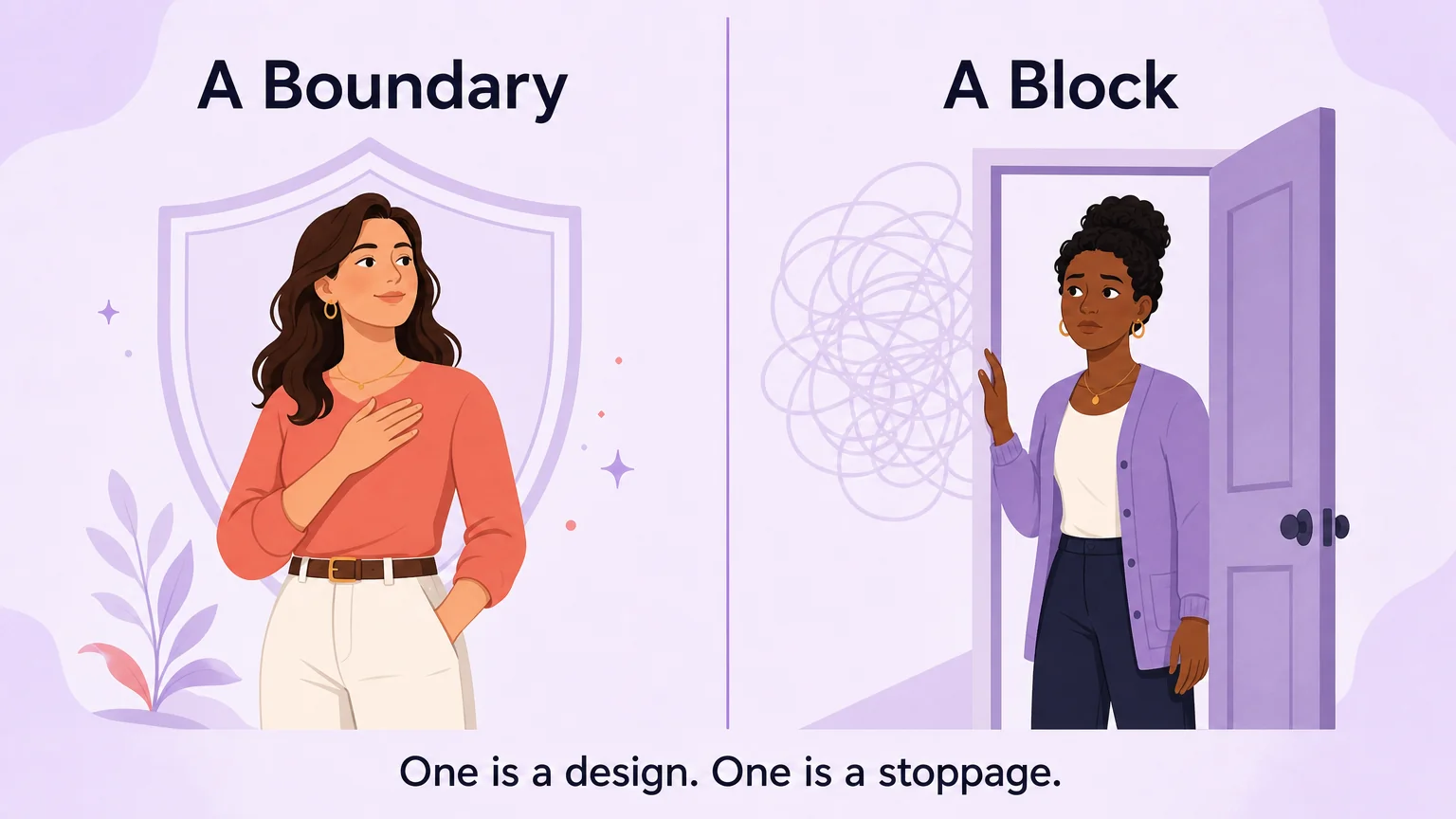
Two very different things get called pillow princess, and telling them apart is the whole first step.
The first is a boundary. Receiving only, as a rule, is closer to an identity than a habit, and it pairs with named roles: the stone top or stone butch, who gets satisfaction entirely from giving and usually prefers not to be touched back; the touch-me-not. Non-reciprocity can be a design, not a debt.
The second is a block: you want to give and something stops you, whether that is fear of doing it wrong, never having been taught, a nervous system that reads touch as a threat, or a body that hurts.
Sort them with four questions, somewhere quiet and unhurried:
- Does the boundary hold by default, or only with certain partners?
- Do you want to give and feel stopped, or not want to give and feel pushed?
- Has this been true your whole sexual life, or did it start at a point you can name?
- Is it only in bed, or does it show up anywhere you are asked to initiate anything?
Many readers will not get a clean verdict, so take the third answer: both are often true, a settled boundary in some contexts and plain anxiety in others. That is a working answer you revisit, not a diagnosis.
In the largest study on this question, researchers surveyed 1,072 women in same-sex relationships, and the desire gap did not predict dissatisfaction. Whether the couple read that gap as a problem did. The label is not the injury. The silence about it is.
For some people the passivity is the point. One woman described her receptivity sitting beside a deep wish to be tied up. That is a kink, not a symptom.
If you recognized a boundary, the rest of this is about clarity and compatibility rather than change, and Step 3 and Step 10 are where you live. If you recognized a block, keep going, because blocks have causes.
By the end of this step you should have written one sentence: this is my shape, or this is my block.
Whichever sentence you wrote, it does not need defending. Desire doesn’t require an apology, and 3Fun is built for exactly that: a private space where a stated preference is information, not a confession.
Step 2: Rule Out Your Body Before You Blame Your Character
Work through this before any behavioral change, because for many readers a body problem is the entire answer.
Let this land before any list of causes arrives. Vaginismus is not a choice or a measure of your desire. It is an involuntary muscle response, the same reflex as blinking when something flies at your eye. Up to 10 percent of women experience it at some point, in a form that has never allowed penetration and a form that developed later.
The causes below need different fixes and cannot be told apart by guessing, which is why each gets a paragraph rather than a line.
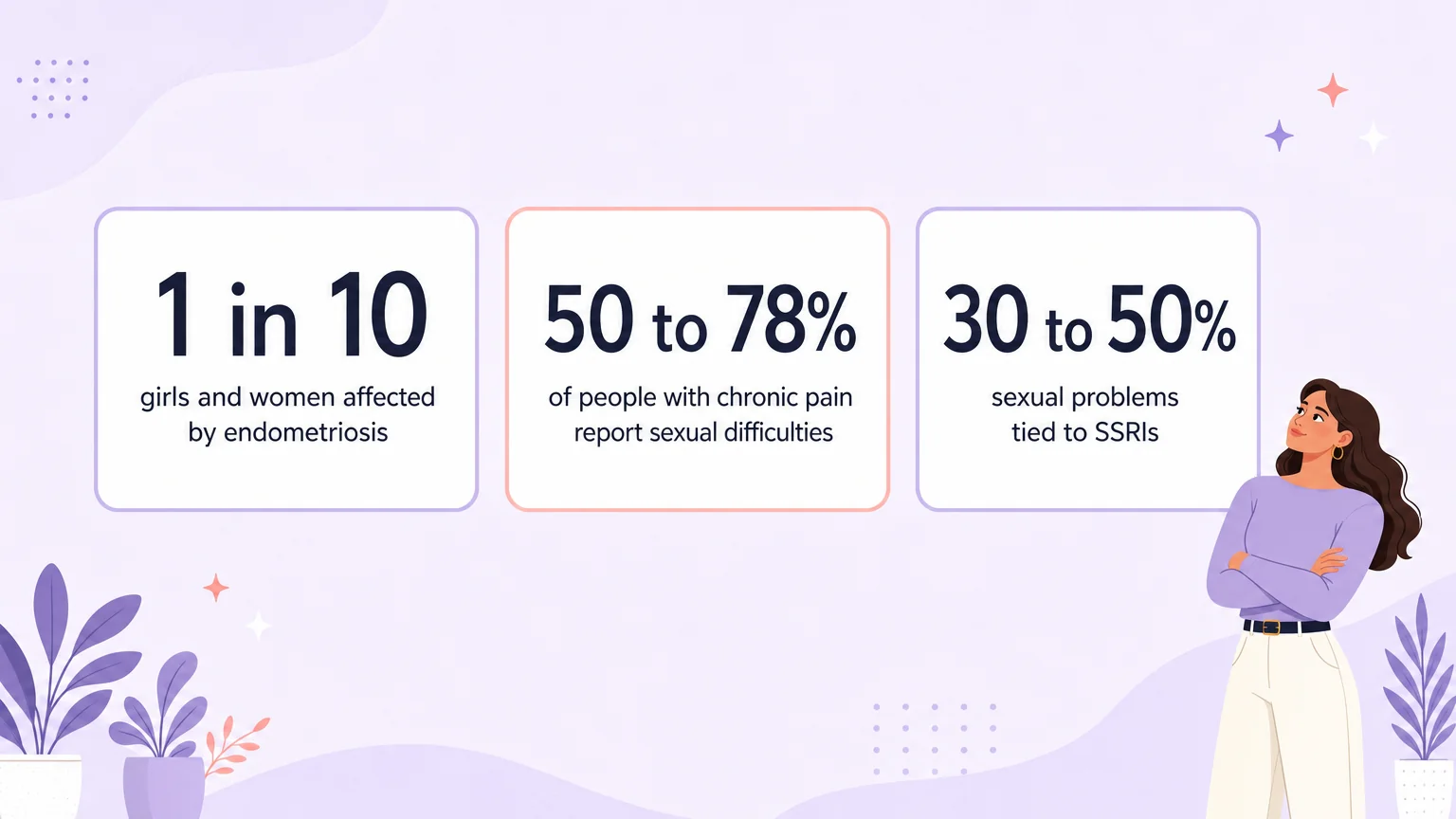
First, pain: endometriosis affects roughly one in 10 girls and women, and deeper pain during sex often points to it. Among people with chronic pain, 50 to 78 percent report sexual difficulties. Pelvic pain conditions share symptoms with each other and with infection, so self-diagnosis is a bad plan. These conditions are treatable, and pregnancy remains possible after treatment.
Second, medication, and tread carefully. Sexual problems tied to SSRIs are realistically 30 to 50 percent. But depression suppresses desire on its own: in one study of 134 patients who had not yet started medication, half the women and 42 percent of the men had already lost interest. And in a prospective pilot study of chronically depressed patients, women’s desire and overall sexual function improved after six weeks on an SSRI, while orgasmic problems worsened mainly in men.
Disclosure is its own problem: 36 percent of patients reported side effects on a questionnaire and 96 percent did under direct interview. Say it out loud rather than waiting to be asked. Waiting to see whether it settles, a dose change, a different antidepressant, and adding another drug are all conversations for your prescriber.
Third, hormones and life stage. Perimenopause and postpartum change lubrication, arousal and available energy, and postpartum adds sleep loss plus the fatigue of being touched all day by someone small.
Then work through four things:
- Get a proper diagnosis first, because these conditions overlap.
- Ask for pelvic floor physiotherapy, and ask whether yours should be down-training rather than strengthening. Kegels make an overactive pelvic floor worse.
- If dilators are prescribed, measure progress in comfort, not sessions. Smallest first, advance only when comfortable.
- Ask for gynecology, pelvic floor physiotherapy and sex therapy together, which is what chronic pelvic pain needs.
A clinician may add biofeedback, water-based lubricants, low-dose topical anesthetics, an estradiol ring or estrogen cream, and botulinum toxin injections in refractory cases.
Treating this first is what makes the rest of the guide work.
See a clinician first if there is pain, burning, or a history of either. Skip this step if sex has never hurt and nothing has changed.
By the end of this step you should have either a clinician’s answer or a clear reason to stop treating this as a willpower problem.
Step 3: Ask Your Partner What They Actually Want

Get the words, and get the answer underneath them: does your partner want what you are about to offer?
Never raise this during sex, or in the raw aftermath. Doing it mid-encounter is a guaranteed fail: nobody can hear a request while being asked to perform.
Do not lead with a complaint or a list of what your partner is not doing. A laundry list arrives as an indictment, and you need the conversation where nobody is defending themselves.
If your partner is likely to hear this as criticism, lead with a shared memory and a question about their experience: “Remember that time when we did…? I loved it so much. What was it like for you?” Then: “Would you be interested in doing it again sometime? Because I sure would.”
For something new, stage it instead.
- Ask whether now is a good time.
- Say out loud that you have been nervous about bringing it up.
- State the want concretely, not as a category: not “I want to be more involved” but the actual thing.
- Tell them not to answer yet, and set a specific time to come back to it.
Two more lines, framed as addition: “I like our routine, and I want to add something new so it can be spicy.” And: “Is there anything you are interested in doing that we are not doing now?”
Now the question to settle first: does your partner want to be touched at all? A stone top or a touch-me-not may have no interest in reciprocation. If that is who you are with, you are not solving a problem, you are creating one.
Ask it plainly: “When you say stone, do you mean you do not want to be touched, or that you do not want to do the touching?” That answer changes what you are solving.
If your partner is stone, any change is theirs to start. Pursuing it is not persistence, it is control.
One person cannot fix this: in a study of 228 same-sex couples, women’s sexual satisfaction depended on their partner’s as well as their own.
By the end of this step you should know what you want to ask for, and whether your partner wants to be asked.
The most attractive thing you can bring into any dynamic is absolute clarity, and it is the one thing 3Fun asks you to lead with: what you want, what you are open to, and what is off the table.
Step 4: Plan a First Session Where Sex Is Off the Table
Run this before any technique. It looks like it is not about sex, and that is the point of it.
- Agree out loud that sex is off the table for the whole exercise, as a rule rather than a soft intention. Nobody has to say yes or no to escalation, and removing that decision removes the pressure.
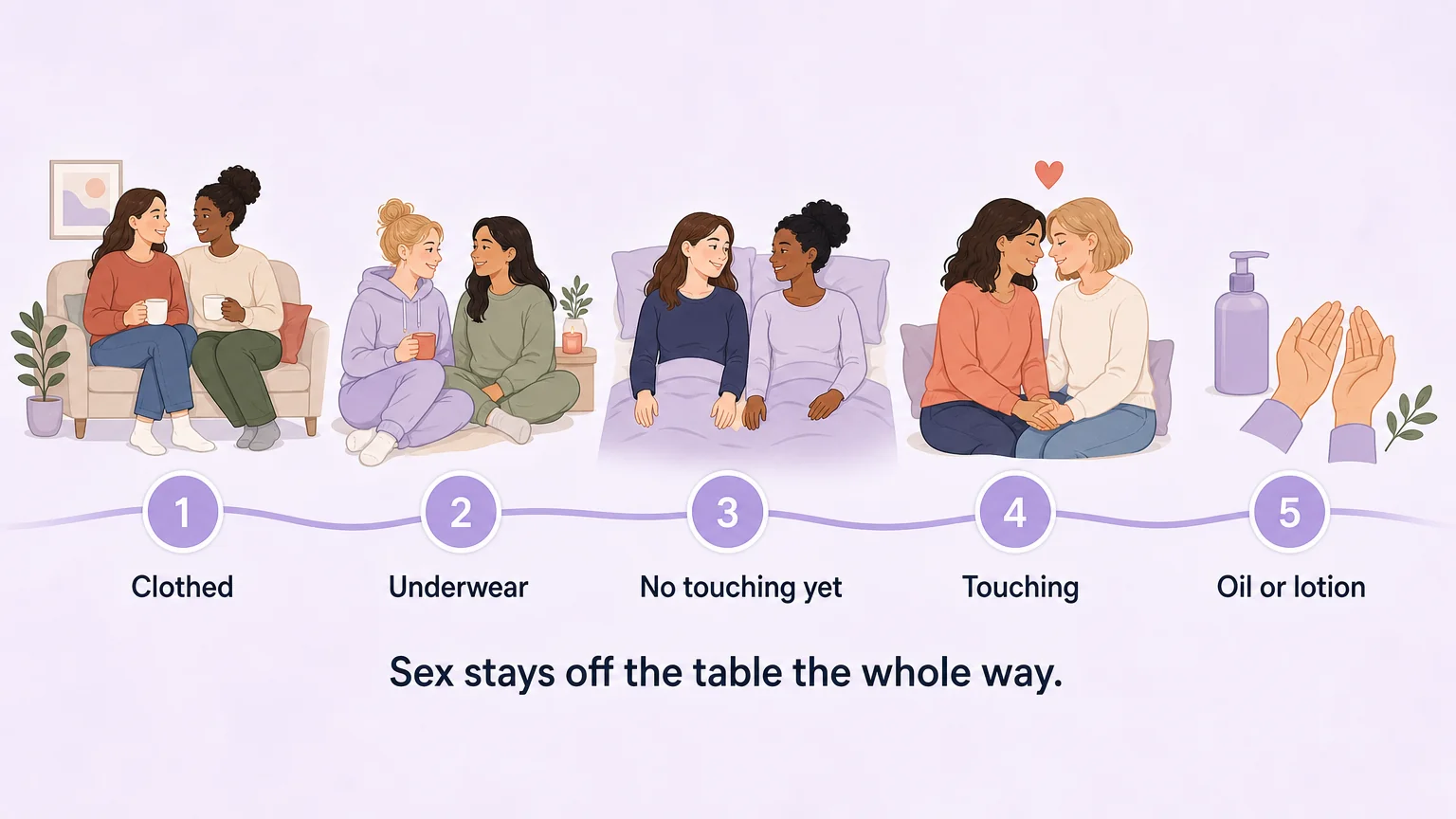
- Start fully clothed, in a warm room, with no genital touching. Some clinics start people nude, which is too advanced for many.
- Take turns, about 15 minutes each and explicitly not five. A nervous system needs time to arrive.
- Agree who goes first before you start, so the decision is not made in the moment.
Then the counterintuitive instruction: if you are the one with anxiety about touch, start as the giver. The giver has more control, and control settles a nervous system.
The receiver describes physical sensation only, never how they feel about it: tickly, scratchy, warm, soft, deep pressure. Not good, not bad, just sensation.
The giver does the same with their own hands: scratchy, warm, bony, soft. That is practice at paying attention rather than monitoring yourself.
If it gets too much, ask for a different area or an extremity before stopping. Either person can stop, and stopping is not a failure state.
Move up the ladder only when you are both comfortable: clothed, underwear, naked with no genital touch, then genital touch, then oil or lotion, with sex off the table the whole way.
Now the disagreement, because both sides are worth having. Sex therapist Jessa Zimmerman does not use classic sensate focus. Her objection is the staircase: a sequence with intercourse at the top turns the whole thing into pass or fail, and it reinforces lying there and taking it.
Her version hands total control to the person being touched. Use the ladder if a structure helps, and her rule if the ladder makes you feel graded.
Both versions agree on the line worth remembering: the goal is wanting it, not enduring it. Tolerating touch with your guard up is the signal to stop and renegotiate, not to push through. And a structured exercise that turns out unpleasant or triggering is a legitimate result, not a personal failure.
Run it twice before you decide anything about yourself, including whether the label fits.
By the end of this step you should have completed two clothed sessions, one in each role, and a short list of what your body responded to.
Step 5: Learn to Participate Instead of Perform

Being on the bottom is not what makes someone a pillow princess. Matched rhythm is the criterion, not who is on top.
So make it concrete, because being more active during sex is gestures rather than attitude: your hand on your partner rather than on the sheets, your hips meeting hers instead of absorbing them, your attention on her rather than on the ceiling.
Saying yes out loud counts too. An enthusiastic yes is active and willing rather than merely permitted, and it can look like leaning in, touching back and eye contact.
Then the mindset shift: stop treating sex as a performance and treat it as a shared meal. A performance keeps you in your head, monitoring and trying to get it right. A meal has room for “a little more of this,” “can we soften that,” “let us try something else.”
Here is the piece that matters most if you feel no spontaneous urge to give: for many people, desire does not arrive before touch, it arrives because of it. That is responsive desire, a normal pattern rather than a broken one, and it means “I do not feel like it” before anything has started is not the same sentence as “I never will.”
The skill is three moves in this order: notice the sensation, name what you want, negotiate it with your partner. Practice it during the exercise from Step 4, where nothing is at stake, and treat orgasm and penetration as options on the menu rather than the bill you have to pay.
If your partner is the one who never moves and never speaks, this step is not yours, and that is not a rebuke. Go to Step 10.
By the end of this step you should have said one thing out loud during sex that you wanted, and heard yourself say it without apologizing.
Step 6: Build a Repertoire From Scratch, Hands and Mouth First
If you have never done this, you are not behind, and you are not a pillow princess by default. New is a starting position.
Pacing first. People with vulvas often burn slow, so build with kissing, teasing and the rest of the body before going near the vulva: nipples, thighs, the neck, ears. The early stretch is about making your partner want the next thing, so do not overplan positions, power dynamics or orgasm.
If you want one named first act rather than a menu, have your partner lie down and give her a slow, focused vulva massage.
Then the mechanics. For oral, hold two or three moves you can do well and rotate them every three to five minutes. Escalate slowly, use your hands too, and ask questions during: “Does this feel good,” “How do you like your clit stimulated.”
A sequence that works for a first time: fingers, then toys, then strap-on play. Never import the choreography of a penis onto a strap. Use lube for all of it, including fingering.
A shortcut with a long-term partner: masturbate in front of her a few times while she watches. You are not asking her to study you. You are showing her the exact spots and pressures directly.
Then the setup: keep nails short and filed, and wash your hands. Use lube rather than saliva, because saliva dries and drags. With a dental dam, lube the vulva first, keep one side against your partner, and change it between orifices and partners. With no dam, non-porous plastic wrap works, never microwave film.
Use gloves or finger cots if fingers move between the vagina, anus and mouth. Do not brush or floss right before oral, which opens small tears in the gums. Skip giving oral if you have cuts or sores in your mouth. HIV risk from oral sex between women is very low, but herpes, chlamydia, gonorrhea, HPV, syphilis, trichomoniasis and hepatitis A and B all transmit this way, many with no symptoms, so testing is admin, not a moral statement.
Not everyone you sleep with has a vulva, so pregnancy and birth control can still matter.
Fingers to start, a toy if your hand fatigues, a strap when you want your whole body in it.
By the end of this step you should have one act you can perform without thinking, a lube you like, and a testing date in your calendar.
Step 7: Adapt When Pain, Illness or Disability Sets the Ceiling
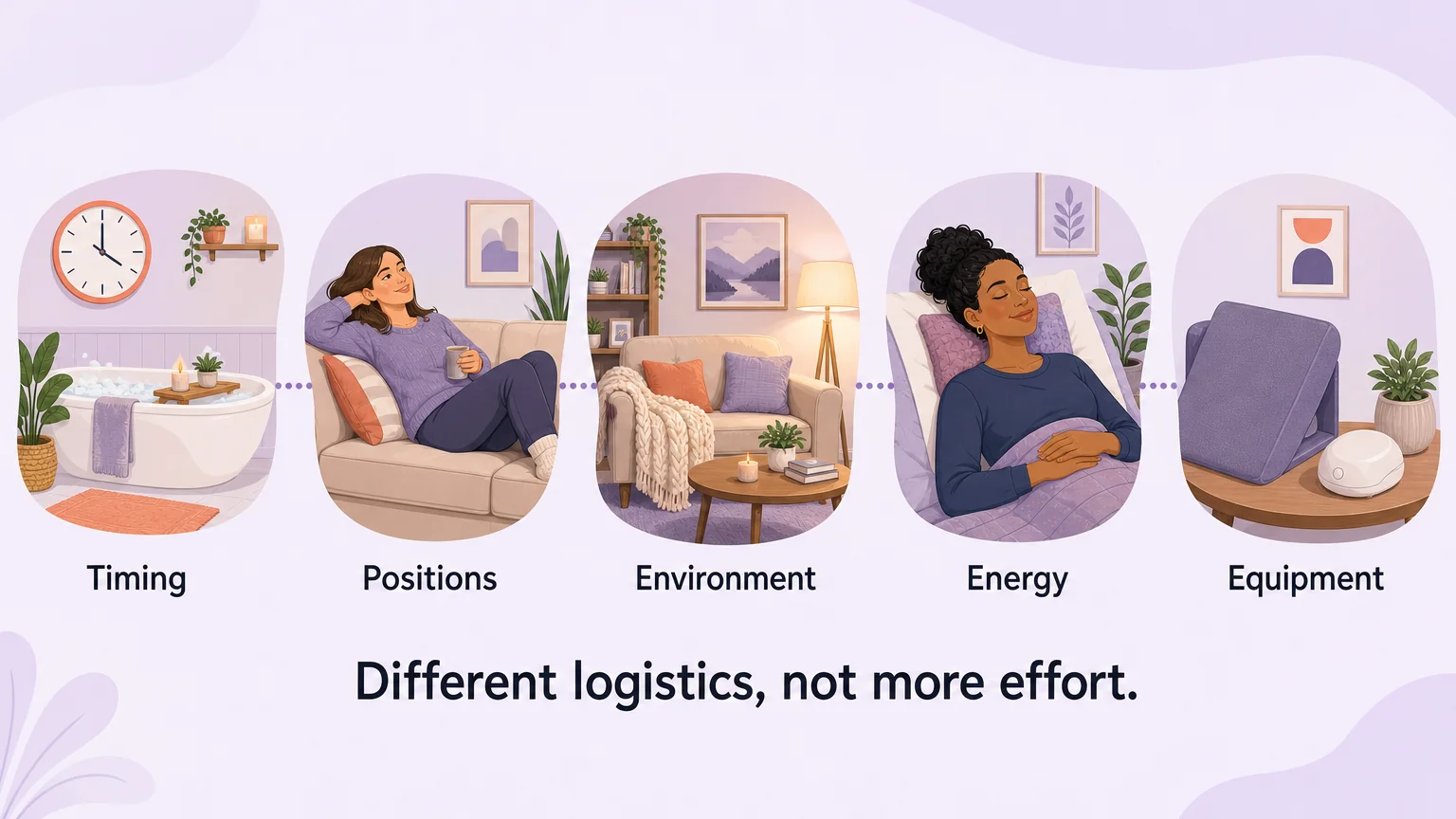
If your body has a ceiling, the answer is not more effort. It is different logistics.
Start with timing. Plan sex around your body rather than waiting for a good moment to arrive. Time it around pain medication, a warm bath or stretching beforehand, and plan the recovery too, because you will pay for it afterward.
Then positions, with the reasoning attached. For chronic and low back pain, spooning was the most commonly recommended position across studies: less exertion, little or no weight on painful areas, better control of depth. For pain that flares when you bend forward, studies recommend tabletop and side-lying; for pain that flares when you arch back, side-to-side or missionary. Treat these as starting points rather than rules, because the clinical literature maps positions almost entirely for straight couples.
Then the environment: wedges, cushions and pillows under the lower back, knees or pelvis change what is reachable and what hurts. An adjustable bed, if you have one, changes it more.
Then energy, framed as a skill. Budget it deliberately, and if you have access to an occupational therapist, borrow their energy-conservation framing.
Then equipment that does what your hands cannot: hands-free, Bluetooth and continuous-vibration toys exist for grip weakness, tremor or joint limits, and an occupational therapist can adapt one with a larger handle. If a position or a device makes speech hard, agree on a signal in advance.
Then widen what counts. Kissing, mutual masturbation, oral, erotic massage and roleplay are all sex. Two safety points: disability does not mean infertile, so safer sex still applies, and when sensation is limited, check your body afterward and stop if something feels wrong.
The most useful sentence here: say what your body can do today rather than apologizing for what it cannot. Do the logistics planning before the mood, because the mood does not keep a schedule.
By the end of this step you should have one position, one prop and one time of day that your body has already agreed to.
Step 8: Adapt for Sensory Needs and Gender Dysphoria
This step is about the body you are giving with, which is not always a neutral instrument. If what stops you is a memory rather than an overload, skip to Step 9.
Sensory overload during sex is a nervous-system response, not a lack of desire and not a lack of love. The triggers are specific: the texture of the sheets, your clothing or the lube; temperature; the pressure, speed and location of touch; smells, sounds, lighting. And thresholds move, so something fine last week can be unbearable after a full day of masking.
So build the kit rather than the philosophy.
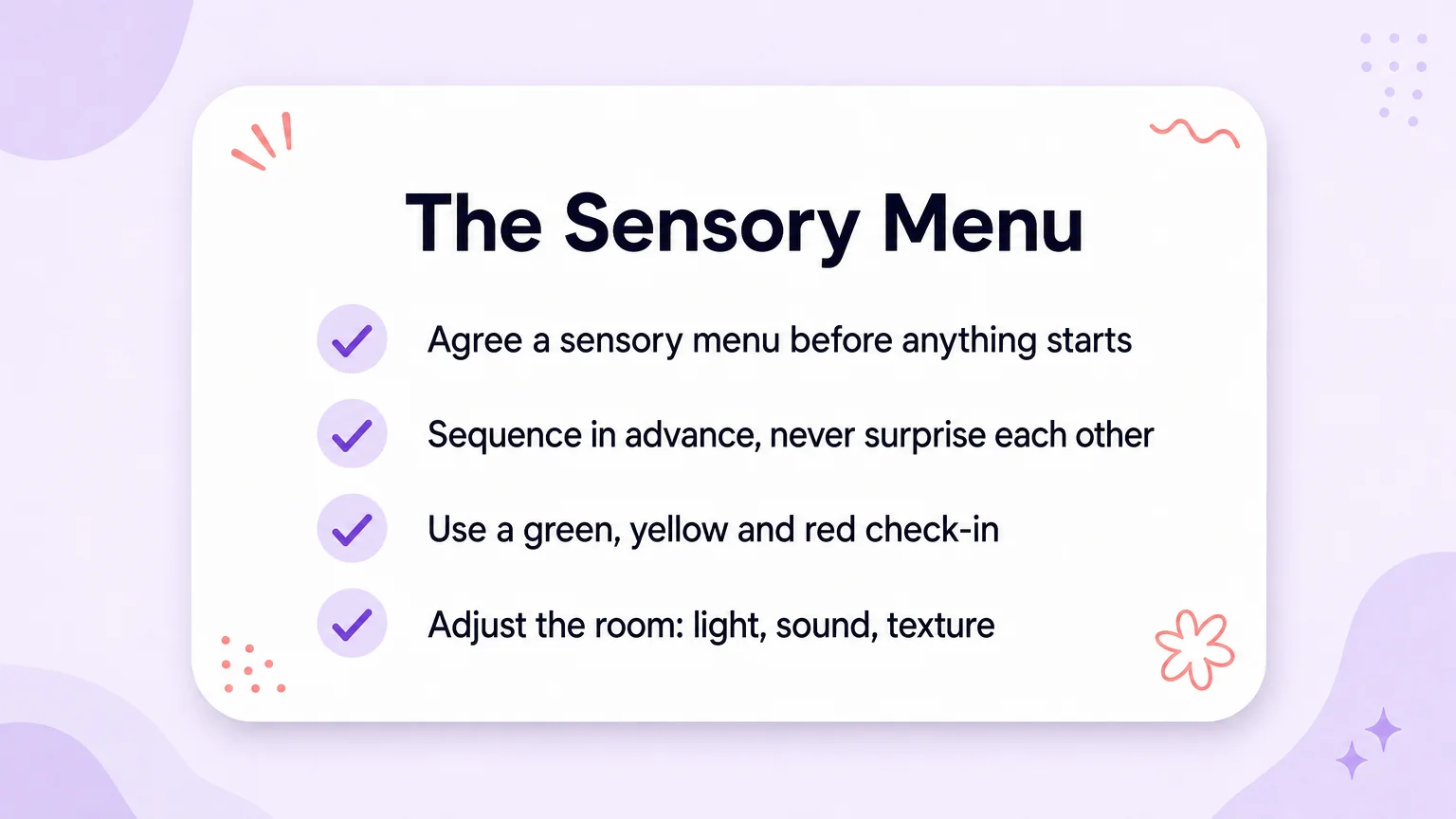
- Agree a sensory menu before anything starts: touches you like, dislike, and might tolerate.
- Sequence in advance rather than surprising each other, and use a green, yellow, red check-in.
- Treat withdrawal as regulation rather than rejection.
- Adjust the room: dim lighting, earplugs, unscented products, a weighted blanket, clothes kept on if that helps, and positions that let you control intensity.
A nervous system has to feel safe before it can feel sexual, which is a conversation for before intimacy.
If you go quiet or go still, that is not you failing to want your partner. And reading a shutdown as rejection is what escalates it, because naming a sensory limit sounds like rejecting someone’s body. A limit that is never named gets read as a verdict, which makes the next one harder to name.
If you are trans or non-binary, dysphoria can make giving complicated. There is no single answer: in one study a strap-on was dysphoric for one participant, because the lack of sensation reminded them of anatomy they do not have, and gender-euphoric for another. Use body-part language that fits you, and define sex for yourself rather than defaulting to a list of acts or a set of genitals. Agree in advance what you do if dysphoria arrives mid-encounter, and treat toys and prosthetics as equipment rather than a workaround.
If neither of these is you, skip ahead.
By the end of this step you should have a written sensory menu and an agreed word for slowing down.
Step 9: Pace and Ground When Past Trauma Is in the Room
Sensory overload and a trauma response can look identical and are not the same event. Overload is a nervous system taking in too much input right now. A trauma response is a body reacting to something it has already survived. If what stops you is older than the room, this is your step.
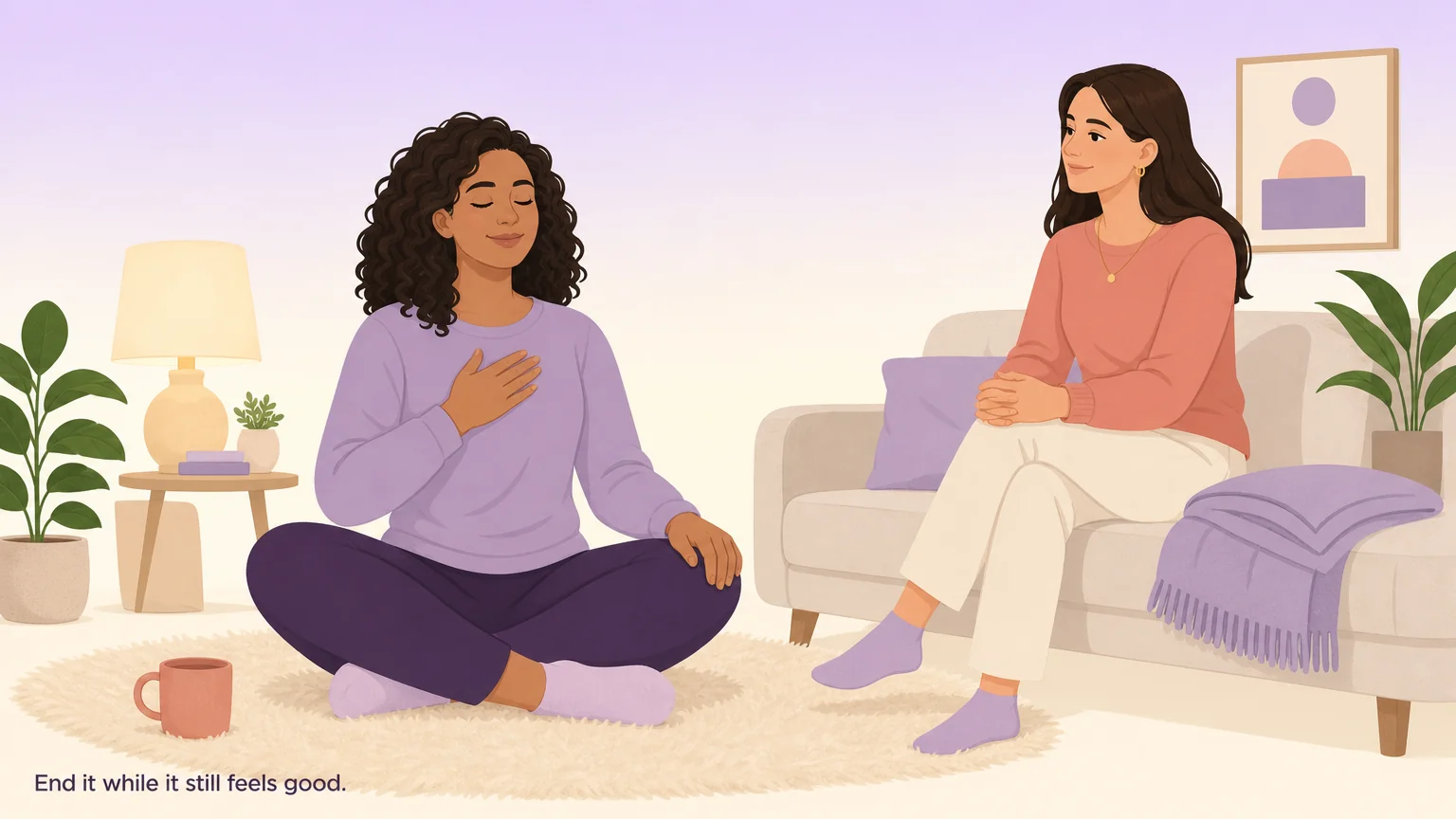
The window of tolerance is the band of intensity in which you can feel something strong and still stay present. Trauma narrows it. The work is not to force past the edge: pushing through produces more sensitization, not less. Hence the rule worth saying twice: end an encounter while it still feels good, not when distress arrives.
One modification to Step 4: unmodified sensate work assumes touch is neutral, and for a trauma history it is not. Add a body-checking pause, a deliberate stop where each person says out loud what they notice in their body and their head.
Then the control rule. The person with the history sets the pace and holds the brakes, every time, because restoring control is what heals and control is what was taken. That means a signal agreed in advance that needs no explanation and no apology, and stopping on it without frustration, which is the most therapeutic thing a partner can do. Withdrawing touch altogether is not safer: it teaches you that a limit costs you the relationship.
When a session goes sideways: name it early (“I am starting to go somewhere else”), and read the body’s move away as a signal about pace, not a verdict. Ground: slow the breath, press your hands against something stable, and name what you can see and hear. Then rebuild in reverse: intercourse off the table for a defined period, and the first rung back is touch that is not sexual.
Here is the ceiling: partner work has a limit, and reaching it is not a failure of love. The answer is trauma therapy rather than a better technique: EMDR, somatic experiencing, IFS, DBT, ACT or EFT, alongside sex therapy. Asking for that is the same move as asking for physiotherapy, not a verdict. Leave room for grief too: if something you wanted to enjoy did not feel good, that loss is real and worth naming.
You set the pace, and the measure of a good session is that you wanted to be in it, not that you finished it.
By the end of this step you should have a signal and a grounding sequence you have practiced.
Step 10: When the Block Is Your Partner’s, Not Yours
Two situations end up here.
Situation one: you want to give, and your partner does not want to be touched. Do not turn their boundary into your project. Ask why, once, directly and without blame. Do not assume trauma and do not demand a reason: a boundary does not have to justify itself, and linking being stone to abuse is wrong and damaging.
Then take the sting out of the refusal. Sexologist Sofie Roos puts it plainly: a stone top not wanting to be touched is about their body and their boundaries, not about you. If the boundary is fixed, the question becomes whether this relationship can work for both of you. Leaving is legitimate; staying while resentful is not.
Situation two. If you have been doing the giving for years, what you feel has a shape and a timeline. It builds slowly, out of accumulated silence rather than one incident, and the temptation is to hear it as a verdict on your partner, which it is not. It is a communication failure and an unmet need, and those are workable.
Do not reach for the cheap fix: friends will tell you to simply give less. Giving less does not create reciprocity, it creates distance, and it teaches your partner nothing except that you have withdrawn. Say what you want instead of withholding what you were giving.
And if you are the stone partner being asked for more, the pressure itself is a thing to name. You are allowed to say that the asking has become the problem.
One piece of history: stone boundaries have shifted before, and the people who shifted were glad of it. One recalled asking herself, after finding out how different it was, what she had been missing. But it always happened because the stone person moved it.
If you have worked through the first nine steps and nothing has moved, stop looking for a tenth technique. What remains is a decision, and it is allowed to be any of them.
By the end of this step you should have made one decision and said it out loud.
Frequently Asked Questions
Is being a pillow princess a red flag?
Not on its own. It becomes one through mismatch or silence: one person receiving, the other wanting more, and neither saying so. If both are happy with the arrangement there is nothing to fix. People use the label as a dig about uneven effort.
What is the opposite of a pillow princess?
The named counterparts are the stone top, the stone butch, the touch-me-not and the service top. A stone top gets satisfaction entirely from giving and usually prefers not to be touched back. A touch-me-not would rather not be touched at all.
Is pillow princess only for lesbians?
It started in lesbian and queer-women culture, describing a femme who only receives. It has since spread across the LGBTQ+ community, and the spread is contested: people who identify with the term have asked others to stop using it loosely.
What actually causes someone to be passive in bed?
Several things need different fixes: identity or preference, where non-reciprocity is the design; anxiety, shame, or inexperience; medication, pelvic pain, perimenopause, postpartum; disability or chronic pain setting an energy ceiling; neurodivergence; a trauma response; and a partner who has never said what they want.
Does the term mean I am lazy?
No. Used about yourself, it describes a preference or a boundary rather than a work ethic, and many people cannot want something before they are being touched. When someone else uses it about you, it is usually a complaint about one-sided effort.
Is it normal to feel nothing, or anxious, while giving?
Both are common and both answer to the same setup. Start clothed, take sex off the table by agreement, and if your anxiety is about being touched, start as the giver. If you feel nothing, give it the full 15 minutes, because five is not enough.
How long should I expect this to take?
Different problems run on different clocks. A single touch session needs about 15 minutes per turn. Pelvic pain treatment is measured in comfort, not sessions. Trauma work is paced to readiness, not a deadline.
The one quality worth screening for: someone who asks before they assume.