If you do not want to be touched during sex, you may have been handed a name that sounds like a warning. If you are dating a touch me not, you may have quietly started taking their boundaries personally.
Both of you are in the right place.
A stone top describing her own sex life on camera: “The enjoyment I derive from sexual intimacy is from pleasing my partner. And on the flip side, receiving sexual touch makes me uncomfortable, and I don’t like it.”
A touch me not lesbian is someone who does not want to receive sexual touch and keeps firm boundaries around their own body, usually preferring to give. It sits inside a cluster of near-neighbors.
By the end, you will know which word fits, and a partner will have concrete things to do and say, and one quiet fear answered.
A note on evidence: people describing their own lives are quoted as testimony, and scholars and named professionals carry the factual claims. This is not a flaw to be fixed, and not a phase.
Touch Me Not vs Stone Top vs Stone Butch: Why These Three Words Are Not Interchangeable
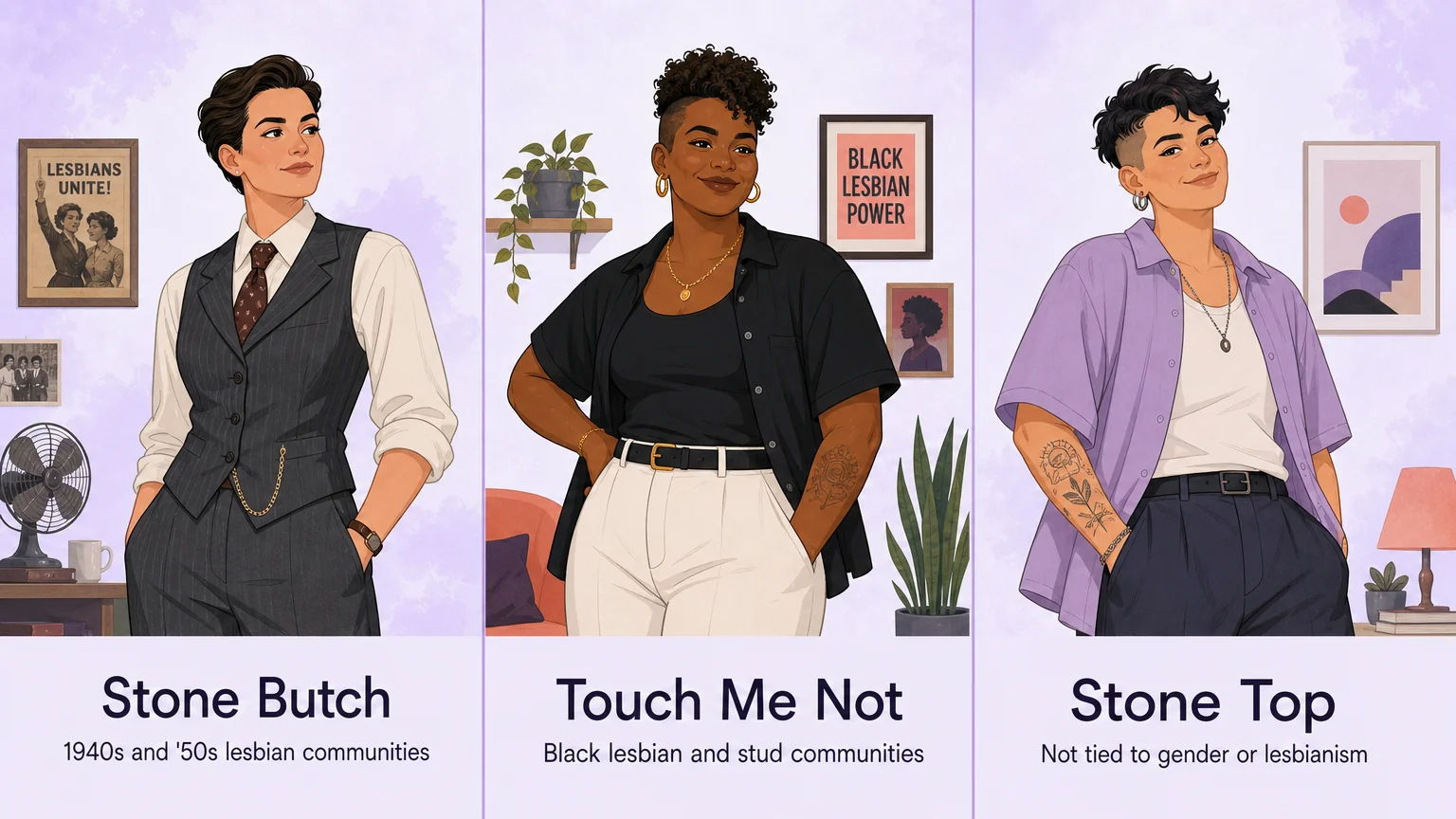
Three words get used as if they were synonyms. They are not. Each comes from a different history.
Stone butch is the oldest. It emerged from lesbian communities in the 1940s and ’50s for butch lesbians who do not “receive” sexually. Feminist scholar and stone femme Ollie O’Neill traces it that way, and it stays butch-specific, so it does not stretch to a femme or someone with no butch presentation.
Touch me not is a cultural term some Black lesbians and queer people use, often masculine-of-center lesbians or studs. The lineage behind it comes below.
Stone top is the widest of the three. Unlike the other two, it is not tied to gender, masculinity or lesbianism. Queer, trans and non-binary people use it to communicate sexual role alongside top, bottom or vers, and it appears in queer BDSM and kink spaces.
Two people describing themselves in a community survey: “I don’t want my body to be touched except under my direction or if I have given explicit in-the-moment consent to a partner I trust and am comfortable with.” The other, giving without reluctance: “I have no problem pleasing my partner, touching her intimately, and making her orgasm… I have no desire for her to reciprocate the intimacy through genital or erogenous zone touching.”
One correction, in the words of a stone top on a queer podcast: “not every masc is a stone top, and not everyone who’s stone top is a masc.”
The vocabulary is contested from inside. “I would prefer a more warming term than stone,” one forum poster wrote, and another said the word “makes a person sound too cold and lifeless, like you have no emotions at all.” People sometimes treat “touch me not” as the gentler wording. It is culturally specific instead. People choose the word for their own life, and using the word someone chose is most of the work.
A label like this is shorthand: letting a partner know a preference without explaining it from scratch. On 3Fun, that shorthand lives in your profile.
The Stone Spectrum: Stone Femme, Stone Bottom, Pillow Princess and How Far the Boundary Goes
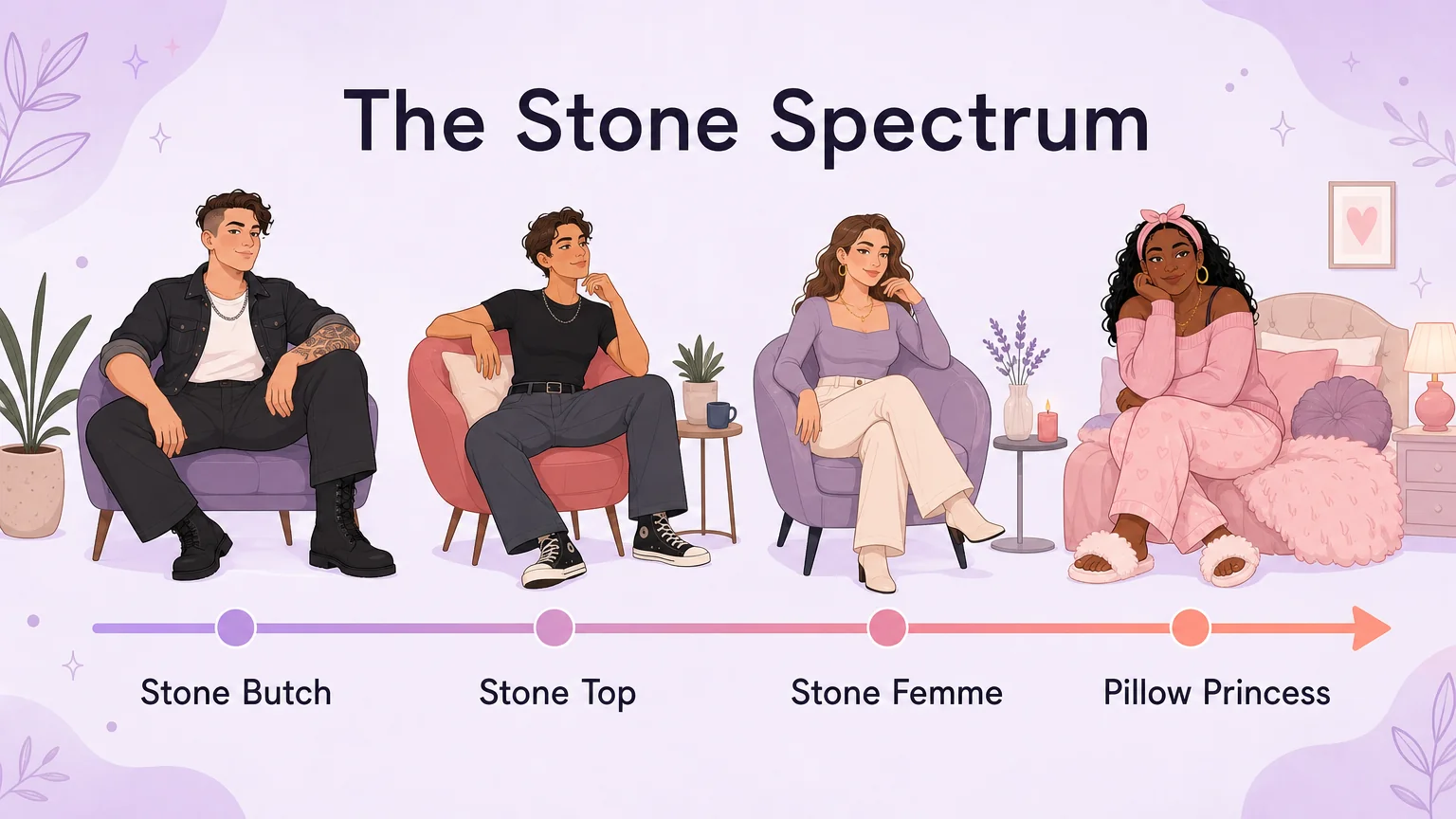
Stone is not one point on a line. Like top and bottom, it is a spectrum, and people move along it or change how they express themselves over time. Sexuality educator Kiana Lewis described the range of “no touching” as “nothing under the belt, maybe it’s nothing at all, maybe it’s only after their partner has received touch and pleasure.” Her next line answers anyone who hears this as an absence: “These folks can receive a lot of physical and emotional pleasure from pleasing a partner.”
On the giving side sit stone top, stone butch, and “stone” on its own. The standalone word is the most portable, and the one people say out loud most often.
Stone femme is a femme who gives but does not receive, which settles the question of whether any of this is masculinity in another coat. Its history is less documented than stone butch’s. O’Neill calls the origins “considerably murkier,” and offers the better answer: stone femmes and stone butches are “opposite sides of the same coin, intertwined yet distinct.”
Stone bottom and pillow princess are complementary roles, not passive ones. Pillow princess came out of the LGBTQ+ community in the 1990s, first appeared online in 2005, and grew a meme life of its own around 2019.
A pillow princess answers the lazy charge in her own words: “pillow princesses (aka me) don’t just lay there and do nothing. Theres different positions, theres the communication, the dirty talk, the grabbing and all that. We simply are just strictly receiving, and that’s okay.” Sex educator Marla Renee Stewart adds the other half: “There are folks who prefer to only be the active partner during sex” who are “specifically looking for a pillow princess to make a lover.” One poster frames it as “a joint dynamic with a touch-me-not/stone top.”
Partners also misjudge how far the boundary reaches. One forum poster who “just hate[s] being touched, but don’t mind touching” cannot get a massage or visit a chiropractor, because she tenses up.
You may also come across “touch me sometimes” in community spaces. It circulates as an informal variant with no settled definition, so treat it as a phrase people use, not an established identity.
Where the Term Comes From: Bar Culture, Stone Butch Blues and a 1950s Reversal
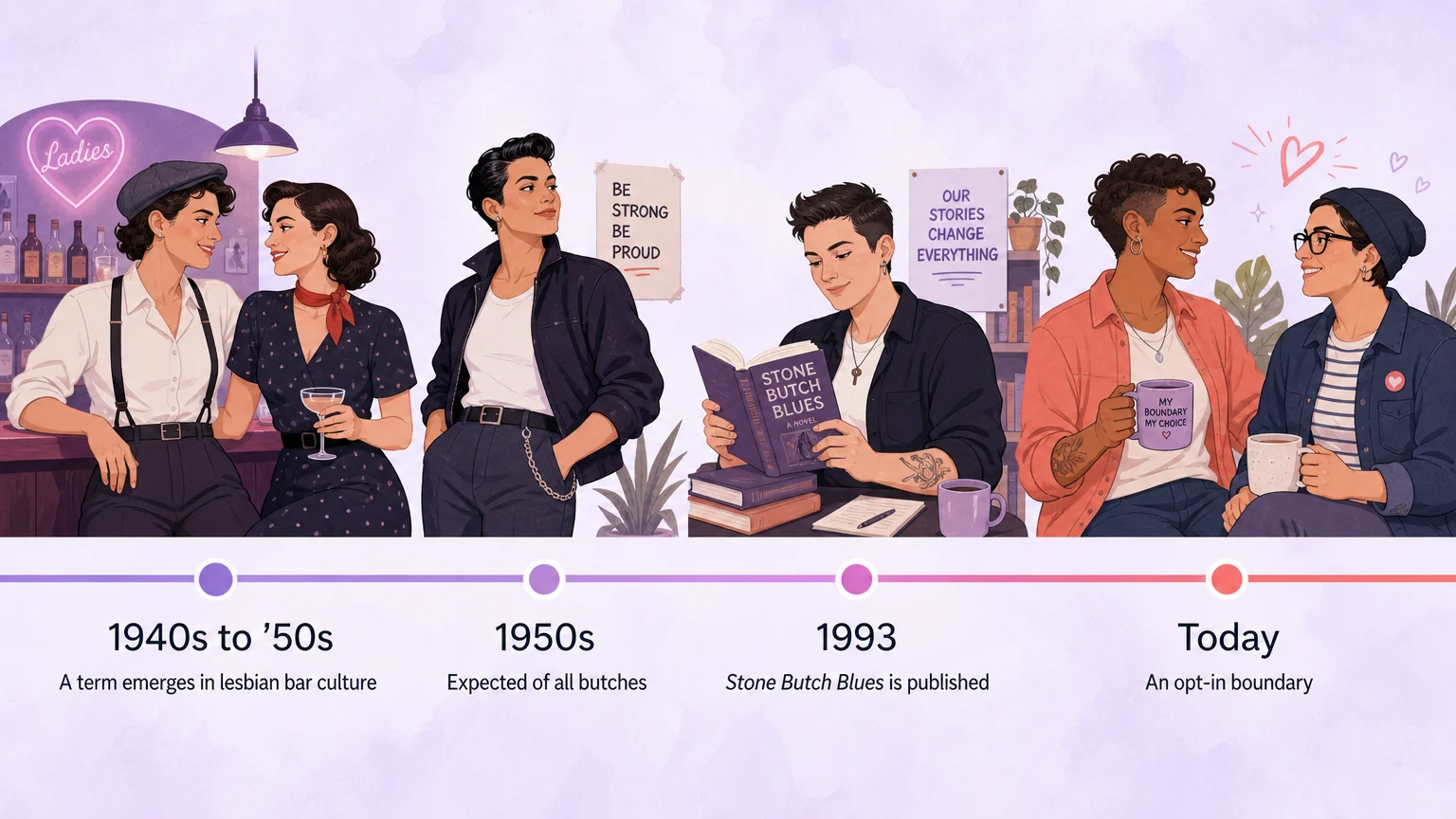
By the 1950s, being “stone” had become an expectation of all butches, and being “flipped,” topped by a femme partner, was taboo. The same word described a rule people were held to. Today it describes an opt-in boundary a person defines for themselves. Same behavior, inverted meaning, and this generation chose it rather than inherited it.
Bonnie Zimmerman’s edited volume Encyclopedia of Lesbian Histories and Cultures (Routledge, 1999) records a lesbian who does not allow herself to be touched during lovemaking, who may take pleasure vicariously from her partner’s enjoyment, and notes the practice may have been particularly prevalent in the 1940s and 1950s. Two things follow: the vicarious pleasure describes a working sex life rather than an absence of one, and the date places the practice two generations before the novel everyone credits.
That novel is Leslie Feinberg’s Stone Butch Blues (1993), whose protagonist Jesse is a working-class stone butch in 1950s Buffalo. At a 1996 reading, Feinberg’s partner Minnie Bruce Pratt introduced her as “my lesbian husband” and noted the book was already a classic. Feinberg treated this vocabulary as something “hammered out and forged” by movements rather than handed down fixed, and her own preferred term was transgender. The book is free to read at lesliefeinberg.net.
Behind the roles were conditions rather than style. Butch-femme bar culture grew out of necessity: the informal three-article rule, police raids, street violence. Butches were often factory workers, femmes often sex workers, so these partnerships were rooted in shared exposure and survival.
Jack Halberstam’s Female Masculinity (1998) places stone butch among “one of many distinct female masculinities,” the academic grounding for treating it as a gender expression rather than a symptom. In the 1970s and ’80s, lesbian feminists criticized butch-femme roles as imitating heterosexuality, which pushed this vocabulary out of view for a generation.
The Black Butch and Stud Lineage Behind the Words Touch Me Not
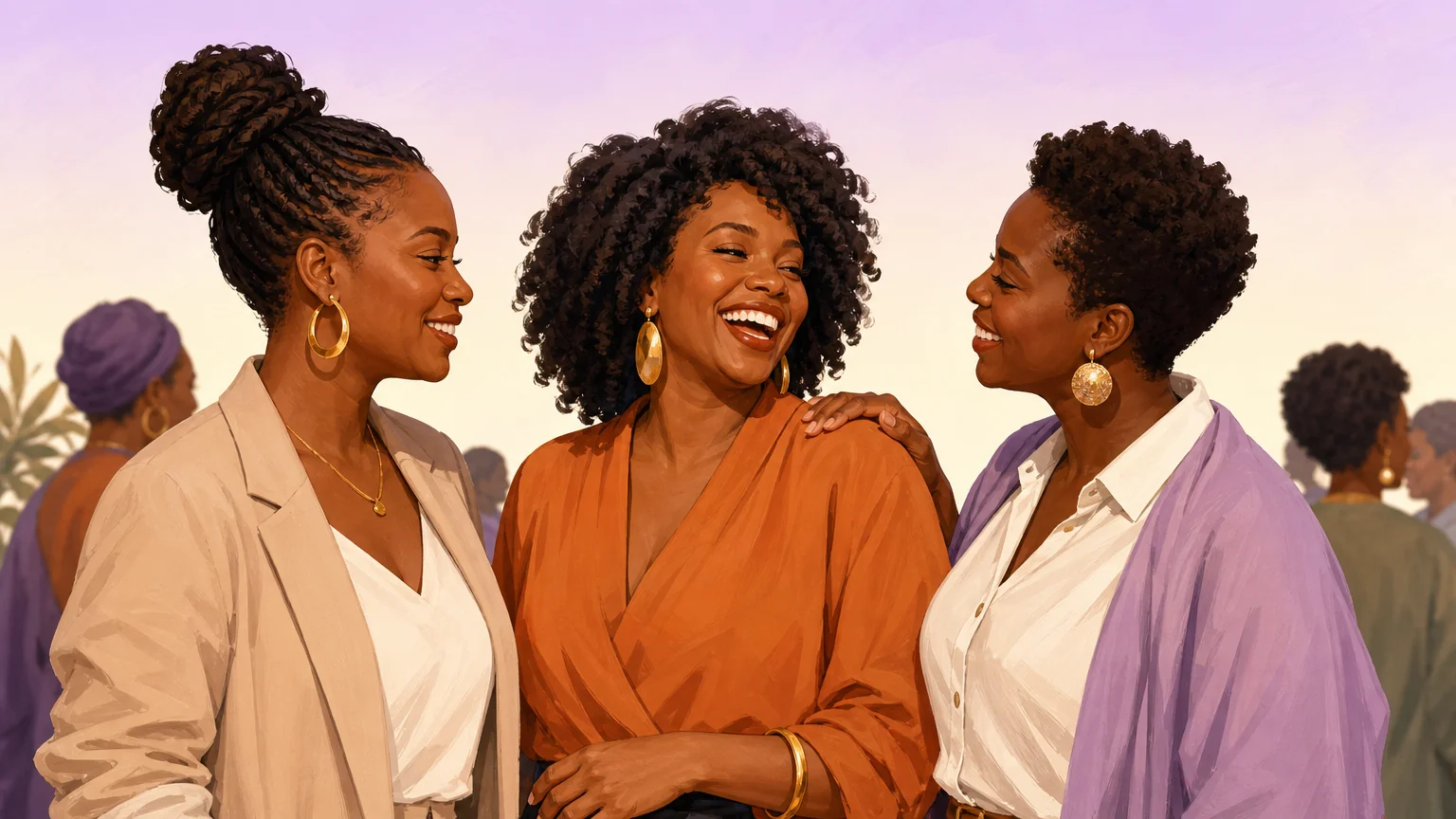
“Touch me not” is a cultural term some Black lesbians and queer people use, often masculine-of-center lesbians or studs. Its lineage tells you whose word it is.
Dr. Bianca D. M. Wilson’s 2009 article “Black lesbian gender and sexual culture: celebration and resistance” calls “stud” a “racially specific term.” The detail that makes it land is methodological: Wilson revised her own study question to ask about studs and femmes rather than butches and femmes, the wording her participants favored. The distinction came from the people she studied, not from academic fashion.
The archival record goes back further. A 1965 Washington University thesis, cited in Kelly Hankin’s The Girls in the Back Room: Looking at the Lesbian Bar, describes a “working-class black lesbian bar” peopled by “studs” and “fishes,” roughly the counterparts of butch and femme. A student paper written in 1965 described a bar that existed then, with its own vocabulary. A Black lesbian explaining the vocabulary on camera gives the community answer to this article’s question: “a stud that doesnt receive is called a touch me not.”
Roxane Gay complicates the category. “People tend to assume if you’re a Black butch, you’re a stud and that’s it,” she told The New York Times. She describes Black butchness as “doubly invisible,” with one exception: studs “are very visible.” She also notes that “Black women often get read as butch whether they are butch or not.” She is not a stud herself: she came back to butch as an adult and calls herself a soft butch now.
The adjacent words matter. Stud names a Black lesbian identity distinct from butch or masc. Stem, a portmanteau of stud and femme, is typically Black or Latinx and largely reserved for those communities. One dating-app description: a stem woman “can dress like a man but have Instagram-worthy feminine makeup on.” The vocabulary shifts by region: one commenter calls AG, short for aggressive, the New York term and stud the Southern one, and says AG phased out over time.
Ownership is a live argument. Sarah Prager argues in Tagg Magazine that “stud” “is a Black lesbian identity and it is not for white lesbians to make their own,” and offers alternatives: butch, chapstick lesbian, soft butch, dyke, tomboy, or an invented term. “It’s a pain to find a new word, but it’s the right thing to do.” The frustration runs hot: “It totally is our term but culture vultures love using our terms.” Prager was muted for a week in a Facebook group after raising white women calling themselves studs on TikTok.
No source sets a rule about who may use “touch me not.” The parallel is documented and attributed; the rest is a decision each person makes.
The community is large: the #studlesbian tag holds more than 20,000 videos, some past 1.5 million views.
Is Being Stone Caused by Trauma? What Stone People Say About the Assumption
Nearly every stone person has been asked some version of “were you abused?” The argument, in advance: trauma is not the default explanation, the assumption does damage in its own right, and for some people stone-ness and a trauma history are connected.
The writer carrying the most weight is both. She is a survivor of sexual abuse and a non-binary stone lesbian, and she calls the trauma claim “extremely damaging,” saying it is “limiting” to tie becoming touch-averse to abuse. She does not deny that trauma can shape a person’s relationship with touch. She is refusing to let it stand as the assumed cause. “Stone sexuality challenges the idea that sex has certain requirements and limitations.”
Arielle Scarcella reached the same conclusion from the other side, after interviewing touch-me-nots: “People should take away that not all women who only want to give were molested or have body image issues.” For the reader’s private worry: “it doesn’t make you any less or more gay for your sexual preference in expression.”
Catherine Henderson argues that Stone Butch Blues feeds “a myth that stone is the result of sexual trauma or gender dysphoria,” noting these may apply to some but are not universal. The reasons have diversified toward personal preference, pleasure and agency. For some people they are. The harm lies in assuming the connection, not in its possibility.
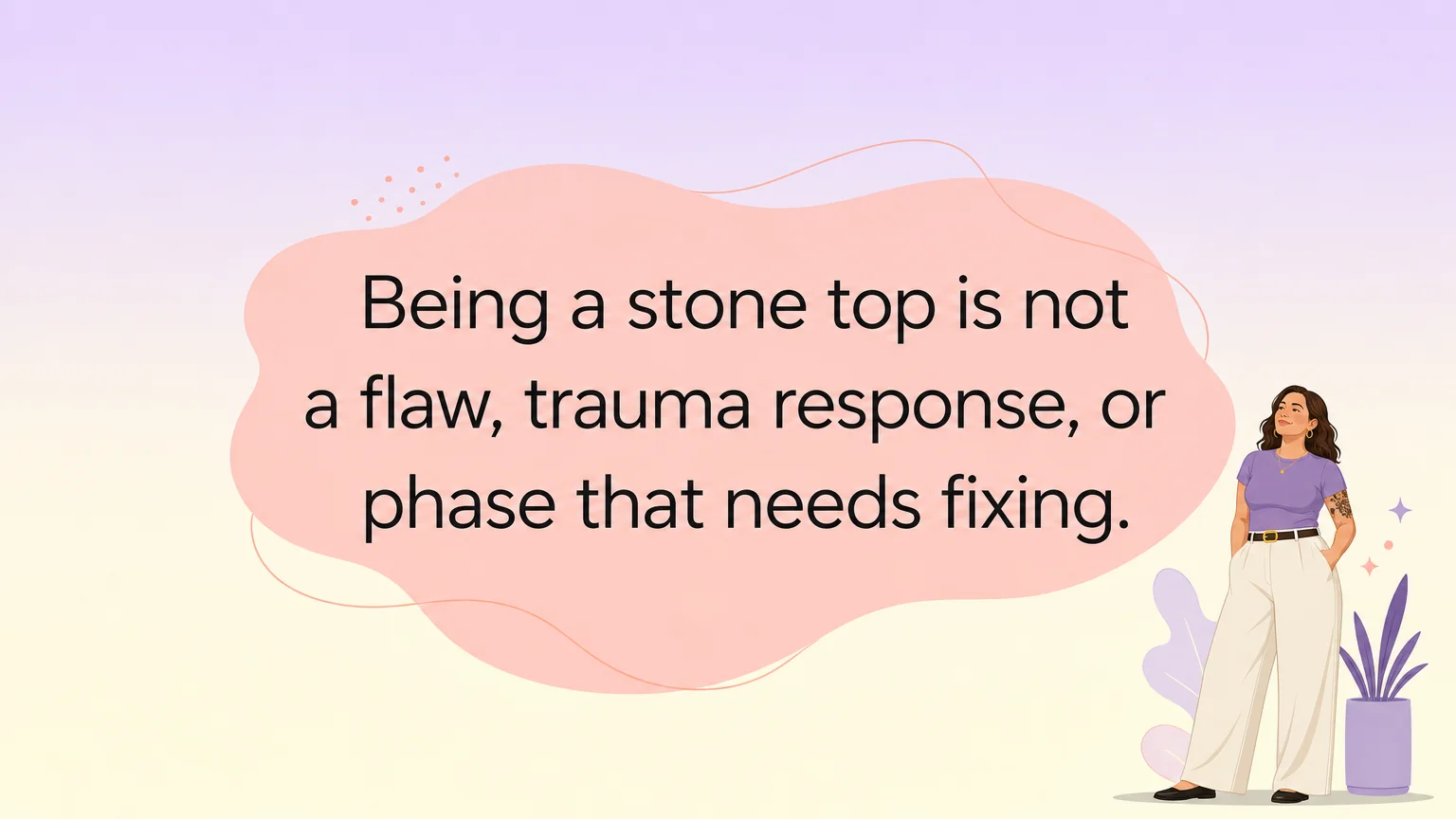
Have two lines ready. You do not owe a why: “you don’t need a why to explain if you do or don’t want to be touched.” The plainest reply is “honestly, it’s rude to ask, y’all.” For the argument: “Being a stone top is not a flaw, trauma response, or phase that needs fixing.”
Controlling your own body can be gender-euphoric rather than protective: “being in control of their body might be very gender euphoric for folks who live in a world where others are constantly trying to control their body.”
Melting the Stone: What It Means and Why Chasing It Backfires
“Melting the stone” describes some stone people being okay with certain kinds of touch in specific situations. It is a variation that already sits inside the spectrum, not a technique a partner applies or a milestone to reach.
The ethics are stated bluntly. Milla Impola, a sex expert for ONE Condoms: “You shouldn’t try and unlock someone or push them to change their stance.” One stone-community guide goes further, calling it a form of control to date a stone top hoping to touch them, and, when manipulative, a form of abuse. Treat that as the writers’ position, not a settled verdict, then weigh the reasoning: the relationship is entered on a promise the other person has not made.
A flat “it will never happen” is not accurate either. Boundaries can change and evolve over time, but “this shouldn’t be the expectation.” Change happens for some people; it must never be the condition of the relationship. If it happens, the stone person holds the pen: they initiate it, and they can revoke it.
The jokes show why. Turning or curing a stone top into a switch is a running bit online, and the pushback is blunt: “The infighting is so stupid. why do so many lesbians care about how other lesbians have sex… Don’t fuck them????”
Reciprocity is an expectation rather than a requirement, and a stone person’s pleasure is not a consolation prize. Impola: “For stone tops, their needs related to intimacy allow them to experience pleasure on their own terms.” Wanting to give is not the same as wanting nothing.
The fit matters more than the fix. On 3Fun, look for someone whose boundaries already line up.
For Partners, and for Anyone Wondering How to Bring It Up
You have noticed that you are not allowed to touch. You have stopped initiating, because the last attempt felt like an imposition. You hear that as a verdict on whether you are wanted.
Here is the answer, from Sofie Roos, a licensed sexologist and relationship therapist of eighteen years:
“A stone top not wanting you to stimulate them is about their body and their boundaries, not about you.”
Roos’s line matters because being allowed to touch a partner is how many people read desire, so a no on touch lands as a no on them. It is not. Their boundary is about their body; your wanting is about you.
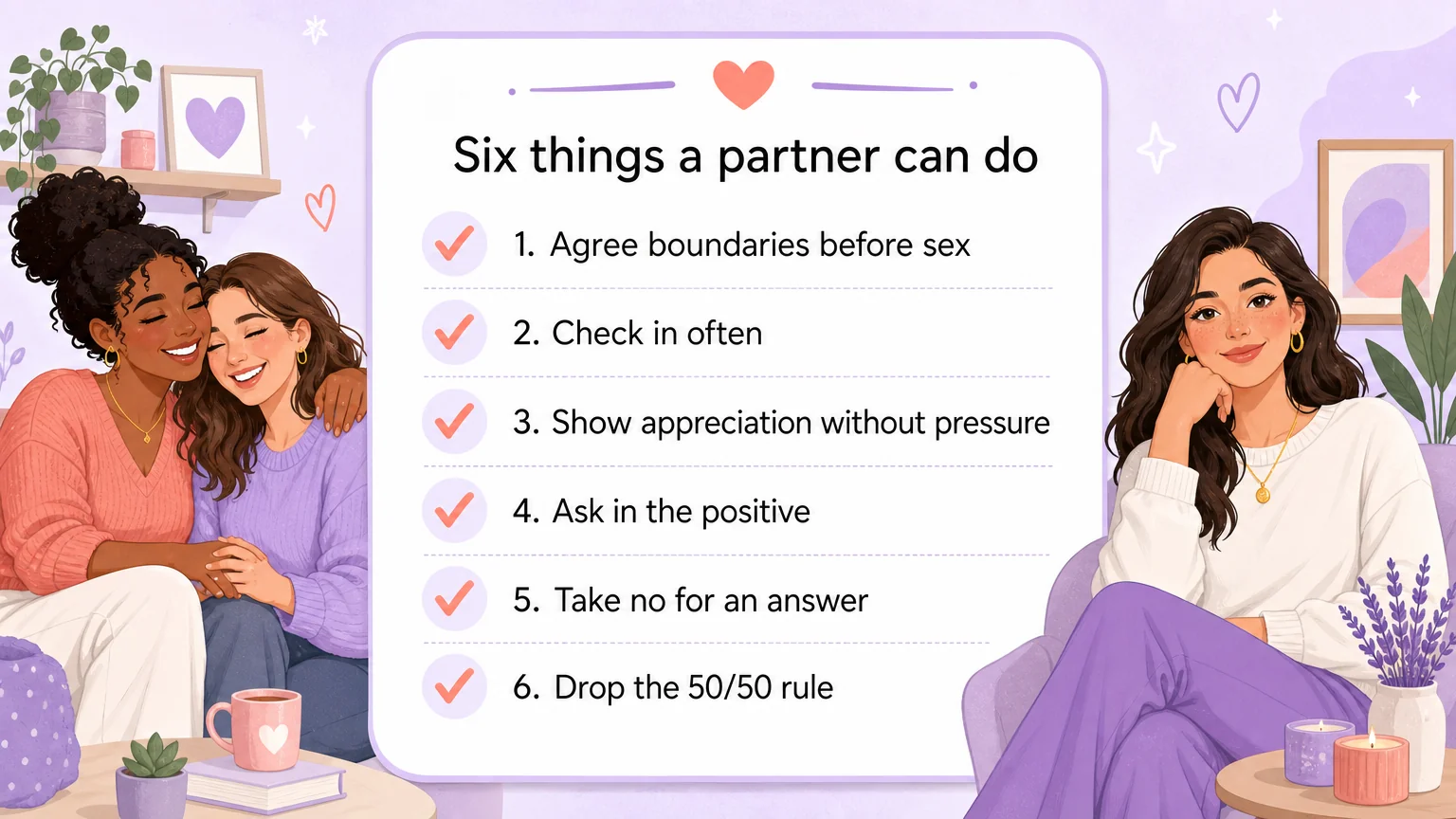
Six things a partner can do
- Agree the boundaries before sex, not during it. Decide in advance what touch is welcome, and leave it there.
- Check in often. Fine last time does not make it fine now. “Still good?” is enough.
- Show appreciation without pressure. Kissing and cuddling when welcomed, words, kindnesses outside the bedroom. A partner who cannot give back in bed can give back on the sofa.
- Ask in the positive. “What do you like and what works best for you?” rather than what am I not allowed to do.
- Take no for an answer. No guilt trips, no sulking. A sulk converts a boundary into a punishment, and your partner learns that honesty costs.
- Drop the idea that sex has to be 50/50. If both people get what they want, it is already balanced. That holds only while the non-sexual side is happening.
When only one thing is missing
Someone on the AVEN forums described stone applying to her for a period of her life, and took pride in how good she was with her hands. Over time it turned into “too much of a chore,” because she “wasn’t being reciprocated with the sex-free physical affection that I really needed.”
What ended her dynamic was not the sexual boundary but the absence of everything around it. That is one person’s experience, in a period that changed.
Widening the menu
Partners picture a narrower sex life than the reality. A stone partner may still want to give oral, use toys, sensual touch, dirty talk, power dynamics or strap play, and to kiss and cuddle when welcomed. Direct genital touch of the stone person stays off the table unless they say otherwise.
How to bring it up
A dedicated conversation beats a mid-encounter pivot. The conversation that goes badly is rarely the problem; the one that comes too late is.
Raise it early. One person puts it at the top of their dating profile. Another says the first date, or at latest the second, because “it’s not fair to lead people on.”
Lead with what is on the table, not the label. Describe what you want and let the term follow. “Be more dominant with me, hands all over me, care that I’m turned on” beats any single word.
Reassure when you decline. Declining with reassurance preserves relationship and sexual satisfaction; hostile rejection predicts the worst. No to this, still yes to you.
Keep it a compatibility conversation, not a negotiation. Differing needs may be a dealbreaker, and that is a legitimate outcome, not a failure.
You do not owe a reason, and declining to give one is not secrecy. These steps come from community writing and general counseling, not clinical guidance.
On 3Fun, people write their intent, desires and limits into a profile before they match, the same act as leading with what is on the table.
A boundary stated early is a kindness to both people, not a warning.
Frequently Asked Questions About Touch Me Nots
What is a touch me not person?
Someone who does not want to receive sexual touch and keeps firm boundaries around their own body, usually preferring to give. It is one of several related terms rather than an umbrella, and a stable preference rather than a passing phase.
What is a touch me not in a relationship?
The boundary covers their own body rather than their partner’s, not a withdrawal of affection. It often reaches past the bedroom: some cannot tolerate a massage. The balance is kept by non-sexual affection as much as by sex. See the partner section above.
Is a touch me not the same as a stone top?
No. “Touch me not” is a cultural term some Black lesbians and queer people use, often masculine-of-center lesbians or studs. “Stone top” is broader and is not tied to gender, masculinity or lesbianism.
Is stone top only for lesbians?
No. The butch and touch-me-not terms are largely sapphic, but stone top is used by queer, trans and non-binary people to communicate role, appears in queer BDSM and kink spaces, and overlaps with transmasculine identities.
Can a touch me not still want kissing, cuddling and affection?
Yes, and this is the most common misunderstanding. The boundary is about receiving sexual or genital touch, not a withdrawal of affection. Kissing, cuddling when welcomed, verbal affirmation and ordinary kindness hold the dynamic together.
Is being stone the same as being asexual?
No, they are different axes. Stone describes what touch someone wants to give or receive; asexuality describes attraction. They overlap for some people, and AVEN hosts a “Stone Asexuals” thread, but neither causes the other.
Is the touch me not flower the same thing?
No. The plant genus Impatiens, commonly called touch-me-not or jewelweed, is unrelated, and so is the biblical “Noli me tangere.” The phrase also collides with Adina Pintilie’s 2018 film Touch Me Not, winner of the Golden Bear at the Berlin International Film Festival.