Two answers about this word are in circulation, and they do not agree. One says a pillow queen is another name for a pillow princess. The other says a queen is the sharper version, the one who expects to be served.
Both are easy to find. Only one of them survives contact with how people use the word.
The plain half, settled in a sentence: what is a pillow queen describes someone who prefers to receive sexual pleasure rather than give it, and who wants her partner to take the lead. That part is not in dispute. Everything after it is.
The rest is where it matters. Whether queen carries more bite than princess. Whether the word is an insult, a label, or a joke aimed at someone. And why anyone would want this at all, which turns out to be the question with the most to say for itself.
Is a pillow queen a different thing from a pillow princess, or the same thing wearing a sharper name?
Pillow Queen vs Pillow Princess: What the Community Says
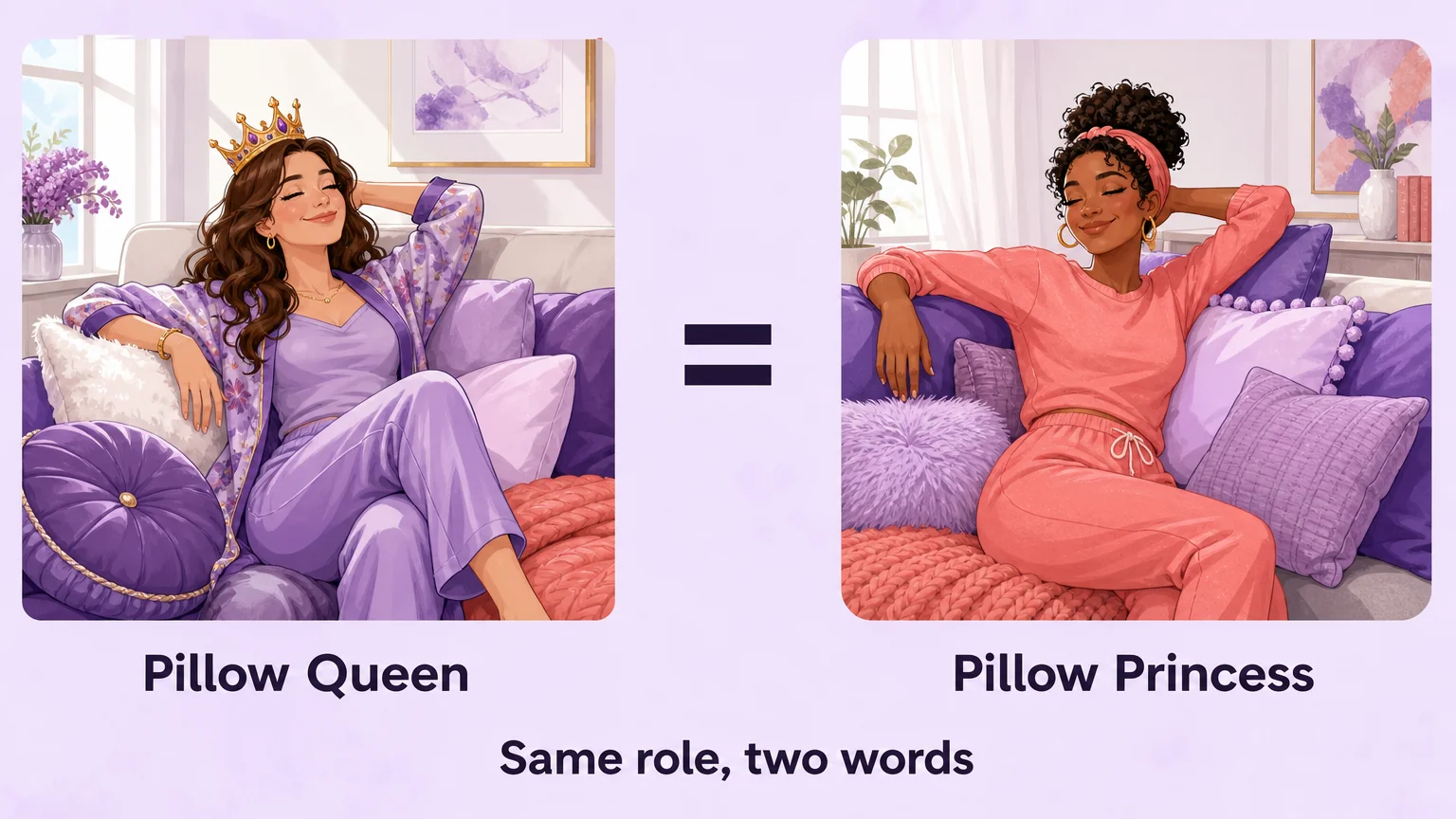
In every dated example of the term in community use, pillow queen and pillow princess mean the same thing. Not a sharper tier. Not a more demanding version. The same role wearing a different word.
A 2020 community post quoting the standard dictionary entry says it outright: “This is the same as a pillow queen aka the bottom in the relationship.”
Self-labelling posts from 2016 and 2017 use it as a plain identity noun, alongside “stud” and “lipstick lesbian,” not as an accusation: “I’m not a dike. Not bi, not lesbian, not straight, a pillow queen, a stud.”
A 2016 LGBT lingo glossary defines it flatly as “a girl who likes to receive oral, but never reciprocates,” with no insult attached.
A German-language queer advice lexicon, published in 2021 and updated in 2024, presents Pillow Queen as the established community term and maps it onto stone butch as one half of a symmetrical pairing. That is a partner term, not an escalation. Its phrasing is deliberately gender neutral: a person who stays lying on the pillows and enjoys the passive part of sex without becoming active.
You will also find a sharper reading, that a queen is used to being pampered, taken care of, treated like royalty, “definitely next level.” That reading is written rather than spoken, and it arrives with no source behind it. It is an editorial interpretation, and the community record does not carry it.
The inference sounds reasonable, and that is exactly why it travels.
“Queen” also turns up inside two ugly phrases aimed at the same behavior, and a word that appears inside real insults starts to feel like an insult by association. Those two phrases come back later.
So if you say pillow queen and your partner says pillow princess, you are both right. Use whichever one sounds like you.
Where the Term Comes From: What’s Verified and What Isn’t
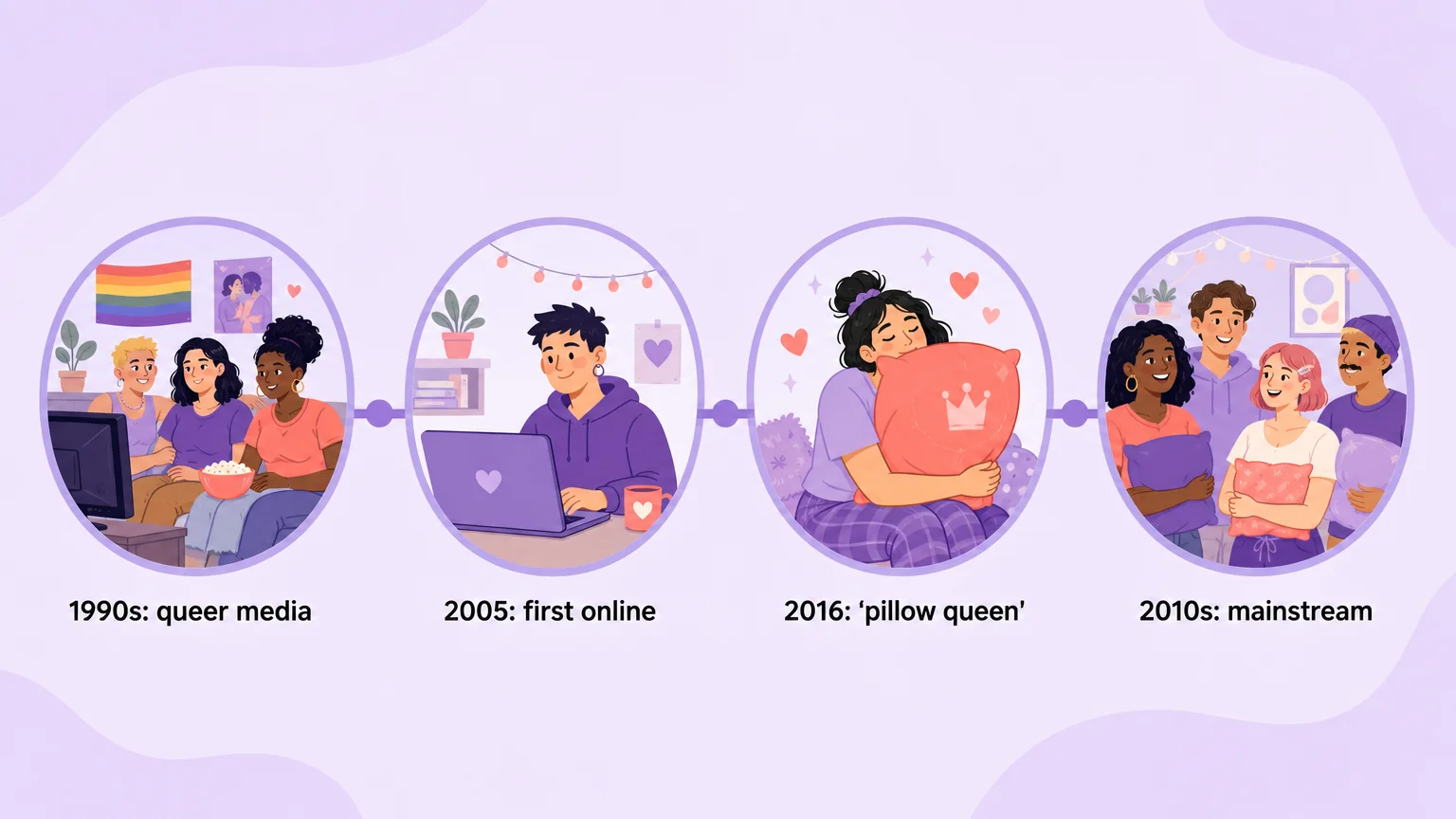
Half of this term’s story is documented. Half of it is repeated often enough to sound like a fact.
Deneuve was a real lesbian magazine, launched in 1990 and renamed Curve in 1996 after a trademark dispute, so a 1992 citation is chronologically possible. The parent phrase dates to LGBTQ+ communities in the 1990s, appears online in 2005, and widened into mainstream use in the late 2010s. Stone butch, the one term here with a deep anchor, goes back to working-class lesbian communities of the 1940s and 1950s, when cross-dressing was illegal. The queen and princess pairing has no comparable anchor.
The 1992 article the origin story rests on has no issue number, no title, no author, and no page. It may exist. Nobody has shown it.
An academic history volume on sexualities uses “Pillow Queen” as its standard term throughout, never “princess,” and traces the concept through a 2001 film, a 2004 sitcom episode, and a 2005 season of The L Word. That raises a possibility: queen may be the older form, and princess the later, softer one. It cannot be proven, and it is more plausible than the idea that queen is some new, harsher edition of the same word.
For pillow queen itself, the earliest dated uses are from 2016. Even the obvious archive for a coinage of that era, the first women-run erotica magazine, On Our Backs, holds nothing earlier. Its paper trail is thinner than its sibling’s, which is why the same borrowed story keeps circulating. Not a word with a lost origin. A word with a thin one.
Is ‘Pillow Queen’ an Insult? What the Evidence Shows
You have heard the word used like a slur, and you cannot tell whether you are being insulted or whether you are the problem for wanting what you want. Both deserve an answer.
Yes, the word can be used as an insult. No, the insult is not inside it. It is imported by whoever is using it.
Sex educator Marla Renee Stewart draws the line precisely. Inside queer circles the term stays descriptive, doing what it was coined to do: helping people find each other, and some people want exactly that.
It turns pejorative entering heterosexual usage in the 2010s, where it collapses into “lazy lover.” A compatibility label reused as a complaint.
The cost matters too. One reader wrote it “made me force myself to cross my own boundaries for years.”
One video line insists a pillow princess “isn’t a real lesbian.” A woman was told at a table full of friends that women who do not go down on women are not lesbians. One writer describes pretending to be a switch because not reciprocating “felt selfish not to, rude even,” and sex that was “mostly about being desired, not her own pleasure.”
The charge is either “you are lazy” or “you are not really gay.” Both police a role rather than anyone’s pleasure.
Receiving is a form of giving. What is offered is access to your body, your trust, your attention. A receiving partner steers through responsiveness.
No comparable word exists for a man who lies there. The misogyny arrived with the co-option, and it brought the same question used to devalue unpaid care work: what do I get out of it?
If the word is aimed at you to make you smaller, that says something about the person saying it. If it describes how you like sex, it is yours.
Starfish, Mattress Queen, and Do-Me Queen: The Words That Carry the Insult
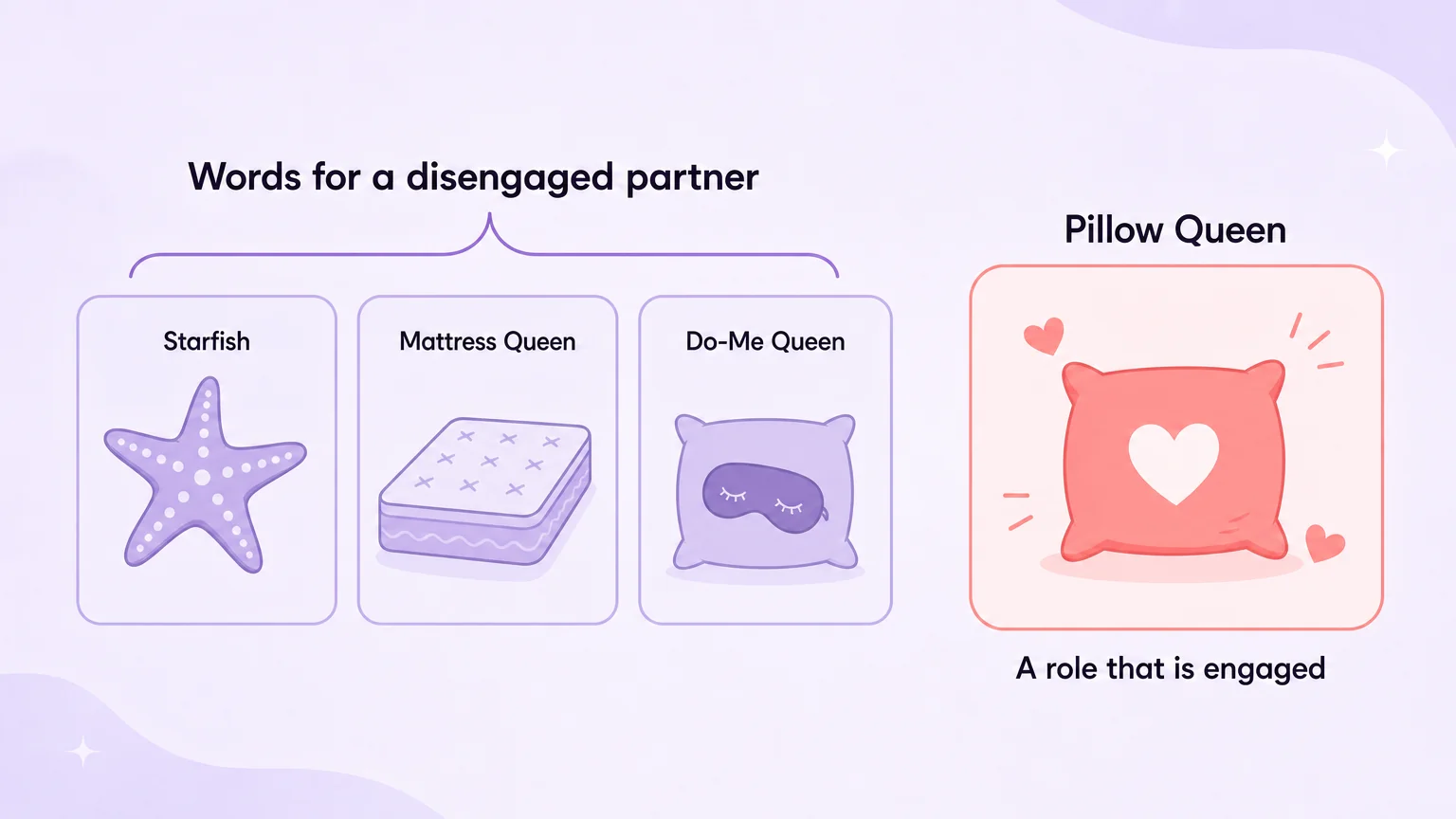
If you keep one thing, keep this. The thing people are trying to insult has its own words, and none of them are “pillow queen.”
Starfish is the straight-culture term for a partner who lies there and contributes nothing. It names a complaint. The community refuses the swap. Asked whether straight couples can call themselves pillow princesses, the answer was a flat no: “that’s called a starfish. Use your own words.” A self-identified pillow princess pushes back: “we’re all starfish. I’m like, I don’t know about y’all, I’m a very active participant.”
The line is participation, not activity. Who is doing what with whose hands says nothing about whether someone is present, responsive, checking in, and paying attention. A receiving partner can be the most engaged person in the room. That is what the role is when it is working.
Two words do carry the insult: mattress queen and the “do-me queen” stereotype. Both describe the same disengaged behavior, and both use “queen.”
That is likely where the belief that pillow queen is the harsher phrase comes from. A word sitting beside two phrases meaning someone who takes without showing up absorbs their meaning. Contamination by proximity, not a definition.
Starfish has no reclaimed use at all. Borrowing it to describe a preference does damage.
A starfish does not participate. A pillow queen participates, and receiving is the participation.
Why Someone Might Prefer to Receive: Six Reasons That Aren’t Laziness
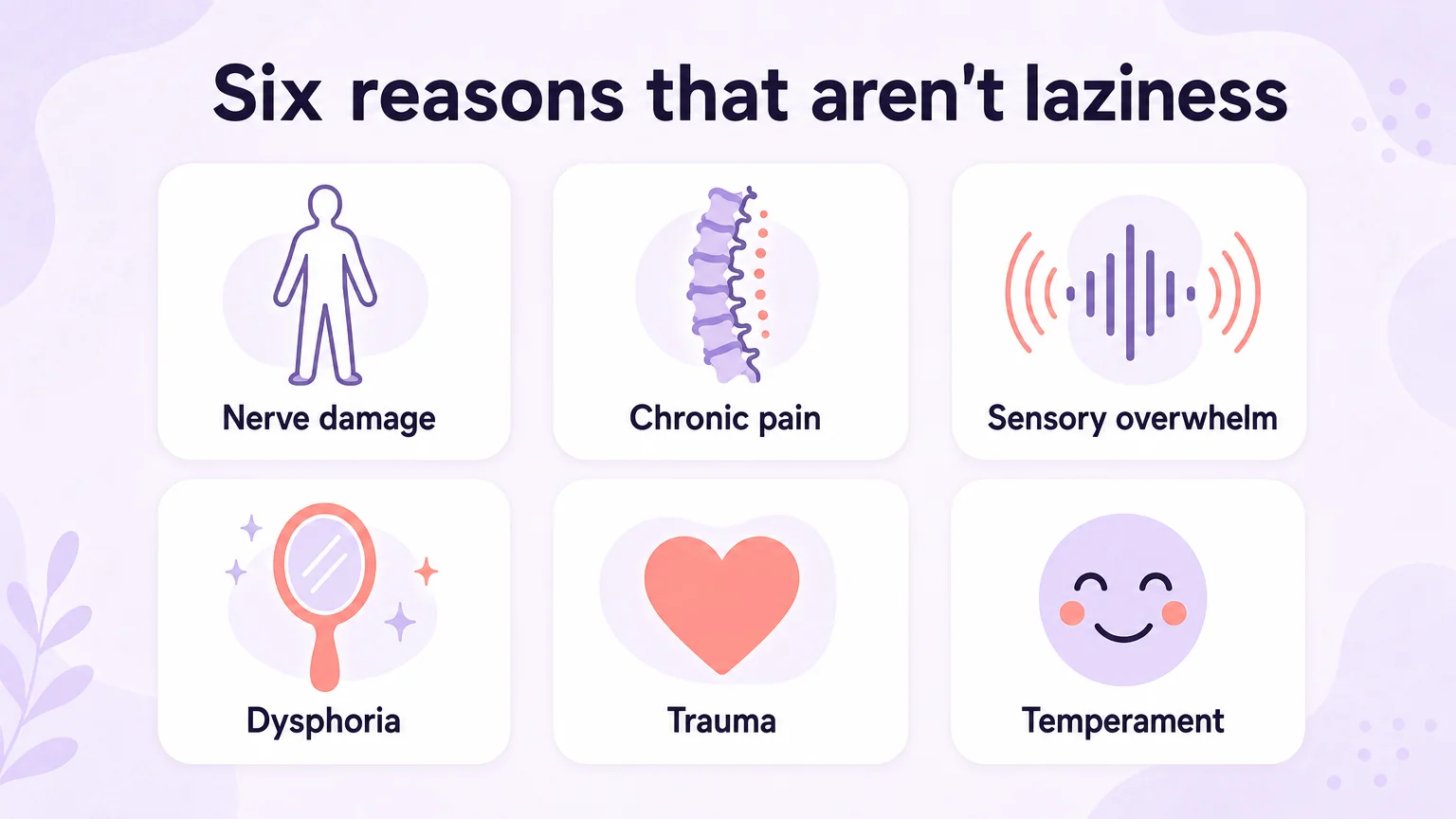
Pillow queen names a preference, not a personality, and it has no single cause.
Nerve damage. One person’s body registered receiving as “either painful or they didn’t feel anything at all,” while their sex drive stayed intact. Drive and receptivity are not the same wire.
Chronic pain and hypermobility. With Ehlers-Danlos, pain shifts daily and energy is the scarce resource. The levers are positioning, pillows, and starting with oral sex. Some find sex “a value add” that helps; for others it is more of a process.
Autism and sensory overwhelm. Many in one mostly-neurodivergent friend group get called pillow princesses, not by choice but by sensory overwhelm, with giving oral sex landing in the same territory as putting food in your mouth. A nervous system fact, not a character failing.
Gender dysphoria. A stone top names it as her reason for not receiving: “a lot of it is rooted in dysphoria… I’m not comfortable being perceived.” Her enjoyment runs the other way: “the enjoyment I derive from sexual intimacy is from pleasing my partner.”
Trauma. After an abusive relationship, one person wanted to give and could not: “You can want something and wish you were capable of it while your entire body still rejects it and is terrified of it.” Treat that as the boundary it is.
Temperament. No cause required: “I love being the center of attention… I love being taken care of. I have a very dominant giving personality in general, but not necessarily sexually.” Wanting to be wanted, on your back, is a whole preference.
For the first five, this is not a choice to be talked out of, and the goal is never to coach someone into giving. The useful question is what works for the body in front of you.
Psychologist Dr. Ruth L. Schwartz notes that desire comes from “a very complex mixture of experience and response to experience,” and that is no reason to pathologize anyone: “There are so many ways to experience sexual pleasure, and they are all beautiful.”
The Giving Partner’s Side: What They Get and What They’re Not Getting
The giving partner is the blind spot. The question rarely asked is what they need.
Start with what givers get. One stone top says it plainly: “the enjoyment I derive from sexual intimacy is from pleasing my partner.” Another framed it as “my satisfaction is in you receiving.” Giving exclusively is its own preference, held for its own reasons.
Then the other half. One stone top dated someone for five months who “did not get on top of me… did not put their hands on me. I don’t think they ever kissed my neck once.” She had told her up front what she wanted: “I’m very open, honest, communicative with the people I go into dynamics with because I do love reciprocation, but in very specific ways.” She owns her part too: “I really enjoy giving… I do need to be better about that.”
A giver who does not enjoy giving should say so, not perform enthusiasm. She has also experimented with receiving and enjoyed it.
The point is not an accusation of receivers. An unmet stated preference is the failure mode, and it runs both ways. Saying what you want is not asking someone to change.
Say it early, say it specifically, and do not wait to see whether they guess. What happens when it is not met comes next.
When Roles Don’t Match: Repair, Renegotiate, or Move On
The problem was never the preference. It is a stated need that goes unmet, or one never said out loud.
One direction is pressure on the receiver to give. The other is quieter: performing mutuality because not doing it “felt selfish not to, rude even.” Both cross your own boundaries to keep the peace. Neither is a relationship.
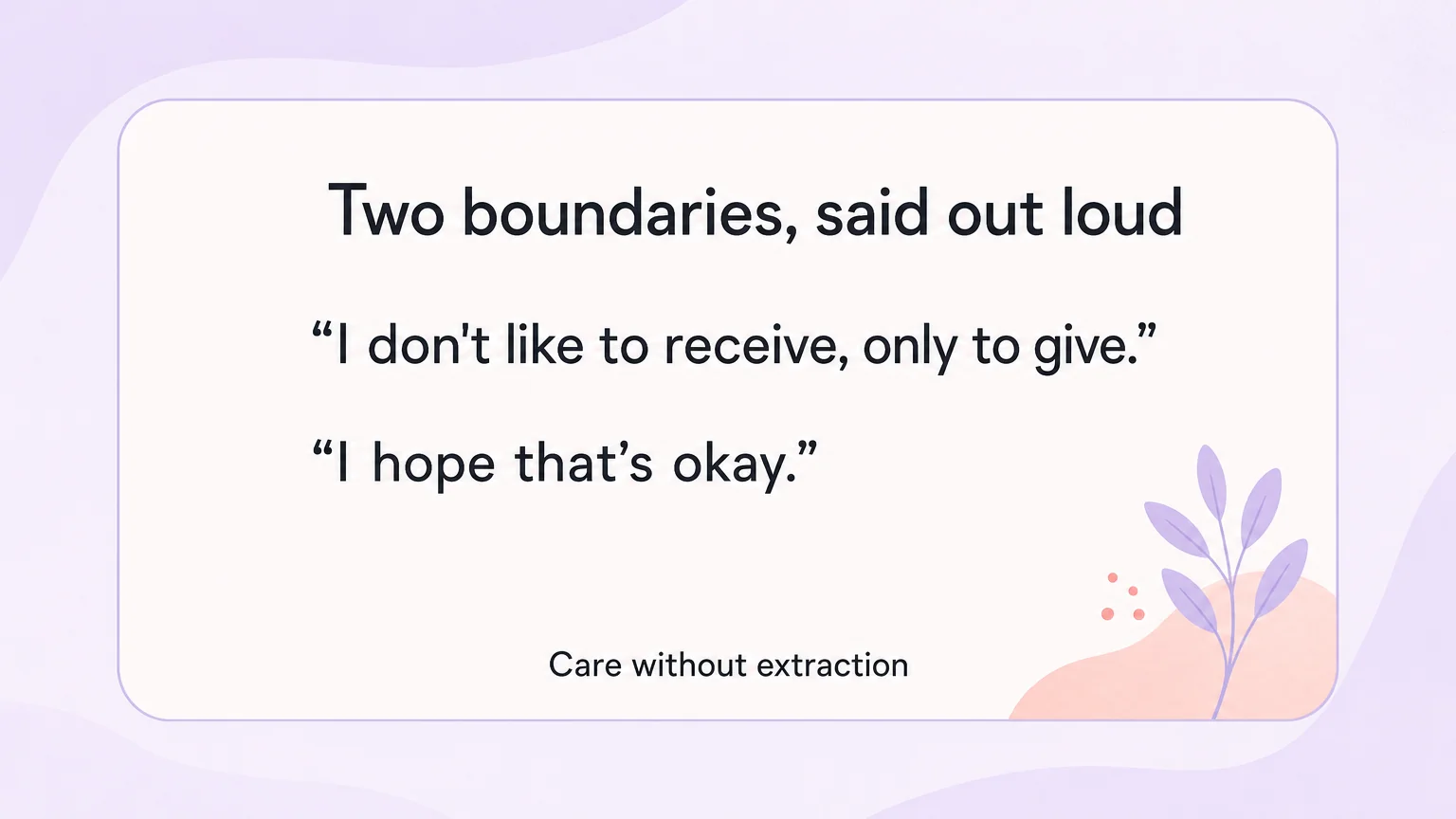
The fix is not one person changing: it is two boundaries stated out loud that fit together. “I don’t like to receive, only to give. I hope that’s okay,” answered with, “I’m not going to pressure you to receive to feed my ego, because I don’t want that done to me.” The writer who lived it calls the result “care without extraction.”
Complementary boundaries dissolve the mismatch. If yours are not complementary, the pairing is what needs looking at.
A structural workaround: toys, described by one receiving partner as “a third party that’s not an extra person.”
None of this is permanent. One person’s path ran switch, touch-me-not, switch, pillow princess, switch again. A stated boundary is not a life sentence, and one you no longer hold was not fake when you held it.
With more than two people involved, someone has to redistribute the split, and nobody has documented how. Knowing what you want and being able to say it is the whole skill, and 3Fun is where people who have learned to say it go looking.
Frequently Asked Questions About Pillow Queens
What is a pillow queen?
In documented community use, a pillow queen is someone who prefers to receive sexual pleasure rather than give it, and who wants her partner to take the lead. A 2020 post quoting the standard dictionary entry says it outright: “This is the same as a pillow queen aka the bottom in the relationship.” No evidence suggests it names a more extreme or more pampered version.
Is a pillow queen different from a pillow princess?
Not in any documented community usage. Every dated example treats the two as the same role under two words, and no first-person source draws an intensity line between them. The sharper reading, that a queen expects to be served, is an editorial interpretation with no source behind it, and the record does not support it.
Is “pillow queen” an insult?
It can be used as one, but the insult is imported rather than built into the word. Sex educator Marla Renee Stewart locates the shift: descriptive inside queer circles, pejorative once it crossed into heterosexual usage. The words that mean a disengaged partner are starfish and mattress queen. Naming those separately is what protects this one.
Where does the term come from?
Deneuve was a real lesbian magazine and was publishing in 1992, which makes the origin story chronologically possible. The specific article behind it has never been produced by anyone: no issue, title, author, or page. For pillow queen itself, the earliest dated uses found are from 2016, so this is not a fresh invention with a shallow shelf life.
Is a pillow princess the same as a starfish?
No. Participation is the line. Starfish names a partner who lies there and contributes nothing. A pillow princess can be fully engaged, and one self-identified pillow princess put it directly: “we’re all starfish. I’m like, I don’t know about y’all, I’m a very active participant.” The community refuses the substitution outright.
Is a pillow princess lazy or selfish?
No. The three accusations, that receiving partners are selfish, lazy, and unwilling to learn what a partner wants, are named and rejected by people who hold the identity. Receiving is itself a form of giving: access to your body, your trust, and your attention. The accusation borrows the same logic used to devalue emotional labor, which is why it lands so hard.
Can a straight couple have a pillow princess?
The community’s answer is no. The term is a lesbian and queer identity, and the straight equivalent already exists as starfish. Asked directly, one stone top is emphatic: “No no no no.” The behavior itself is everywhere. The label is borrowed, and borrowing it erases where it came from.
Do guys like a pillow princess?
Yes, and men claim the label themselves, including gay, bisexual, and probably straight men. “Pillow prince” is a separate matter: it is a recent editorial coinage with no documented first use, invented by writers rather than grown inside a community. Worth knowing before you use it as though it carries history.
Can disability or neurodivergence cause a receiving preference?
Yes, and it is one of the least discussed drivers. The documented ones are nerve damage, where receiving registers as pain or as nothing at all while sex drive stays intact; chronic pain and hypermobility, managed with positioning, pillows, and starting with oral sex; and autism-driven sensory overwhelm. None of these is a reluctance problem, and none of them needs correcting.