Most people first met “power bottom” in an October 2007 episode of It’s Always Sunny in Philadelphia, or in Troye Sivan’s “Bloom,” or on a timeline, and filed it under gay slang, vaguely. You knew it was a gay thing. You weren’t sure what it meant. Asking felt like admitting it.
It isn’t a punchline. A power bottom is one of the most precise and misunderstood terms in queer sex vocabulary, with a real history, a real politics, and real skills behind it.
What follows: a working definition, the origin story, what the role looks like in bed, the myths, why it matters in gay culture, and how to try it with a partner. One correction runs beneath all of it: the receiver is not the submissive. The Gayish podcast dates the term’s digital debut to 2005, and its mainstream moment to that 2007 sitcom. Dr. Joe Kort and Zachary Zane anchor the definitions that follow.
Power Bottom, Defined: What It Is and What It Isn’t
Most people picture a power bottom as a submissive man who takes it on the back. That picture is wrong, and correcting it is the whole game.
Here’s the working definition: a power bottom prefers to be the receptive partner during anal sex but, rather than being passive, controls the encounter. The tempo, the depth, the positions. Sex therapist Dr. Joe Kort says the term was born in the gay male community and describes a power bottom as someone who “knows what he wants and takes control of the penetration.” Writer Zachary Zane adds the practical side: a power bottom tells their partner to switch positions, never waits to be directed, and treats being penetrated and being submissive as two completely different things. The label describes an approach to sex, not a body type, not a personality, not a statement about how much power you hold anywhere else in your life.
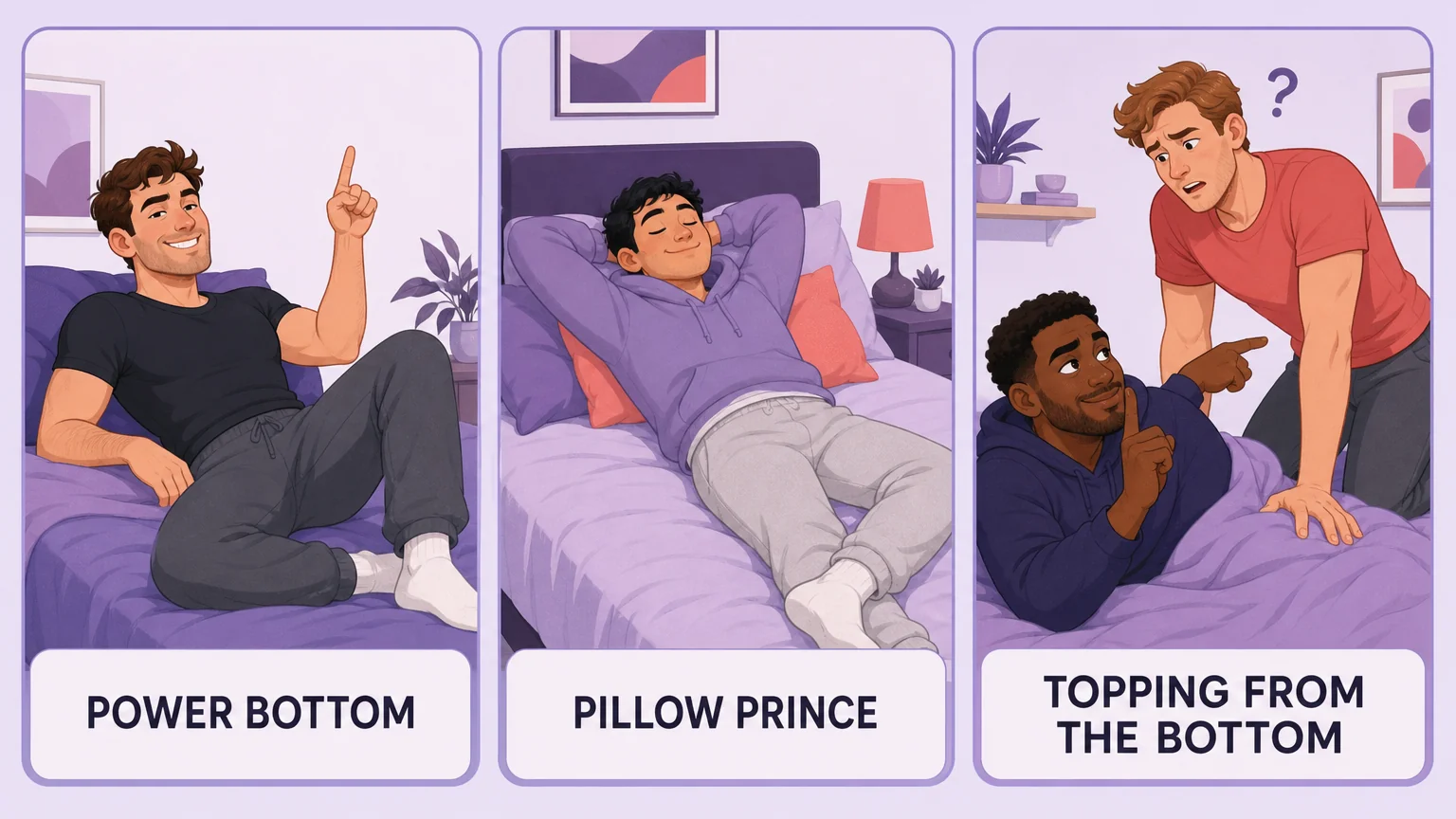
Let’s draw the borders, because the term sits in a family you may be confusing it with. Sex therapist Jesse Kahn stresses that the meaning varies by person, so there’s no single fixed definition, and partners should clarify what the word means to each other. A pillow prince is a bottom who’s “fairly lazy and self-serving” about receiving, the exact inverse of an active, directing power bottom. Topping from the bottom is the BDSM habit where a submissive runs the scene against the agreed dynamic, and that one carries a negative charge that “power bottom” deliberately does not. Power bottoming is claimed on purpose, with pride, in the open; topping from the bottom is usually something someone got caught doing.
One adult performer describes the role as presence more than technique: “There’s an energy you can always see and feel from a power bottom’s presence.” Across the wider vocabulary you’ll meet power tops, service tops, vers, and sides, each a different shade of the same question: who drives. A service top is the mirror image, someone who penetrates while following an eager bottom’s direction. A side skips penetrative roles altogether. When someone calls themselves a power bottom, the simplest way to hear it is: I’m in charge back here. That’s the key.
Where ‘Power Bottom’ Comes From: Leather Bars, the Hanky Code, and a 2007 Sitcom
The reason millions of people know this word is a single episode of television. On October 4, 2007, It’s Always Sunny in Philadelphia aired “The Gang Sells Out,” a moment that the Gayish podcast and Know Your Meme both identify as the term’s mainstream breakthrough.
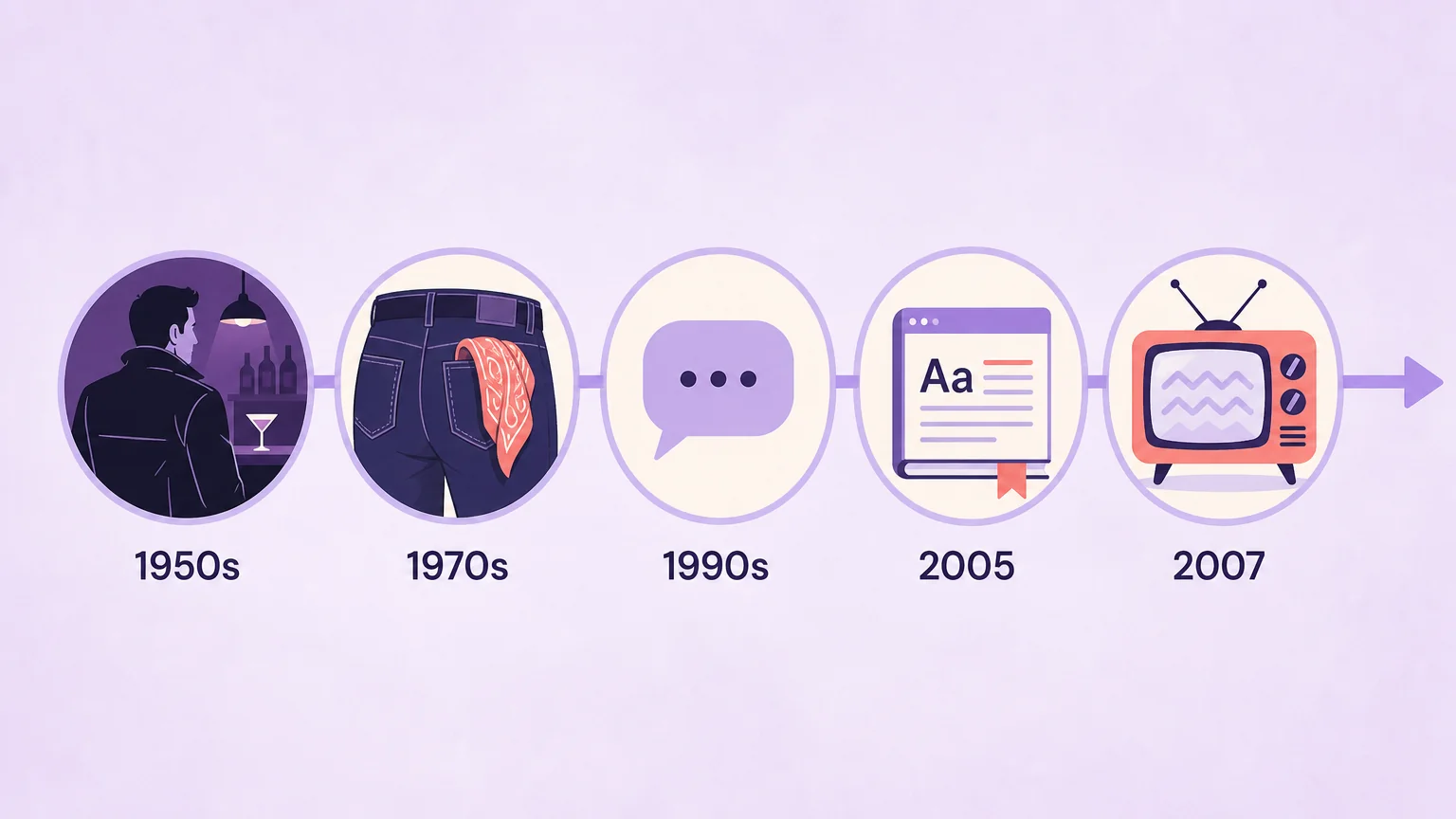
But the story starts decades earlier. The words “top” and “bottom” were born in the gay leather subculture of the 1950s, shorthand for power and position in a scene where those things were negotiated, not assumed. By the 1970s and 1980s the binary had spread through gay and lesbian communities, and the 1970s gave it a wardrobe. The hanky code was a quiet system: the color of a bandana in your back pocket flagged the act you were after, and the side you wore it on flagged your role. Left pocket meant top. Right pocket meant bottom. A dark blue handkerchief meant anal sex. The code’s exact birthplace is disputed, sometimes New York around 1970, sometimes the Trading Post in 1971, sometimes Mr. S Leather in 1972. What matters is that men in bars could read each other’s wants without a word.
The specific term took another twenty years. “Power bottom” was coined in the gay male community in the 1990s, a full generation after “top” and “bottom,” to name a bottom who was anything but passive. Its first digital footprint came on August 19, 2005, when an Urban Dictionary user named Tucker defined a power bottom as “the rather tame dominant male in a homosexual relationship who prefers being on the receiving end.”
The word kept evolving after the sitcom. The Brooklyn punk duo Pwr Bttm named themselves after it. Linguist Arnold Zwicky analyzed “power bottom” as a productive English compound, the kind that spawns variations and stays alive. A word that started in leather bars now lives in your group chat.
What a Power Bottom Actually Does in Bed

What does “controlling the scene” look like when you’re the one being penetrated? More concrete than you’d guess, and less dramatic.
The levers are real. A power bottom sets the tempo, calls the depth, and picks the positions, and has every right to tell the top to switch it up mid-scene. Riding, or cowboy style, is the classic control position, because the bottom sets the pace and the angle. Lie on your back or drop into doggy style and you’re following the top’s rhythm instead, a point the hosts of the Gayish podcast debate out loud, arguing about whether you can be “the one in control” flat on your back.
The first-person descriptions from the community paint the same picture. One power bottom describes being “active while bottoming, using technique and actively working to pleasure the partner, rather than merely receiving,” and calls himself “accomplished in taking well-endowed partners with little difficulty.” Another story makes it unforgettable: a power bottom in a sling propped himself up, wrapped ropes around the top’s waist, and pulled himself onto the cock at his own pace, literally engineering the penetration. That’s the whole role in one image.
There’s a physical payoff underneath all this. The prostate is sometimes called the male G-spot, and it’s so sensitive that prostate stimulation can produce a full orgasm from a finger, a vibrator, or a penis. Some men prefer it to penetrative intercourse entirely. That’s part of why a bottom drives so hard for their own pleasure.
Control here is often verbal. It’s dirty talk, it’s calling the shots on pace, it’s saying what feels good in the moment. And it’s a skill, not a personality. Author Michael Alvear wrote the book “Bottom Like a Porn Star” on exactly this premise: skilled bottoming is something you learn, not something you’re born with. Think of a power bottom as the director of a scene who also happens to be the star.
Power Bottom Myths, Debunked: 6 Things People Get Wrong
The internet has strong opinions about power bottoms, and most of them are wrong. Here are the six that keep circulating, myth first, fact second.
Myth: A power bottom is submissive
Control is the defining trait, not submission. The label exists to keep two things apart that people keep merging: getting penetrated and giving up control. Therapist Dillon Doshi Smith traces the confusion to a heteronormative script, the idea that the man is the top, the alpha, and the woman is the bottom and passive. Drop that script and the myth dissolves.
Myth: Bottoming is weak or feminine
The whole point of the “power” prefix is to break the equation of masculinity with penetrating. Cultural theorist Madison Moore reads the term as a direct pushback on the patriarchal hierarchy that ranks the penetrating role above the receptive one. Nothing about receiving makes a man less of one.
Myth: A real bottom never feels pain
Pain is real, and it’s a hard stop, not a badge of honor. Urologist Rena Malik, M.D., is blunt: some pain can be erotic and exciting, and some pain is the moment to say slow down. Push through and you risk fissures or hemorrhoids.
Myth: Power bottoms are “slutty”
A role is not a body count. The label describes control during a scene, not how many people someone has slept with. You’ll never hear “slutty” applied to a top who sleeps around; the word only shows up when a man receives. The promiscuity charge is stigma wearing a costume.
Myth: You need a big partner or serious stamina for it to be good
Bottoms say the memorable stuff is “much more psychological” than size, stamina, or technique. Gay dating coach Michael Busillo notes that most bottoms aren’t looking to be controlled or dominated at all. They want something deeper. And sex therapist Tom Bruett shows that a single position change can transform a painful first time into a good one.
Myth: Only gay men do it, and they’re bottoms forever
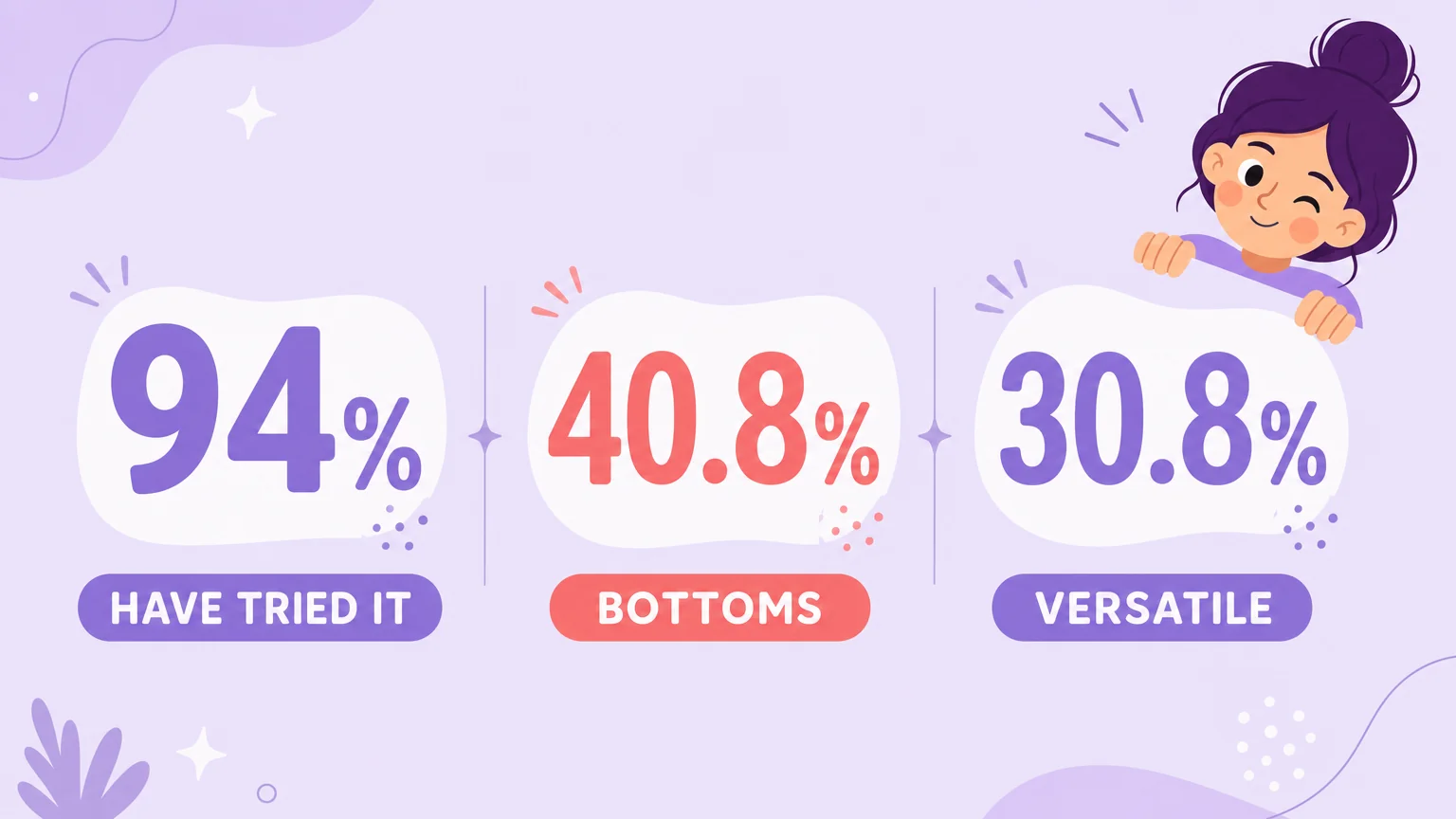
The term has spread into broader queer and BDSM usage, and gay men are far more flexible than the labels suggest. Ninety-four percent have tried bottoming at least once. “Versatile” is the most desired identity even though it’s the least common actual behavior. One large study of 8,755 men found 40.8 percent identified as bottoms, 30.8 percent as versatile, and 24.0 percent as tops. Labels describe a tendency, not a prison sentence.
Bottoming is a skill and an identity, not a verdict on your character.
What ‘Power Bottom’ Means in the Gay Community: Stigma, Apps, and Why ‘Power’ Matters

Bottoming is celebrated in one breath and shamed in the next, even inside gay culture. Sex therapist Tom Bruett puts it plainly: bottom shaming is having a full-on renaissance online, and holding negative views about bottoming will wreck a sex life. A man who enjoys receiving is not a lesser man.
The shame has roots. Therapist Dillon Doshi Smith traces it to that same heteronormative script. Some bottoms describe being pushed into “the feminine one” role in the partnership, which is exactly why the “power” in power bottom matters. It’s a deliberate reframe, cultural theorist Madison Moore argues, a pushback on the idea that receiving means less masculine.
The stigma has voices. One man describes hating “hearing and feeling all this misogyny and subtle homophobia everywhere.” Therapists report that some men feel they must top to be desirable, while others carry shame about wanting to bottom.
The hierarchy leaks into daily life. Dating profiles shorthand “Masc only” and “No fems,” encoding bottoming as lower status. Tall bottoms get rejected for breaking the short-bottom stereotype, while short guys get assumed to be bottoms whether they are or not. Even the viral jokes, the gay bro whose dog “stopped respecting him” after watching him bottom, only land because bottoming reads as losing masculine status. Versatile men report constant pressure to pick a side, while total tops and bottoms get called “boring.”
The reclamation is everywhere. Grindr’s position labels run Top, Vers Top, Versatile, Vers Bottom, Bottom, and Side, and “Side” was added in May 2022 for gay men who skip anal entirely. ENM-friendly apps like 3Fun let users signal roles and being new up front.
Troye Sivan’s “Bloom” became a de facto power bottom anthem, and he later had to clarify he is not one, calling “top or bottom?” interview questions invasive. Lil Nas X leaned into the label, rapping “I might bottom on the low, but I top shit.” Bowen Yang came out as a bottom on SNL. Ross Matthews corrected Howard Stern’s assumption about his position.
Sam Smith gets cast as one online without ever claiming it. The term has even gone literary: a 2023 essay collection titled “Power Bottom” argues that top and bottom labels “cannot offer a fixed structure for one’s desire.”
The word has a double life. It gets used as a tease, even a slur, “power bottom closet queen,” and as genuine praise inside dom/sub scenes, “I’m a gay Dom and believe me, Shane is a massive power bottom.” Read the room before you read the label. Use the word the way it was built, as a compliment about confidence, not a category that shrinks anyone.
How to Try Power Bottoming: A Guide for Bottoms and Their Partners
Here’s the part you can use tonight. Not a lecture. Two guides, one for the bottom, one for the top.
For the bottom: start with position, not gear
The fastest win has nothing to do with lube, toys, or experience. It’s position and relaxation. Sex therapist Tom Bruett describes a couple whose first time bottoming turned from painful to good on the strength of a single position change. Your body has to relax and feel safe before anything else works.
The rest, in order. Check your headspace and consent first; confirm STI status. Get aroused first, because playing without arousal feels medical. Breathe into your pelvic floor and push out, never clench, during insertion. Start small with trimmed-nail fingers or a small plug. Lube generously. Insert slowly, inch by inch.
To train, an anal dilating kit works: insert the smallest size with lots of lube, hold three to five seconds, repeat ten reps, two to three sets, and expect about two weeks before you size up. A small prostate massager solo is the gentler alternative.
Treat pain as a hard stop. Slow down, add lube, switch position, or stop entirely. Pushing through is how fissures and hemorrhoids happen.
For the bottom: the prep reality
The part everyone is anxious about. Douching is optional, and spontaneous sex without it does no damage. If you douche, use a small bulb with a few ounces of warm water, about 30 to 60 minutes before, and don’t overdo it; too much or too deep irritates and strips healthy bacteria. A high-fiber diet, legumes, leafy greens, whole grains, plus daily fiber pills and probiotics, can bulk stool into one smooth mass and make douching mostly unnecessary.
Name the friction plainly: some experienced men still find prep the worst part. “I love the sensation of bottoming, it’s just the prep that kills me.” And some bottoms skip meals before sex to feel clean, a habit therapists flag as a red flag, not a strategy.
On lube: silicone stays slick and needs no reapplying. Water-based dries out and forces constant reapplication. Skip numbing lubes entirely. They hide injury.
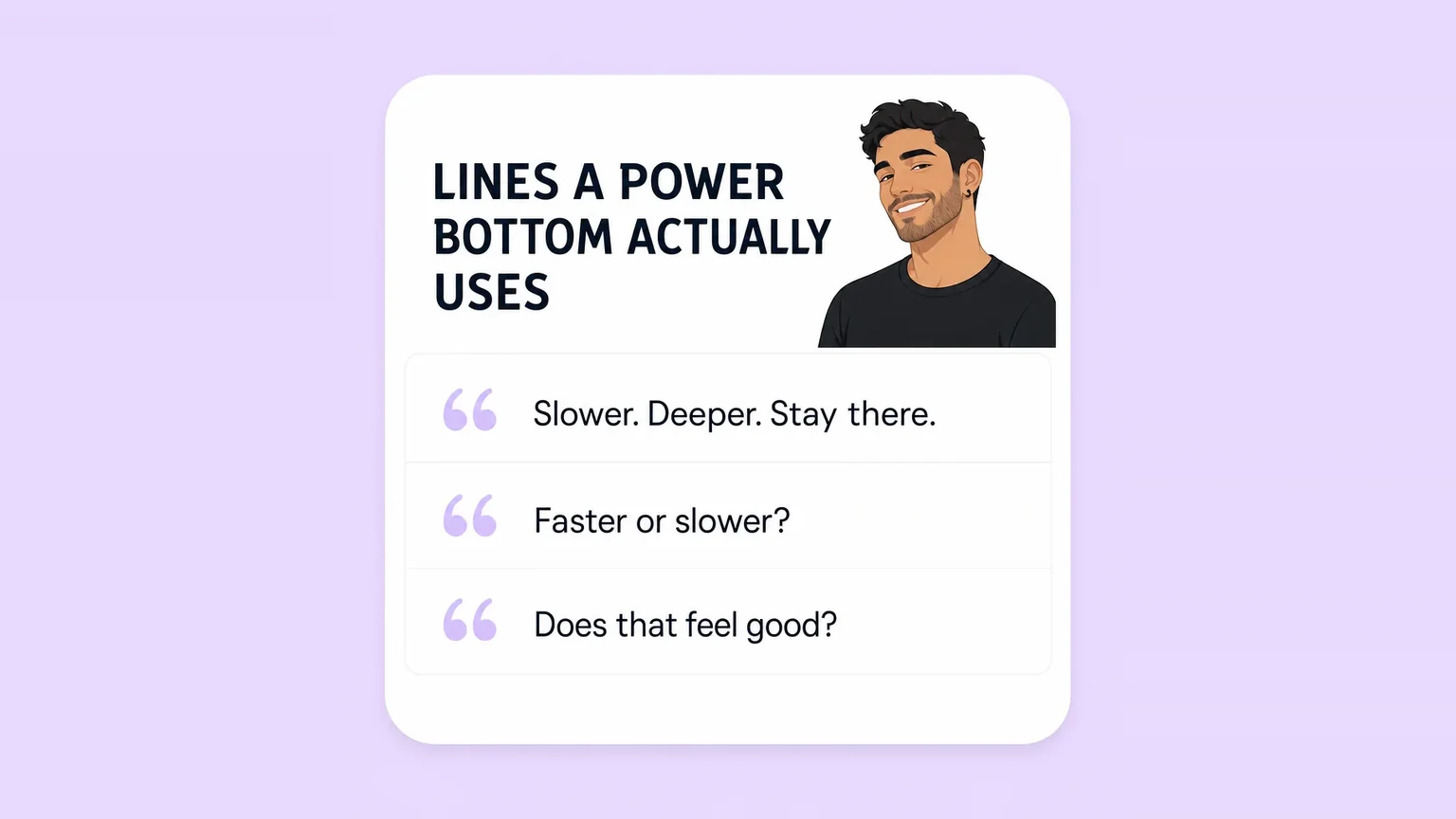
Give yourself permission to direct. Power bottoms use lines like “Slower. Deeper. Stay there.” And if you’re starting late: anal-health expert Dr. Evan Goldstein treats men in their late 50s learning to bottom for the first time. It is never too late, and nobody teaches this in school.
For the top: follow, don’t control
The ground rule: most bottoms, power bottoms above all, are not looking to be dominated. They want to be followed. The sex they remember is psychological, so listen, match their tempo, and check in. “Faster or slower? Does that feel good?”
Try it once with a partner who will follow your lead. The prep gets easier. The confidence doesn’t.
Power Bottoms in Threesomes and Group Play: Making the Dynamic Work With 3+ People
You know how a power bottom directs a two-person scene. So what happens when you add a third?
Roles still hold. They just have to be agreed on out loud first. The protocol is simple: talk about everything up front, fantasies, goals, limits, past experience, desired kink or pain, and keep finding the overlap on the Venn diagram instead of assuming it. Never stop negotiating. Pre-imagine the jealous moments before they happen. Picture watching your partner receive pleasure and sit with the feeling now, not mid-scene.
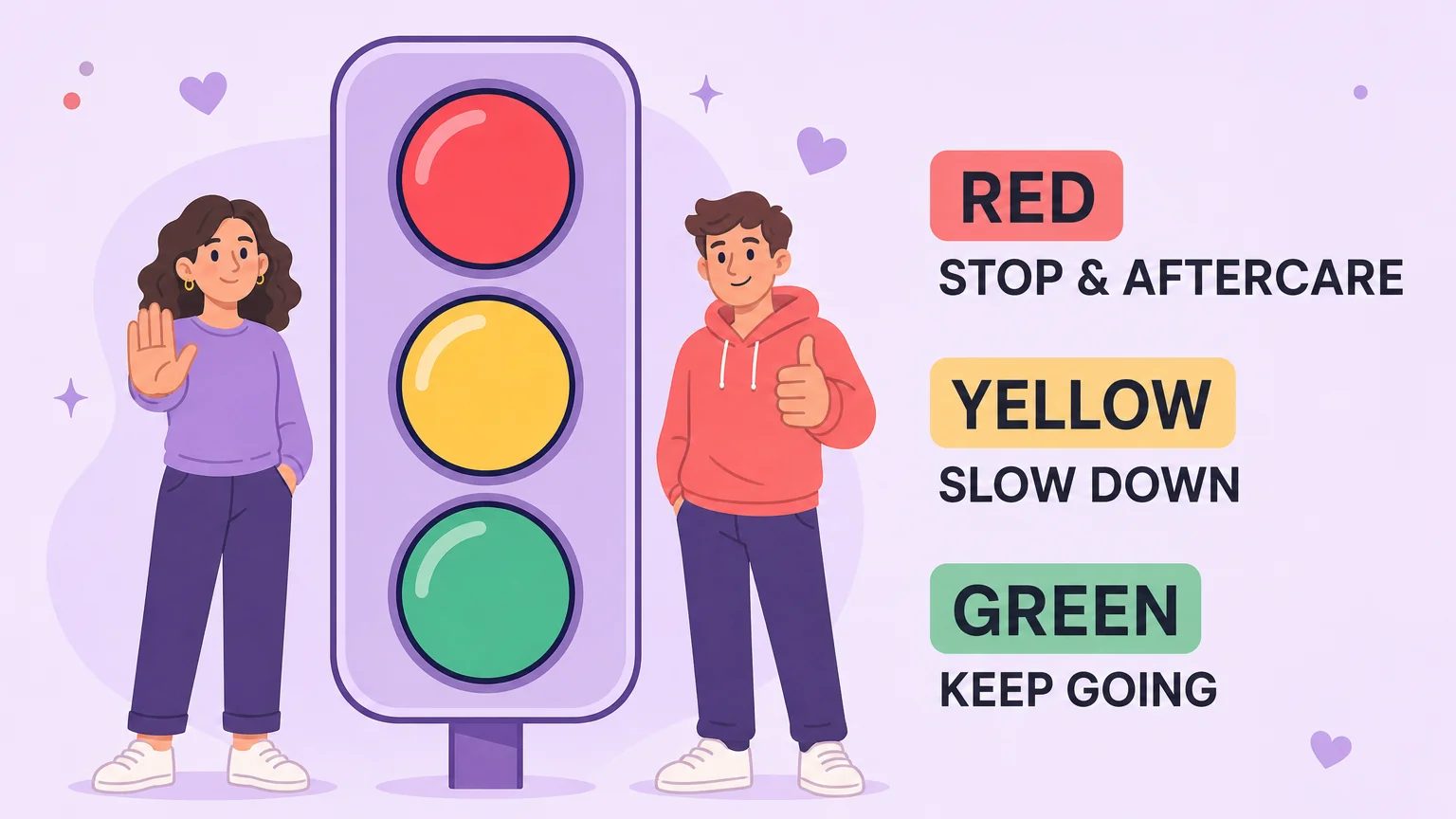
The stop signals need to survive three-plus people. Red, or three hard taps, means stop and aftercare. Yellow, or one slow squeeze, means slow down. Green, or two squeezes, means keep going.
And the power-bottom question directly: who directs the scene when there are three of you? Sometimes the power bottom stays the centerpiece everyone builds around. Sometimes they hand the wheel to a top and keep driving their own pleasure. Both are legitimate. Decide before you’re naked.
Two cautions. The most common failure is couple privilege, treating the third as a prop, when the third should get the star treatment. Agree who brings the condoms and use a new one when switching partners or orifices. And debrief within 24 hours: an emotional check-in, a boundary review, what worked and what didn’t.
This is the conversation ENM apps are built for. 3Fun let couples and singles lay out roles, boundaries, and experience level before anyone’s naked. A bottom who directs from the receptive side translates to group play better than almost any dynamic out there. If that sounds like your kind of team, find them at 3Fun.
FAQ
What’s the difference between a power bottom and a power top?
A power top is the dominant, skilled partner who penetrates. A power bottom is the dominant partner who receives. Both run the show: both set the tempo and decide the positions. The only real difference is who is being penetrated.
Can straight people be power bottoms?
Yes, with context. The term was coined in the gay male community and still lives there, but it has spread into broader queer and BDSM usage, and straight men who bottom can adopt it. Some queer people debate whether that co-opts the word.
How risky is bottoming?
Anal receptive sex is routine and common. Most of the risk lives in the prep and the pace, not the act itself. Pain is a hard-stop signal, not something to push through; ignoring it can cause fissures or hemorrhoids. Go slow and lube well.
Do most gay men prefer top or bottom?
There’s no single answer. Large studies put bottoms at roughly 41 percent, versatile at 31 percent, and tops at 24 percent. “Versatile” is the most desired identity even though it’s the least common actual behavior, and 94 percent of gay men have tried bottoming at least once.
What is the role of a bottom in gay sex?
The bottom is the receptive partner during anal sex, the one being penetrated. But receiving is not submitting. A bottom can be passive, dominant, or anywhere between, and a power bottom is simply a bottom who takes control of the scene.
How do I tell my partner I want to try power bottoming?
Say it plainly, outside the bedroom, and frame it as an experiment you want to run together, not a verdict on your identity. Try: “I want to try bottoming, and I want to be the one who sets the pace.”
What is a pillow prince?
The male counterpart to a pillow princess: a bottom who is “fairly lazy and self-serving” about receiving. It’s the exact opposite of an active, control-taking power bottom. A pillow prince lies there and lets it happen; a power bottom runs the scene.
Do I have to douche before anal sex?
No. Douching is optional, and spontaneous sex without it does no damage. A high-fiber diet can reduce the need. If you douche, use a small volume of warm water 30 to 60 minutes before, and don’t overdo it: too much or too deep irritates.