
When you picture a dominant, who shows up? Stern, dark, all bark. Someone you could never pull off. That image is exactly why you haven’t started.
Here’s the reframe: the gentlest doms are often the most powerful, because their control comes from care, not fear. A soft dom leads with warmth, praise, and clear direction, and stays firmly in charge while doing it. The full definition, the soft-versus-hard map, and the archetype spectrum live in our sister guide. This one is the operational half: how to be a soft dom, not in theory, in practice.
Seven steps take you from the mindset, to a real negotiation script, to a minute-by-minute first scene, to running the style on dating apps and across partners. Professional dominatrix Mistress Tash Mia thought a dom had to be “dark, scary, mean” and that she’d never fit in. The best doms, she learned, are authentic ones.
Desire doesn’t require an apology. You don’t need to audition for the role. This playbook is for the person you already are. On 3Fun, naming what you want out loud is the whole point of the room.
Step 1: Own the Soft Dom Mindset (Impostor Feelings Included)

If every time you imagine taking charge you feel like you’re failing a pop quiz, you’re not broken. You’re normal. First-scene nerves are universal: experienced doms still remember their debut as awkward and rushed, and it ended well anyway. One dom who started the same way says verbal communication was brutal at first; now he can nearly induce an orgasm with his words alone.
Proof the role fits you is already out there. Submissives are asking for caring doms in plain words: “I want to feel genuinely cared for even when I can’t manage it myself.” That need is exactly what a soft dom meets.
So retire the borrowed persona. Professional dominatrix Mistress Tash Mia built her practice from her real personality, sarcasm included, because the best doms are authentic doms. Your humor, your warmth, your actual voice: that’s the material. The obedience you’re after comes from a place of joy, never fear or shame. The “too nice to be a dom” worry doesn’t survive that sentence.
When nerves spike, you have tools. Don’t fake experience: bring your real feelings into the scene and let them show. Use a blindfold, Dan Savage’s favorite trick for nervous doms, so your partner isn’t watching you fumble and neither are you. And lean on exaggerated clarity: be 10 to 30 percent more explicit than feels natural, so your partner clearly reads what you’re doing.
By the end of this step you have permission to lead as yourself. Step 2 hands you the core tool: praise.
Step 2: Praise and Affirmation, Your Core Soft Dom Tool

Start with a line you can use tonight: “The way you followed that instruction was exactly right.” Specific praise lands harder than any generic “good girl,” because it proves you’re paying attention.
Praise kink means using praise on purpose to evoke specific emotional states, adoration, embarrassment, or both at once. Affirmation play goes a step further: it confirms something positive and true about the person, “you are worthy of love,” often aimed at what they find hardest to accept about themselves.
Two rules make praise land for a soft dom. Be specific, because detail shows you see them. And target their inner core pillars, the traits most central to how they see themselves, like intelligence, humor, or steadiness. Praise that hits a core pillar lands twice as deep as a compliment on a haircut.
Then the timing. Praise each act of compliance in-scene, not just the finish. Turn the traffic-light check-in into a praise moment: when they answer, tell them how proud you are that they know their own body so well. And make aftercare a praise moment: “You did great. You took that so well.”
Keep the framing gender-neutral for beginners. Praise the act and the effort, not a gendered pet name. Pet names are negotiated, never assumed. The full library of phrases lives in our praise-kink guide.
Three use cases keep this from being one-note. Praise as recognition in a service dynamic: a “this is exactly how I like my coffee” that means the world. Praise as an accent that steadies harder moments: a “you’re so brave, I’m proud of you” mid-scene. And praise as a standalone scene, built entirely around compliments.
One caution: praise play can be emotional edge play. It can unearth deep feelings, so negotiate it rather than springing it on anyone. For a soft dom, praise is the dominance itself.
Step 3: Negotiate Limits and Safewords, the Exact Conversation
The conversation everyone skips is the one that makes a soft dom scene possible. Start from the right attitude: submission is earned and negotiated, not owed. Calling yourself a dom grants you no authority. As Ms. Elle X puts it, you’re here to lead, not mindread. Negotiation builds the fence line you cannot cross, and inside that fence you get to play freely.
Here’s the script, step by step.
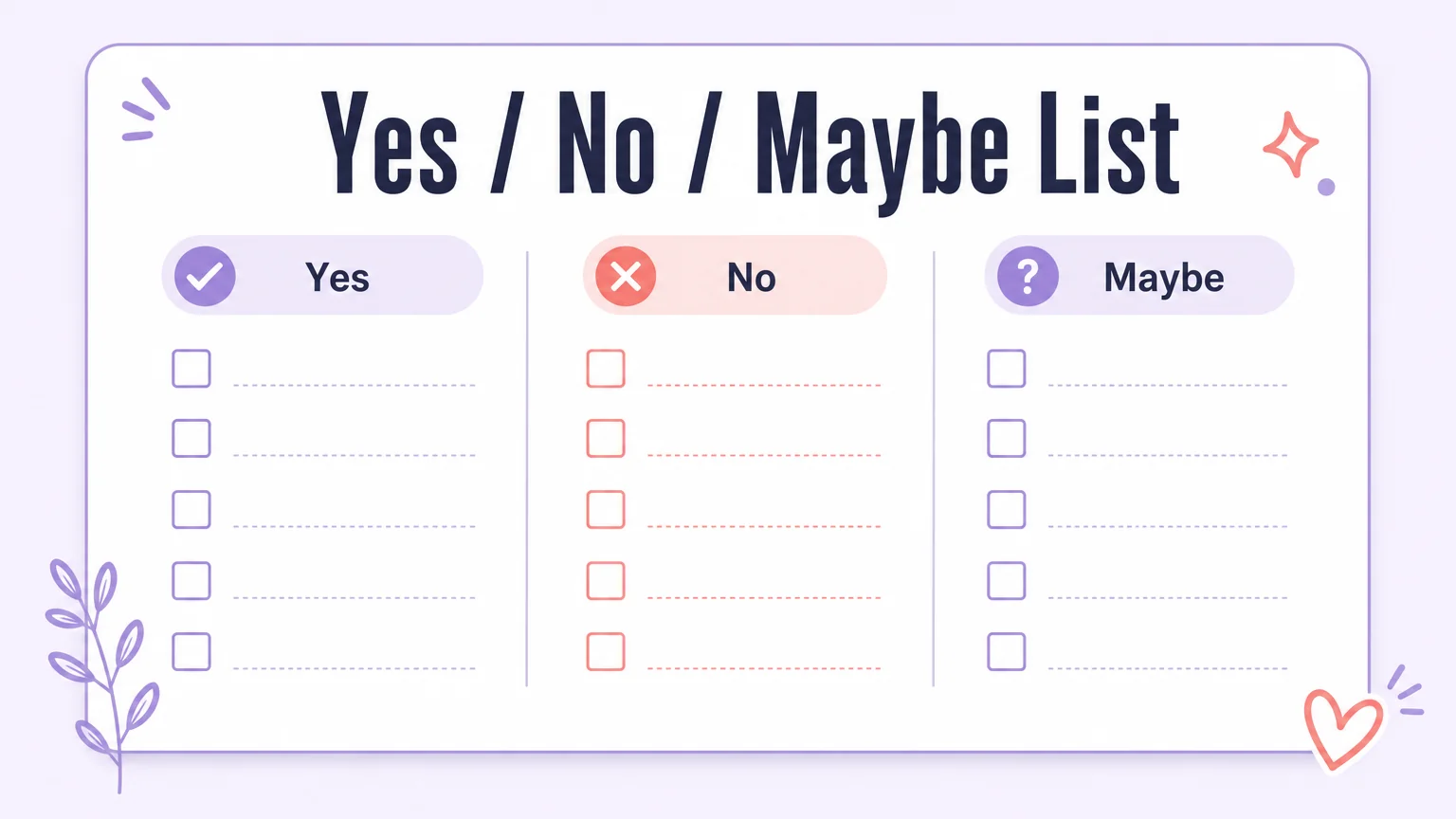
Sit down together beforehand and map out what a successful scene looks like for each of you. Write down hard limits, the total no’s, and soft limits, the maybes that need a check-in. Name one feeling you want during the scene, and one you want to avoid. Then cover intensity levels and any tools.
A Yes/No/Maybe list makes all of this easy: nobody has to guess or confess out loud.
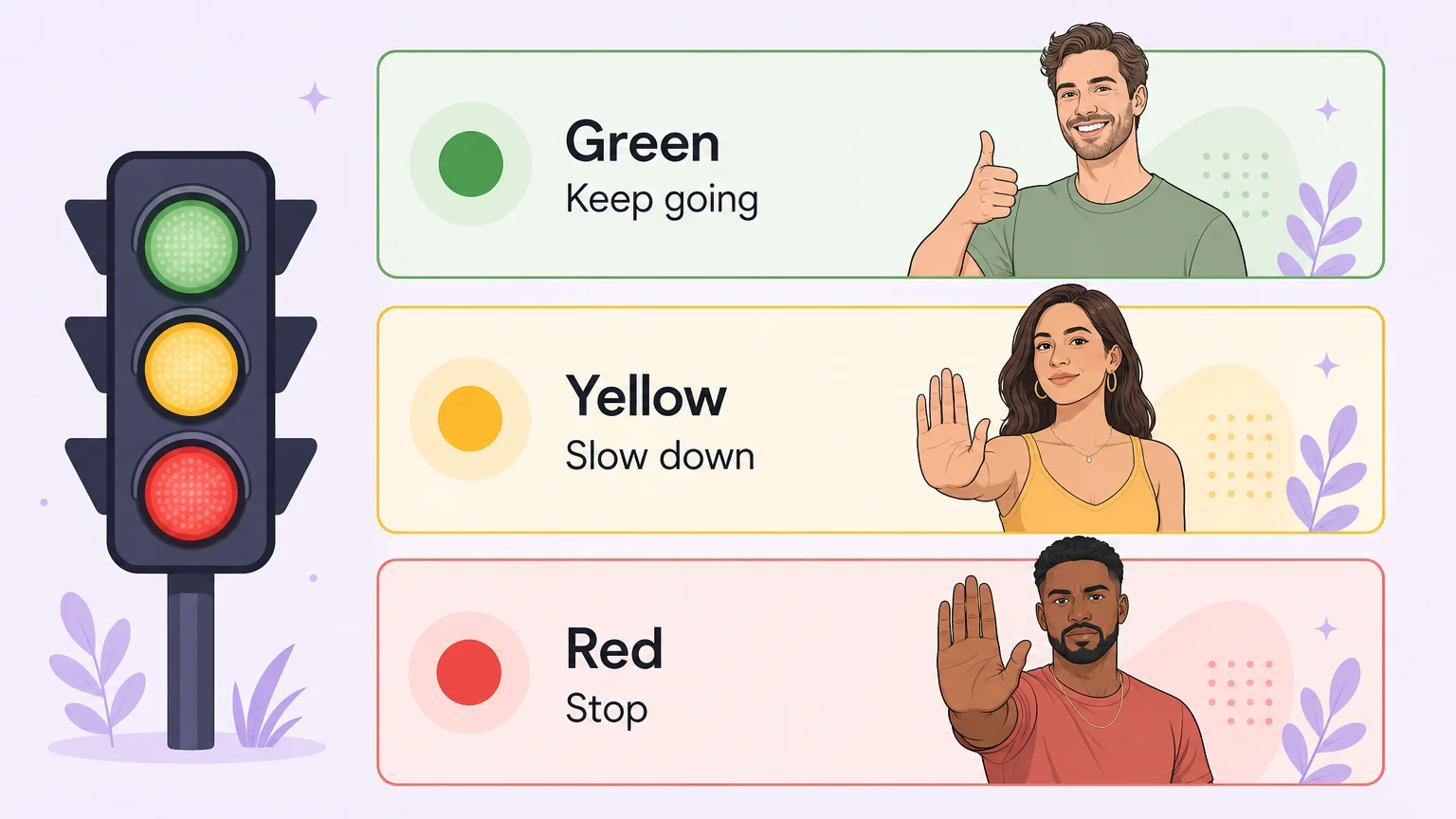
Now the safeword system, fully. Yellow means slow down and soften, so you can adjust without killing the mood. Red means complete stop.
Add a non-verbal signal for when speech isn’t available: drop an object from your hand, or tap twice on the nearest surface. Color safewords take practice to say under pressure, which is exactly why the non-verbal fallback exists. Agree on it, rehearse it once, then trust it.
Before you ask about limits, add the self-awareness layer, because this is a conversation, not a checklist. Ask yourself what happens to you under emotional pressure. Do you freeze, or fawn? Can you say stop to someone you desire? Knowing that about yourself is a safety mechanism, not a quiz.
If face-to-face feels too awkward, write it out. An email or a letter works, and some couples find it easier to be honest on paper. Then play inside the fence you built together.
By the end of this step you have a fence you can trust. Your first scene is next.
Step 4: Your First Soft Dom Scene, Minute by Minute
The hardest part of a first scene is not knowing what to expect. The fix is embarrassingly simple: a script. One submissive wrote out her first scene and walked her nervous husband through exactly what she expected. “I literally saw him relax,” she said. “From his face to his feet.” The guessing was gone.
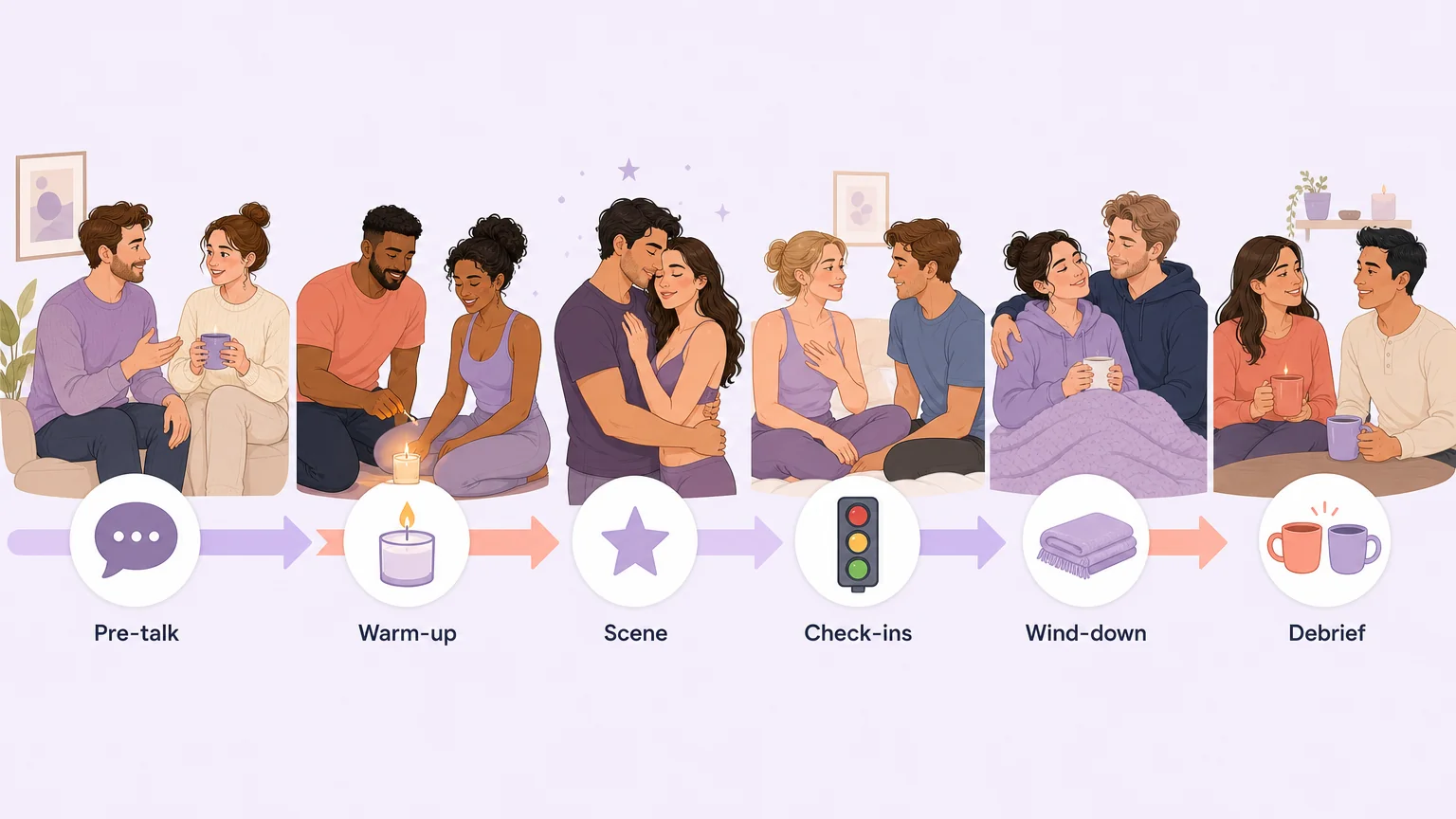
Pre-talk, about ten minutes. Recap the negotiation from Step 3 and restate the safewords out loud, both of you, so they’re warm in both mouths. This is the moment a first scene is won or lost.
Warm-up. Start with low-stakes activities only: gentle direction, a specific request, a blindfold if it’s negotiated. The blindfold is an inexperienced dom’s best friend: it cuts self-consciousness on both sides. Add light impact only if you negotiated it in Step 3.
Scene. Keep it to ONE new element. No first scenes with three kinks stacked on top of each other. Resist adding a third or fourth idea just because it’s going well. Run traffic-light or number check-ins as you go; the color system from Step 3 handles the rest.
Praise, woven through every act of compliance, ties back to Step 2. Each “there you go, exactly right” is the dominance doing its work.
Wind-down. Aftercare begins before the scene ends, not after you’re both spent. Step 5 details the how.
Debrief. Schedule a dedicated time the next day, what some couples call chair time, to review what worked. It feels formal at first. It becomes the habit that makes everything else easier.
Need lines? Three beginner-safe ones. “Close your eyes. I’m going to tell you exactly what I want, and you’re going to take it so well.” “Slow down. I’m enjoying watching you.” “That’s it. Exactly like that. You’re doing beautifully.”
Expect some awkwardness. Every soft dom’s first scene had it, and the script is what makes it survivable. The aftercare that follows is for both of you.
Step 5: Aftercare for Both of You (Sub Drop and Dom Drop)

The person in charge comes down too. A scene floods the system with adrenaline, dopamine, serotonin, and oxytocin, an altered state with a possible comedown, and that comedown can hit the dom as well as the sub. Dom drop is real. Here’s the operational part.
Three buckets, and you cover all of them.
Physical: blankets, water, warmth, skin contact if they want it. The body just ran a marathon of sensation and needs the basics before anything else.
Verbal: affirmation. Make aftercare a praise moment, per Step 2. “You did great. You took that so well.” Words land differently in the quiet after a scene, so use them on purpose.
Emotional: a debrief without judgment. What felt good, what felt strange, what you’d do differently. No scoring, no fixing, just listening. Let them speak first, and when it’s your turn, be honest about how you’re landing too.
Negotiate aftercare in advance and schedule it, the same as the scene itself. As the DOMMED hosts put it, if you’re going to do surgery on someone, you don’t skip sewing them back up. And you are allowed to need care too. Ask for your own blankets, your own water, your own words.
For the 3Fun crowd, add the multi-partner layer. In group or ENM contexts, aftercare can include check-ins with non-participating partners, the ones in the constellation but not in the room. A quick text that the scene went well and everyone is okay goes further than you’d think. Our aftercare guide goes deep on all of it.
Aftercare is not the reward for a good soft dom scene. It is part of the scene.
Step 6: Soft Dom Across ENM, Dating Apps, and New Partners
You match with someone great, and now it’s about when, and whether, to say the words “I’m a soft dom.” Earlier is better. A partner who finds out late feels they’ve been living with a stranger, and resentment like that is hard to come back from.
Split the approach by context.
On kink-friendly apps, put it on your profile up front; it filters for people already on your page. On mainstream apps or first dates, wait until they know you a little. And if they’ve already shared a kink of their own, reciprocate promptly: that is the signal that the door is open.
Two ready-to-use lines. A profile line: “I’m a soft dom. I lead with praise and clear direction, and I’m looking for someone who wants to be taken care of like that.” A first-date line: “I like taking the lead in a gentle way. I’d rather tell you how wonderful you’re being than bark orders.” Specific beats a bare label every time.
Then the multi-partner mechanics. Every connection gets its own negotiation, because different partners have different limits. Re-run the Step 3 conversation per person instead of reusing one script. Respect looks like a fresh conversation every time.
Introduce dynamic architecture. You can be a soft dom with one partner and take a different role with another, and that is deliberate design, not inconsistency. One practitioner pairs two dom tops, one soft and one hard, so each partner gets a different emotional flavor.
Praise scales beautifully as a group-scene dynamic: friends writing nice messages on a partner’s body, or a circle of guests complimenting the honoree. Your core tool becomes a constellation-sized moment.
The through-line is radical transparency. Everyone in the constellation knows about the power dynamic, because that disclosure is part of consent. And clarity, not volume, is the most attractive thing you can bring.
When you’re ready to practice, say it out loud on 3Fun. Create a profile, write the line, and let someone who wants a gentle leader come find you.
Step 7: Mistakes New Soft Doms Make (and How to Fix Them)
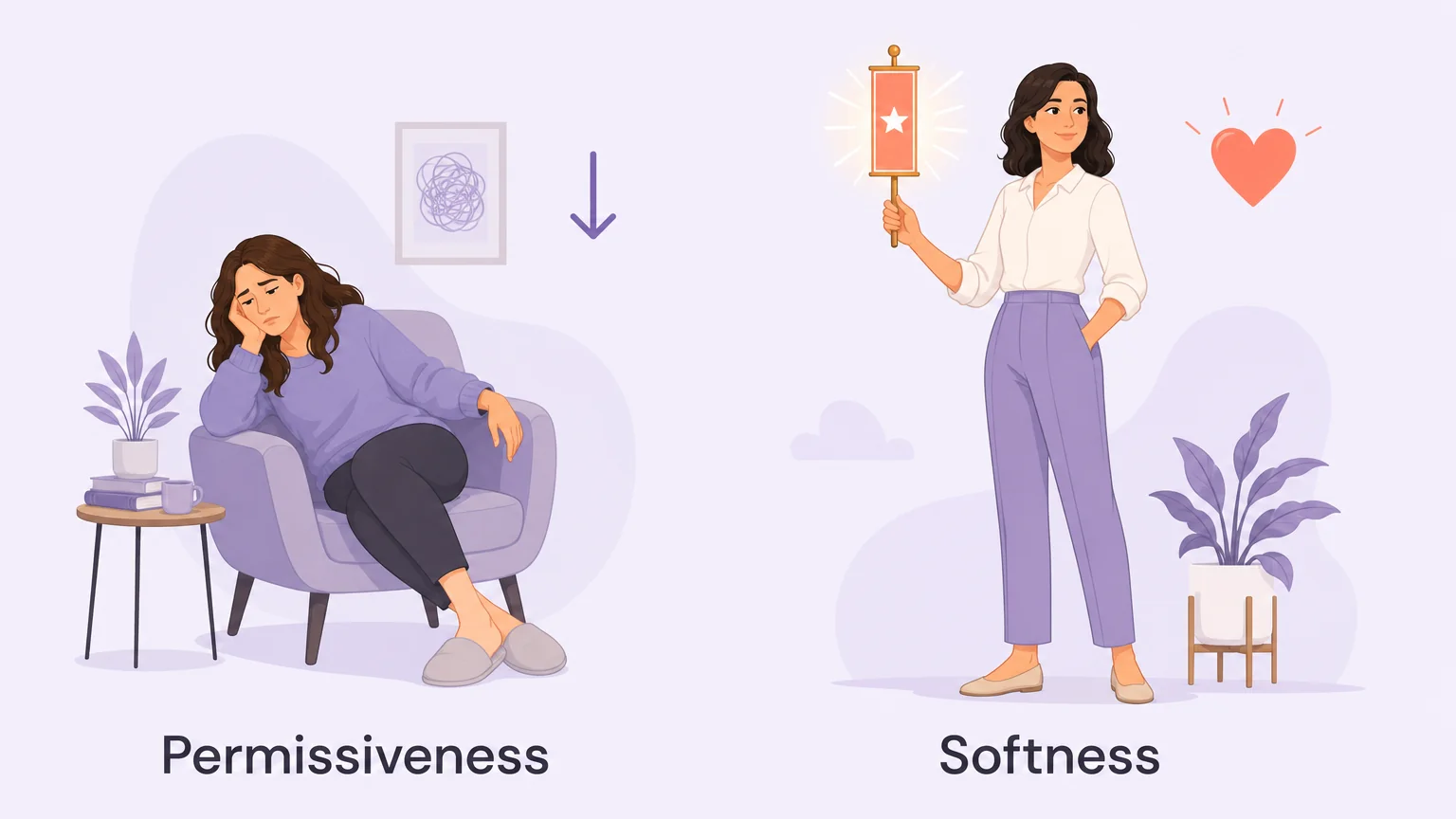
The surprising failure mode: you can be so eager to be kind that you stop being a dom. Run the list, each with its fix.
Confusing permissiveness with softness. This is the big one. Softness is not avoiding confrontation or emotionally checking out. Enforce calmly, with the line “I’m not going to raise my voice, but I will raise my standard.” A sub shouldn’t have to chase a dom who went quiet.
Skipping negotiation or aftercare to keep things easy. Those are the two steps this guide made non-negotiable, because they make everything else possible.
Demanding submission too soon, or assuming a sub is always on. Submission is earned, and it has an off switch. Even the most devoted sub has days when it isn’t available, and a soft dom notices.
Copying a script without negotiating terms. Scripts are scaffolding, not law. Every dynamic differs, so adapt the words to the person.
Inconsistency and vague rules, or acting like you’re above an apology. Both kill trust faster than any single scene can build it.
Raising your voice to assert control. Speak with clarity, not volume. Volume is what you reach for when clarity isn’t there.
Every one of these is fixable, and the fix is almost always more negotiation, more consistency, more care. That is the whole point of being a soft dom.
FAQ: Starting as a Soft Dom Tonight and With New Partners
How do I start being a soft dom tonight?
Run a 15-minute first scene with one light element, and plan the aftercare before you begin. Pull the negotiation from Step 3, keep the scene simple per Step 4, and close with the aftercare ritual from Step 5. A color check at the midpoint tells you everything you need to adjust.
What do I actually say in my first scene?
Say more than feels natural, and lead with direction plus praise: “Close your eyes. I’m going to tell you exactly what I want, and you’re going to take it so well.” That line sets tone, expectation, and consent in one breath. Steps 2 and 4 hold the full mechanism.
How do I tell a new partner I’m a soft dom?
On kink-friendly apps, put it on your profile up front and let it filter for you. On mainstream dates, earlier is better, and if they share a kink first, reciprocate promptly. Be specific about what you want, “I lead with praise and clear direction,” instead of offering a bare label.
What if I freeze up mid-scene?
You can call yellow on yourself. Slow down, name it, adjust. That is the system working exactly as designed. Bring your real feelings into the scene instead of faking confidence, lean on the script that removed the guessing, and use a blindfold to cut self-consciousness.
Can I be a soft dom with one partner and something else with another?
Yes, absolutely. That is dynamic architecture: deliberate, per-connection roles negotiated each time, not inconsistency. One practitioner pairs a soft dom for praise with a harder top for edge, each connection holding its own limits and its own negotiation. The key is telling each partner which one they’re getting.
Every scene starts with the same move: Step 1, owning the mindset. Start there, and the rest follows.