
“What is a hard dom?” Put plainly, a hard dom is a dominant whose style is strict, firm, and intense. They lead with clear rules, calm command, and high expectations, whether for the length of a single scene or across an entire power-exchange relationship. That style is about structure, not cruelty.
Hard, in other words, is not mean. Yet that is exactly where most people’s minds go, and it is worth taking seriously rather than waving off. If you have heard the phrase and wondered whether it describes real dominance or just a partner who is rough, you are in good company.
This guide separates intensity from abuse, shows what a hard-dom dynamic feels like on both sides of the power exchange, gives you a way to tell the authentic thing apart in the wild, and names the specific red flags that mean walk away, whether you are choosing a hard dom as a partner or simply understanding the term. Two ideas carry everything that follows: the line between a hard dom and a harmful partner is consent, and in a healthy dynamic the submissive holds the real power.
What a Hard Dom Is (and Isn’t)
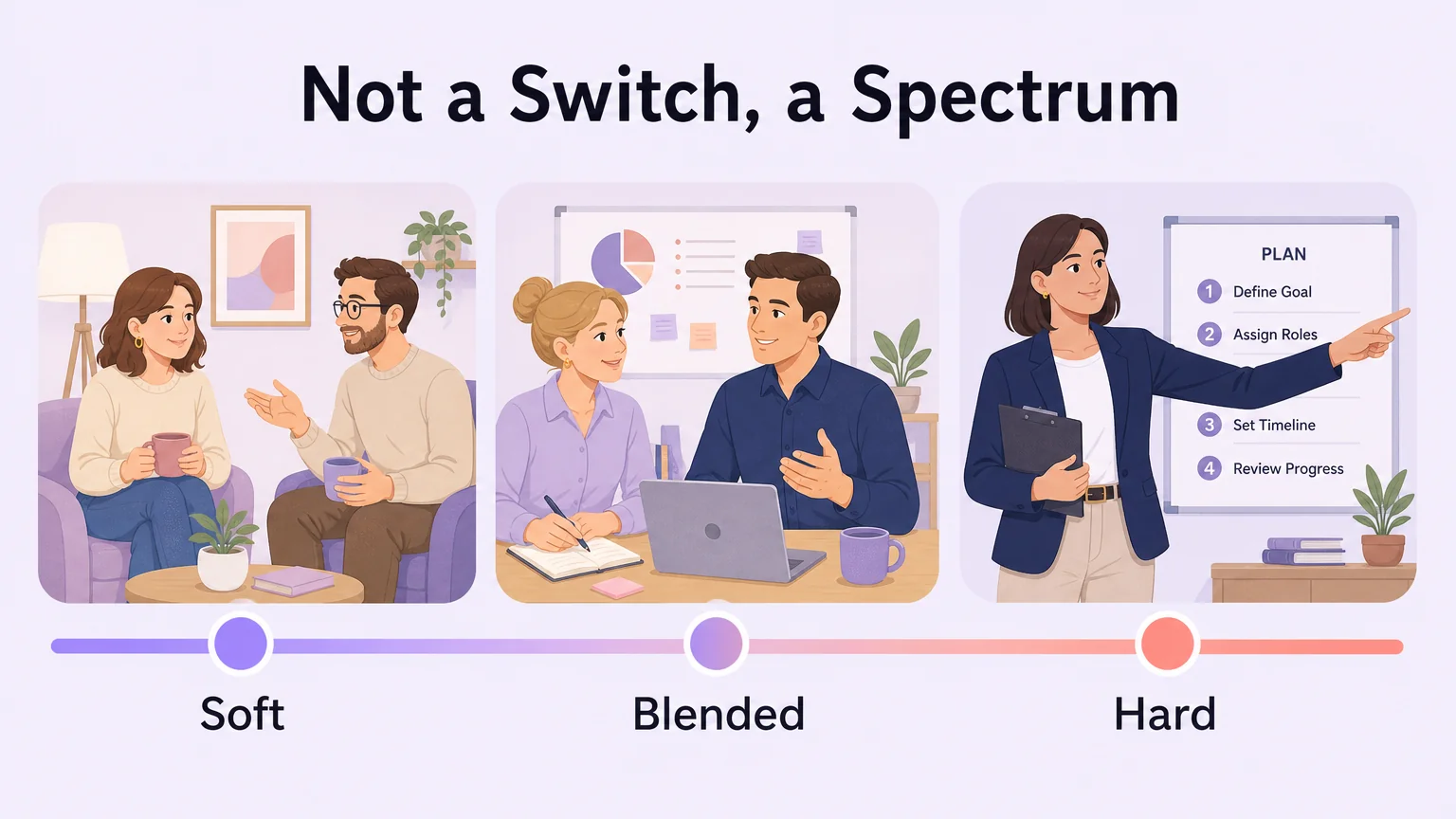
Start with the definition that carries the whole article: a hard dom is a dominant in BDSM who leads with strictness and structure. The core hard dom traits are firm command, clear rules, and high expectations, applied with consistency, and that consistency is the point. A hard dom does not decide how intense things are on a whim; the intensity is the style, applied the same way on Tuesday as on Saturday.
Now the part most people get wrong. Hard describes intensity and expectation, not cruelty. A hard dom who is tender behind the structure is not a contradiction in terms; it is a fully normal version of the dynamic. If you picture a stone-faced figure barking orders at a trembling partner, set that image aside. That is a caricature, and caricatures make poor maps.
Think of hard and soft as a spectrum, not a switch. Most people are a mix of both, and the labels describe how a dominant leads, never how much they care. A dom can be hard in the way they set expectations and warm in the way they actually feel about the person across from them.
And the term covers a wide range of arrangements. A hard dom can be hard for an hour on a Saturday night, or run a structured 24/7 power-exchange household where rules govern daily life. Both are real, because both run on the same foundation: consent. And if you are new here, know this is a world, not a fringe.
The Line Between Hard and Harsh
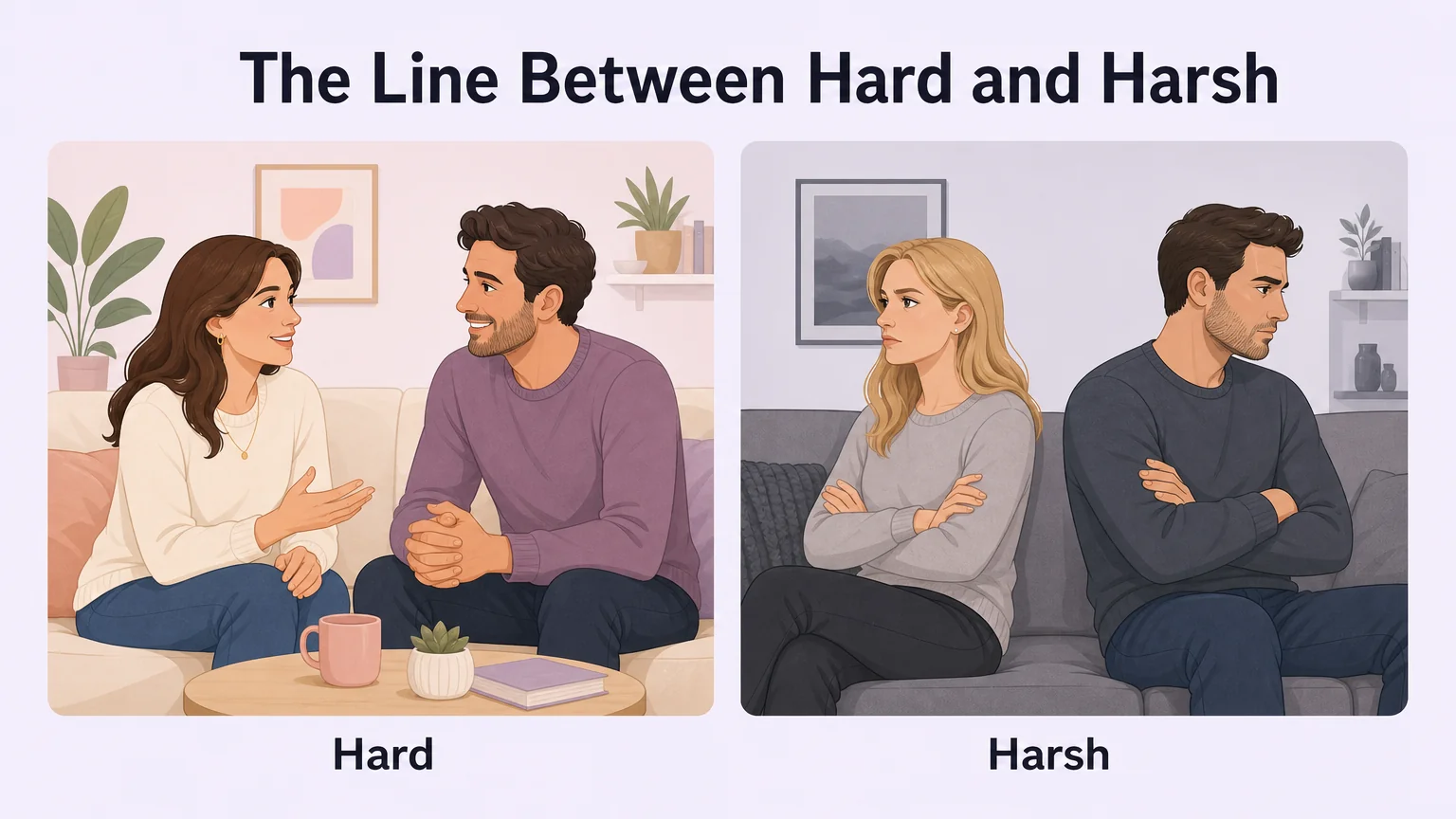
Here is the reframe that carries this entire article: hard is not harsh, and intensity is not cruelty. The two feel similar from the outside, which is exactly why they get confused. But they run on opposite engines.
A hard dom is strict because the structure serves both people. The rules create a container the submissive actually wants to live inside, one that makes them feel held and clear. A harsh partner is punishing because the power pleases them. Same firmness on the surface, completely different purpose underneath. That is the test to carry: what is the structure for?
The dividing line is consent. And consent means more than a one-time yes. A real yes is a completely mindful, willing, and uncoerced choice, one that can be revoked at any moment without fear of repercussions. If a yes cannot be safely withdrawn, it was never really a yes.
Which brings us to the line communities repeat for a reason: the submissive holds the ultimate power. A dominant can only dominate within the limits the submissive consented to, so the submissive is the one holding the red button. Real dominance is a form of service to that consent, not a dictatorship.
That plays out in plain practice. Genuine negotiation. Hard and soft limits named out loud. Safewords honored without question or punishment. Aftercare that actually happens. The moment a safeword is disregarded or punished, the moment a hard limit is treated as a goal to be broken, the experience has crossed from kink to abuse. That has stopped being a style difference. Walk away.
The red flags are specific: a would-be dom who insists there are no safewords, who treats a hard limit as a challenge, who refuses to talk about aftercare, or who plays angry or intoxicated has already crossed the line. And the vetting test is just as clean: a legitimate dominant is happy to be vetted. Someone who resists questions, dodges references, or insists on never meeting in public is telling you who they are ahead of time.
Keep this close: an excellent dominant does not demand obedience. They seduce submission by winning devotion. That, more than any rule, is what separates a hard dom from a tyrant.
Hard Dom vs Soft Dom: Two Ways of Leading
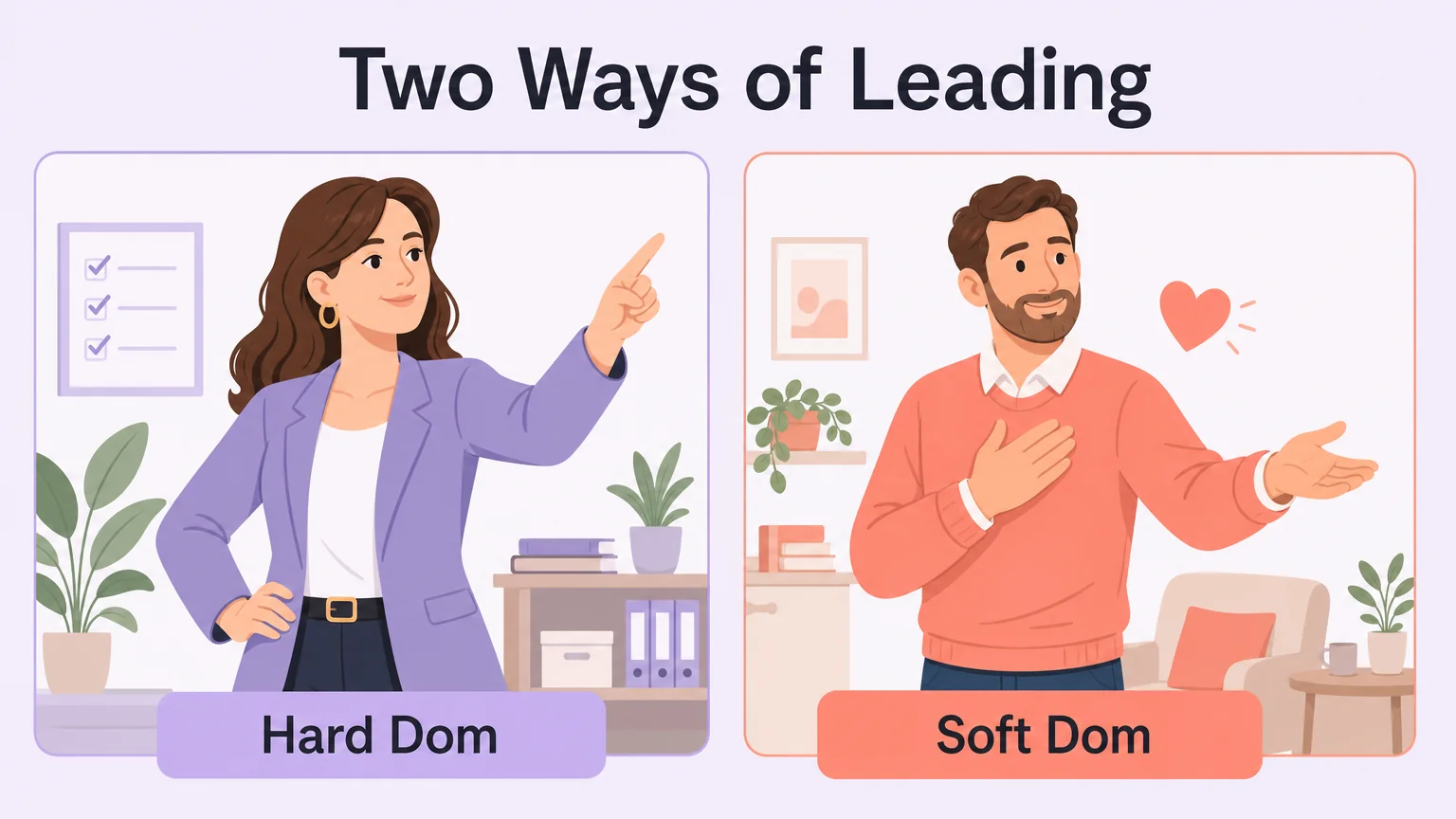
Hard dom and soft dom are different type of doms, obviously, but please think of this as a friendly contrast, not a fight. Hard doms lead with strictness, firm rules, and demanding expectations. Soft doms lead with warmth, praise, and nurture. Neither one is the correct way to be dominant. They are two legitimate styles of leadership, and which one works has everything to do with the person across from you.
To feel the difference: a hard dom sets a rule and expects it kept, then follows through with a consequence agreed on in advance. A soft dom sets a rule with encouragement and celebration built in, cheering you toward it. Both can be deeply caring. The temperature differs, the care does not.
And here is the nuance: few people are purely one or the other. Most doms blend the two, drawing on whichever register the situation calls for, and the style that works is the one their partner actually responds to. Someone who calls themselves a hard dom in one dynamic may run soft in another.
The reassurance that matters most: aftercare is not a hard-or-soft decision. Both kinds of doms give it, and a good hard dom often gives more, not less, because the intensity makes the come-down bigger.
So where do you land? If you are drawn to structure, clear expectations, and firmness, that is hard-dom energy. If you crave warmth and steady encouragement, that is soft energy. Both are valid, and many couples move between the two across a relationship. You are allowed to like what you like.
What a Hard Dom Actually Does
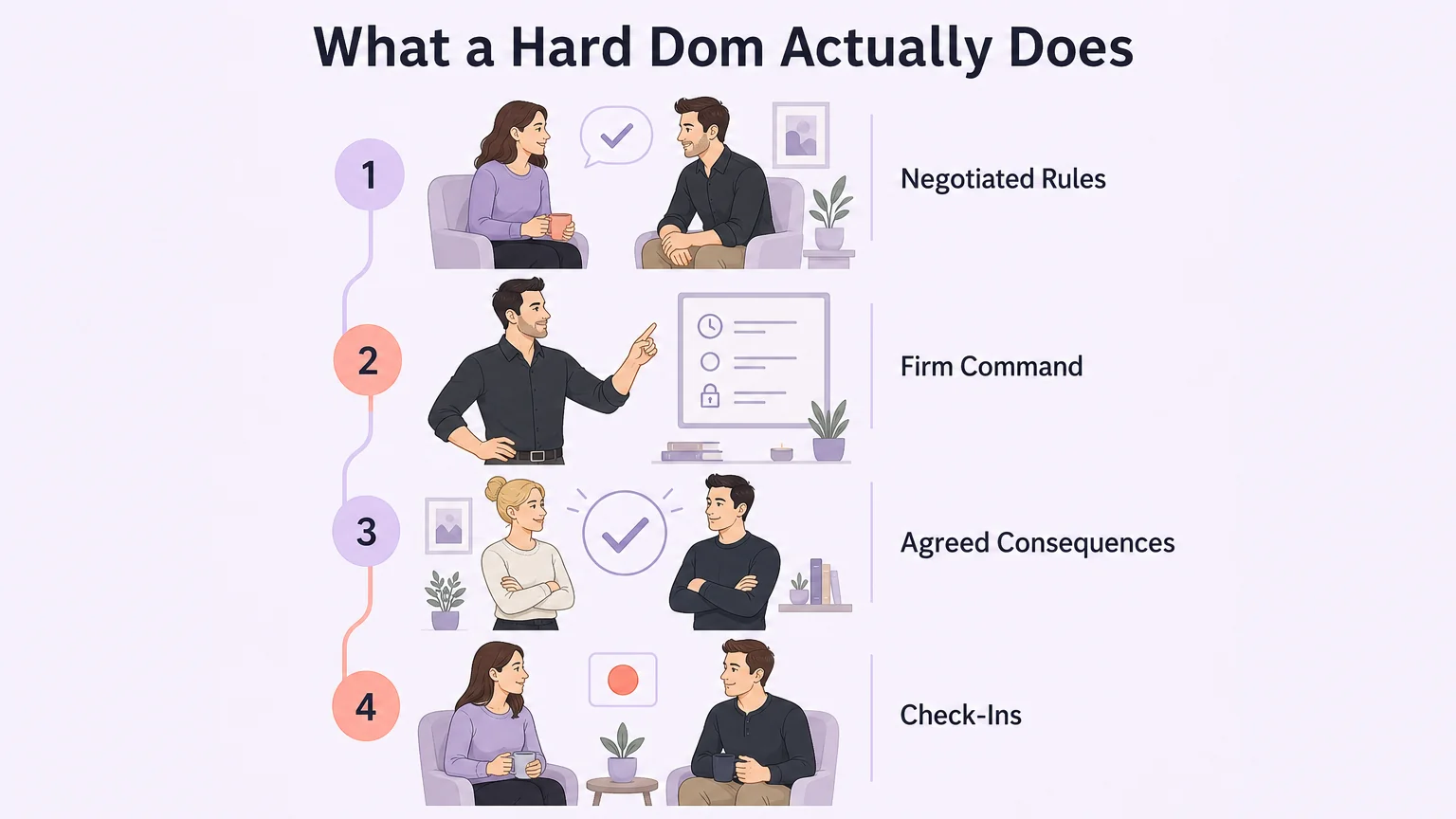
Move from definition to lived experience, because the question underneath is what being with a hard dom feels like. A hard-dom dynamic, whether in a single scene or a whole relationship, is built on four things: a negotiated set of rules, a firm and calm command style, consequences that are proportionate and agreed on in advance, and check-ins that keep everything on the rails.
Take the rules first. In a hard dom and sub relationship, a dom holds lines consistently, and that consistency is precisely what makes the structure feel safe rather than chaotic. When a rule is broken, the consequence fits the moment, never the anger. You discussed it before it ever had to be used.
Here is what firm-but-kind command sounds like. A dom whose sub stayed out late and made them late to a dinner said this: “I feel disrespected when you chose time with your friends over obeying my instruction.” Notice what is missing: no name-calling, no cold fury, no score-settling. It is honest, it is direct, and it is hard. It is also not cruel.
The same discipline applies to the rules themselves. It is easy to create rules. It is considerably harder to create rules that genuinely serve two people. A rule justified only by “because I said so” rests on fragile foundations, and the good hard doms know it. Rules exist to serve the dynamic, not to demonstrate power for its own sake.
Then the check-ins. Many hard-dom scenes run on the traffic-light system: green means keep going, yellow means slow down, red means stop. A skilled dom checks in during a scene, reads body language, and asks for a color rather than assuming. The intensity is high. The supervision is higher.
That is a hard-dom dynamic: intensely structured, warm, and functional. Not scary. Structured is not the same as cold.
Hard Dom, Hard Limit, Sadist: Sorting Out the Words
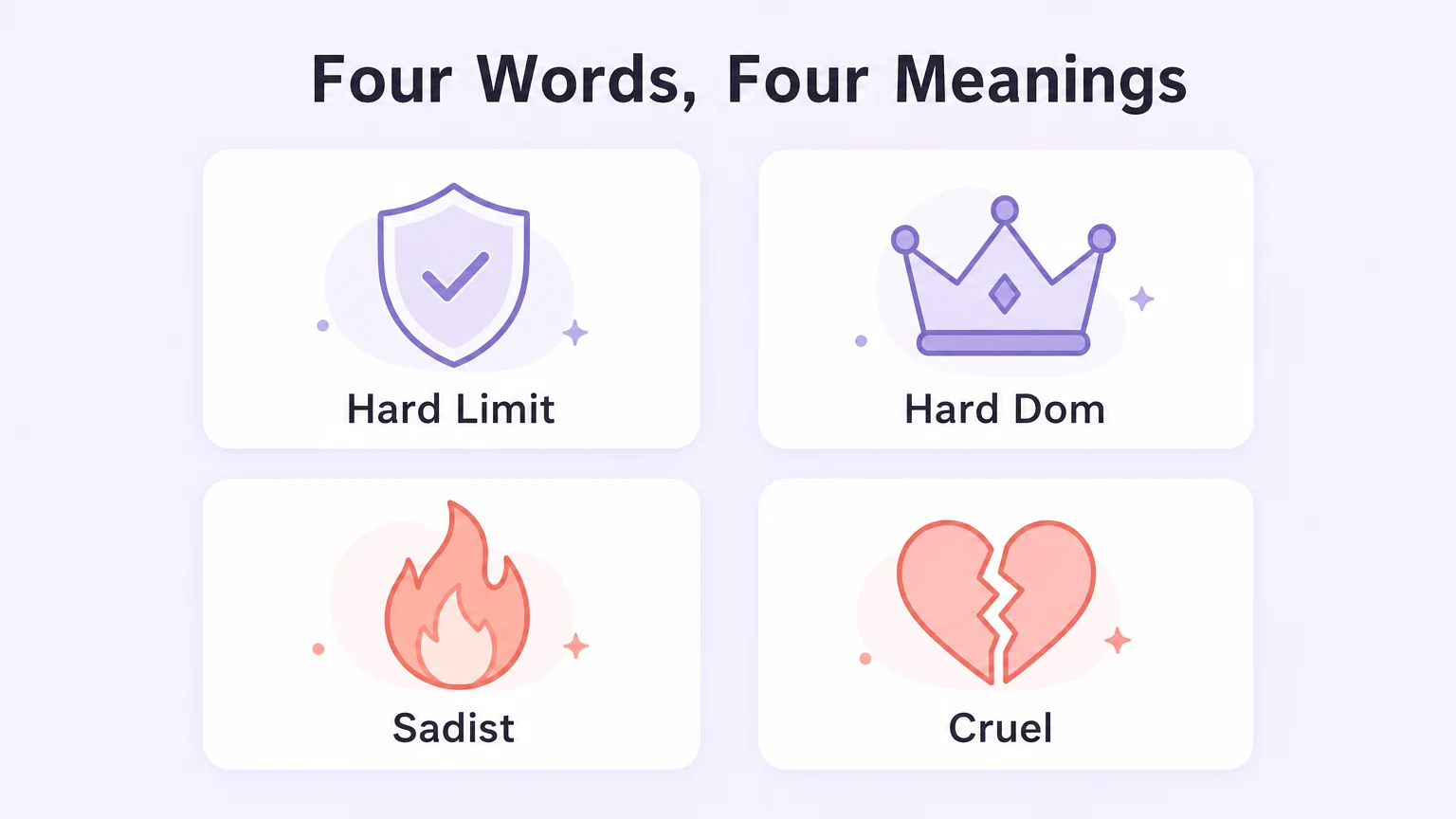
These four words sound like one family, and they are not. Getting them untangled saves you real confusion, because people use them to mean very different things, and some use them to sound scarier than they really are.
The collision that trips everyone up: a hard dom is a style of dominance, while a hard limit is a boundary. The two words share nothing except spelling. A hard limit is the line a person absolutely will not cross, whatever the reason. It belongs to the person who set it, and only they can change it. When a hard limit is violated, there is no negotiation, only cause to end the scene.
So when a would-be dom says they plan to “work on” a sub’s hard limits until she agrees to them, that is the textbook case of abuse wearing the costume of dominance. A limit is not a project. It is a locked door.
Next, hard versus sadist. Dominance is about control. Sadism is about pain. They are separate drives that sometimes travel together and sometimes do not. Plenty of male doms are neither harsh sadists nor hard-core dominants, and plenty of people who enjoy inflicting pain have no interest in running a structured power exchange. If you meet a self-described hard dom, you still know nothing about whether pain is involved. Ask, don’t assume.
Finally, hard versus cruel. Hard is a negotiated style. Cruel is a failure of care. One operates inside an agreement; the other ignores it. Now you have the map: use all four words correctly, and hear the difference when someone uses them to inflate themselves.
Where Hard Doms Fit Among Other Dominant Archetypes
Now zoom out to the wider map, because “hard dom” does not float in isolation. It describes a style of intensity and structure, and that style can show up inside many other archetypes. A sadist, a rigger, a brat tamer, an owner, a Master or Mistress can all run their dominance hard. The label names the how, not the who.
There are common leanings worth knowing. Sadists tend to run their dominance hard, while Daddy Doms often run soft, with the warmth and guidance built into the role itself. But these are tendencies, not laws. A Daddy Dom can absolutely run a strict household, and a sadist can be unfailingly gentle about everything except the pain.
Here is the reframe that saves you from the box: labels are guideposts, not boxes. The same person can be a hard dom inside a scene and a soft partner over breakfast. Most people do not fit neatly into a single label, and that is not a flaw in them. It is how people actually are.
Then there is the one archetype people fear by name: the Tyrant. It sounds like a warning, but the distinction matters. A consensual Tyrant behaves harshly only inside a negotiated dynamic, within limits the submissive agreed to. The moment that harshness escapes the negotiation and bleeds into the rest of life, it stops being a Tyrant and becomes a fake dom. The negotiation is the border, and everyone can see where it is.
Now you have the map. Use it to recognize people, not to file them away.
The Payoffs and the Hard Parts of a Hard Dom Dynamic

Every dynamic worth its name has a ledger, and this one has real columns on both sides. Here is the full picture, because you deserve to decide with your eyes open.
The payoffs are real. There is structure that feels grounding instead of suffocating, the particular relief of never having to guess the rules. There is deep subspace for people who love intensity, the headspace that opens when a submissive feels held by firm expectations rather than anxious about them. And there is the closeness that consensual hard play produces, an intimacy built on safety, trust, and the vulnerability that only those three make possible.
Now the hard parts. After intense scenes, the endorphins fade and the body crashes. This is kink drop, and the surprising part is that it hits the dominant too. Sub drop and dom drop are both real, driven by the same chemical comedown, so aftercare is for both players, and it should never be an afterthought just because it is called aftercare. The harder the scene, the more careful the landing needs to be.
There are quieter costs as well. Holding structure is emotional labor, and a dom carries it. Calling yourself a hard dom can read as a red flag until people know you. And any dynamic can erode slowly, when rules that once served a purpose start to serve nothing but habit. The structure has to keep earning its place.
Here is the throughline: the same intensity that makes this rewarding is what makes it demanding. Both are true at once, and that is the shape of the thing, not a flaw.
Hard Dominance in Open Relationships, Threesomes, and Dating Apps

Here is the version of this world that matches where you are: open relationships, swinging, threesomes, and dating apps, where a hard-dom dynamic lives alongside other relationships instead of inside a monogamous bubble.
The consent scaffolding gets taller here, and that is a feature, not a bug. With multiple partners, negotiation is not just between the two of you. Everyone who touches the dynamic, the other partner in your threesome, the couple you swing with, the third who joins a scene, needs to be on the same page about rules, boundaries, and who knows what. The hard dom’s job is still to hold structure; it just has to hold it across more than one relationship, which means more conversations, not fewer.
On the apps, labels do real work. Terms like “hard dom” function as compatibility signals on profiles, helping people who want the same thing find each other before the first message. The healthy way to wear the label is to pair the intensity with the consent framing instead of wearing it as armor. A profile that says something like “I can be a hard dom, but can be caring and soft as well” signals seriousness, not threat.
Dedicated kink apps like BeeDee and kinki exist, and mainstream ENM apps let people state their desires openly, so finding a hard dom who is also open to the rest of your life is more doable than it sounds. 3Fun exists for the same reason: couples and singles exploring together, with clarity as the whole point. The throughline: hard dominance and ethical non-monogamy run on the same foundation, explicit informed consent, which is why they fit together. Say what you actually want on your 3Fun profile, and the right people will find you for it. The label opens the conversation; the questions before the first message keep it safe.
How Common Is Hard Dominance, Really?
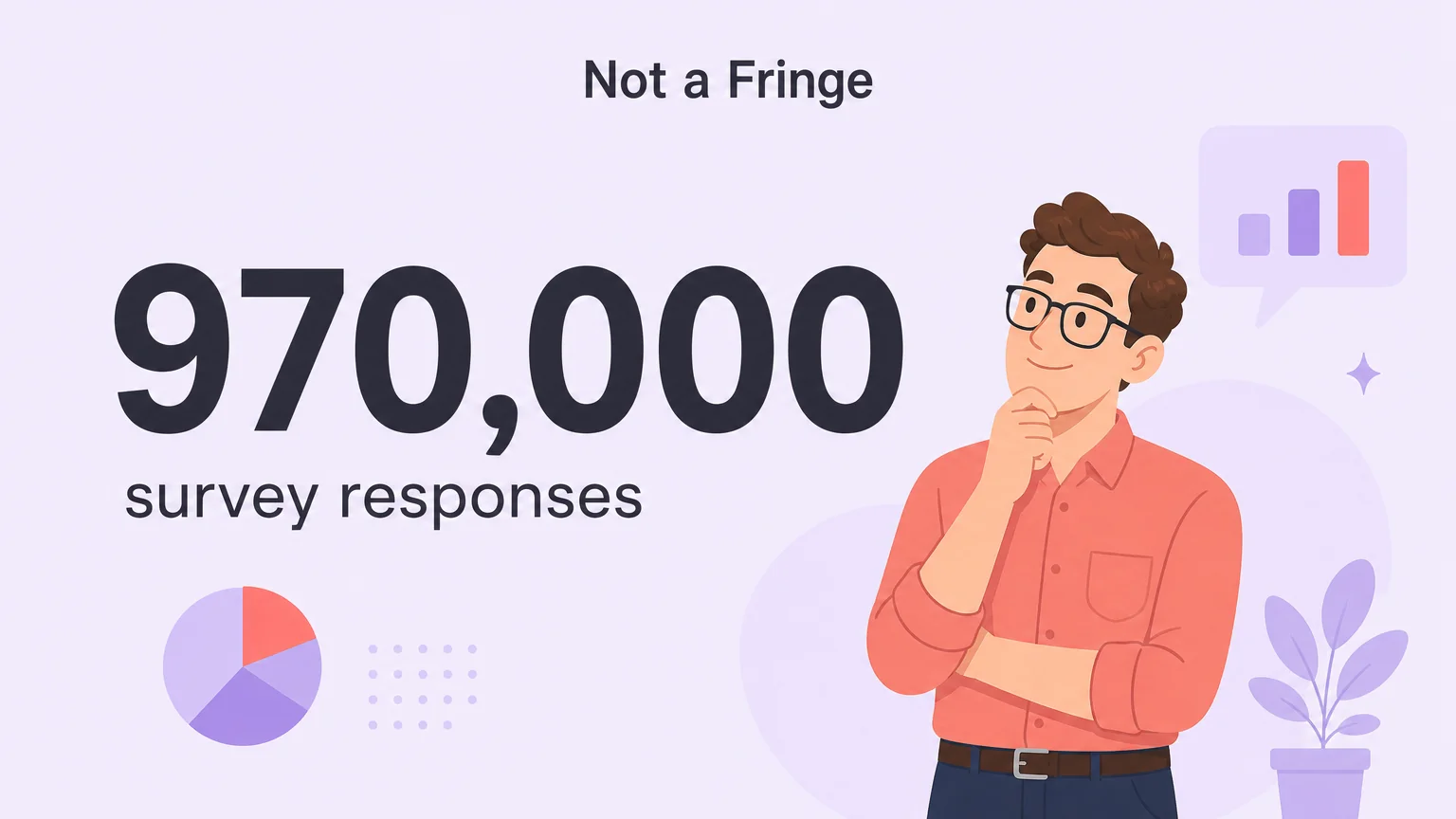
If you have been quietly told that an interest in dominance is fringe, the data says otherwise.
The scale alone should settle it. The Big Kink Survey collected roughly 970,000 responses, a dataset big enough that researchers built a publicly available, demographically representative subsample from it. Whatever you were told about this being a tiny subculture, the numbers do not agree. And the community data points the same way: kink practitioners report levels of wellbeing comparable to the general population.
One finding speaks directly to the readers of this article: across every group surveyed, straight men are the only group whose reported interest in dominance exceeds their interest in submission. That cuts against the old assumption that dominants are rare, strange, or somehow outside the mainstream. They are none of those things. If you have ever wondered whether wanting this makes you odd, the answer is that the data places you in a large, ordinary crowd.
The researchers add their own caveat, and it is worth holding: the data is directional, not definitive. No one-size-fits-all pattern survives contact with real people, and this one does not either. But the direction is clear enough. A great many people carry hard-dom energy, and the healthy ones carry it inside consent.
FAQs: Your Hard Dom Questions, Answered
Quick, direct answers to the questions that come up most often.
Is a hard dom just a dom who’s mean?
No. Hard describes a style of dominance: intensity, firm command, structure, and consequences, all inside a negotiated, consensual dynamic. Cruelty without consent is abuse. A hard dom is hard within the boundaries the submissive agreed to, and the intensity serves the structure, never the dom’s temper.
Does hard mean pain, and is every hard dom a sadist?
Not necessarily. Hardness describes the intensity of control and firmness, not pain. Sadism is a separate drive, the enjoyment of causing pain, and it sometimes travels with dominance and sometimes does not. A hard dom may or may not be a sadist.
Is the hard/soft split real or just marketing?
Both. It is a useful shorthand for a real spectrum, which is why it shows up on dating apps as a signal. But it is also routinely oversimplified. Most doms are a mix of hard and soft, and plenty of people argue a good dom is both. Treat the labels as a starting point for a conversation, not a verdict.
What actually separates a hard dom from an abuser?
Consent. A hard dom operates inside negotiated, enthusiastic, informed, ongoing consent: safewords honored, limits respected, aftercare delivered, nothing done through coercion. When a safeword is disregarded or punished, when a hard limit is treated as a challenge, that is abuse, not kink. The difference is not how intense things get. It is who holds the red button.
Do hard doms give aftercare?
Yes, and a good one gives more, not less. Aftercare is not optional for any dom, hard or soft, and it is for both players, because sub drop and dom drop are both real. Aftercare should never be an afterthought.
What if my dom gives me a command I cannot fulfill?
Speak up, and use your safeword if you need to. A command that breaks your limits stops being dominance and becomes pressure. A real hard dom designs rules their sub can actually meet, so a command you cannot fulfill is information they should want, not a failure on your part.
Is it okay to like being pushed past a soft limit?
Only when it was negotiated with a partner you trust, and never through pressure or with someone new. Soft limits can become playable over time through deliberate conversations. Hard limits do not get “worked on.” If you like the push, know that desire doesn’t require an apology, but let the negotiation lead, not the rush.
How do I find a hard dom safely?
Look in kink communities and on apps where labels can be checked against real behavior. Vet before play: meet in public first, use a safe call with a friend, and ask about experience, aftercare habits, and how they handle a red. The red flags are the test: no safewords, hard limits treated as a challenge, no aftercare talk, playing angry or intoxicated. A real hard dom welcomes the questions.
You do not need to be a masochist to be with a hard dom. You do need to want structure. Explore at your own pace; the healthy version of this dynamic is waiting whenever you are ready. When you’re ready, 3Fun is where couples and singles start that conversation: say what you want, and the right people are listening.