Learning how to be a brat might look like the least obedient move. The brat is the one crossing her arms, rolling her eyes, refusing to kneel on principle. Yet bratting is one of the most devoted forms of submission there is. Every eye-roll, every “make me” is a bid for one thing: an increased power gap with the person you trust to hold you. That is Ms. Elle X’s core insight, and the engine the whole dynamic runs on.
How to brat in BDSM is not being difficult. It is a consensual game with rules, a signal system, and a landing. That is what separates it from being annoying, and from abuse. If you are a bratty sub looking for a map, this is it.
Decide if bratting is for you, negotiate it like adults, learn the moves one rung at a time, escalate and land, keep it safe, and yes, take it into text and three-person scenes. If you are in a couple, you are one unit playing a game. If you are single and exploring, you are an empowered guest, never a toy.
By the end you will know exactly what to say to start the conversation tonight.
Step 1: Are You a Brat? Take the Self-Check Before You Start
Plenty of people spend years calling themselves “a submissive who struggles with obedience” when what they crave is the tension of being told what to do and choosing to disobey. That is how one brat on X, handle This_Guhy, described their own realization.
Here is the tell. If “make me” and “prove it” sound fun rather than stressful, you may already be a brat.
Run this quick self-check. You brat if you push buttons to feel connection. If you use sass and eye-rolls as flirting. If you love being caught and overpowered. If you hunt for loopholes between the letter and the spirit of an instruction.
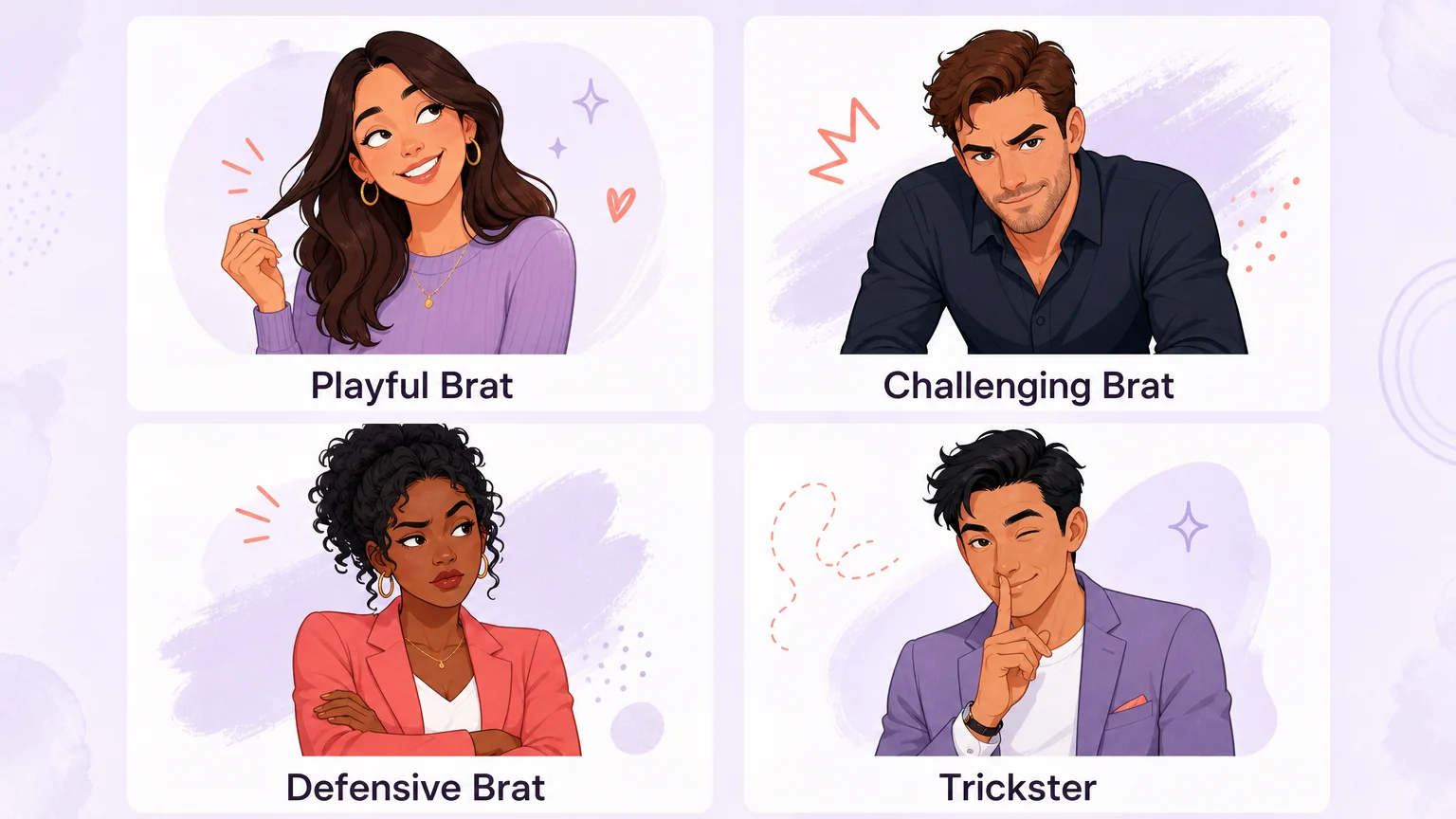
There is no single way to be one. The Feeld brat taxonomy names four flavors. The Playful Brat teases for fun. The Challenging Brat pushes hard so she gets pushed harder. The Defensive Brat uses brattiness to filter out weak partners. The Trickster finds loopholes for laughs. Most brats are a blend.
One caveat. Brat behavior should feel light and mutual. If it is coming from anger or contempt, that is not a brat move. That is disrespect wearing a costume. Educator Evie Lupine calls out the “get out of jail free card” reputation brats carry. Kink educator tripp terrier goes further: bratting is a disciplinarian kink by the submissive, aimed at soliciting authority and discipline. If that is not what you are after, you are not bratting.
And the permission note: you do not have to brat all the time. Evie Lupine describes plenty of “sometimes brats,” people who only act out with a specific partner or in a specific mood. It is a flavor, not a sentence.
By now you should know which flavor you are, and that you are welcome here.
Step 2: Have the Talk: How to Tell Your Partner You Want to Brat
The hardest sentence in bratting is the first one: “I think I want to brat with you.” It feels like a confession. It is not. It is a normal adult conversation about a game you want to play together.
Bring it up outside a scene, in a calm, non-sexual moment. Not while you are mid-spank, not in bed afterward, and not by pranking them to test the waters. Start with a direct opener: “I want to try playful defiance with you, where I push and you catch me, and I want to agree the rules first.”
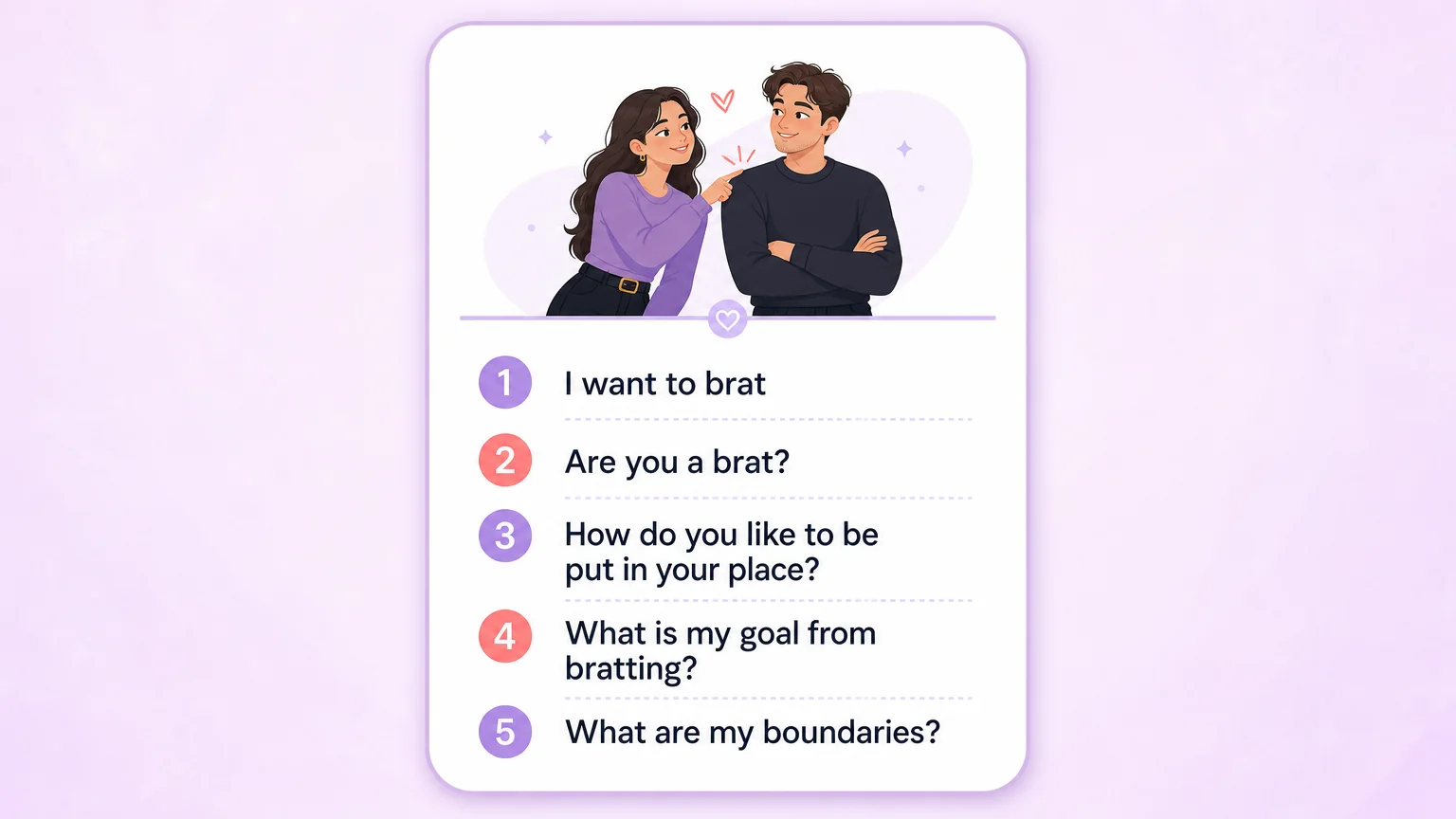
Then run the four questions the Watts The Safeword podcast recommends: “Are you a brat?” “How do you like to be put in your place when I act out?” “What is my goal from bratting?” “What are my boundaries?” For a new partner, add educator Brittany Simon’s cleaner question: “Do we want the brat out tonight, and when should I put her away?”
Before any bratting begins, agree three things.
First, which rules are brat-able and which are core. Evie Lupine’s tiered system is the gold standard: an upper tier of core rules around honesty, well-being, and trust that are never fair game, and a lower tier of flavor rules that are. Start with one or two narrow flavor rules and expand or reel back from there.
Second, the consequence menu. Spell out which punishments are funishments you will genuinely enjoy and which are real corrections. More on that in Step 5, but the menu gets agreed here.
Third, the safety system. A traffic-light safeword for both of you, plus a signal that means “I am bratting right now.” Evie Lupine suggests an alternate honorific used only while bratting, four devil emojis, or a green-to-red fridge magnet that shows your brat mood for the day.
You are not asking permission to misbehave. You are designing a game you both want to play, and the negotiation reads as teamwork, not a lecture.
By now you should have an actual script to speak and a checklist of what to agree.
Step 3: The Brat Move Ladder: From Sass and Loopholes to Run-Away
This is the step you came for. Quick win for tonight: one line of sass. “Make me,” delivered with a grin. A challenge wearing a smile.
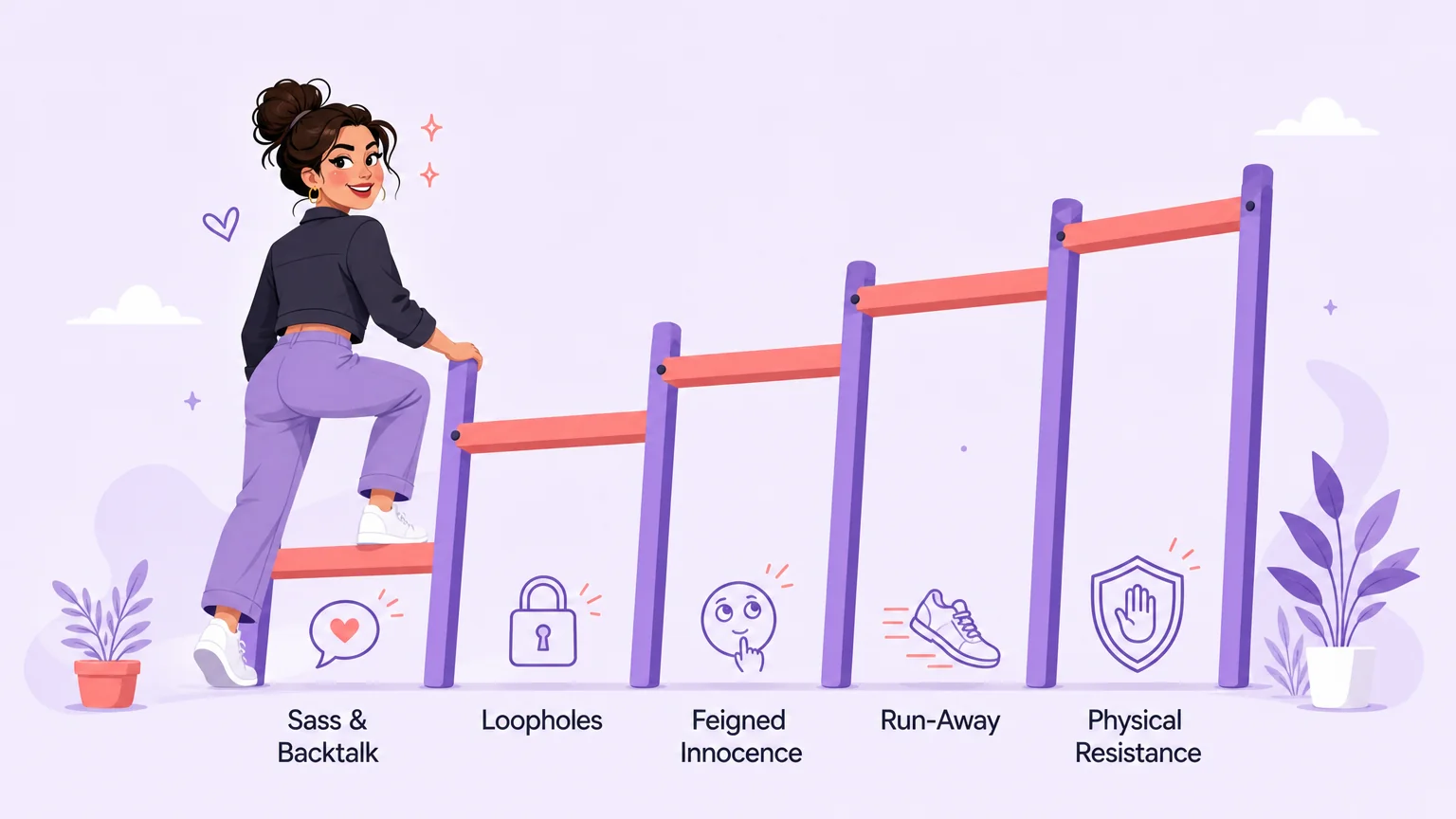
If you are wondering how to start bratting without losing your dignity, the answer is the ladder. Learning how to be a brat is a skill you build a rung at a time, not a switch you flip to full power. Start low, learn what each move asks for, then climb when the reaction says climb.
Rung one: sass and backtalk. The verbal jab. “That’s all you’ve got?” “What are you gonna do about it?” “You can do better than that.” Said with a smile, each one reads as an invitation to prove otherwise. The tamer-read: your partner hears “show me.”
Rung two: loopholes and malicious compliance. Obey the letter to break the spirit. Educator Ms. Elle X’s favorite worked example is the sub who cleans literally half the kitchen: every other dish washed, half the sink, every other floor tile wiped. Technically compliant. Deliberately absurd. The tamer-read: your partner gets to be clever about catching you.
Rung three: feigned innocence. The wide eyes, the baby voice, the “but I don’t waaaant to.” Pure theater, and everyone in the room knows it. The tamer-read: the softer the innocence, the louder the challenge underneath.
Rung four: run-away. Make them chase you. The game shifts from words to motion, and the catching becomes the point. The tamer-read: you are handing them the pleasure of the pursuit.
Rung five: physical resistance. The playful struggle that invites being overpowered. Your body does the sassing now, and the losing is the winning. The tamer-read: you want to be caught and held.
Here is the single sentence behind every rung. Each technique is a bid for a reaction and a wider power gap. So watch what the reaction says. Ms. Elle X is emphatic: address the why, not the what. If your partner meets your sass with delight, you found the right rung. If the delight curdles into real irritation, you have your answer: land it.
Some ground rules before you take bratting any higher. One move per interaction at first. Do not dial to 100 with a new partner. Never brat on an unknown hard limit. And if your partner does not enjoy it, that is compatibility, not failure. Rachel Rampage puts it cleanly: good brats play inside the rails, and some doms simply prefer obedience kink over resistance kink. You are just mismatched.
By now you should have a rung to start on and know what each move is actually asking for.
Step 4: The Bratting Arc: How to Escalate, Surrender, and Land the Scene
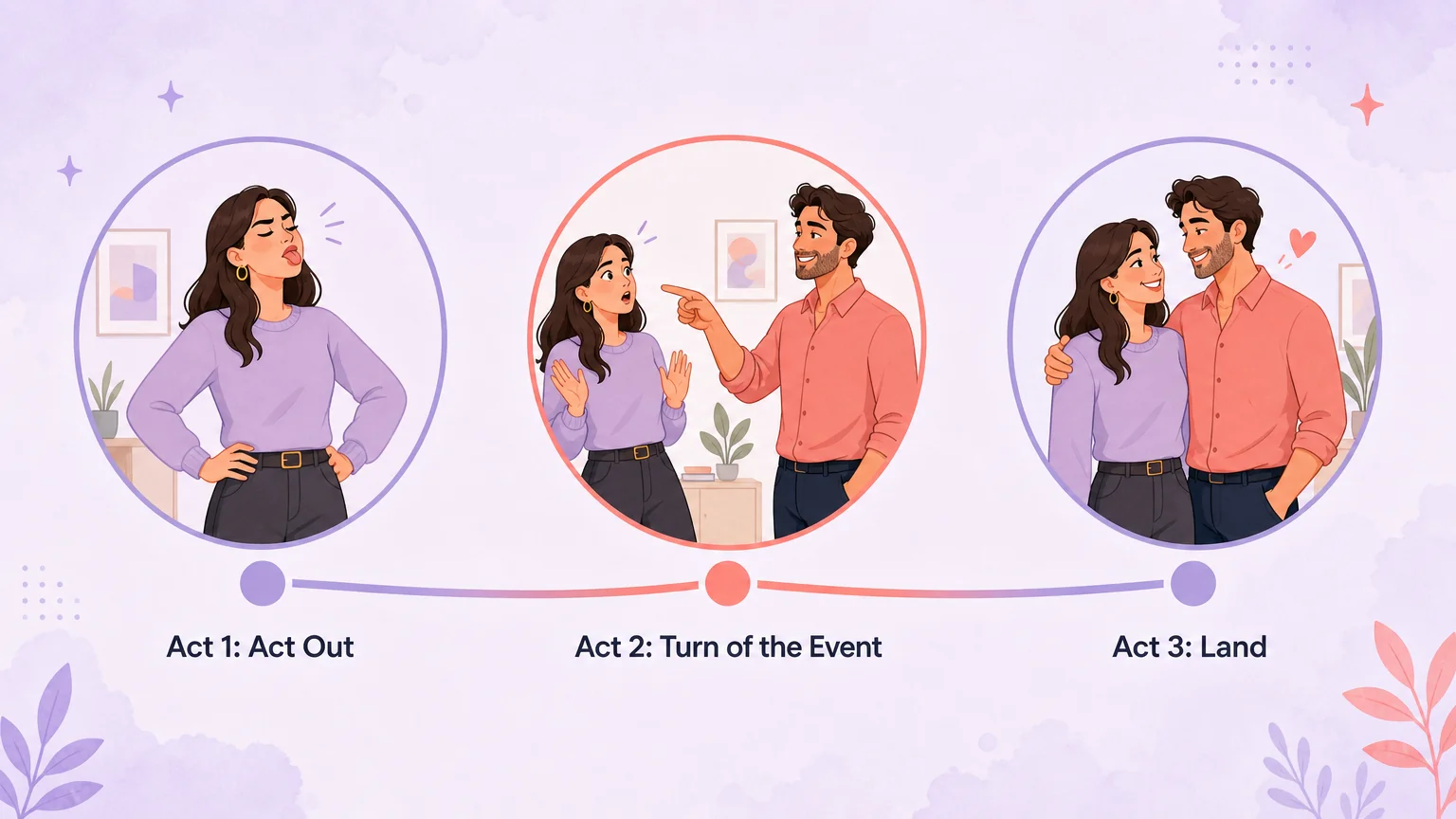
Brat scenes have a shape, and the shape is what keeps them playful instead of spiraling. The community calls it a three-act arc. If you read our guide on what a brat tamer is, you know this arc from their side. This is the same arc from yours.
Act one: the acting out. You poke, prod, talk back, and generally make mischief. This is your bid for a power imbalance. Remember the engine from the intro: your goal is connection, not control. Rachel Rampage describes the brat’s want as being met. Not ignored, not overruled forever. Met.
Act two: the turn of the event. This is the moment the Dom turns it around and retakes control. Your job is to react, not to keep steering the narrative. Ms. Elle X is blunt about this: the submissive started the game, but the submissive must not control it. If you keep topping from the bottom, the game never starts.
Act three: the landing. You submit, get funished or corrected, and the scene closes. This is what converts tension into closeness. Agree the landing beforehand, and renegotiate if it keeps not landing. A brat who never lands, or a Dom who never turns it, leaves the scene to curdle into resentment.
Here is what a landing can look like. Brittany Simon describes corner time that is really reassurance. The Dom puts her in the corner, and every time she turns around he adds ten minutes. He stays behind her. On occasion he pets her. The minutes are not neglect. They are attention, and she can feel it. That is the feeling you are building toward.
The arc is a dance. You are both choreographing it, and the landing is where you get handed back to each other.
By now you should be able to name where you are in the arc and how to land it.
Step 5: Funishment vs Punishment: How to Play the Consequence Game
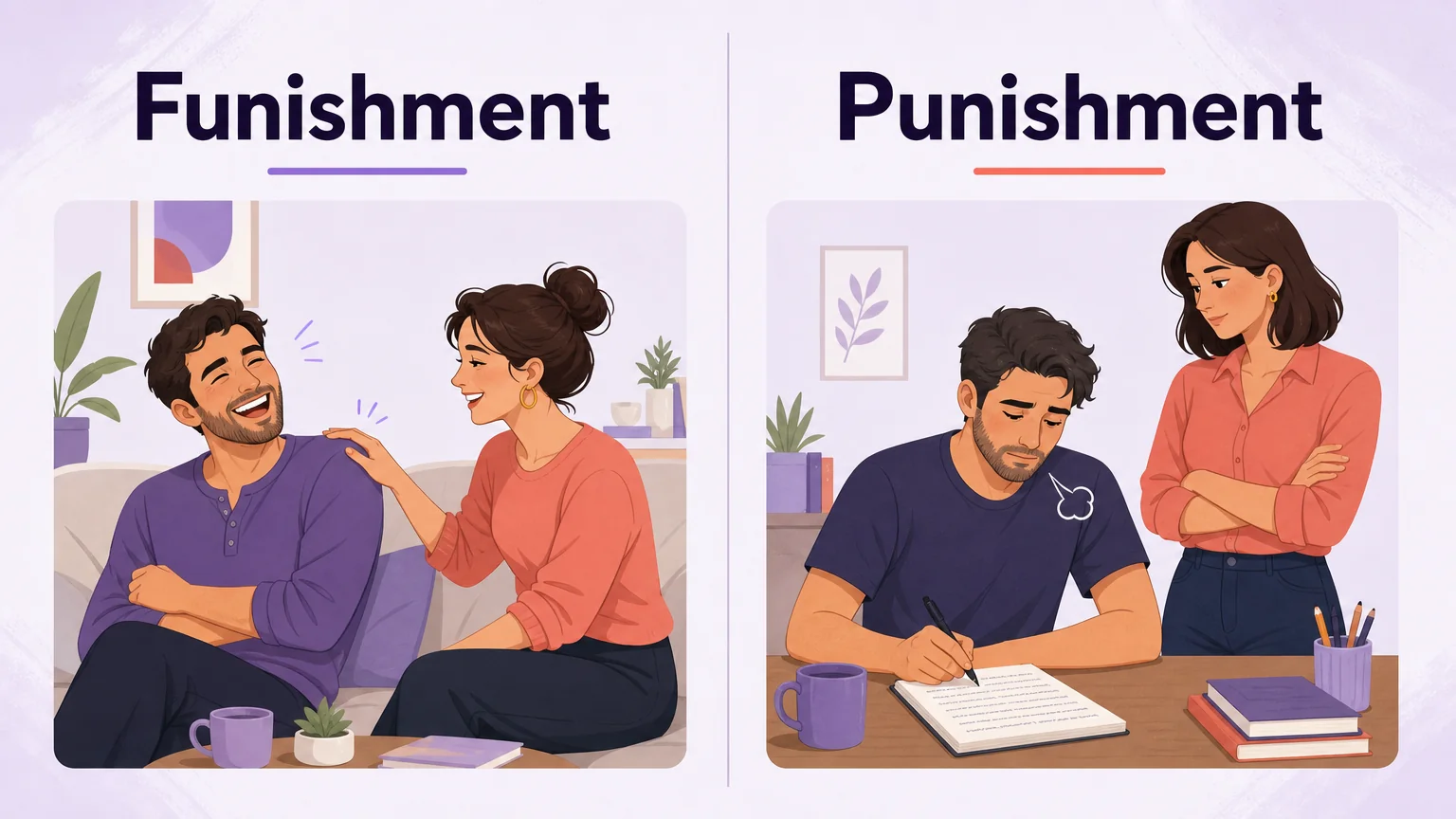
Here is the tangle: if you enjoy the consequence, how is it a punishment at all? It is not, and the distinction is the whole game. Being a bratty sub means knowing the difference and using it on purpose.
A funishment is a consequence you genuinely enjoy: spanking, corner time, being caught. It reinforces the behavior, which is the point. A real punishment is a deterrent you dislike: writing lines, chores, losing privileges. It is meant to stop something. The rules, rewards, and punishments system educator Marcqwuan Reid describes runs on the same distinction.
The practical insight is sharp. If spanking makes you giggle, it is a reward. Evie Lupine notes that physical pain rewards a masochist, so if a real correction is ever needed, expect it to be non-physical. Pain is a prize for a lot of brats, not a deterrent.
Here is your agency. You are allowed to say what you want the scene to deliver. “I am bratting because I want to be put in my place, cornered, chased.” Evie Lupine warns that mismatched assumptions mean nobody gets what they want. Naming it beats guessing.
Reading the tamer is a skill too. A Dom who volleys the sass back wants the game. Ms. Elle X calls this the handler: the banter itself becomes foreplay. A Dom who goes quiet and still is signaling that it is time to land. The tamer ends the match. Both styles widen the power gap you crave, but each needs a different move from you.
Here is the boundary line. If the Dom’s displeasure is genuine and not feigned, the play stops. Ms. Elle X’s rule is the whole game in six words: if in doubt, don’t brat. Pull back to baby brat and test the waters.
By now you should be able to name what you actually want from the consequence and read whether to push or land.
Step 6: Bratty “No” vs a Real “No”: Build a Signal System That Can’t Be Missed
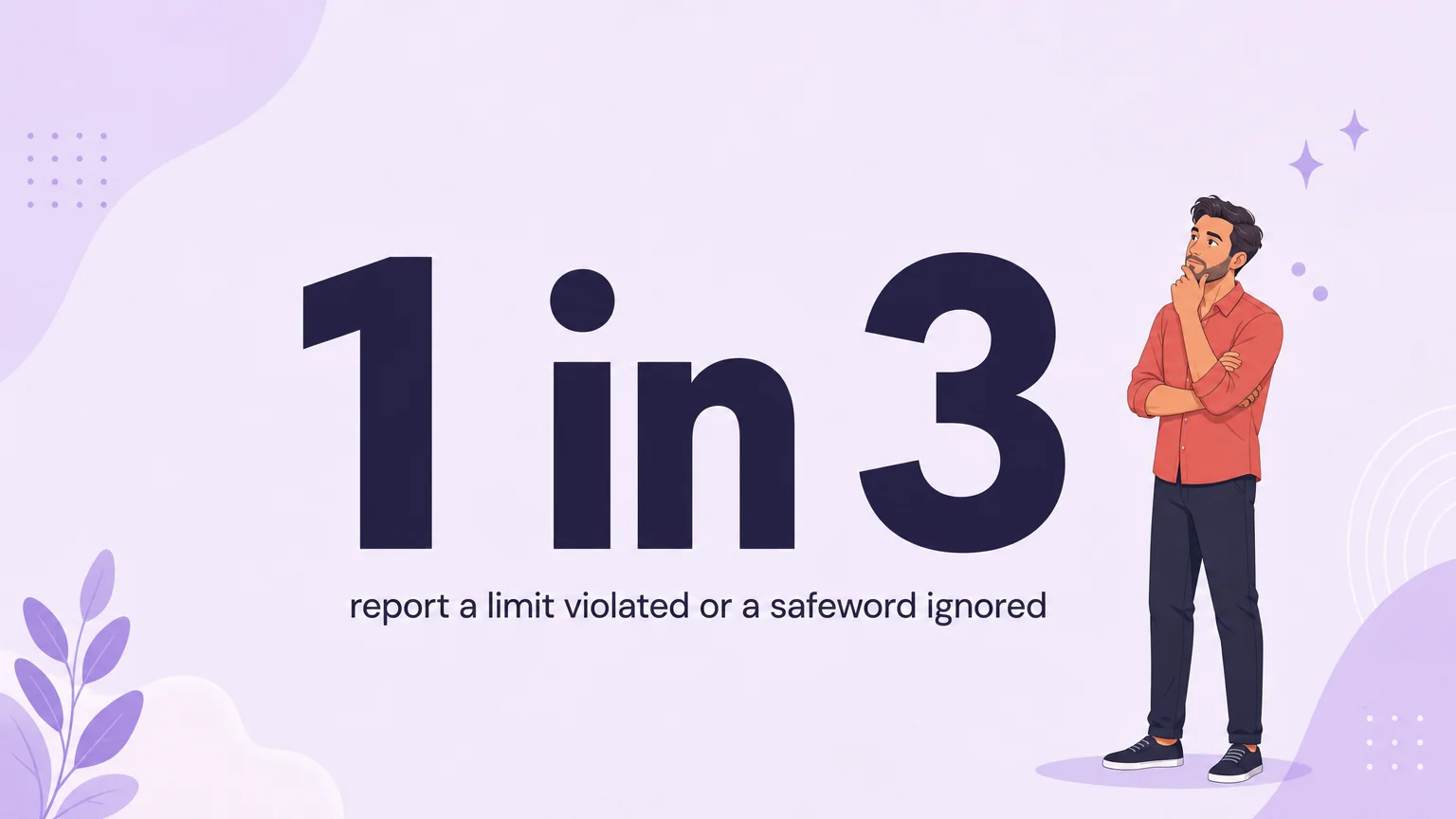
A hard statistic earns this step its place. The NCSF’s 2012 Consent Counts survey of 5,667 kinky people found that roughly 1 in 3 report having a pre-negotiated limit violated or a safeword ignored, typically within their first five years in the scene.
Bratting makes this worse: “no” and “stop” are part of the script, so a normal safeword can get tangled in the act. The safeword stays fully active and non-negotiable, so you need redundancy.
Layer one: a traffic-light safeword that works for both of you. The Dom can safeword too. Some couples run Ms. Elle X’s frame: “You may brat until you hear MY safeword.” Doms have boundaries, Evie Lupine reminds us, and bratting is exhausting for tops.
Layer two: a non-verbal off-ramp for when words fail. A squeeze, a tap-out, or a real-world signal that is never part of the game. Brittany Simon reserves removing her collar for the ultimate message: not a brat move, this is we need to talk.
Layer three: watch the body, not just the mouth. Blank eyes, shallow breathing, a limp body, silence. These shutdown cues matter more than a safeword, because a person in freeze often cannot say one.
Read the data straight. Violations land hardest on women and gender-minority respondents: roughly 1 in 3 women and over a third of gender-queer and trans respondents reported them in the NCSF 2014 Consent Violations Survey. A redundant signal matters most to the people at highest risk. The same foundation underlies our guide on what a brat tamer is.
One more rule, plain. Never punish under anger. If either of you is genuinely angry, the scene stops and you walk away. Watts The Safeword says it without ambiguity: actions under anger become abuse.
By now you should be able to name your three layers of off-ramp.
Step 7: Brat Over Text: Long-Distance Bratting and Dating-Profile Signaling
Quick win first. Reply to a serious command with a single word. Send a text backwards. Switch to another language and dare them to translate. Text bratting is beginner-friendly because the moves are tiny and instant, and if you want to learn how to be a bratty sub across a time zone, this is where you start.
But the safety floor comes before the fun, because text strips away tone. Write the safewords and check-in intervals down. Agree an AFK rule: no reply in 15 minutes means the scene is paused. End every negotiation with a summary recap. Educator Lilith Foxx calls this the text negotiation structure, and it is non-negotiable.
Then the toolkit. Annoyingly short replies. Changing the subject mid-seriousness. Emoji and GIF escalation. Voice notes, because bratty inflection carries meaning flat text cannot. Text while they are trying to be serious about something else. Pause just long enough before obeying that they can feel the beat. Each one is a brat move in miniature, and each works better because the screen hides your grin.
Give the game teeth across distance. Orgasm control and conditional orgasms. Self-spanking video tasks. Written lines or apology notes. Remotely app-controlled toys that let a Dom raise or lower vibration live, which turns a cheeky text into an immediate reaction in your own body.
The arc lands over text too. End with the Dom’s corrective line and your submission, then the aftercare exchange. A scene that starts, escalates, and lands across the miles beats one that fizzles into a chain of jokes.
Now the 3Fun angle. A dating profile can pre-negotiate the dynamic before the first message. Keywords like “submissive brat” and “kitten energy” are a standing invitation and a filter at once. They tell a matched partner what kind of game they are signing up for, before anyone says hello.
If you are single, here is the frame that keeps you safe: you are an empowered guest in whatever dynamic you join, never a toy in someone’s toybox. Your brat energy is your own to offer, and your safeword travels with you.
By now you should be able to run a text scene that starts, escalates, and lands safely.
Step 8: After the Scene: Brat Guilt, Sub Drop, Aftercare, and Debrief

Nobody warns you about the crash after the thrill. Name it without shame: sub drop is a neurochemical event. The adrenaline, dopamine, and endorphins that carried you through the scene plummet, and it can hit hours or even days later with sadness, anxiety, fatigue, and sometimes self-disgust.
Then there is the brat-specific flavor of guilt. Feeling like you were annoying. Like you pushed too far. Like enjoying defiance makes you a bad submissive. This is common, and it is not a verdict on you. Evie Lupine points out that many natural brats were told in vanilla life that they were “too much” or “rude” or “immature.” The kink relationship is supposed to be the place that quirk gets loved and rewarded, not punished twice.
The aftercare playbook, from your side. Ask for what you actually need. Physical comfort: blankets, water, cuddles. Verbal affirmation: “You were incredible and I kept you safe.” And plan for contact over the following days, because drop does not keep office hours.
Delay the debrief on purpose. Reconnect first, then talk the scene. Do not ask a crashing partner open-ended questions they cannot think through yet. “What do you need?” lands on an empty brain. Hold them first.
When you do talk, run the honest debrief. What escalated well. What landed. What nearly crossed a line. Brats often need to renegotiate after a hard scene, and that is part of the deal, not a failure.
This is not a flaw in your foundation. It is part of the adventure, and aftercare is how you stay teammates.
By now you should have a pre-planned aftercare script and the debrief questions ready.
Step 9: Bratting With Three: How the Dynamic Works in Threesomes and Swinging

Here is the level-up chapter. When there are three of you, who holds the rules? That question changes everything. A two-person brat scene runs on shared shorthand, and adding a third body forces you to write that shorthand down.
Start with the consent matrix, the tool that makes three-person bratting safe. Before play, map every activity across every pair and the full group: A and B, B and C, A and C, and all three together, with a yes, no, or intensity level for each cell. The kink writer behind the yvex.de framework calls it a matrix for a reason. It makes the invisible visible.
Give the third person an absolute one-way veto. Any guest can stop anything, any time, no negotiation required.
Here is the failure mode that silences the third: couple privilege. An established pair has shorthand, inside jokes, and a rhythm that can crowd out the guest without anyone meaning to. The veto has to be loud and honored, precisely because the shorthand makes it easy to miss.
The shapes bratting takes with three. The cleanest is one bratty submissive played by two dominants. The brat’s surrender is doubled, the power is coordinated, and both doms have to agree on the rules before the brat gets anywhere near a loophole. Or a couple who brat together bring a third into their playground as a guest. The energy that usually bounces between two people now has a third set of hands to catch it. Educator Summer Tao frames the whole thing as a three-act dynamic, and with three bodies the acts just get bigger.
If that third is you, remember the frame. You are an empowered guest, not a toy in the toybox. You bring your own safeword, your own limits, and your own right to land the scene. You are not required to perform a role the couple wrote for you.
On multiple safewords: every person carries their own red. In a group, the group red beats any individual green. Cross-reference Step 6, because the layers get more important, not less, when the bodies multiply.
By now you should be able to imagine your own three-person configuration and the matrix you would build to make it safe.
FAQ: Bratting Questions, Answered
How do I know if I am actually a brat?
See Step 1. Playful defiance sounds fun to you. “Make me” and “prove it” read as invitations, not stress. You push buttons to feel connection, sass as flirting, love being caught, and hunt loopholes in a rule’s letter and spirit. It should feel light and mutual, not angry.
What are the classic bratty things to say?
The core set: “Make me,” “You can’t make me,” “That’s all you’ve got?,” “Prove it,” “What are you gonna do about it?,” “Mmmhm, sure,” “Whatever,” “Maybe later.” The tells matter too: the eye-roll, the pause before obeying, the pout. Deliver any with a grin and it reads as play, not pushback.
Is it possible to be a respectful brat?
Yes. The respectful brat minds the Dom’s boundaries and responds to real reactions, not feigned ones. Watch for the line between playful frustration and genuine displeasure, and pull back when it turns real. Ms. Elle X’s rule is the whole answer: if in doubt, don’t brat. Respect keeps the game a game.
Do brats make good submissives?
Yes. Rachel Rampage puts it plainly: bratting is a style of submission, not a moral category. A good brat invites dominance instead of replacing it, and there is always a new “how will you handle this” to play with. A partner who prefers obedience kink is a compatibility issue, not a defect in you.
Can there be too much bratting?
Yes. Brat too close to the sun and it turns mean, tests out of distrust, or never lands. Watts The Safeword notes that bratting is exhausting for tops, so scenes need an on and an off, plus a landing that brings you back. When your partner’s strain turns genuine, flip the switch off.
Is there such a thing as a bratty Dom?
Yes. Doms are just brats with power, Watts The Safeword says. A Dom who withholds praise, refuses to give in, or teases, “You haven’t earned it yet” runs bratty energy from the top. It is a play style, not locked to the bottom.