You have felt the pull to lead and the pull to surrender, sometimes in the same week. If you are asking what a switch in BDSM is, you are likely already living part of the answer.
One night you want to set the pace, give the orders, hold the room. Another night you want to hand the reins over and let someone else drive. That does not make you indecisive. It makes you a switch, and roughly a quarter to a third of people who practice BDSM feel exactly the same way.
A one-line definition tells you the word and stops there, leaving you with more questions than answers. This piece will not.
We will walk through the definition, the one distinction that trips people up, why switching happens, how to know if it is you, and how to do it safely, including the threesome and ethical non-monogamy angle. Whether you explore on your own or with a partner, one person or more than one, the answer starts in the same place.
This is the full map, not a one-line shrug.
What It Means to Switch: The Simple Definition
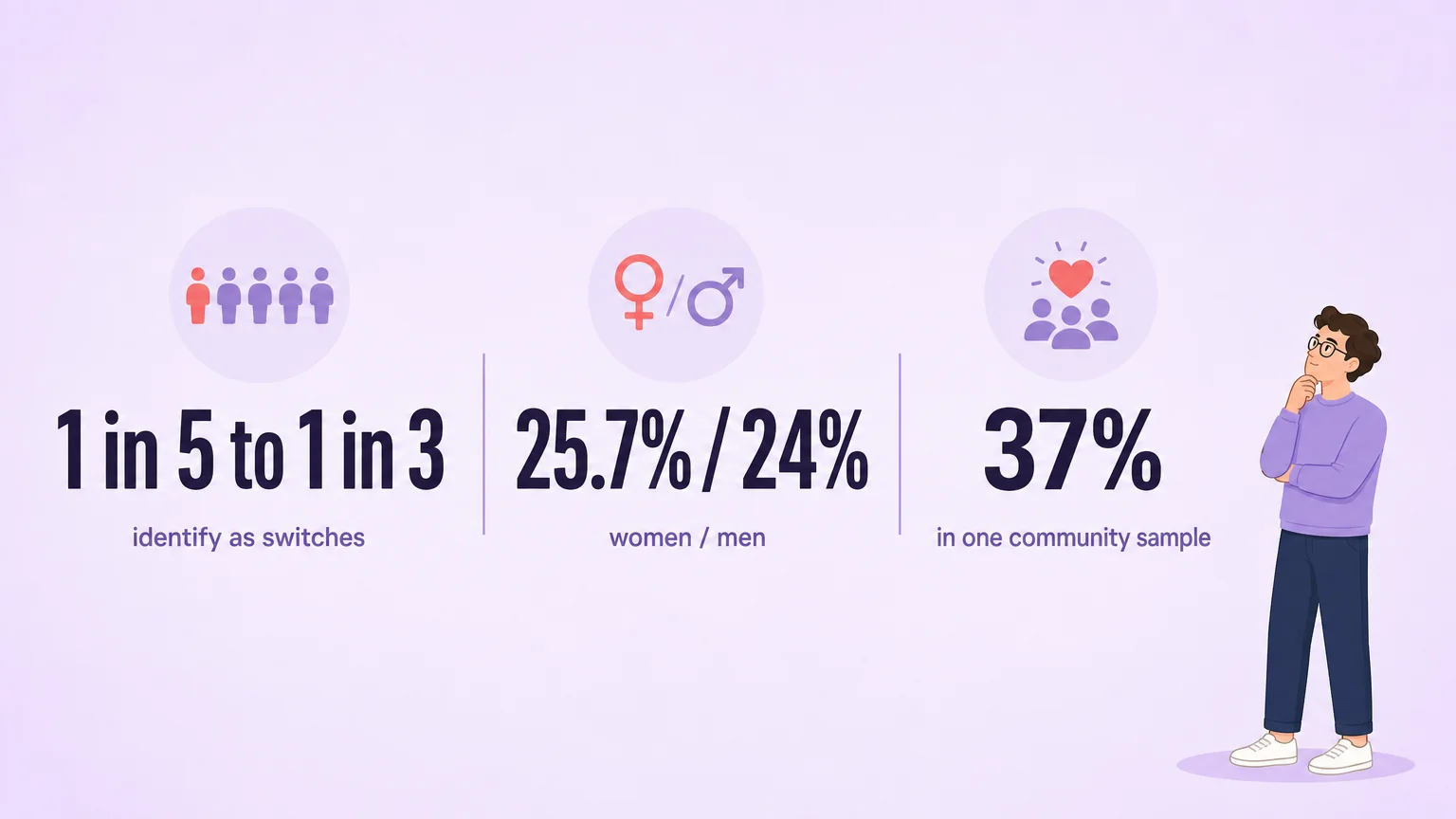
Here’s a number that surprises most people: among those who practice BDSM, roughly one in five to one in three identify as switches. One 2015 study put it at about 25.7% of women and 24% of men. Another community sample ran as high as 37%.
The numbers also shift by gender; one dissertation reported about 30% of men and 16% of women identifying as switch. Wanting both sides is not an edge case. It sits close to the center of the conversation.
So what is a switch, exactly? A switch is someone who takes the dominant or top role sometimes and the submissive or bottom role other times, rather than committing to one side. Some people reach for the word “versatile,” or “vers” for short, to name the same shape. The two terms overlap, but “switch” is the one most tied to BDSM power roles, while “vers” more often points to who takes top and bottom during sex.
The part that trips people up is the split. Being a switch is not a 50/50 obligation. You do not have to divide your time evenly between commanding and surrendering. You can be a sub-leaning switch who only tops on occasion, or a dom-leaning switch who rarely yields. Your balance can shift with your mood, the partner in front of you, or simply the year you are in.
That permission to move changes how you hold the label. A switch is not a box you climb into; it is a word that describes what you already do, and it is yours to define. Some switches hold one role with one partner and another with someone else. Some flip with the same person. Neither is more legitimate. If calling yourself a switch helps you stop forcing yourself into a single role just to feel like you belong, use it. If it does not, set it down.
Best for: People who have felt the pull toward both sides and want a word for it. Skip if: You already know the basics and want the mechanics of switching safely, which come a few sections down.
Top/Bottom vs Dominant/Submissive: What You’re Actually Switching
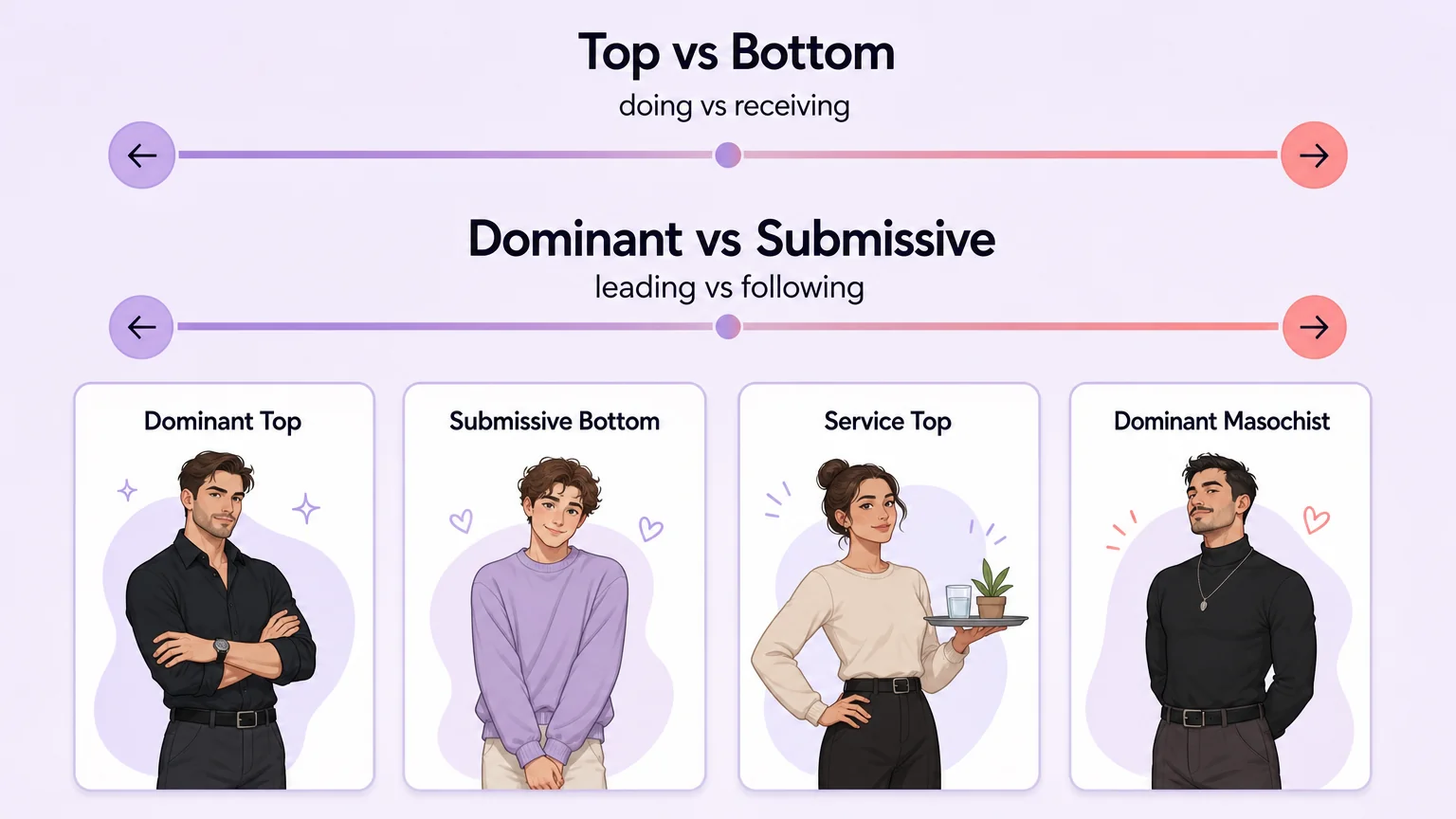
Can a dominant also be a bottom? Yes. Meet the dominant masochist: someone who leads the dynamic but bottoms for sensation like rope or impact, staying in charge while tied up. It only sounds like a contradiction if you have not separated two things that are actually independent.
The first axis is top and bottom, which describes physical action: who is doing versus who is receiving. Topping means giving the sensation. Bottoming means taking it.
The second axis is dominant and submissive, which describes psychological control in a power exchange: who holds authority versus who yields it. A dominant directs. A submissive follows.
Split them and four combinations unlock. A dominant top leads and acts. A submissive bottom follows and receives. A service top tops at the bottom’s instruction, doing the action while the bottom runs the scene. And the dominant masochist bottoms physically while staying in charge. Four very different people, four very different nights.
Think of it in hands. The service top ties the rope because the bottom asked. The dominant masochist asks for the rope while the other person ties it. The hands do the same work, but the person holding the power changes everything about the scene.
Now connect it to you. A switch can move along either axis, or both at once, which is why one word covers so many different lived experiences. The same person can be a dominant top on Friday and a submissive bottom on Saturday, a dominant who bottoms for rope, or a submissive who runs the scene from below. All of them are switches. The label does not prescribe the combination.
Why does the distinction matter? Because it clears up most switch confusion. Once you know the two axes are separate, a whole set of combinations stops looking like a contradiction.
Quick comparison: Top and bottom is about bodies. Dominant and submissive is about power. You can switch one, the other, or both, and none of those is more of a switch than the others.
Why People Switch: The Psychology Behind Both Roles
Until very recently, almost no one had studied switches as switches. In 2025, the first in-depth qualitative study arrived: “Switch It Up,” by researcher Theodore Bennett, published in Sexualities. It drew on fifteen in-depth interviews and reached a blunt conclusion: switches are a substantial part of the BDSM world, yet remain largely overlooked and significantly under-researched.
What the study found matters more than the academic framing. Switching is not a random mood swing. People connect it to their sense of self, and they are open to a wider range of roles and activities than a fixed label suggests. How much flexibility a person feels varies widely.
Switches also play differently with fellow switches than with fixed-role partners. The study even built a model of how switches make those in-the-moment role choices.
That model replaces the lazy story of a coin flip between two fixed selves. You are making a situated choice, weighing the partner, the energy of the moment, your own mood, and the agreement you made. In practice, your role depends on mood, the specific partner, the connection, or plain practicality. Two people who both prefer the same role may simply take turns.
None of that means something is “off” in you. It means you are reading the room, the person, and yourself, and responding honestly. The study found the opposite of pathology: switches describe their flexibility as part of their identity, not a crack in it.
There is a quiet payoff, too. Switches tend to develop a deeper understanding of both mindsets, which builds empathy and stronger connections. You have sat in both chairs, which makes you a more attentive partner in either one.
The verdict: Switching is a fuller kind of fluency in the language of power.
Am I a Switch? A Quick Self-Check
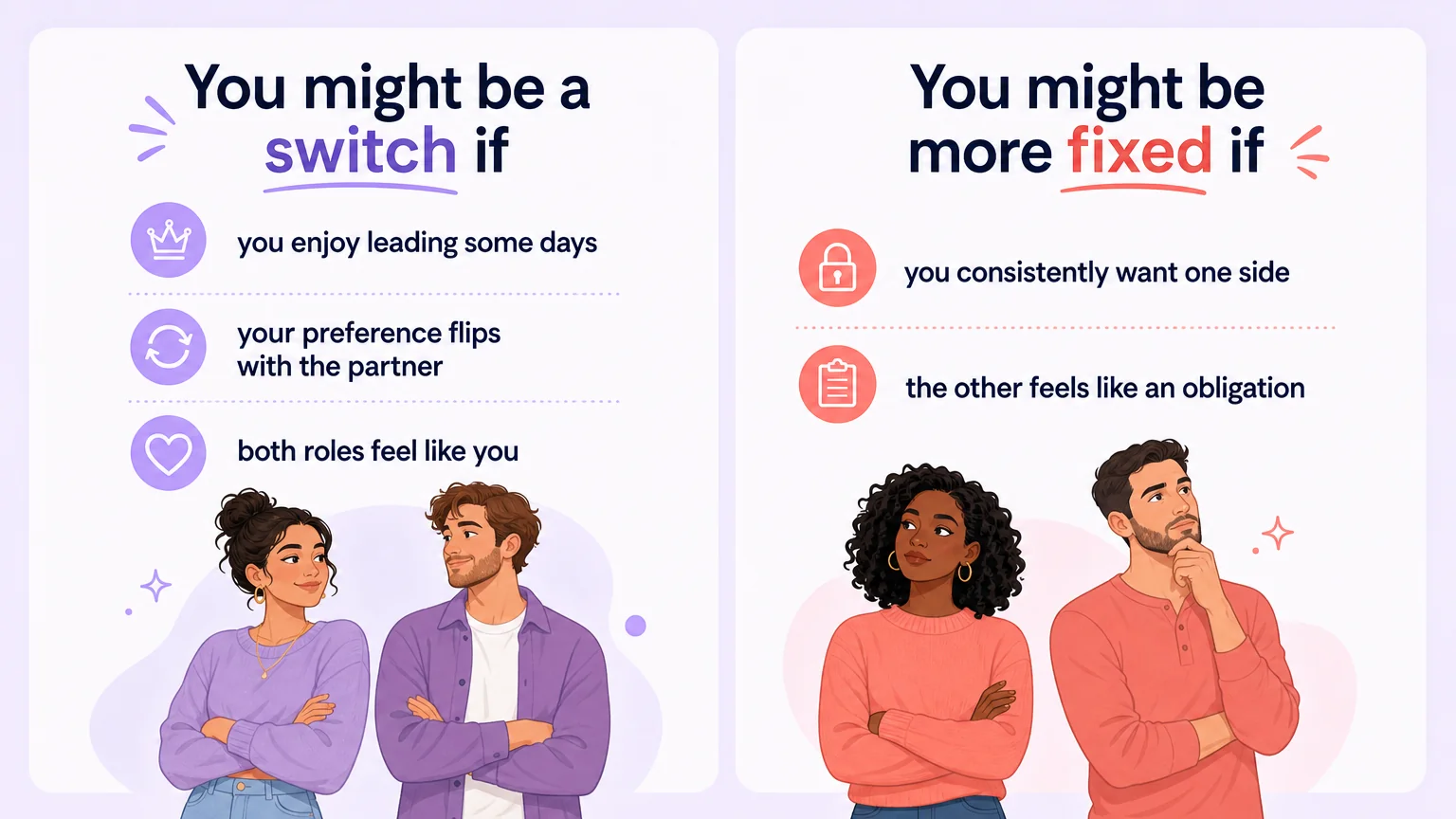
This is a lens, not a quiz. There is no score that makes you valid, and no threshold you have to clear to claim the word.
You might be a switch if you genuinely enjoy directing a scene some days and surrendering on others. If your preference flips depending on the partner in front of you. If you feel a small sense of relief when a label finally lets you do both instead of picking one. If you have caught yourself scripting the same fantasy from both chairs, once as the one in control and once as the one letting go. If the idea of being pinned to a single role feels like a slow exhale you never asked to take.
You are probably more fixed if you consistently want one side and the other feels like an obligation you would rather skip. There is nothing wrong with that either. Fixed and fluid are both legitimate places to live.
If you want a low-friction starting point, people in the community often use bdsmtest.org to see a percentage breakdown across dominant, submissive, and switch, among other archetypes. Treat the result as a fun heuristic, not a diagnosis. The number will move over time. Think of it as a mirror, not a verdict.
Identity can still evolve, and you do not have to force yourself into a box to belong.
Direct recommendation: Try naming yourself a switch for a month and see if it fits. The label is yours to pick up or put down.
Switch Stigma: Why People Tell You to ‘Pick a Side’

Here is the part the kink world often dances around: it pushes people to pick a side. A dominant. A submissive. Something fixed you can file. Switches get treated as not quite belonging to either camp.
The exclusion gets concrete fast. Some personal ads literally demand a “pure” submissive and not a switch. The message underneath is that moving between roles makes you less real, less committed, or harder to predict.
There is a related misreading. A 50/50 switch is sometimes read as secretly dominant, someone only playing at submission. That assumption says more about the person making it than about you.
That is a lie. Moving between dominance and submission is not confusion; it is authenticity. Identity in BDSM is often far more fluid than people imagine, and someone comfortable in both roles feels whole in more than one position, not unable to decide.
For some, the wound runs deeper than a stranger’s ad. Past controlling partners demanded robotic predictability, making shifting from day to day feel like being “bad.” If you grew up where your moods had to stay consistent to be loved, the freedom to switch can feel almost forbidden. Kink educator Ms. Elle X calls the antidote radical permission: the freedom to change your mind, which only becomes possible when you feel safe with a partner who will not take your shifting moods personally.
Here is the reframe that matters: naming your full self is the point. The problem was never your fluidity. It was other people’s discomfort with it.
The verdict: You do not owe anyone a fixed label. You owe yourself the truth of what you want, on any given night.
How to Switch Roles Safely: Consent, Safewords, and Mid-Scene Flips
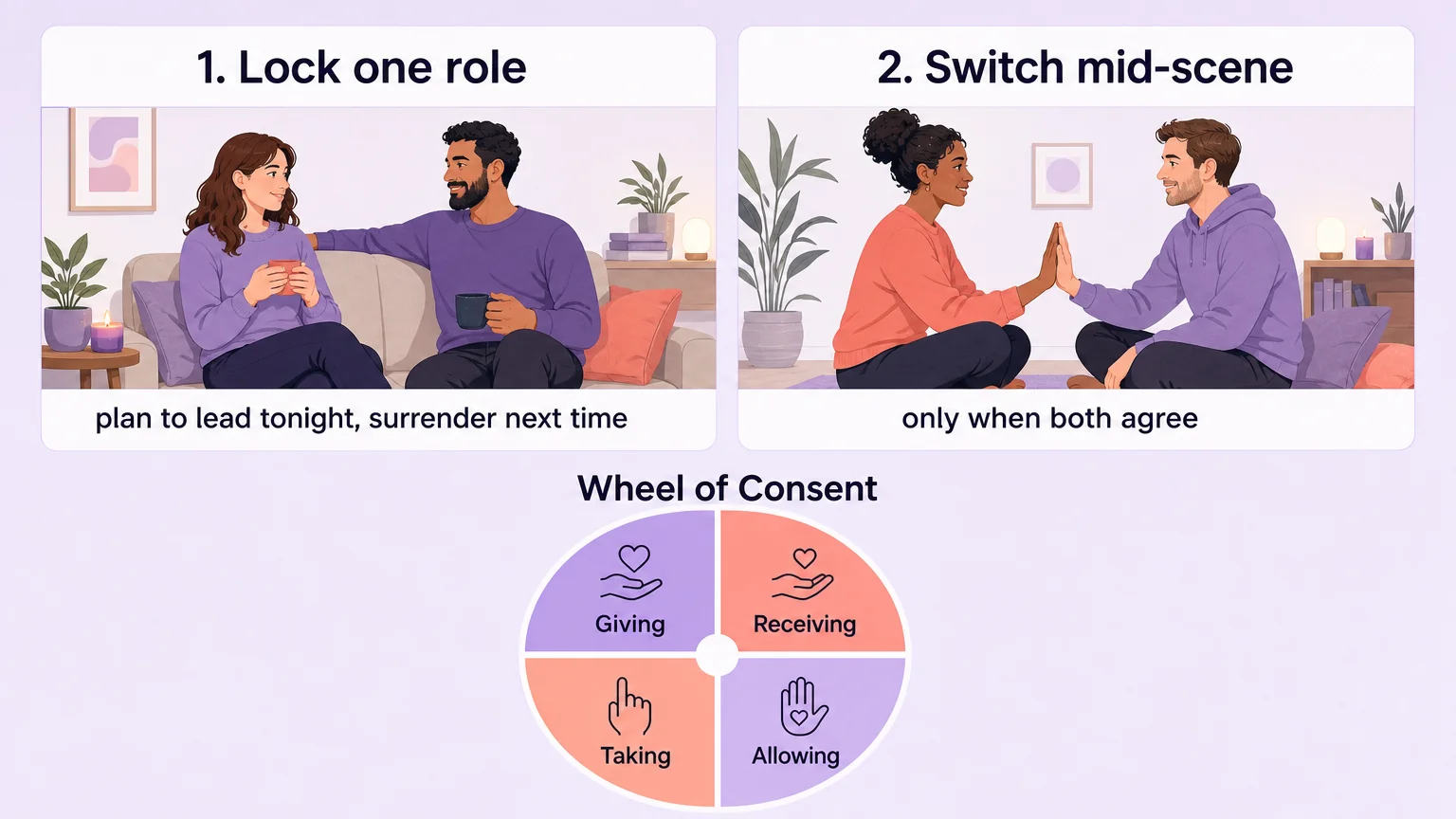
Kink educator Brandon The Dom lays out two legitimate ways to switch, and both start before anyone touches anyone.
The first is to lock one role for the whole scene and swap next time. You plan to lead tonight, and you plan to surrender next week. This works best for elaborate or higher-risk scenes, where clear planning and negotiation matter.
The second is to switch mid-scene, but only when both partners walk in explicitly agreeing that a flip is possible. Nobody gets ambushed by a power grab.
The failure mode is predictable and avoidable. When one person tries to switch and the other will not, you get two submissives with no direction, or two dominants fighting for control.
Betty Martin’s Wheel of Consent is the tool that makes flips feel natural instead of forced. It reframes any act through four dynamics: giving, receiving, taking, and allowing.
Take oral sex. If the “giver” has an oral fixation, they may be taking for their own pleasure while the receiver allows. The physical act never changes, but who is in control flips, and a smooth switch follows. The same frame works in reverse: reframe a “taking” act as “allowing,” and a top becomes a bottom without moving a muscle.
The safety spine underneath all of it comes from Jimi Diesel, a switch in a committed relationship. Safewords and signals are non-negotiable. Check-ins are constant. You should be able to pause and say you need a breath for a second without it being taken personally.
Aftercare can be as simple as holding each other afterward, and it applies in both directions. The partner who leads also needs a check-in, not only the one who surrendered. The whole structure rests on agreements, check-ins, and safety. As he puts it, dominance without care is just ego, and submission without choice is just harm.
If both of you switch and want to drop roles entirely, primal play is an optional alternative. You shed the protocol and tussle instinctively for control, no script required. It fits couples who want to stop thinking about roles entirely.
Direct recommendation: Start with the locked-role approach. Master that before you attempt mid-scene flips, and never attempt a flip you did not agree to in advance.
Switching With a Fixed-Role Partner: How to Make It Work

You want both sides. Your partner only wants one. Neither of you is wrong, and that is the first thing to accept.
Start with disclosure. Err on the side of being upfront early, even on vanilla dating apps, so a mismatch surfaces before feelings deepen. Name three things: your non-negotiables, what has room to compromise, and what is simply a nice-to-have. Consciously decide which mismatches you are willing to work with and which you are not. Early honesty can mean more early no’s, but a better fit over the long run.
For the fixed-role partner who wants to explore the other side, the on-ramp is concrete. Voice the desire honestly first. State your boundaries up front. Accept that trying something new carries a little discomfort. As Jimi Diesel puts it, if you cannot bring it up with your partner, you are not ready to do it. The mismatch is not the problem; the silence about it is.
A mismatch rarely has to be fatal. It comes down to compatibility: whether both people are consciously willing to flex.
Quick verdict: Flex when the gap is small and the willingness is real. When one person’s need and the other’s hard limit cannot coexist, the mismatch itself is the answer, and the kindest move is to name it early.
Switching in ENM, Threesomes, and Swinging

There is a scenario worth naming directly: the “middle” in a threesome. One person who is submissive to one partner while dominant to another, inside the same dynamic.
Luca Vale, a pro switch in New York’s kink and non-monogamy scene, describes his first kink relationship. He was submissive to the male partner and, at that partner’s instruction, dominant toward the female partner. Three people, one dynamic, and a switch moving between roles depending on who he was facing. Nobody paused to renegotiate the labels; the roles simply flowed to fit the three people in the room.
That is the advantage of switching in non-monogamy: fluidity. In a cuckolding dynamic, Vale steps back when the other man’s dominance rises so he can step up, then retakes control when the moment shifts. He reads the other person’s relationship to power and moves with it rather than against it. That is a different skill from deciding who tops and who bottoms: reading power as it flows, in real time, across three people instead of two.
The wider point follows. Because switches can inhabit either role, they are compatible with a broader range of partners and dynamics. In a space built on more than two people relating in more than one way, that flexibility is an asset, not a quirk.
It is also worth naming plainly: switching and non-monogamy often emerge together. Both are ways of exploring more of yourself. Vale frames his own work less as fixed-role performance and more as human relating, holding multiple identities, bull and dominant among them, without needing to be pinned to one. That is what switching buys you: the room to be several things at once, without any of them canceling the others out.
If you are a single in this space, the same fluency serves you. You can match the energy of whatever room you step into, on your own terms.
The verdict: If you already relate to more than one person in more than one way, being a switch is a natural extension of that same muscle. You are not confusing roles. You are simply fluent in more of them.
FAQ: Common Questions About Being a Switch
Is a switch the same thing as ‘vers’?
Related but not identical. A switch moves between dominant and submissive or top and bottom roles, while “vers” usually means taking both top and bottom positions during sex. Switch points at power; vers points at position. In practice, “vers” signals sexual position and “switch” signals power.
How common are switches in BDSM?
Roughly one in five to one in three people who practice BDSM identify as switches, most often cited around 25 to 30%. One 2015 study found about 25.7% of women and 24% of men, and one community sample ran as high as 37%. Wanting both sides is common, not unusual.
Do switches need to split dominant/submissive 50/50?
No. You can be a sub-leaning or dom-leaning switch, and your balance can shift with mood, partner, or the year. It is a spectrum, not a strict split. There is no quota on either side, and going months without one side does not make you less of a switch.
Can a dominant also be a bottom?
Yes. Top and bottom describe physical action; dominant and submissive describe psychological control, and the two axes are independent. A dominant can bottom for sensation like rope or impact, and a service top can act at the bottom’s direction. Matcha, a dominant and fem daddy, bottoms for rope and impact as therapy and performance. Leading and receiving are not opposites.
When should I tell a new partner I’m a switch?
Early, even on vanilla dating apps. Being upfront lets the other person evaluate fit before feelings deepen, and it avoids the hurt of a late-disclosed non-negotiable. Name your non-negotiables and what has room to compromise, and bring it up plainly, without apologizing for it.