If you want to find the BDSM guide for your first scene, here’s the starting point: your first scene does not begin with a blindfold, a flogger, or a safeword. It begins with a conversation between two people who already trust each other.
That conversation is where most couples stall, so this guide is built around it. By the time you finish, you and your partner will know exactly how to bring it up, agree on what to try, stay safe while you do it, and take care of each other afterward.
If you need the foundations first, read our guide to what BDSM is before you start. If you already know what you’re curious about and just want the step-by-step playbook for your first scene, you’re in the right place. Exploring on your own? Step 10 shows you how to vet a play partner safely before you meet anyone alone.
One thread runs through every step that follows: consent, communication, and checking in go both ways. Wanting to explore together is not a problem to fix. It’s a sign of a secure relationship, and it’s something the two of you get to build rather than stumble into.
Step 1: How to Bring Up BDSM With Your Partner

Your goal: open the conversation without triggering judgment or pressure, so you and your partner can talk about it as a team instead of a confessional.
Most couples never get past the first sentence. The fear is that naming a kink will make you look “too much,” or worse, broken. That fear is louder than the actual risk.
As sex therapist Dr. Amanda Pasciucco puts it, most people carry fantasies, and the shame wrapped around them is culturally programmed, not truth. If your partner’s first reaction is a wince, don’t read it as rejection. An initial “squick” is usually a reflex built from a lifetime of hearing that certain desires are wrong, not a verdict on you.
So how do you open it? With a script you can say out loud. The low-pressure opener relationship therapists recommend: “Can I share a fantasy with you? No pressure. I just want to open the door.” If your partner hesitates, Pasciucco’s reflective lines keep the door open instead of shutting it: “I think I hear you saying…” and “I don’t have that part of me yet, and I’m willing to do some work to create it.”
Pick your moment carefully. A relaxed, private moment: after sex, on a walk, a cozy night in. Never mid-sex, never mid-argument, and never with “we need to talk” energy, which turns a conversation into a court summons.
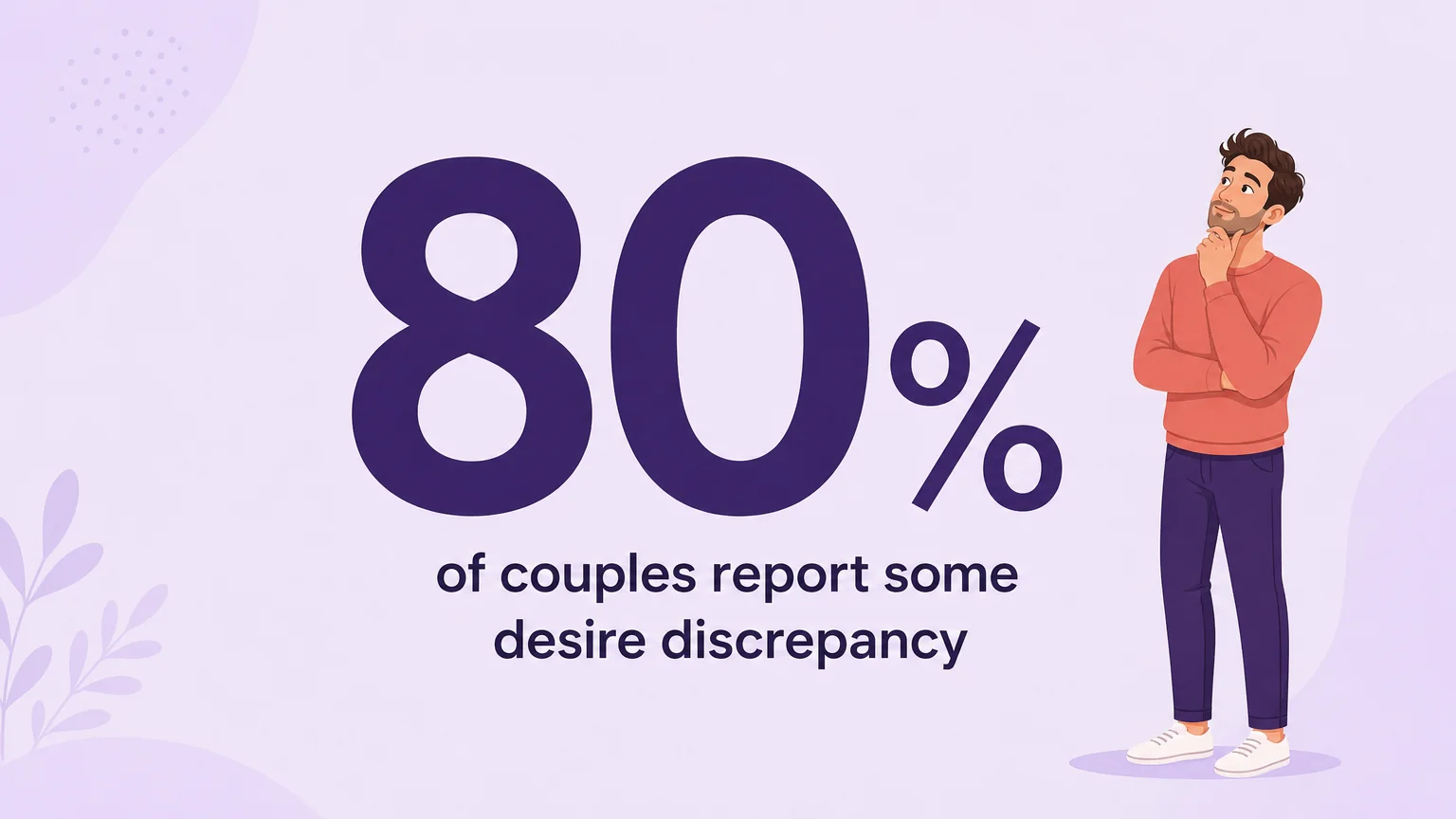
Now the part most couples don’t name out loud: one of you is probably more into this than the other. That’s normal, and it’s the default, not the exception. More than 80% of US couples report some desire discrepancy. The mistake is letting the eager partner rush the hesitant one.
Dr. Stefani Goerlich’s advice is to tiptoe: start slow, no timetable, at the hesitant partner’s pace, never pressure, never judge. If your partner says “I need to learn more first,” that’s a green flag, not a stall. It means they’re taking you seriously rather than waving you off.
Keep this first conversation small. Name one or two specific acts you’re curious about, not the whole acronym. You’re opening a door, not presenting a syllabus.
Milestone: the conversation is open and nobody’s on the defensive. Next, find the ground you both share.
Step 2: Build a Yes/No/Maybe List Together
Your goal: replace a dozen awkward “so what are you into?” conversations with one structured exercise that surfaces the shared ground you didn’t know you had.
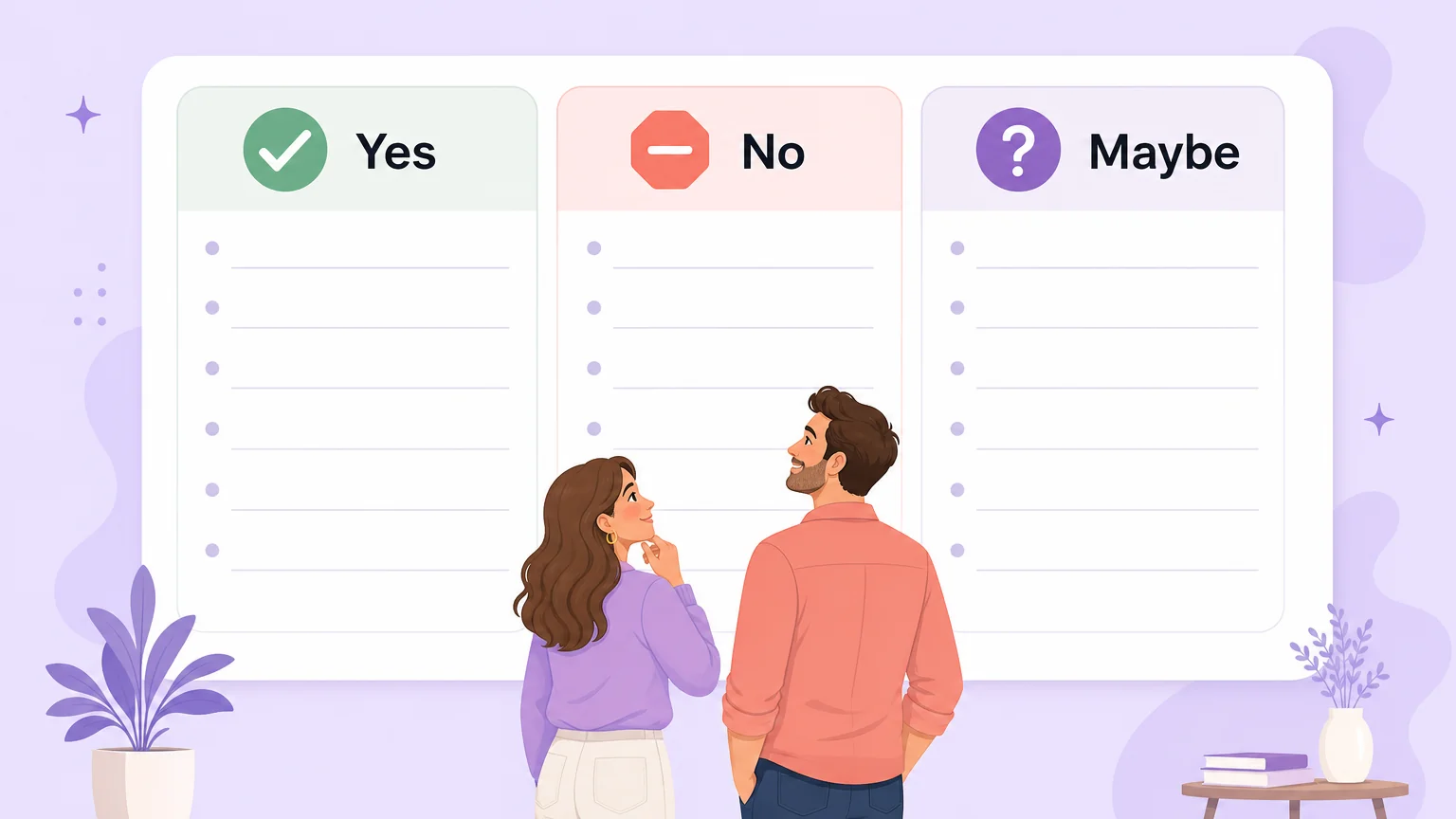
This is BDSM 101 in a single tool. The Yes/No/Maybe list is a private inventory you each fill out separately, then compare together. You complete yours alone first, with no one looking over your shoulder, so an unfiltered answer can surface without an audience.
Three columns do the heavy lifting: Yes (you want it), No (a hard limit), and Maybe (you’re curious, with conditions). Add Give, Receive, and Notes columns so every item is specific about who’s doing what. “Spanking” is vague; “I want to receive light hand spanking, not flogging” is a plan you can act on.
The distinction that makes this work is soft versus hard limits. A soft limit is something you’d try under the right conditions: hand spanking yes, flogging no. A hard limit is a non-negotiable that doesn’t get debated. Both are valid, and both deserve respect without a single “why?”
When you compare lists, do it without judgment. The point isn’t to find out who’s kinkier; it’s to surface the overlap you didn’t know you had. Start from the overlapping Yes items. Unpack the Maybes together, one at a time, asking what the conditions would need to be.
Never pressure a No, and never treat a No as a rejection of you. Try only one or two new things the first time, and come back to the list later. It’s a living map, not a one-time quiz. If your partner is the hesitant one, frame the exercise as a shared curiosity, not a test you’re grading.
If you trip over the vocabulary while you fill it in, our BDSM terms glossary covers hard limits, soft limits, Dom, sub, and switch in plain language.
A list you fill out solo is homework. A list you compare together is a menu you both get to order from.
Milestone: you each know your own limits, and you’ve found at least one overlap you’re both genuinely curious about.
Step 3: Choose Your Safewords and Practice Them
Your goal: agree on a system that lets either of you slow or stop anything, instantly, with zero ambiguity, before the first touch happens.
Here’s the surprising part most beginners skip: the safeword exists partly so you never have to say the word “no.” In a scene, “no” and “stop” are often part of the play, and a dedicated word removes all ambiguity.
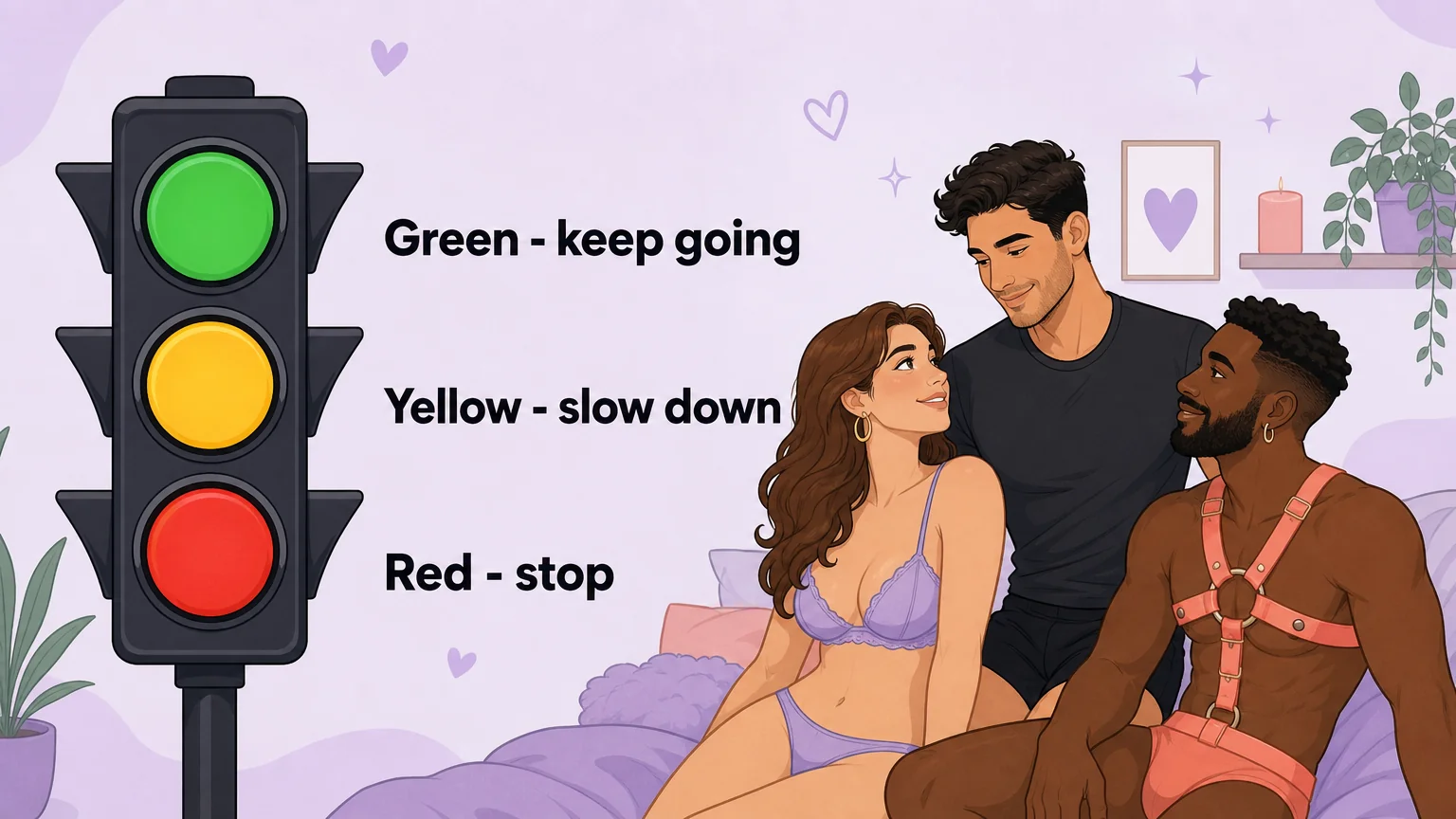
That’s exactly what the traffic-light system does for you. Green means keep going. Yellow means slow down, or pause and check in. Red means stop everything, right now.
Yellow is the unsung hero of the whole system. It lets you correct course without killing the momentum. You say yellow, your partner eases up or asks what you need, and the scene keeps its shape. It’s not a failure; it’s a steering wheel.
Plan a non-verbal fallback too, for when someone’s mouth is gagged or they go quiet in deep headspace. A tap-out, a double squeeze of a hand, or a dropped object all work. Agree on it before you need it, not while you’re frantically trying to communicate it.
Now the crucial part: practice. Say the words out loud together before the scene. Then, during warm-up, deliberately call one yellow, just once, so using it stops feeling like failure. You’re rehearsing the emergency exit so it’s available when it matters.
One rule is non-negotiable: a safeword is sacred, and anyone who ignores one is disqualified. No exceptions, no second chances. Dr. Gloria Brame’s standard is blunt on this point: continuing with someone who won’t honor a safeword is the red flag you don’t negotiate around. Treat your safewords as equipment you would never start without, the same way you wouldn’t drive without brakes.
Milestone: you both know exactly how to hit the brakes, and you’ve rehearsed it once, out loud, together.
Step 4: Plan Your First Scene, Beat by Beat
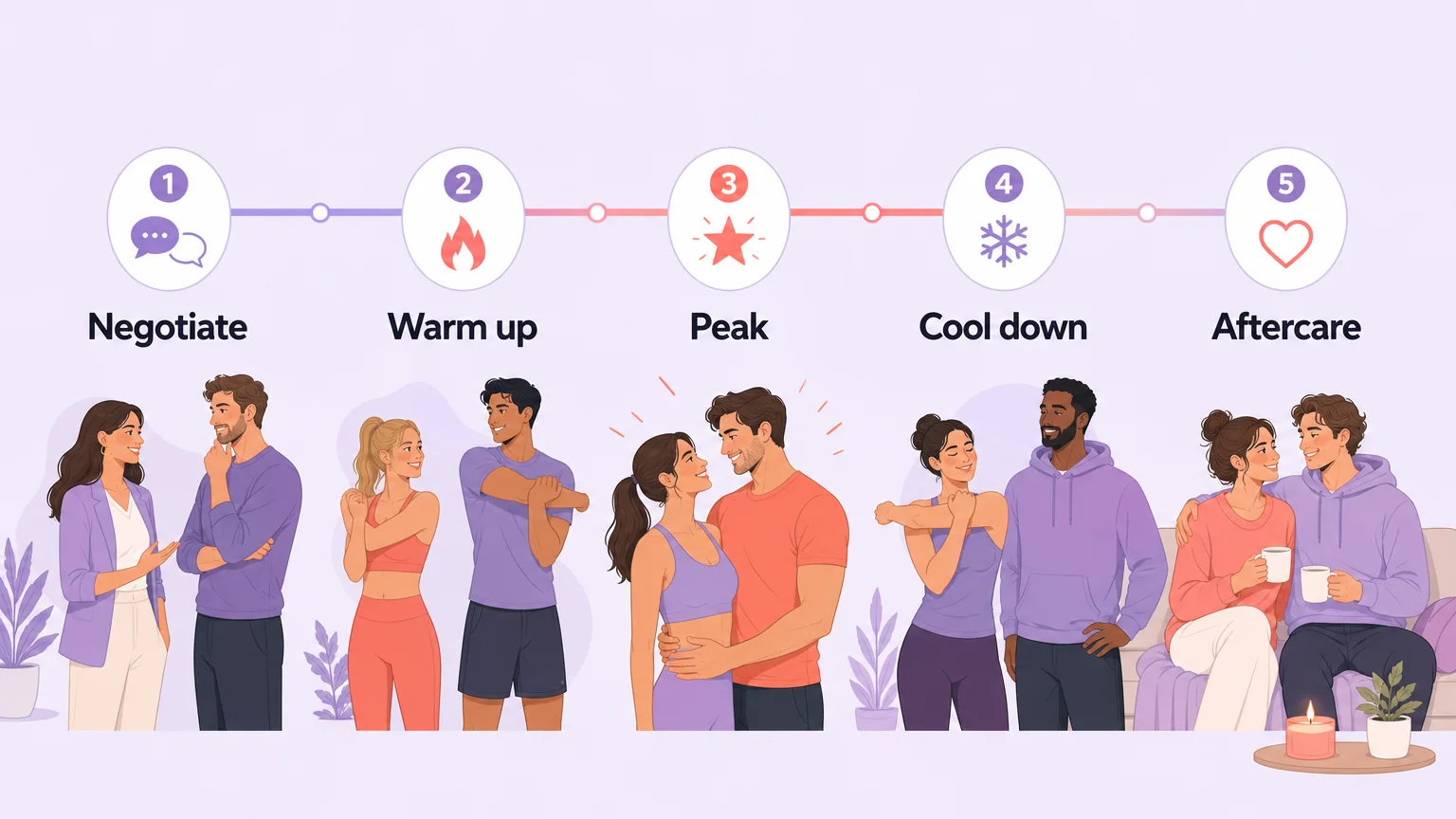
Your goal: map the scene before it starts so neither of you freezes at “okay, now what?”
A scene is a story, and mapping it out removes the freeze. Kink educator Evie Lupine describes the structure as a story arc: negotiation, headspace entry, warm-up, peak, cool-down, and aftercare. Her core point is that step zero is negotiation, before any play begins. You agree on what’s happening before the first touch, not in the middle of it.
That negotiation is where you also name your shared goal for the scene: to feel closer, to explore a sensation, to hand over control. Agreeing on the why keeps you both pointed the same way when the intensity rises.
For your first BDSM scene, keep the menu small. These are BDSM for beginners staples: light spanking, scarf or soft bondage, blindfold teasing, biting, and hair pulling. Skip rope, breath play, and intense impact this early. Those carry nerve-injury or breathing risk you’re not ready to manage, and they can wait until you’ve built the skill and the trust to attempt them safely.
Here’s a shape you can borrow. Agree on a light spanking-and-blindfold scene. The warm-up is gentle touches and a few soft strokes over clothing, easing into bare skin as you both settle in. The warm-up ends and the peak begins when you slip the blindfold on and land a handful of firmer strokes, deliberate but short.
The cool-down is slowing back down, returning to soft touch, with reassuring words. Decide who does what, how far it goes, and what stays off-limits, in advance. Write it down if it helps you both see the shape.
That’s the whole trick to a first scene done well: one or two activities, fully negotiated, with an agreed beginning, middle, and end. Less is more here. A single activity done attentively beats a packed agenda executed on autopilot.
When you’re ready to expand the menu, our guide to the types of BDSM maps the fuller play list. If you already share a clear fantasy, you can compress this step, but never skip the limits conversation inside it.
Milestone: you have a written, agreed scene shape with a beginning, a middle, and an end.
Step 5: Set Up the Space and Get Into the Right Headspace
Your goal: create a room and a mental state where the scene can happen, before any skin touches skin.
The scene technically starts before the first touch, in the room itself and in your heads. Set up your play space the way experienced practitioners do: a tidy, private, hazard-free area, with anything you’ll need staged where you can reach it. If you’re using restraints, they should be quick-release, with a pair of scissors always within reach. And one rule is absolute: you never leave a restrained partner alone, not for a second, not for anything.
Then the mental prep. Sober, rested, unhurried, and off your phones. This is not the moment to check a notification, because the scene needs your full attention, not a divided one.
If either of you is tired, stressed, or distracted, that’s a reason to pause, not a reason to power through. A good scene deserves your best attention, not your leftovers.
Before you begin, do a final check-in. It’s the “are you ready?” beat from Evie Lupine’s Act 1: confirm the safeword one more time, and let that single moment mark the transition out of everyday mode and into the scene. This is also the natural place to say a final “actually, not tonight” without it being awkward. The transition is a door you both walk through on purpose.
Build this into a five-minute routine you repeat every time: tidy the space, set out your kit, take a breath, and check in. The ritual itself becomes the cue that you’re stepping into the scene together.
Milestone: the space is safe, the phones are down, and you’ve both crossed the threshold on purpose.
Step 6: Run the Scene From Warm-Up to Cool-Down
Your goal: move through the scene in three deliberate beats so it neither fizzles out nor overshoots.
Most first scenes fail one of two ways: they fizzle out, or they overshoot, because there’s no shape to the play. This step gives it one.
Warm-up. Ease in gradually. If there’s impact, start soft. If there’s intensity, start mild. Check in verbally as you go, a simple “still good?” that keeps the line of communication open. Evie Lupine’s frame: this phase gets both of you into the right headspace before anything intense happens. It’s the runway, not the flight.
Peak. The most intense moment of the scene, the payoff you planned in Step 4. Keep it short and deliberate, and keep your attention on each other, not on performing a version of the scene you saw somewhere. Use yellow freely if either of you needs to adjust; that’s what it’s for, and using it well is a skill, not a sign of weakness. The person leading gets to check in too; their comfort matters just as much, and consent runs both directions.
Cool-down. Ramp back down with verbal cues that the scene is ending, so your partner knows the arc is closing rather than cut short. Evie Lupine’s rule is to never quit cold turkey. You ease out the way you eased in, so the ending feels like a landing, not a stop sign.
A first scene doesn’t need to be a marathon. Twenty to thirty minutes is plenty. Leaving a little wanting is better than overshooting, because you want your first memory of this to be “we wanted more,” not “that went too far.”
Stay present with each other rather than performing. If laughter happens, that’s fine; it’s human, and it means you’re both still in the room, not lost in a script.
A scene that’s slightly shorter than you wanted and ends warm beats a scene that ran too long and ended flat.
Milestone: you’ve completed a scene with a full arc, and both of you are intact and talking.
Step 7: Do Aftercare for Both of You

Your goal: understand that the scene isn’t over when the play stops, and care for both of you through the comedown.
Aftercare is not a nicety. It’s chemistry, and it goes both ways. As BDSM educator Amp of Watts The Safeword explains, a scene floods the brain with endorphins and dopamine, which dampen pain and feel incredible in the moment. But when the dopamine subsides, a hormone called prolactin rises, which is why “what goes up must come down.”
That’s the mechanism behind why someone can feel depressed, alienated, or even used after a scene they genuinely loved. It isn’t a failure of the scene or a sign you did anything wrong. It’s the body rebalancing after a big emotional and physical event.
Build a small aftercare kit before you need it, in a bag or drawer where you can grab it fast. Evie Lupine’s essentials: water and electrolyte packets, chocolate or something sweet for the mood lift, a protein bar (the single most overlooked item, for both top and bottom after impact play), a blanket and warm socks for the post-scene cold, and magnesium or aloe cream for soreness. Feeling cold after a scene is common, which is why the blanket and socks matter more than they look.
Correct the myth that aftercare is only for the submissive. The Dom or top worked hard too, and needs it as much. It’s also not proportionate to scene intensity; a short, light scene can still leave someone off-balance, while a long intense one might leave you both steady. What each of you needs is individual, which is why you talk about it rather than assume.
How long should it last? Anywhere from twenty minutes to several hours, continuing until everyone feels grounded, safe, and steady again. For a light first scene, twenty focused minutes of water, warmth, and conversation is usually enough. The full ritual has more depth than fits here, so read our complete aftercare guide when you want the deep dive.
One rule to hold onto: negotiate what aftercare looks like for each of you before the scene, not after.
Milestone: both of you are rehydrated, warm, and back on steady ground together.
Step 8: Debrief the Next Day
Your goal: catch a crash that may still be two days away, with a sixty-second check-in.
The scene isn’t done when it ends. Sub drop can land within 1 to 48 hours, and Dom or top drop often arrives even later, around two to three days after. Neither partner is exempt, and the timing is never predictable, which is exactly why checking in matters.

The next-day debrief isn’t just for the person who bottomed; it’s for both of you, and it’s how you catch a drop before it lands. If one of you does feel off, the response is simple: reassurance, rest, water, and time. You don’t need to fix it; you need to be present while it passes.
Keep it light. Ask what worked, what surprised you, what you’d change, and how each of you is feeling. Frame it as curiosity, not a performance review or a post-mortem.
A text, or a question over coffee, is enough. It’s not a summit meeting, and it shouldn’t feel like a job evaluation. You’re not scoring the scene; you’re learning what to carry into the next one.
Your responsibility to each other outlasts the scene itself. The couples who debrief turn it into a regular habit, a small ritual of its own that gets easier every time. The ones who skip it only remember it matters after the drop has already hit, when a short check-in could have caught it earlier.
Milestone: you’ve checked in once, and you’ll check in again tomorrow.
Step 9: Sidestep the Beginner Mistakes
Your goal: know the classic first-scene disasters and their fixes, so you don’t have to learn them the hard way.
Here’s the wake-up call. “Light choking” meant something drastically different to two partners. One applied so much pressure the other feared passing out or having their throat crushed, because the same words don’t always name the same act. That’s the case for skipping breath play and choking entirely in a first scene, when you haven’t yet learned how the two of you communicate.
The rest of the mistakes are just as avoidable, and most of them come down to rushing, guessing, or skipping a conversation.
Unsafe bondage: someone tied face-down with shopping bags, a knife brought near their eyes and throat, and no way to get free fast. The fix: quick-release restraints, scissors within reach, and never leave a restrained partner alone.
Frenzy: the beginner’s urge to rush into extreme play, breath play, or knife play before trust and skill exist. The fix: slow down; trust comes first, and the extreme stuff isn’t going anywhere.
Over-scripted roleplay: it turns into “dinner theater” and everyone’s trying not to laugh. The fix: keep it loose, and let the laughter happen.
Skipped aftercare: a Dom who finished up and walked away, leaving a submissive still restrained for half an hour until someone else came to free her. The fix: aftercare is mandatory, for both of you, every time.
Skipping safewords because they “kill the mood.” The fix: they’re the equipment that keeps the mood safe.
Playing under the influence. The fix: sober, always, because consent needs a clear head.
Notice the thread running through every one of these. Each disaster on this list is a communication gap, not a freak accident. Every one of them is avoidable with the steps you’ve already done: talk first, agree on limits, keep a safeword, and stay present.
Milestone: you can name the mistakes, which means you won’t walk into them blind.
Step 10: Vet a Play Partner If You’re Going Solo
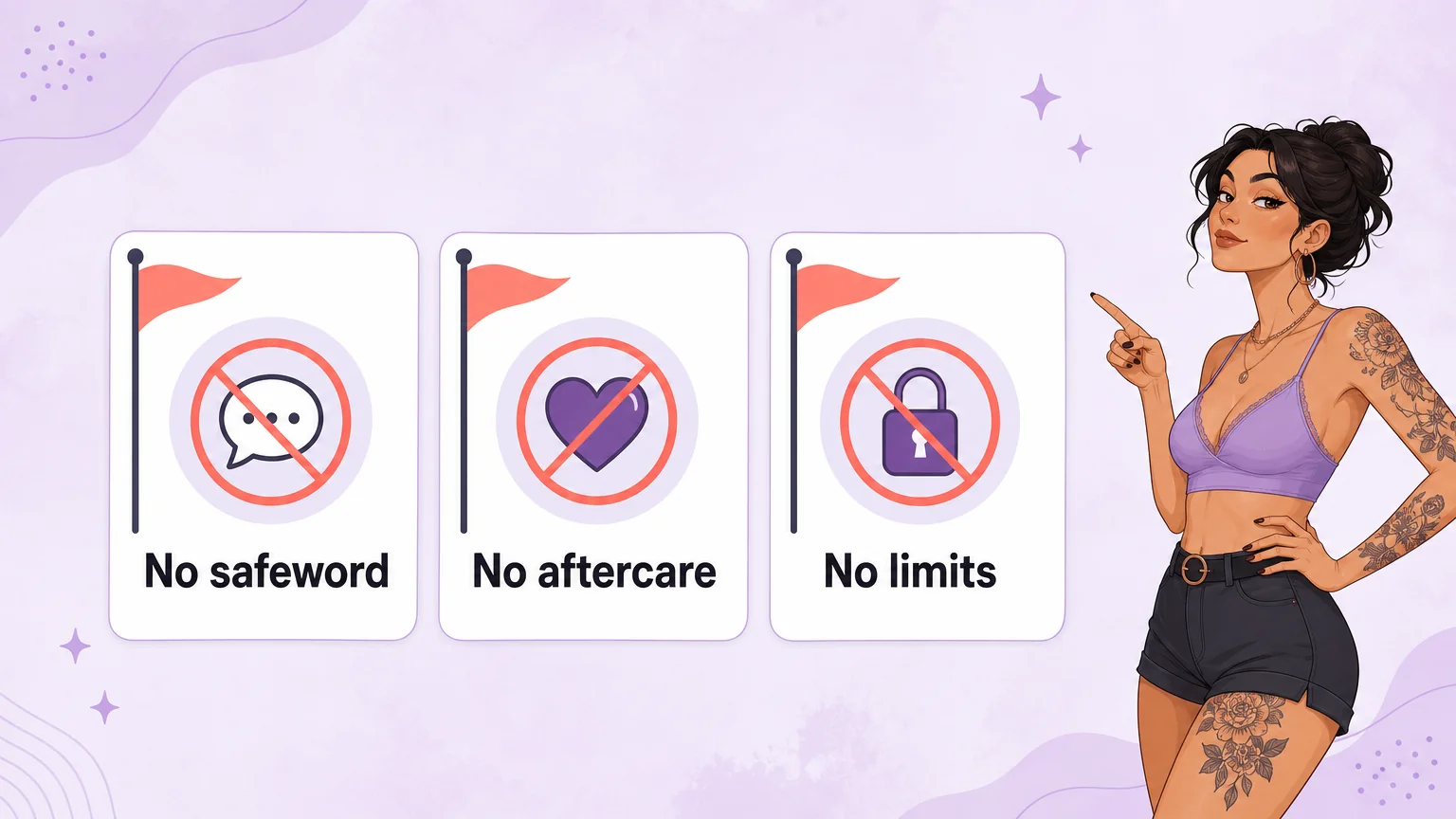
Your goal: judge a potential play partner by behavior, not a self-authored profile.
A profile is self-authored, so a person’s resume is their behavior, not their bio. If you’re a single going in alone, vetting is your safety net, and it’s the difference between a good first experience and a bad one.
Dr. Gloria Brame’s standard: vet by behavior, not words. Watch how someone handles hearing “no.” Watch whether they rush you, how they talk about previous partners, and whether they take responsibility for their own baggage rather than blaming everyone else.
From TheDuchy’s playbook: meet as equals (be wary of anyone who insists you call them Master or Mistress before trust exists), move from text to voice to video to confirm identity, and ask for references, plus “tell me about a time a scene went wrong.” Cross-check what they say with people who know them, like local community members or mutual contacts, rather than taking a self-authored profile at face value.
Keep first scenes low-intensity and public, like a play party with a trusted friend present who knows where you are. Arrange a safe call, and tell someone you trust about it; a partner who pushes back on that is telling you something. Wait about a month before private play, and trust your gut if anything feels off.
And the hard red flags: refuses to use a safeword, won’t provide aftercare, or claims to have “no limits.” Walk away from all three, no matter how charming the profile or how much you want this to work.
If you’re a couple, you can skim this step. But the red flags apply to anyone you might invite into your dynamic.
Milestone: you have a way to tell who’s safe before you’re ever alone with them.
FAQ: Your First BDSM Questions, Answered
What if my partner says no or reacts with judgment?
An initial “squick” is usually modeled behavior, not rejection, so don’t read it as a verdict on you. Respect the no without guilt-tripping, offer to learn together, and remember that consent goes both ways. If they need time or education first, that’s a green flag, not a closed door. An early mismatch doesn’t mean you can’t find common ground, as long as you’re both willing to look for it.
Do we need a safeword, or can we just say no or stop?
A dedicated word is recommended, because “no” and “stop” can be part of the play. The traffic lights are the easiest to remember: green to keep going, yellow to pause, red to stop. Pair them with a non-verbal signal, like a double tap, in case someone goes quiet in headspace. Treat the safeword as equipment you check before you start, not a mood-killer.
Does everyone need aftercare, and is it just for the submissive?
Aftercare goes both ways. The Dom or top worked hard too, and can drop just as hard as the person who bottomed. It’s also not universal, and not everyone wants the same kind, so negotiate what it looks like for each of you before the scene, not after. It’s not proportionate to intensity either; a short, light scene can still leave someone off-balance.
How long should aftercare last?
Anywhere from twenty minutes to several hours, continuing until everyone feels grounded and steady again. For a light first scene, twenty focused minutes of water, warmth, and conversation is usually enough. Add a next-day check-in, because the drop can arrive days later and can hit either partner. The scene ends, but your responsibility to each other doesn’t.
What if my partner says they have no limits?
That’s a red flag, not a virtue. Everyone has limits; claiming none means the person hasn’t thought about their own safety, which leaves you exposed too. Treat it as a reason to slow down and keep talking, not a reason to celebrate. If they insist they have none, that’s your cue to walk away, not to negotiate.