
You and your partner have a language that took years to build. You know each other’s coffee order, the exact tone of voice that means “long day,” the precise spot on the couch nobody else would recognize as claimed. That intimacy is the foundation. But sometimes a foundation needs a new room. That is where bdsm roleplay ideas come in: not as a fix for something broken, but as a door to a wing of your relationship you haven’t furnished yet. The scenarios below range from zero-prep entry points to full-evening productions. Read them together. Send your partner the one that made you pause. Desire doesn’t require an apology. Great relationships don’t outgrow adventure. They build a bigger container for it.
1. Strangers at a Bar: Meet Your Partner for the First Time

You arrive fifteen minutes apart. Different shirt, the cologne she hasn’t smelled in two years, a shift in posture that makes you look like someone who doesn’t already know where the evening is going. You walk in and she’s at the bar. She glances up. You hold eye contact one second longer than a stranger would.
She looks away first. That is the game beginning.
Across the room, your partner is wearing a version of herself you do not get to see anymore: the version who gets ready without knowing how the night ends, who chooses an outfit for possibility rather than practicality. You watch a man at the corner table notice her. You feel a flicker of something. Not quite jealousy. It is the sudden recognition that the person you married is still someone other people want. You have just been too close to see it.
You cross the room. “I don’t usually do this, but I saw you from across the bar and couldn’t leave without saying hello.” She smiles like she’s deciding. She asks your name. You give her the one you agreed on. She gives you hers. Neither of you breaks. The bartender assumes you just met. Neither of you corrects him.
The electricity is not in the acting. It is in the pursuit. Your brain processes being desired by a stranger differently than being desired by your spouse, even when the stranger and the spouse are the same person across the table. Novelty lights up the same neural circuitry whether it is real or played, and the body follows where the mind leads.
Stay at least thirty minutes. Let her wonder if you’ll approach. When you leave together, keep the names until the front door closes.
On the drive home, ask each other: what did you notice tonight that you don’t usually see?
2. The Blindfolded Sensory Journey: Trust Through Touch

If the word “roleplay” makes you and your partner freeze, start here. No backstory. No costume. No line you have to deliver while keeping a straight face. Just a blindfold and someone you already trust.
One of you lies down. A soft scarf folded twice, pressed gently over the eyes. The other gathers whatever is in the house: an ice cube from the freezer, a feather duster from the hall closet, a soy candle with a low melting point. This is not about equipment. This is about attention.
The giving partner starts with temperature. Ice along the collarbone. Warm breath on the stomach. A fingertip tracing a path the blindfolded partner cannot predict. Alternate sensations. Let each one land and fade before the next arrives. Whispered check-ins float through the dark: “Green?” A murmured confirmation. The traffic light system works just as cleanly here as it does in the most intense scene. You want the muscle memory before you need it.
The psychological truth of this scenario is disarmingly simple: losing sight sharpens everything else. Touch becomes landscape. Sound becomes proximity. The awareness of being completely in someone’s care becomes the entire point. You are not performing desirability. You are not managing your face. You are lying still and blindfolded while the person who loves you teaches your body to listen differently. That trust, that surrender of one sense to gain the others, is the intimacy. It does not require you to be anyone but yourself.
Five minutes from kitchen to bedroom. Zero shopping. One rule: establish your safeword before the blindfold goes on. Even light play needs a fence around the playground. The safety toolkit below explains why.
3. Praise Kink: The Easiest Door into Power Exchange
No equipment. No negotiation framework with subsections and bullet points. Just words that land exactly where they are aimed.
Ms. Elle X, a BDSM educator, identifies praise as the single most accessible entry into power exchange, and the reason is hiding in plain sight. Choose a simple task for the receiving partner. Undressing slowly, a full minute for each button. Kneeling beside the bed, waiting to be acknowledged. Reciting a short phrase the giving partner chose in advance. The task is not the point. The point is what happens after it is completed.
The giving partner watches. And then verbalizes: “You’re doing so well for me.” “I love watching you.” “I’m so proud of you.”
The power is not in commands. It is in one person’s words becoming the other’s entire focus, a reward earned through action and attention. Start with one task. Nail it. Then build. Praise lands harder when it is specific and when it is earned. Make them wait before you give it. Then make it count.
Many people move through entire days, entire weeks, starved for specific and genuine appreciation. Praise kink fills that gap inside a container where receiving does not make you needy. It makes you chosen. The words are free and the dynamic is immediate. If power exchange feels like a cliff you are not ready to climb, praise kink is the staircase. Take the first step tonight.
4. The Massage That Isn’t Just a Massage: Service as Seduction
For the partner who is curious but cautious, the one who warms to the word “sensual” but tenses at the word “kink,” this is your bridge. The physical connection is already built in. The roleplay just adds permission for it to go somewhere new.
Start with atmosphere. Dim lighting. Massage oil warmed between your palms, not squirted cold from the bottle. A playlist without words. One partner is the massage therapist, professional and composed. The other is the client, carrying a week of tension they have not yet named out loud.
Begin clinical. Shoulders. The knot near the right shoulder blade that has been there since Tuesday. Lower back, legitimate pressure, the kind of touch that makes someone exhale for the first time all day. This is real. This is helping. Then, so gradually neither of you could point to the exact moment, let the touch linger. Let your hands slow down.
From there, let the instructions soften. “Turn over for me” lands differently inside the script than it would in a doctor’s office, and both of you will feel the shift. The therapist’s hands stay professional for one more breath, then personal. The client receives without having to reciprocate. For many people, especially those who spend their days taking care of everyone else, that alone is radical.
The scenario works because the “should we or shouldn’t we” tension builds itself. The roleplay does not have to announce its arrival. It just gradually becomes. The psychological pull is the combination of genuine physical relief and the transgressive thrill of crossing a boundary you both agreed to blur. At what moment, exactly, did it stop feeling like a massage? If either of you is nervous about where to begin, begin here.
5. Mirror, Mirror: Watching Desire Through Your Partner’s Eyes

What if you could see yourself the way your partner sees you, just for a few minutes, without the static of self-criticism?
Position a full-length mirror. Soft lighting behind it, so what you see in the glass is warmth rather than inspection. One partner sits or stands in front. The other stands behind, hands on shoulders, eyes locked through the reflection.
The giving partner narrates. Not performative compliments that ring hollow. Genuine observation: “I love the way your shoulder curves here. I have never told you that out loud.” Or: “I’ve watched you get dressed a hundred times and I don’t think you know what I’m seeing.” The words are specific because the attention behind them is specific. This is not flattery. This is someone who has studied you for years reading their notes out loud.
You can take it further: “Watch yourself while I touch you. See what I see. Don’t close your eyes.” Keeping your eyes open is the hardest part. It is also the point.
The only speed that works here is glacial. Silence between words is the point. Many people spend years being looked at without ever feeling seen. This short-circuits that gap by putting the looking and the narration in the same hands. The mirror is the excuse. Behind the glass, your partner is showing you a version of yourself you have been too close to notice.
Afterward, ask yourselves what you saw that surprised you. The answer will almost never be about bodies.
6. Boss and Employee: The Performance Review
Your desk. A chair positioned directly in front of it, not off to the side. A notebook, closed, resting near the dominant partner’s hand. The setup takes ninety seconds and does more atmospheric work than any costume could.
The dominant partner sits behind the desk as the boss. The submissive partner is the employee, called in for a private meeting after hours. Work-adjacent clothing does the rest: a blazer, glasses, sleeves rolled to the forearm. Nothing you would need to buy. “Close the door behind you,” the boss says. “We need to discuss your… performance.” The pause before the last word does more than the word itself.
Start formal. Let tension build through silence and eye contact before any physical touch. The boss controls the pace. The employee waits to be addressed. That waiting is the dynamic. Most adults have felt this cocktail of emotions in real workplaces: authority, evaluation, the desire to please someone whose opinion matters. But here the evaluation is consensual, the stakes are pretend, and the correction is the reward you both showed up to receive.
What makes this work, psychologically, is that the power structure is instantly legible. Neither of you has to explain who holds the cards. The furniture already said it. The boss speaks and the employee listens. When the boss stands and circles the chair, the employee does not turn; they wait. That small discipline, that choice to wait instead of track, is the scene in miniature.
Debrief afterward: what felt powerful for each of you, and did the power feel the way you expected it would? Best for couples who share a sense of humor about corporate absurdity and can wink at the roles even while playing them straight. Skip this entirely if either of you has a genuinely toxic work situation. Real powerlessness does not make good fantasy material. Real trust does.
7. Teacher and Student: The Private Lesson

Choose a real skill. Not a prop skill. An actual thing one of you can do that the other cannot yet. A guitar chord. A phrase in a language one of you speaks. A yoga pose that requires a spotter. The scene lives in the space between genuine instruction and something more, and it only works if the instruction itself is real.
Set the room like a lesson is about to happen. Chairs facing the same direction. Whatever the skill requires: an instrument, a book, an open floor. The teacher stands. The student sits, attentive, a little nervous in a way that feels good.
Spend the first ten minutes teaching. Real corrections, real feedback, real moments of the student getting it right and the teacher noticing. This is the foundation. The credibility of the teaching makes the eventual shift more powerful because both of you have already invested in the roles. When the teacher’s hand lingers on the student’s wrist to correct their positioning, it lands differently than if you had started there.
From there, let the dynamic evolve. The teacher’s feedback becomes more personal. “Good. You’re paying attention. I like students who pay attention.” The student’s eagerness to please becomes visible. Being taught by someone you trust creates a specific kind of intimacy, one where imperfection is safe and correction is care. The psychological core is three layers deep: mentorship, the desire to be seen as competent, and the vulnerability of showing up as a beginner for someone whose approval you want.
Afterward, debrief with two simple questions: what did it feel like to be the one who does not know, and what did it feel like to be the one who knows? The skill you taught does not matter. The dynamic of guiding and receiving guidance is the entire point.
8. Doctor’s Special Examination: Trust in Expert Hands
The bed becomes the examination table. A clean sheet, corners tucked. The desk lamp angles toward the center of the mattress, casting a circle of warm light. The doctor wears a button-down shirt, sleeves rolled to just below the elbow, glasses if they help the persona. No white coat. Nothing that reads as cold. Professional, not clinical.
The patient arrives with a concern. Tension they cannot locate. A racing heart. Trouble sleeping that started about a week ago and will not let go. The concern does not need to be medically coherent. It needs to be specific enough to give the examination a shape.
The doctor begins slowly. Methodically. Every touch is announced before it happens: “I’m going to check your shoulders now. Tell me what you feel.” “I’d like to listen to your breathing. This might feel cool.” The power is not in the authority of the coat. It is in unhurried attention, the kind of presence that makes someone feel like the only person in the world who matters for this one hour. Your body. Your responses. Your wellbeing. All of it mattering completely to the person standing over you in the lamplight.
The fantasy is not illness. It is being the sole object of someone’s focused care, examined so thoroughly that nothing about you goes unnoticed. The doctor’s hands move from professional assessment to something more personal so gradually that the line blurs before either of you names it.
Afterward, two questions: what did it feel like to be examined that way, and what did it feel like to be the one in the shirt and glasses with someone’s trust placed entirely in your hands? This scenario depends on the doctor feeling safe, not triggering. Skip it if either of you has medical trauma. The fantasy works because the patient is in control of the examination from the first announced touch to the last.
9. Owner and Pet: Care-Based Power Exchange

The “pet” partner chooses an animal that resonates. Kitten, puppy, fox. Whatever feels right, not performative. There is no right answer and no one is grading the authenticity of your inner animal. The “owner” prepares a space: soft blankets on the floor, a bowl of water, small things to eat that can be offered by hand.
The pet’s role is presence. Respond nonverbally. Accept affection. Curl up near the owner’s feet and breathe. The owner’s role is protection: stroking hair, speaking in a softened voice, giving simple directions that require no complex thought to follow. “Come here.” A pause. “Good. Stay right there. I’ve got you.”
This is the slowest scenario in the entire article. There is nowhere to get to. Silence is not a gap to fill. It is the medium. The psychological payoffs are mirrored and equally real. For the pet: the relief of not making decisions, not performing competence, not holding up the architecture of adult life for a single hour. For the owner: the deep satisfaction of being someone’s safety, the person whose presence alone is enough to let someone else stop running.
You do not need a collar. You need a partner who understands that being held without having to perform is one of the most radical gifts two adults can give each other. The entire point is being allowed to stop being an adult for a while, held by someone whose only job in that hour is to hold you. The dynamic is everything. The props are optional.
10. The Interrogation: Consensual Information Games
What would it feel like to be chased, verbally, by someone who already knows exactly where you are weakest, and to make them work for the answer anyway?
Two chairs. Facing each other. Knees almost touching. A single lamp angled at the subject, leaving the interrogator’s face half in shadow. The subject holds a small secret, trivial and charged: “I finished the dessert you were saving.” “I’ve been thinking about you all day and pretending I haven’t.” “I have a crush on someone in this room.”
The interrogator’s job is extraction. Lean forward. Speak slower than feels natural. Let the silence after each question stretch. “You know why you’re here.” A pause. “Let’s not waste each other’s time.” The subject resists, deflects, offers partial answers the interrogator rejects. The psychological engine is not coercion. It is cat and mouse, resistance and release. The crack in the voice when the secret surfaces. Surrender here is not defeat. It is the moment the scene was built to deliver.
The interrogator controls pace through proximity. Lean closer on the hard questions. Pull back when the subject wavers. Give them room to choose surrender before demanding it. The secret does not matter. The chase does. Afterward: at what moment did you almost break, and what pushed you over? Skip this scenario if either of you has experienced real interrogation or coercion trauma. The fantasy depends on the safety of knowing the person across from you would stop the moment you said the word.
11. Captor and Captive: Surrender Within a Safe Container
Capture and surrender fantasies are among the most common in both BDSM communities and general population research. If you have carried one in silence, afraid of what it means about you, it means you found a psychological container for exploring helplessness, trust, and the relief of not being in control. Your brain knows the difference between fantasy and threat. Research on consensual power exchange shows that the prefrontal cortex processes eroticized power dynamics as desired stimulus, not trauma. The fantasy is not a confession. It is a map of something you want to explore inside a structure you control.
That established, this scenario requires the most thorough pre-negotiation of any in the article. Both partners must agree on the full arc: how the capture begins, what happens during, and specifically how it ends. No ambiguity. No improvisation around the resolution.
The scene itself begins with anticipation. The captor waits in a designated space. The captive enters, or is led. A soft blindfold goes on, but loosely. Nothing that cannot be pushed off. Silk scarf restraints, tied with a slip knot that releases in one pull. “Don’t turn around. I want you to listen very carefully.” The captor’s voice is low. Controlled. Each instruction given as if there is no alternative but to obey.
The psychological engine of this scenario is helplessness as relief. No decisions to make. No control to maintain. Placing your physical safety in someone’s hands and watching them prove, moment by moment, that they are worthy of it. For some couples, controlled vulnerability with a safe partner can reprocess old experiences of powerlessness in ways that feel healing rather than threatening. But that potential also means you both need to be prepared for emotional responses that surprise you.
De-roling after this scenario is non-negotiable. Real names, immediately. Physical contact: hands held, bodies touching, the warmth of the partner, not the captor. Verbal affirmation out loud: “I love you. That was play. You are my partner.” The more intense the scene, the more deliberate the return must be. The aftercare section below covers the full protocol. Read it before you plan this scene.
12. Master and Servant: A Full Evening of Protocol

This is not a twenty-minute scene. It is a three-phase evening with a deliberate arc, and the structure itself is the intimacy. Before the evening begins, set aside thirty minutes for a shared planning session using the conversation framework below. Agree on the phases, the protocols, and the single candle that will mark the boundary between the scene and your real life.
Phase one is preparation. The servant dresses the master: each garment presented, each button fastened with deliberate care. A drink is prepared and served. The space is arranged to the master’s specifications. Protocol is formal and unambiguous. “Yes, Sir” or “Yes, Ma’am” is the standard response, and the formality is the point. It creates a simplified world where every expectation is clear.
Phase two is service. A meal, simple and prepared in advance, served with specific protocols. The servant stands while the master eats, or kneels beside the table, attentive to every need before it is voiced. After the meal, an inspection period: the master walks the space, evaluates the servant’s work, gives feedback that is measured and deliberate. The servant’s real job in this phase is not just obedience. It is anticipation: noticing the glass is nearly empty, the napkin has shifted, the master’s shoulders are tense. Attentiveness is the skill being practiced.
Phase three is reward or correction. Based on the servant’s performance across the evening, the dominant gives feedback. Praise and reward for a job well done, or a pre-negotiated correction for lapses. The formality begins to soften here. By the end of this phase, personas may naturally relax. That is not a failure of the scene. It is the arc completing.
When the candle is blown out, protocol ends. No ambiguity. No role-bleed. The scene is over, and both of you are yourselves again. The psychological twin engines of this scenario are equally powerful: for the dominant, the satisfaction of designing and executing a complete evening with a willing partner. For the servant, release from decision fatigue, every action prescribed, every rule clear, both people fully competent inside a simplified world.
Afterward, debrief: which phase felt most alive, and what surprised you about sustaining a dynamic across an entire evening?
13. The Stranger Hookup: Anonymous Intensity with the Person You Trust Most
Same arrival-separately premise as section one, pushed further into intensity. The fantasy: two strangers who want purely physical, emotionally disconnected sex. Degradation language that would never leave your mouth in your real relationship. Rough handling. No tenderness. That is the entire point, and it is the absolute contrast with how you actually treat each other that makes the scene possible.
One couple who shared their version of this scenario publicly emphasized a principle that should be your foundation: kink and love are separate rooms in the same house. They did advance dialogue preparation before the scene. They set safewords and agreed on non-verbal check-in gestures for moments when speech might fail. They staged explicit verbal affirmation that what was about to happen was play, not the relationship, and they did it right before the scene started, not hours earlier when the idea was still abstract.
Different outfits than what your partner expects. A hotel room if one is available: the unfamiliar space reinforces the strangers premise, makes the fantasy tactile. Aftercare supplies are pre-staged on the nightstand before either of you steps into character. Water. Chocolate. A blanket folded within reach. The aftercare plan is not an afterthought. It is the most important preparation step.
“I’m not looking for anything serious,” one of you says to the other. “I’m looking for someone who can handle me. Are you that person?” The scene moves faster than any other in this article. That speed is part of the fantasy. And that speed is exactly why the landing matters more here than anywhere else.
The degradation language, the rough handling, the absence of tenderness: all of it is possible only because the respect underneath is absolute. You are exploring the shadow side of desire inside a container built on trust. Saying things you would never say in real life precisely because you both know they are not true. Afterward, de-roling needs extra time. Real names, immediately. Gentle touch, immediately. Verbal affirmation out loud: “I love you. That was play. You are my partner.” Debrief a question that matters: what was the hardest thing to hear or say tonight, and does anything need to be explicitly left in this room when we walk out?
14. The Caregiver Dynamic: When Power Exchange Feels Like Being Held

SpicyAli, an intimacy expert, asks a question that reframes the entire category of caregiver dynamics: not “what do you want to do?” but “what comfort does this fantasy give you?” For most people drawn to these dynamics, the answer is simpler and more profound than the fantasy itself suggests. The relief of being allowed, for once, to stop performing competence.
One man, years deep in a life of being in control: at work, at home, the person everyone else leans on. He explored a caregiver roleplay for the first time with quiet terror about what it meant. Afterward, he described it as a safe zone where he could stop performing and just be. He told SpicyAli that for the first time in a long time, he did not feel weird or ashamed. He felt understood. He connected to a version of himself, he said, that did not have the need to explain or to apologize. That is not pathology. That is relief with a name.
Set a clear container before you begin. A time window. A physical space: the couch with soft blankets, the bedroom with only one lamp on. A clear signal for when the dynamic ends. The caregiver provides gentle direction, physical comfort, verbal reassurance. The receiving partner accepts care without reciprocating, without performing, without maintaining any adult composure they do not feel.
Pacing here is glacial. There is nowhere to get to. Being here is the point. The psychological need being met is one of the most universal and least admitted: the desire to be held without having to earn it. For adults in high-responsibility roles, this is the fantasy that feels most forbidden and most needed. The caregiver also receives something essential: being someone’s safe harbor, watching tension leave a body because your presence made it safe to let go. This is less about being little and more about letting someone else hold the world for a while, together, by agreement, with an end time that makes the surrender safe.
How to Create Your Own BDSM Roleplay Scene
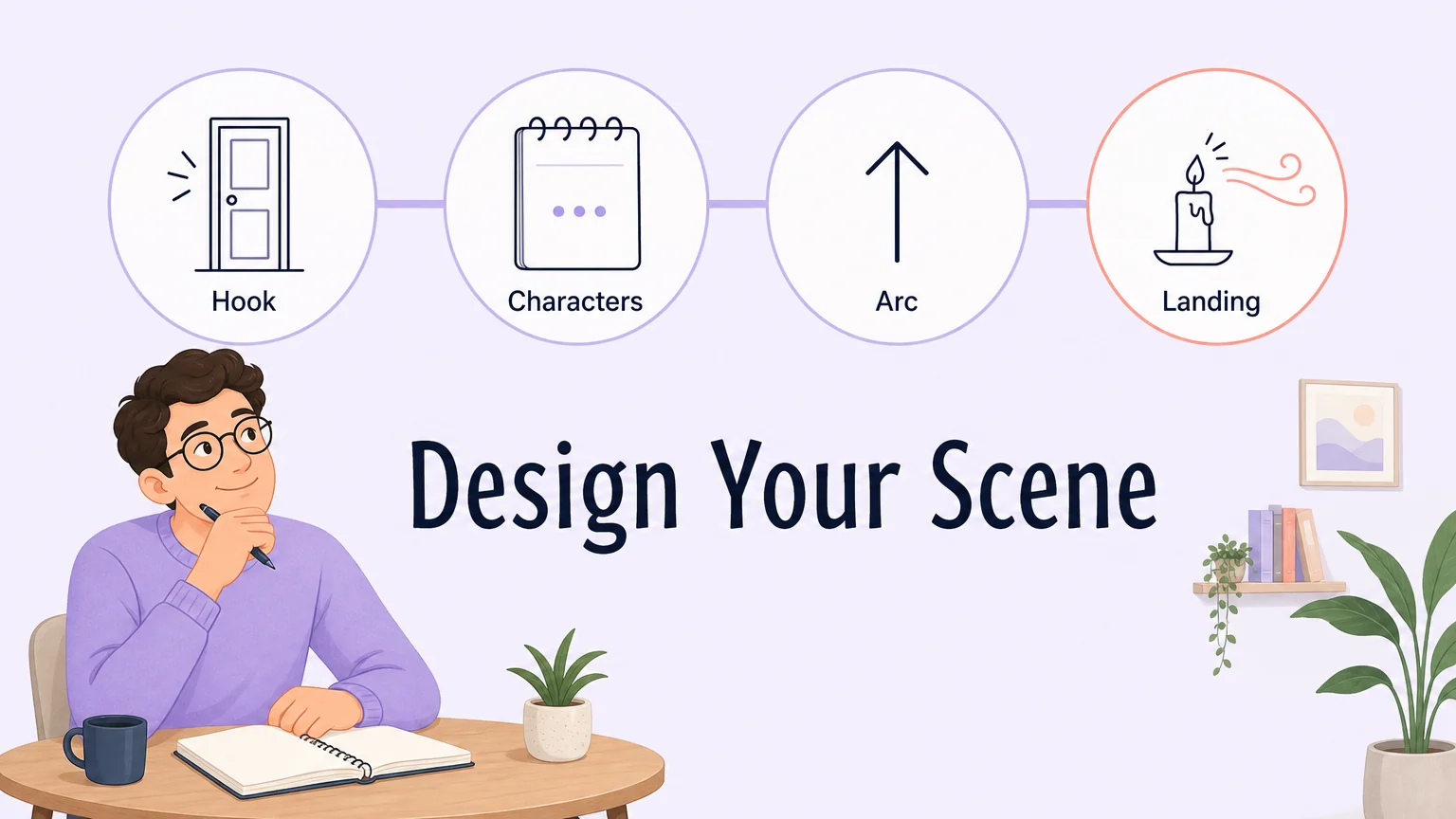
Miss Jenn, a licensed therapist and BDSM educator who teaches roleplay storytelling at DomCon LA, treats scene design as teachable craft. Building a narrative arc with characters, motivation, and resolution is not improv instinct. It is a skill. And like any skill, it has a structure you can learn, practice, and make your own.
The structure has four parts. You and your partner can sit down with a notebook and build a scene in thirty minutes. The planning itself is foreplay, not logistics. Co-creating a fantasy is mutual vulnerability that is often more connecting than the scene itself.
Start with the hook. What kicks off the scene? A knock at the door. An email summons. A stranger’s eye contact held too long across a room. Pick a clear starting signal: a phrase, a gesture, the lighting of a specific candle. Something that tells both of you, without question, that we are in the scene now. The hook should be simple enough to describe in one sentence. If it takes three, pare it back.
Next, the characters. Each partner defines their persona in exactly three bullet points. A name. One personality trait. One motivation. That is it. Over-complicated backstories collapse under pressure because your brain cannot hold eight invented facts and also stay present in your body. Three points is the sweet spot where the character feels real without becoming a homework assignment you panic-forgot.
Now the arc. Where does the tension build? A good scene has exactly one escalation point where the stakes rise: the boss closes the door, the interrogator leans in, the caregiver says “let go.” Plan one escalation. Do not plan five. Multiple escalations dilute each other. One strong escalation lands and gives the scene its shape.
Finally, the landing. The final beats that signal this chapter is closing. Not aftercare. The moment just before it begins. How does the scene end? The candle blows out. The door closes. The code word is spoken. The spell breaks. Both of you know, without hesitation, that the scene has concluded and the people in the room are yourselves again.
A shared notebook is the only essential prop. Start with one scene. Play it. Debrief it: what worked, what surprised you, what you want more of next time. Iterate. Your tenth scene will feel like a shared language neither of you had before you built it together.
How to Talk to Your Partner About BDSM Roleplay

You are not starting cold. You have fourteen roleplay ideas in front of you and at least one made you pause. The easiest opener in the history of difficult conversations: send your partner the link. “This one made me think of us. Curious what you think.”
That is it. The article did half the work. The idea is already on the table, not floating in your head as an abstract “I want to try kink” that your partner has no context for. One scenario, one link, no pressure to respond immediately.
From there, Coach Grethe’s RBDSM framework gives you a map for a conversation about your entire relationship, not just about what happens in bed. RBDSM stands for Relationships, Boundaries, Desires, Sexual health, Meaning, plus Aftercare and Trauma. The framework creates safety through explicit conversation before anything physical happens. Grethe describes it like a fence around a playground: nothing creates freedom as much as boundaries. A child in a fenced playground plays freely because the parent can stop scanning the horizon. Two adults with clearly stated limits can ask each other for anything, because they trust the other person will say no honestly when they need to.
Use the framework playfully: “Hey, I’m learning about this concept called RBDSM. Want to explore it with me?” The tone matters as much as the words. Invitation, not demand.
The Yes/No/Maybe list is your neutral third party. Both of you fill it out independently. Only mutual “yes” answers get shared. No one defends a “no.” No one performs a “yes” they are not feeling. You are building a shared menu, not a list of prohibitions. Coach Grethe notes that when she started, she could not really access what she wanted until she practiced expressing it. Naming desire is a muscle. This conversation is your first rep.
If sending a link is not your style, the in-person version is just as clean: “I’ve been reading about something I think could be fun for us to explore together. Want to look at one of the ideas with me?” This is not a confession. It is an invitation. Desire does not require an apology.
BDSM Safewords, Limits, and Safety: The Architecture of Trust
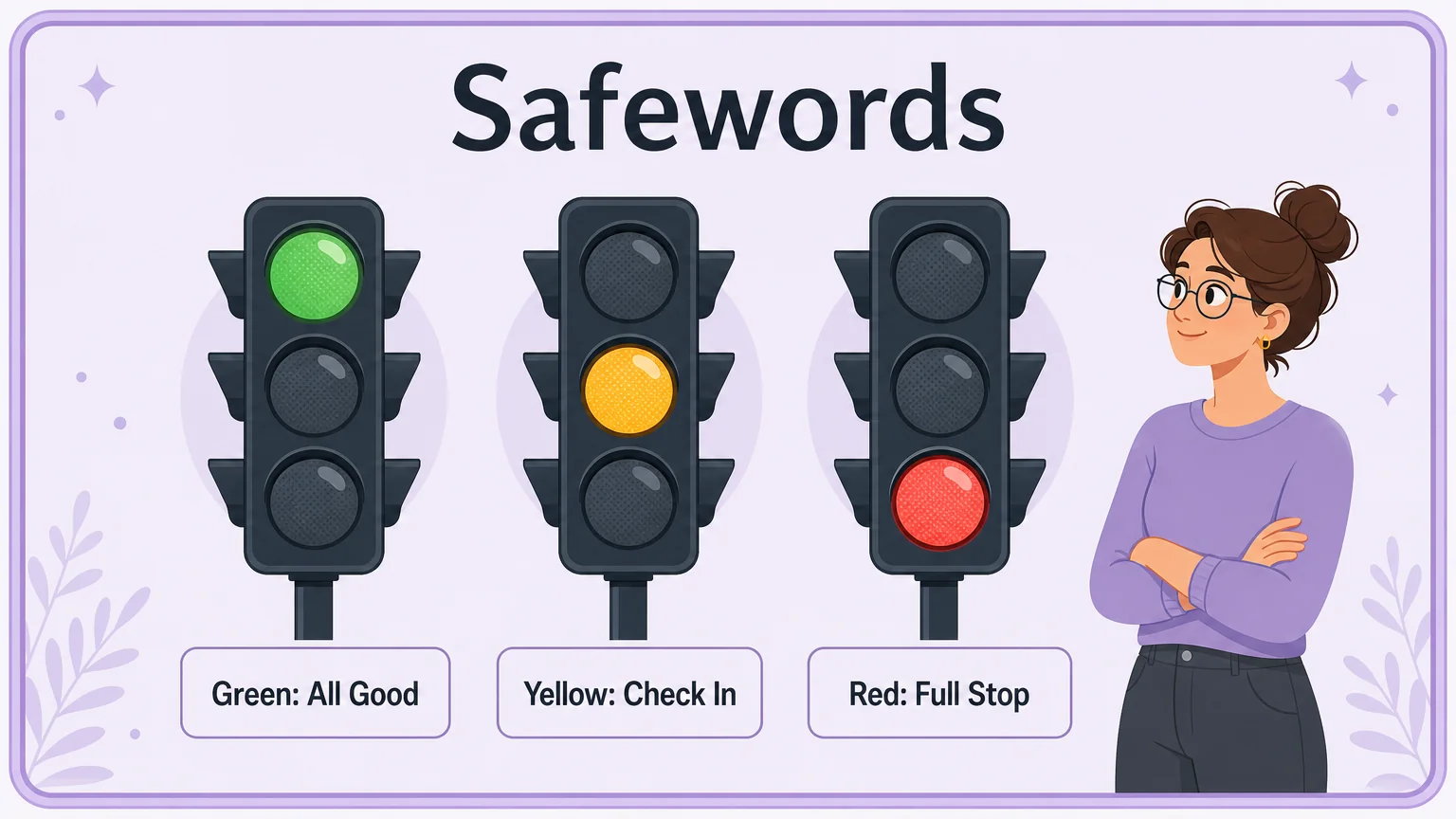
The safeword is not the emergency brake. It is the reason you can drive fast. “Nothing creates freedom as much as boundaries,” Coach Grethe says. “If I know you have strong boundaries, I can ask you for anything, because I know you will say no if you don’t want to do it.”
Start with the traffic light system. It is universal across kink communities for a reason: it is simple enough to remember under intensity that makes complex vocabulary evaporate. Green means all good, keep going. Yellow means adjust something, check in. The scene corrects course but does not stop. Red means immediate full stop. No negotiation. No guilt. No “but we were almost there.” The person who calls red should hear “thank you for using your safeword” as standard practice. Safewording proves the system works.
Non-verbal backups are essential for scenes involving gags or moments when speech deserts you. Three grunts in a row. Dropping a bell or keys. A raised fist. Three taps anywhere your partner can feel them. Agree on the signal before the scene and confirm it right before you begin.
Hard limits are absolute: never on the table, not up for negotiation, respected as permanent unless the person who set them explicitly reopens the conversation. Soft limits are the territory of “curious but not ready,” or “maybe under specific circumstances,” or “ask me again in six months.” Soft limits can evolve. Hard limits are the fence posts. Both deserve equal respect, but they serve different functions.
The opt-in negotiation model is safer than opt-out. Build from what you both actively want rather than trying to exhaustively list what you do not. A “no” from your partner is not rejection. It is a gift. It means they will never let you cross a boundary you did not know you needed. The explicit framework, the safewords and limits and the conversation before anything else, is precisely what lets you lean into intensity. The rails are solid. That is the point.
BDSM Aftercare Is Not Optional: What Happens After the Scene Ends

You are flying high after an electric scene. Everything felt right. You are still half-lit with it, grinning, untouchable.
Then a day or two later, it arrives. Exhaustion that sleep does not touch. Sadness with no obvious source. A fog where your thoughts usually live. You wonder if the scene was a mistake. You wonder if this means you regret it.
That is not regret. That is biology.
Kat Nash, a dominatrix and host of the Into the Dungeon podcast, describes the neurochemical cascade behind what the community calls “drop.” During an intense scene, your brain floods with adrenaline, endorphins, and dopamine. When those chemicals deplete afterward, anywhere from minutes to seventy-two hours later, the crash is physiological. Submissives experience exhaustion, sadness, brain fog, a bone-deep loneliness that feels personal but is not. Dominants experience guilt, self-doubt, a deflated mood that can curdle into “what is wrong with me for wanting this?” Both crash patterns are documented, both are normal, and both are why aftercare is a physiological requirement rather than a romantic gesture.
At one high-protocol femdom event, serving submissives who gave hours of attentive service without structured aftercare broke down in tears. Submission alone, psychological surrender without any physical intensity, was enough to trigger the crash. No one had planned for it. The lesson: plan aftercare before the scene, not during the crash.
The plan has two layers. Immediate: blanket, water, chocolate or something with sugar, quiet holding. Let the nervous system settle. Do not rush to process. Delayed: a check-in the next day, a debrief twenty-four to forty-eight hours later. “What felt amazing? What surprised you? What do we adjust for next time?”
Then de-roling: the deliberate transition from persona back to self. Use real names. Change clothes. Step outside for two minutes. “I’m [real name], your partner. That was play.” Role-bleed, where scene emotions contaminate real life, is real and preventable. The scene is not over when the play stops. It is over when both of you feel like yourselves again.
FAQ
What if I feel stupid or cheesy during roleplay? You will, at first. Almost everyone does. The goal is shared exploration, not acting. If you laugh, recover and keep going. Start with mini-scenes, not full productions.
Is it normal to feel sad or crash after an amazing scene? Yes. It is called drop, and it is neurochemical rather than emotional. When endorphins and adrenaline deplete after an intense scene, the crash is biological. Aftercare is the antidote. The aftercare section below walks through the full protocol.
Do we need safewords even for light roleplay? Yes. Using safewords in low-stakes scenarios builds the muscle memory for when stakes are higher. The traffic light system works at every intensity.
How do I bring this up with a partner who has never expressed interest in kink? Outside the bedroom, during a calm moment. Send them a link to one of the scenarios above: “This one made me think of us. Curious what you think.” Make space without pressure. The conversation framework below has the full approach.
What if one of us wants to stop mid-scene but the other is really into it? The scene stops immediately. No negotiation, no guilt. Safewording proves the system works. Experienced players say “thank you for using your safeword” as standard practice.
What if we try it and we do not like it? That is useful data, not failure. Debrief what did not work, adjust, try some other different BDSM ideas. A scene that does not land still teaches you something about your desires. The goal is not getting the scene right. It is learning to talk to each other about desire.