“Free use.” The phrase lands like a contradiction. How can being used be something you freely choose? How can surrender feel like liberation?
That tension is exactly where the real conversation starts.
What is a free use kink, underneath the provocative label and the TikTok discourse? It is a consensual arrangement where one partner makes themselves available to the other without needing permission asked each time. It is the desire to be so fully wanted that asking becomes unnecessary. If that idea stirred something in you before your brain had time to judge it, you are in the right place.
This isn’t a flaw in your foundation; it’s an extension of your adventure. What follows is a clear map: what free use means, the psychology behind the desire, how to talk about it with a partner, how to build a safe agreement, what aftercare looks like, and how it works when there are more than two of you.
Practitioners describe the experience simply: no decisions, no performance, just presence. That relief, and the architecture that makes it safe, is what we are here to unpack.
What Free Use Actually Means (And What It Definitely Doesn’t)
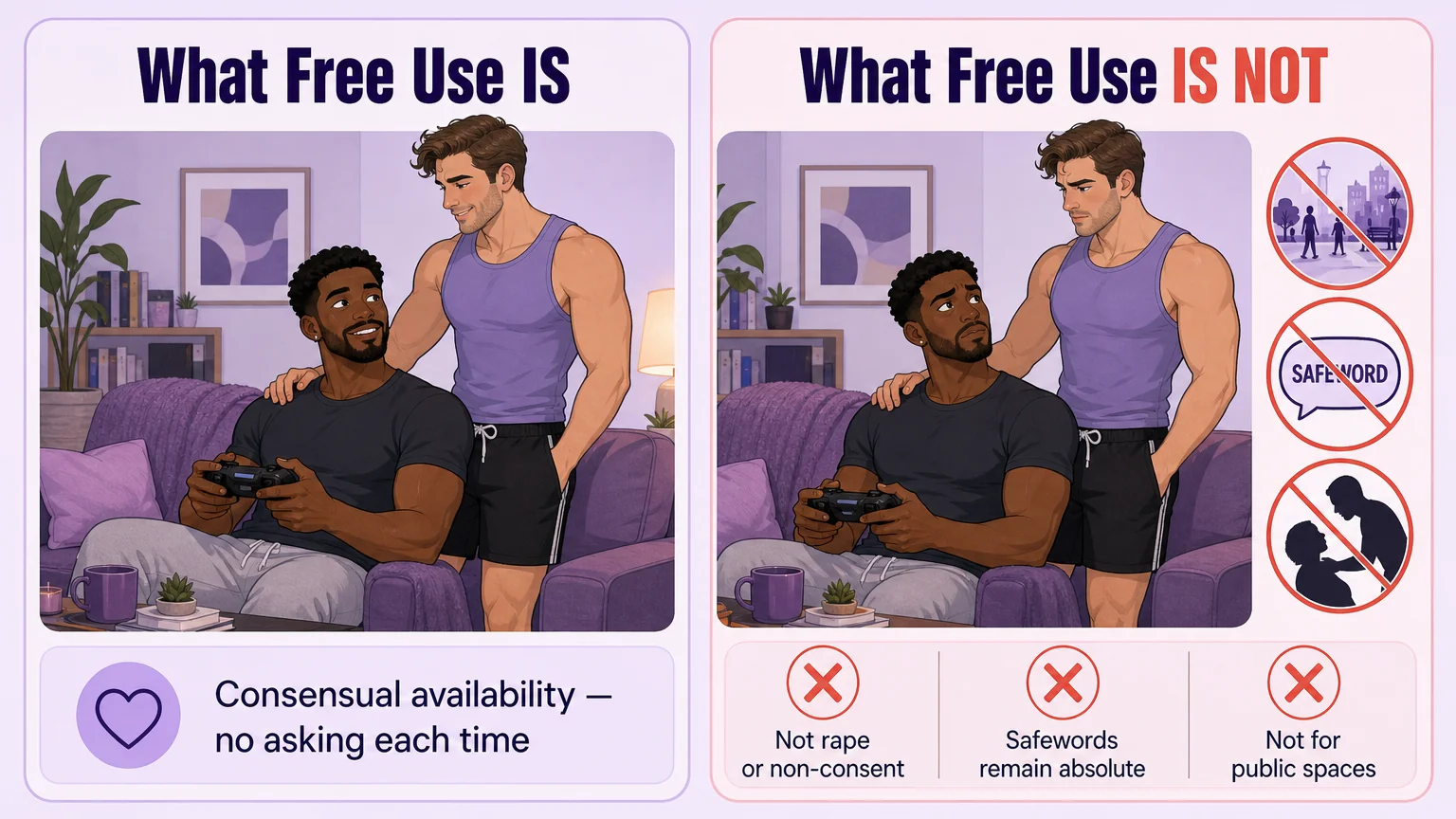
Free use is a consensual arrangement where one partner grants the other freedom to initiate sexual activity at any time without needing explicit permission each time. It extends the submission and domination dynamics common in BDSM. The permission does not disappear; it moves upstream into a shared agreement, so spontaneity can flow downstream.
TikTok amplified the term around 2022 and 2023, which is likely why you are encountering it now. It is also why confusion circulates alongside legitimate definitions: viral clips rarely include the consent infrastructure that makes the dynamic functional.
In real practice, “anytime, anywhere” is fantasy shorthand. Most couples limit free use to the home, exclude situations like cooking or handling anything dangerous, and both partners retain an absolute right to say no at any moment.
Three hard lines, stated plainly.
First, this is not rape or non-consent. Practitioners describe the appeal as casual availability and relief from decision-making, not resistance or force. The defining visual of the dynamic is one partner continuing to read, game, or text during sex. That casualness is the entire point.
Second, safewords remain absolute. Blanket consent means you do not have to negotiate before each encounter. It does not mean you cannot stop one. If anyone tells you blanket consent replaces safewords, that is a red flag, period.
Third, bystander consent applies. The community almost universally considers public free use unethical. What happens between consenting adults stays between consenting adults.
Free use exists across every gender, sexuality, and relationship structure, ranging from mild (limited private activities) to intense (long-term dynamics). It is entirely separate from the “Free Use World” fantasy genre where fictional societies treat sex as casually as a handshake. That is worldbuilding. This is a negotiated dynamic between real people.
So if free use isn’t CNC, and it isn’t a free-for-all, and it isn’t the fantasy world you have seen in erotica, what makes it different from the terms people keep mixing up?
Free Use vs. CNC vs. Blanket Consent: Three Terms That Keep Getting Confused
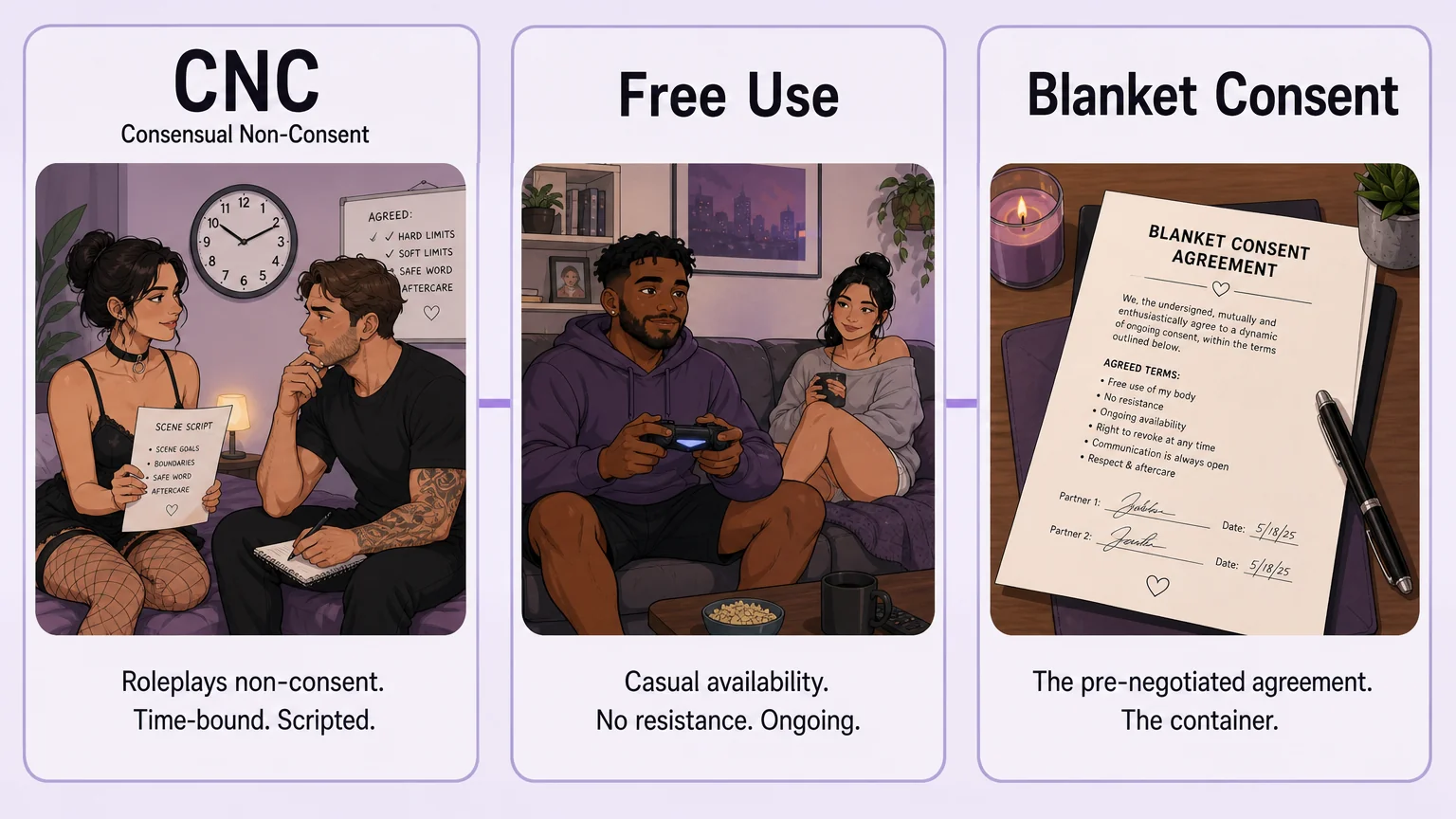
The terms get thrown around interchangeably in kink spaces, and the confusion has real consequences: you cannot ask for what you cannot name. Most people are still guessing, and the guessing leads to mismatched expectations — which, in a dynamic built on precise agreements, is exactly what you are trying to avoid.
The three concepts exist on one connected spectrum:
CNC (Consensual Non-Consent) is the broad umbrella. You consent to have your consent disregarded within pre-negotiated boundaries. CNC scenes are time-bound and often scripted, with resistance or a performance of non-consent as part of the scene. The definition also covers non-sexual contexts: being force-fed a disliked food, a negotiated kidnapping scenario. CNC is when the concurring partner agrees not to have their consent explicitly obtained for certain activities in the future, within an intentional, negotiated kink framework.
Free Use is a subtype of CNC, but the difference is sharp. The submissive consents to the act itself, not the performance of non-consent. There is typically no resistance. The dynamic is ongoing rather than time-bound, characterized by casual availability. The partner being “used” may keep doing dishes, texting, or gaming. The intimacy lies not in struggle but in radical access.
Blanket Consent is the pre-authorized permission agreement that creates the container for both. It covers hard limits, soft limits, pre-approved activities, time and context boundaries, and safeword protocols. Blanket consent is broader: you can have blanket consent for specific acts (spanking during scenes, for example) without having a full free use arrangement. But you cannot have ethical free use without the consent architecture blanket consent provides.
You can have CNC without free use. You cannot have ethical free use without CNC’s consent architecture.
Now that you can tell the difference between three terms most people confuse, the bigger question is: why would anyone want this?
Why Would Anyone Want This? The Psychology Behind the Surrender
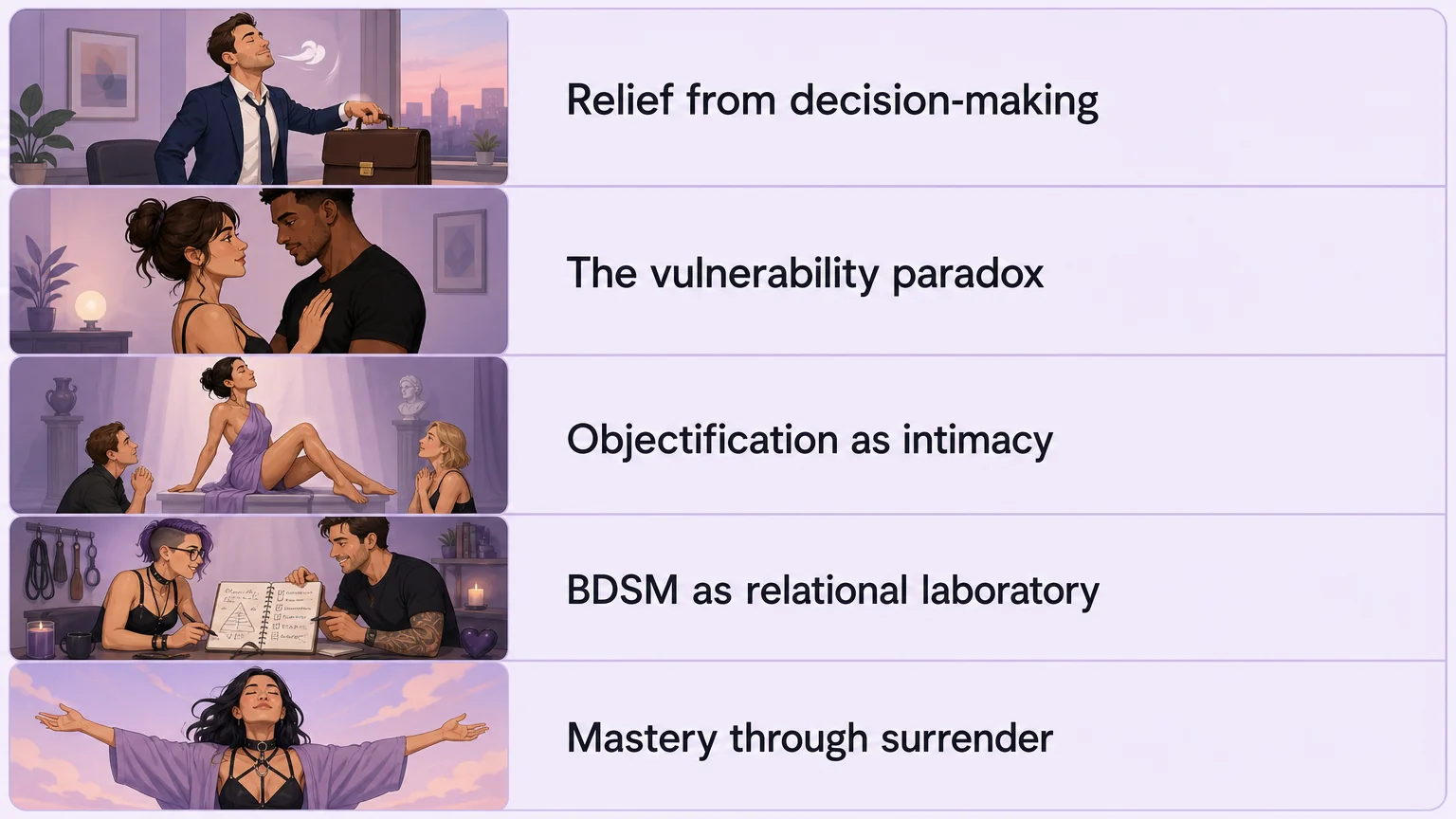
The most accessible insight is the one practitioners lead with: relief from decision-making. People with high-pressure jobs describe the experience as “no decisions, no emotions, no responsibilities, just obedience or stillness.” The appeal is not about degradation. It is about permission to stop being in charge.
Underneath that sits a genuine psychological architecture.
The vulnerability paradox. Consider how vulnerable a dynamic becomes when you tell someone: I am here whenever you want me. No asking, no waiting. That level of exposure requires a corresponding depth of trust. The vulnerability is not the cost; it is the point.
Objectification as intimacy. The Progressive Therapeutic Collective distinguishes consensual erotic objectification from erasure: “Some people eroticise being worshipped like a sculpture or displayed like art. It’s not always humiliating. Sometimes it’s divine.” The trust deep enough to explore temporary disappearance of self is itself a form of intimate connection.
The self-ownership paradox. A Princeton dissertation identified that the free use fetish derives its charge from violating the sacralized boundary of self-ownership. The fantasy of being “turned into an object” is about relinquishing the burden of perpetual subjectivity. The same research frames power in BDSM as something that circulates rather than a commodity: partners “exchange identities as it were,” creating mutual dependency for self-definition.
BDSM as relational laboratory. Aubrey Aust, an NYU researcher in relational psychology, describes BDSM as a space where people explore fantasy, desire, and wanting through language and physical practice. You are building a specific trust architecture, not just doing a scene.
Mastery through surrender. Academic research on BDSM notes that “by theatricalizing and eroticizing situations of powerlessness, one gains mastery over them.” Surrendering control within a safe container can transform vulnerability into strength. Mastery through surrender is not a contradiction.
Jessica Benjamin, in The Bonds of Love, described the deeper paradox: “The individual tries to achieve freedom through slavery, release through submission to control.” The submissive seeks recognition through an other powerful enough to bestow it.
Establishing robust boundaries and committing to aftercare increases psychological safety, which allows the nervous system to relax and permits deeper, more uninhibited pleasure. True sexual abandon requires confident knowledge that a partner will respect agreed-upon limits.
The desire makes sense once you see the architecture underneath it. Now let’s talk about the architecture that keeps it safe.
The Consent Architecture: What Makes Free Use Safe Instead of Scary
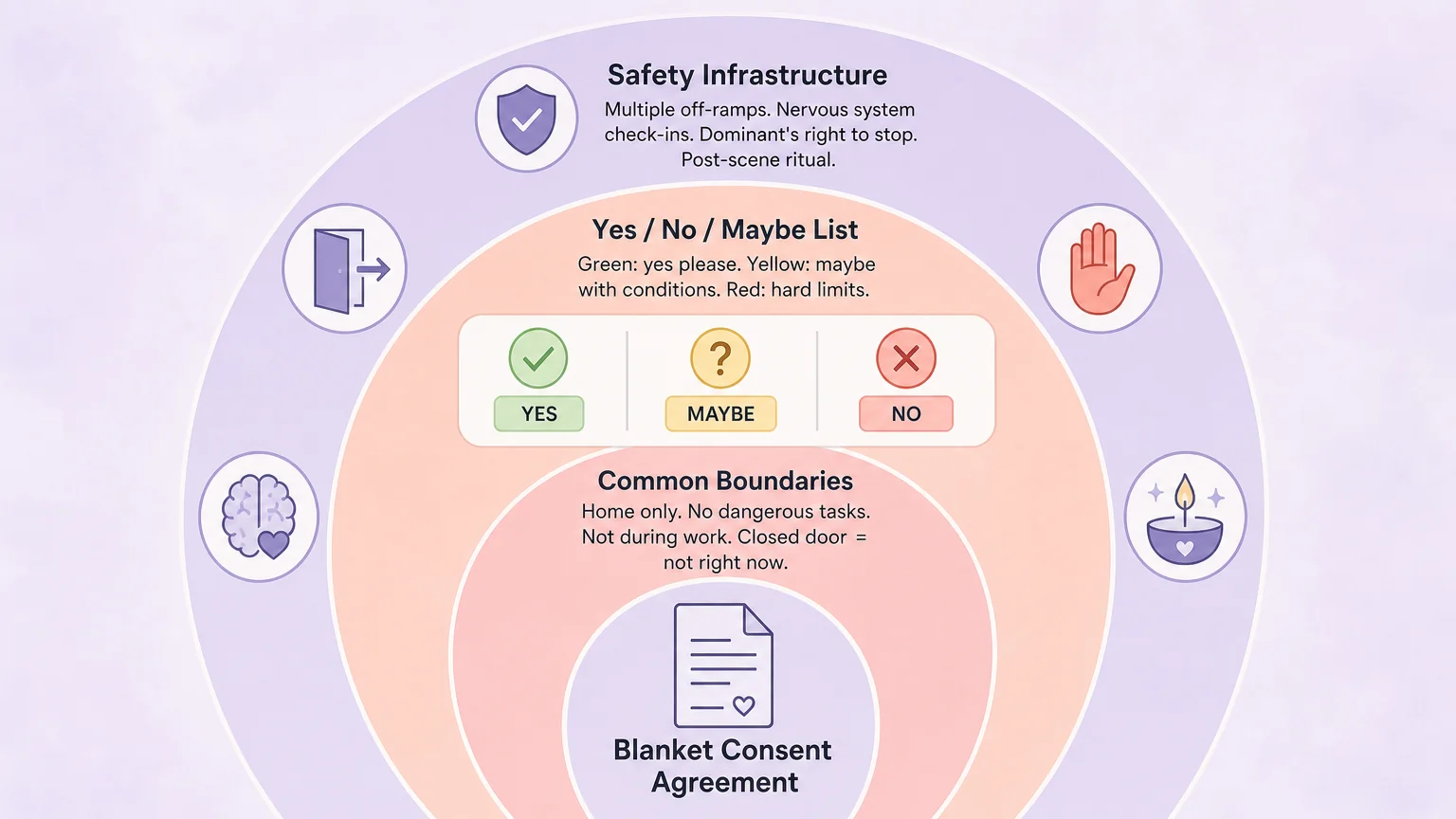
The difference between free use and abuse is entirely in the consent infrastructure. Ethical free use has more consent infrastructure than conventional sex. It just moves the negotiation upstream so spontaneity can flow downstream.
The foundation is blanket consent: a pre-negotiated written agreement covering hard limits, soft limits, pre-approved activities, time and context boundaries, and safewords. Without this container, free use is unnegotiated sex with extra steps.
The non-negotiable: safewords do not go away. Blanket consent means you don’t have to negotiate before every encounter. The safe word means you can still stop any encounter. Those are two completely different things. If someone tells you blanket consent replaces safe words, walk away from that person.
Most couples build their agreements around common boundary categories: confined to the home, excluding dangerous tasks, not during work calls, not when sick or having a hard mental health day, a closed door meaning “not right now,” and time windows rather than 24/7. The boundaries are not restrictions that ruin the dynamic; they are the walls that make the room safe to play in.
The Yes/No/Maybe List is the standard tool: Green Zone (yes, please), Yellow Zone (maybe, with conditions), Red Zone (hard limits). Each partner fills one out independently, then you compare. This surfaces misalignments before they become breaches.
Beyond the safeword, a full safety infrastructure has specific, redundant layers:
Multiple off-ramps. A verbal safeword, a physical hand squeeze, a dropped object, and a visual cue. Four ways to stop, not one. A single safeword fails if the person cannot speak.
Nervous system literacy with built-in pauses. Both partners learn to recognize the danger signs of dorsal shutdown: blank stare, shallow breathing, limp collapse distinct from relaxation, complete silence. During longer free use windows, the dominant checks in directly: “How are you doing? Still green?” These pauses prevent dissociation from accumulating.
The dominant’s equal right to stop. Dominants can experience overwhelm, guilt, or sudden unease and need the same zero-shame access to the off-ramp.
Post-scene ritual. Change clothes, turn on lights, make tea. These small acts signal to both nervous systems that the intensity was contained and the everyday self has returned.
For couples ready to build their written agreement, two independently developed templates exist: the Dom Sub Living Free BDSM Contract and the BeMoreKinky contract templates. Both give you language for things that are genuinely hard to put into words.
The more explicitly you negotiate upfront, the more freely you can play downstream.
How to Bring Up Free Use With Your Partner (Without It Sounding Like an Ultimatum)
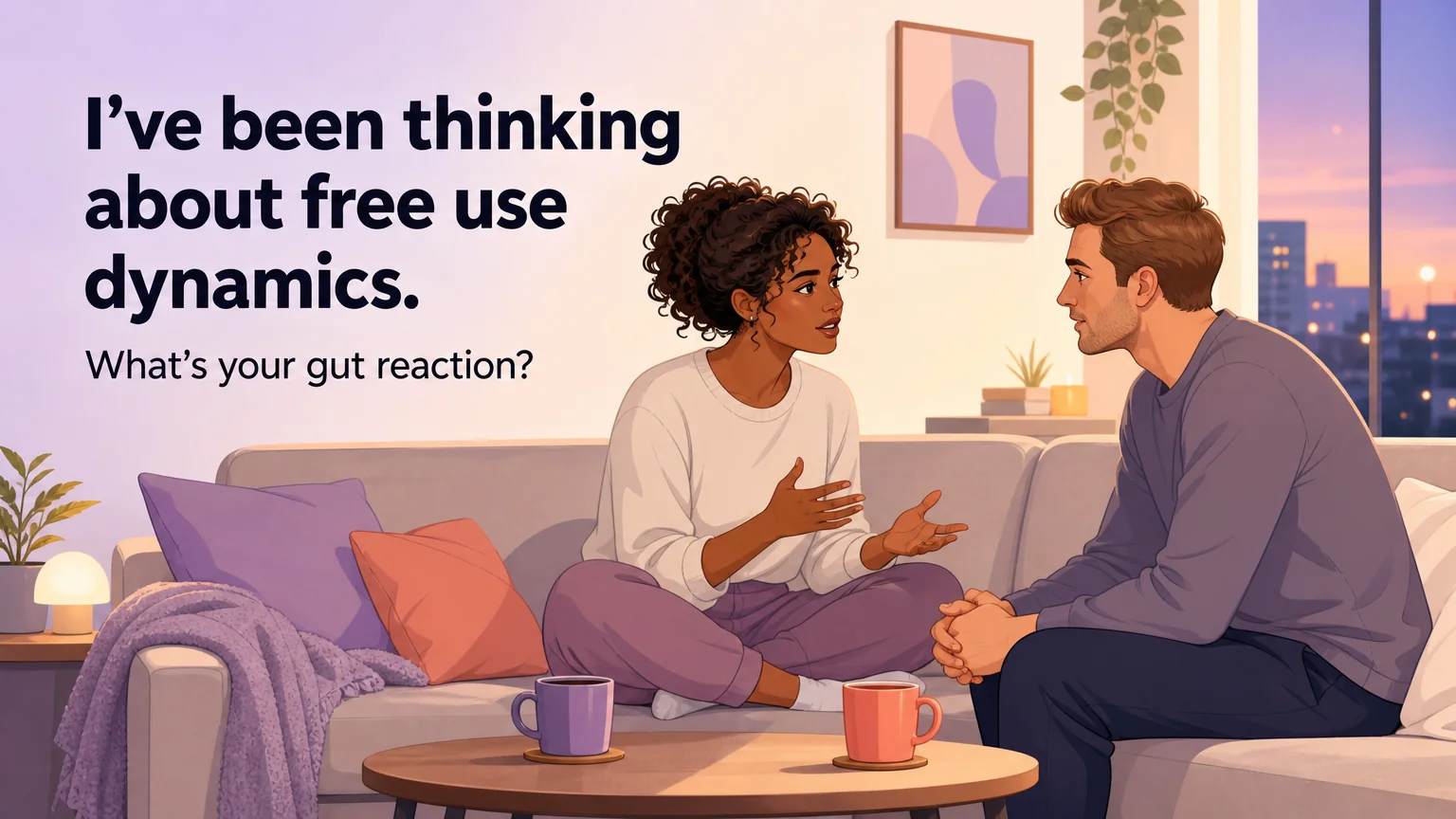
It is rational to be nervous about this conversation. That nervousness does not mean you should not have it.
When the concept of free use first comes up between partners, the reaction is often the same: that sounds intense. Intriguing, but a little nervous. There is a real worry that free use could become overuse. If experienced kink educators feel that way, you are allowed to feel it too.
Bring it up during a calm, clothed, private moment. Never during sex. Never right after sex. The goal is a conversation between equals, not a negotiation mid-arousal.
Frame it as an invitation, not a demand. The opening line: “I’ve been thinking about free use dynamics. What’s your gut reaction to that idea?” You are opening a door, not selling a subscription.
Give your partner time to sit with it before needing a response. Your partner may need days to process curiosity, excitement, fear, or confusion. All of those reactions are valid. None mean the answer is no.
If they do not know what free use is, share resources together. Read an article. Listen to the Dom Sub Living podcast episode on blanket consent as a shared starting point. Having the same conceptual vocabulary before discussing personal application changes everything.
The goal is collaborative exploration, not convincing. If your partner lands on no, that no is the end. A dynamic built on pressure is not a dynamic.
Growing up in a strict high-control religion adds another layer. Saying these things out loud and putting them down on paper can bring up shame that takes real work to move through. But the work is worth it. Religious and cultural guilt is a real barrier. Naming it directly is part of the permission structure. Shame is not evidence your desire is wrong. It is evidence you were taught certain desires were wrong.
How do you know if your relationship is ready? Three signals: both partners can articulate what draws them to this specifically, not just agree; you have navigated a difficult conversation about wants and needs and came out stronger; and your partner reads your state accurately in daily life, noticing when something is off without being asked. If those signals are present, the conversation is worth having.
Building Your Free Use Agreement: A Step-by-Step Framework
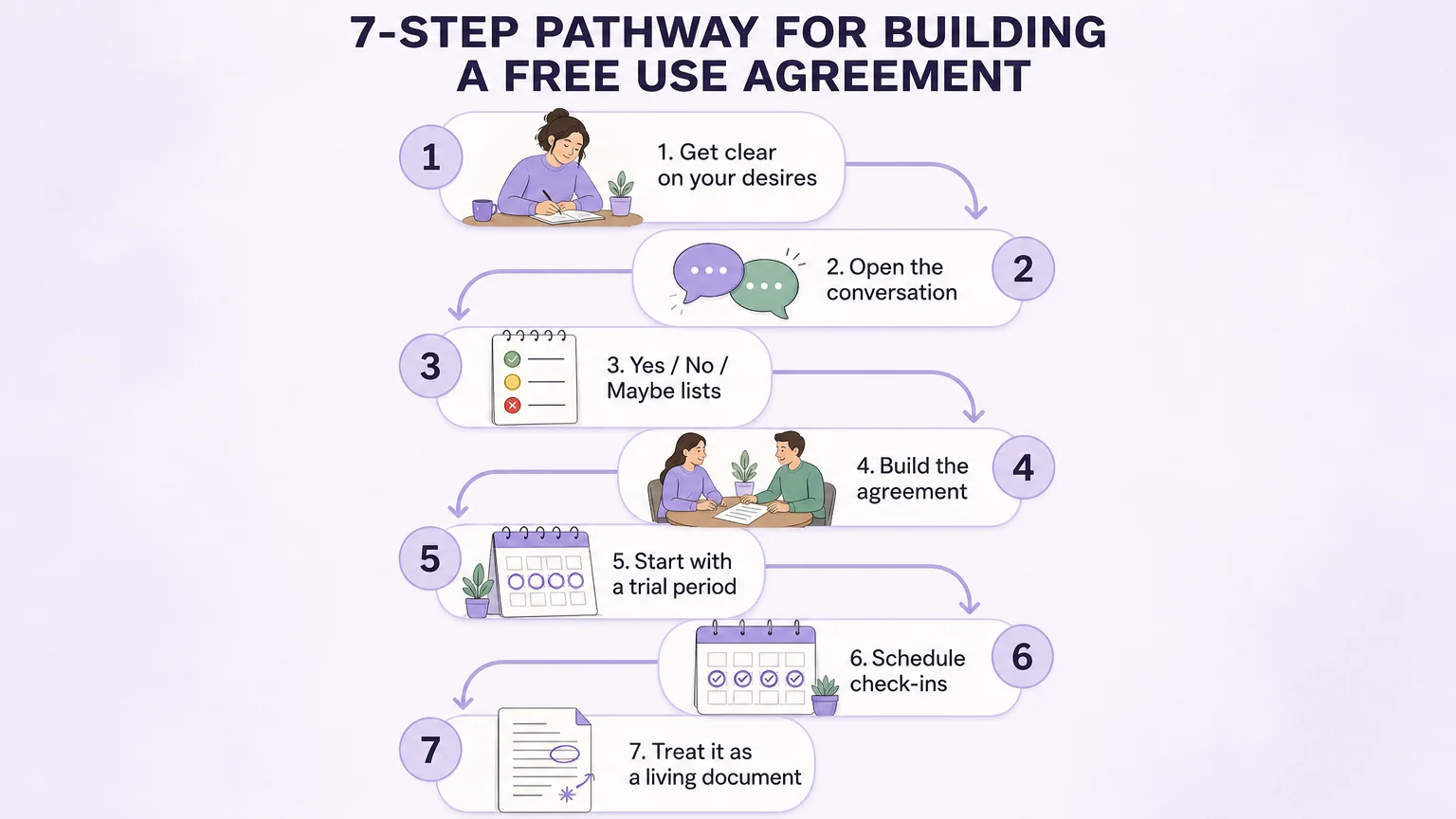
The pathway below synthesizes the Dom Sub Living and BeMoreKinky frameworks for building a free use agreement.
Step 1: Get clear on your own desires first. If you are the submissive: what specifically appeals to you? Feeling wanted without having to ask? The removal of constant negotiation? If you are the dominant: “It sounds hot” is not a foundation. “I want to act on desire within a container built on trust” is.
Step 2: Open the conversation, not the negotiation. Start with “I’ve been thinking about free use dynamics. What’s your gut reaction?” Read educational resources together before drafting terms. Both partners need the same conceptual map before drawing boundaries on it.
Step 3: Complete Yes/No/Maybe lists independently, then compare. Green Zone (yes, please), Yellow Zone (maybe, with conditions), Red Zone (hard limits). Do this separately, then compare. This forces both partners to articulate what they want, not just agree.
Step 4: Build the blanket consent agreement together and write it down. Use the Dom Sub Living contract or the BeMoreKinky template as a starting point. Cover hard limits, soft limits, pre-approved activities, time and place contexts, and safeword protocols. Be specific enough that two people read the same document and walk away with the same understanding.
Step 5: Start with a trial period, not forever. Two weeks. Weekends only. A single three-hour window. No pressure for it to be permanent. No feeling like you have to have everything figured out before you begin. The trial gives real data about what free use feels like in practice versus theory.
Step 6: Schedule regular check-ins and treat them as non-optional. Weekly or monthly, sit down outside the dynamic and ask: “Is there anything in our agreement that doesn’t feel right anymore? Is there anything you want to add?” The number one thing that breaks free use dynamics is couples doing the hard work upfront and then never talking about it again.
Step 7: Treat the agreement as a living document. What felt exciting three months ago may feel different now. A soft limit might need to become a hard one. Your agreement should reflect who you are now, not who you were when you started.
Two real moments. On a Sunday afternoon, she is doing dishes. Her dom walks in and initiates. She reports: “I don’t feel caught off guard. I don’t feel like something is being done to me. I actually feel wanted and I feel needed.” The pre-negotiated agreement makes spontaneous initiation feel affirming.
On a stressed-out evening, she texted her dom about a migraine. He comes home, asks about her headache first, and only after hearing it improved says: “Good, because I had a really stressful day and I wanted to take it out on you.” Consideration and the dynamic coexist.
Even with the best agreement, things go wrong. Here is what to watch for.
The Mistakes That Break Free Use Dynamics (And How to Avoid Them)
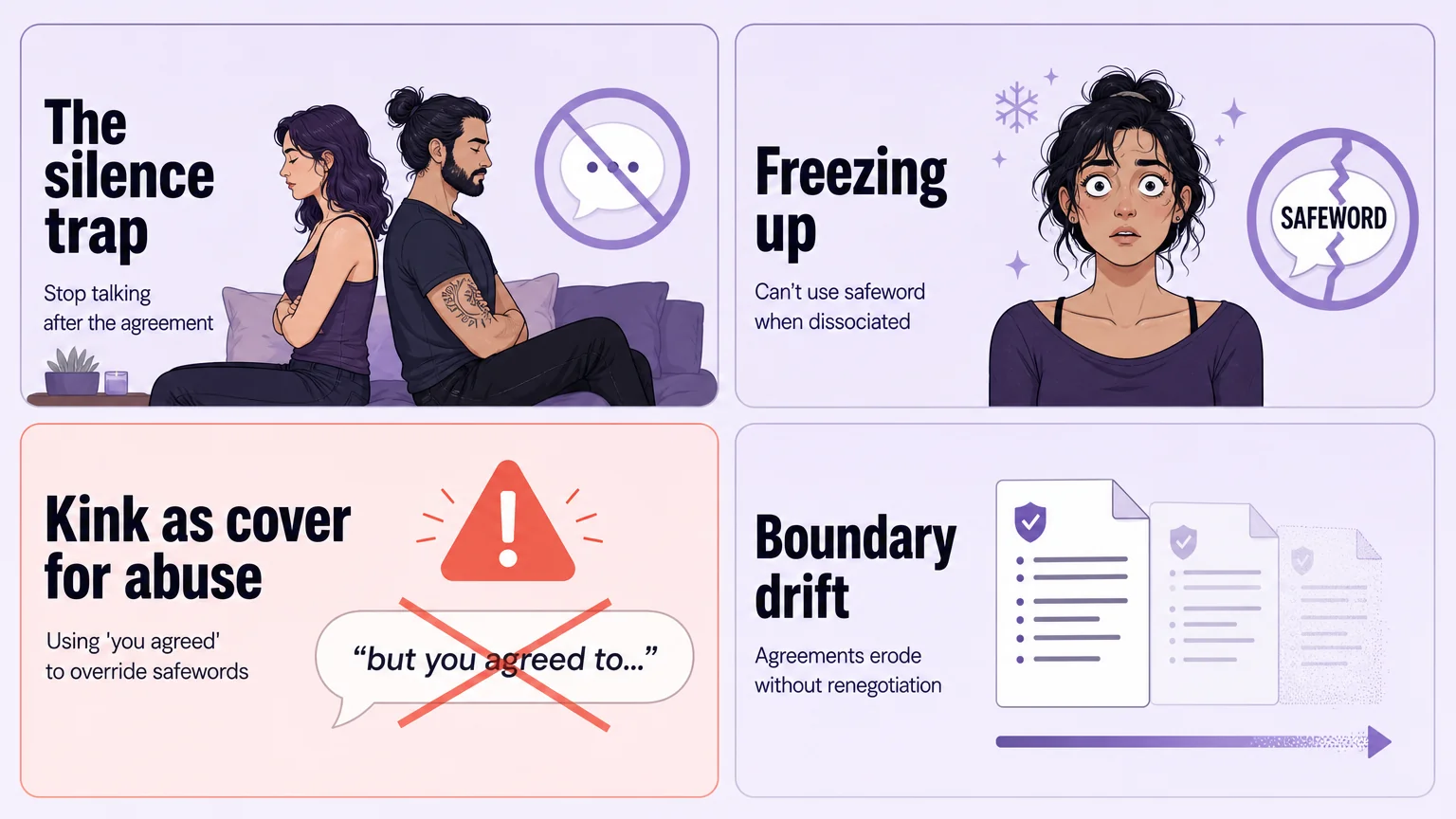
The number one failure mode is not a safeword ignored or a boundary crossed. It is quieter. Couples do all the hard work upfront, write everything down, feel solid. And then they stop talking about it. Weekly or monthly check-ins are the maintenance that keeps the agreement alive.
The second failure mode is freezing. One couple’s first free use experience went significantly rougher than expected because they had not pre-negotiated intensity levels. The submissive froze and could not use her safeword because she “didn’t think I was supposed to.” In free use, a partner might freeze, dissociate, or go into fawn mode: complying without truly being present, which looks like consent from the outside but is a trauma response. The solution is the full safety infrastructure: multiple redundant off-ramps, built-in pauses, and both partners trained to recognize the difference between relaxed compliance and dissociated shutdown.
The third failure mode: people who use “kink” as a cover for abuse. If your partner uses “but you agreed to free use” to override a safeword or pressure you, that is not kink. That is abuse. The line is bright and does not move.
The fourth failure mode is boundary drift. Agreements erode silently without renegotiation. What started as “free use during weekend evenings” becomes every evening. Boundaries require active, recurring confirmation.
When free use works, the payoff is transformative: “I don’t feel caught off guard. I don’t feel like something is being done to me. I actually feel wanted and I feel needed.” The mistakes are avoidable. The maintenance is straightforward. And the result, when the container holds, is a depth of trust most couples never access.
One mistake deserves its own section, because skipping it does not just break the dynamic. It breaks the people in it.
Aftercare: The Part Nobody Talks About (That Makes Everything Else Work)
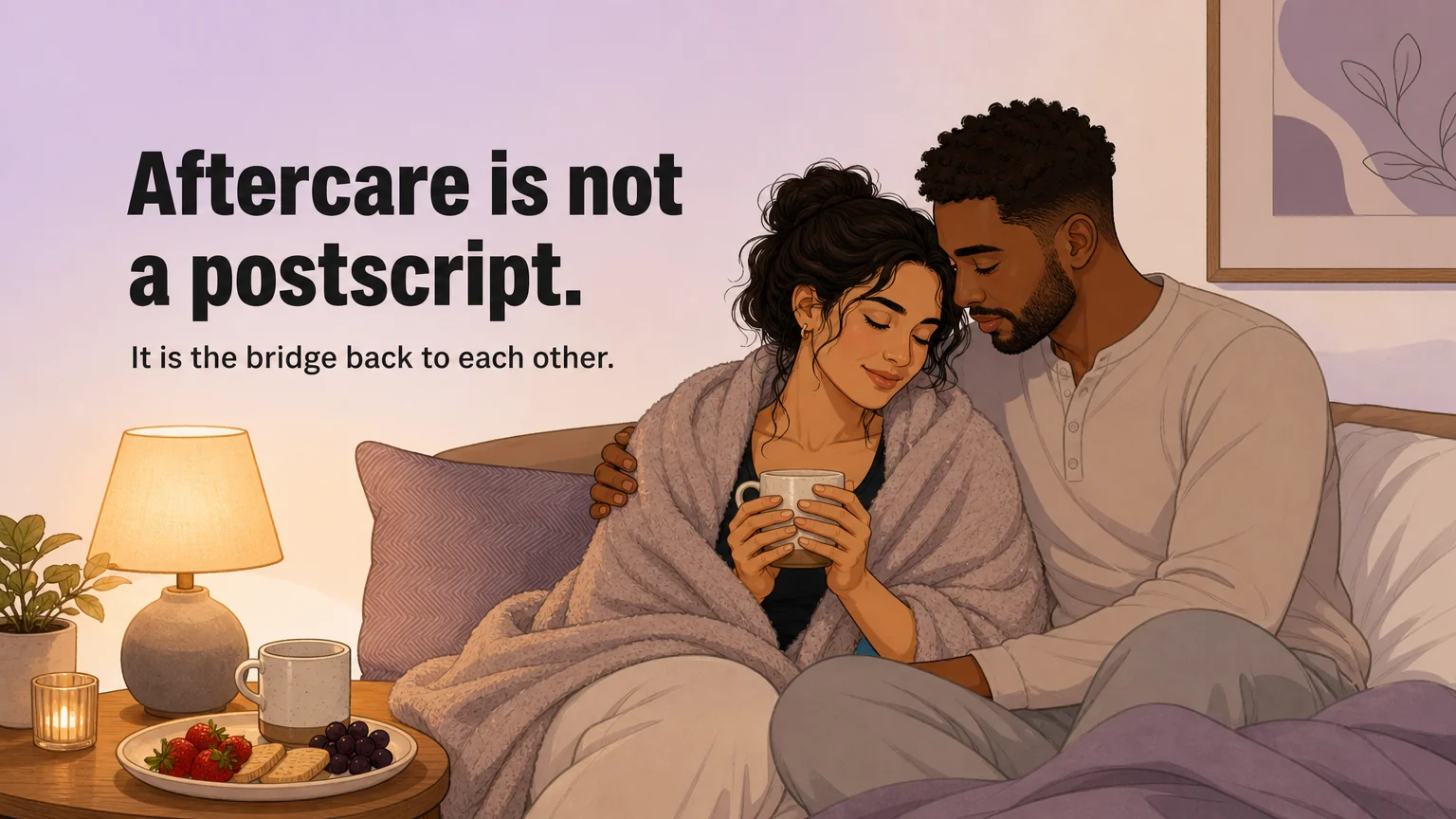
Aftercare is the practice of providing physical comfort, emotional support, and connection after kink scenes. It is vital because kink can produce altered headspaces and emotional crashes, subdrop and domdrop alike, that surface hours or even days later. A good kink scene can quickly become a bad one if the person leaves without proper care.
Here is what aftercare looks like in practice:
Physical comfort. Cuddling, hydration, snacks, warmth. A soft blanket, low lighting, a quiet room. The body needs to come down as well as the mind.
Verbal processing and debriefing. Talk through what happened while both partners are still in the post-scene window. Name what worked. Name what felt intense. The debrief is a reconnection ritual, not a performance review.
Somatic grounding. Deep breathing together. Sensory touch that is not necessarily sexual: a hand on the chest, back stroking, held hands. Change clothes, turn on lights, make tea. These small rituals signal to both nervous systems that the intensity was contained and the everyday self has returned.
The 24-hour availability window. Agree that both partners stay emotionally accessible for continued processing. Emotional reactions can surface hours or days later. The check-in the next morning is aftercare too.
Aftercare is not a postscript. It is the bridge that carries both partners safely back to everyday life, what makes the next scene possible without accumulated emotional debt.
Aftercare is for dominants too. For the dominant, this dynamic is not an easy one. It actually asks more of you, not less. Dominants can experience drop, guilt, or shame after a scene. They may feel conflicted about having “used” someone they love, even when everything was consensual. They need to hear “that was good for me too” explicitly. Domdrop is under-discussed in kink education, and in free use specifically, the dynamic can amplify a dominant’s worry that they crossed a line. The function of aftercare is simple: it converts intensity into intimacy instead of injury.
Everything we have covered so far assumes two people. But what if there are three, or more?
Free Use With More Than Two: Threesomes, ENM, and Multi-Partner Dynamics
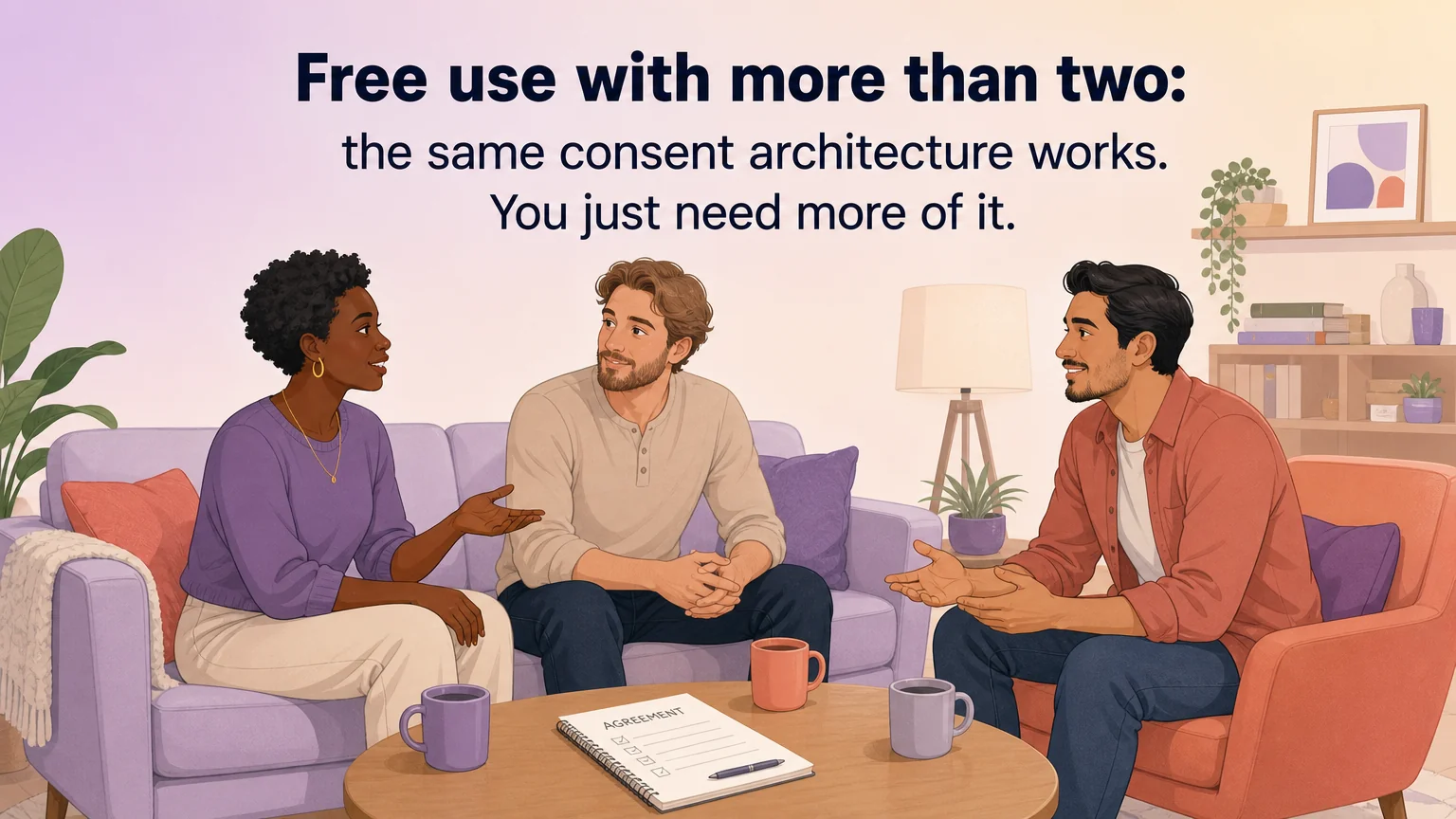
When free use meets multi-partner dynamics, the rules multiply. If you practice free use with your partner and are also exploring threesomes or ENM, here is what you need to know.
The bright line comes first: most experts strongly advise against CNC or free use with casual partners. The trust infrastructure is not there. Free use between established partners within a group context is fundamentally different from attempting it with a new third.
When established partners bring free use into a multi-partner setting, these additional layers become non-negotiable:
Who monitors whom for safety? In a threesome, the couple may default to monitoring each other, but the third also needs a safety observer. Assign this explicitly. Everyone needs a designated person checking their state.
Who calls safewords, and how? When the receiving partner is physically positioned between two people, speech may not be possible. Non-verbal signals (hand squeeze, dropped object, visual cue) must be demonstrated to all participants before the scene begins.
What does aftercare look like for each participant? The third is not a prop. They need the same post-scene care as everyone else. Plan aftercare logistics in advance: who stays, who leaves, what is the debrief cadence. If you are not willing to provide aftercare to everyone in the room, the scene should not include them.
Which acts are available to which partners? Free use with your primary partner does not automatically extend to a third. Each person needs their own Yes/No/Maybe list. The intersection of three lists is naturally smaller than two. Define what is available to the primary partner only, what is available to the third, and what requires separate negotiation.
The jealousy dimension deserves direct attention. Power-exchange dynamics in a group setting can trigger comparison (“they’re more submissive than I am”), exclusion (“I’m watching something I’m not part of”), or fear of replacement. These feelings are normal and navigable. The solution is the same architecture that works for two: pre-negotiation, explicit agreements, and check-ins. The jealousy conversation should happen before the scene, not as a crisis during or after.
Reading multiple people’s states simultaneously is an advanced skill, not a beginner one. Free use does not scale automatically. But the same consent architecture that works for two works for three or more. You just need more of it, more explicitly, with more willingness to slow down when anyone in the room needs to.
FAQ
Is free use the same as CNC?
No. Free use is a subtype of CNC. CNC roleplays non-consent with resistance; free use is ongoing casual availability without asking. You cannot have ethical free use without CNC’s consent architecture.
Does free use mean I can never say no?
No. Safewords remain absolute. Blanket consent removes pre-encounter negotiation, not your right to stop. If someone claims free use replaces safewords, walk away.
Is free use just a rape fantasy?
No. The appeal is casual availability and relief from decision-making, not resistance. The defining visual is one partner continuing everyday activities. Some combine free use with CNC resistance, requiring separate negotiation.
How do I bring up free use with my partner?
Bring it up during a calm, clothed moment. Start with: “I’ve been thinking about free use dynamics. What’s your gut reaction?” Give your partner time. Share resources. Collaborative exploration, not convincing. If they land on no, that no is the end.
What boundaries are typical for free use?
Home only, excluding dangerous tasks, not during work, a “not right now” signal, time-limited windows, both retaining safeword rights. Most couples start with defined windows and expand. Write everything down and revisit regularly.
Can free use work in a threesome or with multiple partners?
Yes, with more explicit negotiation. Assign safety monitoring, demonstrate non-verbal safeword signals to everyone, plan aftercare for all participants, define which acts are available to which partners. Advised against with casual partners.
What is aftercare and why does free use need it?
Physical comfort, emotional support, and connection after scenes: cuddling, hydration, verbal processing, somatic grounding, 24-hour availability. For both partners; dominants experience drop too. Skipping it invites emotional crashes hours or days later.
How do I know if my relationship is ready for free use?
A safeword system used in practice; navigated a difficult conversation about wants and came out stronger; the dominant reads the submissive’s state accurately; both partners articulate their own desires. Communities like r/ThekinkPlace and r/SubSanctuary offer discussion spaces.
What is blanket consent and how is it different from free use?
Blanket consent is the pre-negotiated agreement: hard limits, soft limits, pre-approved activities, time and context boundaries, safeword protocols. Free use is the dynamic it contains. You can have blanket consent for specific acts without a full free use arrangement.
Does free use include sex while one partner is sleeping?
Only if pre-negotiated. Somnophilia requires its own explicit consent. Never assumed by default. Add it to your written agreement as a pre-approved activity if you want to include it.