
You are curious about DDLG rules. You want a playbook that tells you which rules to set, why each category matters, and how to build a set that fits your specific dynamic.
DDLG rules are the scaffolding of your dynamic. Not the cage. The structure that makes everything inside it safer, richer, and more connected. Whether you and your partner are stepping into this for the first time or deepening a dynamic that already hums, this guide gives you a clear framework.
You will walk away knowing the rule categories that anchor every healthy DDLG relationship, the negotiation process that makes building rules feel collaborative instead of clinical, the tools that keep you both on track without turning your phone into a surveillance device, and the reward and punishment systems that strengthen your bond instead of fraying it.
This is architecture, not theory. Let’s build something that holds.
What DDLG Rules Actually Are (and Why They’re the Engine of the Dynamic)
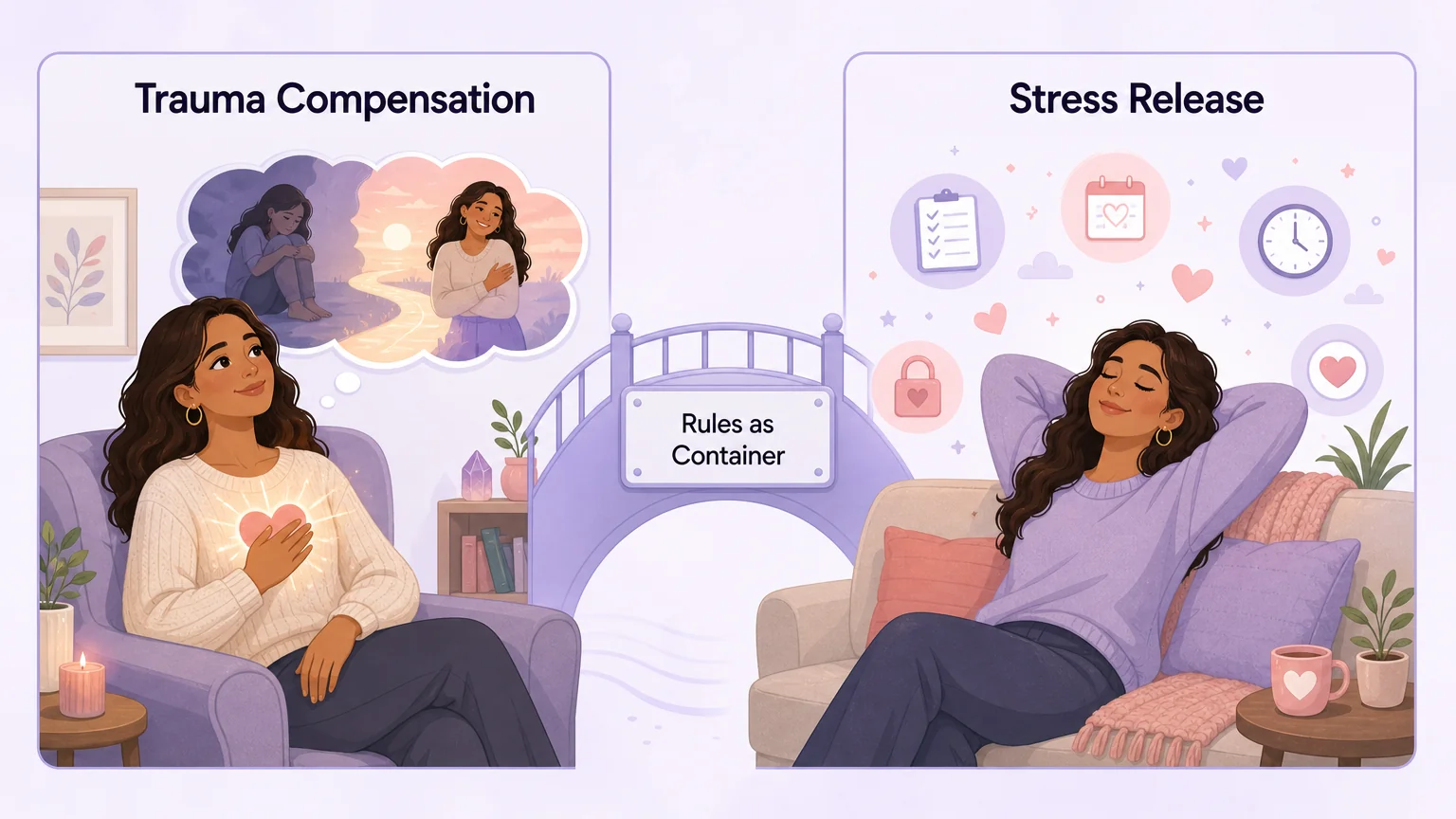
Most people assume DDLG rules are about the Dom imposing order from above. The reality runs closer to the opposite. The strongest rule sets are built outward from what the little needs to feel safe, seen, and held. The Dom’s job is to listen carefully and build a container sturdy enough to hold what the little is asking for.
Rules create predictable structure, and predictable structure makes little-space feel like relief instead of performance. When a little knows exactly what is expected and what happens when expectations are met or missed, the brain responds. Structured caregiving triggers oxytocin and dopamine. The anxiety dial turns down. The space between “I have to manage everything” and “I am being taken care of” opens up, and that is where the dynamic lives.
Two psychological engines drive this. The first is trauma compensation: revisiting vulnerable developmental stages on your own terms, with an adult partner who responds differently than the original caregivers did. The healing is in the rewrite. The second is stress release: temporary, negotiated escape from adult pressure through a structure that holds you so you do not have to hold yourself. Neither engine requires shame. Both are legitimate human needs running through a consensual adult framework.
There is a critical distinction between rules-as-punishment-trap and rules-as-container. A bad rule set sets the little up to fail. A good one makes breaking rules rare because the rules align with what the little actually needs. Design a bedtime rule around the little’s actual sleep needs, not an arbitrary standard that guarantees nightly infractions and resentment.
And here are 7 DDLG rule categories that you can follow:
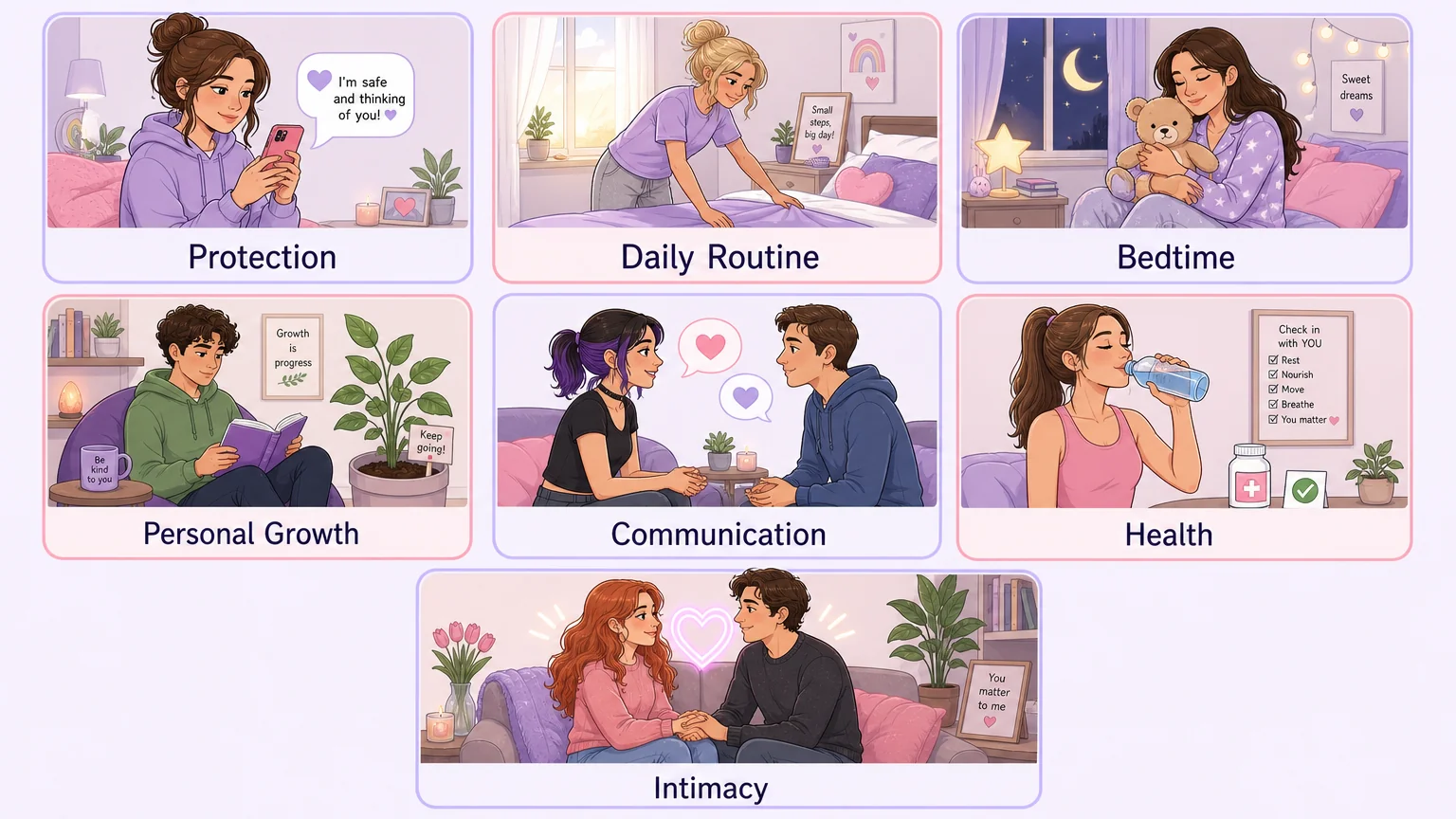
1. Protection and Check-In Rules: The Non-Negotiable Foundation
If you only set three rules, make every one of them a protection rule. Everything else is decoration. Protection rules are the floor, and without the floor, there is nothing to stand on.
What goes in this category:
Location-sharing check-ins when one of you is out alone. Pick a platform both of you trust and set the expectation clearly: “Share your location when you leave, check in when you arrive.”
Tell Daddy or Mommy immediately when something is upsetting you. This is one of the hardest rules for many littles to follow, because it requires overriding the instinct to handle everything alone. Frame it explicitly: “Your job is not to protect me from your feelings. Your job is to let me in.”
Safe word protocols with both a verbal word and a non-verbal gesture. A safeword is useless if the little goes nonverbal during a scene or a hard conversation. Establish the word. Also establish a tap-out gesture, a hand signal, a specific emoji sent by text. Two channels, always.
The distinction that matters: these rules exist to protect, not to control. If a little breaks a protection rule, the response is concern and conversation, not punishment. “You didn’t check in and I was worried” is a care statement. “You broke rule seven so here is your consequence” misunderstands what protection rules are for. Do not conflate the two.
2. Daily Routine and Household Rules: The Rhythm That Holds It Together
The difference between a DDLG dynamic that feels real and one that feels like bedroom cosplay comes down to what happens between 9 AM and 9 PM. The Tuesday-morning check-in, the chore that got done because someone was counting on it, the routine that holds shape across an ordinary week: that is the skeleton underneath.
Daily routine and household rules are the most tangible category. Both partners can see them happening. Both partners can point to the thing that got done and say: that was us, that was the dynamic working.
Examples that fit: a morning routine that includes making the bed, brushing teeth, and sending a good-morning message. Household chores framed as service: “Daddy takes out the trash; little keeps the bedroom tidy.” Meal rules: eat three meals, send a photo of at least one. Hydration tracking: a specific number of water bottles per day. A daily check-in window: “Between 7 and 8 PM, we sit down and talk about the day.”
These rules work because they are concrete. When the little folds the laundry because the rule says so, and the Dom notices and acknowledges it, both partners feel the dynamic functioning in real time. These are love letters written in action, sent back and forth across an ordinary day.
The key is specificity. “Help around the house” is not a rule. “Empty the dishwasher before 10 AM” is a rule. “Eat better” is not a rule. “Eat three meals and send a photo of lunch” is a rule. If you cannot check the box, you did not write the rule.
3. Bedtime Rules: Where Structure Meets Intimacy

Ask anyone in a DDLG dynamic what their first rule was, and “mandatory bedtime” will be the most common answer by a wide margin. Bedtime rules bookend every single day with the dynamic. No matter what else happened between morning and night, the bedtime rule is there waiting, pulling both partners back into the roles they chose.
What a bedtime rule set typically includes: a specific lights-out time (“In bed by 10:30 PM, lights off by 11”). A wind-down window with no screens 30 minutes before bed. A bedtime story ritual: the Dom reads aloud, the little reads aloud, or you trade chapters. Sleeping with a specific stuffie chosen or gifted by the Dom. No phones after lights-out. A goodnight phrase that stays consistent: “Goodnight, little one. Daddy loves you,” said the same way every night, because consistency is the point.
Bedtime rules create a daily closing ceremony. The day ends not with drifting apart into separate phones and separate headspaces, but with a deliberate, shared transition. The little is tucked in, literally or figuratively. The Dom performs the care ritual. Both partners fall asleep inside the dynamic.
For couples who live together, this might mean the Dom physically tucking the little in and reading aloud. For long-distance couples, it might mean a voice note with a story, a video call goodnight, or a shared wind-down over a messaging app. The format adapts. The function stays the same: every day gets a deliberate ending, and that ending belongs to the dynamic.
4. Personal Growth Rules: Why the Best Daddies Care About Your Reading List
The single biggest green flag in a DDLG dynamic has nothing to do with how strict the Dom is or how elaborate the rules are. It is whether the rule set includes personal growth. A Dom who builds rules around your development sees you as a whole person. A Dom who only builds rules around obedience and service is shopping for a kink dispenser, not building a dynamic.
Personal growth rules signal something unambiguous: I care about who you are becoming, not just what you do for me.
What belongs: a reading plan (“Read one book per month and write a short reflection”). An exercise routine with movement targets that fit the little’s actual body and capacity, set collaboratively. Journaling: three sentences a day, or a weekly long entry, or whatever threshold makes it sustainable. Work or study commitments: “Study for 45 minutes before you open social media.” And the most overlooked rule in the entire category: no negative self-talk. “You are not allowed to speak about my little that way, including when you are the one speaking.”
The mechanism is straightforward. A Dom who invests in your growth demonstrates long-term thinking. This is someone who wants the person on the other side of the rules to be healthier, sharper, and more fulfilled six months from now than they are today. That is the signal. Do not ignore it.
5. Communication and Behavior Rules: The Guardrails That Keep the Dynamic Clean
The fastest way to erode a DDLG dynamic is not a broken rule. It is a broken communication pattern. You can fix a missed chore. You can adjust a bedtime. But when communication becomes a weapon or a withdrawal, the damage compounds fast.
Communication and behavior rules are the shared language of the dynamic: here is how we talk to each other inside this container, and here is what we do not do.
Rule examples: address your Dom by their agreed title (this signals “we are in the dynamic now”). Be polite: please and thank you still matter inside a power-exchange relationship. No silent treatment: if you need space, say “I need space, I will check in at 6 PM.” Permission to leave heated conversations: “I need to pause. Can we come back to this in 20 minutes?” Both partners get this right. No phones at meals. Use your words when upset instead of making the Dom guess. Wear a day collar or symbolic item as a tangible reminder of the connection.
The through-line: communication rules prevent small fractures from becoming breaks. A little who knows she can say “I need 20 minutes” does not have to flee the conversation. A Dom who knows the silent treatment is off the table does not have to chase or guess. Without these guardrails, the dynamic runs off the road in a slow drift neither partner notices until the damage is done.
6. Health and Self-Care Rules: Because “Daddy Issues” Isn’t a Substitute for Actual Care
If your DDLG dynamic is making you less functional, something is wrong. Worse sleep. Skipped meals. Neglected mental health. A dynamic that started as stress relief and became another source of pressure. The pattern is common: some couples slide into a version where the little’s wellbeing becomes performative while actual health markers deteriorate.
Health and self-care rules exist to prevent exactly that slide.
What goes here: medications taken on time, every time. Meals eaten before a cutoff: “Eat before 5 PM, I am checking.” No caffeine after 8 PM. Basic hygiene as a baseline of functioning, not a compliance metric. Regular exercise at whatever level the little’s body can sustain. Therapy attendance if therapy is part of the mental health plan. And the harder ones: tell Daddy or Mommy about self-harm urges, anxiety spikes, depressive episodes, suicidal thoughts. These are “I am not okay and I need you to know” reports, not “bad behavior” reports.
The critical distinction: these are support rules, not compliance rules. A missed dose of medication is a “let’s talk” moment, not a punishment moment. If the little is struggling to eat, the response is help, not discipline. The Dom’s role is anchor, not enforcer. The rule creates a checkpoint where the little reports honestly and the Dom responds with care.
A dynamic that makes someone healthier is worth keeping. A dynamic that makes someone sicker needs dismantling, no matter how good the chemistry felt. Health rules are your early-warning system. Use them.
7. Intimacy and Pleasure Rules: The Category Nobody Names but Everyone Uses
Most DDLG rule lists skip this category. That is like writing a cookbook and leaving out the chapter on salt. The intimacy dimension exists whether you name it or not. Naming it is what makes it safe and mutually fulfilling.
Intimacy and pleasure rules cover the physical territory of the dynamic, framed as negotiated intimacy, never degradation or obligation. Every rule in this category is opt-in.
Examples couples commonly negotiate: no climaxing without permission (this transforms orgasm from a private act into a shared one and anchors the power exchange). Attention on Daddy or Mommy when out together: oriented toward your person, not performative. Sitting at the Dom’s feet during quiet time at home. The Dom bathes, washes, or feeds the little during designated intimate time. The Dom chooses the little’s drink or meal when you are out. Outfit approval within pre-negotiated limits.
The framing is everything. These rules are about two adults building a consensual structure around physical intimacy that deepens the roles they have chosen. The difference between “you must do X” and “we have agreed that X belongs to our dynamic” is the difference between coercion and connection.
Some DDLG dynamics are entirely non-sexual, and that is equally valid. Age regression for stress relief, caregiver dynamics built around comfort with no sexual dimension, dynamics where little-space is a sacred non-sexual zone. If that describes your dynamic, this category shrinks or disappears entirely, and nothing about the rest of the rule set changes.
How to Build Your Rule Set Together
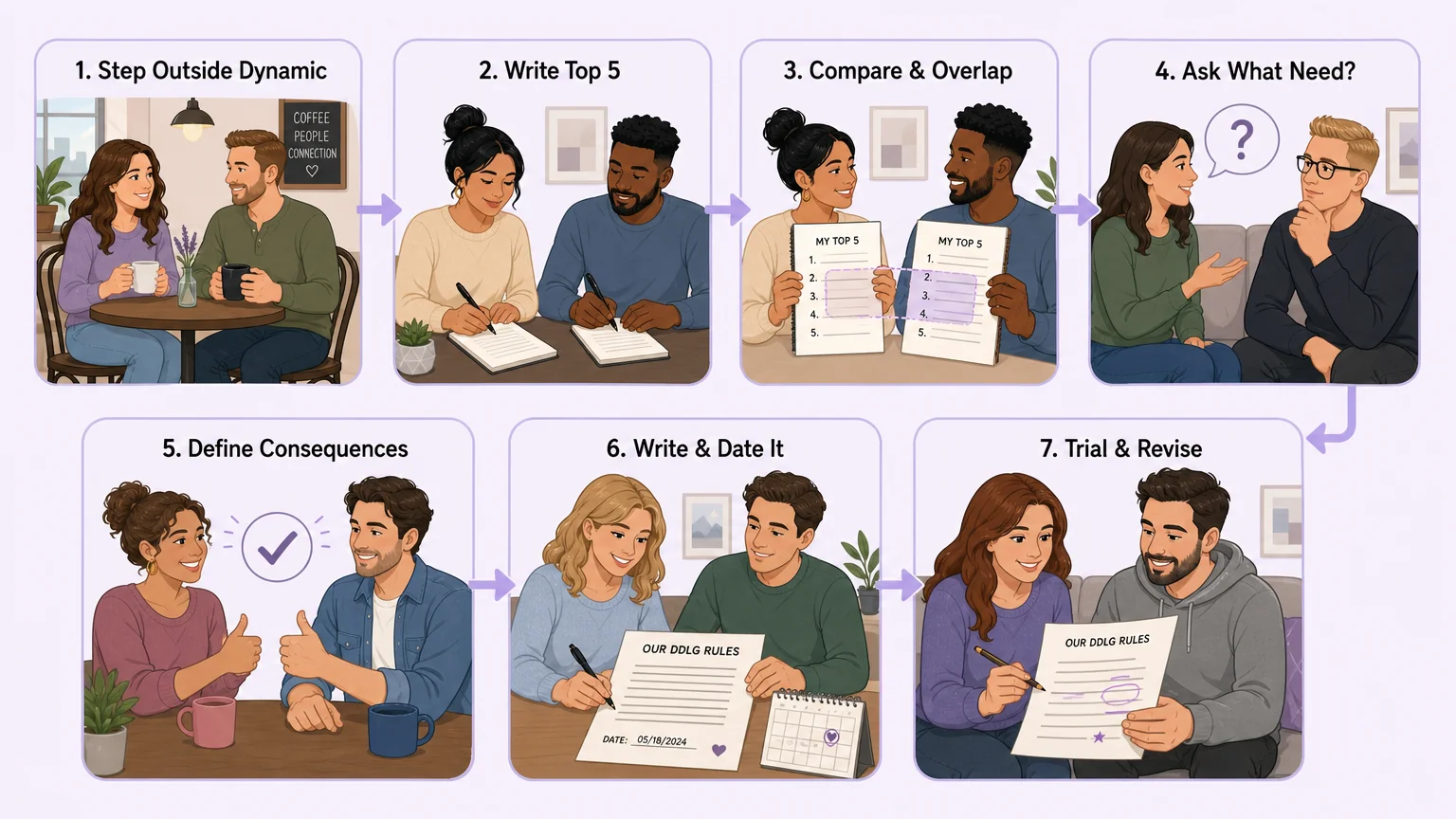
You now have more rule ideas than you can implement. The goal is to turn that inventory into a living document that belongs to both of you.
Step outside the dynamic first. Have this conversation as equal adults, with titles parked. You are two people building a structure you will both inhabit, and you both get equal say.
Each person writes their top five rules independently. Compare only when both lists are complete. Mark the overlap first. Those rules appeared on both lists because they matter most to both of you. They get priority.
For each rule, ask: “What need does this serve?” If the answer is “because it sounds hot” or “because I read it somewhere,” set it aside. If the answer is “because my little needs help winding down at night” or “because I feel safer when I know where you are,” it earns its place.
Define consequences together. Both partners know exactly what happens when a rule is followed and when it is broken. Ambiguity is how resentment starts.
Write it down. Date it. A shared document, notes app, or physical notebook. The format matters less than the fact that it exists outside either partner’s memory.
Set a two-week trial period, then revise. A rule that looked great on paper may feel stifling. A rule you thought was minor may anchor the whole dynamic. Adjust without ego.
Your rules are a living document. The set you write this week will not be the set you use six months from now. That is not failure. That is growth.
How to Track It All
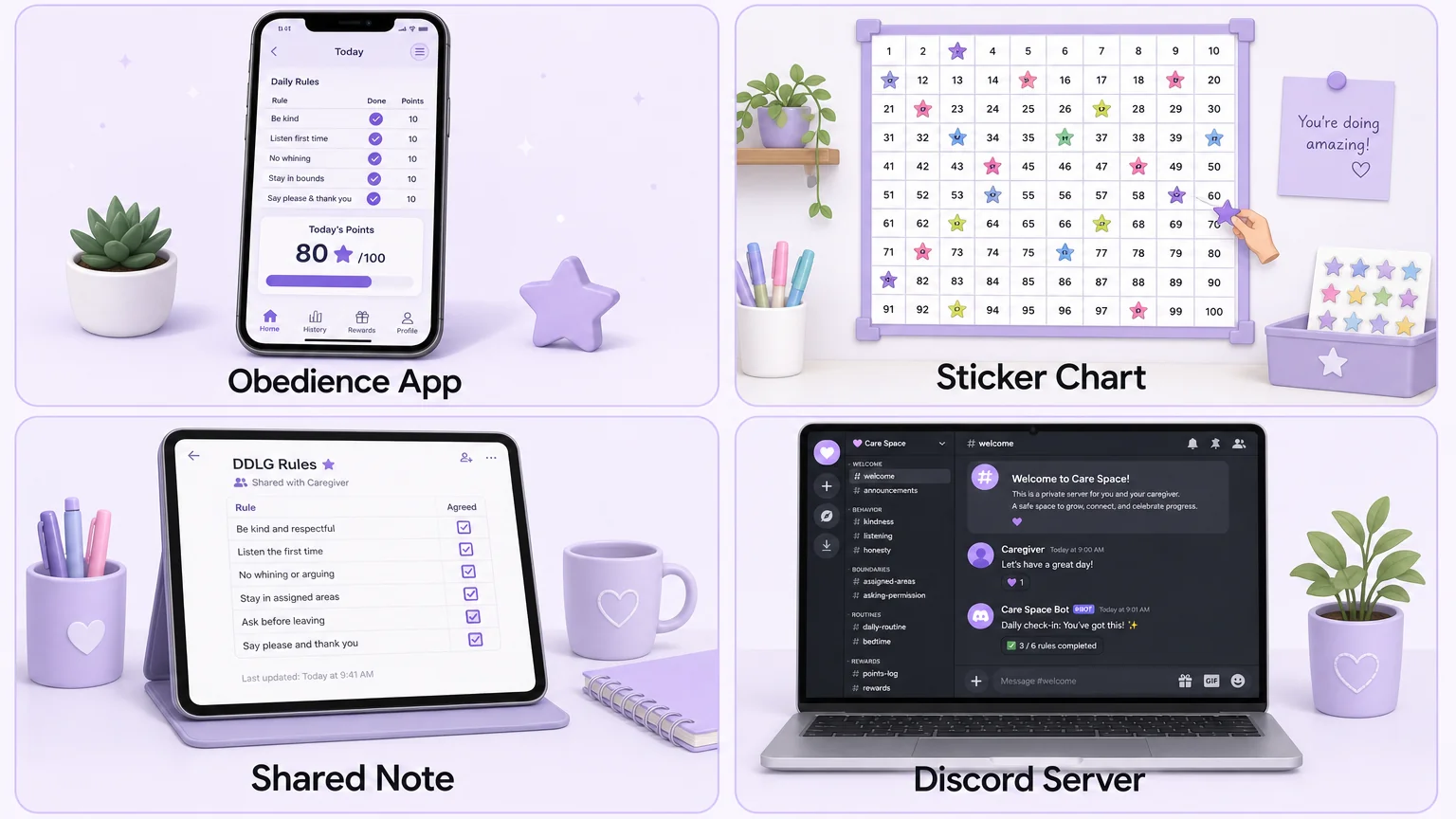
You have got 7 categories of rules in a shared note. It is Tuesday. Neither of you has looked at it since Saturday. The rules have become decorative, and a decorative rule set is worse than none. It teaches both partners that the dynamic is optional.
The tracking layer keeps rules alive. Here is what works.
Shared notes are the lowest-friction option and the easiest to ignore. Build a review rhythm: every Sunday evening, open the note together and go through each rule with a yes or no. Without that rhythm, the note becomes invisible within a week.
Physical sticker and star charts put rules where both partners see them every day. A 100-space grid on the fridge or wall. One sticker per completed task. A full chart equals a pre-agreed reward. For many littles, the tactile act of placing the sticker beats tapping a screen.
The Obedience app handles habit tracking, point systems, punishment logs, and real-time sync ($8/month or $35/year). For long-distance couples, the sync alone justifies the cost.
Alternatives: ChoreMonster and Mothershp can be repurposed. Discord private servers with custom channels per rule category give you a free option with the bonus of a shared space that feels like home.
The tool matters less than the rhythm. Pick a weekly check-in time and protect it. Review the rules as two adults assessing how well the structure serves the relationship. If a rule is consistently missed for two weeks, the rule is the problem, not the person.
Rewards That Actually Motivate: Beyond “Good Girl” and Stickers

“Good girl” hits differently when it is earned. The phrase lands because it was attached to something real: a week of consistent rules, a hard conversation handled well, a growth milestone reached. But if praise and stickers are your entire reward economy, the lever loses its weight.
Rewards need tiers that mean something different.
Small, daily rewards for day-to-day consistency: extra time before bed, picking the bedtime story, choosing the movie on date night, a special snack reserved for rule-completion days. These are signals. The dynamic noticed.
Weekly rewards mark sustained effort: a new coloring book, fresh art supplies, a new stuffie. Being taught something new: the Dom teaches a skill, whether cooking a dish or playing a song, because “I am investing in you beyond the roles.”
Major rewards for milestones: “All About Little Day,” where the Dom plans an entire day around the little’s favorite things. A new collar, which in many dynamics carries the symbolic weight of a ring. A Little Care Package: stuffies, snacks, art supplies, and personal notes assembled by the Dom.
The most powerful rewards are attention and time. An afternoon where the Dom’s full attention is on the little is what gets remembered.
Do not leave Dom rewards out. Crafts made for Daddy or Mommy. Snacks prepared as a surprise. An “All About Caregiver Day” where the little plans and runs the day. A Dom who feels appreciated stays engaged. A Dom who feels like a rule-enforcement machine burns out.
Punishments That Correct (Without Breaking the Dynamic)

The most common way DDLG dynamics collapse is a punishment that felt unfair, came from anger, or left the little feeling abandoned instead of corrected. That wound corrodes trust until the dynamic no longer feels safe.
Punishment follows a structure. It is a ritual, not a reaction: notification, a waiting period (never punish in the heat of the moment), a short lecture on why the rule matters, administration of the agreed consequence, and aftercare treated as non-negotiable.
Light corrections for minor or first-time infractions: writing lines, early bedtime, phone taken away for a set period, extra chores.
Moderate corrections for repeated infractions: corner time, losing toys or TV privileges for a defined window, writing a reflection on what happened.
Serious pre-negotiated corrections for major violations: spanking or impact play within pre-established limits, extended privilege loss with a clear end date, a substantive essay on the violation. These should be rare. If serious corrections happen weekly, the rule system needs a hard re-examination, not more punishment.
A critical distinction: funishment is not punishment. If the little wants it and would break rules on purpose to get it, it belongs on a separate list. Funishment is foreplay with a plot. Keep the lists separate.
What you never use as punishment: the silent treatment, revoking comfort items, name-calling or degradation outside negotiated limits, revoking basic needs, emotional withdrawal. Any of these damages the dynamic faster than the original infraction ever could.
Aftercare is not optional. It is the closing ceremony that returns both partners to equal ground: cuddling, reassurance, the words that need to be said. “I still love you. You are still my good girl. We are okay. The punishment is done.” Skip aftercare and you are accumulating debt.
The 5 Mistakes Every New DDLG Couple Makes With Rules
Most DDLG dynamics fail because the rule system collapsed, not because chemistry was absent. Here are the five collapse points and how to skip them.
Too many rules, too fast. A couple writes 25 rules in one evening and tries to enforce them all starting Monday. By Thursday, both partners are exhausted. Start with three to five rules. Stabilize for a week. Add one per week. A rule set is built, not launched.
Inconsistent enforcement. Bedtime is enforced Monday and Wednesday, skipped Tuesday and Thursday. The little learns rules are situational, and situational rules are not rules. A consistently enforced three-rule set beats a sporadically enforced fifteen-rule set. If you cannot enforce it consistently, do not put it on the list.
Rules that do not fit the little’s needs. A Dom imposes rules based on what sounds authoritative. The little’s actual rhythms fight them. For every rule, ask: “What area of your life actually needs more structure?” If the answer is nothing specific, cut it.
Punishing from emotion. The Dom gets angry and issues a disproportionate punishment. The little feels attacked instead of corrected. Trust takes a hit. If you are angry, postpone. Say “We will address this, but not right now.” Administer the consequence from care, not reaction.
No review rhythm. The rule set gets written once and never revisited. Old irrelevant rules stay. New needs go unaddressed. Schedule a monthly rules review, out of dynamic, as equal adults. What is working? What needs to be added, adjusted, or retired? This is the maintenance that keeps the engine running.
How About the Long-Distance DDLG Relationship

A large portion of DDLG dynamics happen across time zones. The structure adapts. It does not disappear. Long-distance dynamics need more structure, not less, because physical presence cannot fill in the gaps.
Outfit approval adapts easily: the little sends a photo before leaving the house, the Dom approves or suggests changes. This keeps the Dom involved in a daily decision and gives the little a tangible moment of being cared for across the distance.
Video call check-ins replace in-person presence: a morning call to set expectations, an evening call to review the day, screen-sharing for shared activities like watching cartoons or coloring together.
Bedtime ritual via voice note or video: a recorded story sent every night, a goodnight call, a digital goodnight phrase that closes the day the same way every time.
For tools, the Obedience app was practically built for long-distance dynamics with real-time sync across time zones. Discord private servers with dedicated channels give you a persistent shared space.
Punishment adaptations for distance: stuffie jail (a specific stuffie placed somewhere visible but out of reach), temporary no-contact for a pre-negotiated time-limited window (serious infractions only, never as a weapon), early bedtime enforced via call where the Dom stays on the line until the little is in bed with the lights off.
The distance is real. So is the dynamic. The structure bridges the gap.
FAQ
Isn’t DDLG just pedophilia?
No. DDLG is a consensual power-exchange dynamic between adults. Age play is roleplay between consenting adults. Any dynamic involving an actual minor is abuse. The distinction is categorical.
Do we actually need written rules, or can we just vibe?
“Just vibing” dissolves dynamics. Without written rules, you have a mood, and moods shift. You do not need a contract. You do need clear, written expectations both partners can reference without relying on memory. Five rules in a shared note beats “we’re kind of doing the thing.”
How many rules should we start with?
Three to five. Add one per week once stable. A small set consistently enforced builds trust. A large set inconsistently enforced builds resentment.
What is the difference between punishment and funishment?
Punishment corrects behavior. Funishment is foreplay with a plot: a consensual scene that borrows the language of discipline for mutual pleasure. Both partners know which is which before it starts. Keep separate lists.
Can you do DDLG long-distance?
Yes. It requires more structure, not less. Outfit approval photos, video check-ins, screen-sharing, bedtime stories via voice note, and synced apps. Distance is a logistics problem, not a compatibility problem.
What if I keep breaking the same rule?
That is a design problem, not a discipline problem. The rule does not fit your capacity or needs. Sit down out of dynamic and ask: is this rule too hard, too vague, or not serving the need you thought? Redesign it. A rule broken every week was written wrong.
Is DDLG 24/7?
It can be, but most dynamics are not. The majority are partial: the dynamic is “on” during certain times or contexts, and both partners step into equal-adult mode for the rest of life. There is no purity test. Whatever you negotiate is the right configuration.
What if my partner is into it but I am not sure?
Start with one rule for one week. A bedtime. A daily check-in. One point of accountability. See how it feels. You are experimenting, not committing. If it works, add another. If it does not, you learned something honest about yourself. Do not fake enthusiasm. Your partner deserves your honesty more than your performance.