
The cold drag of steel across bare skin. The held breath. The absolute stillness of two people who trust each other completely. That is the real starting point of knife play. Not danger. Not cutting. Trust.
So what is knife play, exactly? It is a kink, or specifically a consensual BDSM edgeplay practice that uses knives, blades, or blade-like objects for physical sensation and psychological intensity. Knife play is not synonymous with cutting or blood play. Most knife play never breaks the skin, and most practitioners never want it to. The goal is the sensation itself. Cold metal. Light tracing. The electric focus that comes from being completely present with your partner, every nerve alive, every moment sharpened to a single point.
Under RACK (Risk-Aware Consensual Kink), practitioners accept that absolute safety is impossible with edgeplay. The managed risk is part of the experience. The spectrum runs from sensation-only play with a chilled butter knife to advanced edge work, and most people stay firmly on the sensation end. The space between curiosity and readiness is where good exploration happens.
What follows is a practical guide for couples curious about knife kink. No gatekeeping. No judgment. Clear information, and the respect to let you decide what belongs in your bedroom.
What Knife Play Actually Is, and What It Is Not
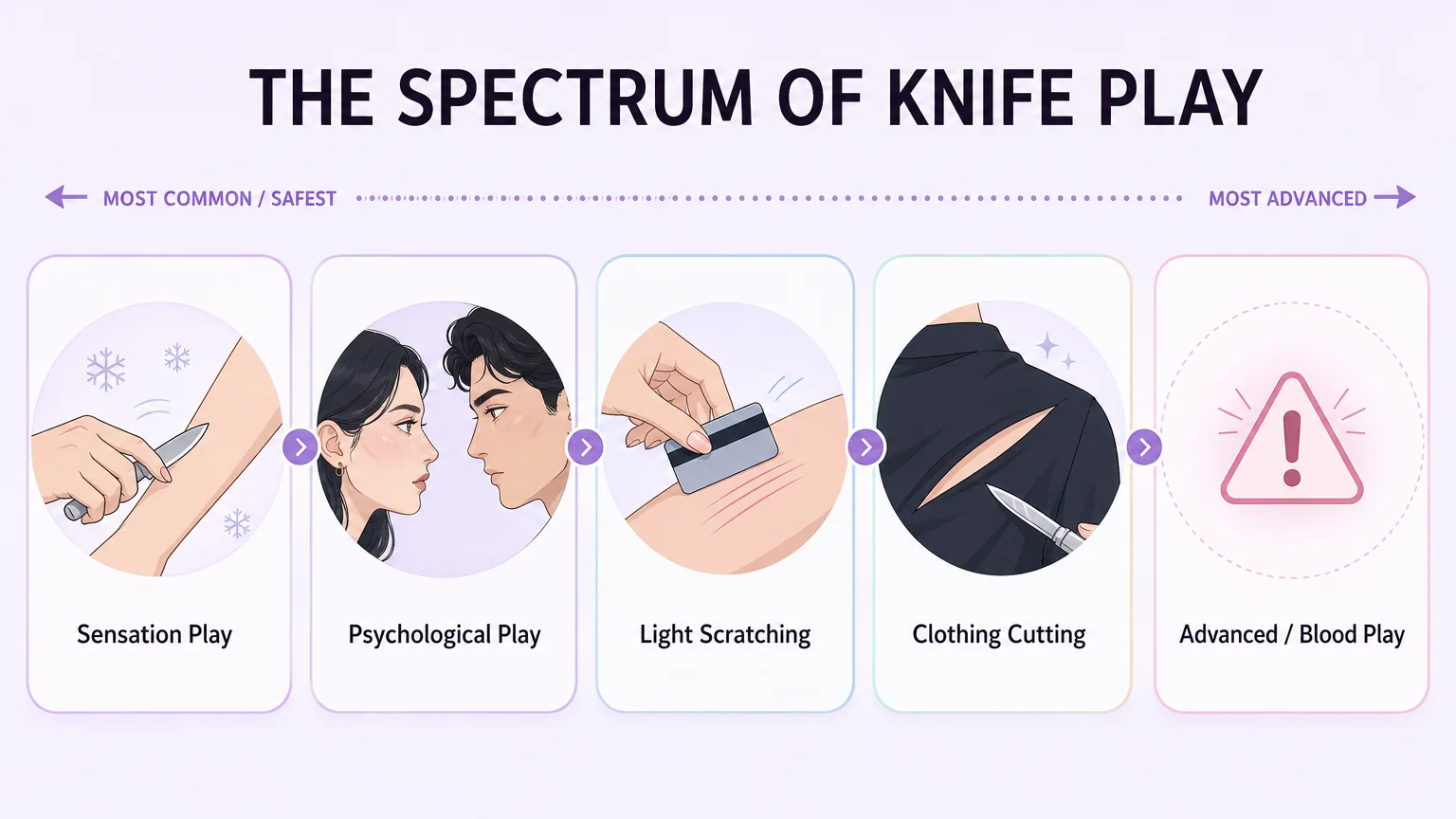
Knife play is consensual edgeplay involving knives or blades for physical and psychological stimulation. Before you picture the most extreme version and close the door, understand the full spectrum.
Sensation play is where the vast majority of knife play lives. Dragging the dull spine of a blade across skin. Cold metal trailing slowly over a shoulder blade or down a thigh. No cutting. No risk of cutting. Just the sensation of temperature, texture, and pressure against the body’s most sensitive canvas.
Psychological play does not require the blade to touch skin. The sound of a knife opening in the dark. The visual weight of it resting on a nightstand. Eye contact held across the blade. The mind fills in what the body does not feel, and the effect is often more intense than any physical contact.
Light scratching and marking produce superficial lines that fade within hours. The edge traces. It does not bite.
Clothing cutting uses the blade to remove clothing. Thrift store outfits are standard. The sound of fabric tearing. The sudden vulnerability. All sensation, all theater, no blood.
Advanced play involves superficial cutting or blood play. This is a separate activity with separate protocols, risks, and training. It sits at the far end of the spectrum. It is not where anyone starts.
What knife play is not: violence, self-harm, a substitute for therapy, or something anyone should feel pressured to try. A partner should never spring this on you without explicit prior negotiation.
Knife play sits within edgeplay alongside fire play, breath play, and needle play. The RACK framework (Risk-Aware Consensual Kink) applies here, not SSC (Safe, Sane, and Consensual). Edgeplay carries irreducible risk. Pretending something is “safe” is more dangerous than honestly naming the risks.
This is also why community education matters. Events like Casa Kink’s Sharps Jam exist specifically to teach edgeplay skills in a supervised environment. The BDSM Wiki’s foundational rule for knife play is straightforward: practice on yourself first before ever placing a blade on another person. Skill is built in layers. Start there.
Why Knives: The Psychology and Sensuality of Knife Kink
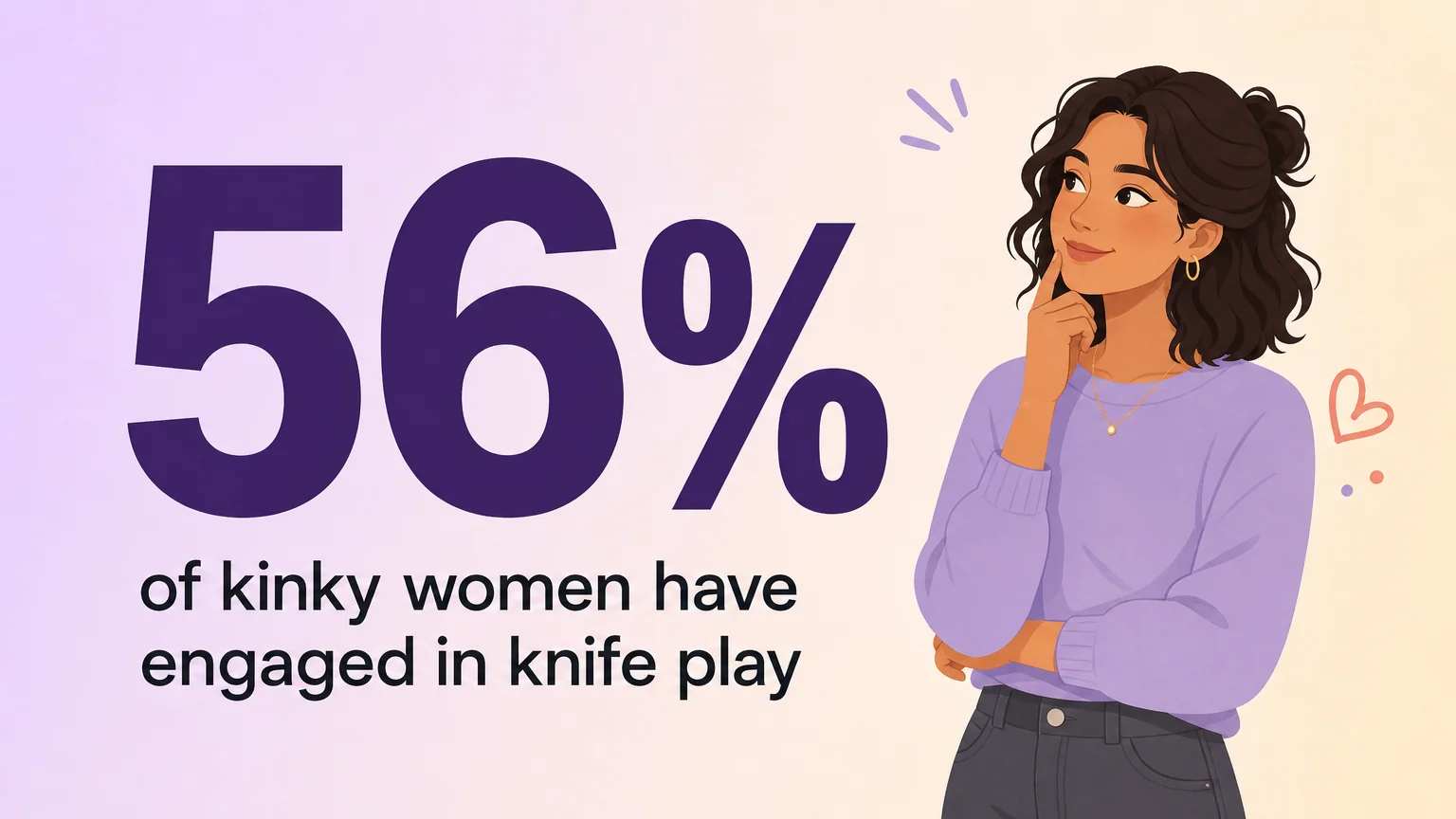
More than half of kinky women have engaged in knife play, according to a landmark study published in the Archives of Sexual Behavior (2015) that surveyed 1,580 women from the kink community.
The neurochemical sequence explains the appeal.
First, the blade appears. The amygdala fires. Heart rate spikes. Sensory awareness narrows to a pinprick. Everything that is not the knife and the partner holding it disappears. Then the blade touches skin. Cold. Adrenaline and cortisol flood the system. The body does not know the difference between a threat and a consensual scene.
Then nothing bad happens. The blade withdraws. Endorphins surge. Dopamine rewards the survival. Critically, oxytocin releases, because the threat was managed by a trusted partner.
That oxytocin spike is the key. This is not just arousal. It is bonding. The neurochemical cascade runs adrenaline, then endorphins, then oxytocin, then dopamine. Each stage deepens the connection. The dominant’s power is defined by their capacity not to harm. The submissive’s arousal comes from confronting primal vulnerability and having fear transformed into pleasure by someone they trust absolutely. This is the psychological engine that makes knife kink one of the most intensely bonding practices in BDSM.
Rose Rivera, a longtime BDSM educator, put it plainly: “When we’re little, we’re told not to play with knives, and so a lot of the times in our sexuality, we take the things that we weren’t supposed to do that were taboo.” This is not pathology. The forbidden becomes erotic. It is one of the most predictable patterns in human sexuality.
Then there is the sensual dimension, which is often the real point. Cold metal on warm skin is an exquisite physical sensation before it is anything psychological. The slow drag of steel. The complete presence a scene demands. For many practitioners, the sensuality is the destination. Sometimes a cold butter knife on a warm back is just that: an extraordinary sensation, shared with someone you love.
Sarah Newbold’s “The Art of Knife Play,” published in February 2025 as the first mainstream guide to the practice, frames knife play as an art form built on precision and presence rather than danger. That framing captures what most practitioners describe: the blade becomes a brush, the skin a canvas, and the shared focus the point of the entire exercise.
Knife Play for Couples: Trust as the Ultimate Turn-On

Knife play, done right, is one of the most intimate things a couple can do. Not despite the blade. Because of it. The knife creates conditions that force total presence, total communication, and total trust. Those are the raw materials of intimacy.
Radical honesty in communication. The negotiation required before a knife play scene forces you to name desires, fears, limits, and aftercare needs in explicit detail. It is a conversation most couples never have. You cannot tiptoe around what you want when a blade is on the table. That clarity spills into every other corner of the relationship.
Proof of trust, made concrete. The bottom offers vulnerability at a level most people never reach. The top proves themselves worthy of it with every controlled movement, every check-in, every moment of focused care. Both partners walk away with evidence that is not abstract. It is embodied.
Neurochemical bonding. The oxytocin released when a trusted partner withdraws a threat creates a bond that conventional sex rarely matches.
Relationship resilience. Couples who navigate high-stakes scenes together report that everyday challenges feel smaller by comparison. When you have placed your body in your partner’s hands and they held it safely, a disagreement about dinner plans loses its charge.
If your partner brought this up, hear this: they are almost certainly not asking because they want to hurt you or be hurt. They are asking because they trust you enough to share a vulnerable desire. That trust, the fact that they brought it to you rather than burying it or taking it elsewhere, is the foundation. You do not have to say yes. But please hear what the asking itself means.
Treat the first scene as a structured trust exercise, not sex. Explicit negotiation. Safety protocols confirmed aloud. Aftercare planned in advance. The goal is the shared experience of extreme vulnerability met with extreme care. Everything else is secondary.
How to Bring Up Knife Play With Your Partner
Wanting to try something that involves a blade does not make you dangerous. It makes you human, with a desire you are trying to navigate honestly.
Pick your moment carefully. A calm, connected time outside the bedroom. Not during sex. Not after an argument. Your tone should be curious, not demanding. You are opening a door, not pushing someone through it.
The opener: “Can I run something by you? I came across something recently that stuck in my head, and I would love to hear what you think.” This frames it as a shared exploration, not a demand.
Name it gently: “It is called knife play. Before you picture anything extreme, most of it is just sensation stuff, like dragging something cold across skin. I am not saying I want to jump into anything.”
Lead with the why: “What actually draws me to the idea is not the knife itself. It is the trust element. The idea of being that vulnerable with you, or having you be that vulnerable with me, and both of us being completely present.”
Then make space. Pause. Do not defend, argue, or push. Your partner’s reaction is information, not rejection.
If they seem unsure: “If it is not your thing, that is completely okay. I care more about us being on the same page.”
If there is mutual curiosity, build safety immediately: “We would start with the safest possible version. Like, literally a butter knife and a blindfold.”
For the partner receiving this: separate “this surprises me” from “this scares me” from “this is wrong.” They are different reactions. Ask questions. “What about it appeals to you?” lands better than “Why would you want that?”
If the initial reaction is negative, do not escalate. A shocked “absolutely not” in the moment is not necessarily a permanent no. Some partners need time to sit with the idea before they can separate their knee-jerk response from their actual boundaries. Give them that time. Do not bring it up again for at least a week unless they do first.
If your partner needs more information before deciding, offer to explore resources together rather than sending them a pile of links. Read an article side by side. Watch an educational video together. Make it collaborative from the start.
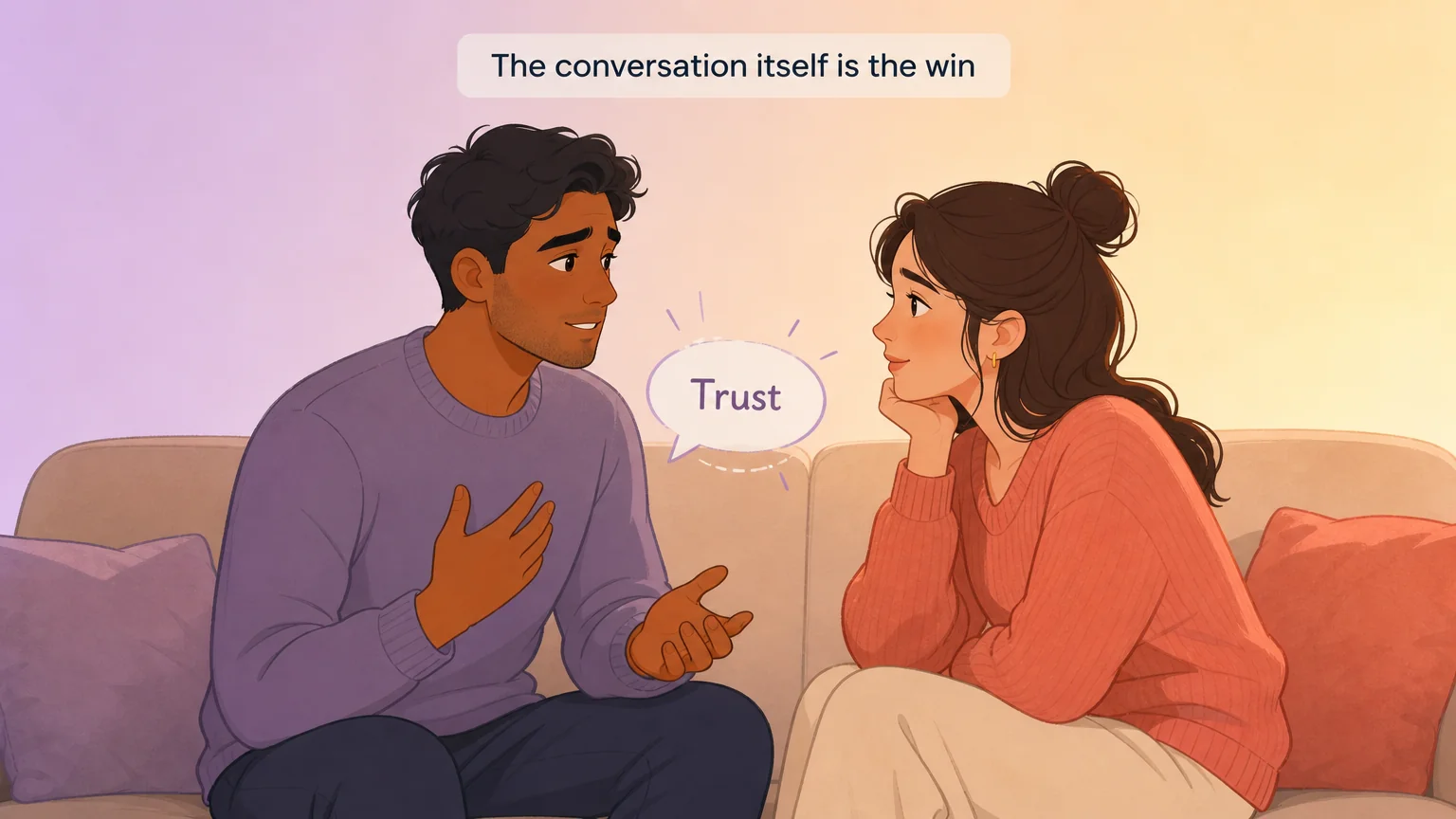
The conversation itself is the win. Whether or not you ever pick up a blade, naming desires, hearing each other, and respecting limits is exactly the kind of communication that keeps relationships alive. A partner who can hear you without shaming you, even if they are not interested, is a partner worth having.
Is Knife Play Self-Harm? The Difference That Changes Everything
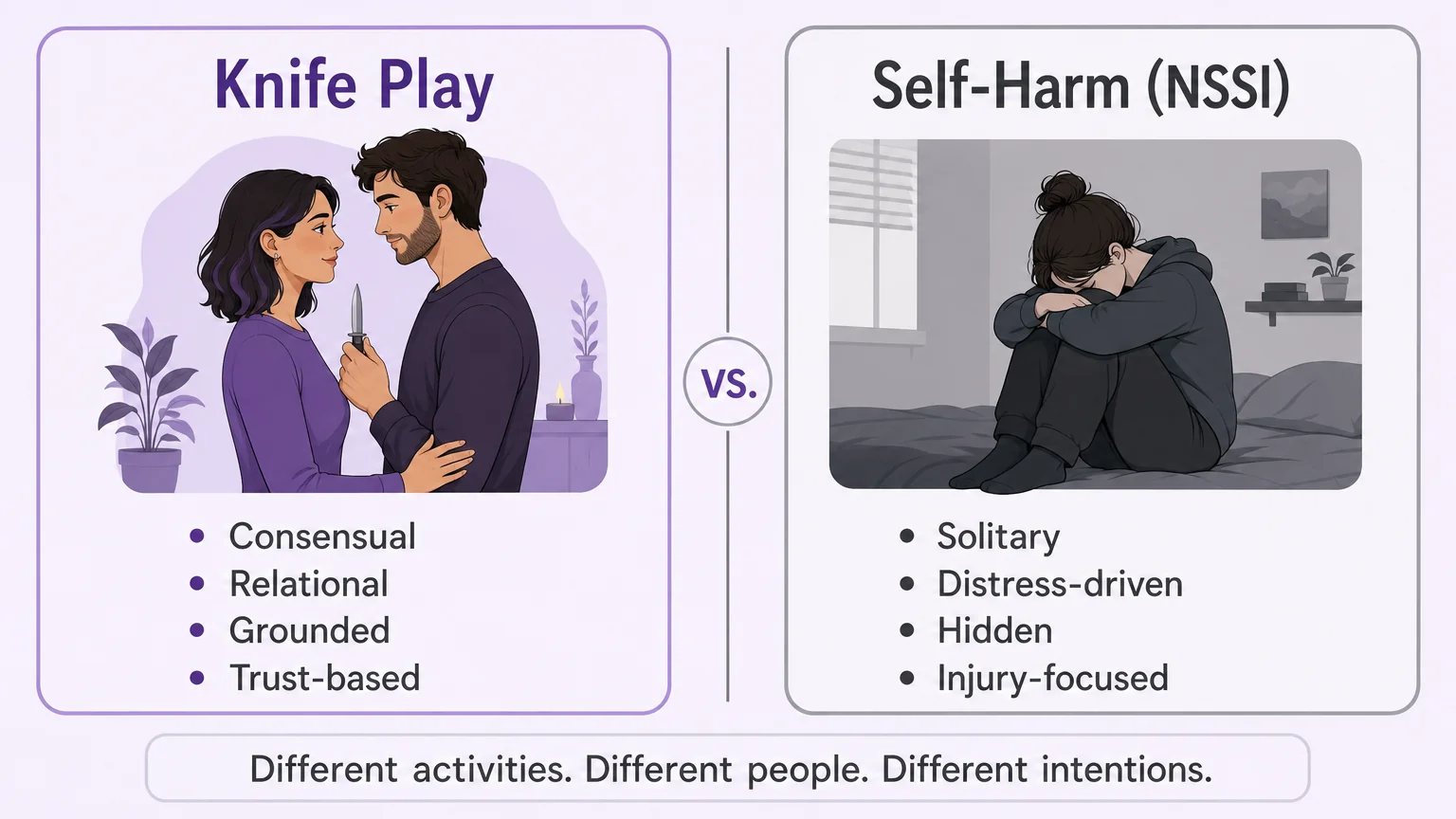
If you have wondered whether knife play is just self-harm dressed up in kink language, you are asking the right question. The answer is no. These are fundamentally different activities, and the distinctions matter.
Intent. Self-harm, or non-suicidal self-injury (NSSI), is a coping mechanism for emotional distress. The goal is the injury itself. Knife play is about sensation, power exchange, trust, and erotic connection. The blade is a tool for intimacy, not a valve for emotional pressure.
Emotional state. NSSI is driven by distress, shame, and numbness. Knife play is entered into from a grounded state with safewords, check-ins, and mutual care.
Context and presence. NSSI is solitary and hidden. Knife play is relational. It requires a partner, negotiation, consent, and mutual presence. The presence of a caring partner who stops at a safeword is not a minor detail. It is the defining feature.
Clinical training from COSRT (the College of Sexual and Relationship Therapists) explicitly distinguishes BDSM practitioners from NSSI populations. These groups differ in personality characteristics, relational closeness, and adverse childhood experiences. The distinction is not theoretical. It shapes how therapists assess risk, how educators design workshops, and how communities set safety norms.
If you are drawn to knife play and have a history of self-harm, that does not disqualify you. Be especially honest with yourself and your partner. A kink-affirming therapist can help you map where your motivations overlap and where they diverge. Ask yourself before a scene: am I seeking connection or relief? The answer tells you whether you are in the right headspace. The goal is erotic connection, not emotional regulation through injury. Those two things travel in opposite directions.
Your First Knife Play Kit: What to Reach For (And What to Skip)
You want to try this, and you definitely do not want to cut anyone. The best beginner tools are either already in your house or cost under forty dollars.
Tier one: zero cost, zero risk. A credit card dragged across skin produces a convincing sharp sensation. A butter knife, especially one chilled in the freezer for ten minutes, is the perfect starter tool. The cold metal feels remarkably sharp against warm skin, and condensation droplets mimic the sensation of something trickling. Your partner, blindfolded, will not know the difference. Start here even if you own fancier tools. Mastering sensation control with zero risk builds the muscle memory and confidence that advanced play depends on.
Tier two: beginner purpose-built. An acrylic training knife, such as the INK by Chaotic Kink (approximately forty dollars, eight inches, just over one ounce), is designed specifically for BDSM knife play. It has realistic weight and feel. It is engineered to give way under excessive pressure. It cannot cut skin. A martial arts training knife in aluminum or rubber does the same job. These tools let you practice pressure control and body mechanics without any medical consequence for mistakes.
Tier three: the real thing. This is not for beginners. A single-edged fixed-blade surgical stainless steel knife is the standard. One side is sharp, one side has a dull spine for sensation play. The counterintuitive truth: a sharp blade is safer than a dull blade for advanced play. Less pressure required, more control, cleaner wound if an accident happens. This is a preview, not a recommendation. Most knife play practitioners never use a live blade, and reaching tier three typically takes months of tier-one and tier-two practice.
What to skip: kitchen knives, folding or pocket knives (joints trap bacteria and can collapse), double-edged blades, serrated blades. Your first tool should feel safe to both of you. If a training knife unsettles your partner, use a butter knife. Starting below your comfort zone is the point.
Techniques and Scene Ideas: From First Touch to Full Experience
The question every curious couple eventually asks: what do you actually do?
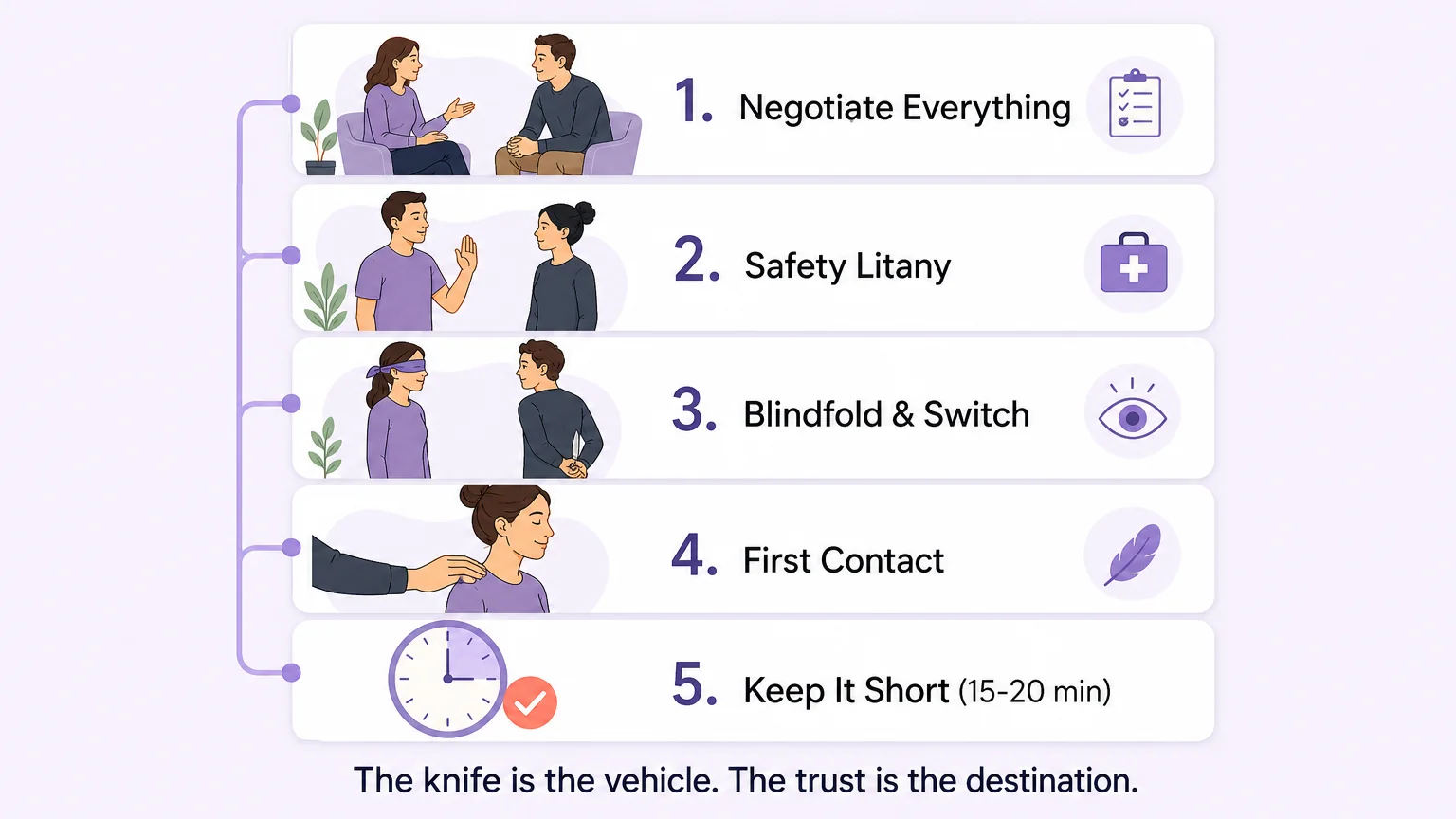
A first scene, step by step.
Negotiate everything beforehand. What will happen, what will not. Where the blade goes and where it never goes. How you communicate during. What aftercare looks like. No surprises.
Perform the Safety Litany together. Both partners name the no-go zones aloud. Both confirm the tool is intact. Both confirm the first aid kit is open. Both verbalize the emergency plan. Both confirm the safeword. Saying it aloud makes it real.
Use the blindfold-and-switch. Show the real knife. Blindfold. Switch to the dull alternative. The mind will not know the difference, but the body stays completely safe.
First contact: light, slow strokes on the back, shoulders, and outer arms. Vary the cadence. Watch breathing and body language. Check in verbally. “Still green?”
Keep it short. Fifteen to twenty minutes for a first scene. End before the intensity peaks.
Beyond the first scene, a catalog of techniques by intensity.
Pure psychological play, zero contact: hold the knife in your partner’s line of sight. Make eye contact. Speak low and slow. The knife never touches skin. The scene is entirely in the mind. This works especially well as a standalone experience. Ten minutes of eye contact across a blade can produce more intensity than an hour of physical play.
Sensation play, no cutting: dull spine dragging, chilled metal trailing, back-of-the-knife pressure, cold butter knife with condensation, credit card simulation under a blindfold. All sensation, no risk. Vary speed and pressure unpredictably. The brain cannot habituate to an irregular rhythm, so every stroke lands fresh.
Temperature play: chill a metal blade in ice water. As it warms against skin, condensation drips. The trickle mimics the sensation of blood without a single drop being real. Alternate cold and warm tools for a contrast that heightens both sensations.
Clothing cutting: thrift store clothing only. The sound of fabric tearing. The sudden exposure. Pair with a blindfold for maximum intensity. Cut slowly. Let the sound do the work. The anticipation between each cut is where the scene lives.
Wax play combination: drip hot wax, let it cool, scrape it away with the dull edge. Hot, cold, and sharp in sequence. This combination creates a full sensory arc that many couples return to repeatedly.
Treat the whole thing as a structured exercise. Negotiate every detail. Use the safest tools. Spend as long on aftercare as you did on the scene. The knife is the vehicle. The trust is the destination.
Safety, Anatomy, and the Legal Reality
Knife play requires preparation. This is not a spontaneous activity. It demands sobriety, focus, and a safety protocol both partners can recite from memory.
These are the zones where the blade never goes: the neck (carotid artery), the inner wrists (radial artery), the inner thighs (femoral artery, where a cut can be fatal within minutes), behind the knees, the abdomen, the face, the genital area, the Achilles tendons, and the chest near the subclavian artery. If you cannot name all of these from memory, you are not ready.
The Safety Litany is your ritual. Both partners name the no-go zones aloud. Both confirm the tool is clean. Both confirm the first aid kit is open. Both verbalize the emergency plan, the nearest hospital, and who drives. Both confirm the safeword.
Your safety toolkit: sterile blades if using real ones, antiseptic (Chlorhexidine or Betadine), sterile gauze, butterfly closures or Steri-Strips, a commercial tourniquet (CAT or SOFTT-W), a hemostatic agent (QuikClot or Celox, emergency only), written emergency contacts, and a charged phone within arm’s reach. Most of this will never be used. That is exactly how you want it.
The legal landscape is gray. In the United States, United Kingdom, and Canada, consent is generally not a valid defense to serious bodily harm. R. v. Brown (UK, 1994) convicted gay men for consensual BDSM where no one needed medical attention. A more hopeful precedent: R. v. Gubbels (Canada, 2022) acquitted a knife play charge after recognizing BDSM as governed, consensual play. Understand the legal risk in your jurisdiction. Consider written negotiation records. The true edge of the blade is not its sharpness, but the clarity of the contract signed between two nervous systems.
Aftercare: The Scene Does Not End When the Knife Goes Down

The hardest part of knife play might not be the scene itself. It might be the hours and days after. Both partners can experience drop. Both partners need care. For knife play, aftercare is as essential as the safety kit.
Physical aftercare starts the moment the scene ends. Disinfect any scratches. Dress any cuts. Sanitize every blade before storing. Offer water and sweet snacks; blood sugar crashes after intense play. Wrap your partner in blankets. The adrenaline drop causes chills that are physical, not emotional.
Emotional aftercare for the bottom includes cuddling, skin-to-skin contact, and talking through the experience. Reaffirm they are safe and cared for. They may feel unexpectedly emotional. This is a normal neurochemical comedown. It passes.
Emotional aftercare for the top is equally critical. Dom drop is real and common. Tops can experience intense guilt, shame, and self-disgust after a scene, even when everything was fully consensual. Holding a blade to someone you love can trigger a psychological backlash hours or days later. This is normal. It is not evidence you are a bad person. It is your brain processing an intense experience. Name it before it arrives. Knowing Dom drop exists and that it follows a predictable timeline makes it easier to ride out.
Specific Dom aftercare: the bottom should message the next day to check in and reassure the top they are not a bad person. Provide detailed feedback about what worked. A simple “I felt completely safe with you” can cut through the shame spiral faster than anything else. Switch out of roles after the scene. Return to being equals who just shared something extraordinary. Journal about feelings if they linger.
The next-day check-in closes the emotional loop. Both partners connect outside of roles. “How do you feel? What came up overnight?” Share what the experience meant to each of you. This conversation often becomes the most intimate part of the entire process. The scene is not finished until it happens.
FAQ
Does knife play always involve blood or cutting?
No. Most knife play never breaks the skin. Deliberately breaking skin is blood play, a separate activity with separate protocols.
Is knife play legal?
It operates in a legal gray zone. Consent is generally not a defense to serious bodily harm. Canada’s 2022 R. v. Gubbels acquittal recognized BDSM as governed, consensual play. Understand your jurisdiction before advancing beyond sensation play.
What is the safest way for absolute beginners?
The blindfold-and-switch. Show the real knife. Blindfold your partner. Switch to a chilled butter knife or credit card. The mind delivers the full experience while the body stays completely safe.
What if my partner says no?
Respect it immediately as a hard limit. The honest conversation was already a win. Do not bring it up again unless they do first.
Can knife play be romantic rather than scary?
Absolutely. The complete presence, vulnerability exchange, and extended aftercare can make a knife play scene more intimate than conventional sex. Many couples say the bonding exceeds anything they have experienced otherwise.
How do I know when I am ready for a real blade?
Handle a blade on your own skin first. Name every no-go zone from memory. Complete multiple dull-blade scenes with clean aftercare. Your partner should articulate exactly what they want. Feel zero pressure to level up. Most practitioners never use a real blade, and that is a complete practice.