Your partner says something during sex. “You feel so good.” “I love the way you do that.” The words land somewhere deeper than expected. Maybe a TikTok crossed your feed and suddenly a dozen half-remembered moments snapped into place: the rush when someone called you a good girl, the way a genuine compliment during intimacy made your whole body respond differently than any touch alone.
Here is what you stumbled into: a praise kink. The term means getting sexually aroused by receiving or giving verbal praise, compliments, and positive affirmation. The line is simple: positive reinforcement during intimacy triggers heightened sexual arousal. Not just a warm feeling. A physical response.
Nine categories of praise kink phrases follow, organized by situation and emotional need. No dungeon required. No scene to negotiate. Just words you can actually say, plus a guide for getting them past your lips. Pick what fits. Skip what does not.
1. The Classics: “Good Girl,” “Good Boy,” and Why Two Words Hit So Hard
“Good girl” and “good boy” are the gateway phrases for a reason. Short, instant role dynamic, work in almost any intimate context. The category extends far beyond two words.
Seven variations worth keeping:
- “That’s my good girl.” The possessive anchor changes the delivery. Ownership, not just approval.
- “Who’s my good girl?” The question form invites a response. It opens the interaction instead of closing it.
- “You’re being so good for me.” Affirm the effort, not just the result.
- “Such a good girl. I’m proud of you.” The second sentence lands hardest.
- “You want to be a good girl for me, don’t you?” Teasing. Pulls them toward the role instead of assigning it.
- “Good pet” or “Good [kitten/puppy].” Adjusts the frame without changing the mechanism.
- “That’s it. That’s my good girl.” Certainty. Closes the loop.
The question form invites participation. The statement form delivers certainty. Mix them based on whether you want to open up interaction or lock in a moment.
These tap into approval-seeking circuitry. They are performance-based praise: you are good because of what you are doing. The categories ahead target who someone is, not just what they are doing for you.
2. Body Talk: Phrases That Make Someone Feel Completely Wanted

Physical praise is the easiest entry point. Zero role-play. Zero special vocabulary. You are saying out loud what you are already thinking. The only rule: be specific. “You’re hot” is forgettable. “The way your back arches when I touch you” is not.
Try these:
- “You look so good in that.” Simple, immediate, about something they chose to wear. Lands before anything physical starts.
- “Your [body part] is irresistible.” Fill in the blank. Specificity makes it real.
- “You taste so good. I can’t get enough of you.” Sensory and urgent.
- “You’re so beautiful right now.” The word “right now” says “I am seeing this version of you, in this moment.”
- “God, you look amazing.” Short. Breathless. Works mid-scene.
- “Everything about you is perfect.” Use sparingly. Overuse dilutes it.
- “Look at that pretty face.” Playful. Appreciating them like a piece of art.
- “I can’t stop thinking about your [body part].” The anticipation version. Drop it before anything happens and let it simmer.
A practical tip: target the traits they are most proud of, or most insecure about. If they work hard on their arms, praise their arms. If they have a complicated relationship with their stomach, a genuine “I love the way your stomach looks right now” can be transformative. Specificity proves you are paying attention. If you do not actually find something gorgeous, do not say it.
3. In the Moment: What to Say While It’s Happening

During-sex praise is not about poetry. It is about rhythm. The best phrases are short enough to say on a single exhale because you are, presumably, otherwise occupied.
Start with these:
- “Just like that.” Three words. Infinite applications.
- “That’s it. Don’t stop.” Encouragement plus direction.
- “Yes. Yes, exactly.” Pure positive feedback.
- “You’re doing amazing.” Clean, simple, exactly what someone in their head needs to hear.
- “God, you feel so good.” Sensation-focused. What they are doing to you, right now.
- “You look incredible under me.” Visual appreciation during the act.
- “You take it so well, baby.” Frames effort as skill.
- “You kept eye contact that whole time. Good job.” Micro-specific. “I noticed exactly what you did.”
- “You remembered exactly what I asked. That’s so good.” Recognition of attentiveness.
For a partner who gets in their head during sex, hearing “I love that, keep going” signals safety to their nervous system. Praise activates the autonomic nervous system, creating feelings of belonging. This is real-time reassurance that prevents the mental spiral of “am I doing this right?”
Try using traffic-light check-ins as natural insertion points. When they respond “green,” tell them you are proud of them for knowing their body so well.
4. Deeper Than Sex: Phrases That Recognize Who Someone Is
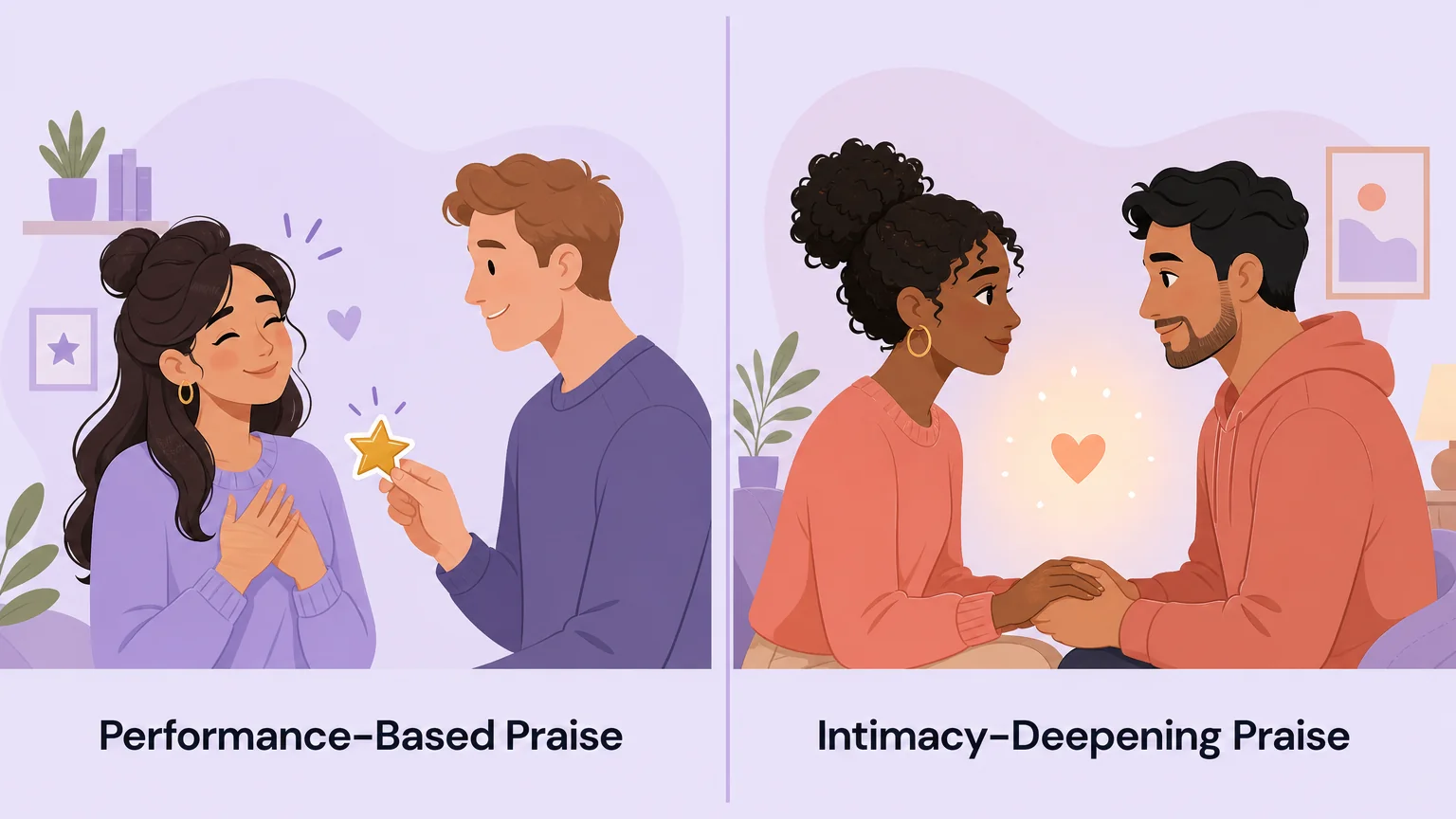
These are for after something vulnerable happened. After they let you see them fully. Not about what someone is doing. About who someone is being with you.
This is intimacy-deepening praise:
- “The way you trust me with your body tonight touches something deep in me.” The gift of trust.
- “Even when you were unsure, you stayed connected, and that meant everything to me.” Emotional courage.
- “Most people don’t notice how deeply you listen, but I felt it in every word I spoke.” A quality usually unseen.
- “You don’t have to be perfect with me. You just have to be here.” Praise as permission.
- “I watched you go somewhere really raw tonight. You stayed open even when you were scared.” Bravery in vulnerability.
- “I have never seen someone so beautiful when they let go.” Stays with someone for years.
- “I see you. I feel you. And you matter.” Each lands deeper than the last.
A warning: for many people, praise is actually scarier than being degraded because it touches the parts a person desperately wants to believe but does not fully trust yet. Use these when you mean them, and stay present for whatever comes up.
Performance-based praise says “you did good.” Intimacy-deepening praise says “you are good because of who you are.” This category is for the moments that matter.
5. You’re Mine: Possessive Praise That Feels Like Belonging
Possessive praise is where “you’re mine” lives, and it is bigger than most people realize. The classics section affirmed a role. These phrases affirm a bond. They say you belong here, with me, and that belonging itself is the turn-on.
Try these:
- “You’re mine. All mine.” The archetype. Direct, unapologetic, endlessly adaptable to tone.
- “I can’t believe I get to be the one who sees you like this.” Belonging reframed as gratitude.
- “No one else gets to see you like this.” Exclusivity as praise. Showing you this version is the compliment.
- “This body is mine tonight.” Primal. Use with negotiated consent.
- “You belong to me.” Heavy. Direct. Use intentionally.
- “I’m keeping you.” Lighter. Whispered during afterglow, it lands as promise, not command.
- “Look at what’s mine.” Admiration plus possession combined.
Possessive praise ranges from soft (“I’m keeping you,” whispered) to primal (“this body is mine,” growled). Match the intensity to the moment and to what your partner actually responds to.
The consent layer matters: possessive praise works because it is chosen, not assumed. “You’re mine” feels good precisely because the person hearing it has freely given you that claim. Without that foundation, it is just control. With it, it is belonging.
6. Flirty and Playful: Praise That Teases and Builds Heat

Playful praise is the smirk in your voice. Not heavy. Not profound. A compliment delivered with a raised eyebrow and a hand on their hip: teasing, anticipatory, fun. For couples just starting to vocalize during sex, this is the easiest lane because it feels like flirting, not performing.
Here is what it sounds like:
- “You have no idea what you’re doing to me.” Faux-exasperated. “You are affecting me more than you know.”
- “What a sweet little treat you are.” Playful. Tone carries the meaning.
- “Someone’s eager tonight.” Teasing observation. Acknowledges desire without making it heavy.
- “Look what you do to me.” An invitation to see the effect they have. Let them look.
- “You’re such a pleasure to touch.” The verb you choose sets the entire tone.
- “You look so precious when you’re needy.” Teasing vulnerability without mocking it. “Precious” does the work.
- “I’ve been thinking about you all day.” Anticipatory. Builds heat across hours.
One couple discovered this by accident. Neither knew the term “praise kink.” They started saying what they actually felt during sex: shy compliments that turned into a back-and-forth rhythm neither expected. Flirty praise is not a performance. It is what happens when you stop filtering the thoughts already in your head.
7. Over Text: Praise Phrases for When You’re Not in the Same Room

Texting is the recommended starting point: you craft your words, edit before sending, and process the response without being physically exposed. For anyone who freezes up in person, this is the training ground.
Send these:
- “I can’t stop thinking about how good you looked today.” Physical, specific, low-pressure.
- “You made me feel so calm when you talked like that.” Emotional and unexpected.
- “I keep thinking about last night.” Anticipation builder. Let them wonder which part.
- “You’re going to earn something special when I get home.” Praise as promise. The waiting is part of it.
- “You’re so good at making me feel wanted.” Meta-praise about their effect on you.
- “I love how responsive you are even from a distance.” The connection persists across physical space.
- “Counting down the hours.” Short, suggestive, zero pressure.
Voice notes deserve their own mention. Hearing your partner’s voice say “good girl” or “I’m proud of you” through headphones can be electric. A ten-second recording carries someone through their afternoon.
For couples navigating distance, keep a shared note where you log specific compliments after each encounter. It becomes a record either partner can revisit. Written praise has a shelf life spoken praise does not.
8. After It’s Over: Phrases for the Quiet That Follows

The minutes after sex are when praise does its most important work. During sex, praise is fuel. After sex, praise is glue. It tells your partner they are still wanted, still valued, still seen. For beginners especially, this is where trust gets built.
Reach for these in the quiet:
- “I’m so lucky to have you.” Simple, unambiguous, impossible to misinterpret.
- “You were perfect for me tonight.” The words “for me” matter. A personal truth, not an objective rating.
- “Thank you for being such a good girl.” Gratitude framing. “You gave me something, and I noticed.”
- “You handled that so well. I’m proud of you.” Acknowledging effort, not just outcome.
- “You trust me, and that means everything.” Names the foundation.
- “You make me feel so good, and I hope I did the same for you.” Reciprocal. Opens the door for them to share.
- “You took everything so well.” An aftercare classic.
A morning text saying “I’m still thinking about last night” extends the praise across time.
Try a debrief afterward: “How was that for you? How did you like it? What could I do differently?” The debrief is itself praise. It says “your experience matters to me.”
9. For the Group Chat: Praise in Threesomes and Beyond
Most praise kink content assumes two people. That leaves out anyone exploring threesomes, swinging, or group dynamics. Praise does not break when more bodies enter the room. It scales.
Here is what it sounds like in a group context:
- “You’re doing beautifully.” Steadying and warm. A grounding anchor when nerves are up.
- “I love watching you two together.” Witnessing praise. You are the audience, and you like the show.
- “You look amazing between us.” Frames the person as the center of something beautiful.
- “You’re being so good for everyone.” Collective framing. The praise comes from the whole room.
- “You handled all of that so well.” Navigating multiple partners is a skill.
One idea: friends taking turns telling someone what they appreciate about them, one by one, in detail. Praise in group settings can be structured and intentional.
A boundary note: praise carries additional weight in group settings because it is witnessed. Be intentional about spreading attention. Praising one partner effusively while staying silent toward another can sting. The skill is the same: genuine, specific, well-timed affirmation. You just have more people to aim it at.
How to Actually Say These Out Loud
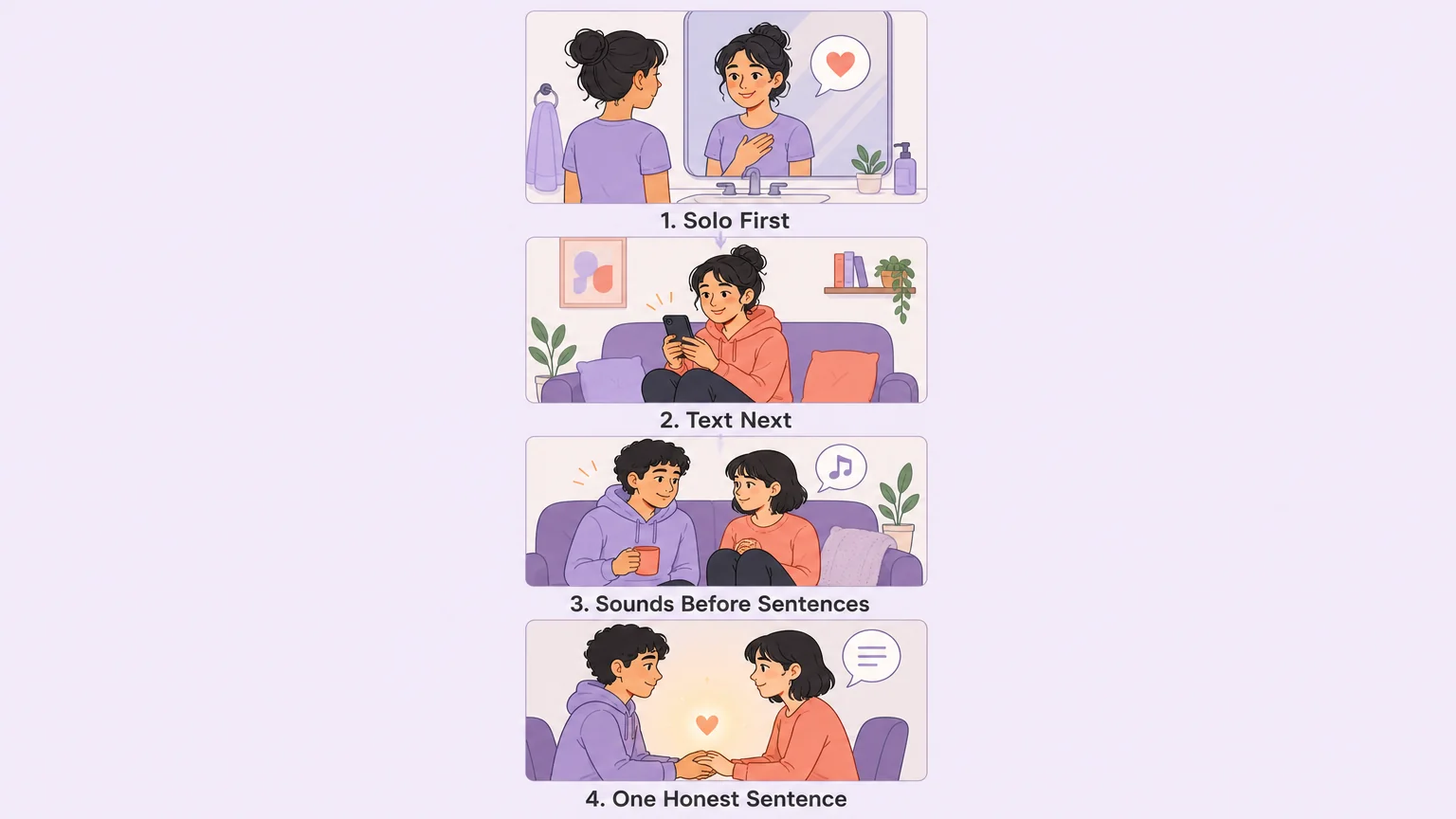
Having the words is one thing. Saying them is another. Here is how to get from “I could never” to “I just did.”
The Practice Ramp
- Solo first. Say phrases aloud to yourself: in the shower, in the car, into a voice memo. If a phrase makes you cringe alone, it will not land with a partner.
- Text next. Start with “I can’t stop thinking about how good you looked today.” Sit with how it feels to send it and when they respond.
- Sounds before sentences. During sex, start with moaning, sighing, a whispered “yes.” Build the muscle without the pressure of full phrases.
- One honest sentence. Say one true thing you actually feel: “You feel so good.” “I’ve been wanting this all day.”
The Delivery Rules
- Mean it or skip it. Insincere praise is worse than silence.
- Time it in the pause. Praise lands hardest between breaths.
- Pair it with touch. A hand on the back of the neck gives words somewhere to land.
- Match your natural voice. Do not perform a character.
When It Flops
Laugh together. Shared awkwardness can deepen connection more than a perfect line. If something crosses a line, “that was not it for me” resets everything. It may be funny, it may be awkward, it may be messy. You get to talk about it.
FAQ
Does having a praise kink mean I have low self-esteem?
No. Praise kink is about how affirmation interacts with arousal, not about compensating for insecurity. You can have solid self-worth and still get turned on by being told you are doing beautifully.
Can men have praise kinks?
Yes. Men in high-pressure careers often experience sexual praise as the only context where they feel genuinely wanted for who they are, not what they produce. One man discovered his when his girlfriend praised him back.
Can I have both a praise kink and a degradation kink?
Yes, this combination is common. Some enjoy degradation during a consensual power struggle and praise as the reward after submitting. “My pretty little slut” carries both in one breath.
Do I need to be into BDSM to enjoy a praise kink?
No. Praise kinks can and do pop up in otherwise vanilla sexual contexts. Communicating genuine appreciation during intimacy belongs to everyone.
What if I try this and it does not work for me?
Then you learned something useful. If the phrases feel forced or the dynamic does not click, let it go. The goal was never a new label. It was understanding your desire.