You are at a party, or listening to a podcast, or lying awake at 2 a.m. with a question you cannot shake. Someone says “kink.” Someone else says “fetish.” Everyone nods like they know the difference. They do not. Most people do not. The confusion is not a personal failing. People use these terms interchangeably everywhere, and clear explanations remain hard to find. That quiet pause where you pretend to follow along is the reason this article exists.
People swap the words like synonyms, but they describe two different things about how desire works. Plain-language clarity on this distinction is hard to find. Here it is.
Here is the promise: by the time you finish reading, you will understand what separates a kink from a fetish across five clear dimensions. That knowledge will change how you think about whatever it is you are curious about, and give you the language to talk about it. No judgment. No clinical distance. Just clarity, delivered like someone who actually wants you to understand.
What Each Word Actually Means
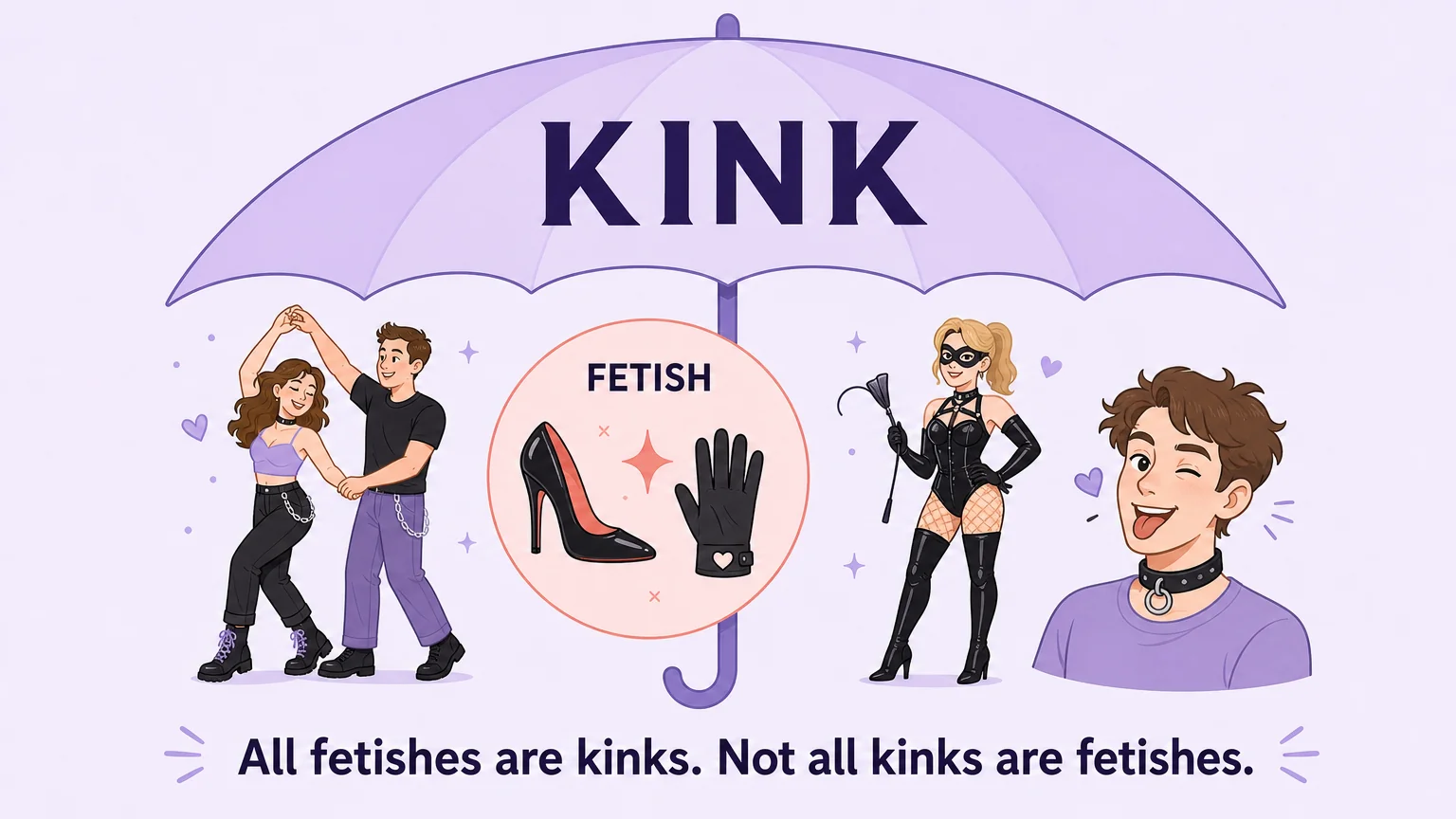
Kink is the big tent: any form of sexual expression that falls outside the mainstream. That covers BDSM, role-play, sensation play, power dynamics, voyeurism, group sex. The whole landscape of “not vanilla.” It is an umbrella term, broad by design. It is not a clinical category. It is a cultural one. The line between vanilla and kink shifts across time periods, communities, and individual relationships. If you have ever been curious about something you did not hear about in health class, you have brushed up against kink.
A fetish is the specific thing under that umbrella. It is an enduring sexual fascination with a particular non-genital body part (feet, hair, hands), an inanimate object (shoes, stockings, leather), or a specific material (latex, rubber, silk). The fixation is durable. It does not come and go with moods or seasons. Clinically, a fetish persists for at least six months and centers on something other than genitals: a body part, a texture, a garment, a material.
Here is the hierarchy that makes everything click: all fetishes are kinks, but most kinks are not fetishes. A fetish lives inside the kink category like a square inside a rectangle. Someone with a rope fetish has a kink, but someone with a bondage kink does not automatically have a rope fetish. Someone who needs verbal praise to reach arousal has a praise fetish; someone who enjoys praise during sex but does fine without it has a praise kink. The direction only runs one way.
Definitions are the foundation. But the sharper distinction is in how each one operates inside your desire. That is what the next five sections map out, one dimension at a time.
1. Kink vs Fetish: Enhancement or Necessity?
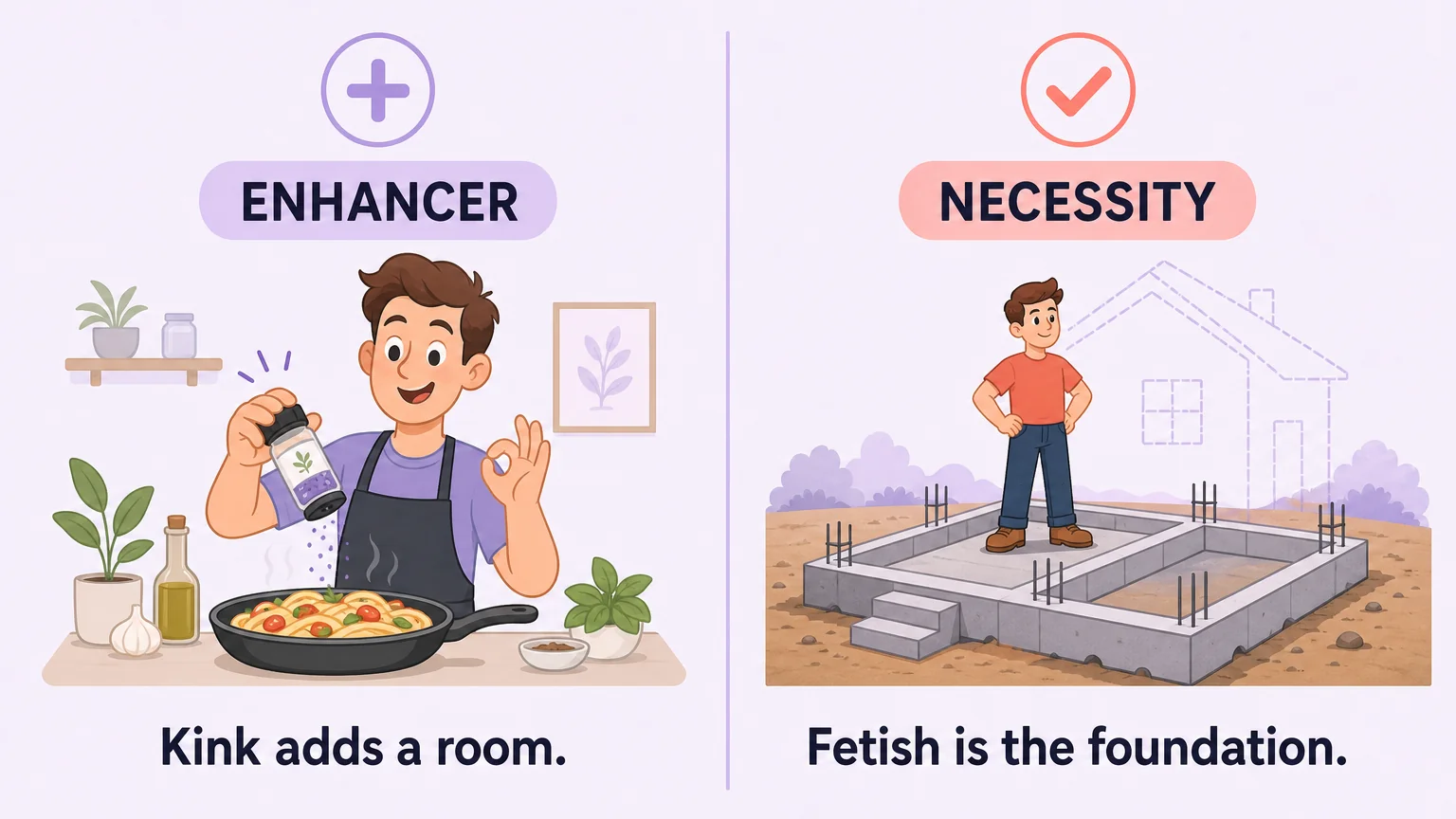
The most useful question you can ask yourself: is this thing an enhancer, or a necessity? Does it add heat to an already-working engine, or is it the engine itself? This is the single most useful distinction in the entire kink-vs-fetish conversation. If you only take one concept from this article, take this one.
Take a couple who enjoys spanking during sex. The spanking intensifies everything, makes it electric, but they have satisfying sex without it. On a Tuesday night when neither of them has the energy for theatrics, they still connect just fine. That is a kink. It adds. It does not anchor.
Now take someone who finds high heels arousing and enjoys incorporating them into sex. If heels add a charge but the evening works without them, that is a high-heel kink. If the person cannot experience arousal unless high heels are present, that is a high-heel fetish. Same object. Different relationship to it. This is why two people can share the same interest but experience it at completely different levels of intensity. The object is identical. The psychological role it plays is not.
The test itself is simple: if you removed this element from your sex life entirely, would your arousal still function? A “yes, but it would be less fun” points toward kink. A “no, I genuinely cannot get there without it” points toward fetish. Kink adds a room to the house. Fetish is the foundation.
That test is clean on paper. In real life, it gets messier, because desire does not live in two neat boxes.
2. Kink vs Fetish: A Spectrum, Not Two Boxes
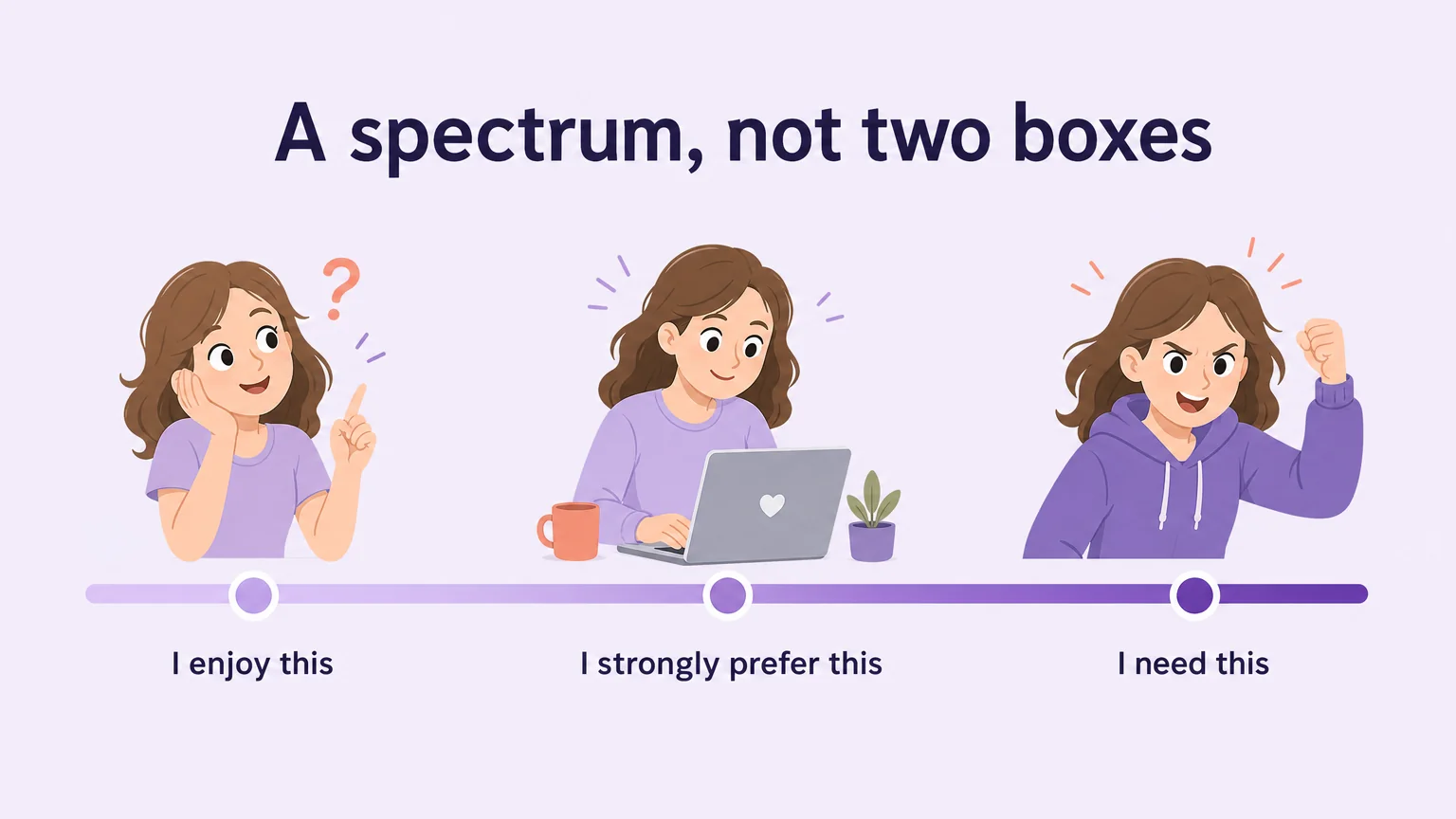
Kink and fetish are not separate containers. They are points along a single line. The more narrowly focused your erotic interests become, the more intense the arousal from a particular object or activity, and the more exclusive that arousal, the further along the spectrum you move.
At the near end: “I enjoy this.” A clear preference that adds heat, but sex works without it. In the middle: “I strongly prefer this and sex feels incomplete when it is missing.” The thing has become central. A partner who needs a power-exchange dynamic to feel fully engaged, but can still experience arousal through other pathways. At the far end: “I can only experience arousal through this.” The fetish has become the exclusive channel.
Most people are not at the poles. Even people with fetish-level interests often still enjoy non-fetish sex. The necessity is relative, not absolute. The question “when does a kink become a fetish?” does not have a single clean answer because it is rarely a single moment. The binary is seductive. It promises a clear label. But desire is messier than that.
For some, the intensity intensifies gradually over years. For others, it was there from the first moment of discovery. If you do not fit neatly into either box, you are in good company. Most people do not.
If intensity alone does not draw the line, what else separates them? The answer is in what each one fixates on.
3. Kink vs Fetish: Activities or Objects?
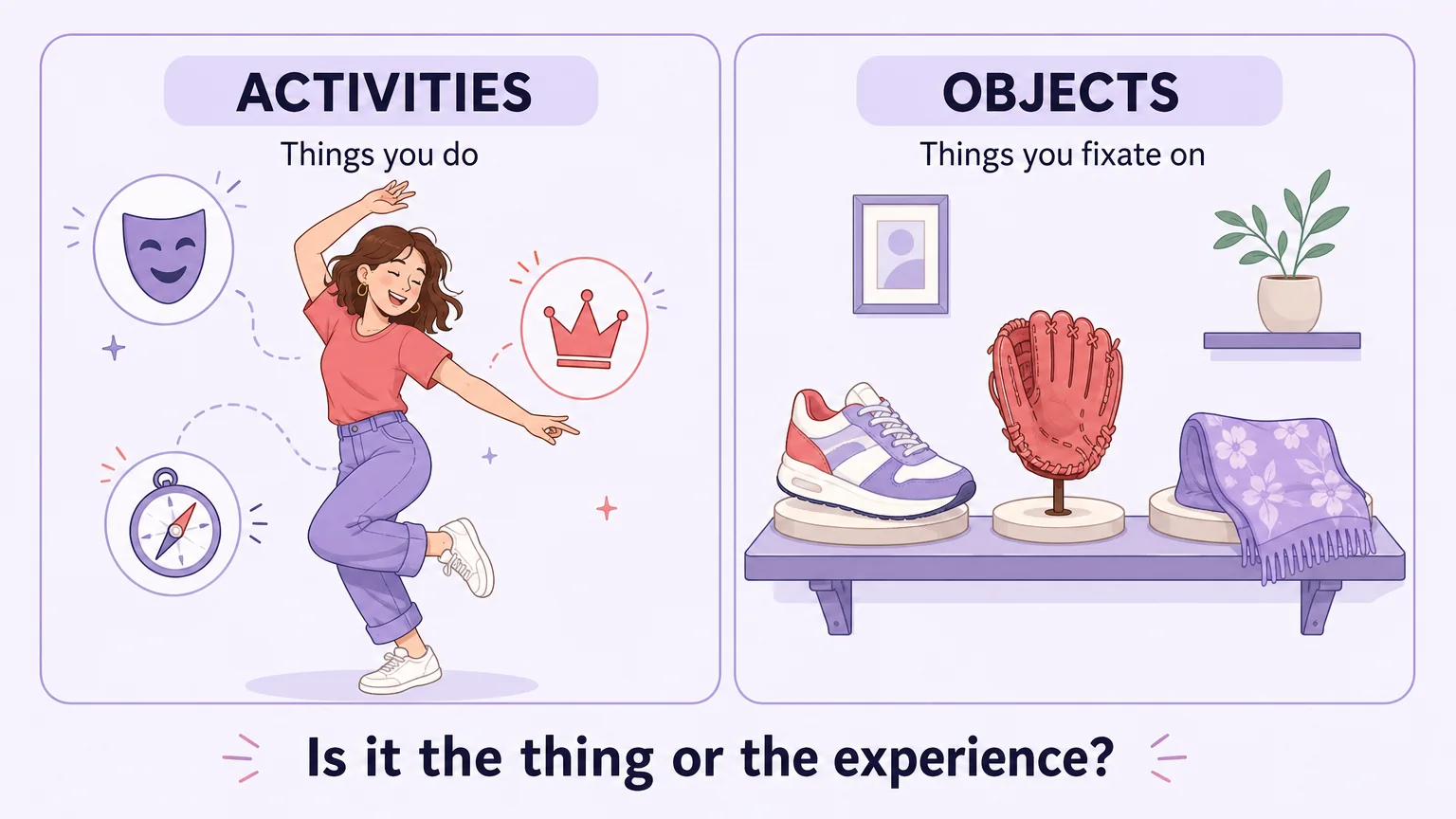
A fetish almost always fixes on a thing. Feet. Leather. Latex. Hair. Shoes. Stockings. These are objects or body parts you can point to. A kink typically attaches to an activity or a dynamic: being tied up, giving up control, taking a role, exploring a sensation. These are things you do.
This is why BDSM activities live in kink territory. Someone who enjoys being restrained during sex has a bondage kink. They do not have a “bondage fetish” unless rope or restraints specifically, as objects, are required for their arousal. Someone who enjoys the sensation of being tied up during sex but does not fixate on rope itself has a kink. Someone who cannot get aroused without rope in the room has a fetish. The activity versus the object: that is the line.
The science adds another layer. Big Think’s Tree of Kink research mapped how fetishes cluster into recognizable families: foot-related (feet, shoes, stockings), leather-and-rubber (latex, PVC, rubber), body-fluid-related. Having one fetish in a cluster statistically predicts interest in others in the same cluster. If someone has a foot fetish, they are more likely to also have a shoe or stocking fetish than a latex one. Your desires are not random. They follow patterns that researchers are only beginning to map.
Ask yourself: is it the thing that pulls you, or is it the experience? The answer tells you something about where you land.
4. Kink vs Fetish: Flexible or Fixed?
Kinks are curious by nature. Someone who experiments with role-play this year might discover sensation play next year, then find themselves drawn to power dynamics two years later. A kink that felt electric at 25 might feel routine at 35. A new partner introduces an interest you never considered. That flexibility is part of what makes kink exploration feel open-ended and playful.
Fetishes are different. Because they are typically formed through conditioning or imprinting at key developmental moments, they tend to be stable. The neural pathways that anchor a fetish do not rewire themselves easily. A foot fetish that emerged in adolescence is likely still there decades later. A latex fetish does not typically swap out for a leather one next season. This is not rigidity for its own sake. It is a predictable consequence of how the brain encodes these associations.
This stability is not a problem. It is simply how fetishes work. The research supports this: people with fetishes consistently describe them as enduring, unchanging features of their sexuality, not passing phases. Fetish interests reported in early adulthood typically persist unchanged decades later.
Understanding this distinction matters because it shapes expectations. If you have a kink, treat it as an invitation: something to explore and see where it leads. If you have a fetish, treat it as information: something to integrate into how you build a fulfilling sex life. Both approaches are valid. They are just different.
5. Kink vs Fetish: How Each One Forms
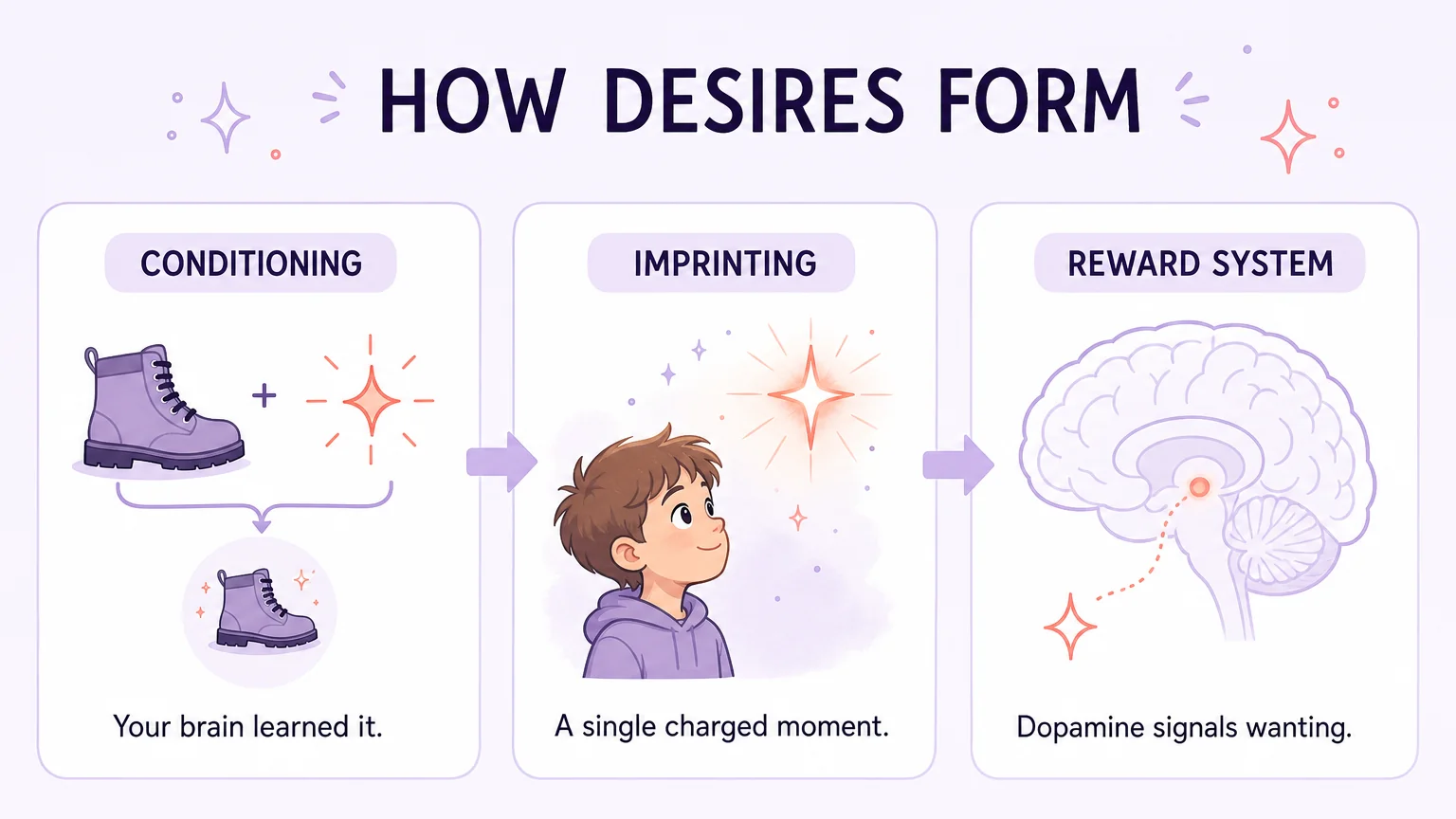
Your desires did not fall out of the sky.
The strongest scientific account for how fetishes form is classical conditioning. A neutral stimulus paired with sexual arousal enough times eventually triggers arousal on its own. In the 1970s, researchers Rachman and Hodgson proved this directly: men shown nude images paired with boots later responded with arousal to boots alone. The response even generalized to sandals and high heels. Your brain learned it. That does not make it less real. It makes it explained.
Some fetishes seem to form through sexual imprinting: a rapid, durable connection forged during a single emotionally charged moment in childhood or early adolescence. A foot fetish, for example, might trace back to a childhood incident where feet became stamped with an emotional charge: a moment of shame, excitement, or intensity that the brain never let go of.
At the neurological level, the brain’s dopamine reward system gives the fetish object “incentive salience.” Dopamine signals wanting, not liking. That is why fetish desires can feel non-negotiable. They live in the brain’s “must have” circuitry, not its “enjoy” circuitry.
Kinks, by contrast, form more casually: through curiosity, exposure to new ideas, positive sexual experiences that open doors to further exploration.
And foot fetishes, preferred by roughly 47% of people with fetishes, may have a biological component. The brain regions for foot sensation and genital sensation sit directly adjacent in the somatosensory cortex. Some researchers suspect neural crosstalk: a literal overlap in the brain’s body map that makes the connection feel hardwired.
Your desires have a history. That history makes sense.
How to Talk About Either One With a Partner

Knowing what separates a kink from a fetish is useful. Saying it out loud to someone you care about is the part nobody teaches, and it is the part most people lose sleep over.
Start with timing. Choose a calm, non-sexual moment: cooking dinner, walking, lying on the couch. Never during sex. Never when either of you is tired, hungry, or rushing.
Lead with love. “This is not about something missing. This is about something I want to explore with you.” That one sentence changes the frame from deficit to invitation.
Frame it as curiosity, not demand. “I have been thinking about something I might be curious to try” lands completely differently than “I need you to do this.”
Name the feeling underneath: trust, surrender, sensation, vulnerability. “I think I am curious about what it would feel like to give up control a bit” is a door someone can walk through.
Make space for their reaction. Enthusiasm, confusion, curiosity, and discomfort are all valid responses. If they say no: “Thanks for being honest with me. I am glad I can talk to you about this.” A no is not incompatibility. It is clarity. You can explore independently through fantasy, reading, and online communities.
The disclosure itself, done well, builds intimacy regardless of the answer. Make it a two-way conversation. Ask what they have been curious about. The goal is not getting a yes. It is both of you feeling like you can say what you want out loud.
Your First Move: Exploring Without Overwhelm
Understanding the difference is step one. Step two is doing something with it, without diving into the deep end before you know how to swim.
Start with yourself. Journal about what draws your curiosity. Not just the what, but the feeling underneath. Is it about trust? Surrender? Sensation? Power? That feeling is your compass.
Educate yourself before involving anyone else. Gigi Engle’s “Kink Curious” is the best entry-point book for beginners. Evie Lupine’s YouTube channel covers everything from praise kink to aftercare with warmth and precision.
When you are ready to try something with a partner, introduce one small element: a blindfold, not a full dungeon scene. Use the traffic-light safe-word system: green means continue, yellow means slow down and check in, red means stop immediately. Negotiate explicitly before any play: interests, limits, roles, safe words, specific terms for language and touch.
Aftercare is not optional. It is the emotional cooldown that keeps both of you safe and connected afterward.
If you want to find community, start with FetLife. Create a pseudonymous account, go to the Events tab, search for “munches” in your city. Munches are casual, non-sexual gatherings at restaurants or cafes. Message the host to say you are new. Attend in regular clothes. Talk about normal things. Go several times before deciding.
Exploration is not a performance. It is a practice. Start small. Stay curious. The goal is not to become someone else. It is to become more of who you already are.
The Difference That Changes How You See Yourself
The difference between kink and fetish is not academic trivia. It is a lens for understanding yourself. You now know the five dimensions that separate them: enhancement versus necessity, spectrum versus binary, activities versus objects, flexibility versus stability, and casual formation versus conditioned imprinting. Each dimension offers a different angle on the same core question: what is this desire, and what does it ask of me?
Knowing whether something is enhancement or necessity changes how you approach it: with a partner, with yourself, in how you build a sex life that actually fits.
If it is a kink: you have an invitation. Here is a door. See what is behind it. You can open it or not, and that freedom is the point.
If it is a fetish: you have information. This is part of how you are wired, and the task is building a sex life that makes room for it. Neither statement is better or worse. They are different maps for different terrain.
The data backs the normalization. Over 90% of Americans report having BDSM-related fantasies. Nearly half have tried something. Research consistently finds that people who practice kink tend to score higher on measures of psychological well-being: less neurotic, more conscientious, stronger communicators.
The DSM-5, the manual clinicians use to diagnose mental health conditions, is explicit: having an atypical sexual interest is not a disorder. It only becomes one when it causes significant, lasting distress or involves people who cannot consent. Most people with kinks and fetishes never come close to meeting clinical criteria. Their desires are a normal variant of human sexuality.
The distinction between kink and fetish is useful, but it is not the question that matters most. The question that matters is: how do I bring this part of myself into my life in a way that feels good, safe, and true? Answer that, and the labels take care of themselves.
Questions You Probably Still Have
Is it normal to have kinks or fetishes?
Completely. Studies show over 90% of Americans report BDSM-related fantasies, nearly half have tried something, and an estimated 45 to 60% of the population has some form of kink. About 10% have a fetish. The DSM-5 is clear: having a kink or fetish alone is not a disorder. Desire does not require an apology.
Can a fetish be changed or “cured”?
Fetishes formed through conditioning create durable neural pathways that resist quick fixes. Therapy with a kink-aware provider can help manage distress around unwanted interests, but most people find accepting and integrating their fetish into consensual sexual expression more effective than trying to eliminate it. The goal is self-acceptance, not erasure.
Is BDSM the same as having a fetish?
No. BDSM is a broad category of kink activities involving consensual power exchange: bondage, discipline, dominance and submission, sadism and masochism. These are activities and dynamics, not object fixations. Someone who enjoys being tied up has a bondage kink. They have a fetish only if rope or restraints themselves, as objects, are required for arousal.
What is the difference between a kink and a paraphilia?
In clinical language, “paraphilia” is the medical term for what most people call a kink: any atypical sexual interest. A “paraphilic disorder” is diagnosed only when the interest causes significant distress, impairs functioning, or involves non-consenting persons for six months or longer. Most kinks and fetishes are paraphilias but not paraphilic disorders. The label matters less than whether your desires cause harm or suffering.
How do I find kink community as a complete beginner?
Create a FetLife account with a pseudonym. Use the Events tab to find local “munches”: casual, non-sexual gatherings at restaurants or cafes. Message the host to introduce yourself as new. Attend in regular clothes. Look for TNG (The Next Generation) groups if you are under 35. Online communities like r/BDSMcommunity and r/BDSMAdvice offer anonymous entry points.
What if my partner is not into it?
A partner’s no is not a referendum on your worth. You can explore your kink independently through fantasy, porn, reading, and online communities. Honest disclosure itself often deepens intimacy even when the specific activity is not shared. If the kink or fetish is essential to your fulfillment, that is real information for both of you, and it is better to know it than to bury it.