
Queer theory is the study of how sexuality and gender get sorted into normal and abnormal, and what that sorting does to people.
That sentence is the whole field in miniature. The subject is a sorting, not a list of identities. The sorting has effects, and the effects land on real people. Two of its words need unpacking later: normal, which turns out to be a moving target, and sorted, which is something institutions do rather than something nature does.
Many people arrive at the term carrying something else. Some have met it as an identity label, a word for themselves or someone close to them. Some have met it as an accusation in a public meeting, where it named a threat rather than a subject. Some have met it as a tidier synonym for gay studies, which it is not quite.
By the end of this piece you will be able to explain the term accurately and say why it makes people angry, without having the argument decided for you. The word arrives as baggage for some readers and as a blank for others. Both are in the room here.
Queer Theory, Queer Studies, and Queer Identity: How They Differ
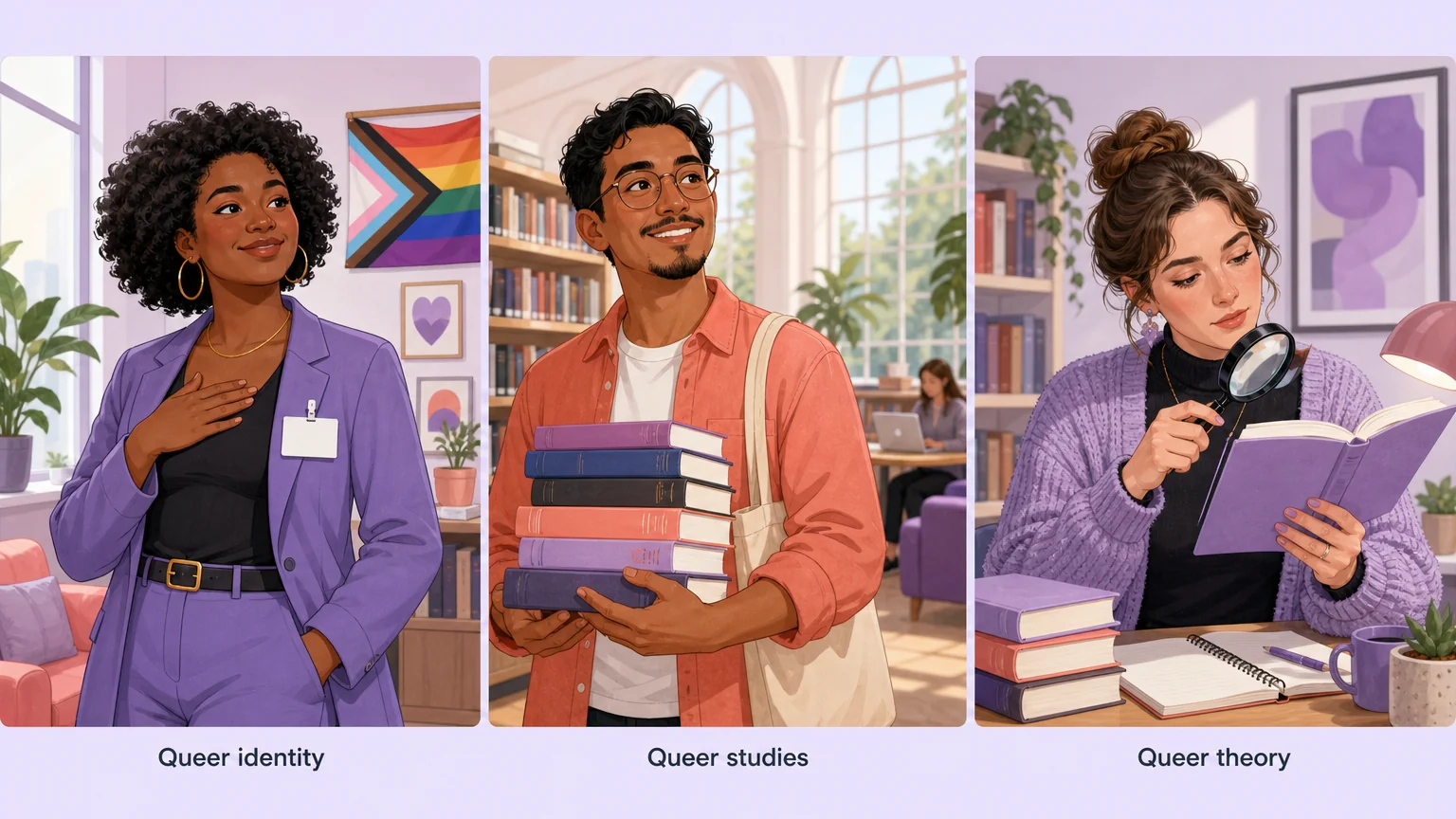
Three things share one syllable, and almost every confused argument about the term is really a collision between them.
Picture a party. Someone says, “I’m queer,” and means something about who they are. A course catalog lists Introduction to Queer Studies, and means a department’s subject matter. A journal article argues that the category “heterosexual” was invented in a particular century, and means a method of analysis. Same syllable, three jobs.
Queer identity. “Queer” is a reclaimed umbrella label for people who are not heterosexual or not cisgender. It began as an insult and can still land as one. Not every LGBTQ person uses it for themselves, and some still find it offensive. The usage rule is short. If the word describes you and you want it, it is yours. If someone applies it to you, you are not obliged to take it.
Queer studies. The broad interdisciplinary field that takes sexuality and gender as its subject across history, law, sociology, anthropology, literature and politics. A department teaches this.
Queer theory. The analytical wing of that field, closest to philosophy and literary criticism. It asks how the categories themselves were built, and who they serve. A paper argues this.
Four clarifications, because the misreadings are sturdy. Queer theory is not a rulebook for how to be queer. It does not tell anyone how to structure a relationship. It is not a claim that everyone is secretly queer. Butler argues that there is no natural, essential gender or sexuality for queer people to deviate from, and Sedgwick’s universalizing claim is that sexual definition matters to everyone, not that everyone is homosexual. It is not a synonym for being gay or trans.
Plenty of people use “queer” about themselves without ever studying the theory, and a dating app like 3Fun is built for those people as they are.
If you remember one distinction, make it this one: identity is what a person is, studies is what a department teaches, theory is what a paper argues.
Why the Theory Is Named After an Insult
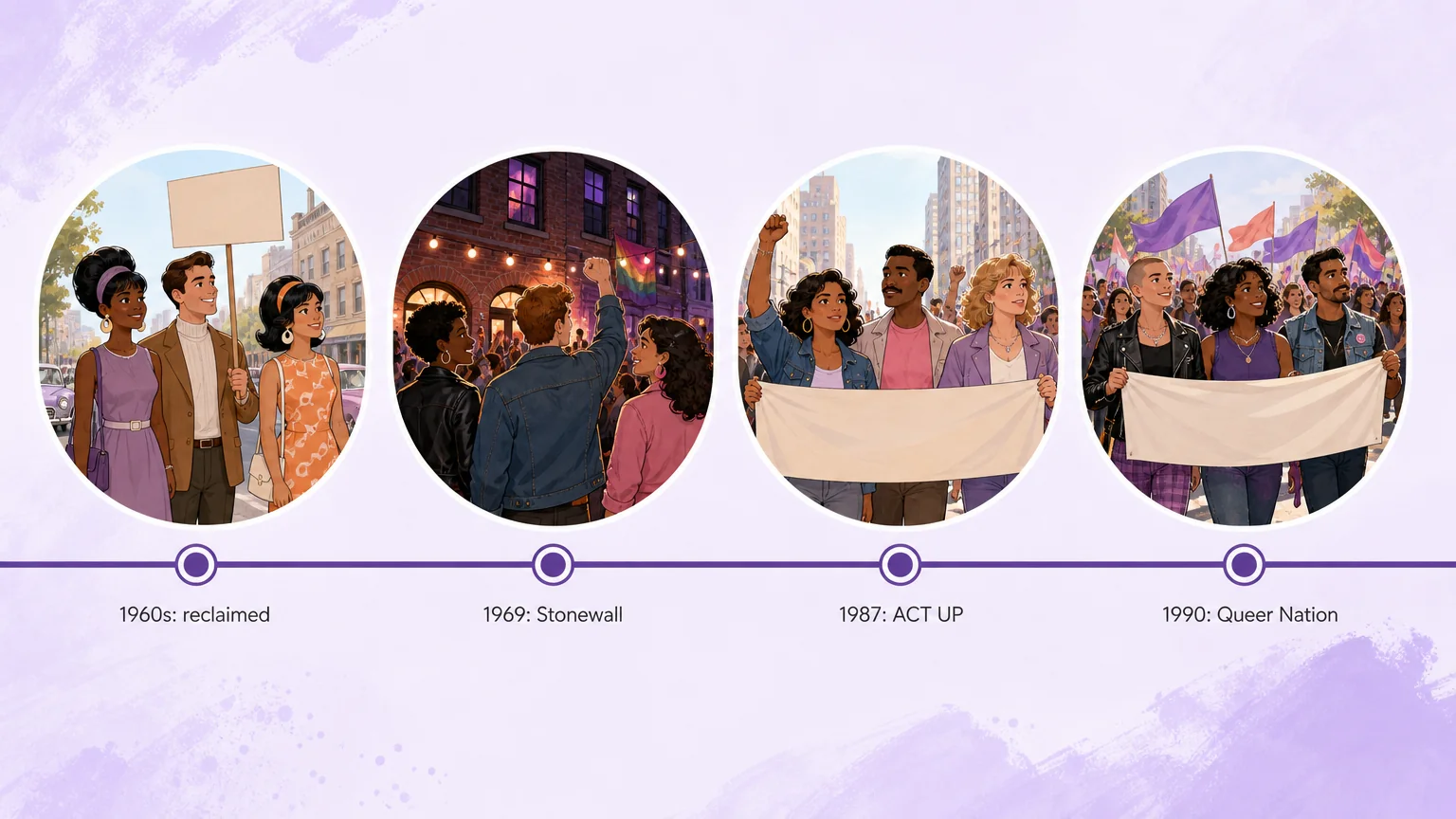
The field took a street insult and yoked it to the heaviest word in the humanities. That was neither an accident nor a courtesy.
“Queer” was used against LGBTQ people and still can be. From the 1960s, people in the community reclaimed it as an umbrella term for anyone not heterosexual or not cisgender. Some never took it up, and some still refuse it, part of why the name stays contested.
The politics came first: Stonewall in 1969, the AIDS crisis, ACT UP in 1987 with its slogan “Silence = Death.”
Queer Nation formed in New York in March 1990 from ACT UP veterans. Its first “Nights Out,” on April 13, 1990, went to a straight bar at South Street Seaport, making the point that queer people would not be confined to gay bars for public displays of affection. The chant that traveled with them, “We’re here! We’re queer! Get used to it!”, is the shortest bridge from street to theory.
The academic half arrived almost simultaneously. The coinage is usually credited to the film theorist Teresa de Lauretis, at a conference on lesbian and gay sexualities. Her reasoning matters more than the attribution. She wanted gay and lesbian sexualities studied on their own terms rather than as deviations from heterosexuality, and she argued that “lesbian and gay studies” had flattened real differences and centered white middle-class gay men.
Four works supplied the material. Foucault’s History of Sexuality argued that sexuality is a historical construct rather than a natural given that power holds in check. Gayle Rubin’s “Thinking Sex” described a hierarchy with married reproductive sex at the center and everything else at the edges. Sedgwick’s Epistemology of the Closet and Butler’s Gender Trouble, both from 1990, are the other two.
David Halperin has described the pairing of “queer” with “theory” as controversial at first, because “theory” carried the weight of the humanities while “queer” was only beginning to enter gay-affirming use.
The name was never neutral. It was a refusal, and everything queer theory is praised and blamed for follows from that refusal.
The Ideas Behind Queer Theory, in Plain English
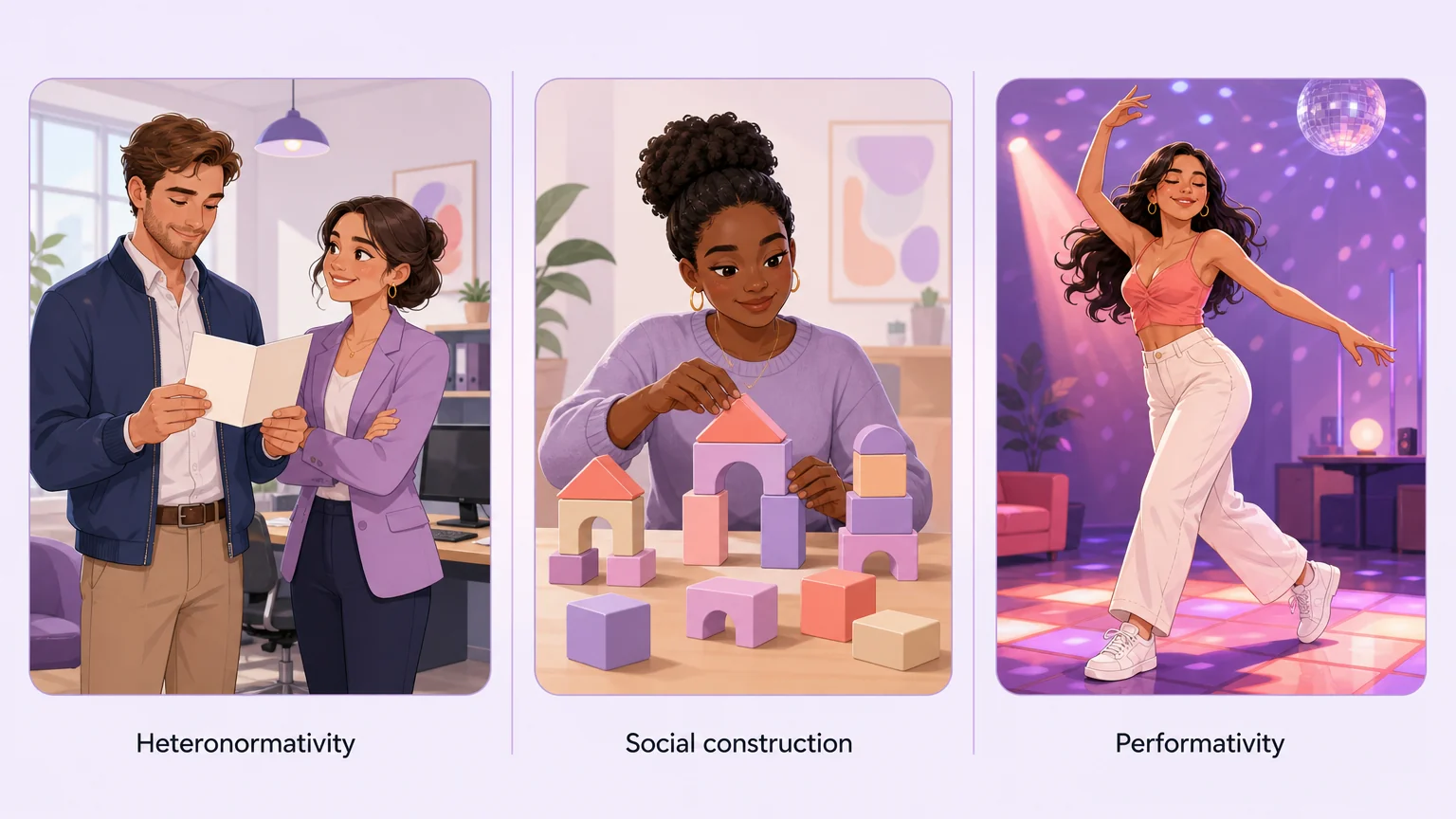
Three ideas carry most of the weight. Learn them and a page of queer theory stops looking like fog.
Heteronormativity is the assumption that heterosexuality is the default, normal or preferred way to be, bundled with the belief that gender comes in two kinds and that a man-and-woman couple is the standard shape of a relationship.
Consider an office “bring your spouse to work” day. The invitation assumes every employee has an opposite-sex partner. Nobody in the room meant harm. The people it fits never notice the assumption, and the people it does not fit have to decide whether to explain themselves.
This is not a claim that heterosexual people are bad. It describes a default that makes some people visible without effort and makes others account for themselves. The critic closely associated with the term is Michael Warner.
Social construction and essentialism are easier as a pair. Essentialism holds that identity is fixed, innate, universal and unchanging. Its most familiar everyday form is “I was born this way,” which plenty of people find both true and politically useful. Social construction holds that identity is made in particular times and places, through institutions, language and repetition.
The concrete version: sexual practices have existed across history, but the identity categories that can be named and managed appeared at particular moments. Apply a test to any claim. Does it say people have always had this identity, or that the category showed up at a specific point?
Performativity is the idea that gender is not the outward expression of an inner truth. It is produced by repetition, and because it has to be repeated, it can be done differently or done badly.
Think of a dance floor. You learn the steps by watching other people, repeat them until they feel natural, and the repetition hardens into a rule. A smaller example: saying “I do” at a wedding does not describe a fact; it makes one.
One misreading needs killing. Performativity does not mean gender is fake, and it does not mean anyone can choose anything. Butler’s point includes the constraint. The script is set by culture and history, and some performances get punished.
The two founding texts most often named are Butler’s Gender Trouble and Sedgwick’s Epistemology of the Closet, both published in 1990.
Construction is the engine, heteronormativity is what it finds, and performativity is how the thing keeps being made.
What It Means to “Queer” Something
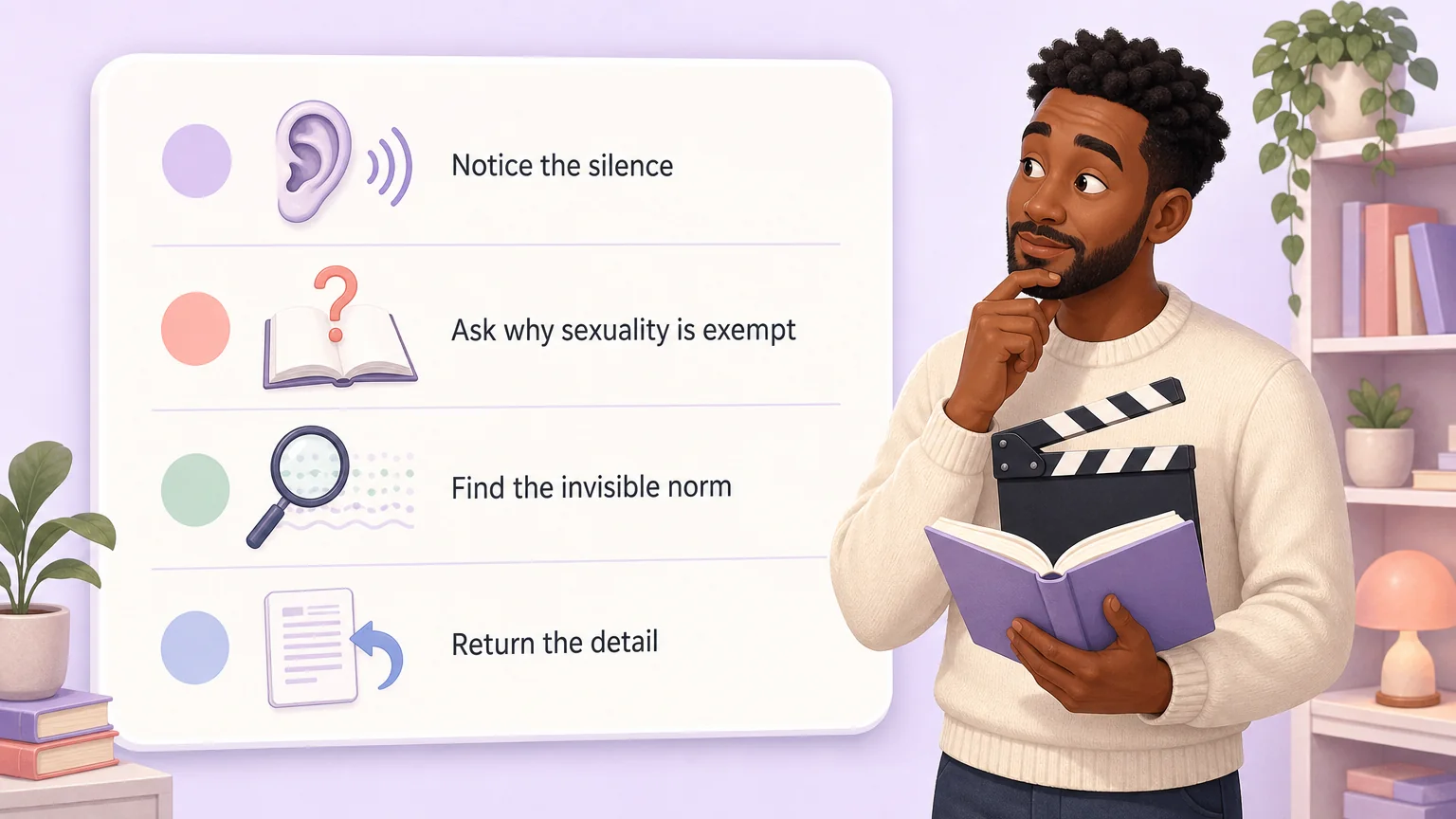
To queer something does not mean to claim it is secretly gay. The verb is a lens, not a label. It means using queer theory’s questions to see possibilities the standard reading did not permit. You are not imposing queerness on an object. You are asking what the object’s own assumptions have ruled out.
Take the invitation from the last section, the office day for spouses. Queering it is not a stunt. It is three questions. Who does the invitation assume? Who has to ask a follow-up before replying? Who gets to say yes without a second thought?
The point is to notice that one arrangement was treated as the default and every other one became a request.
The fix is unglamorous, which is the point. Write “partner” instead of “spouse.” Write the policy so a same-sex partner is included without a special request. The analysis was never the hard part.
The same move works on a text. A queer reading asks why a writer’s sexuality should be treated as irrelevant when gender, race or class is treated as relevant. Whitman, Woolf, Wilde and Hughes were gay, lesbian or bisexual, and for a long time criticism simply did not mention it. The goal is not to out anyone. It is to ask what the silence was doing, and who it protected.
The lens also turns on categories that look too obvious to examine. The historian Jonathan Ned Katz turned it on heterosexuality itself and argued that it too is a modern invention. Naming that is what strips the category of its “just the way things are” quality.
Notice the silence, ask why sexuality would be exempt when everything else about a writer counts, find the norm that never announces itself, and then return the overlooked detail to the reading as something worth analyzing. Try those four moves on the next film, ad or family arrangement you notice, and see what the standard reading left out.
Where Queer Theory Argues With Itself

Some of the sharpest criticisms of queer theory come from people who accept its premises. This is a field arguing with itself, not a doctrine under siege from outside.
The subjectless critique. If the field refuses to name any fixed subject, it can study how sexuality gets talked about but struggles to talk about actual people. The charge, made from inside, is that categories which did real explanatory work get thrown away.
Adam Isaiah Green points to the lesbians documented at Cherry Grove on Fire Island, who called themselves “ladies,” “dykes” or “postfeminists” for generational, ethnic and class reasons. Those distinctions were doing work. A theory that dissolves them can no longer describe the people who made them.
Joshua Gamson puts the same worry more sharply. Under this approach it becomes nearly impossible for the theory to speak of a lesbian or gay subject at all.
The materialist feminist objection. Rosemary Hennessy argues that the focus on culture and representation crowds out the analysis of capitalism and patriarchy. The theory can then miss how structures shape sexuality and oppression, which is what it promised to explain.
The trans studies tension. Susan Stryker, editor of The Transgender Studies Reader, writes that trans studies mounts the same challenge to ideas about what counts as normal. But she charges queer theory with sometimes privileging homosexual ways of differing from heterosexual norms, while trans studies presses on the links between the material body, psychic structures and gendered social roles. The two emerged around the same time, they are related, and they are not interchangeable. This is a live disagreement, not a settled one.
Homonormativity. Lisa Duggan coined the term for LGBTQ politics that pursues assimilation into existing institutions and speaks for white middle-class gay men. It is a critique of a political strategy, not a statement about how anyone should live.
The field does not deny the pattern. It can account for race, class, gender and nation without always doing so, and queer of color critique, crip theory and queer ecology grew partly out of exactly these arguments.
Disagreement is the field working, not failing. Queer theory is not one settled position, and its own arguments are the proof.
Why “Queer Theory” Became a Scare Phrase

For many readers the phrase arrived not as a subject but as an accusation, at a meeting or in a comment thread, and clearly not as a compliment.
Two objections are about the writing and the institution, not the ideas. Brent Pickett argues that the field is written by a small ideologically oriented elite, carries a class bias, and is referenced mainly at universities. Ros Coward argues that its advocates use obscurantism to shield the field from outside criticism and never turn that skepticism on their own position as elite academics. Both charges concern who can read the work, not whether the arguments are true.
A serious intellectual objection comes from Carl Trueman. He argues that queerness destabilizes and thereby excludes all other categories. Following Pamela Paul, he adds that saying you are queer can mean anything and therefore communicates nothing stable.
A blunter version circulates: queer theory says all norms are bad and should be destroyed. That is not the field’s argument. The field analyzes how norms are produced and enforced. Analysis is not a demolition order.
The school fights show the gap between the slogan and the field. France piloted a gender-equality program called ABCD de l’égalité in 275 schools from September 2013, and in June 2014 announced it would be discontinued after a campaign against what opponents called “théorie du genre.” In 2023, Florida’s Department of Education ruled that AP Psychology violated state law over its content on sexual orientation and gender identity, and the College Board said the ruling effectively banned the course content. The standoff was resolved days later. Both fights were about curriculum content, not literary theory.
So the phrase does two jobs. It names an academic field, and it names a bundle of feared changes in schools and culture. Both uses are real. They are not the same thing.
When someone says “queer theory,” ask which job the phrase is doing. That question is most of the argument.
FAQ
Is queer theory Marxist?
No. The charge describes queer theory as a cultural offshoot of Marxism and the Frankfurt School. The documented intellectual lineage runs elsewhere: twentieth-century French philosophy, feminist theory, gay and lesbian studies and social constructionism. Identity-based academic fields of the 1970s were influenced by Frankfurt School critical theory, which is much narrower than the claim usually made. Materialist feminists criticize queer theory precisely for neglecting capitalism and patriarchy, which is the shortest correction to the charge.
Is queer theory only about sex and gender?
No. It spread into disability studies through crip theory, into ecology, into communication studies and into ethnic studies through queer of color critique. Robert McRuer coined crip theory at the intersection of disability, gender and sexuality, and the vocabulary now turns up wherever a field asks who its default subject is. In communication studies, that means asking how families talk about sexuality and gender. The questions travel, and the answers change with the field.
Do I have to agree with queer theory to understand it?
No, and there is no single position to agree with. The field records sustained internal disagreement, and outside critics from religious conservatism to liberal feminism call it obscurantist, class-bound or politically corrosive. Understanding an argument is not endorsing it, and rejecting one critic’s framing does not commit you to another’s. Reading a position closely is the only way to disagree with it well.
Why is it called “theory”?
Because “theory” is the most prestigious word in the humanities, and pairing it with a street word was meant to be jarring. David Halperin has described the combination as sounding strange to 1990 ears for that reason: “theory” carried the weight of a discipline, and “queer” was only beginning to be used in a gay-affirming way outside activist and artistic circles.