Two words, one letter apart. Inside the scene, people pronounce them the same way, so where does the difference actually live? That is the question behind dom vs domme, and most answers get it backwards: this is not a male-versus-female question at all. Strip away the spelling and the stereotypes, and you are left with one role wearing two names.
The real answer is simpler and stranger: the role is the same. A dom and a domme are both the dominant partner in a D/s power exchange. Both lead, both negotiate, both hold power, both provide aftercare. What actually changes is the label’s gender coding, the cultural script each dynamic inherits, and how the world reads each role.
That distinction decides which dynamic feels like home, which word feels like yours, and how you read everything you see in kink spaces from here on. Let’s start with the answer you came for.
So What’s the Actual Difference Between a Dom and a Domme?
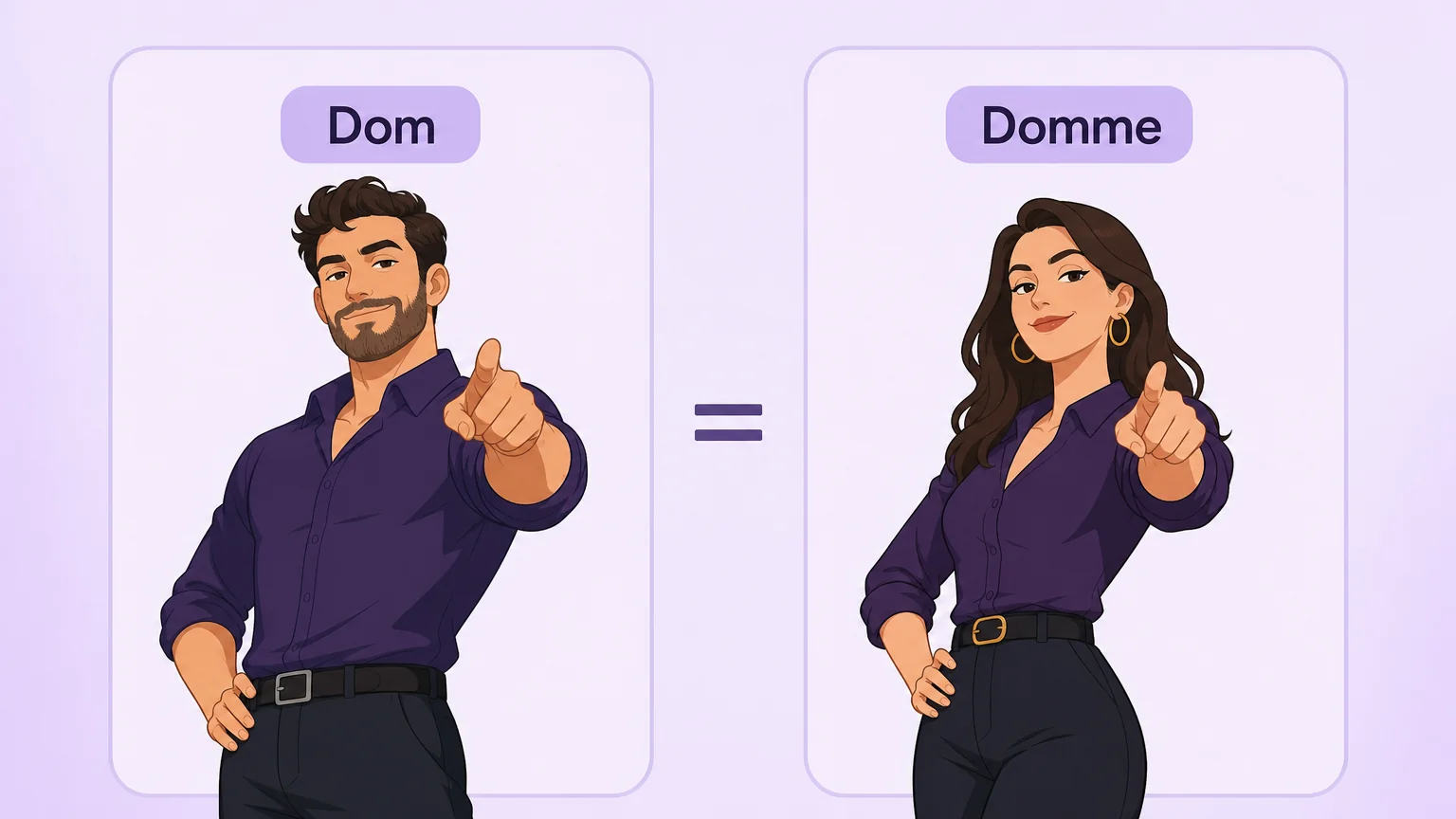
Here is the whole answer in one breath. A dom and a domme are the same role: the dominant partner in a D/s power exchange. A domme is a female-identifying dominant.
Nothing about the mechanics of dominance changes between them. Both lead, both negotiate, both hold power, both provide aftercare, and both can be soft or strict. Read that twice, because it contradicts almost everything you have picked up about these words.
The word you pick changes how you are seen, not what you do, and that is a hard thing to internalize because pop culture treats the two as opposites. What differs is three things: the label’s gender coding, the cultural script each dynamic inherits, and how the world reads each role. Put them side by side and it stops being abstract.
| Dom | Domme | |
|---|---|---|
| Role | The dominant partner in a D/s power exchange | The same role, held by a female-identifying dominant |
| Gender coding | Neutral default spelling; commonly read as male, not exclusively | Femme-coded spelling; the terminal “e” marks the role as female |
| Pronunciation | dom, rhymes with tom | Written domme, pronounced dom; the “e” is silent |
| Label choice | Used by male dominants and by some female dominants who don’t want a gendered word | Used by female dominants who want their identity visible |
| Typical dynamic | M/f: male Dominant, female submissive; the statistical default | F/m: female Dominant, male submissive; real but less common |
| Cultural script | Mirrors mainstream gender scripts | Deliberately inverts them |
| How others read it | Steady, natural, rarely questioned | Cold or threatening; held to a double standard |
Same job description, different badge, different world reaction.
Now notice what the table does not say. One version is not stronger, kinkier, or more real. A domme is not a dom with extra steps, and a dom is not a domme without the effort. The job description is identical; the reception is not.
Two people can run the exact same scene with the exact same care and get treated completely differently by the outside world. That is the part nobody says out loud, and it is the whole reason the dom vs domme question exists.
Read the table top to bottom and the whole story is there. Rows one through four are about the person: same role, same job, spelled and said differently by choice. Rows five and six are about the dynamic: which gender sits where, and which cultural script the pairing inherits. Row seven is about the world: how onlookers react to what they think they see.
Same person, same job, wildly different weather.
Keep that table close. Everything after this is one row of it, opened up. That is the difference, and the rest is proof.
1. The Words, Decoded: ‘Dom’ and ‘Domme’ Are the Same Role
This is the evidence behind the table’s first row, and it starts with etymology. A dom is short for “dominant,” a word that traces to the Latin “domus,” meaning house, the master of a household: the partner who exercises control and takes the lead in a D/s power exchange. A domme is the femme-coded spelling, either a clipped cousin of “dominatrix” or a coined pseudo-French feminine inflection of “dom,” with the terminal “e” marking feminine the way French gendered nouns do. Two spellings, one job.
Here is why “one job” is not a slogan but a precise claim. In kink, the difference between a top, a dom, and a Master is the magnitude of ongoing power exchange. Kink educator Evie Lupine lays out the ladder: a top performs the actions of a scene, and the power exchange ends when the scene ends. A top can even be submissive. A dom or a domme, by contrast, holds an ongoing power-exchange role, authority that lives outside the scene, negotiated and real. In other words, the label describes how much ongoing power a person holds, not what they do. And that magnitude is identical for a dom and a domme.
One more layer keeps the roles straight and answers a quieter question: what is a dom versus a sub, really? “Top” and “bottom” describe who performs the actions in a scene. “Dom” and “sub” describe who holds the power in the dynamic. Those are two different axes, and people prove it every day. “Someone can be a top AND a sub,” as one account puts it. A submissive can do the flogging. A domme can take the spanking. The action is not the power.
Which brings us to the strongest evidence here. Dominance is not a gendered trait. Evie Lupine puts it plainly: anyone of any sexuality or gender identity can be a dominant, and the idea that dominance is inherently masculine or inherently feminine is false. That is exactly why dom vs domme is one role, not two.
Curiouser, who identifies as a dom, flips the same point: she does not feel the need for a gendered word for what she is, yet people gender her anyway. The label is personal. The reading of it is not.
There is history behind all of this, and it hands off to the label debate. Older BDSM publications called women who dominated “dominant females,” because the word “dominant” alone was presumed to be male. The femme-coded “domme” spelling was coined to fight exactly that assumption.
Words carry the assumptions of the people who minted them, and the history of these two is the history of who was presumed to hold power. One role, two spellings. The difference is the badge, and the badge is a choice, which is next.
2. How to Say It: ‘Domme’ Is Written with an ‘e’ but Pronounced ‘Dom’
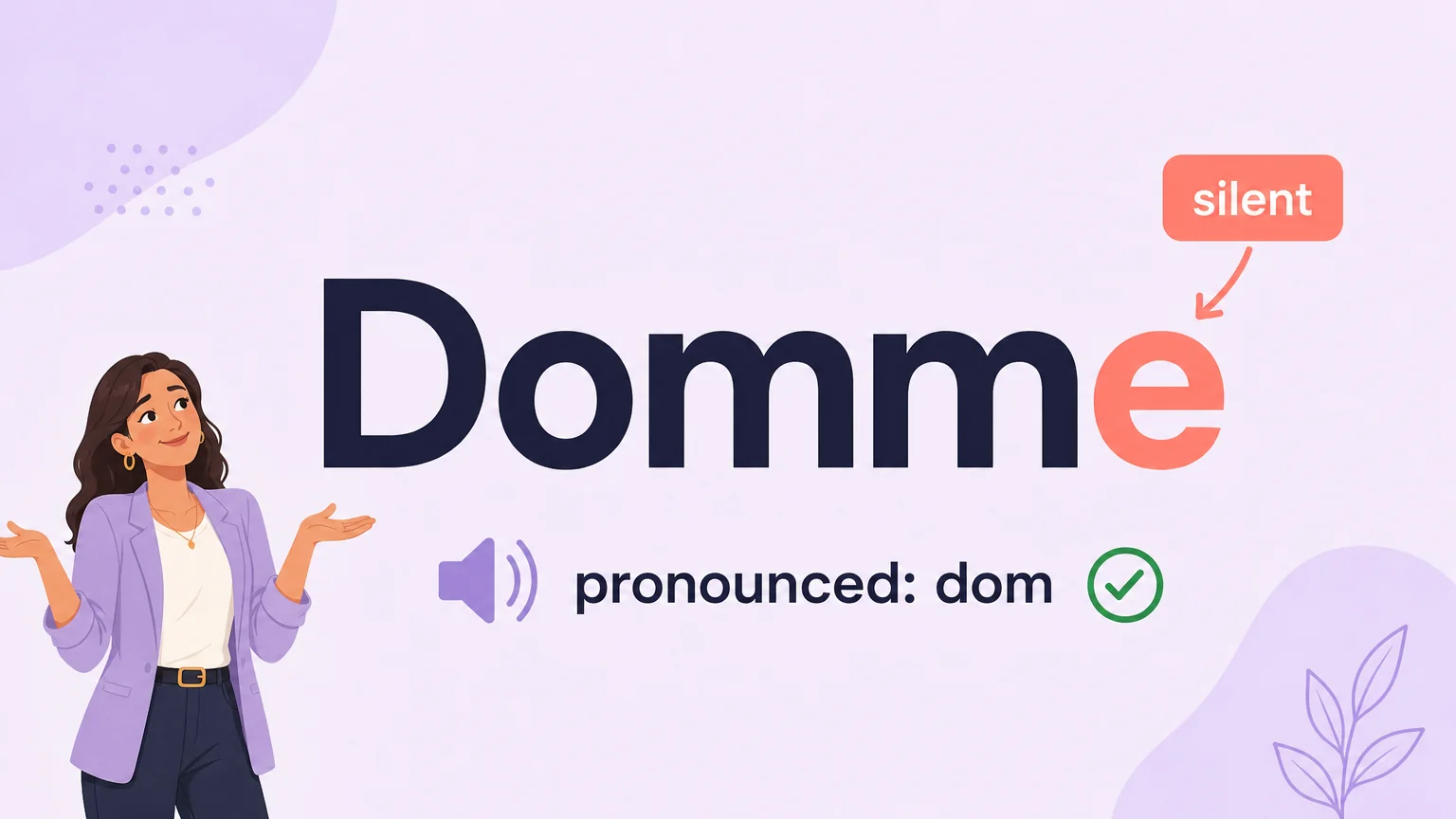
Confident answer first: inside the scene and the profession, “domme” is written with the French-flair “e” but pronounced exactly like “dom.” The terminal “e” is silent. “Dom-may” is the widely repeated, gently laughed-at mispronunciation that outsiders reach for, a classy-sounding overcorrection that no one in the room uses.
The spelling practically begs for the French pronunciation, which is exactly why newcomers guess wrong. The “e” looks like it should be spoken, the way it is in “madame.” In this word it is silent, and the silence is the point.
Be honest about real variance. Kink educator Curiouser notes that “some pronounce it dom, some ‘dame.’ I pronounce it dom.”
If you are ever unsure in a new space, asking is the green-flag move. No one worth playing with will punish a sincere question, and most dominants will simply correct you warmly and move on. Mispronouncing a word once is nothing next to being the person who pretended to know it.
Now look at the table and see what the pronunciation is really telling you. The written “e” is the gender signal, table row two: it marks the role as female. The identical sound is the same-role signal, table row one: it says the job does not change.
The spelling is for the eye, the sound is for the ear, and they tell two sides of the same story. English is full of silent letters; the “e” in domme just happens to carry meaning.
Say it like “dom.” The “e” is for the eye, not the ear, and if you are ever unsure, asking is the move. The pronunciation is the simplest proof that the dom vs domme difference is a label, not a job.
3. The Label Debate: Why Some Women Choose ‘Dom’ and Others ‘Domme’
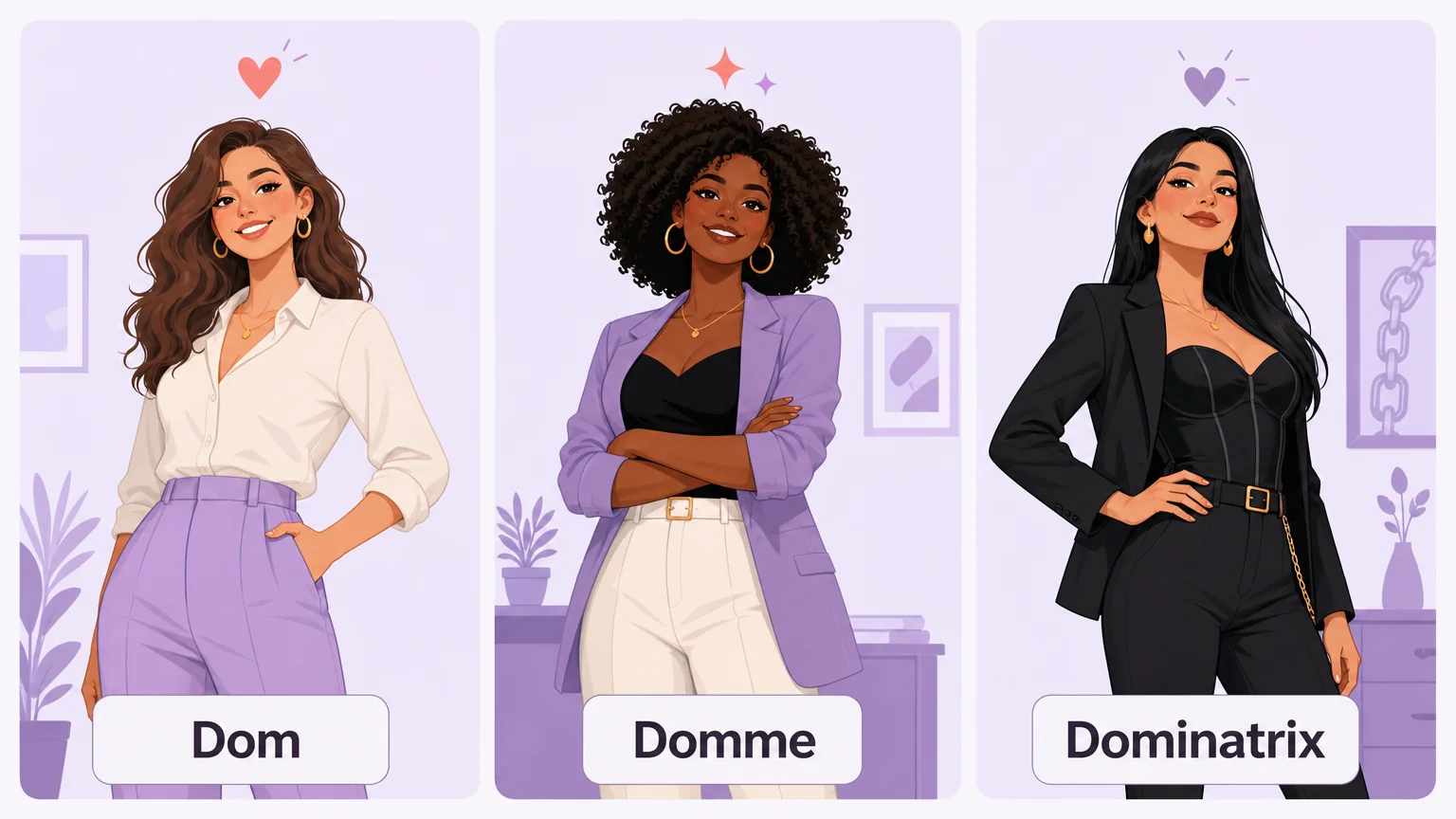
The table says the domme spelling “marks the role as female.” The people who live this say it is more interesting than a rule. Most glossaries present the feminine spelling as settled fact; the women who live under it will tell you it is a live argument that has been running for decades and did not start on the internet.
Here is the question everyone is too polite to ask: if “domme” is the feminine word, why do so many women who top call themselves “dom”? It sits right under the surface of the dom vs domme difference, and there are three lived answers.
Position one: “dom” is gender-neutral, and some female dominants deliberately prefer it. Curiouser identifies as a dom, not a domme. “I don’t feel like there needs to be a gendered word for who I am,” she says. For her, the plain word fits.
Position two: “domme” or “dominatrix” keeps female dominance visible and resists erasure. Mistress Amanda Wildefyre puts it bluntly: “dom smells of a time when we once used ‘he’ to refer to everyone.” She argues that female dominance is always subject to erasure, and the femme-coded word is a refusal to let that happen.
Position three: plenty of people just pick the label that looks or feels right. One female-presenting user puts it with total honesty: “im a dom bc it looks better not bc it means anything.” Sometimes the choice is that light. It counts.
Underneath all three positions sits a deeper claim: dominance and gender are two separate dials. As one account puts it, a person could identify as male and be feminine but also be dominant, and another could identify as female, be masculine, and be submissive. The dominant role does not belong to a gender. It belongs to whoever holds it.
There is a structural argument underneath the whole debate. There is no equivalent gendered term for “sub.” No “subbe,” no “switche.” Some community members read that asymmetry as meaningful: “domme” implies female domination is a fundamentally different, and therefore lesser, thing than male domination.
If you cannot be a “subbe,” why do you need a “domme”? Other people read it the opposite way: the “e” is precisely what protects female dominance from being swallowed by the male default.
The stakes are not abstract. The word a woman uses shows up in her profile, in the ads she posts, and in how she introduces the dynamic to a new partner. It tells the room how she wants to be seen, and it shapes how she is treated before she has said a single word.
Here is what the record shows. Which term a woman uses, “domme,” “dominatrix,” “dom,” or “dominant,” is chosen mostly by personal preference and the conventions of the local BDSM scene.
None of this is new. Before the internet, publications that wanted to describe a woman who dominated had to reach for a phrase, “dominant females,” because “dominant” alone read as male. The gendered-label argument is that old, and it is still unresolved, which is the point.
Not a rule. Not a test. A wardrobe.
So there is no wrong answer, only the one that fits. And anyone who polices another person’s chosen label is missing the point of the whole table. The gender coding is real, table row two, but the label choice is personal, table row four. A badge and a script, not a different job.
4. How the Difference Shows Up in Real Life: M/f vs. F/m
The words are settled. Now the actual dynamics, because this is where the difference stops being linguistic. First, learn to read the notation from table row five: M/f means male Dominant plus female submissive; F/m means female Dominant plus male submissive.
Capital letters mark the dominant side of the slash, lowercase the submissive side, a convention that traces back to Old Guard Leather guidelines. This shorthand shows up everywhere in kink writing and personal ads, so it is worth a minute of your life.
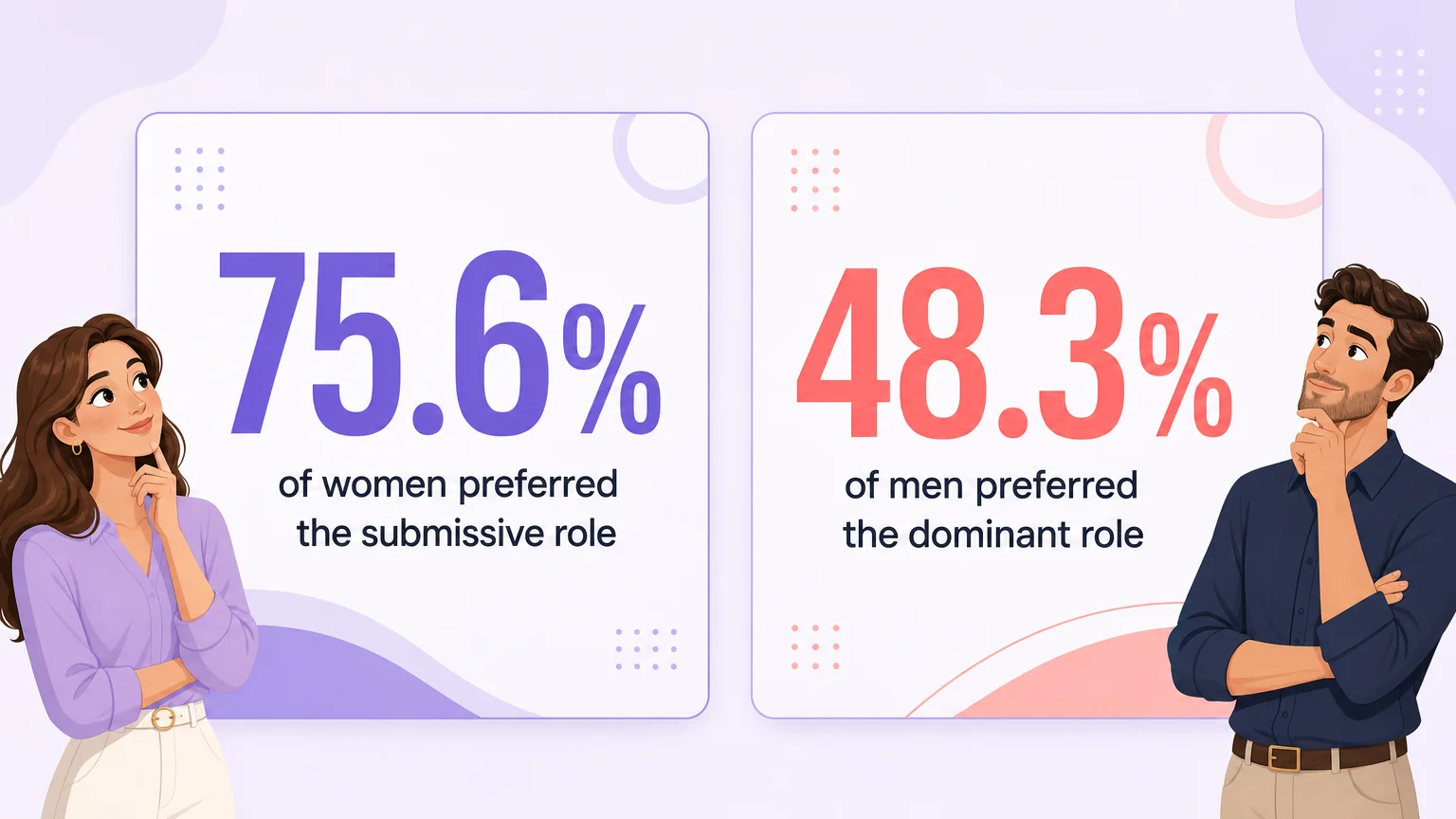
Now the honest numbers, the most bracing fact in this conversation. Dutch survey data published in Archives of Sexual Behavior in 2024 found that about 75.6% of SM-practicing women preferred the submissive role, against about 8% who preferred dominant and 16.4% who switched.
Among men, 48.3% preferred the dominant role and 33.4% the submissive. So M/f is the statistical default, and F/m is the real but less common dynamic. That imbalance is a large part of why “male dom” reads as the default in the first place. Numbers, not nature.
The imbalance also explains a quieter fact: there is almost no mainstream imagery of the F/m pairing. As one history account puts it, there are not a lot of mainstream films about female dominant, male submissive relationships, and even fewer good ones. Newcomers absorb the male dom as the default because it is the only version they have ever seen on a screen.
Here is what each dynamic tends to look like day to day, and this is table row six, the cultural script. A dom-led M/f dynamic often mirrors mainstream scripts, steady and familiar. A domme-led F/m dynamic deliberately inverts them.
That inversion is where female-led relationships, FLRs, live: a continuous, often 24/7 dynamic in which the female partner holds the dominant role and the male partner willingly submits, built on explicit consent, with intensity ranging from low to extreme control.
The lived effect is real. Sex therapist Rachel Zar notes that for a woman who feels disempowered in her day-to-day life, leading at home can be a wonderful, cathartic way to feel powerful and in control. The surrender carries its own charge, too.
As Dan Savage observes, for some men, sacrificing male power and privilege is an intrinsic part of the eroticism of submitting to a dominant woman. This is not a pathology. It is a preference, as ordinary as any other.
One more thing the numbers hide: the power is balanced. Research on real scenes finds the line between dominance and submission is not that clean, and often the power lies with the sub, not the dom.
Do not flatten doms or dommes into a single mold. Inside each role there is a full spectrum. A dom or a domme can run soft, nurturing, praise-led, the gentle femdom that surged in search interest around 2018 and 2019. Or strict. Or scene-limited, or 24/7.
Same role, mirrored power, different cultural scripts and different odds of meeting each one. That is the dom vs domme difference, and it lives in the world, not in the person.
5. Where the Difference Gets Distorted: The ‘Cold Domme’ and the ‘Ravenous Dom’
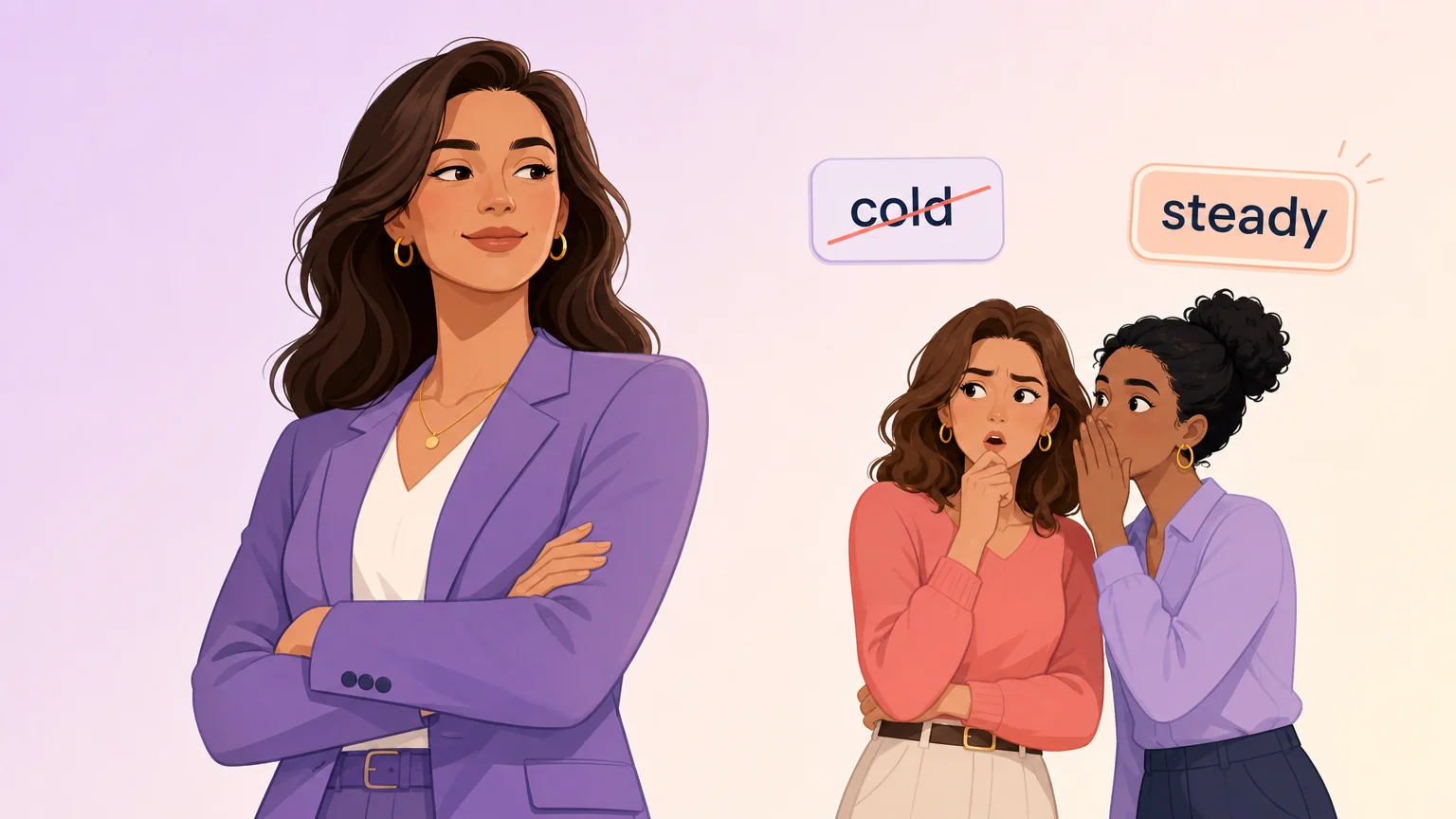
The table says a domme gets read as “cold or threatening” while a dom gets read as “steady, natural.” Here is why, and it is the dom vs domme difference people feel every single day.
Lay the two tropes side by side and the symmetry is clear. The masculine trope: sex is part of his power, he wants it too much, so he reads as abusive or predatory. The feminine trope: withholding sex is her power, and not having sex at all is her “true dominance.”
Curiouser names both, then names the thing underneath them: a single cultural inheritance, the Madonna/whore script. The assumption runs like this: masculine figures get applauded for being sexual, while feminine figures get valued for withholding sex, for staying pure. That script predates BDSM by centuries. Kink simply inherits it.
This is not two stereotypes. It is one belief wearing two costumes. Because the culture assumes women do not genuinely want or love sex, the culture reinterprets any sex a female dominant has as against her will.
As Curiouser puts it, it becomes “a socialized submissive act of service,” which is how a dominant woman loses her dominance creds. The moment she has sex, she must have been submitting. She is clear that none of this is a verdict on anyone’s choices: if you fit one of these roles, there is nothing wrong with you or what you like. The harm is the assumption, the way people get cast into a role that was never theirs.
The mirror image hurts men just as badly. Masculine folk are expected to want sex to excess, even to the point of lying, cheating, or pretending to be dominant just to access kinkier sex. Any man whose desire does not look like that is shamed for it.
And male submissives get read as degrading or pathetic, sometimes even inside kink spaces. The research is blunt here: male subs do not have a lot of respect in the community, a real pain point for F/m dynamics. One commenter names the tell exactly: the problem starts when a story treats the submissive role as more degrading or pathetic.
The submissive is not the lesser half of anything. The judgment is.
The rebuttal is simple and grounded. Most female dominants enjoy a wide range of sexual activities, just like most doms do, just like most humans do, regardless of gender or kink role. Curiouser is frank that female dominants are an anomaly in most of the world’s scripts, but they are not non-sexual by default, and their sexuality does not determine their dominance.
She has lived it: people admonish her for enjoying and wanting sex as a dominant woman, and tell her she is not truly dominant if she lets a man have sex with her. The consequences ripple outward. Women get warned that enjoying sex makes them bad at a role they love, and men get told their desire is either too much or not enough.
The stereotype is the broken thing, not the roles. Same role, two different yardsticks, and the yardsticks are wrong, not the dominants.
6. Domme vs. Dominatrix vs. Pro-Domme vs. Findom: The Terminology Map
None of this changes the dom vs domme answer in the table. It clears away the lookalikes. Newcomers keep conflating a domme with entirely different things, and the whole map unlocks with one axis: professional versus lifestyle.
The conflation is understandable. All of these words describe a person holding power, and the casual reader has no reason to split them. But the split changes what you can expect from an interaction, so it is worth thirty seconds to get straight.
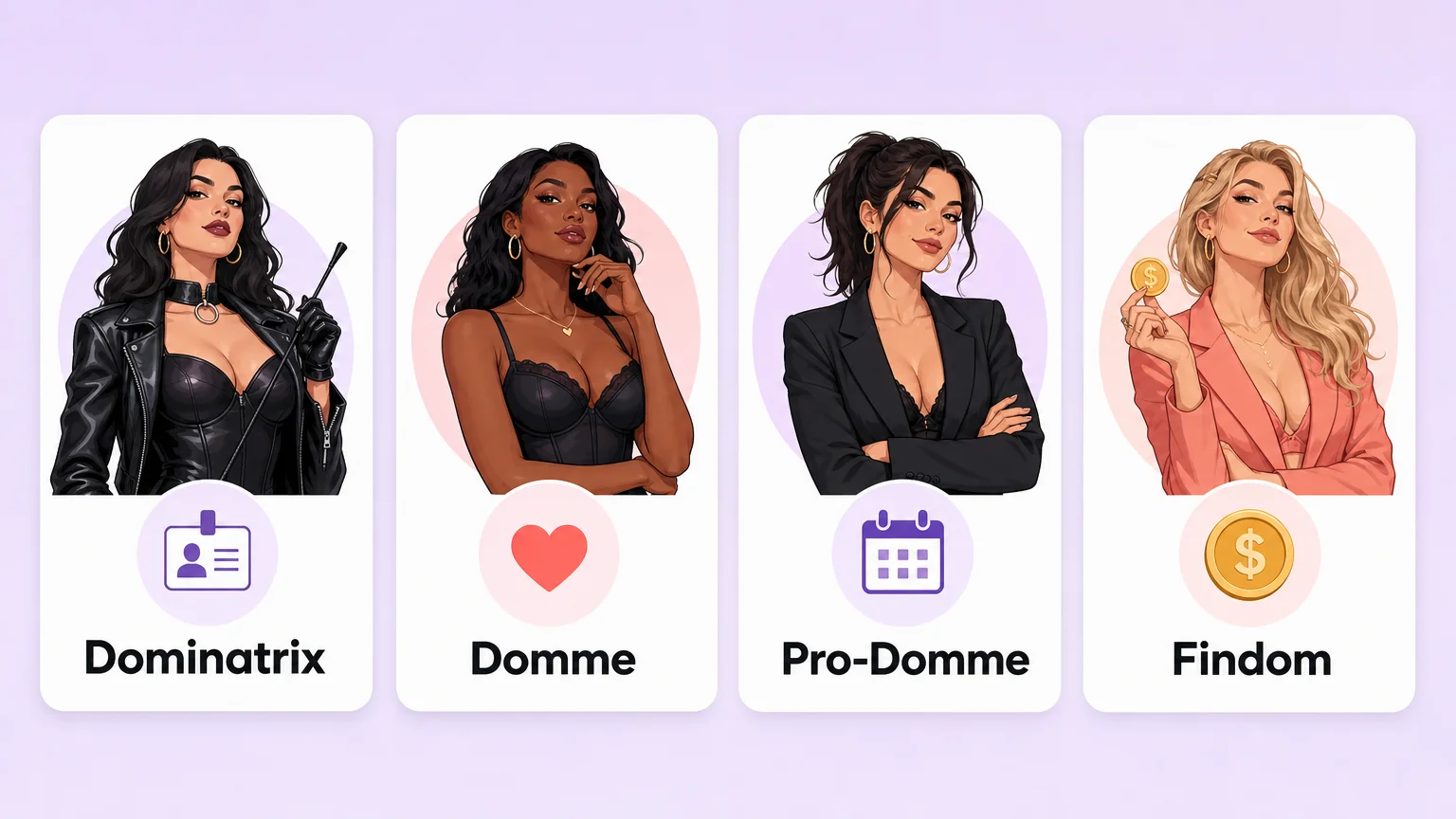
A “dominatrix” almost always signals a professional, paid female dominant, in its modern BDSM sense since about 1961. Mistress Amanda Wildefyre prefers it because it “sounds dangerous,” and she has a point: it carries the professional charge.
A “domme,” by contrast, covers both professional and lifestyle, non-paid, female dominants. That is why knowing which word someone uses tells you their context. In short, a dominatrix is a job title; a domme can be an identity.
If someone calls herself a dominatrix, you can assume a session-based, paid service. If she calls herself a domme, she could be running sessions or living a full relationship dynamic with no money involved. And “pro-domme” is the explicit compound for the paid version: session-based, vettable, with tribute as part of the transaction. The word is the first clue to the setup.
Then there is “findom,” financial domination, which is a distinct dynamic, not a synonym for domme-ing. A submissive consensually gives money, gifts, or financial control, often online-only, frequently with no sex and no physical contact at all. The roles have their own names: findomme, finsub, pay pig.
One caution, delivered without alarm: findom carries real financial risk. The mechanics are concrete: tributes, wishlist items, scheduled payment arrangements, often conducted entirely through platforms, with a single conversation and nothing else. Because no physical contact is involved, the boundary does its work in the wallet instead, which is why the ethics are heavier, not lighter.
Ethical dommes decline payments that would genuinely harm someone. Boundaries are the whole job.
For the family tree, know that “domina” sits in history as another attempt at a classier word. David Jackson, editor of DDI, Dominant Directory International, popularized it in the 1990s. “Domme” was the same instinct, an effort to give the word a classier turn.
Dominatrix and pro-domme mean paid. Domme means either. Findom is the money niche. And none of them mean sexless.
7. The Consent Playbook: One Standard for Doms and Dommes
Here is where the same-role thesis from the table stops being philosophical. A dom and a domme are both humans running a power exchange, and the safety contract is identical on either side of the slash. The dom vs domme difference changes none of it.
The negotiation comes first, always. Before any scene, talk goals, hard and soft limits, specific activities and tools, whether sex is included, health conditions, medications, allergies, triggers, and aftercare needs.
The working rule is that an enthusiastic yes from everyone in the room is the only green light there is. Anything short of that is a stop. Name the limits out loud, not in your head: a limit no one has heard is a limit that can be crossed.
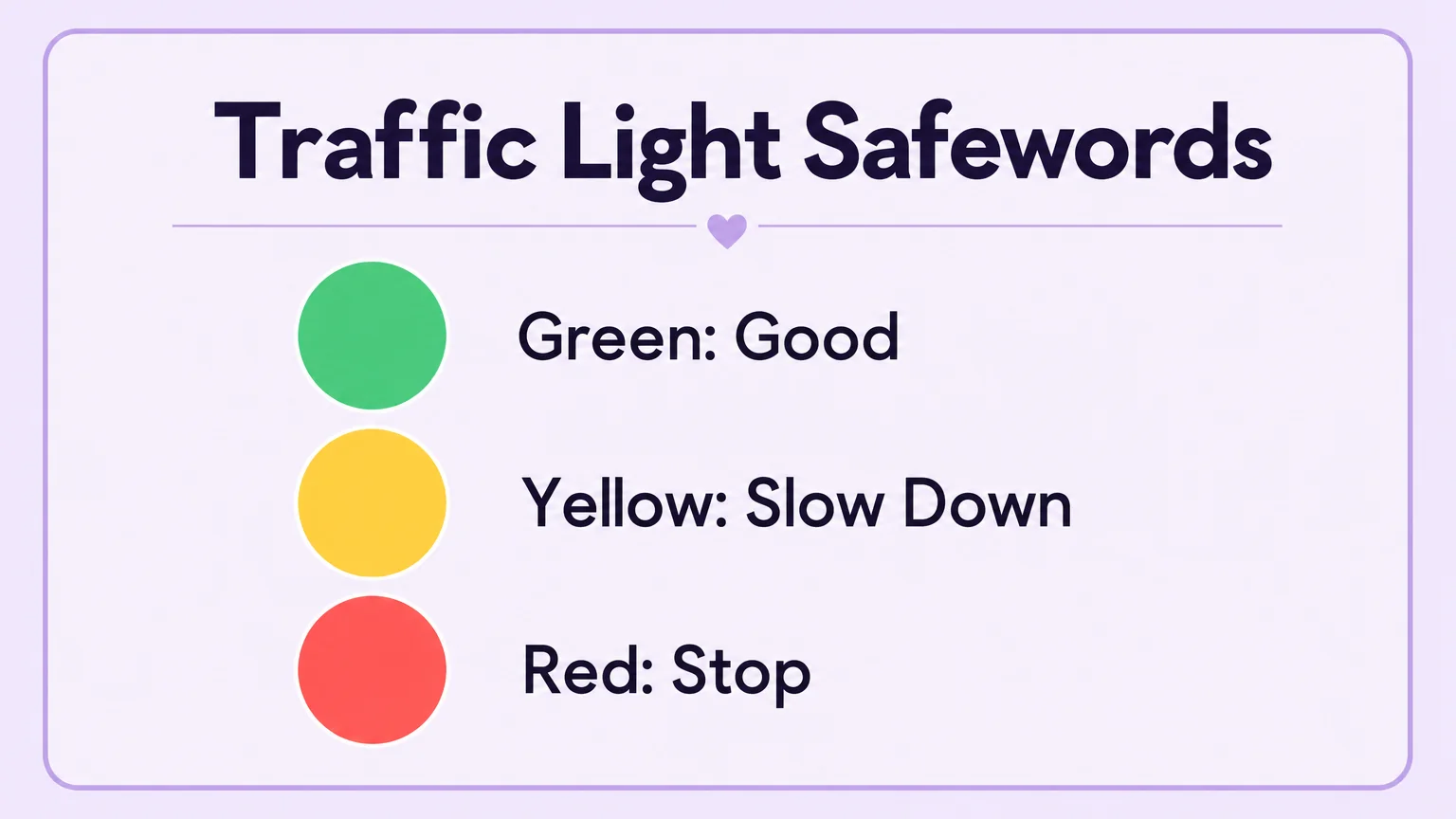
Agree on safewords in advance. The traffic-light system is the most common: green for good, yellow for slow down, red for stop. Add a nonverbal signal too, a tap, a dropped object, a snap, for when speech is unavailable.
Treat consent as active, ongoing, and revocable at any point. “Do whatever you want” is a red flag, not a green light.
Break character immediately when a safeword is used. The dom or domme has safewords too, and is also at risk. The power exchange runs both ways, and so does the care.
Plan aftercare before the scene, not after: blankets, water, snacks, quiet space, verbal reassurance, and a calm debrief about what felt good versus too much.
Then schedule follow-up check-ins around 24 and 72 hours to catch sub drop or dom drop, the emotional low after the adrenaline and endorphins crash. Skipping aftercare is how a beautiful scene turns into a lonely night. It is the delivery.
Two ethical frameworks do the talking here: SSC, Safe, Sane, Consensual, and RACK, Risk-Aware Consensual Kink. They are the floor, and they apply to pros and lifestyle players alike.
Finally, a practical filter for anyone exploring with a pro. If a “Mistress” or “Domina” contacts you first with an unsolicited “you seem like the perfect submissive, go to this link,” that is the classic scam. Block it, do not interact.
Evie Lupine says this single check filters out at least 90% of scammers and bots. Legitimate pros are overwhelmed with inquiries, have websites, screen their clients, and never cold-call strangers. They do not offer “special exceptions, just this once,” and they do not roleplay for free. They run this like a business, and they are far too busy for cold outreach.
Before any scene with a dom or a domme, the full negotiation is the single most important thing you can do. Enthusiastic mutual consent is non-negotiable on both sides.
The Bottom Line: Which Label and Which Dynamic Fits You?
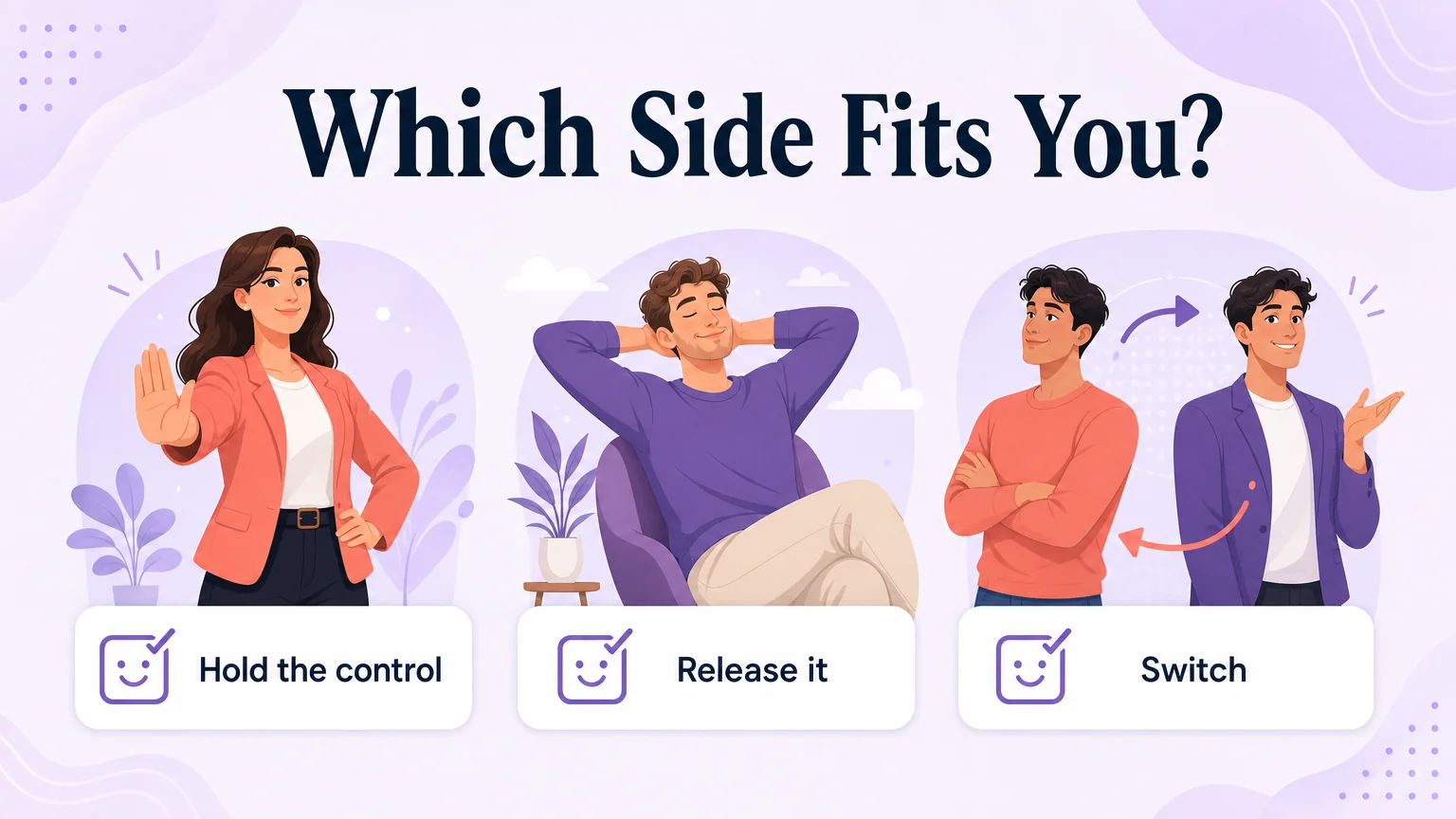
Here is the question hiding behind the two words. Which side of this do I belong on, and which word is mine? The answer: the label follows the direction of the power exchange you want, not your gender. Run this in about a minute.
First: when you picture a D/s dynamic, which position makes you breathe easier, holding the control or releasing it? If holding, explore the dom side. If releasing, the sub side.
If both or neither, switches and top/bottom dynamics exist and are valid. The binary is a ladder, not a wall.
Second: if a female-dominant dynamic is calling to you, match the dominant’s flavor to your needs instead of assuming all dommes are the same. The nurturing, mommy type leads with care, praise, and accountability. The fiery type thrives on intensity, push-pull, growth through friction. The planner type, the micromanager, directs the details of your life.
Do you like to be praised and encouraged, or do you prefer strictness? Does someone organizing your life feel supportive or smothering?
Third: decide scene-limited or continuous. A top/bottom scene is contained. An ongoing dom/sub dynamic, possibly 24/7, possibly an FLR, is a way of living. Both are legitimate.
Fourth, the permission that matters most: if a label feels wrong, you are allowed to use another. Personal preference plus local scene convention is how the community actually chooses labels.
One honest self-check, delivered gently, for anyone drawn to the dominant side. Author Michael Makai asks a fair mirror: would you still want to be dominant if there were absolutely no sex involved? If you cannot separate wanting to be dominant from wanting the sex, that is a signal to keep exploring what the role means to you, not a verdict.
Dominance is a learnable skill, not a personality you either have or do not. The skills are concrete: how to negotiate, how to read a partner, how to set a scene, how to give and receive feedback. Every one of them can be practiced outside a scene. There are whole beginner tracks built for the shy switch, the person who suspects they want this but does not know how to start, including gentle femdom basics and communication drills.
And the finding part is simpler than people fear. Real dynamics start with a conversation, not a costume, and the first conversation does not have to be the perfect one. It is easier when the conversation happens somewhere people say those preferences out loud. 3Fun is built for exactly that.
Whatever row of the dom vs domme table you landed on, the role is the same. You are choosing a label and a script, not a different job, and not a different person.
FAQ
What does ‘domme’ mean?
A domme is a female-identifying dominant in a BDSM D/s dynamic: the same role as a dom, with a femme-coded spelling. The terminal “e” marks the role as female, and the word covers both lifestyle and professional female dominants. The spelling does the talking: it announces that the person holding the power is a woman, without changing what holding power means. You will hear it in dating profiles, in scene advertisements, and in how dominants introduce themselves. It is written “domme” and pronounced like “dom.”
What’s the difference between a dom and a domme?
A dom and a domme are the same role: the dominant partner in a D/s power exchange, and a domme is a female-identifying dominant. The mechanics are identical. Both lead, negotiate, hold power, and provide aftercare. The difference is the label’s gender coding, the cultural script each dynamic inherits, M/f versus F/m, and how the world reads each role, not the job itself. The domme label announces that the dominant is a woman, and that announcement changes how the dynamic is read, not how it runs.
Is ‘domme’ pronounced ‘dom-may’?
No. Inside the scene and the profession, “domme” is pronounced like “dom,” and the final “e” is silent. “Dom-may” is the common outsider mispronunciation, a French-flavored guess the spelling invites, since the “e” looks like it should be spoken the way it is in “madame.” Some people say it like “dame,” so asking is always fine. The identical sound is deliberate: it is a reminder that the role has not changed, only the badge.
Can a woman call herself a ‘dom’?
Yes. “Dom” is technically gender-neutral, and some female dominants deliberately choose it because they do not want a gendered label. Others prefer “domme” or “dominatrix” to keep their identity visible. Some women choose “dom” because it is what they are, a dominant, full stop. Others choose “domme” because the feminine spelling is the point. Neither choice makes anyone less of a dominant, and the conventions vary by scene and region. There is no wrong choice. It is personal preference and local scene convention.
Is a domme the same as a findom?
No. A domme is a female dominant in a D/s dynamic, which may or may not involve sex or money. Findom, financial domination, is a specific niche built around consensual financial control, often online-only, with no sex or physical contact required. The interaction is built on tributes, gifts, or scheduled payments, so the risk profile is financial rather than physical, and boundaries matter double. It carries its own financial risks and ethics.
What does ‘dom’ mean in BDSM?
In BDSM, “dom” is shorthand for “dominant,” the partner who takes the lead and holds the power in a D/s power exchange. It is commonly read as male but technically gender-neutral, which is why some women who dominate use it, and why the femme-coded “domme” spelling exists to make the female dominant visible. One quirk explains a lot of the noise around this word: in Dutch and German, “dom” means “dumb,” which is why the term sometimes turns up in unrelated results.