
There’s a reason you keep ending up here: dating a dominant man draws you in, and a small, sensible voice warns you that’s exactly how it starts to go wrong. Both things can be true.
That voice isn’t wrong, and it isn’t the whole story. Some men lead. Some men take. The difference is everything, and most people only learn to spot it the hard way.
These 13 tips separate the man who leads from the man who takes. You’ll learn what dominance really means, where the line sits between dominance and control, the screening questions that do the work, and the negotiation that makes power exchange feel both safe and hot.
Hold one frame the whole way through: a dominant man’s power is a loan, not a takeover. You hold the keys the entire time.
And keep this test with you: how he treats the word “no.” It’s the entire subject in miniature.
1. Know What ‘Dominant Man’ Actually Means (Beyond the Alpha Myth)
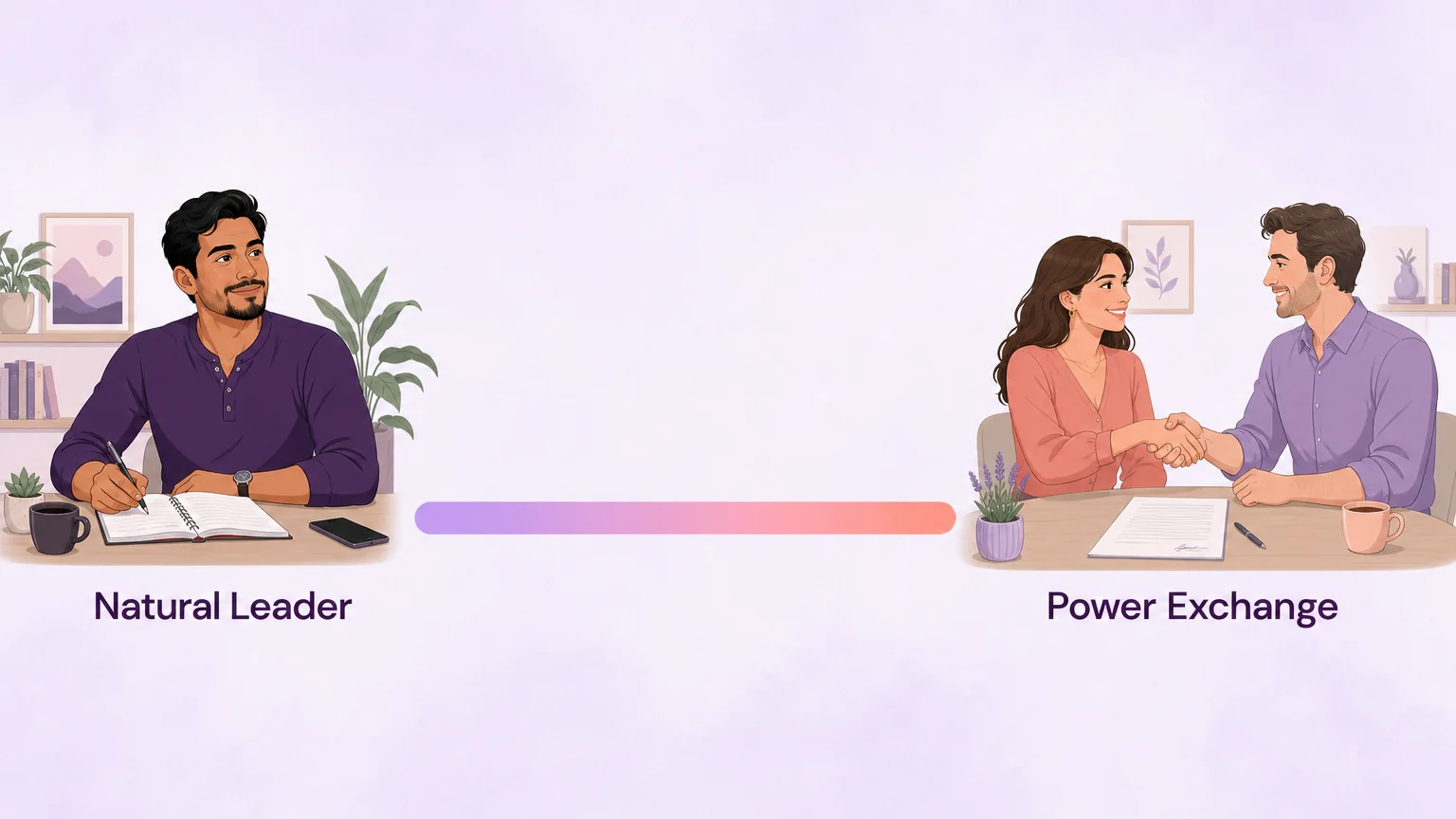
Start with a definition you can hold before you date anyone: dominance is a spectrum. On one end sits the man who naturally leads in daily life, the one who plans, decides, and handles logistics without being asked. On the other sits a fully negotiated power-exchange dynamic, the kind where authority is granted, conditional, and revocable. Both are dominant. Neither requires BDSM.
Now bring in the research that flips the popular story. A classic 1974 study on dominance and attraction found that women were most drawn to men who were both physically dominant and competent, and least drawn to dominant-but-incompetent men. Read that twice: dominance alone read as a liability, not a turn-on. Competence was the second half of the sentence, and it still is.
What a dominant man is like in everyday life is simpler than the stereotypes: leadership, self-confidence, charisma, decisiveness, a natural tendency to take charge. Real dominance often shows up as quiet, steady responsibility, not loud chest-beating. The man who calmly books the table, plans the weekend, and calls when he says he will is exercising dominance just as much as the one who lectures.
That’s why the first rule of dating a dominant man is to stop treating the word as a personality type and start treating it as a skill. The signs vary, but they all share this: he acts on his own word. Hold this frame for everything ahead: his dominance is something he brings to the relationship, not a claim he gets to make about you.
The mirror piece, when she leads instead, is our 9 Tips for Dating a Dominant Girlfriend.
2. Ask Yourself Why You’re Drawn to Him (and Whether That Pull Is a Trap)

Before you blame yourself for the pattern, name what’s genuinely attractive first, so you feel seen rather than pathologized. Decisiveness is restful. Being pursued feels like being chosen. And a competent partner makes the world feel smaller and safer, like someone else has the map.
Now the mirror, gently: psychology research ties a preference for dominant and ‘bad boy’ types to anxious attachment, and describes ‘fatuous love’, which is intense passion without the emotional intimacy to hold it. There’s a line that has stuck with people for a reason: we accept the love we think we deserve. Read that as information, not a verdict. It’s a question about your history, not a judgment on your character.
Attraction to dominance tells you something about what you’re seeking and why, and it’s worth examining before it runs the show. Two questions can do that examination for you. What does his decisiveness free you to feel? And what would you feel if he went quiet tomorrow?
The healthy version wants someone who leads. The trap wants someone who leads because you don’t trust yourself to choose. When dating a dominant man, that distinction is the difference between a dynamic that feeds you and one that quietly repeats a wound. Neither makes you broken. One of them just asks more of you, and you deserve to know which one you’re in.
3. Learn the Line Between Dominance and Control
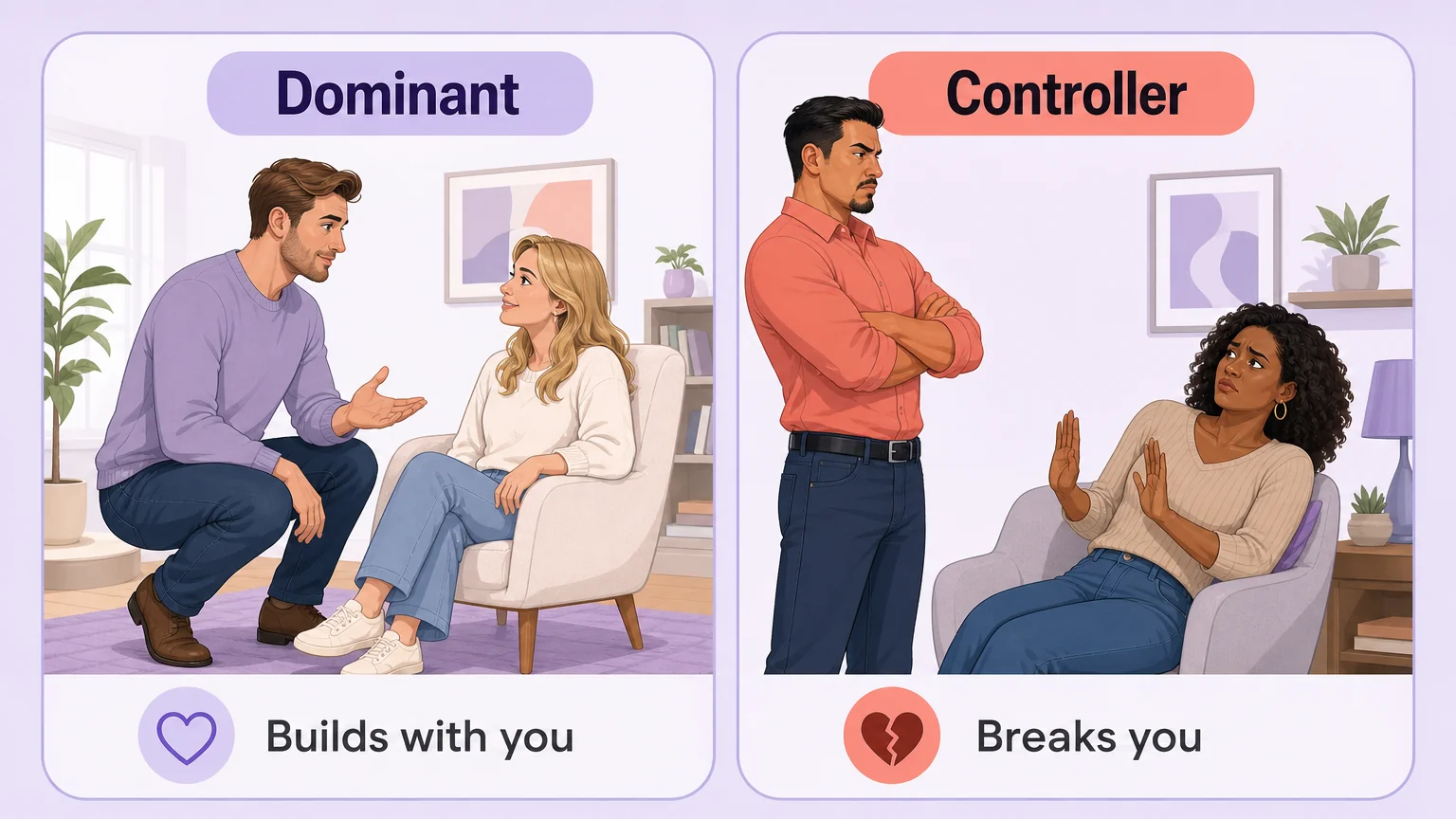
Learn this line before you fall for anyone, because when dating a dominant man every other tip in this piece hangs off it. Here it is in concrete pairs you can test any man against.
A dominant asks what your limits are. A controller decides they don’t exist.
A dominant takes responsibility for the dynamic. A controller takes responsibility for you.
A dominant’s authority is a loan, something you can recall at any moment. A controller treats it as a permanent transfer.
Sit with that last pair, because it’s the whole argument. Healthy dominance builds something with you; control breaks you and calls it leadership. Control is command wearing dominance’s clothes, and it is everywhere once you learn to see it. And note what neither pair mentions: age, money, or how many push-ups he can do. This line has nothing to do with how impressive he is.
Then the vivid version, the litmus test that recurs through this piece. Hand either man the word ‘no.’ A dominant hears it, honors it, and maybe checks in to make sure you’re okay. A controller hears it and starts negotiating with your safety, your mood, your loyalty. Watch what happens to his warmth the second you decline something. That’s the whole man in one motion.
If you remember one sentence from this article, make it this one: dominance is responsibility, and control is theft of the word no.
4. Study the Green Flags and Red Flags in a Dominant Man
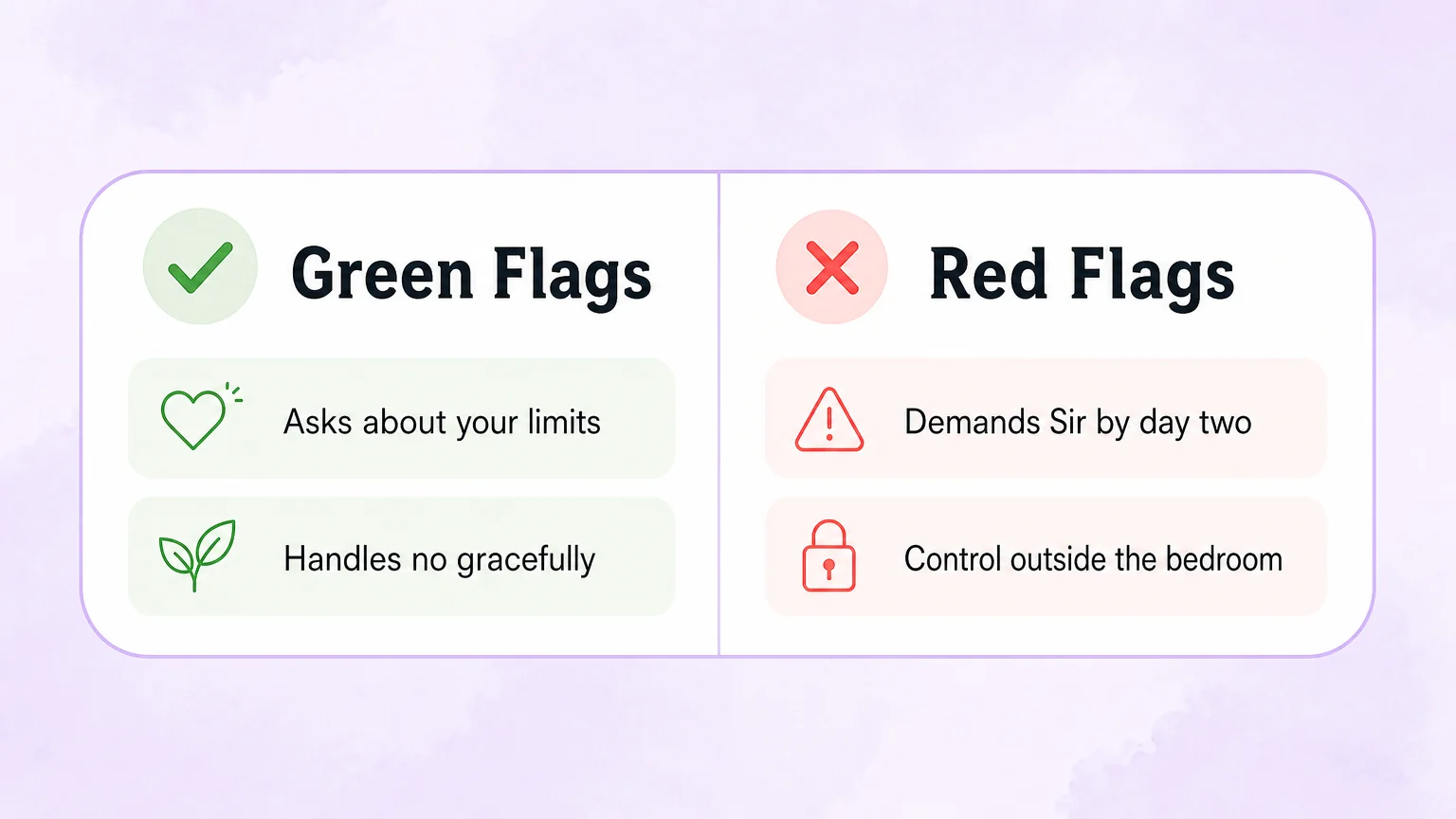
Study this field guide before you invest, and run every signal against a real man. These are the green and red flags of a dominant man, and some come from real stories you’d recognize.
Red flags. The man who wanted ‘Sir’ by day two, before he knew your last name: titles are earned, not demanded. The one who calls safewords ‘for beginners’: that’s a man planning to cross you. The one whose dominance climbs out of the bedroom and into your friendships, your schedule, your clothing: that’s control with a costume change.
The one who cites an ‘alpha dominance’ influencer and announces he holds the final word in his household: that’s ideology, not a skill. And the one who uses kink or polyamory as cover for outbursts he shrugs off as ‘just how I am’: that’s manipulation with a membership card.
Green flags to balance each one. He asks about your limits before anything else. He says ‘yellow’ himself when he’s unsure. He treats aftercare as his responsibility, not your request. And he has people who’d vouch for how he plays, easily, without defensiveness.
And the fastest read you’ll ever get, in your own interest: if you’re dating a dominant man right now and this list made you nod, that’s the answer, not the question. You already knew. Now you have language for it.
5. Run These 8 Screening Questions Before Chemistry Decides
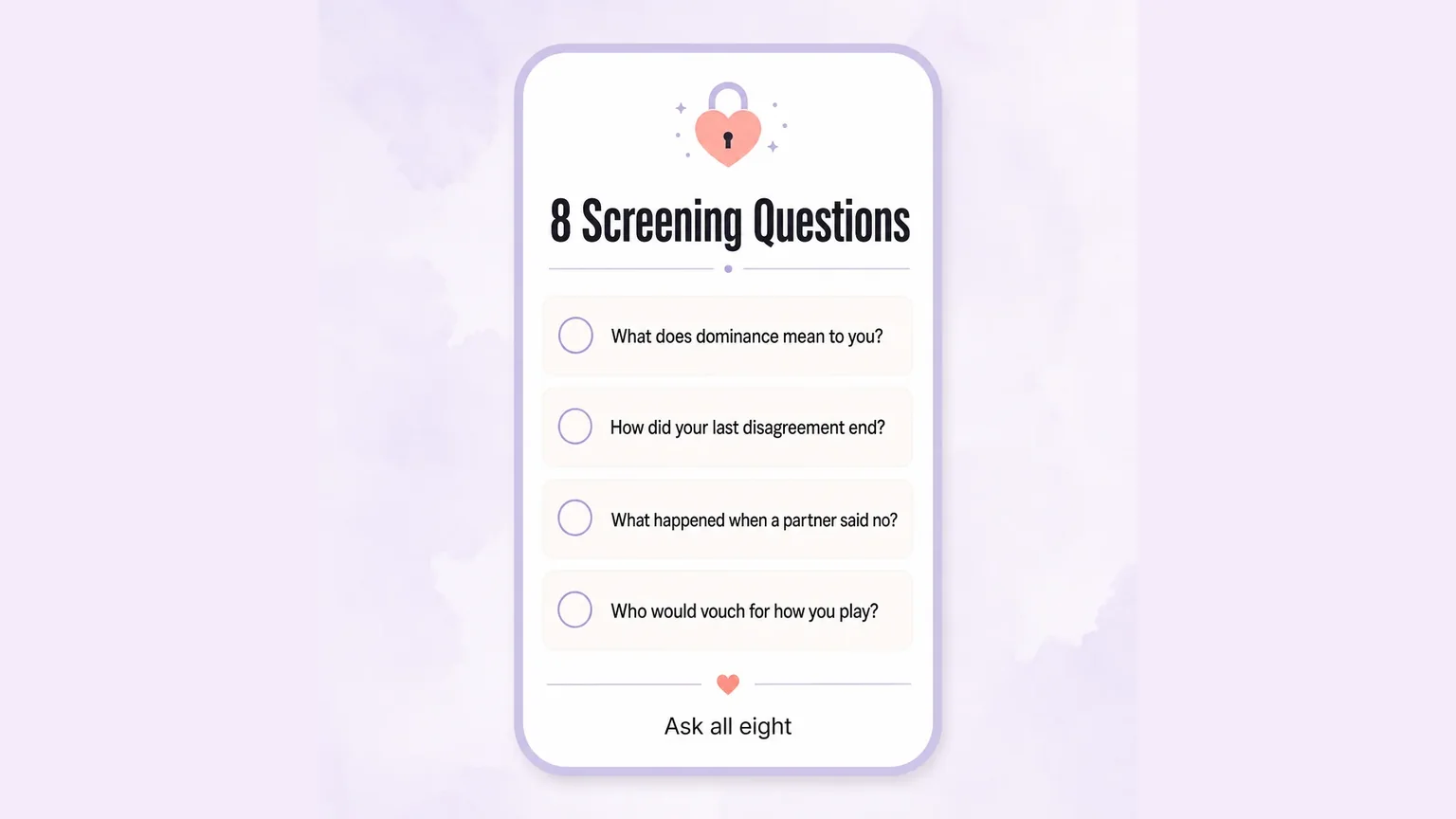
Run these questions before chemistry runs you, because a good dominant will answer them like a man with nothing to hide. Use a process in three moves.
Move one, before the date: a phone or video call beats a text marathon. Texting is low-effort and lets a performance hide. Voices carry honesty; curated gifs don’t.
Move two, on the date: daytime, low-commitment, no big events, no getting drunk, no overnight. Structure the meeting so you’re actually looking at him, and watch how he treats the waitstaff and anyone who can’t do anything for him. That’s a man off his best behavior, and it shows.
Move three, the eight questions worth asking:
- What does dominance mean to you day-to-day versus in bed?
- How did your last disagreement end?
- What happened the last time a partner said no to you?
- What are your kinks beyond the obvious? If it’s just “handcuffs and spanking,” he’s new.
- Who taught you how to play, and who do you look up to? Fifty Shades is not a handbook.
- Are you seeing anyone else, and do they know you’re dating?
- What does your aftercare look like?
- Do you have people who’d vouch for how you play?
Notice what’s missing: nothing about how impressive he is. You already know that part.
Number eight is where the kink-community rule saves you years. Ask for references from previous play partners, and if he refuses, or gets angry, that IS the answer. No caveat needed.
Run these questions before chemistry runs you. When you’re dating a dominant man, this screening is the difference between choosing him and being chosen by the version of him he wants you to see.
6. Negotiate the Power Exchange Like You’d Negotiate Anything Important
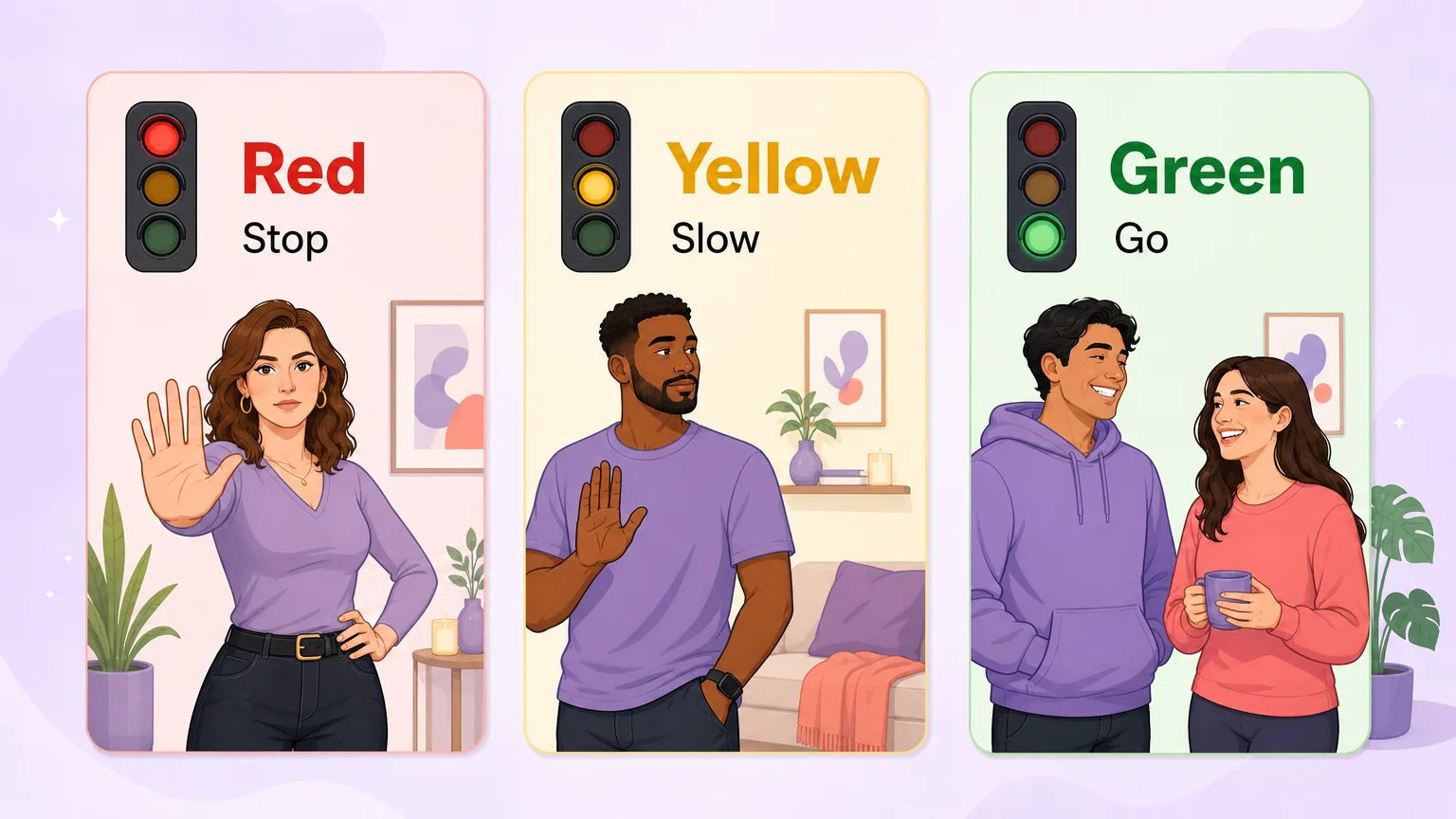
Negotiate the power exchange like a smart friend teaching you a new game, because when you’re dating a dominant man this is the entire relationship in miniature. It happens between equals, and the power is granted, not taken. That’s the sentence to hold before anything else.
Start with the traffic-light safeword. Red means stop immediately. Yellow means reduce intensity but keep going. Simple and precise, and it answers the hardest question, when does a scene stop, before the scene ever starts.
And the reframe that changes everything: a safeword is not a failure. It is proof that the power was always yours to recall. That’s the single most potent expression of your retained power. The community shorthand for the contract you’re entitled to is SSC and RACK: safe, sane, consensual, and risk-aware. Know those four letters, because they are the floor.
Then cover the part everyone forgets: renegotiation. The agreement is not set once and locked. It gets a power audit, a scheduled, calm check-in where there are no punishments, no rewards, just feedback on whether the agreement still serves you both. Changes go on a trial basis with a review date. That’s the difference between a living dynamic and a contract written in stone.
And if he can’t talk about consent like this, calmly and without ego, he’s not ready for the power you’d be lending him.
7. Set Boundaries That Actually Hold
Expect boundaries to erode under a dominant man’s confidence, and know why before it happens. When dating a dominant man, they rarely fail because he’s physically strong. They fail because power makes partners self-censor.
The mechanism, plain: in any dynamic with a power imbalance, the lower-power partner learns to edit what she asks for to keep the peace. Over time, that quietly converts genuine desire into obligation, and it erases your erotic truth. You stop saying what you want because saying it costs too much, and then you start believing you never wanted it.
The rule that cuts through the fog: if it’s not an enthusiastic yes, it’s a hard no. And a yes given to avoid his reaction isn’t consent. It’s accommodation. Name that difference out loud, because it’s the entire boundary in one sentence.
Then the move that preserves both the dynamic and the boundary: state your limit in the same calm, direct register he leads in, and treat his response as data, not as a threat to the relationship. You’re not negotiating the limit. You’re reporting it.
And the test that closes the case: a real dominant is relieved to meet a limit. A controller is insulted by one. That reaction is the whole review.
8. Know What a Healthy Dominant Should Give You Back (and the Soft Side You’re Allowed to Want)

Look for what comes back to you, because every good negotiation is sold on what’s in it for you. A healthy dominant gives you structure. Rituals and agreements don’t control you; they liberate you, and they hold him to his responsibility.
What a healthy dynamic returns: the relief of being seen and wanted without performing, the safety of a partner who plans and handles the logistics, the growth he calls you forth into even when it’s uncomfortable. These are the product.
A quiet testimony: one woman, after years of failed relationships, learned submission and called the result more peace than anything before it. No ropes, no cuffs, just a negotiated way of relating that finally fit. Not for everyone. But proof the desire isn’t the problem.
Structure without love is tyranny, but love without structure is chaos. Both halves matter, and a man who gives you only one half isn’t giving you a dynamic.
Then the softness, both directions. He is dominant and soft for you at the right moments, and he has a safe place to be vulnerable himself. The ideal of bleeding next to a shark is a toxic fantasy, not a relationship goal. A man who only gives orders is a manager, not a partner. When dating a dominant man, the difference is whether he gives anything back.
9. Never Skip Aftercare (and Learn the Difference Between Drop and Abuse)

Never skip aftercare, and treat it as a pre-negotiated condition, not a courtesy. First, understand the drop with real warmth, not alarm.
Intense play floods the body with adrenaline, endorphins, and oxytocin. The comedown can land hours or days later as sadness, emptiness, irritability, or a longing for reassurance you don’t know how to ask for. That’s sub drop. It’s a normal neurochemical response, and on its own it is not proof the scene was bad.
Now the mirror: Dom drop. Guilt, self-doubt, feeling unseen even after a scene that went well. Dominants talk about it even less, which is exactly why the care has to run both directions.
Then draw the line that protects you. Being pushed past your limits day after day, ignored safewords, or a refusal of aftercare is not drop. It’s harm. The difference matters, because one is chemistry and the other is a choice he keeps making.
Aftercare is the practice that holds all of it. Negotiate it in advance rather than improvising under pressure. Make it physical: hydration, warmth, food. Emotional: reassurance, praise, back to your name, protective touch. And check it again the next day, because drop has a delayed fuse.
And a line that doubles as a filter at every stage of dating a dominant man: a dominant who leaves the second the scene ends has told you exactly how he’d leave after anything else.
10. Negotiate Openness and Thirds With the Same Care as the Power Dynamic

Negotiate openness and thirds with the same care as the power dynamic, because when dating a dominant man they are the same skill. Opening the relationship or adding a third is voluntary stress-testing of the relationship’s operating system. A diagnostic, not a repair kit. It amplifies what’s already present; it can’t fix what’s cracked.
The pre-flight checklist, in plain terms: get specific about which acts are on and off the table, both to perform and to watch. Plan how attention flows so no one gets stranded in the corner.
Agree on safer-sex protocols and who provides barriers for every act. Decide who cares for whom afterward. And agree on a universal safeword, with exactly what happens the moment it’s used.
Then the emotional vocabulary that keeps the whole thing sane. Jealousy is a dashboard light. It signals something is off, but it doesn’t tell you what, so you investigate instead of acting on it. Compersion, the pleasure in your partner’s pleasure, is the muscle that grows with practice. Learn both words, because they’ll do the heavy lifting.
And the warning, straight, because this is where a power dynamic quietly becomes a control mechanism. In a dominant-led couple, a man who must dictate exactly who she’s allowed to play with has crossed from exploration into control. He’s not sharing. He’s accounting.
Negotiate the open part with the same care you negotiate the power part. That’s what keeps the whole thing ethical.
11. Decide What Happens When You’re Both Leaders
Decide what happens when you’re both leaders, before the first argument about it. When dating a dominant man, the worry is fair: strong women attract dominant men, and the fear of a power struggle is real. So normalize it first.
Now break the myth that there’s only one way to be dominant. Sex therapists describe several distinct types of dominance, not one monolithic trait. That single fact matters, because it means there are more ways to fit together than the stereotype suggests. You don’t have to recognize yourself in a caricature to belong to this story.
The practical answer: two leaders can date beautifully when the power is negotiated like anything else. The usual shape is that one partner consciously takes the follower role in specific contexts.
Not in all of life. Not by losing herself. In this scene, on this trip, for this kind of decision. That’s a negotiation, not a surrender.
The hard part deserves plain language: hyper-independence has to be examined. If you can’t tolerate receiving care, or letting him take the lead on anything, then your problem isn’t that he’s too dominant. It’s that surrender you can’t tolerate isn’t surrender. It’s control wearing armor.
So don’t fight over who drives. Agree on who drives this stretch of road, switch it up on the next one, and renegotiate the map together.
12. Screen for the Right Dominant Man on Dating Apps
Screen for the right dominant man on dating apps with a strategy in three clean moves.
First, what you write in your profile. Signal directness, your values, and your relationship structure plainly, without kink-dropping or performing for an audience. A woman who states what she wants is already filtering for the man who can handle her. And it quietly scares off the pretenders. That’s the point.
Second, how to raise dominance. Let it surface in the flow of normal vetting. When you’re dating a dominant man, a man who can discuss what he wants calmly, without performance, is worth more than one who announces it in the first message. The announcement is marketing. The calm discussion is him.
Third, which apps to try. Kink-aware and ENM-friendly spaces let you filter on values before you filter on chemistry. And mainstream apps work fine when you screen hard, because the screening, not the platform, is what protects you.
A run trigger, from a real story: a match cites an ‘alpha dominance’ influencer and announces he holds the final say in his household. That man has learned dominance as ideology, not as a skill, and every woman who’s seen that pattern will tell you the same thing: run.
So put the line in your profile that you date with negotiation, not guessing. That’s the exact clarity 3Fun was built on.
13. Know When to Walk Away (and End It Cleanly)
Know when to walk away, and treat the exit criteria as facts, not feelings. Walking on eggshells around him. Hiding innocent things to avoid his reaction. Limits that keep moving without negotiation.
Aftercare that quietly stopped. A dominance that climbed into your schedule and friendships.
Say it plainly: none of these is the cost of a strong man. Each one is the dynamic gone wrong, and you do not owe your loyalty to a failure mode.
The sustainability truth, the part no one hands you on the way in: a good power exchange is work, not magic. It has to hold in flat weeks, not just in chemistry, whether you’re dating a dominant man or anyone worth your time. If you’ve opened the relationship, that work doesn’t get lighter; it gets more explicit. The people who make it look easy are doing the most unglamorous talking.
When it’s over, end it cleanly, the way you came in: with your keys. Use the same skill that built the dynamic: clear, direct, non-punitive communication, honest about what wasn’t a fit rather than what he did wrong.
And close the whole thing with this: the right man isn’t the one who leads you. He’s the one who never forgets the whole thing was always yours to call.
FAQ: Dating a Dominant Man
The questions that keep coming up, answered straight.
What’s the difference between a dominant man and a controlling one?
Control is command instead of consent. A dominant asks what your limits are, handles the word no gracefully, and takes responsibility for the dynamic. A controller decides your limits don’t exist and takes responsibility for you. The test is the same every time: hand him the word no and watch.
Is a dominant man in bed automatically dominant in life?
No. Dominance that stays consensual and contained to the bedroom is different from control that creeps into how you dress, who you see, and what you think. If his dominance extends into everyday life without negotiation, that’s control wearing a costume, and it usually shows up right after you commit.
Do I need to be submissive to date a dominant man?
No. Dominant men respect self-possession, and over-submission is a turnoff. The best partner for a strong leader may need even greater self-confidence to comfortably surrender. Two leaders can also date healthily, as long as the power is negotiated instead of fought over. Surrender is a choice you make, not a role you perform.
What if I’m not into BDSM but he identifies as dominant?
Dominance and kink aren’t the same thing. Submission can be a natural relationship dynamic with no ropes or cuffs, the way one partner plans and the other relaxes into it. What matters is that you negotiate explicitly what dominance means to both of you. The red flag is only when he wants control you never agreed to.
Is it a red flag if he wants to be called “Sir” immediately?
Yes. Demanding honorifics, obedience, or a rulebook in the first days is the hallmark of an inexperienced instadom. Titles are earned and negotiated, not claimed. A man who demands “Sir” before he knows your last name is performing dominance, and performance is what you’re screening for.
How do I know if sub drop is normal or a sign of abuse?
Drop is a normal neurochemical low that lands hours or days after intensity, and on its own it isn’t proof of harm. Being pushed past your limits day after day, ignored safewords, or refused aftercare is abuse, not kink. If you’re afraid to ask for care, that’s your answer.
Does a dominant man still need emotional vulnerability?
Yes. Healthy dynamics run both ways. A man who must be strong in every moment is a man slowly isolating himself. Bleeding next to a shark is a toxic ideal, not a relationship goal. The partner you can go soft with, and who can go soft with you, is the whole point of the exchange.
How do dominant dynamics work when we open the relationship or add a third?
Negotiate like a contract: which acts are on and off the table, how attention flows so no one is stranded, safer-sex protocols, who cares for whom afterward, and a universal safeword with a defined procedure. Opening up amplifies what’s already there, so only do it on a secure foundation. If it’s not an enthusiastic yes from everyone in the room, it’s a hard no.