
What does the Bible say about homosexuality? A small number of passages mention same-sex behavior, and not one of them was written in the vocabulary of sexual orientation. Readers who treat those passages as Scripture have reached opposite conclusions about what they require today.
Seven passages are usually cited. A handful of others are read as positive. The disagreement is not about whether to read the Bible. It is about how.
Four things follow. Each passage gets its immediate context, including the ones whose stated sin is not what the popular version says. The Hebrew and Greek words get examined, and so do the English versions, which disagree with each other.
Jesus gets his own section, because what he does and does not say is narrower than either side’s slogan. The traditional and affirming cases get stated at full strength, each followed by the strongest objection it must answer.
By the end you will know what the texts say, who reads them which way, and why the question stays open for people who take Scripture seriously. There is no conclusion to hold back.
Is Homosexuality a Sin? What the Texts Say and What They Do Not Settle
Someone is usually asking what the Bible says about homosexuality because a family member came out, or a sermon landed badly, or they are in a pew wondering about themselves. A direct answer means splitting the question in two.
The first question is what the texts say about same-sex acts, and the next section answers it passage by passage. The second is whether those texts settle what a same-sex relationship is today, and that one is contested by people who agree on the first answer.
The passages are laws, narratives, an argument, and vice lists. They name acts, not a class of persons.
The traditional answer is stated in the Catechism of the Catholic Church, paragraphs 2357-2359, which calls homosexual acts “intrinsically disordered” and “contrary to the natural law,” and says that “under no circumstances can they be approved.” The same paragraphs call the inclination “a trial,” say such persons “must be accepted with respect, compassion, and sensitivity,” and add that “every sign of unjust discrimination in their regard should be avoided.” The Southern Baptist Convention’s 2010 resolution uses “intrinsically disordered and sinful” and commends “loving, redemptive ministry.”
On this framing the orientation is not the sin. The act is.
The affirming answer, argued by Matthew Vines, James Brownson, Karen Keen, Cheryl Anderson, David Gushee, and Pastor Zack Lambert, holds that the texts address ancient practices: assault, cult prostitution, pederasty, idolatrous excess. On that reading the condemnation does not carry over to a modern relationship.
The history is agreed. Karl Maria Kertbeny coined the term in an 1868 letter and published it in 1869. Orientation as a concept postdates these texts by roughly 1,900 years, and the English word “homosexual” did not appear in a Bible until the Revised Standard Version New Testament of 1946. Both sides draw opposite conclusions from that.
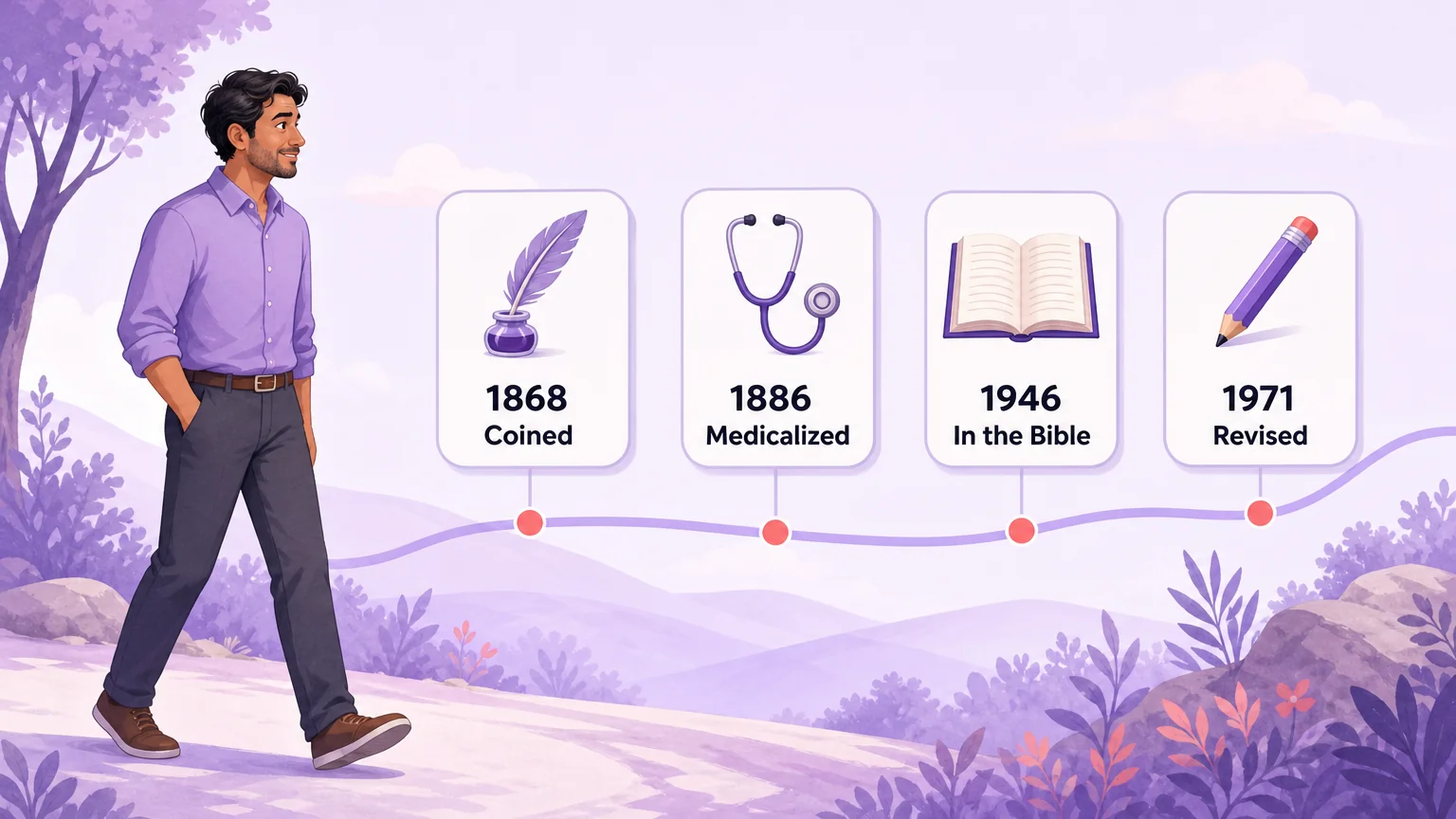
Nothing here settles whether the acts are sinful. What follows is the material readers, scholars, and communities use to make that call.
Where in the Bible Does It Talk About Homosexuality?
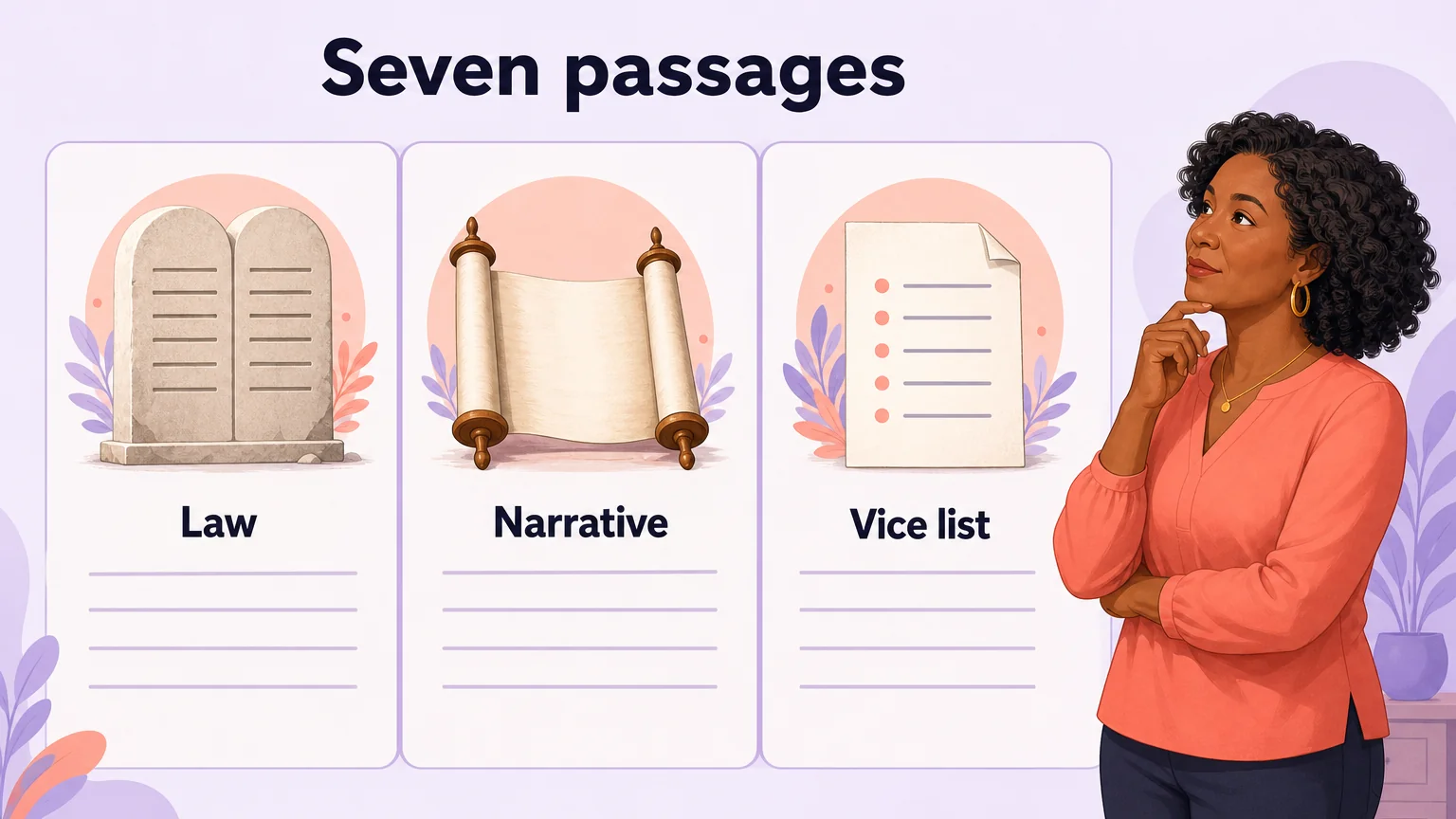
Seven passages are usually cited. Only two of them are laws, and one is a story whose stated sin is something else entirely.
| Passage | What happens | What each side does with it |
|---|---|---|
| Genesis 19:1-13 | A mob demands two visitors for sex; Lot offers his daughters. | Traditional: a verdict on same-sex acts. Affirming: attempted gang rape and broken hospitality. |
| Judges 19:22-24 | Gibeah’s men demand the Levite; a woman is given over and dies. | Traditional: a second witness. Affirming: atrocity, not a category of relationship. |
| Leviticus 18:22 | A law against male same-sex acts inside the Holiness Code. | Traditional: binding moral law. Affirming: a covenant marker, not universal ethics. |
| Leviticus 20:13 | The same act, now with a death penalty attached. | Traditional: the act’s seriousness. Affirming: part of a code Christians do not enforce. |
| Romans 1:26-27 | Paul describes desire redirected within idolatry. | Traditional: the desire itself condemned. Affirming: idolatrous excess, not covenant love. |
| 1 Corinthians 6:9-10 | A vice list naming malakoi and arsenokoitai. | Traditional: Paul names the act. Affirming: exploitation or prostitution. |
| 1 Timothy 1:10 | arsenokoitai listed among lawbreakers. | Traditional: a repeated witness. Affirming: the same lexical dispute. |
Genesis 19 narrates two visitors arriving, a mob demanding they be brought out for sex, and Lot offering his daughters in their place. The offense the story states is the violation of hospitality and the threat of sexual violence against guests. Ezekiel 16:49-50, the only Hebrew Bible passage listing Sodom’s sins, names arrogance, excess of bread, untroubled ease, and neglect of the poor, then adds, “In their haughtiness, they committed abomination before Me.” Isaiah 1:9-17 uses Sodom as a name for injustice.
Jude 7 reads the episode as sexual immorality. Judges 19:22-24 repeats the scene at Gibeah, where the men demand the Levite “so we can have relations with him,” and the woman is given over and dies. The sexual reading became central later in the interpretive tradition. Both readings use the same verses.
Leviticus 18:22 and 20:13 sit in the Holiness Code, chapters 17 through 26, whose rationale is Leviticus 19:2: “You shall be holy, for I, the Lord your God, am holy.” Verse 18:22 comes immediately after the ban on giving children to Molech, and the same chapters prohibit incest, bestiality, and child sacrifice. The operative word is to’evah, usually translated “abomination.” Chapter 20 attaches the death penalty; which parts still bind is a later question.
Romans 1:26-27 sits inside an argument about idolatry and its consequences. Paul names women first, which is why pederasty-only readings struggle there. English versions diverge: the NIV’s “shameful lusts” and “unnatural,” the ESV’s “dishonorable passions” and “contrary to nature,” the KJV’s “vile affections” and “against nature.”
1 Corinthians 6:9-10 is a vice list that ends, two verses later, “and such were some of you.” 1 Timothy 1:10 places arsenokoitai among lawbreakers.
Five more texts are sometimes read as positive. 1 Samuel 18:1-4 describes a covenant between David and Jonathan. 2 Samuel 1:26 has David grieving Jonathan with the line the King James Version renders “passing the love of women.”
Ruth 1:14 has Ruth clinging to Naomi. Matthew 8:5-13 has a centurion pleading for a servant. Acts 8:26-40 has an Ethiopian official baptized. No text calls these relationships sexual, and the readers who cite them disagree about how far the language goes.
That is a handful of passages, none written in the vocabulary of orientation, and a dispute that turns on context and word choice rather than whether the texts exist.
What Did Jesus Say About Homosexuality?

Nothing explicit. No Gospel records Jesus saying anything about same-sex behavior. Not one word in any of the four accounts. Both sides concede the point, and neither side finds a direct ruling in the Gospels.
What he does say is on the record. Answering a divorce question in Mark 10:6-8 and its parallel in Matthew 19:4-6, he quotes Genesis 1:27 and Genesis 2:24. In Matthew 5:27-30 he locates the offense in lust. In Mark 7:21-23 and Matthew 15:19, porneia comes from the heart.
Andrew Bunt, content director at the UK ministry Living Out, reads the Mark 10 quotation as an indirect answer. Jesus cites “male and female” before the marriage line, which Bunt calls “unnecessary information for the conversation about divorce,” and treats as a statement about design. Bunt states the direct point himself: “It’s true that Jesus never talked directly about same-sex sexual relationships (which is actually further evidence that he believed them to be sinful).” A related form of the argument leans on Matthew 5:17, where Jesus says he did not come to abolish the Law.
The affirming reading treats the silence as the answer. Jesus addressed sexual ethics repeatedly and cited other Levitical commands, yet never reached for Leviticus 18:22 or 20:13. The surrounding pattern gets cited too: the centurion, the Samaritan woman, table fellowship across purity lines, the Ethiopian official.
Both moves are inferences from what is not said, pointed in opposite directions. Neither is a proof text, which means the red letters settle nothing here for either side.
Jesus’s teaching on marriage is in the text, and both sides quote it. What it establishes is the thing in dispute.
What the Words Mean: To’evah, Malakoi, and Arsenokoitai
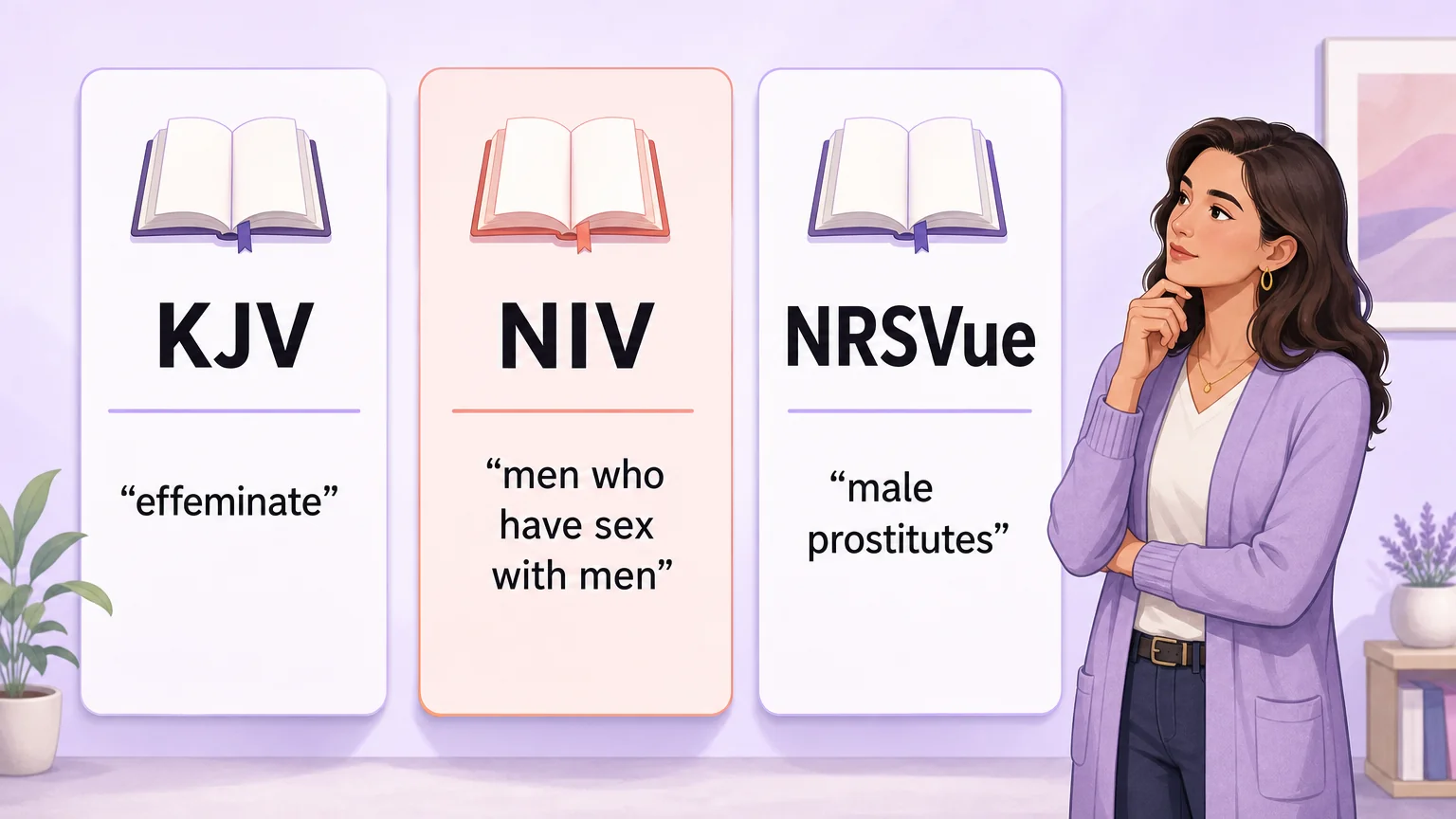
The most informative thing on a Bible page is often the footnote. The NRSV Updated Edition prints “Meaning of Gk uncertain” twice at 1 Corinthians 6:9. That note is this section in miniature: the Greek is disputed, and every English rendering is already an interpretation.
Start with to’evah, Strong’s 8441. It occurs 117 times in the Hebrew Bible and covers idolatry, unjust weights, dishonest scales, pride, certain foods, and sexual offenses. “Abomination” is a translation choice, not a definition.
Leviticus 18:22 and 20:13 apply it to male same-sex acts. Because the word covers so much, its force in Leviticus is itself disputed.
Then malakoi and arsenokoitai. Malakos means “soft ones,” which the KJV renders “effeminate” and the NRSVue renders “male prostitutes.” Bunt reads it as the passive partner. Arsenokoitai compounds arsen, male, and koite, bed, and echoes the Septuagint of Leviticus 18:22 and 20:13. It appears first at 1 Corinthians 6:9 and again at 1 Timothy 1:10, and it is rare in surviving Greek before Paul.
Bunt argues Paul coined the word precisely so as not to limit the ban to one known ancient practice, and treats the coinage itself as the argument. David Instone-Brewer, reviewing the documentary 1946, accepts that arsenokoites “certainly refers to homosexuality in some sense” while adding that “there’s still some debate about what that sense is.”
| Version | 1 Corinthians 6:9-10 |
|---|---|
| NIV | “men who have sex with men” |
| ESV | “men who practice homosexuality” |
| NRSVue | “male prostitutes, men who engage in illicit sex” |
| CEB | “both participants in same-sex intercourse” |
| KJV | “effeminate… abusers of themselves with mankind” |
| NASB | “homosexuals” |
These are not minor stylistic differences. They are different claims about what Paul named.
One more term: porneia, the broad word for sexual immorality that heads these lists. It does not by itself specify same-sex activity, which matters because the lists are often read as one undifferentiated category.
The 1946 history: “homosexual” entered an English Bible in the Revised Standard Version New Testament of 1946 at 1 Corinthians 6:9, and the RSV replaced it with “sexual perverts” in 1971. Instone-Brewer’s judgment is that the 1946 choice was an interpretive decision, not a fabrication. The date is correct. The conspiracy version is not.
The footnote is the useful part of the page, because it tells you a decision was made. Much of the argument about what the Bible says about homosexuality happens at this level, one word at a time.
Why Faithful Readers Disagree: The Traditional Case and the Affirming Case
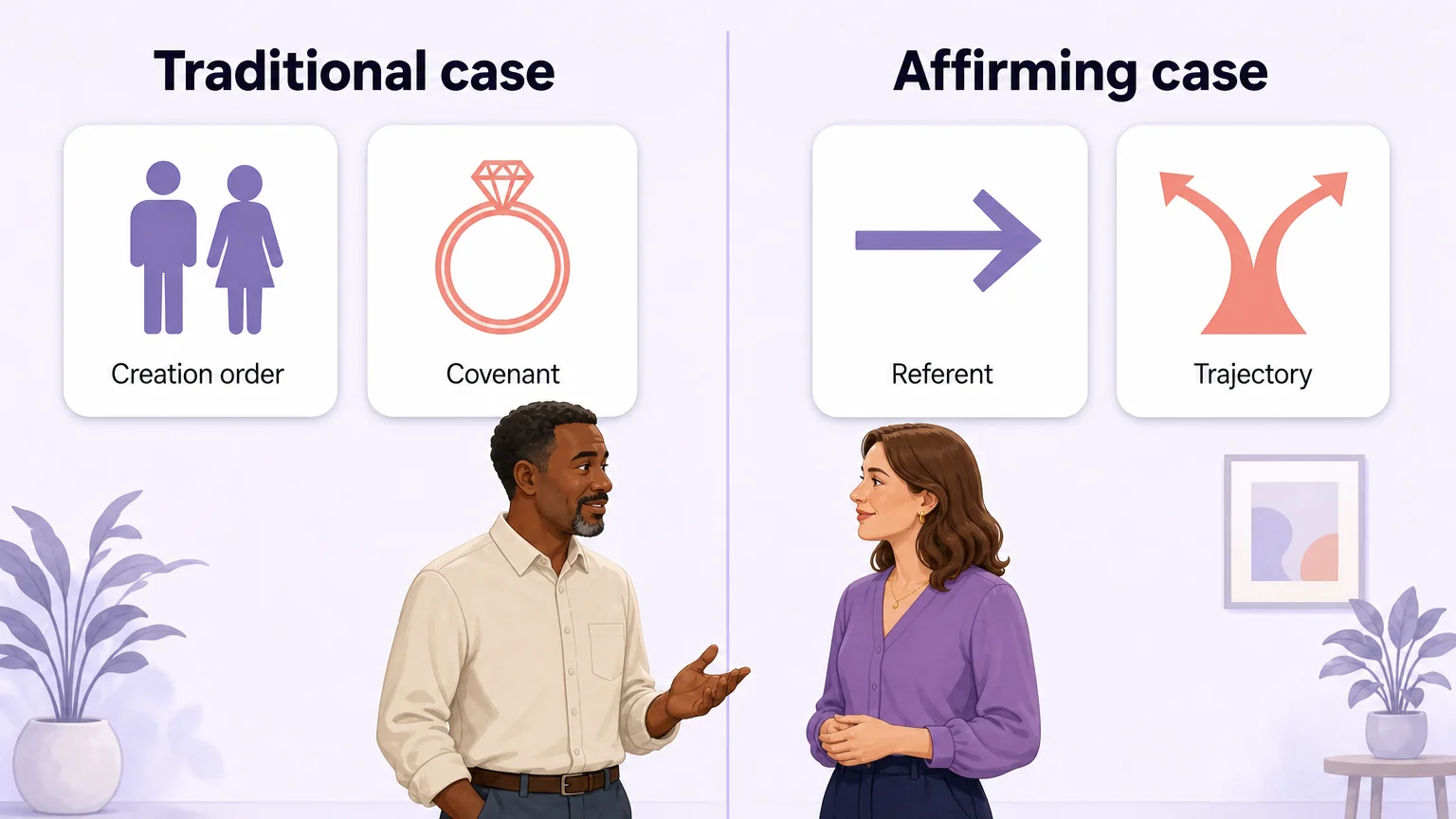
The strongest point on each side is the one its opponent has to answer. Both cases below are serious accounts of what the Bible says about homosexuality, and both are stated the way their own defenders state them.
The traditional case
The case runs through four moves. Creation order comes first: Genesis 1:27 and Genesis 2:24, cited together by Jesus in Mark 10. Then Ephesians 5:31-32, where marriage images Christ and the church, which Bunt uses to argue a same-sex union cannot image what marriage is for.
Romans 1 supplies the third: Paul’s charge is that desire was redirected away from the Creator toward the creature, not merely that someone exploited someone. The fourth is the Septuagint root of arsenokoitai, which ties the word back to Leviticus.
Robert Gagnon adds a moral argument. Being born with an orientation toward a behavior is true of everyone, so an attraction never settles whether acting on it is good. Discipleship in the New Testament, he argues, is framed as self-denial, taking up a cross.
What this case must answer, in its critics’ sharpest form. The texts were written without the concept of orientation, and they do not describe covenant partnerships, so the traditional case has to show that ancient acts and a modern relationship are the same object of judgment. It also has to explain why the other prohibitions in the same chapters are not enforced today, and why the cost of this reading falls, for life, on one small group.
The affirming case
The referent argument, in Lambert’s words: what Paul condemned was “power and abuse and unrestrained lust,” not covenant fidelity, so the texts and the modern relationship are not the same object.
The exploitation reading, set out at book length by Robin Scroggs in The New Testament and Homosexuality in 1983, fits a world organized by age and status asymmetry. Myles Markham, writing for the Human Rights Campaign, makes a hermeneutical argument: every reading interprets, Acts 15 and the church’s later reversals on slavery and on women’s equality are precedents for changed teaching, and Matthew 7:17-18 supplies the test of good trees and good fruit.
The strongest version belongs to Richard Hays, with Christopher B. Hays, in The Widening of God’s Mercy in 2024. Hays did not revise his exegesis. He still holds that “though only a few biblical texts speak of homoerotic activity, all that do mention it express unqualified disapproval,” and argues instead that God repeatedly widens mercy past earlier biblical boundaries. Even the most cited recent change kept the exegesis and moved the argument.
What this case must answer. If the texts sit on a trajectory, what limits the trajectory, and who decides. Romans 1:26 names women, which the pederasty reading has trouble explaining.
Rebecca McLaughlin’s critique: moving the argument to the character of God makes this a dispute about theology proper rather than about sexuality, and the Gentile analogy breaks because Scripture never commanded Gentile exclusion against a command. And the historical objection: the ancient world did not draw the exploitative-versus-consensual line the reading depends on.
Both cases are internally coherent. Each carries a cost it has not discharged. The split is not between people who read the Bible and people who do not.

What Does the New Testament Say About Homosexuality, and What Does It Change?
The New Testament never repeats the Old Testament’s laws on this subject. It changes the vocabulary, the audience, and the frame, and readers disagree about how much that changes.
What is new: the terms are Greek now. Malakoi, arsenokoitai, and porneia stand where Leviticus had to’evah. The setting is diaspora congregations in Greco-Roman cities. The form is the vice list.
Romans 1:26-27 and the two vice lists are the only places same-sex acts are named, and 1 Corinthians 6:11 frames them in redemption: “and such were some of you.”
The traditional reading says the moral law carries over. Ceremonial and civil law was fulfilled in Christ. The moral law remains.
The proof offered is that Paul, who relaxed circumcision and food rules, still condemned this. Acts 15, where the church ruled that Gentile converts need not keep the whole law, is the precedent both sides claim.
The affirming reading says these texts are as culturally situated as the Old Testament ones, and that Acts 15 shows the church re-reading inherited law under new conditions.
The shellfish objection arrives first, and it deserves a hearing. Traditional readers answer that the food laws were ceremonial and expired, while the sexual prohibitions belong to the moral law. Affirming readers answer that the split is imposed on the text rather than found in it.
What the Bible says about homosexuality in the New Testament is a reframing rather than a settlement, and the two camps read it in opposite directions.
If You Are the One Asking: What Christian Communities Teach
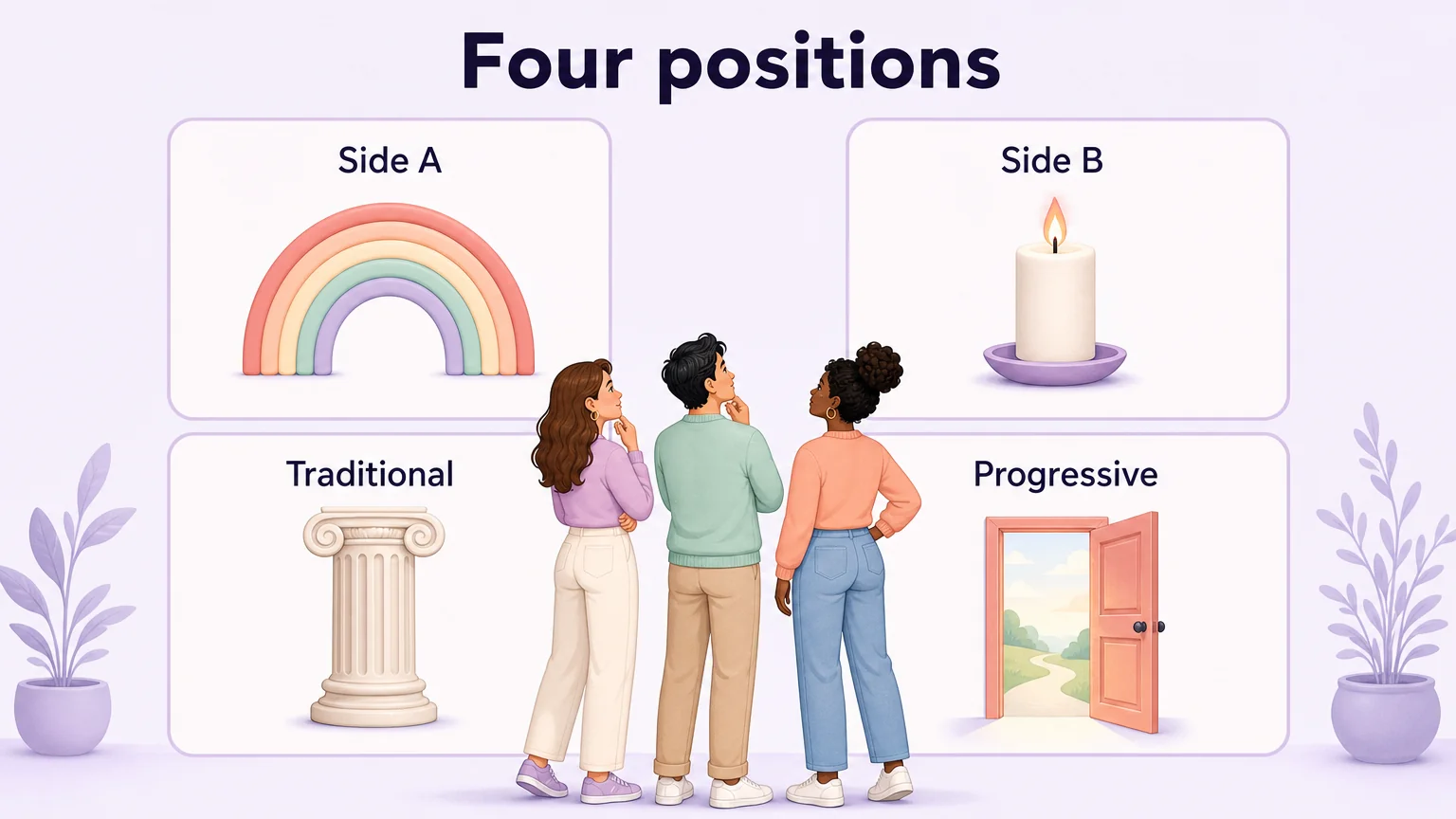
If you are the one inside this question, the argument has a cost it does not mention, and that cost is usually paid alone.
The positions have names. Affirming, sometimes called Side A: Matthew Vines, Zack Lambert, and the Episcopal Church, the ELCA, the Presbyterian Church (U.S.A.), and the United Methodist Church after 2024. Celibate, or Side B: David Bennett, Andrew Bunt, Wesley Hill, and Living Out, which is not the old ex-gay movement and does not claim attraction changes.
Traditional and non-affirming: the Catholic Catechism, the Southern Baptist Convention, Robert Gagnon, Christopher Yuan. Progressive: David Gushee.
The camps argue among themselves too. Yuan criticizes Side B from the traditional side, and reports that Hill has said he would write parts of Washed and Waiting differently.
The denominational landscape. Catholic: paragraphs 2357-2359. Southern Baptist: the 2010 resolution.
United Methodist: in 2024 the General Conference deleted the 1972 “incompatible with Christian teaching” clause 523 to 161, removed the wedding ban 447 to 233, and repealed the clergy ban 692 to 51. It also replaced the celibacy standard 544 to 121 and added conscience protection 479 to 203, after roughly a quarter of U.S. congregations, about 7,600, were reported to have disaffiliated between 2019 and 2023.
Episcopal: the 1976 General Convention’s “children of God” language, its first openly gay bishop in 2003, a blessing rite in 2012, and marriage language now reading “two persons.” ELCA: the 2009 Churchwide Assembly vote reported at 559 to 451. Presbyterian Church (U.S.A.): the denomination ratified Amendment 10-A in 2011, removing the ordination bar, and changed its marriage definition in 2015. Anglican Communion: Lambeth 1998 Resolution I.10, reported at 526 to 70 with 45 abstentions, advisory rather than binding.
Two details from people inside it, offered as texture rather than evidence. David Bennett’s mother, on hearing he was gay, first asked whether he had gotten someone pregnant or was on drugs. Kaleb defines celibacy as lifelong singleness and his attraction as something he did not choose and does not expect to change.
Nothing here requires you to settle it. Plenty of people live with it unresolved for years.
What the Bible says about homosexuality is one question. What a community does with it is another. What to do with that belongs to you, your conscience, and whatever community you answer to.
Frequently Asked Questions
Is homosexuality a sin?
Traditional readers say the acts are sinful, and many distinguish the orientation from the act. The Catechism calls the inclination “a trial” and the acts “intrinsically disordered.” The Southern Baptist Convention’s 2010 resolution calls the behavior “intrinsically disordered and sinful.” Affirming readers say no, arguing the texts address ancient practices rather than orientation or covenant relationships. Matthew Vines and Pastor Zack Lambert hold it.
What did Jesus say about homosexuality?
No Gospel records Jesus saying anything explicit about same-sex behavior, and both sides agree on that fact. Andrew Bunt infers a position from Jesus quoting Genesis 1:27 in Mark 10. Affirming readers treat the silence as significant, since he cited other Levitical commands but never Leviticus 18:22. Both are inferences from what is absent, and neither is a direct ruling.
Where in the Bible does it talk about homosexuality?
Seven passages are usually cited: Genesis 19:1-13, Judges 19:22-24, Leviticus 18:22, Leviticus 20:13, Romans 1:26-27, 1 Corinthians 6:9-10, and 1 Timothy 1:10. Two of them, the Leviticus verses, are the only laws. Five other texts are sometimes read positively: 1 Samuel 18:1-4, 2 Samuel 1:26, Ruth 1:14, Matthew 8:5-13, and Acts 8:26-40. None is described in the text as sexual.
What does the New Testament say about homosexuality?
The New Testament never uses the category. Same-sex acts appear in Romans 1:26-27 and the two vice lists at 1 Corinthians 6:9-10 and 1 Timothy 1:10, with the vocabulary malakoi, arsenokoitai, and porneia. The lists name behavior, not a class of persons.
The frame at 1 Corinthians 6:11 is redemption: “and such were some of you.” Whether those texts settle the modern question is the dispute.
What does Jesus say about homosexuality compared with what Paul wrote?
Jesus addresses marriage in Mark 10 and desire in Matthew 5. Paul addresses same-sex acts in Romans 1 and 1 Corinthians 6. Whether Paul develops Jesus’s teaching or departs from it is the dispute.
Traditional readers say Paul applies a creation ethic Jesus affirmed. Affirming readers say the silence itself is the teaching. Neither writer uses the vocabulary of orientation.
What does arsenokoitai mean?
Arsenokoitai is a compound of arsen, male, and koite, bed, echoing the Septuagint of Leviticus 18:22 and 20:13, first attested at 1 Corinthians 6:9. Outside 1 Corinthians and 1 Timothy, it appears nowhere in the New Testament.
Andrew Bunt argues Paul coined it to cover the act broadly. Robin Scroggs reads it as pederastic exploitation. The NRSV Updated Edition footnotes “Meaning of Gk uncertain.”
Was Sodom and Gomorrah destroyed for homosexuality?
Genesis 19 narrates an attempted gang rape of visitors, and the stated offense is the violation of hospitality and the threat of sexual violence. Ezekiel 16:49-50, the only passage listing Sodom’s sins, names arrogance, excess, and neglect of the poor, then adds “abomination.” Jude 7 reads the episode sexually. Traditional readers treat Jude as the key to the story. Both readings use the same verses.
Did the word “homosexual” really not appear in the Bible until 1946?
Correct for English Bibles. The Revised Standard Version New Testament of 1946 used it at 1 Corinthians 6:9, and the RSV changed it to “sexual perverts” in 1971. The claim concerns English translations, not the Greek text.
David Instone-Brewer calls the 1946 choice an interpretive decision rather than a fabrication. Older versions used “effeminate” and “abusers of themselves with mankind.”
Can you be gay and Christian?
Every major position says yes to the person and divides on the terms. Side B, represented by David Bennett, Andrew Bunt, and Wesley Hill, says yes with celibacy. Side A, represented by Matthew Vines and Zack Lambert, says yes including covenant relationships.
The Catechism requires respect and chastity. The Episcopal Church’s 1976 convention called gay persons “children of God” with “a full and equal claim.”
Do all Christians who hold the traditional view oppose gay people?
No, and the distinction is more than a defense. The 2010 Southern Baptist resolution commends “loving, redemptive ministry.” The Catechism forbids “every sign of unjust discrimination in their regard.” Andrew Bunt, Robert Gagnon, and Christopher Yuan each argue that a gay person is no different from any other sinner. Official language and lived practice are not always the same thing.