
It’s late, and the question won’t leave you alone: how do you become a femdom? Not the version in your head, the one who already owns a toy bag and a dungeon. You mean you, with a partner in mind, starting from zero, quietly sure you aren’t the type. You can be gentle, shy, and brand new and still be the type.
Becoming a dominant is a learned sequence of ordinary moves, not a personality transplant. The doubt that you aren’t bossy enough, the terror of the first conversation, the mystery of what a first scene even looks like: all of it has an answer, and none of it starts with shopping.
This is the getting-started roadmap: deciding whether femdom is really for you, building your presence, raising it with your partner, negotiating like a pro, learning the words, running a first scene this week with no gear, and keeping it sustainable.
Follow it in order and you can move from tonight’s questions to a real conversation in about a week.
Hold the reframe that runs under all nine steps: you do not become a femdom by acting bossy. You become one by leading with presence and consent.
Step 1: Decide If Femdom Is Really for You (No, You Don’t Need to Be Bossy)

By the end of this step, you’ll have an honest yes or not-yet, plus a written want list you’ll reuse when you negotiate.
Start with the doubt, because almost everyone carries it. You were given dolls, told to smile, told not to be bossy. Of course being in charge feels foreign.
The mistake that keeps women stuck is confusing a skill gap with a fixed identity. One woman’s first attempts felt awkward, unsure, anxious, so she assumed dominance just wasn’t for her. The problem was that she had no skills yet.
It’s like being shoved on stage to perform the tango before you’ve learned the steps. Nobody reads that as “you’re not a dancer.” They read it as “you haven’t practiced.”
Domination is not aggression, and it’s not volume. It’s presence. A woman under five feet tall found her power lives in stillness, not muscle: stillness can dominate more than shouting ever could.
One more story, because it’s probably the shape yours takes. A newcomer felt completely lost, sure she’d never figure femdom out. Then she tried being gentle and firm with him, and discovered she was thrilled to have a tall man kneeling in front of her.
Now the decision. Answer these tonight: did any moment above pull at you? Does the idea of him waiting for your permission feel exciting? Does watching him feel good because you told him to?
Then write your want list: three things you’d genuinely enjoy, not things you think you should want. A useful want line is specific, like “I want him to ask before he touches me,” not “I should learn to be bossier.”
My direct recommendation: treat this as a time-limited experiment, not a lifetime verdict. Give yourself two weeks of exploring the idea. You aren’t deciding who you are. You’re deciding what you want to try next.
Step 2: Find Your Femdom Style and Practice Your Presence
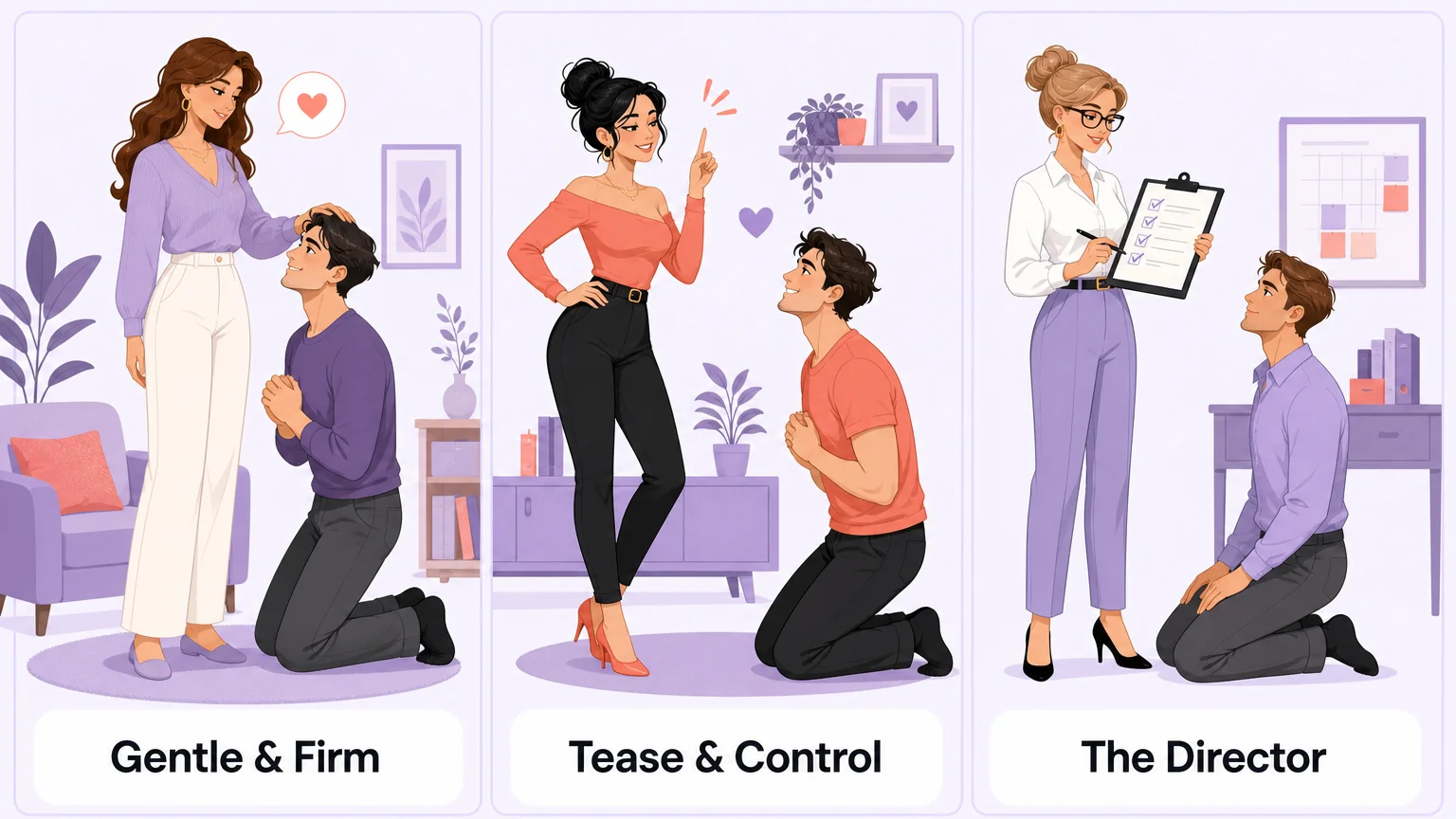
By the end of this step, you’ll know which starter flavor fits you and have a daily drill for wearing it.
The most powerful register is the quiet one. The stern, snapping persona most beginners picture is optional, one costume in a closet full of them. Remember the woman under five feet? Presence did what force never could.
Three starter styles from working dominants. Pick the one that feels like you.
- The Gentle-and-Firm domme. Warm, praise-heavy, kind in tone and immovable in direction. This is the woman who discovered she loves being gentle and firm with him.
- The Tease-and-Control domme. Playful, loves suspense and games, keeps him guessing, and saves denial for later.
- The Director. Organized, loves tasks and rituals, and runs a scene on time and on plan.
Playing a persona is legitimate too: a strict teacher or a playful villain gives you a safe distance to experiment from.
Two reassurances from experienced educators. You can be warm and still be dominant. It’s fine to be silly sometimes; a lot of BDSM is about being silly. Say what you mean rather than fawning, and let the quiet do the work.
Now the practice, because this is where femdom gets built. Confidence is built, not born; the best dominants started out overthinking and second-guessing.
Drill it daily: say one command to yourself in the mirror, slow your words, and hold your own gaze. Then practice a lower, steady voice even on ordinary errands, because a submissive can feel when you don’t trust yourself.
First-time nerves are normal and healthy. As one educator put it: you’re going to mess up, and we all mess up on every side of the slash.
Best-for:
- Warm by nature? Start with Gentle-and-Firm: direction wrapped in praise.
- Love games and suspense? Start with Tease-and-Control: every scene a question you’re in no hurry to answer.
- Love structure? Start with Director: clear orders, a satisfied sub.
Step 3: How to Bring Up Femdom With Your Partner (Scripts Included)

By the end of this step, you’ll have one opening sentence you can actually say out loud.
The talk feels like a confession, so it never happens. That’s the whole problem. You don’t need a grand speech. You need one warm sentence and a clear way in.
Starter lines, adapt freely:
- “I’ve been thinking about something I’d love to try with you, and I want to say it right, so bear with me.”
- “I love the idea of being the one who decides what happens in bed sometimes.”
- “What would you think about me taking charge for a night, and you just relaxing and enjoying it?”
One rule makes it land: lead with specific behavior, not labels. Don’t open with the word femdom or BDSM unless he’s unusually kink-aware. “I’d love to be the one who tells you what to do” lands. “I want to build a female-led dynamic with agreed protocols” lands like a contract.
Explain the emotional side of submission, not just the acts. For many men it’s relief: being wanted, being allowed to let go, being led and adored while they serve. It isn’t humiliation.
Make it mutual from the first breath. Ask about his fantasies too, and frame what’s in it for both of you. This only works as a shared experiment.
If he’s curious but shy, use a low-pressure invitation. Run the single-rule experiment: for a few hours or a weekend, he asks before opening a soda or sits on the floor instead of the couch. It’s allowed to feel silly; that’s part of the point. Or run a time-boxed service week framed as no-femdom, just serve-her fun, so he can discover the feeling without carrying the label.
The rejection beat, because you want it before you need it. If he isn’t interested, that’s survivable, and it is not a verdict on you. Never push. Never guilt. Never ask him to pretend the power is his when it isn’t.
One line for the ENM reader: if you’re dating or swinging, raising a kink interest with a new play partner is an ordinary, consent-forward thing to do. For that conversation, it helps to be somewhere the question isn’t strange. On 3Fun, couples and singles who want the same kind of adventures find each other without the awkward first explanation.
Your deliverable: pick or adapt one opening sentence and say it aloud once to yourself before the real conversation.
The verdict: an awkward five-minute talk beats years of silent wanting. And raising it is already your first act of leadership.
Step 4: How to Negotiate Your First Femdom Scene Without Killing the Mood
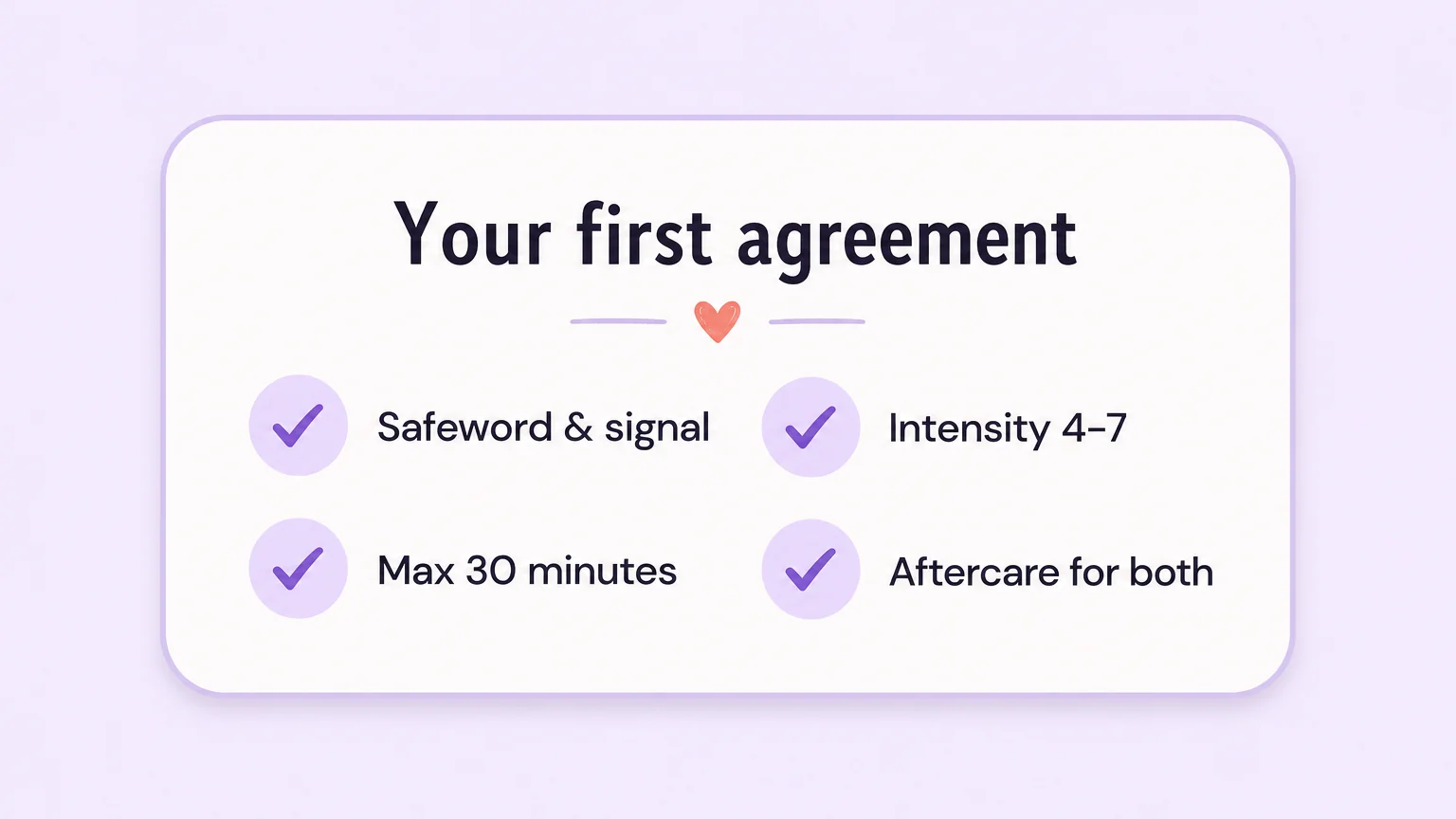
By the end of this step, you’ll have a one-page agreement you and your partner both signed off on.
Start with the reframe a sex therapist uses: schedule the conversation. Putting it on the calendar doesn’t make it a chore; it gives you anticipation for the event. Negotiation isn’t the unsexy admin before the fun. In femdom, it is the craft of domination itself.
Here’s what a negotiation actually is: the conversation about boundaries, limits, expectations, and goals that prevents relationship ambiguity. What you’ll do, what you want to do, what you won’t do.
Hold it somewhere private and sober, ideally on the calendar. Work a simple checklist: what you’d like to do, receive, and give. This isn’t a legal contract. It’s a shared plan you both wrote.
The items, with beginner-ready numbers:
- A safeword. Pick something absurd that can’t slip out mid-play; pineapple works. Add a non-verbal signal, three pats or three blinks, for when his mouth is full. Any signal stops play instantly.
- An intensity band. Agree a 1-10 range in advance, roughly 4 to 7 for a first scene.
- A scene length. About 30 minutes or under.
- Aftercare for each of you. You won’t get your own by default unless you ask for it.
For the first scenes, keep communication in plain English rather than coded safewords. And know this: you’re allowed to have your own limits, and to say you don’t know something. Both are fully compatible with being the dominant.
If he’s the experienced one, plant it here: his ideas and feedback belong in this conversation, agreed in advance, not sprung mid-scene. And you decide your own style.
Your deliverable: write the one-page agreement together. Activity, intensity band, safeword and signal, scene length, aftercare for both.
My direct recommendation: if you take only one thing from this step, take the written agreement. A scene you both agreed on is a scene neither of you has to guess about.
Step 5: Beginner Command Language: What a New Femdom Actually Says
By the end of this step, you’ll have a short command list and the confidence drill to back it up.
Here’s the quick win: you can start tonight with three kinds of lines and nothing else.
At the moment of truth, beginners freeze because they think command means volume, cruelty, or a porn script. It doesn’t. Command is calm, specific instruction plus acknowledgment. You need a handful of lines, not a monologue, and every one of them is learnable.
Instruction lines. Calm and specific. Short, clear, delivered as statements, not requests. “Kneel.” “Look at me.” “Tell me what you want.” “Wait.” A dominant who can’t say what she means will flounder, especially with a strong-willed or experienced submissive.
Praise lines. Your acknowledgment is the reward, and submission is earned, not demanded. An excellent dominant doesn’t demand obedience; she seduces submission by winning devotion. Make your praise specific: “Good. That’s exactly what I wanted.” Specific praise is fuel. Vague praise is noise.
Correction lines. Coach instead of punish. “Not like that. Like this. Try again.” Punishment breeds fear and hiding. Calm re-instruction builds skill.
Now the voice and pace. Fewer words. A steadier, lower register. And the power of the pause: silence is suspense, and it buys you time.
And permission to be authentic: if it feels silly, it’s allowed to be silly. Laughing together doesn’t break the scene; it keeps you both human inside it.
One optional beat: choose a title that fits you. What he calls you matters less than that you both like it.
Before your scene, write your command list: two or three instructions, one praise line, one correction line. Then rehearse them aloud once in the mirror. That’s the confidence drill from Step 2, now doing real work.
Hear the difference:
- Commanding versus asking: “Kneel.” versus “Would you mind kneeling?”
- Praising versus correcting: “Good, exactly like that.” versus “No. Wrong.”
Rotate those three kinds of lines through a whole scene and you have a working script.
Step 6: Run Your First Femdom Scene, Start to Finish (No Gear Required)

By the end of this step, you can run a first scene this week with nothing but your hand and a plan.
The picture most of us carry of a femdom scene involves gear and an attitude you don’t have yet. The actual scene is thirty minutes, your bare hand, and a plan.
The frame. This is a dress rehearsal, not an attempt to blow anyone away. Keep it to about 30 minutes or under, with one or two implements at most.
Stay inside the intensity band you agreed in Step 4, roughly 4 to 7 on a 1-10 scale. Communicate in plain English, and for the first scenes treat any “stop” or “no” as an actual stop.
The arc. Open by stating plainly what is about to happen, then give him a job. The number-counting task turns his feedback into part of the game: when you spank him, he says the number of the spank and its intensity. “One, that was about a five.” You calibrate without guessing, he stays in the scene, and you get better in real time.
Now choose one activity.
Hand spanking is the standard entry to impact play and needs zero gear. Aim for the fleshy part of the bottom, avoid the tailbone, and start light, almost like tapping. Treat his running feedback as calibration, not failure.
Or sensation play, with a blindfold and things already in your house: a feather duster, an ice cube, the back of a cold spoon. Explore textures slowly and check for sensitivities as you go. It builds trust without a hint of threat.
If he has done this before, the same scene still works. His ratings are data that makes you better; that isn’t topping from the bottom. Bratting gets parked with a brand-new domme, and his knowledge is a resource, not a challenge to your authority.
When it feels awkward or funny, keep it light. Silly is part of this. And if at any point you don’t want the scene, you’re allowed to stop it. Never play to please a partner.
The wind-down. Stop before anyone is spent or frustrated. Then immediate aftercare: water, a blanket, cuddling, plain reconnection talk. Never an abrupt exit.
On gear, the short version: you need nothing for this scene. If you buy anything, make it a cheap sleep-mask blindfold or a set of Velcro wrist restraints.
Two safety rules matter. Soft, quick-release restraints beat metal handcuffs or rope for now. And if you ever use a collar or leash, it should fit about two fingers under it, with pressure on the back of the neck, never the front of the throat.
Your first scene isn’t graded on polish. It’s graded on whether you both end it feeling safe and closer. A dress rehearsal that ends well is a win.
Step 7: Aftercare for Both of You (Yes, Doms Drop Too)

By the end of this step, you’ll have a personal aftercare plan and a three-line debrief script.
The person in charge can be the one who crashes afterward. Drop hits anyone who does this, in any role, and the word subdrop wrongly left tops out of the conversation. You can run a beautiful femdom scene and still feel the low a few days later.
Expect the timing. Drop usually starts the day after a scene, sometimes a few days later, and lasts from half a day to about a week. Tell drop from a bad scene by its signs: low mood, irritability, guilt, sadness, emptiness; chills, aches, lethargy, trouble sleeping.
The care plan is for you, not just for him: light conversation and cuddling, water, a protein-rich snack, a proper night’s sleep, a walk or a warm bath. Arrange these for yourself the way you already do for him.
And hold this: something isn’t bad just because it has side effects. First-time drop hits harder before you learn to mitigate it, then eases with experience. It’s information about pacing and care, not a verdict on kink.
Two habits make it sustainable. For a new dominant, the debrief is nearly more important than the scene: talk it through soon after with kind, specific phrasing, or journal first and calendar the conversation. Checking in afterward is part of being the dominant, not optional.
Keep a short scene diary, a few lines on the play and how you both felt, to learn your own pattern.
Pace yourself. Playing several days back-to-back builds a cumulative drop that hits hard when you stop.
Before your next scene, write your personal aftercare plan, the three or four things you need after play, and hand it to him as part of the negotiation. Add a three-line debrief script: what I loved, what I’d change, how we both feel now.
You aren’t less of a dominant for needing care; you’re the model of it. The domme who asks for her own aftercare is the one who gets to keep playing for years.
Step 8: Add the Signature Move: Teasing, Edging, and Orgasm Control
By the end of this step, you’ll have one permission game you can run in your next scene.
The most famous femdom skill is mostly a game of timing and restraint. It needs no toys, and done right it’s one of the lowest-risk things you can add.
The shape. Bring him close, then stop or slow just before the point of no return. Let the arousal settle, then repeat. Let him finish only when you decide. The built-in payoff: that stop-start buildup tends to make the eventual orgasm stronger.
Frame the power for your register. This is permission-based control. The sentences that do the work are “not yet” and “now.” It works in the gentle-and-firm style as easily as the stern one. He finishes when you decide, and that alone makes even the gentlest dominant unmistakably in charge.
The safety and consent mechanics, plainly. Agree the plan and the signal for “near the edge” in advance. The safeword still applies; if he calls it, the scene stops or release is granted immediately.
Use lube to avoid chafing from prolonged stimulation, and stop if it stops feeling good or causes pain or numbness. This is pleasure, not a number.
Know the medical lines. The heavy “blue balls” discomfort of prolonged arousal is uncomfortable but harmless. An erection lasting more than four hours is a medical emergency. If you’re ever unsure, slow down or stop. Never push on.
Two optional refinements. The squeeze technique, a firm hold at the base for about thirty seconds, helps him hold the edge. And the ruined orgasm, release with stimulation removed, is a flavor for later if it appeals.
Run a permission game next scene. Bring him close a few times, each time saying a version of “wait.” Then give him the finish as a reward, and praise him for holding. That turns this whole step into one exercise.
Best-for: if he responds well to being led and praised, keep it soft and playful. If he asks for more structure, add a standing rule, like asking permission before he finishes. A collar can be the scene-on signal: fitted two fingers under, never front-of-throat pressure.
Step 9: Bedroom-Only or Full Dynamic? How Far to Take Your Femdom
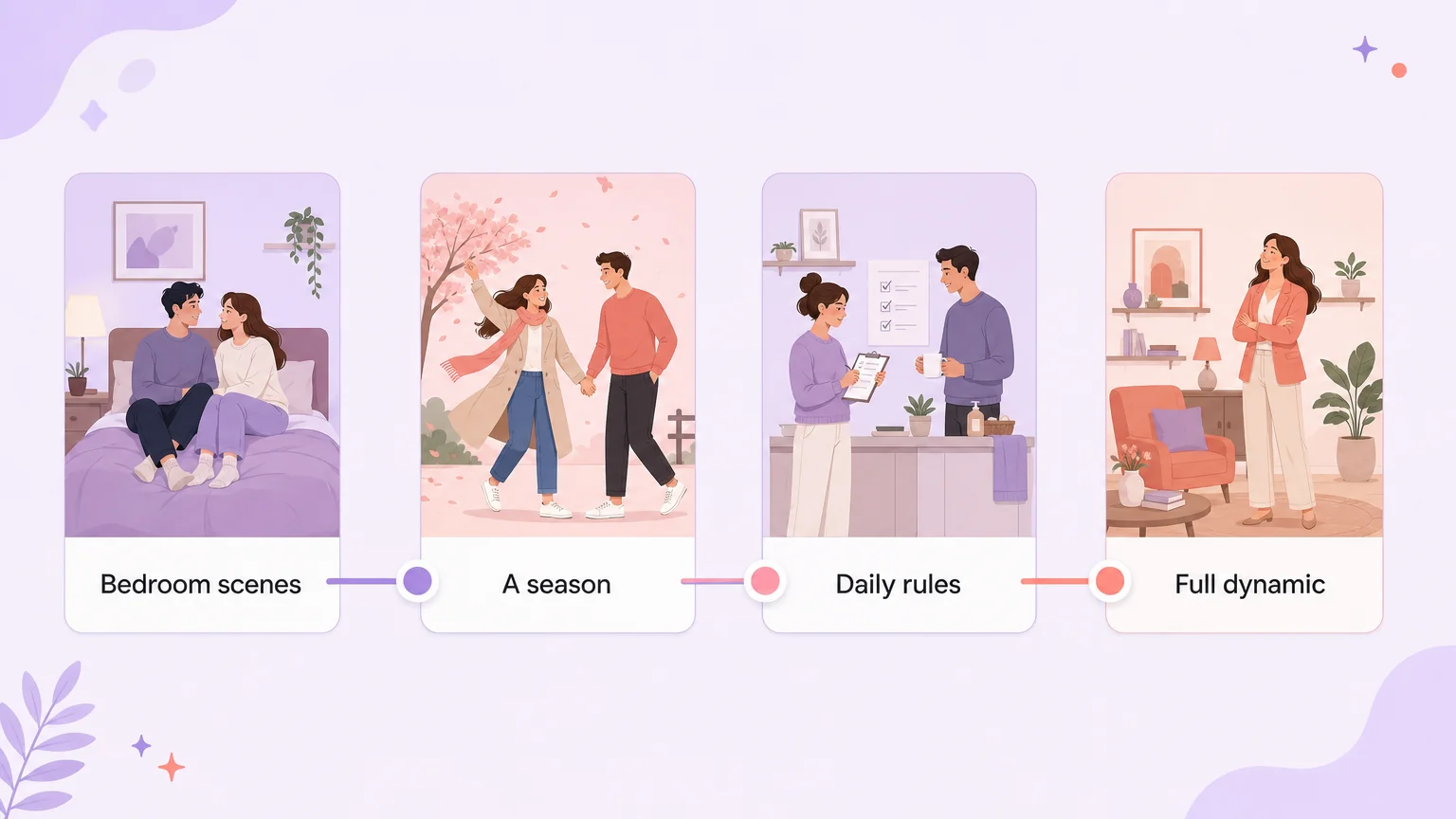
By the end of this step, you and your partner will have made one conscious decision about how far this goes for now.
The quiet fear under many first scenes: a taste of femdom means the whole relationship gets restructured. Let it go.
Most power-exchange relationships are partial, from one small rule up to near-total. Total 24/7 exchange is a poor starting point for nearly everyone new to kink. Bedroom-only is normal, and complete.
The play route sprinkles D/s flavor into scenes you already enjoy: a pet name, a “thank you” after each spank, a pretend punishment-for-disobedience scene when there are no real rules yet.
The rule route suits an established relationship better: try one tiny rule for a few hours, a weekend, or a full day. He asks before opening a soda. He stays off the couch.
Scaling: try any new element two or three times and keep notes before keeping it. Start with exactly one rule, the most fun one for you, and add another only once the last becomes a habit, every two to six weeks. Save rituals for later; never run a long rule book.
Scope is a dial, not a ladder. One FLR coach maps four settings: gentle leadership, shared structure, a defined female-led arrangement where roles and decisions are consciously assigned, and an erotic female-led life. “She picks the restaurant” and “she runs the household decisions” are both legitimate settings.
Two mechanics keep it healthy. Renegotiate in open, out-of-dynamic talks on a rough cadence, not when a problem appears. And enforce everyday rules by coaching the behavior rather than punishing, because punishment breeds fear and hiding and rarely changes anyone.
Switching? It’s completely legitimate to be dominant with one partner and submissive with another, or to shift over time. That’s a preference, not a contradiction.
One red line: if a partner systematically steers scenes away from what you agreed mid-play, that is topping from the bottom, and it changes the agreement without a new one. Name it and talk it out outside the scene, instead of shutting down all feedback.
Your deliverable: one conscious decision about how far this goes for now, and the single first rule you’ll trial if you want to grow beyond scenes.
Femdom isn’t an all-or-nothing identity you graduate into. It’s a dial you both hold, and the couple that keeps talking gets to turn it up and down for years.
This kind of exploring is easier when you are not explaining yourself from scratch. On 3Fun, couples and singles who want the same honest adventures find each other without the awkward first conversation. Whether you are building a femdom dynamic with a long-term partner or hoping to meet someone who would love to kneel for you, it is a good place to start.
Frequently Asked Questions About Becoming a Femdom
I’m not a naturally bossy person. Can I really do this?
Yes. Dominance is presence and knowing what you want, not bossiness or aggression. Most of us were socialized toward agreeableness, given dolls, told to smile, told not to be bossy, so your hesitation is culture, not aptitude. The skill builds in small doses, starting with the mirror drill. Nerves and self-doubt aren’t evidence you’re wrong for this. They’re where every confident dominant began.
My partner is far more experienced than me. Am I already failing as a domme?
No, and his experience is an asset, not a threat. Run dress-rehearsal scenes where he gives you plain ratings, number and intensity, that calibrate you. That’s data, not topping from the bottom. You still decide your own style, so keep the phrase close: I’m going to dominate you the way I want to dominate you. His knowledge is a resource. Yours is the authority.
What if I bring it up and my partner isn’t interested?
Rejection is survivable, and it is not a verdict on you. A no about femdom is not a no about you. Never push, guilt, or bargain. Give him space to sit with the idea, and keep the door open without pressure. Many partners say no at first and come around later, but only if the asking felt safe and unpressured. That’s the outcome you’re protecting.
I don’t have a partner right now. Can I explore this on my own?
Yes. The inner work comes first and needs no partner: decide your style, practice your presence, write your want list. Confidence is built before anyone kneels. And when you date or play in non-monogamous spaces, raising a kink interest clearly and consent-first is normal, even attractive. You’re bringing a defined self to the table, not asking someone else to define you.
Does this have to become a 24/7 thing?
No. Most dynamics are partial, and many stay entirely in the bedroom. Total power exchange is a poor starting point for nearly everyone new to kink. You set the dial: bedroom scenes only, a small everyday rule, or as much structure as you both genuinely want. Add one small rule at a time, and only if you both want more. Bedroom-only is complete, not a consolation prize.
Is it normal to feel low or guilty the day after, even though I was the one in charge?
Yes. That’s drop, and it happens to tops too, not just submissives. It typically starts the day after or a few days later and passes within days. Plan your own aftercare in advance: water, food, rest, a walk, reconnection. A post-scene low is information about pacing and care, not proof the scene was wrong.
Femdom is never about acting bossy. You become a dominant by leading with presence and consent, and that is the whole roadmap in one line.