
Roughly one in three people have engaged in some form of BDSM. That number comes from a Norwegian population study of over 4,000 adults. The person sitting next to you on the couch is statistically more likely to share your curiosity than not. This is not a fringe interest. It never was.
BDSM is not about becoming someone else in a dimly lit dungeon. It is about two people who already trust each other deciding to trust each other in a new way. Research backs this up: couples who explore kink together consistently report higher intimacy, deeper communication, and stronger relationship satisfaction. A 2024 systematic review covering nine studies identified enhanced self-awareness, improved communication skills, and increased trust as consistent psychological outcomes of BDSM practices.
If you are a couple who already likes each other and you are curious about exploring kink together, you are in exactly the right place. These 19 BDSM ideas are organized from zero equipment to gentle tools. Start at the top, find what sparks interest, and build from there. Nothing on this list requires you to buy anything you do not already own. Nothing requires you to become anyone other than who you already are together.
You are not one person dragging the other into something strange. You are two people walking into something new, side by side.
1. Sensory Blindfold: See Less, Feel More

Your brain’s sharpest prediction tool is your eyes. Take them offline, and everything else wakes up.
One partner wears a blindfold. A sleeping mask from your nightstand drawer works perfectly. The other partner touches, kisses, or simply moves around them. The blindfolded partner has no idea what is coming next: a fingertip on a collarbone, breath near an ear, the hem of a shirt lifted slowly.
Dr. Thaina Cordero, a sexologist specializing in gentle BDSM, calls this sensory exploration rather than intensity. Removing sight forces both partners into a different kind of attention. The giver becomes more intentional. The receiver becomes more receptive. That dynamic is the point. You are not performing. You are paying attention.
Start with five minutes. The blindfolded partner sits or lies comfortably. The other partner uses only the lightest touch possible: a single fingertip tracing a collarbone, breath near an ear, a palm hovering just above skin. No talking from the giver. The silence, combined with the blindfold, creates a focused presence that busy brains rarely experience.
After switching roles, ask each other: “What did you notice that you normally would not?”
Best for couples who overthink. Removing sight removes the performance pressure for both people. This is the gateway. Everything else on this list builds from here.
2. Fingertip Cartography: Mapping Each Other Without a Map
If you have been together a while, you know exactly where your partner’s hands go. You could draw the route from memory. This is the opposite of that.
One partner lies down. The other uses only fingertips to trace every part of their partner’s body, skipping the predictable zones. The inside of an elbow. The ridge of a hip bone. The curve behind a knee. No talking. No rushing. No destination.
The 2024 Melavc, Jug, and Gomboc systematic review identified enhanced body awareness as a core psychological benefit of BDSM practices. This activity delivers that benefit in its simplest form: two people paying exquisite attention to each other.
Set a timer for ten minutes. Switch roles. Afterward, each person names one spot they had never paid that kind of attention to before.
Skip this one if you are short on patience. It only works when you are genuinely unhurried.
3. Temperature Contrast: Ice Cubes and Warm Breath
Your freezer already contains one of the most versatile sensory tools available. It costs nothing and leaves zero evidence.
Take an ice cube. Run it along your partner’s skin: neck, stomach, inner thigh, spine. Then follow the same path with warm breath or a warm palm. The contrast between cold and warm creates a sensation the brain cannot tune out.
Temperature play is collaborative. One partner creates the sensation. The other receives it. Neither role is passive. The person with the ice cube must watch for reactions and adjust. The person receiving must stay present enough to communicate.
Start on less sensitive areas, shoulders and arms, and move inward only as your partner responds. Have a towel ready. Ice melts, and pausing to mop up pulls both of you out of the moment.
“Warm or cold first? Your call.”
The simplest item on this list with the highest surprise-to-effort ratio.
4. The “Don’t Move” Challenge: Restraint Without Restraints
The most effective restraint you own does not live in a drawer. It lives in a single instruction: do not move.
One partner gives the command. The other follows it. The giver then touches or teases while their partner holds position. If the receiving partner moves, the giver stops. The rule is the restraint.
Power exchange does not require equipment. It requires an agreement. The receiving partner learns what it means to surrender control of movement. The giving partner learns what it means to be trusted with that surrender.
Start with 90 seconds. The receiving partner chooses a comfortable position first. The giving partner agrees to stop the moment they hear the safe word. Before starting, the giving partner asks: “If you move, I stop. Do you understand?” The formality of the question is part of the dynamic.
This is the entry point to power play. Master this before you buy anything.
5. The Praise Audit: Words That Land Deeper Than Touch
The dominant-submissive dynamic does not require cruelty. For many couples, the most intense version runs on the opposite fuel: praise.
One partner sits or kneels. The other speaks directly to them, not about sex, but about who they are. “You are so good at what you do.” “I love watching you when you do not know I am looking.” “You handled that difficult thing at work this week.” Specific, genuine, unhurried praise with undivided attention.
The Hebert and Weaver 2015 study found BDSM couples demonstrate higher intimacy and trust. Praise-based verbal play builds exactly that. The speaking partner pays attention to who their partner actually is. The receiving partner practices absorbing that without deflecting.
The speaking partner prepares three specific things they genuinely admire. They deliver them slowly, with eye contact. The receiving partner’s only job is to receive. No “no I’m not.” No changing the subject.
Afterward: “What landed? Which one did you feel in your body?”
Best for couples uncomfortable with degradation-based BDSM but curious about psychological intensity. Praise can be just as intense.
6. Mirror Work: Watching Yourselves Together

Most people have never watched themselves being touched by someone who loves them. The mirror changes that, and it changes how you experience your own body.
Position a full-length mirror where both partners can see themselves. One partner stands behind the other, hands on their shoulders or waist. Both look into the mirror together. The partner behind slowly undresses the partner in front, maintaining eye contact through the reflection.
The 2024 Melavc review identified enhanced self-awareness as a core outcome of BDSM practices. Mirror work accelerates that awareness by making both partners witnesses to their own intimacy. You see yourself being touched. You see the person touching you. You see the two of you as a unit. That third perspective, the one you cannot access alone, is what makes this exercise hit.
Start clothed. Just stand together and look. Talk about what you see: observation, not critique. “I love how your shoulder fits under my hand.” Let it be awkward. The awkwardness is the point. Working through discomfort together is one of the core relationship skills BDSM teaches. You are not performing for the mirror. You are learning to see yourselves the way you actually look together.
“Tell me one thing you see in the mirror that you do not normally notice about us.”
Best for couples who have been together long enough that novelty requires intention. This changes the visual of your own relationship.
7. Outfit Selection: Dressing Your Partner Through Their Eyes
Power exchange does not start in the bedroom. It starts the moment one partner chooses what the other will wear.
Before a date night or an evening in, one partner selects the other’s outfit from skin out. Every item. The choosing partner considers what they want to see. The chosen partner wears it. No revisions. No “but what about the blue shirt instead.”
This is power exchange at its most practical. No one is naked. No one is restrained. But the dynamic is real: one leads, one follows. The choosing partner pays attention to fabrics and fit. The chosen partner experiences what it feels like to be dressed by someone paying that level of attention.
Start with a single evening. The choosing partner lays out the outfit in advance. The chosen partner puts it on without commentary.
The choosing partner says: “I want to see you in this tonight.”
If this feels exciting rather than controlling, you will probably enjoy going deeper into D/s. If it feels uncomfortable, that is useful information too. Talk about why.
8. The Command Hour: Sixty Minutes of Leading and Following
One hour. That is the container. When the timer goes off, you are back to equals.
Set a timer for 60 minutes. During that hour, one partner gives commands. The other follows. Commands can be non-sexual: “Make me tea.” “Sit here.” “Tell me about your day.” Or intimate: “Kiss me here.” “Undress slowly.” “Wait.” What matters is the exchange itself: one person issuing instructions and the other choosing to follow.
Structure makes vulnerability safe. The timer is the walls of the room. Molly Redasz’s 30-day workbook emphasizes that building communication foundations before physical play is the difference between a good BDSM experience and a bad one. The Command Hour is that principle in microcosm.
Two rules before the timer starts. One: the safe word ends the hour immediately. Two: the commanding partner is responsible for the other’s wellbeing. This is leadership, not extraction.
“What do you need from me during this hour to feel safe?”
If an hour feels like too much, start with fifteen minutes. The container size matters less than the container existing at all.
9. Service and Devotion: Acts That Say “I See You”
The word “submission” makes some people flinch. Try “devotion” instead. Same structure. Completely different feeling.
The serving partner performs small acts of care: pouring a drink, removing shoes, brushing hair, applying lotion. Each act done with full attention. The receiving partner accepts without reciprocating. That last part is the key. Accepting care without immediately trying to return it is uncomfortable for many people.
Alexandra and Andi, a real couple who explored BDSM together, reported that the most surprising discovery was how intimate service felt. Service creates a one-way current of attention that both partners feel from their own side of the current.
Choose three acts. The serving partner performs them in silence. Eye contact is encouraged. Switch roles on a different night.
“What would make you feel cared for right now?” The receiving partner answers honestly. Then the serving partner does exactly that.
Best for couples where one partner is naturally more nurturing and the other struggles to receive care.
10. Edging Exchange: The Pleasure of Almost
The most powerful word in this activity is a single syllable: almost.
One partner brings the other close to orgasm, then stops or slows. Then again. And again. The receiving partner communicates where they are: “close,” “almost,” “stop.” The giving partner responds in real time. It is a conversation conducted in sensation and timing.
Edging requires exquisite attention from both people. The receiver must stay aware of their own body. The giver must read and respond moment by moment. That shared attention is couple-level intimacy. Neither partner drifts. Drifting is not possible when both of you are tracking the same edge.
Start with the agreement that the first session is about learning, not achieving. The receiving partner practices saying “stop” before the point of no return. The giving partner practices stopping immediately, without negotiation.
“Tonight we are just learning each other’s edges. No destination required.”
This is the item that teaches both partners the most about each other’s bodies.
11. The Possession Script: Words That Claim Without Harming

The hottest thing you can say might be two words you have never said out loud: you are mine.
This is a short verbal script, not improvised, not roleplay. Just spoken words:
“Tonight, you belong to me. I decide what happens to you. You will tell me what feels good and what does not. I will listen. But tonight, you are mine.”
Chiara and Frank, married over 25 years, realized they had been doing a form of BDSM their entire relationship without the vocabulary. Naming the dynamic makes it real and gives both partners permission to inhabit roles they may already be playing unconsciously.
Read the script aloud before an intimate moment. Talk about which lines landed and which felt off. Edit together. Then try the version you built.
“Did any of that feel true? Did any of it feel wrong?”
Skip this one if either partner has a history of controlling relationships. Possession language lands differently for different people.
12. Strangers at a Bar: The Pickup You Already Made

You already picked each other up once. Could you do it again, starting from zero, in a bar neither of you has been to before?
Go separately. Arrive 15 minutes apart. You are strangers. You know nothing about each other except that you find this person interesting enough to approach. Everything you learn tonight, you learn fresh.
The Sagarin 2009 study found that consensual BDSM scenes produced measurable reductions in cortisol and increases in relationship closeness. Roleplay accesses the same mechanism: the shared vulnerability of a novel experience. Meeting as strangers strips away accumulated assumptions and lets you see your partner the way they present themselves to the world, not the way you have catalogued them over years.
Pick a bar neither of you frequents. Dress differently than usual. Your own name is fine. The point is the posture, not the alias. Approach each other with the energy of someone who wants to know who this person is. Let the conversation find its own shape. You may end up in unexpected territory because the person across from you is not “your partner of X years.” They are someone you just met.
On the way home: “What did you learn about me tonight that you had forgotten?”
Best for couples who can finish each other’s sentences. This breaks that in the best possible way.
Bonus: If you are a big fan of such BDSM roleplay ideas and want more, you can check this guide of ours: 14 BDSM Roleplay Ideas to Explore With Your Partner.
13. The Interview: Power Dynamics in Three Questions
Forget the costumes. The most interesting power imbalance is also the simplest: one person asks the questions, and the other has to answer.
One partner is the interviewer. The other is the candidate. The interviewer holds the power. Questions start professional, then drift personal. The candidate must answer.
The interviewer sits across a table, not beside. Questions are written: three professional, three personal, one the candidate does not see coming. Eye contact is required. The formality of the setup does the work. No props. No costumes. Just two people, a table, and questions that build.
The interviewer’s last question: “And what makes you think you deserve this position?” Let the answer land.
This scenario works because the tension is structural, not theatrical. You are not pretending to be someone else. You are just sitting differently and looking at each other through a frame that changes what you see.
14. Artist and Muse: Drawing Each Other Into Focus
One partner’s job is to look. The other’s job is to be looked at. Harder than it sounds.
One partner poses. The other draws them. The artist studies. The muse is studied. No sexual expectation. No critique afterward.
Artistic attention and desirous attention land differently. The artist notices things desire skips over. The muse experiences being seen without demand.
The muse chooses the pose and clothing level.
“What did it feel like to be looked at that way?”
Try this if one or both of you are visually inclined. Skip it if drawing feels like a chore.
15. The Strict Professional: Manners, Posture, and Permission
You are not pretending to be anyone else. You are just being the most formal version of yourself.
One partner adopts a formal, professional demeanor: correct posture, precise language, clear expectations. The other must address them properly, ask permission before sitting or speaking, and maintain composure. Think “strict but fair,” not “punisher.”
Formality creates psychological distance, and distance creates tension. A 2025 Guardian profile of a professional couple described how D/s dynamics became a natural extension of their structured personalities. One partner found deep relief in submission precisely because her work life demanded constant control. This is that dynamic in a single evening.
Use last names. Knock before entering rooms. Pour drinks with ceremony. The formality is the scene.
Try this if you both appreciate structure in daily life.
16. Over-the-Knee: The Beginner’s Guide to Spanking
Most first spankings go badly not because someone crossed a line, but because there was no technique. Here is the technique.
Start with communication: “Where? How hard? What is the signal to stop?” Warm up with light rubbing and gentle tapping. The first actual strike should be barely felt. Build gradually. Check in verbally between strikes. Alternate cheeks. Avoid the tailbone and kidneys entirely. End with soothing touch.
Impact play releases endorphins. The Hebert and Weaver finding about BDSM couples and intimacy applies directly here. The spanking opens the door. The aftercare conversation afterward walks through it.
Start over clothing. Hand only, no implements for several sessions. The receiving partner provides real-time feedback: “harder,” “softer,” “same.” The giving partner adjusts immediately.
“What do you want to feel afterward? Sore? Relaxed? Euphoric?” The answer shapes the session.
Technique transforms spanking from “what if I hurt them” to “I know how to make this good.”
17. Soft Restraint: Scarves, Silk, and Held Wrists
Before you buy anything, try what you already own: your hands, a scarf, the silk tie you wore to that wedding.
The simplest version: the giving partner holds the receiving partner’s wrists above their head with their own hands. Direct, warm, instantly releasable. The moment the restrained partner tenses, the restraining partner feels it through their palms.
Restraint creates a profound trust exchange. One partner is physically vulnerable. The other is responsible for that vulnerability. Both roles require presence and care. Neither is passive.
Start with held wrists for one minute. Graduate to a silk scarf only after both partners feel confident. The scarf must be loose enough to slip two fingers under. Never tie knots that tighten under tension.
“Can you breathe easily? Can you move your fingers? Do you feel safe?” Wait for the answer.
Skip if either partner has a history of trauma involving restraint. This is not about pushing through. It is about choosing in.
18. Sensation Toolkit: What Your Kitchen and Closet Already Hold
Walk into your kitchen. Open a drawer. You are looking at a starter sensation kit.
A wooden spoon for light tapping. A silk scarf for dragging across skin. A makeup brush for barely-there sensation. A leather belt folded in half for thuddy impact. A metal spoon chilled in ice water for cold precision. Wooden beads for rolling across shoulders.
Lay out five household items. Both partners handle each one. Discuss: “Which of these interests you? Which makes you nervous?” Start with the one that excites both of you.
Buy nothing. Use what you have. Upgrade only when you know what you like.
19. Candlelight and Wax: Warmth Without Risk
Not all candles burn the same way. The difference between a good wax play experience and a trip to the ER is knowing which candle to light.
Use low-temperature candles: soy, paraffin, or massage candles. Never beeswax, which burns hotter. Hold the candle at least 12 inches above the skin. Height controls temperature. Test on your own inner arm first. Drip on the back or chest only. Never the face, genitals, or broken skin.
Wax play combines visual beauty, physical sensation, and trust. Watching wax cool and solidify on skin is part of the experience, the visual of something momentary becoming tangible.
Have cool water and a cloth nearby. Tie back hair. Do one drip first, wait, and ask how it felt before continuing.
“Where do you want to feel this? Where should I avoid?”
When done correctly, this is warm, not painful. Start high, move slowly, and the only thing that burns is candle wax.
How to Plan Your First BDSM Scene: Negotiation, Play, and Aftercare
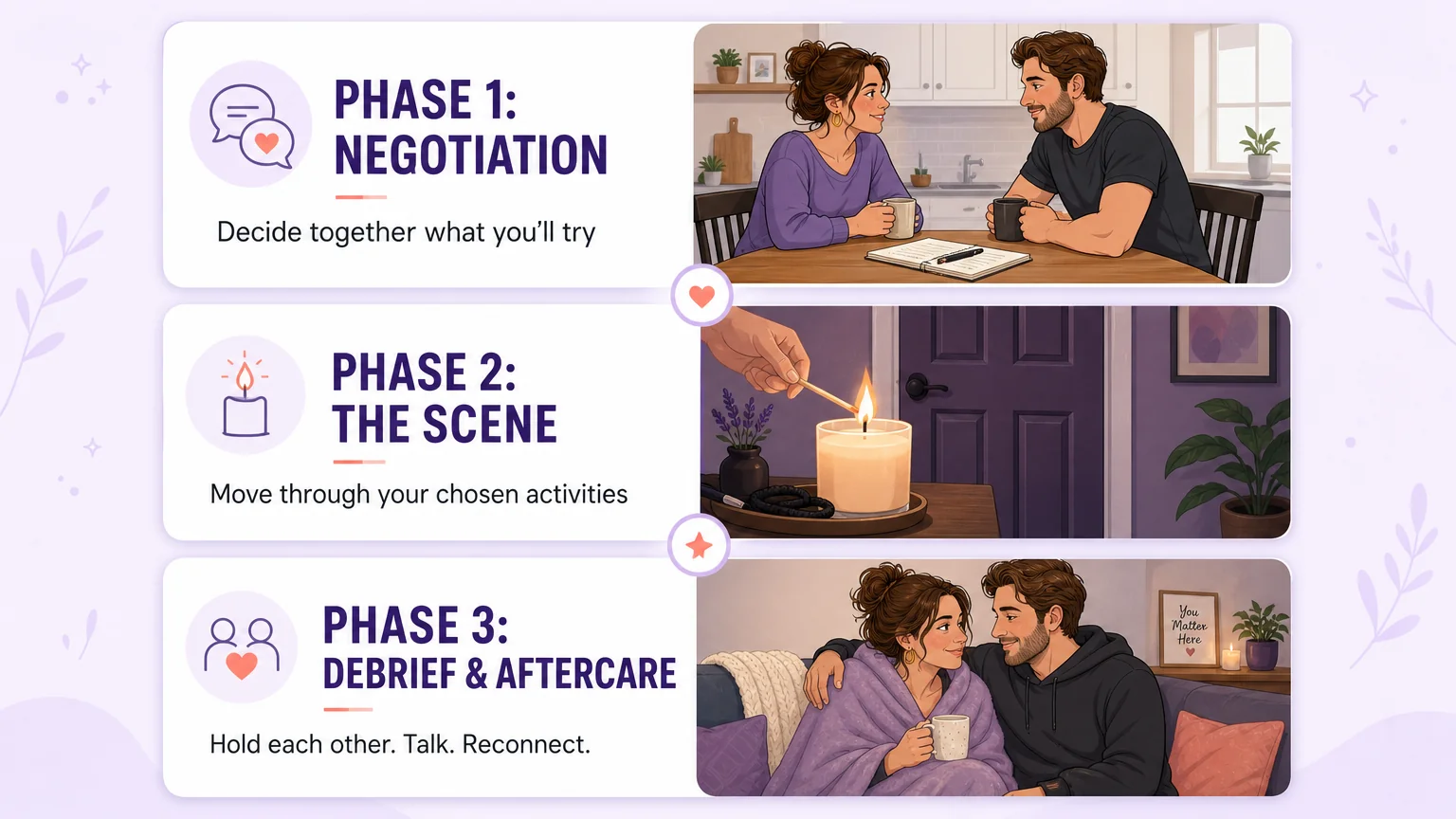
Having a list of ideas and knowing how to weave them into an actual evening are two different skills. Here is the second one.
Phase one: Negotiation. Earlier in the day, sit down outside the bedroom. Which two or three ideas from this list will you try? Who takes which role? What is the safe word? What is off-limits? Lilith Foxx emphasizes that aftercare must be negotiated as part of the scene. Decide now what you will both need afterward: water, a blanket, silence, conversation, contact.
Phase two: The scene. Start with a small ritual. Light a specific candle. Close a door. Say a phrase you both agreed on. The marker tells both your brains: we are entering a different kind of space. Move through your chosen activities. Check in verbally between them. Use the safe word if needed. Using it is success, not failure.
Phase three: Debrief and aftercare. Hold each other. Share water. Talk about what worked and what surprised you. Foxx notes that emotional drop can hit hours or days later. Plan a check-in for the following morning.
The Sagarin 2009 study’s finding about increased closeness after scenes points to the structured communication as the mechanism. The negotiation beforehand and the debrief afterward are where the connection actually builds.
“One thing I loved about tonight. One thing I would change for next time. One thing I want you to know.”
Best for couples ready to weave individual activities into a cohesive experience.
Frequently Asked Questions About BDSM for Beginners
How do I bring up BDSM without making it sound like something is broken in our relationship?
Lead with what is working. “I love what we have, and I am curious about exploring something new together, not because anything is missing, but because I trust you enough to want to go deeper.” Frame it as expansion, not repair. A low-pressure entry: send your partner this article and say, “Some of these sounded interesting. Want to read through together and see if anything sparks curiosity?”
Do we need expensive equipment to try BDSM?
No. The first 11 items on this list require nothing but two bodies in a room. The remaining items use things already in your home: scarves, ice cubes, a sleeping mask, a wooden spoon, a soy candle. Dr. Thaina Cordero’s “gentle BDSM” framework is built entirely on sensory exploration, not gear. Buy things only when you know what you consistently enjoy.
Is BDSM always about pain? We are not interested in that.
No. BDSM is a spectrum. Sensation play, power exchange, roleplay, and service submission involve zero pain. Many experienced practitioners never engage in impact play. Start with the Gateway items (1 through 6) and Power Dynamics Light items (7 through 11). None involve pain. You may never want to go further, and that is a complete BDSM practice.
What if one of us wants this more than the other?
This is the most common starting point. The more-interested partner takes responsibility for patience: do not push, do not pout, do not campaign. The less-interested partner takes responsibility for curiosity: read, ask questions, try one low-stakes activity before deciding. Find the overlap. If your partner’s ceiling is “a blindfold and maybe some light restraint,” that is a rich and complete exploration. BDSM is about what you both enthusiastically consent to, not about reaching someone else’s intensity level.
What is a safe word and why can we not just say “stop” or “no”?
A safe word is a pre-agreed word that immediately pauses or ends the scene. In roleplay or power exchange, “stop” can be part of the agreed-upon dynamic. A safe word is unmistakable. The traffic light system is most common: “green” means keep going, “yellow” means slow down or check in, “red” means full stop and move to aftercare. If you never plan to engage in resistance play, “stop” and “no” work perfectly well. Just agree on that explicitly before you begin.
What is aftercare and do we really need it?
Aftercare is intentional tending to each other after a scene: physical (water, blanket, soothing touch) and emotional (talking, holding, quiet company). Yes, you really need it. Lilith Foxx explains that the neurochemical comedown after intense play can produce unexpected sadness, anxiety, or rawness hours or days later. Aftercare mitigates this. The Sagarin 2009 finding of increased closeness after scenes is not about the spanking. It is about the holding afterward. Even a 10-minute debrief with water and contact counts. Plan for it before you begin, and the comedown becomes part of the connection rather than a crash.