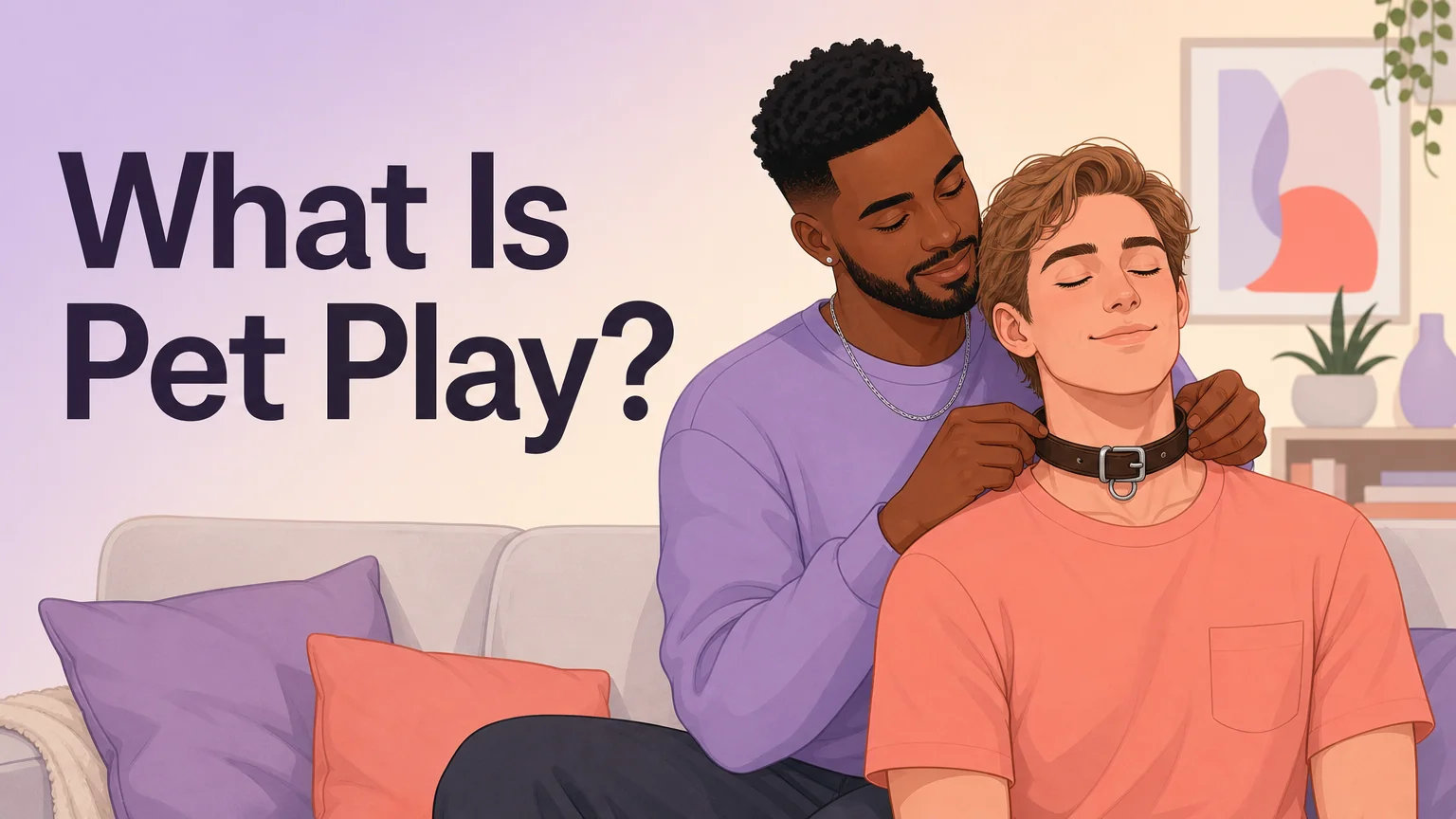
The first time you put on a collar, something shifts. Not into someone else. Into a version of yourself with the volume turned down on anxiety and up on presence. The weight of the leather anchors you. The inner monologue quiets. Your handler’s hand settles at the back of your neck, and for a few minutes, nothing outside this room needs to be managed.
That is pet play. And if you have never heard it described that way, you are not alone.
Pet play is consensual adult role-play within BDSM where one partner adopts a non-human animal role and another takes on the role of owner, handler, or trainer. It can be erotic, therapeutic, social, or all three. And it is having a cultural moment. Pup contingents march at Pride. TikTok sex educators reach millions with videos about collars and headspace. The “Golden Retriever energy” dating trend reflects a broader appetite for playful, animal-like affection in relationships.
This is not a fringe thing anymore. We are going to cover what pet play actually is, why the psychology behind it matters more than the gear, how couples explore it together, and where to find your people if you want to see it for yourself.
So What Is Pet Play, Actually?
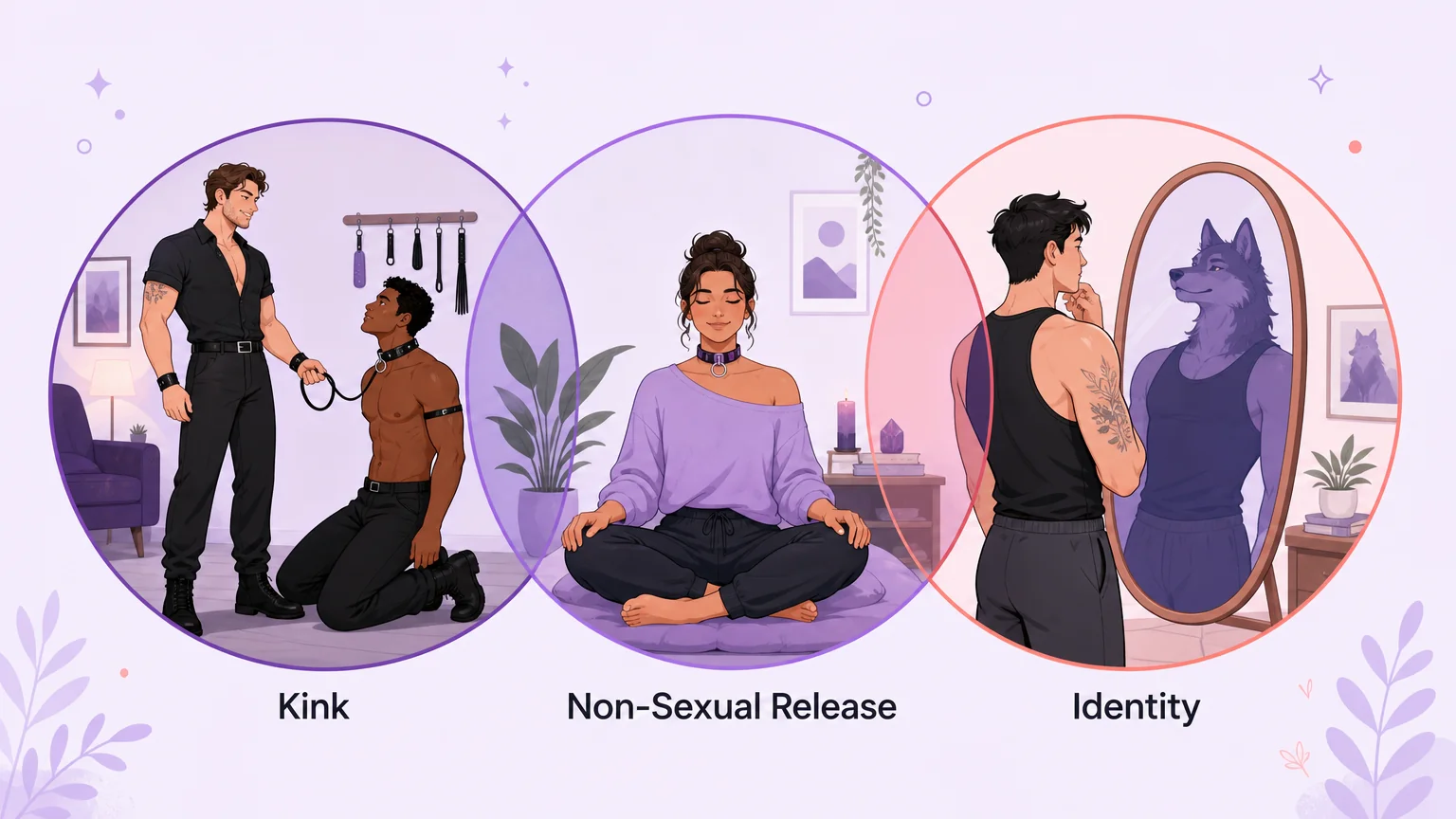
Pet play is consensual adult role-play where one partner adopts a non-human animal role and another takes on the role of owner, handler, or trainer. It lives within the BDSM umbrella, but it does not require pain, bondage, or even sex. The power exchange is the throughline.
It breaks down across three categories.
First, pet play as kink: erotic power exchange where dominance and submission play out through animal roles. The collar signals ownership, the handler commands, the pet complies. The dynamic is the point.
Second, pet play as non-sexual release: the headspace is the entire reward. Stress relief, escapism, nervous system regulation. The goal is quiet, not arousal.
Third, pet play as identity: for therians and otherkin, it expresses an internal non-human identity. Rare, but it exists on the spectrum.
Most public pet play spaces are non-sexual; sexual dimensions are clearly signaled and usually private.
Pet play is not the same as being a furry. Pet play is temporary BDSM role-play, something you do. Furry is a permanent identity centered on anthropomorphic animal characters, something you are. Pet players are 3.6 times more likely to also be furries, but the communities are distinct.
And pet play is not bestiality. Full stop. Pet play involves consenting human adults. Bestiality involves real animals who cannot consent. Only 6.9 percent of pet players have ever engaged in zoophilic behavior, and the vast majority are repulsed by it. The consent distinction is non-negotiable.
Pet play is often called an entry-level kink. It is playful, low-pressure, and works solo or partnered. You do not need a dungeon. You need a collar and curiosity.
The Hidden Psychology: Why Grown Adults Love Being Pets
Pet play is not really about pretending to be an animal. It is about borrowing an animal’s permissions. Permission to be nonverbal. Permission to be led. Permission to receive affection without earning it first. Permission to exist in a body without the weight of human self-consciousness.
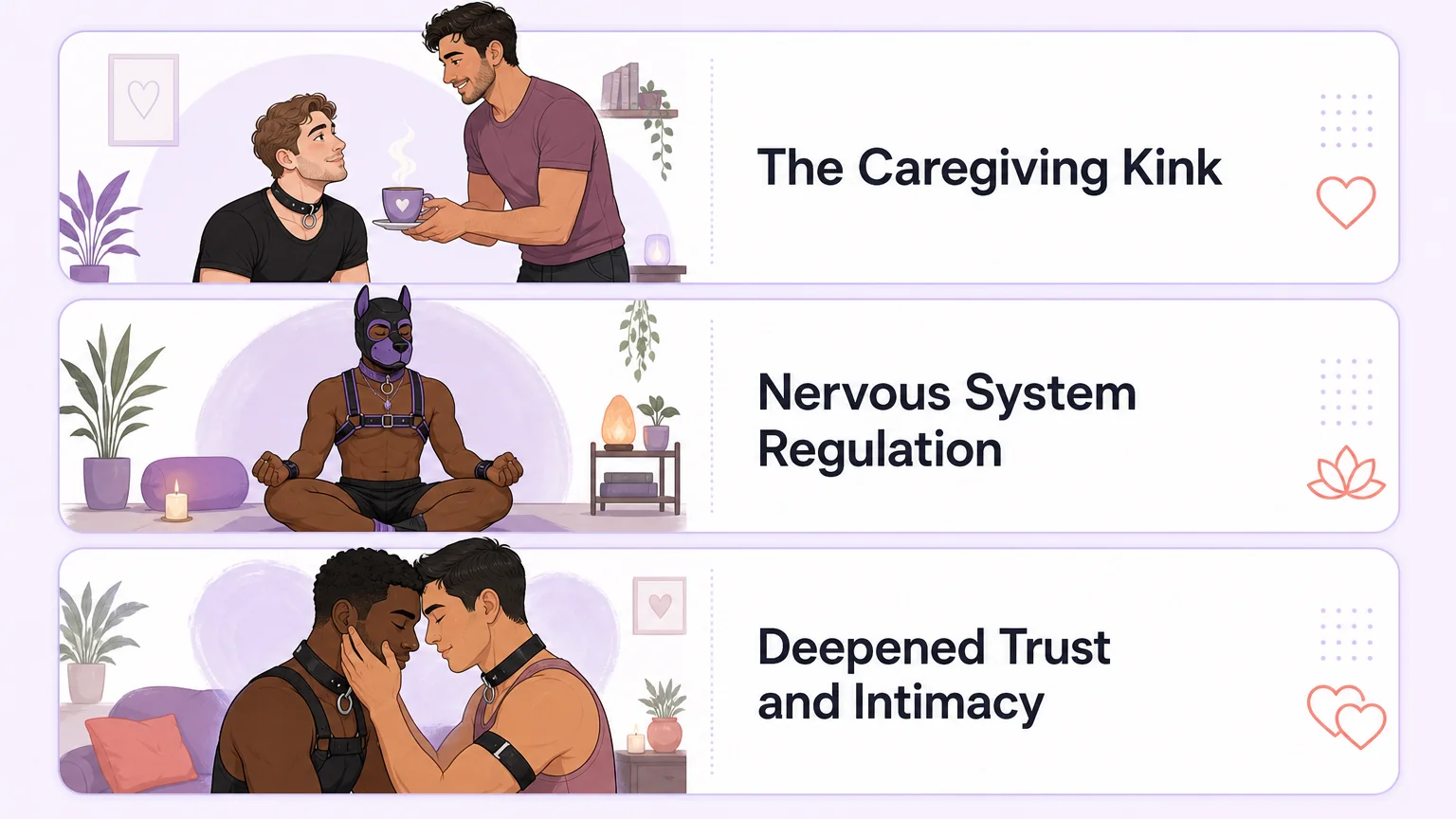
Why would anyone want this? And what does it say about you that you are curious? The answer sits in three psychological pillars, each backed by clinicians and researchers who have studied what happens under the collar.
The caregiving kink. Stefani Goerlich, an award-winning certified sex therapist and author of “Kink-Affirming Practice,” frames pet play as part of a family of caregiving kinks that includes age play and DDlg. The common thread is receiving structured, unconditional care within a consensual container. The submissive gets relief from adult decision fatigue. Someone else holds the reins for a while.
Gigi Engle, a certified sex and relationship psychotherapist, puts it plainly: “Being a pet means your only responsibility is to make your owner happy, be cute, and receive affection.” That is not degradation. That is a structured vacation from being the person who handles everything. For people who spend their days managing teams, budgets, households, and crises, the appeal is obvious.
Nervous system regulation. Aspen Roberts, known in the community as Mx Pup Aspen, is a neurodivergent practitioner who also works as Back Office Manager at Inclusive Therapy Group. They describe pup space as “body-led and mind-slowed,” a state that interrupts anxiety cycles, quiets overstimulation, and grounds runaway emotions.
For someone with ADHD or autism, pet headspace provides access to sensory needs that everyday life blocks. The texture of gear. Non-verbal communication that bypasses the exhaustion of verbal processing. The handler’s routines that supply external structure for an overwhelmed brain. Roberts frames this explicitly as nervous system regulation. The collar is a grounding object. The commands are a signal the brain recognizes: you are safe, you are led, you can stop scanning for threats.

Deepened trust and intimacy. Research shows that pet players strongly prefer partners they already know and trust. This is not about strangers. It is about vulnerability within safety. The handler-pet bond can be deeply reparative for people carrying relational wounds. Being seen, held, and celebrated not in spite of vulnerability but because of it.
None of this means pet play is therapy, or that everyone who does it is processing trauma. Some people just like the vibe. But understanding the psychology underneath the collar makes it harder to dismiss as weird, and easier to see why someone you love might be curious.
Puppies, Kittens, Ponies: A Field Guide to Pet Play Types
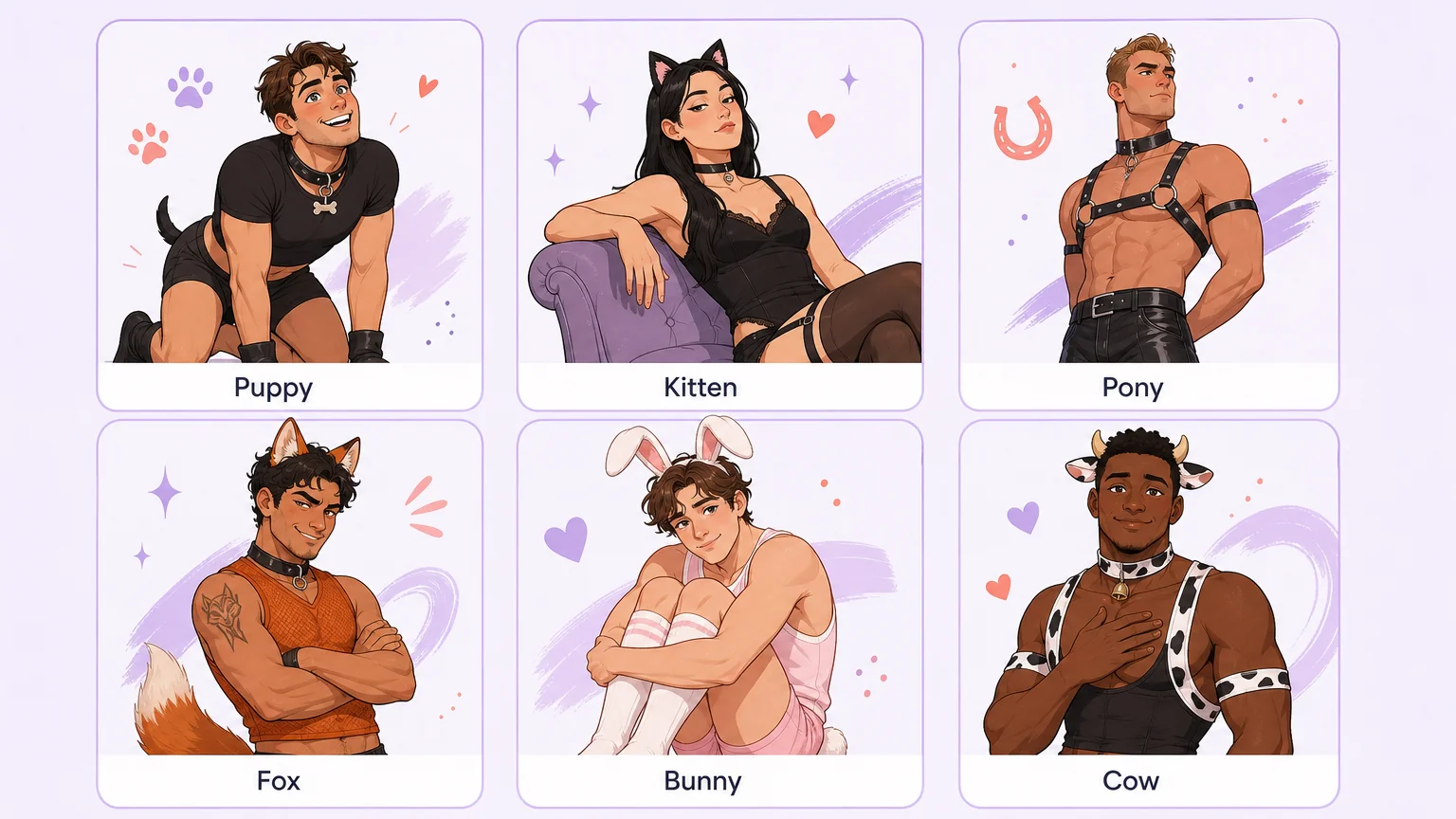
Not all pets are created equal, and that is the fun of it. Here is who shows up at the mosh.
Puppy/Dog. The most common and community-rich variant. Energetic, loyal, playful, eager to please. Puppy play has the deepest infrastructure: moshes, contests, PAH groups, major event presence. The personality spectrum runs from excitable untrained pup who wants to wrestle to disciplined working dog who thrives on commands and structure. “Golden Retriever energy” made literal, with a collar.
Kitten/Cat. More selective, independent, sensual. Feline players tend toward aesthetic gear such as delicate collars and elegant ears. The vibe is “you may admire me” rather than “please throw the ball.” A cat player can lean playful or aloof. The handler earns the cat’s attention rather than commanding it, which is exactly the dynamic shift some people want from power exchange.
Pony/Horse. The most structured and discipline-oriented variant. Pony play involves training protocols, pulling carts, showmanship, and elaborate leather harness gear. It draws heavily from equestrian culture and has its own dedicated sub-community with more ritual and protocol than other types.
Fox. Clever, mischievous, harder to pin down. Fox players describe themselves as somewhere between pup and cat: social but on their own terms. They tend to value wit and cunning over obedience, which makes for a more playful, less hierarchical dynamic. Smaller community footprint, distinct appeal.
Bunny. Soft, cuddly, prey-energy. Often more submissive and nurturing in dynamic. Can overlap with kitten energy but tends toward gentler, less aloof interactions. Gear leans toward soft accessories: fluffy tails, ear headbands, pastel tones.
Cow (HuCow). Nurturing, service-oriented, often tied to lactation or caregiver dynamics. HuCow play emerged from the broader BDSM community with established protocols around milking, breeding, and farm-animal roleplay. A smaller niche worth acknowledging as part of the spectrum.
Fantastical creatures exist in the community too. Dragons, were-creatures, hybrids. Nobody checks your pet credentials at the door. Many people blend types or shift depending on mood. This is a menu, not a personality test.
Pet Play for Couples: How to Explore It Together

One of you just sent the other a link to this article. Or you are reading it solo, trying to figure out how to bring it up without sounding like you are announcing a new identity. Either way: breathe. This is a conversation, not a confrontation.
Act 1: The first conversation.
Bring it up in a calm, non-sexual moment. Never during or right after sex. Lead with what appeals to you, not what is missing. “I love how playful we are together, and I am curious about exploring that in a different way” lands differently than “I need something our sex life is not giving me.”
Frame it as an experiment, not an identity announcement. “What if we just tried a collar and some pet names and saw how it felt?” gives your partner room to be curious rather than defensive.
Respect the answer. If they are not interested, do not pressure. Ask what adjacent things they might enjoy instead. Some of the best pet play dynamics began when one partner said “I am not sure about the full thing, but I would try X.”
Act 2: Negotiate the container.
The Puppy Play Negotiation Form, available at pupplay.info, walks you through seven domains: intentions and headspace, roles and personality, communication style, gear ownership, activities and limits, health and safety, and aftercare. Think of it as a shared checklist, not a contract. It exists so you do not have to invent the conversation from scratch.
Act 3: Handle the wobbles.
Real dynamics evolve. One partner’s curiosity might deepen into identity over time — what started as occasional play can become a core part of how they express themselves. The other partner, who knew exactly how to engage before, suddenly feels lost. That moment is not a crisis. It is a recalibration. Talk about what has shifted. Experiment with new ways of interacting. Dynamics change, and that is not failure.
Or consider a couple whose physical connection has faded — not from lack of love, but from life crowding out the space for it. One of them stumbles onto pet play and sees something unexpected: affection, affirmation, and playfulness, without the pressure of sex. They bring it up not as a fix for what is broken, but as a bridge back to each other. That instinct is not a red flag. It is evidence of a relationship worth returning to.
If your partner is not interested, you are not out of options. Some people practice pet play solo or with community members rather than their primary partner. This is not a relationship failure. It is a configuration choice, and the community has room for it.
You do not need to have this figured out. The people who are best at this started exactly where you are: curious, uncertain, and hoping the other person does not think they are weird.
What You Actually Need: Gear Basics for Beginners
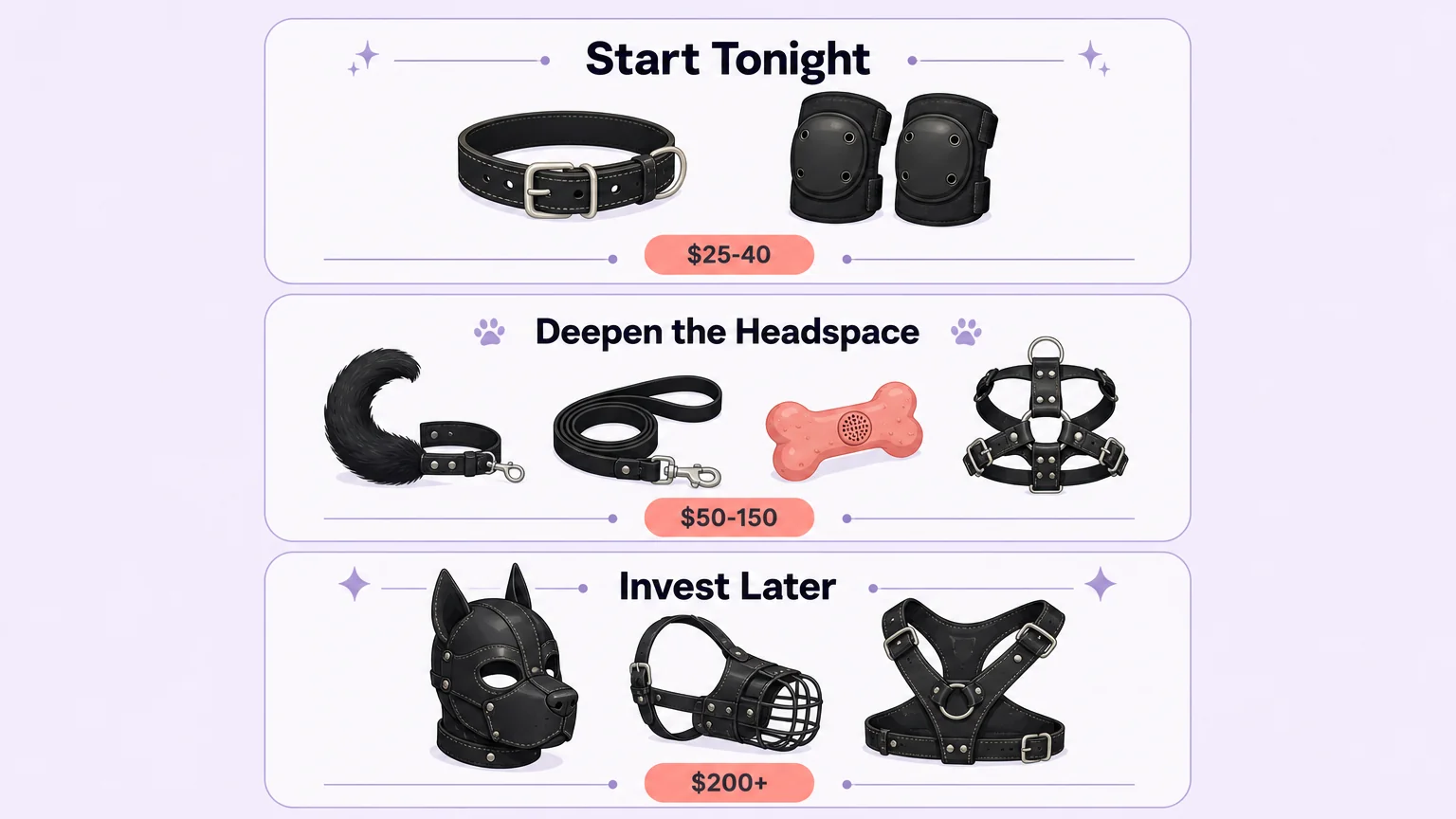
The only true non-negotiables in pet play are consent, communication, and a safe environment. Everything else is optional. Do not drop hundreds of dollars on something you are not sure about yet.
Tier 1: Start tonight.
A simple collar is the quintessential starter item. Ten to twenty dollars from any pet store or Etsy. It immediately signals the role and works for every pet type. Knee pads are unglamorous but essential if you will be on the floor. Fifteen dollars from a hardware store. Keep it cheap and functional.
Tier 2: Deepen the headspace.
A belt-attached tail, described by the community as “pure vibe,” instantly anchors the animal headspace. A standard six-foot leash for canine players, though feline types tend to be less tolerant of being led. Soft toys, squeakers, tug ropes, and plushies function as what experienced players call an “instant pup button.” A harness for the physical sensation of being leashed. Community rule: never pull someone’s tail. Treat it the way you would treat their spine.
Tier 3: Invest later.
A custom pup hood from Mr. S Leather or Tailspace.net is the most powerful headspace tool because it reduces “human mode” and encourages non-verbal communication. Muzzles for those who want restricted speech. Custom-fit harnesses in leather or neoprene. These are investments, not entry requirements.
Safety note: fit matters. Two fingers between collar and neck. A hood must never compromise breathing, comfort, or the ability to signal stop. Spend on safety now. Upgrade the rest later.
Finding Your Pack: The Pet Play Community and Where to Start
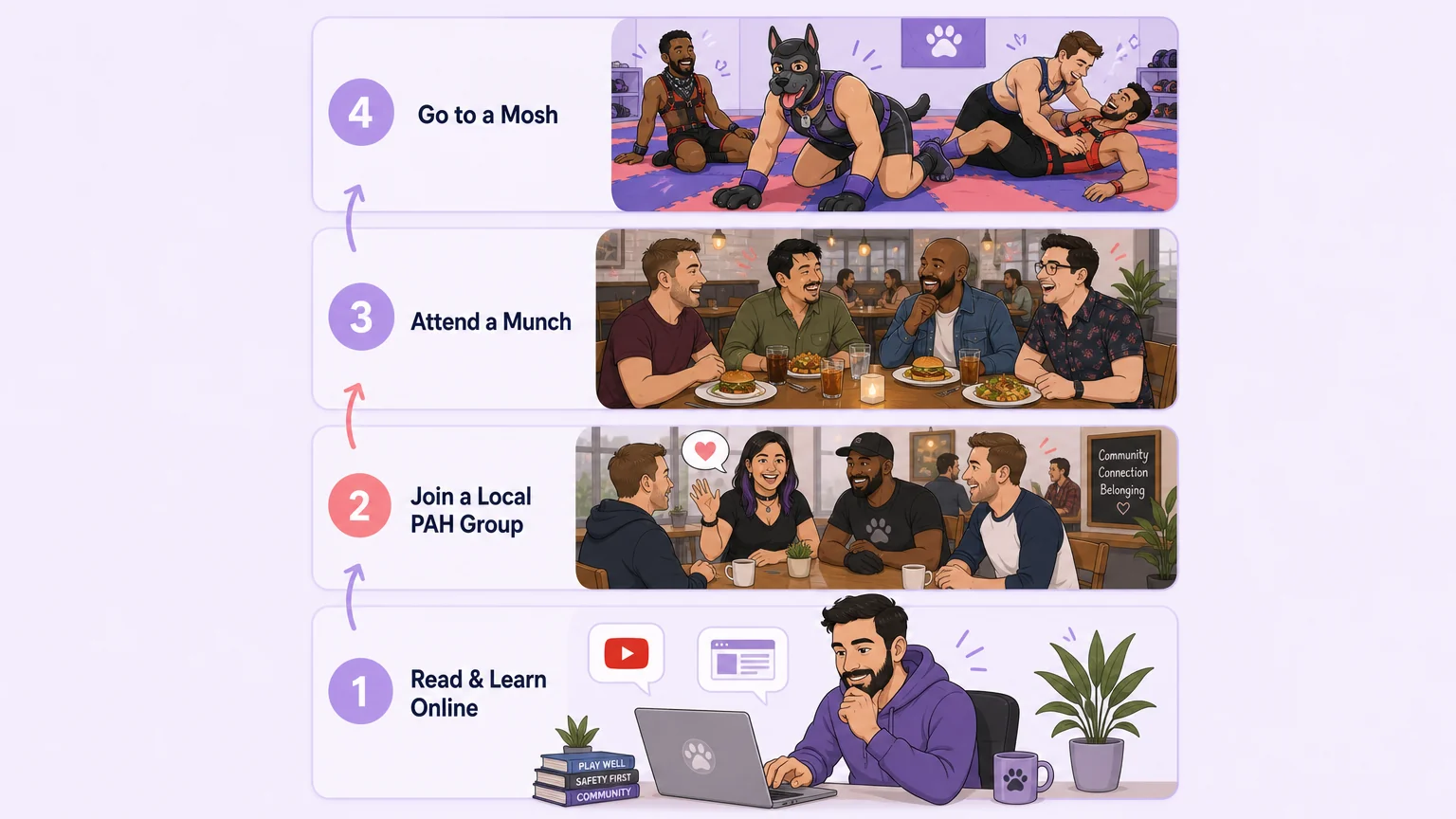
A brand-new pup arrived at camp once and told Pup Denali, a community leader, “For the first time in my life, I feel normal.” Then he burst into tears. That is what community can do. But nobody walks into their first mosh knowing what to do. Here is the actual path.
Read first, show up later. Spend a few hours with puppyplaycommunity.org, Evie Lupine’s YouTube channel, or Watts The Safeword. A little vocabulary goes a long way toward not feeling lost.
Find a local PAH group. Pups and Handlers groups exist worldwide. Use puppyplaycommunity.org’s directory, FetLife, Facebook, or Instagram. Join the online group and introduce yourself. These spaces expect newcomers.
Attend a munch before a mosh. A munch is a casual social gathering in street clothes at a restaurant or bar. Zero gear. Zero play. Just people meeting people. It is the lowest-stakes entry point in the entire scene.
Then go to a mosh. A mosh is a padded play space where pups wrestle, romp, and get into headspace. The etiquette is straightforward: no gear required, jeans and a T-shirt are fine, consent is paramount. Always ask before touching anyone, especially a pup in headspace, just like you would with a real dog. Do not pull tails. Most public meets are non-sexual. Bring water and snacks.
Major anchor events include International Mr. Leather in Chicago each May, Folsom Street Fair in San Francisco each September, Mid-Atlantic Leather in DC each January, CLAW in Cleveland each April, and Pride events worldwide each June.
Crimby, a Husky in Pittsburgh, first encountered pet players at the Andy Warhol Museum where he worked. Their confidence captivated him. He now calls the community his family. Your entry point might be a museum, a Pride parade, or a Google search at 1 AM. They all count.
Pet Play Meets ENM: How It Fits the Swinging and Open-Relationship World
If you are already comfortable negotiating threesomes and navigating open-relationship boundaries, you have a head start on pet play. The skills transfer.
Rea Pearson is a UK-based psychosexual and relationship therapist who works with clients navigating pet and owner dynamics alongside polyamory, swinging, and threesomes. She treats pet play not as an isolated fetish but as one dimension of how people configure intimacy in non-traditional relationship structures. Pet play and ENM share the same communication and consent foundations.
On the practical side: some sex parties and group events have designated pet play spaces or welcome pet play within negotiated scenes. The same consent frameworks that govern ENM govern this. You are adding headspace to the mix, not rewriting the rules.
Someone might have a handler they scene with non-sexually, a partner they have sex with outside pet space, and a primary partner who does both. This is normal within ENM and within pet play communities. People already practicing ENM have spent time building the exact skills pet play negotiation requires: stating desires clearly, respecting limits, checking in, and debriefing after.
Pet play does not replace your ENM dynamic. It gives you one more language for intimacy within it.
The Misconceptions Worth Clearing Up
If you have Googled pet play and immediately wondered whether this makes you weird, the short answer is no. Here is the longer one.
“Is not this just bestiality?” No. Pet play involves consenting human adults. Bestiality involves real animals who cannot consent. Only 6.9 percent of pet players have ever engaged in zoophilic behavior, and the vast majority are repulsed by the idea. The consent distinction is absolute.
“What if I feel ridiculous?” Most people do, at first. The self-consciousness fades as the headspace takes over. The gear helps, especially the hood. Nobody at a mosh is judging you. They have all been where you are. Then your brain lets go and you stop watching yourself from the outside.
“Will this take over our sex life?” Pet play does not have to be sexual, and even when it is, it is usually one dimension of a relationship, not a replacement for everything else. Most practitioners move in and out of pet space fluidly. It is a room in the house, not a renovation of the whole building.
“What if people find out and judge me?” Privacy is your right. You control who knows. Many people have public-facing lives that never intersect with their pet play identities. The people who matter will either get it or accept it. You may be surprised how many people in your circle already know someone in the scene.
“Is there not something uncomfortable about BIPOC submissives in muzzles and cages?” Yes. Racialized imagery in pet play, particularly involving Black and dark-skinned submissives with muzzles or cages, can evoke historical trauma. X user @bunnihopi put it directly: if you cannot create pet play content with a submissive character of color without putting them in a muzzle and cage, do not try. Be aware of what your scene imagery communicates. If you are creating content, do the work to ensure you are not reproducing racist tropes. This is not a reason to avoid pet play. It is a reason to practice it with awareness.
Serious questions deserve serious thought. You are doing exactly that.
Aftercare: The Part Nobody Talks About Enough
Pet play headspace is not like flipping a switch. Coming out of it, especially after an intense scene, can be disorienting. Your brain chemistry shifts during power exchange. The comedown is real. Aftercare is what makes it safe.
Transition out gently. Use the pet’s human name. Speak in normal tones. Remove gear gradually. Do not just pop the collar off and say “okay, dinner?” Guide them across the threshold. Some people need a few minutes of quiet. Others want immediate physical contact. Ask beforehand which kind of transition they need.
Physical care comes first. Water, snacks, a blanket. Check for discomfort. Knee pads leave marks. Collars irritate. Floor play strains muscles you forgot you had. The body needs tending before the conversation starts.
Emotional check-in goes both ways. Cuddle, talk, reassure. The handler needs aftercare too. They have been holding responsibility for another person’s wellbeing in an altered headspace. They may need to hear they were a good caretaker. Say it out loud.
Debrief after both parties are fully back. What worked? What did not? What felt amazing? What would you adjust next time? Do this when everyone’s human brain is back online, not during the comedown.
Watch for drop. Sub-drop and dom-drop can arrive hours or days later as the neurochemical high recedes. A check-in text the next day, something as simple as “how are you feeling about last night?”, is part of aftercare. It is not extra credit.
Aftercare is not what you do because something went wrong. It is what you do because something went right, and you want to land safely.
FAQ
Is pet play the same as bestiality?
No. Pet play involves consenting human adults roleplaying as animals. It does not involve real animals, who cannot consent. Research confirms that only 6.9 percent of pet players have ever engaged in zoophilic behavior, and the vast majority are repulsed by the idea. The ethical distinction is total and non-negotiable.
Is pet play the same as being a furry?
No, though there is overlap. Pet play is temporary BDSM role-play, something you do. Furry is a permanent identity centered on anthropomorphic animal characters, something you are. Pet players are 3.6 times more likely to also be furries, but pet play gear tends toward leather and rubber while furry gear tends toward plush and playful. The communities have distinct motivations and structures.
Does pet play have to be sexual?
No. Pet play exists on a spectrum from purely non-sexual, whether therapeutic, stress relief, or social connection, to explicitly erotic. Many participants engage in pet play solely for emotional release, community, and the headspace experience. Most public meets and moshes are non-sexual. Sexual dimensions are clearly signaled and usually private.
What is pet play kink, and how does it differ from non-sexual pet play?
The pet play kink is the erotic side of the spectrum: power exchange, dominance and submission channeled through animal roles, where the collar signals ownership and the dynamic drives arousal. The non-sexual side shares the same headspace and gear but orients toward stress relief, sensory regulation, and community belonging. Most practitioners move fluidly between both, depending on the context and partner. Neither is more legitimate than the other.
What if my partner is not interested?
Start by understanding what specifically appeals to you, whether playfulness, caretaking, or escape from stress, and look for adjacent activities your partner might enjoy. Some people practice pet play solo or with community members rather than their primary partner. If your partner is open but uncertain, start small: a collar, pet names, and a ten-minute scene. Respect their no. A negotiation form can make the conversation less intimidating by providing structure.
Do I need expensive gear to start?
No. The community consensus is clear: headspace is the core, not gear. The only non-negotiables are consent, communication, a safe environment, and aftercare. A simple collar at ten to twenty dollars and knee pads at roughly fifteen dollars are enough to explore. Build your kit slowly. Do not spend significant money on something you are still discovering.
How do I find pet play events near me?
Follow local pup clubs on Instagram, FetLife, or Facebook. Use puppyplaycommunity.org’s worldwide PAH directory. Attend a munch, a casual social gathering with no gear, before a mosh. Major anchor events include International Mr. Leather in Chicago each May, Folsom Street Fair in San Francisco each September, and Pride events worldwide each June.
Can I do pet play if I am single?
Yes. Many people explore pet play solo, wearing gear at home, practicing animal behaviors, or joining online communities. Solo pet play can still provide stress relief, sensory regulation, and identity exploration. You can attend munches and moshes as an observer or participant without a handler. Some people find handlers through the community.