You heard the term and felt something flicker. Maybe it was a partner’s offhand comment. A scene in a show that lingered too long. A TikTok that was supposed to be a joke but landed somewhere deeper. And now you are here, turning the words over in your head, wondering what they say about you.
Here is what a mommy kink is. Here is where it comes from psychologically. Here is how it differs from related terms people toss around. And here is how to explore it, or talk about it, without shame. No jargon. No judgment. No assumptions about who you are or what you are into.
Desire does not require an apology. This article is not here to give you permission. It is here to hand you a map.
What Is a Mommy Kink? A Clear Definition
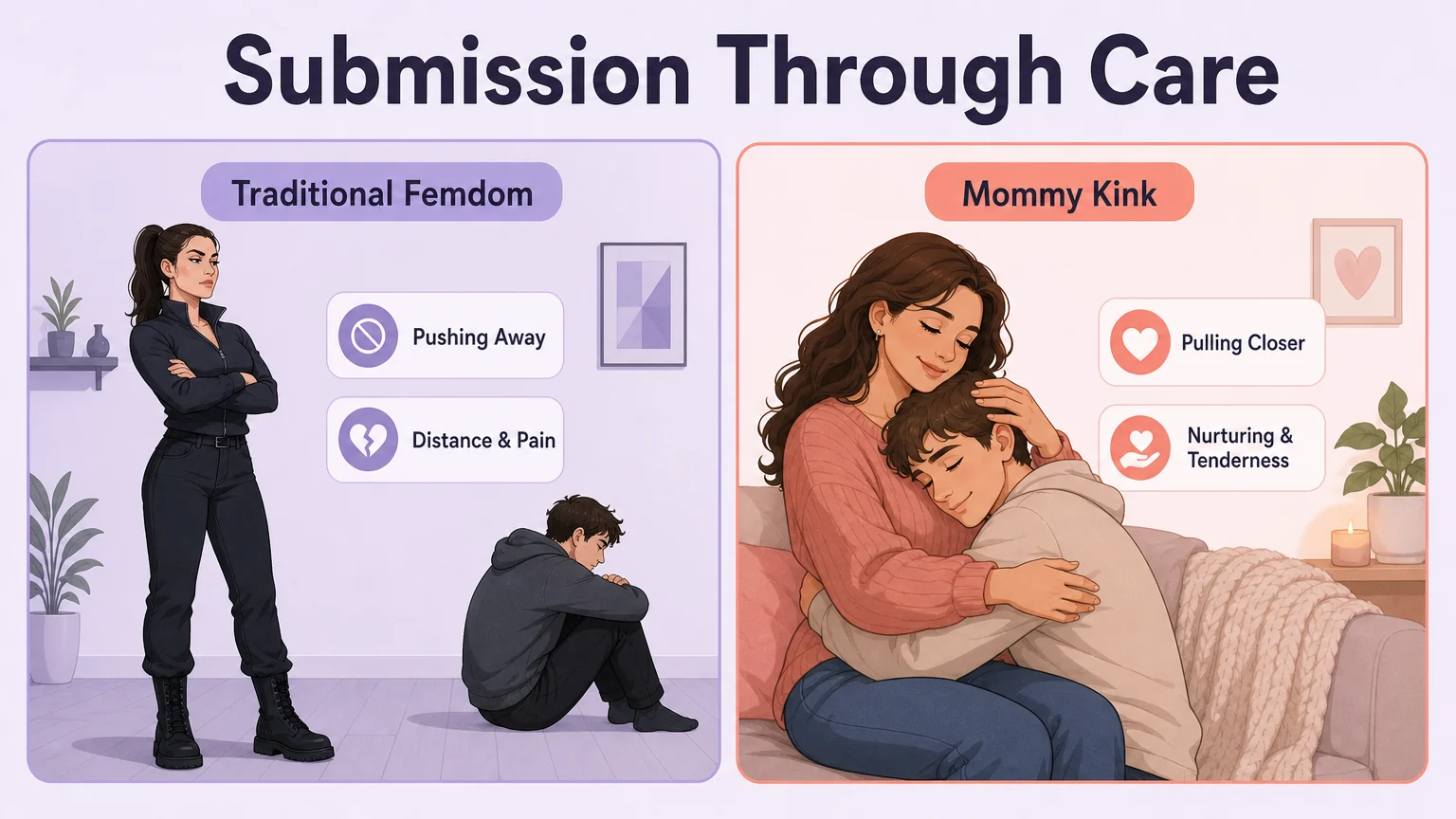
A mommy kink is a consensual dynamic in which one partner assumes a nurturing, maternal, dominant role while the other takes a more submissive, cared-for position. Everything else is flavor and preference.
The phrase that separates this kink from every other domination style is “submission through care.” Traditional female domination is framed as pushing someone away, denying them, or inflicting something. Mommy kink is the opposite. It pulls someone closer. It holds. It’s a deeply bonding experience, nourishing and nurturing for both the submissive and the top.
Three things to get clear right now:
It is about care, not control. The engine here is not punishment or distance. It is tenderness, emotional attunement, and unconditional positive regard. The dominant nurtures. The submissive receives. That is the loop.
It is not about actual mothers or children. It does not imply an attraction to children, any more than pet play implies an attraction to dogs. This is consensual adult roleplay about an energy, not a literal relationship. The word “mommy” describes a role. It does not describe a person.
Most of it lives outside the bedroom. The kink happens by making the other person feel like you are that protective caregiver figure who is there for them no matter what. The emotional container, the protective presence, the sense of being held, matters more than any specific sexual act.
What this is not: incest, pedophilia, or necessarily ageplay or lactation. Those are adjacent practices some people include. They are not the definition. The definition is simpler than the noise around it. It is the eroticization of being held, guided, and unconditionally accepted by a caring authority figure.
Is This Normal? Shame, Stigma, and What the Data Says
A man once logged onto an anonymous chat platform, hesitant and holding something back. After a few minutes, he admitted he had a longtime interest he had never explored with anyone. The mommy taboo. He was shy. Embarrassed. Convinced his desire meant something was wrong with him.
He is not alone. The shame is real, but it is cultural, not clinical.
Clinical context. The DSM-5 classifies paraphilic interests as disorders only when there is distress or non-consensual behavior. Having the interest is not pathological. BDSM practitioners consistently show favorable psychological characteristics compared to the general population. The stigma you feel was handed to you. It is not a diagnosis.
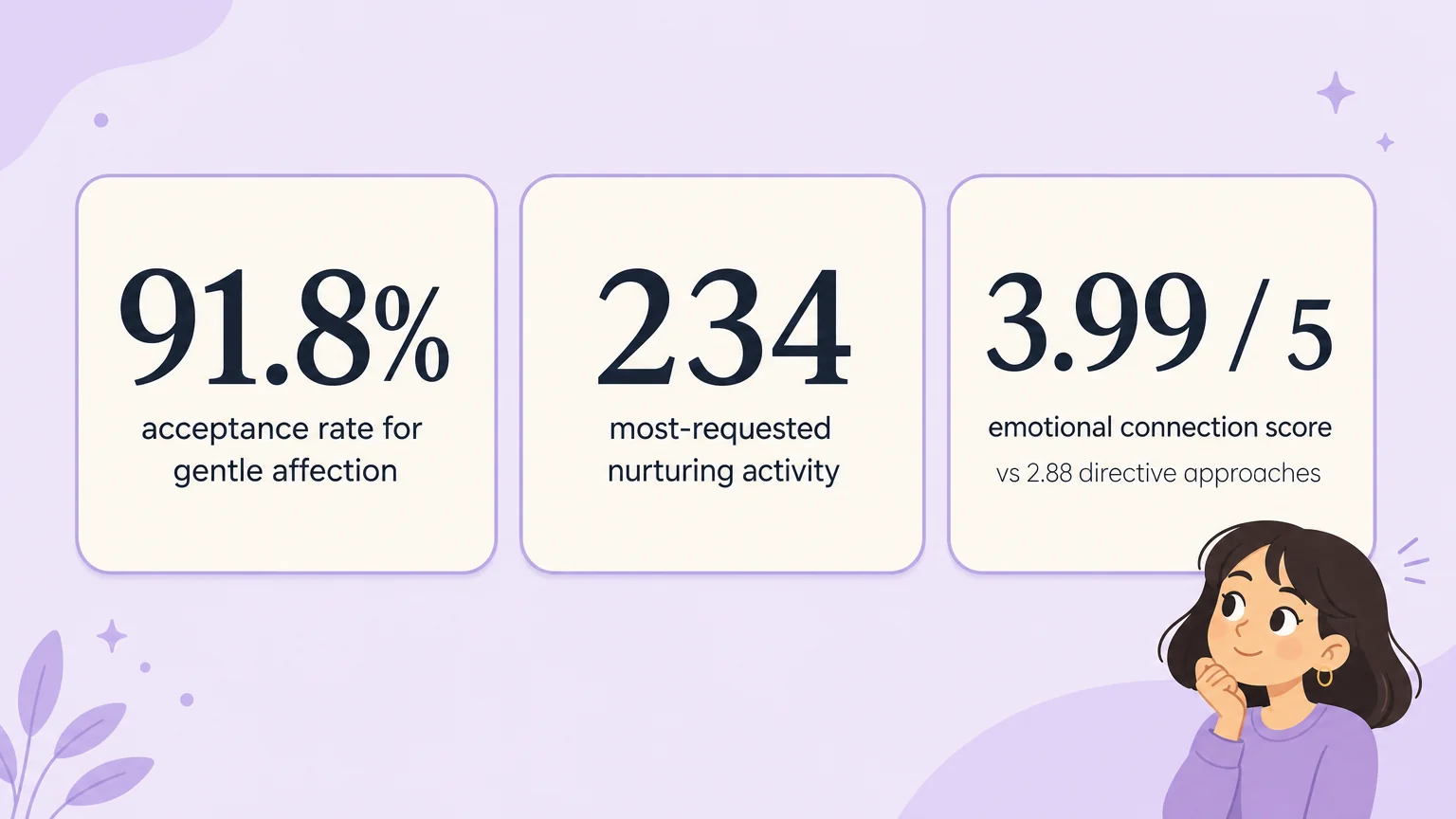
The numbers. “Be called good girl” was the single most-proposed activity among approximately 11,000 couples on the BeMoreKinky app: 234 proposals. “Hair gently stroked” had a 91.8% acceptance rate. Submissives scored highest on “Emotional Tone and Meaning” (3.99 out of 5) and lowest on “Directive Style” (2.88 out of 5). A full point gap. People are not craving orders. They are craving connection dressed as structure.
Google Trends confirms it. Search volume for maternal-themed adult content has grown roughly 15% year-over-year. Linguistic research shows sexualized use of parental terms increased over 40% in online discourse since 2018. The desire for nurturing dominance is not fringe. It is mainstream enough that nobody wants to admit it yet.
Real voices. “He told me that for the first time in a long time he didn’t feel weird or ashamed that he was into this. He felt understood.” That is a professional host recounting a session with a male sub who carried his mommy kink like a secret he was afraid would ruin him. On the other side of the internet, tweets call the kink disgusting, shameful, something to purge. Those voices are loud. They are not true.
This is not a flaw in your foundation. It is an extension of your adventure.
The Psychology: Why Nurturing Becomes Erotic
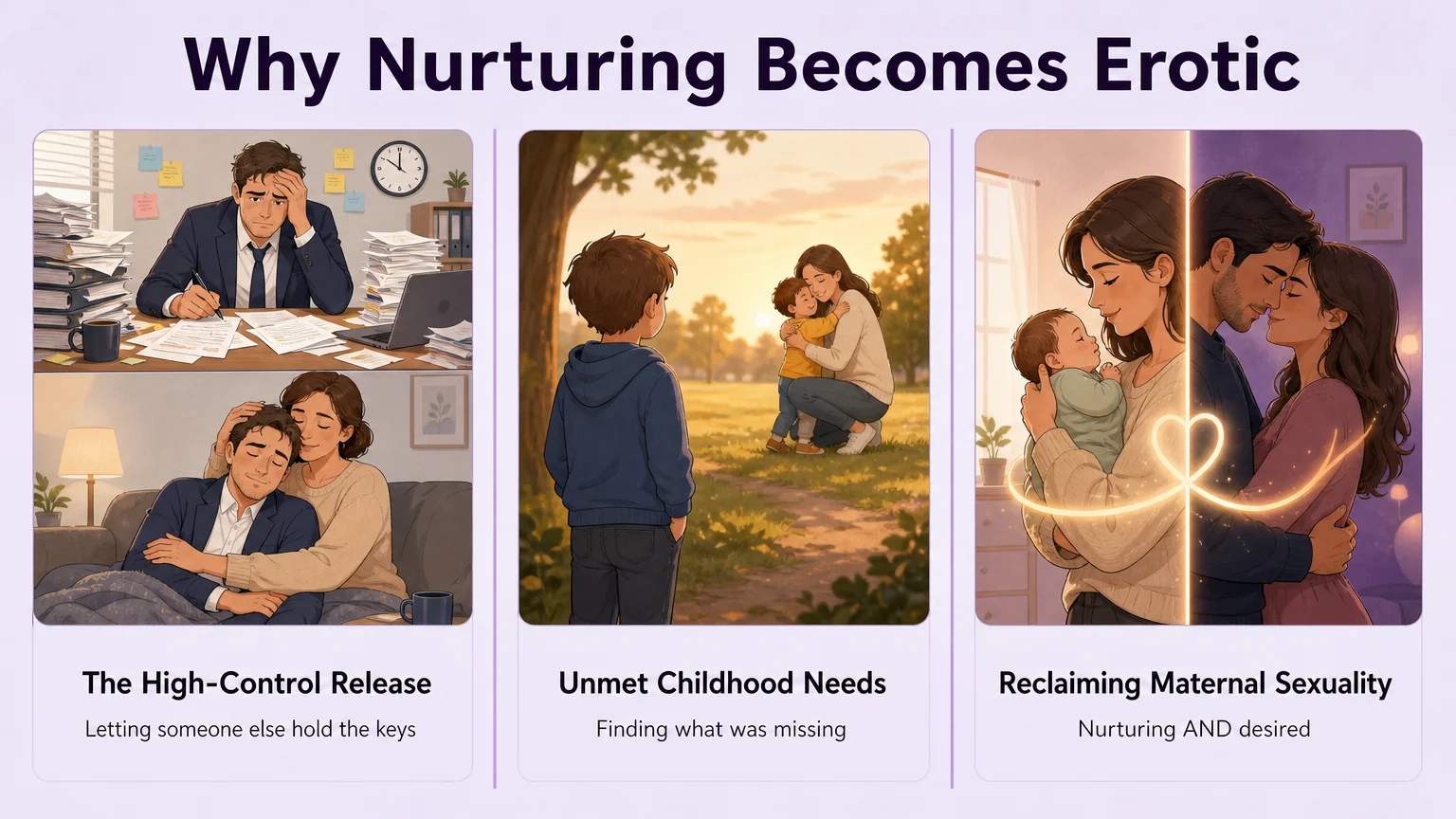
Why does being held, soothed, and told you are good cross into erotic territory? Several pathways, often overlapping.
The High-Control Person Seeking Release
A man logs onto a chat platform and starts talking about his everyday life. He is always in control. His job. His home. His family. The roleplay stops being fantasy. It becomes a safe zone where he can stop performing and just be held.
This is one of the most common pathways: the person whose daily life is a fortress of competence. The one everyone leans on. The kink is the one room where someone else holds the keys.
Among ~11,000 couples on BeMoreKinky, 11.3% of daily tasks were self-assigned submission: journaling, fitness, mindfulness. Submission as relief from managing yourself, not obedience to another person.
Unmet Childhood Needs
A man on YouTube describes being hugged by his mother exactly once. He was 35. “Having a mother that never hugged you, never gave you any love. And then you see a mother that does these things and you’re like, oh my god, I want that.”
A peer-reviewed study found that attachment anxiety mediates the relationship between perceived parental rejection and BDSM preferences. Some people are drawn to nurturing dominance because they did not receive enough nurturing as children.
But the kink doesn’t have to be from a wound. Not everyone has a neglect story. For some, it is reparative. For others, it is simply the energy that feels like home.
Reclaiming Maternal Sexuality
Society forces women into a binary: pure nurturing mother, or sexual being. Not both. The mommy kink realigns the two.
Allowing mothers to be sexy in general can only be a good thing. The kink directly confronts the madonna/whore complex. This kink refuses the choice.
What All Three Pathways Share
Sometimes people need to choose a safe partner to relive their childhood because they didn’t have a good one. When they process this as adults, it becomes healing, transformative, and cathartic.
The thread running through all three pathways: the desire to be seen, held, and accepted without having to earn it. That is not pathology. That is human.
Mapping the Territory: Mommy Kink, Mommy Dom, Daddy Kink, and Internet Slang
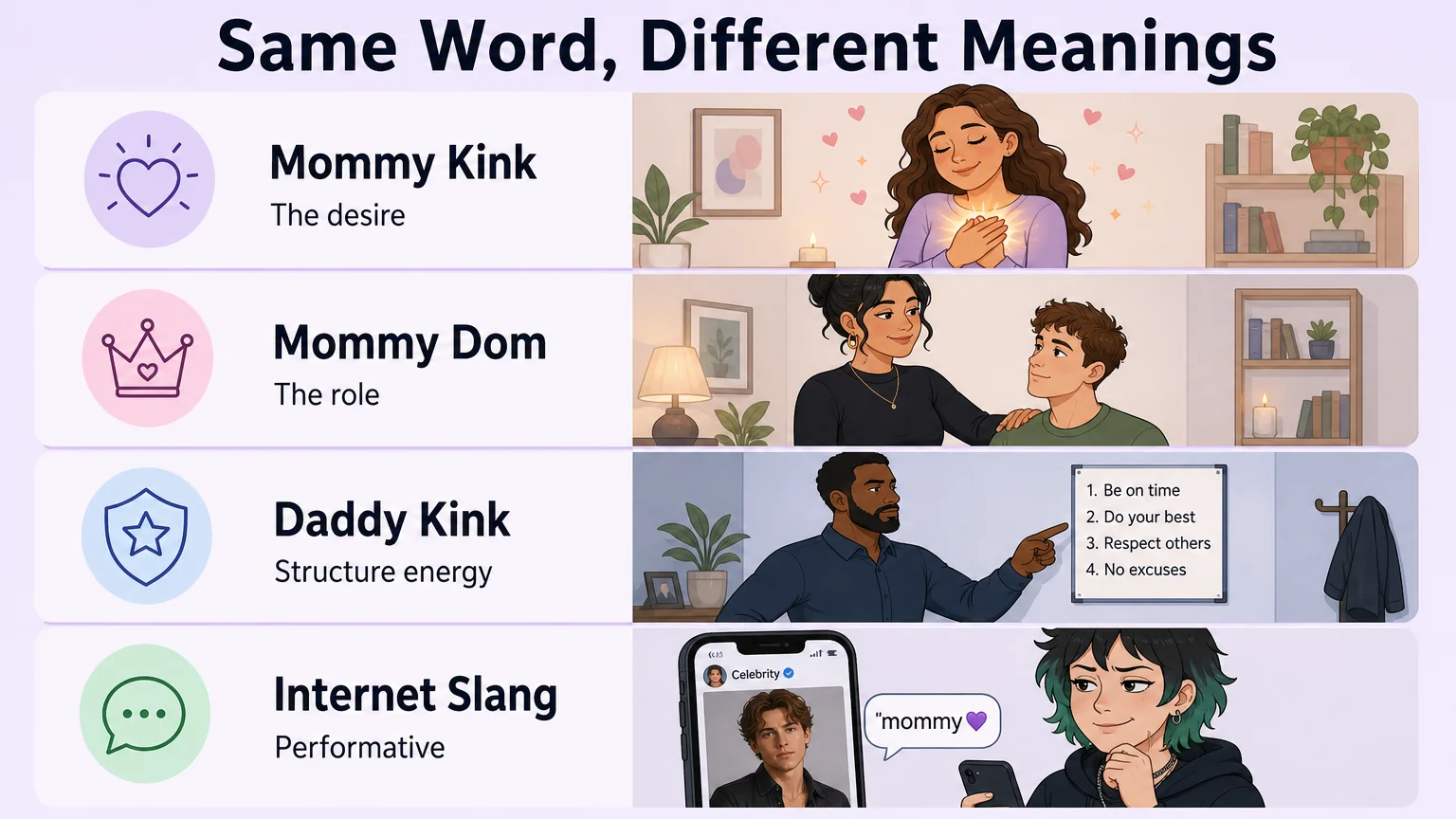
You have probably heard “mommy kink,” “Mommy Dom,” “MDLB,” “mommy” as a comment on a thirst trap, and maybe “gentle femdom,” all in different contexts, none clearly defined. Let’s untangle them.
Mommy Kink vs. Mommy Dom
The kink is the broad desire: the attraction to maternal-type nurturing dynamics. The Dom (or Domme) is the person who takes the dominant, nurturing role within that dynamic. The kink is the interest. The Dom is the role. MDLB (Mommy Dom/Little Boy) and MDLG (Mommy Dom/Little Girl) are specific sub-communities that may include age regression. They are subsets, not the whole thing.
Mommy Kink vs. Daddy Kink (DDlg)
Both fall under Caregiver/little (CGL) dynamics. The difference is flavor, not structure.
Daddy doms are often associated with structure, rules, and discipline. Mommy doms are more often linked with warmth, comfort, and emotional nurturing.
Neither is tied to gender. Anyone can embody either role across cis, trans, and non-binary spectrums. The mommy kink is notably less heteronormative and particularly popular in queer spaces. The energy defines the role, not the anatomy.
Internet “Mommy” vs. Actual Kink
“Mommy” as TikTok slang, calling a hot celebrity “mommy,” the “muscle mommy” trend, the “forced mommy voice” meme, is performative, ironic, or aspirational. Not everyone who comments “mommy” under a picture of a hot woman necessarily has a mommy kink.
The line has blurred in useful ways. The slang created cultural openness. Someone joking “mommy? sorry. mommy? sorry” might be testing the waters of something genuine. The meme is not the kink. It can be the doorway.
Historical Roots
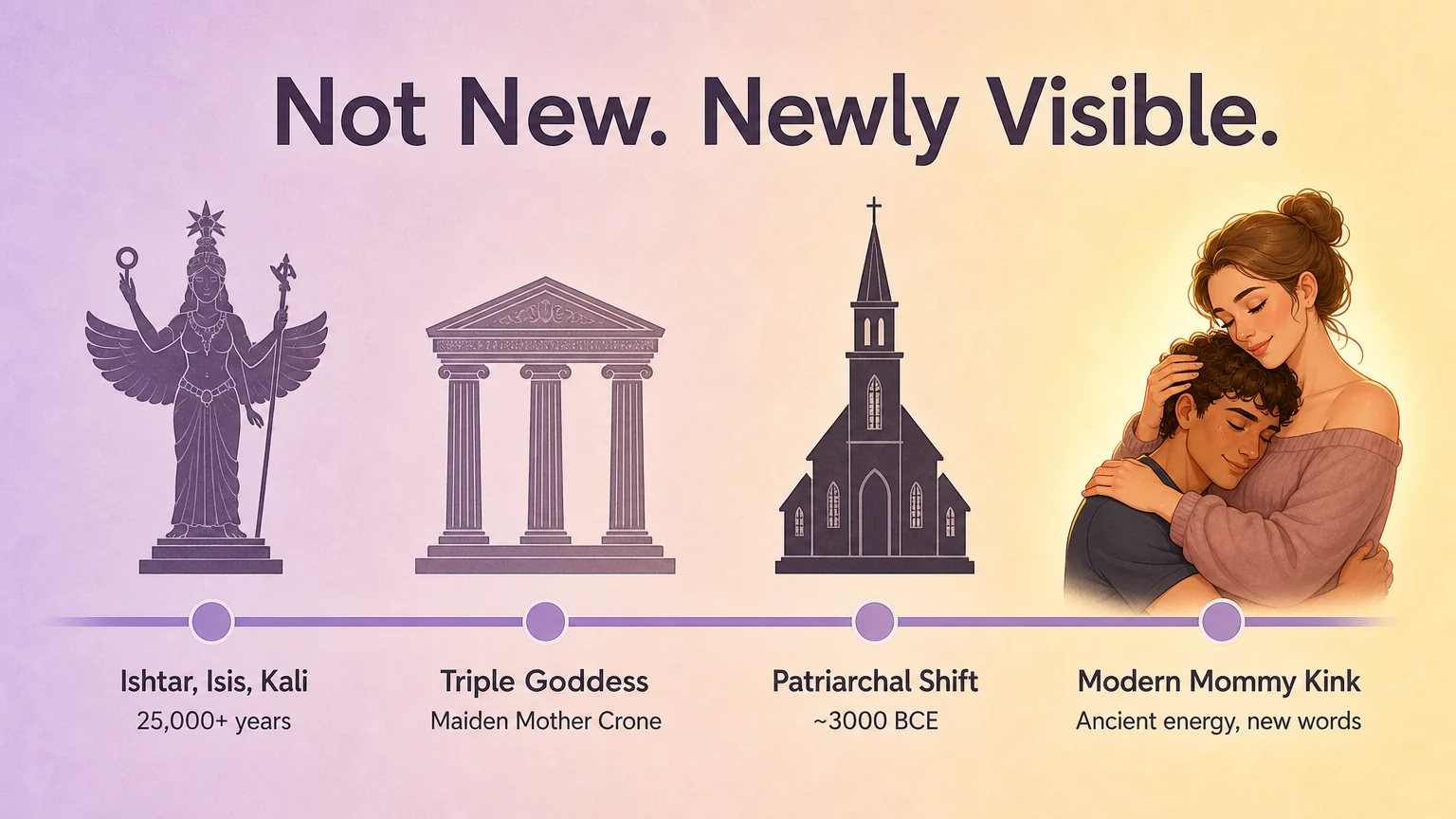
This energy is not new. It is newly visible.
The Mother Goddess archetype, from Ishtar to Isis to Kali, has been worshipped for over 25,000 years across virtually every culture. The “triple goddess” pattern, Maiden, Mother, Crone, appears in Greek, Egyptian, Hindu, and Celtic traditions. Sacred sexuality and divine feminine worship were central before patriarchal suppression reshaped the religious landscape around 3000 BCE.
The modern mommy kink is a contemporary expression of an ancient current: the nurturing, powerful feminine figure who holds, guides, and transforms. Same energy. New vocabulary.
Labels are tools, not diagnoses.
Beyond the Stereotypes: Who’s Into This?
Most coverage of mommy kink centers queer women and femme-presenting people. That is valid. The kink is especially popular among queer women and “less heteronormative than DDLG,” as VICE reporting notes. It is also incomplete.
Straight men. HBO’s Succession gave mainstream audiences a depiction of a man seeking maternal-type domination from an older woman. Anonymous male subs on chat platforms. Men on YouTube sharing testimonies about maternal neglect and the longing for feminine warmth. “I grew up desperately needing to feel like someone cared about me, loved me, would protect me and hold me when I cry, and tell me I’m a good girl who made them proud.” These voices are underrepresented, not rare.
The “expected to lead” sub. The kink is especially important for subs who do not feel that they fit society’s traditional expectations of what a submissive person might be. People who, because of their gender, appearance, or personality, are always expected to take the lead. Being told they do not have to is liberation.
Trans and non-binary participants. Babies are essentially kind of genderless, so the mommy dynamic can offer gender euphoria for both the mommy and the sub. Roles defined by care, not anatomy.
People grieving or choosing childlessness. The kink allows people who cannot or chose not to have children to experience mothering and being mothered in a consensual, bounded container.
Queer women and non-binary people. We’re hardwired for human connection, and anyone who needs to feel that connection by way of caretaking or being taken care of can find a mommy kink appealing. Plenty of gay women report similar experiences.
The unifying thread is not a demographic. It is a shared emotional need. The need to be held. The need to let someone else drive for a while. The need to be told you are good.
Your First Steps: Beginner-Friendly Ways to Explore
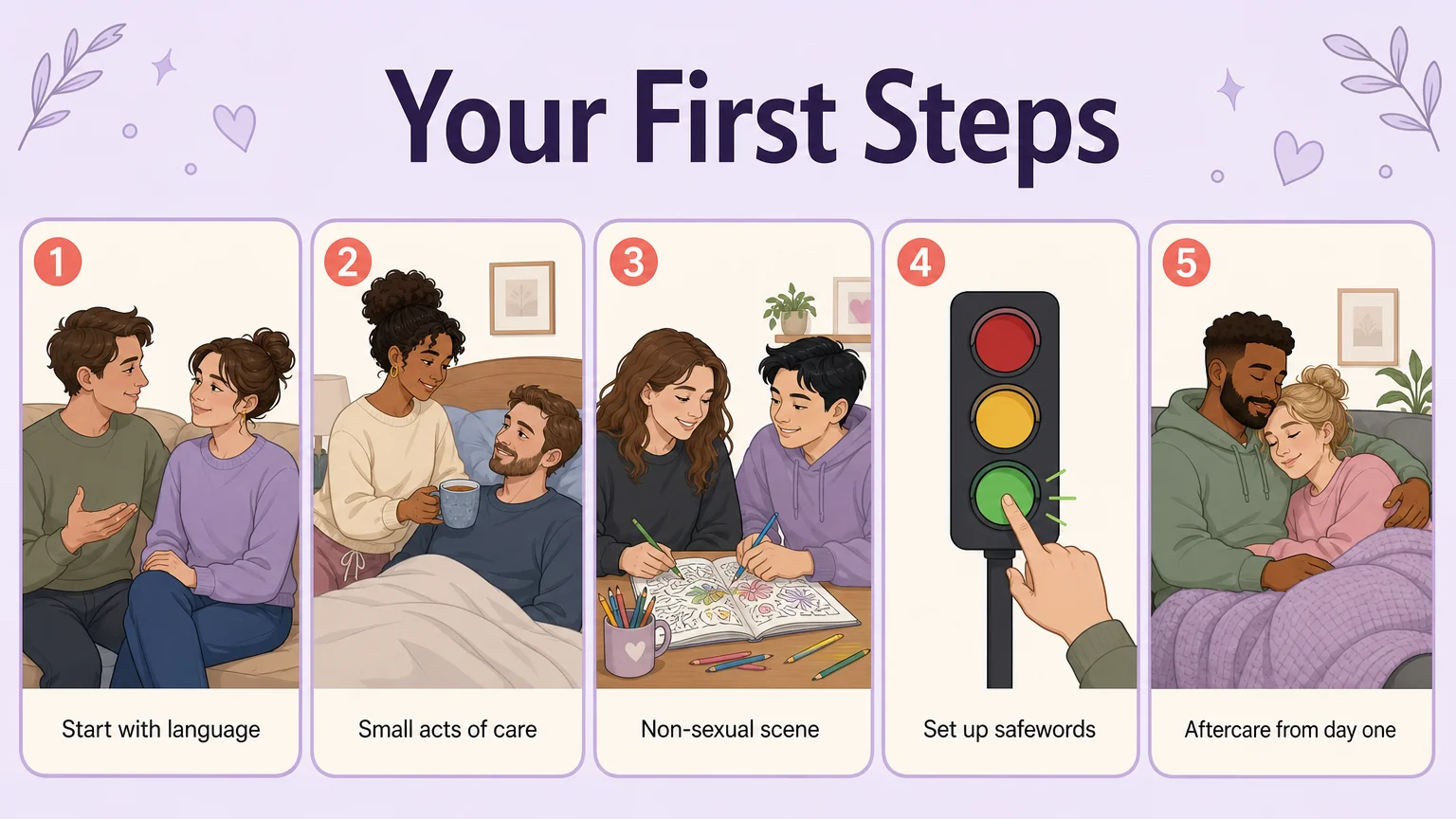
Looking at comprehensive MDLB guides can feel like being handed an advanced alpine climbing manual when you wanted to try a hiking trail. You do not need ageplay. You do not need lactation. You do not need a full power-exchange contract. You can start small.
Start With Language
Try affirming, caring phrases outside any sexual context. “I’ve got you.” “You did so well today.” “I’m proud of you.” “Come here, let me hold you.” Notice how it feels. No scene. No roles. Just words and the space they create.
Small Acts of Nurturing Care
Make a meal for your partner. Offer reassurance after a hard day. Be the protective presence when they are vulnerable. Mommy kink energy can live in a cup of tea brought to bed and the way you say “drink this.” The dynamic is in the delivery, not the furniture.
Try a Non-Sexual Scene
Some ageplay sessions have zero sexual component at all — just shopping together online while one person chooses things for the other. Pick an activity where one person leads with nurturing authority and the other receives. Coloring together. Having your partner pick your outfit. Being read to. See what the dynamic feels like without the pressure of sex. If it clicks, you will know. If it does not, you learned something without risking anything.
Set Up Safewords Before Anything
Introduce the traffic light system. Green means good, keep going. Yellow means slow down, check in. Red means stop immediately. This is not optional. It is the foundation. Knowing you can stop at any moment is what makes exploration safe enough to be fun.
Add Aftercare From Day One
After any scene, even a non-sexual one, include cuddling, quiet time, reassurance, water, and gentle check-ins. Aftercare is not advanced-level kink. It is baseline human care after vulnerability.
“Hair gently stroked” had a 91.8% acceptance rate when proposed on BeMoreKinky. Tenderness is the entry point, not the advanced course. The Burnett Foundation’s guiding principle says it best: “Every mommy/daddy dynamic is unique. Follow what feels natural and great, not what you think it should look like.”
The Conversation: How to Talk to Your Partner About It
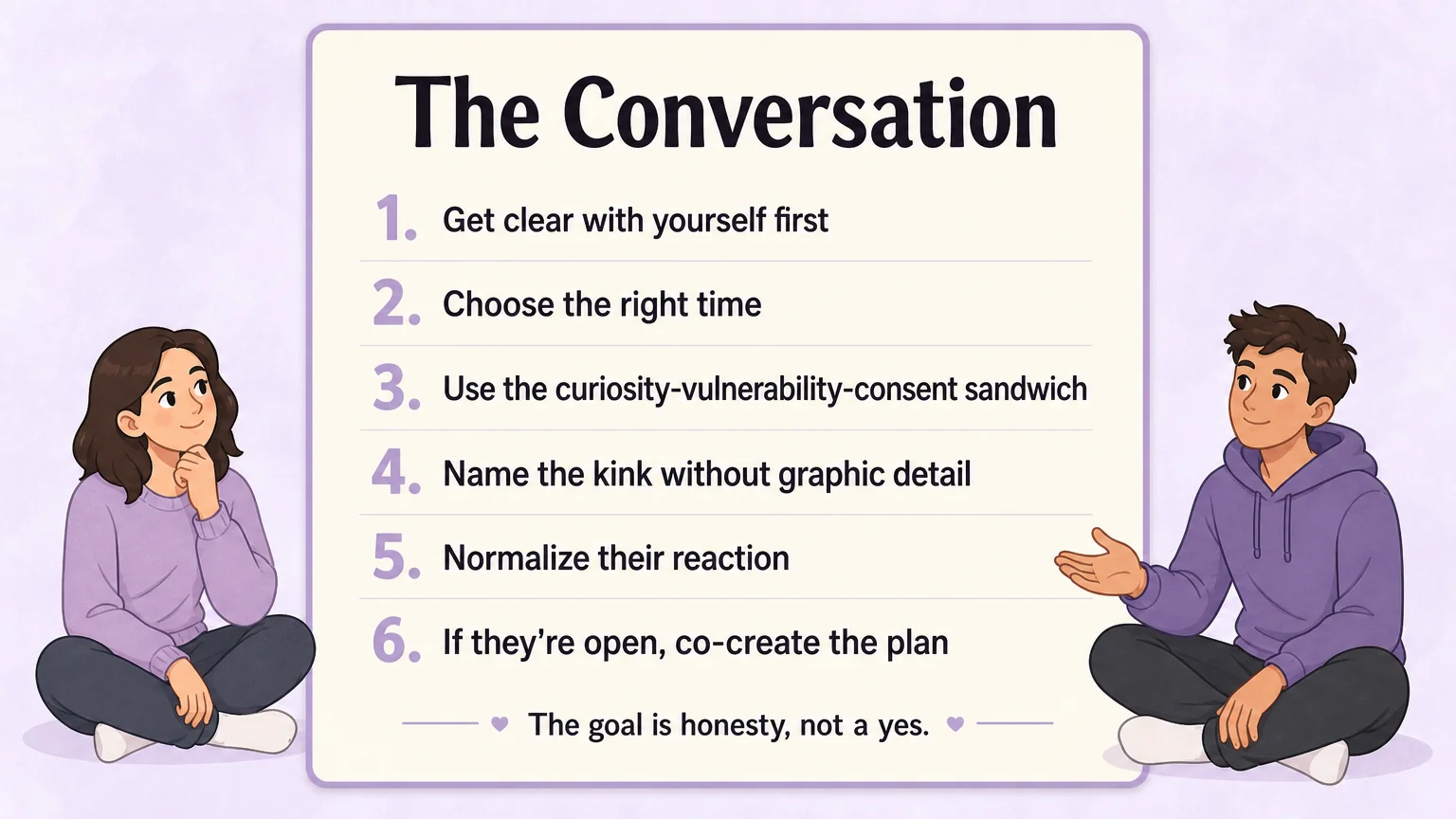
Telling a partner about any kink is hard. Telling them about this one, with its cultural baggage, the word “mommy,” the assumptions people make, can feel impossible. You do not have to wing it.
Here is a practical framework for having that conversation.
Step 1: Get clear with yourself first. Is this a curiosity or a core desire? What specifically turns you on about it? The nurturing, the power exchange, the taboo. Knowing your why helps you explain rather than defend. Write it down.
Step 2: Choose the right time. A calm, non-sexual moment when you are both emotionally connected. Not during intimacy. Not during conflict. Saturday morning coffee, not midnight after a fight.
Step 3: Use the curiosity-vulnerability-consent sandwich. “I’ve been thinking about something that turns me on and I’d love to share it with you. It feels a little vulnerable, but I trust you. Can we talk about it?” You are not confessing. You are inviting.
Step 4: Name the kink without graphic detail. Share the emotional appeal: “I think what appeals to me is the feeling of being taken care of, of someone being in charge but in a warm, nurturing way.” Then reassure: “You don’t have to say yes. I just want your honest feelings.”
Step 5: Normalize their reaction. If your partner seems surprised, confused, or needs time, that is okay. Give them space. Offer resources, including this article. Do not demand an immediate answer.
Step 6: If they are open, co-create the plan. Discuss boundaries together. Set safewords. Define hot versus off-limits. Agree on aftercare. This is not your kink they are tolerating. It is a dynamic you are building together.
The goal is not a yes. The goal is honesty between two adults who trust each other. As the host from that anonymous chat platform put it: “You do deserve a space to explore it with someone who will meet you with warmth and curiosity, not with judgment.”
Healthy Boundaries, Red Flags, and When to Check Yourself
With any kink, there is a healthy version and an unhealthy version. Knowing the difference keeps exploration safe. This is basic emotional hygiene, not fearmongering.
Red Flags in Partners
Adapted from the Burnett Foundation’s safety checklist:
Do you feel safe in their presence? Does this person do what they say they will do? Are they claiming big titles like “Master” or “experienced Dom” without community vetting? Are you being pressured? Are your boundaries continually crossed? Does this person encourage your own research, or do they position themselves as the sole authority? Do they check in before, during, and after?
If something feels off, ask the community. Trust your gut. That pit-in-the-stomach sensation is not something to override. It is data.
Red Flags in Yourself
When does a kink cross into unhealthy dependency?
Roughly 65% of cohabiting women report carrying the mental load. A healthy mommy kink is negotiated, bounded, and mutual. Both partners get something. An unhealthy one leaks into every corner of the relationship and becomes a one-way emotional drain.
The kink should be a room you visit together. Not the whole house.
The RACK Framework
The BDSM community increasingly uses RACK: Risk-Aware Consensual Kink. It acknowledges that kink carries real risk and requires informed, enthusiastic consent. It is more useful than “safe, sane, and consensual,” because “safe” is a moving target and “sane” is a loaded word. RACK says: know the risks, consent actively, check in continuously.
If you feel safe, informed, and in control of your limits, you are on solid ground. If you are being coerced, losing your sense of self, or cannot stop, seek professional support.
FAQ
Is a mommy kink about wanting to have sex with your actual mother?
No. It is consensual adult roleplay. It does not imply an attraction to children, any more than pet play implies an attraction to dogs. The word “mommy” describes a role, not a person.
Does having a mommy kink mean I have mommy issues?
Not necessarily. Some trace connections to absent or complicated mother figures. Others do not. The kink doesn’t have to be from a wound. For some, it is reparative. For others, it simply taps into nurturing energy that feels safe.
Can you have a mommy kink without ageplay, diapers, or lactation?
Yes. MDLB and MDLG are sub-communities that may include age regression. The broader mommy kink requires none of these. Many practitioners never do ageplay, ABDL, or ANR. The core is nurturing dominance. The rest is optional.
Is the mommy kink only for straight men with female doms?
No. It is popular across all gender configurations and is especially prevalent among queer women. Anyone can embody the mommy role. The dynamic is about the energy, not the anatomy.
Does mommy kink only happen during sex?
No. Most of the kink happens outside the bedroom by making the other person feel like you are that protective caregiver figure who is there for them no matter what. The emotional container pervades the entire relationship.
What is the difference between mommy kink and Daddy kink?
Both are Caregiver/little dynamics. Daddy doms lean toward structure, rules, and discipline. Mommy doms lean toward warmth, comfort, and emotional nurturing. These are flexible archetypes. Individual dynamics vary, and neither is tied to gender.
Is calling someone “mommy” on social media the same thing?
No. Internet “mommy” slang is often performative or ironic, a cultural meme, not a kink declaration. The slang has created openness that makes it easier to explore genuine interest. The line is blurry, but intention matters.
How do I know if my interest is healthy or unhealthy?
Healthy play is sought without pressure, with boundaries and consent respected. Unhealthy play involves coercion, violated consent, or loss of self. If you feel safe, informed, and in control of your limits, you are on solid ground. If not, seek professional support.
Does the mommy kink have historical or cultural roots?
Yes. The Mother Goddess archetype, from Ishtar to Isis to Kali, has been worshipped for over 25,000 years. The modern mommy kink is a contemporary expression of an ancient archetype: the nurturing, powerful feminine figure who holds and transforms.