
You are up later than you meant to be, scrolling through a thread that has taken a sharp turn into territory you did not expect. Someone linked to artwork of a person being swallowed whole by a giant creature. Your first reaction is probably confusion. Your second might catch you off guard: curiosity.
That flicker has a name. It is called a vore fetish, short for vorarephilia, and it means experiencing sexual arousal from the fantasy of being swallowed or swallowing someone else whole. UK searches for the term surged 26 percent over the last five years, per an analysis of 160 million Google searches. You are far from alone in wondering what this is. That double-take at your own reaction is exactly where understanding begins.
No, this is not cannibalism. It is a fantasy that lives entirely in imagination, art, and roleplay. Swallowing a person whole is not physically possible, and the overwhelming majority of people with this interest have zero desire to harm anyone. So why are people drawn to it? What does it look like in practice? Let’s walk through it. No judgment, no flinching.
The Different Types of Vore: Soft, Hard, and Everything in Between
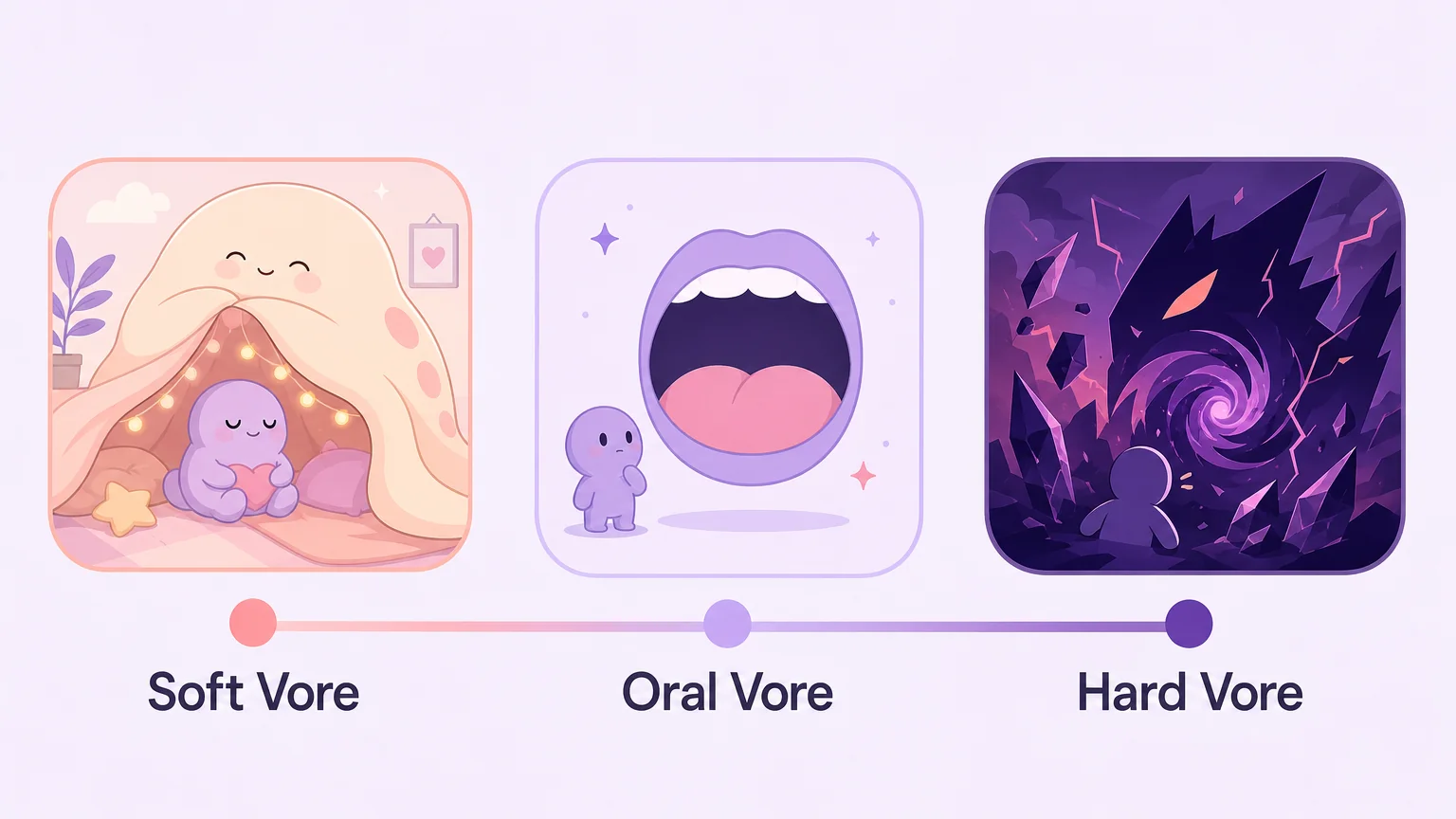
Vore is not one thing. It is an entire fantasy ecosystem with its own vocabulary. Understanding the spectrum is the fastest way to stop seeing it as a single scary monolith and start seeing it for what it is: a rich imaginative world where the variety itself tells you everything about how people actually engage with this fetish.
The big divide is soft vore versus hard vore, and the difference matters.
Soft vore is by far the more common form. Estimates put it at roughly 90 percent of community content. The prey is swallowed whole and alive. No blood, no chewing, no injury. The emphasis falls on comfort, safety, and sensual intimacy. The predator holds the prey inside them, unharmed. The scenario often reads as protective rather than threatening: a giant creature sheltering someone inside their body, safe from the outside world. For many, the appeal lives in that exact contradiction: something that should be terrifying becomes tender.
Hard vore sits on the other end of the spectrum. This variant involves graphic violence: ripping, chewing, blood, and gore. It is a smaller, darker niche, and it is not what most of the community engages with. If you stumbled onto something intense and assumed all vore looked like that, you saw the exception, not the rule.
Beyond that core split, the variants branch out by body part and scale. Oral vore, through the mouth, is the most common. Then there is anal vore, vaginal vore (sometimes called unbirthing), cock vore, and breast vore. Macro/micro vore plays with size: a giant predator swallows a tiny prey, or the reverse. Soul vore abstracts the whole thing further, focusing on consuming a person’s essence rather than their physical form. Each variant maps to a different psychological pull, which is why the same person might be drawn to some types and repelled by others.
Whatever the variant, the common thread is fantasy. Nobody is actually getting eaten. The entire fetish operates inside imagination, and that is exactly where the community keeps it.
Why Vore? The Psychology Behind the Fantasy
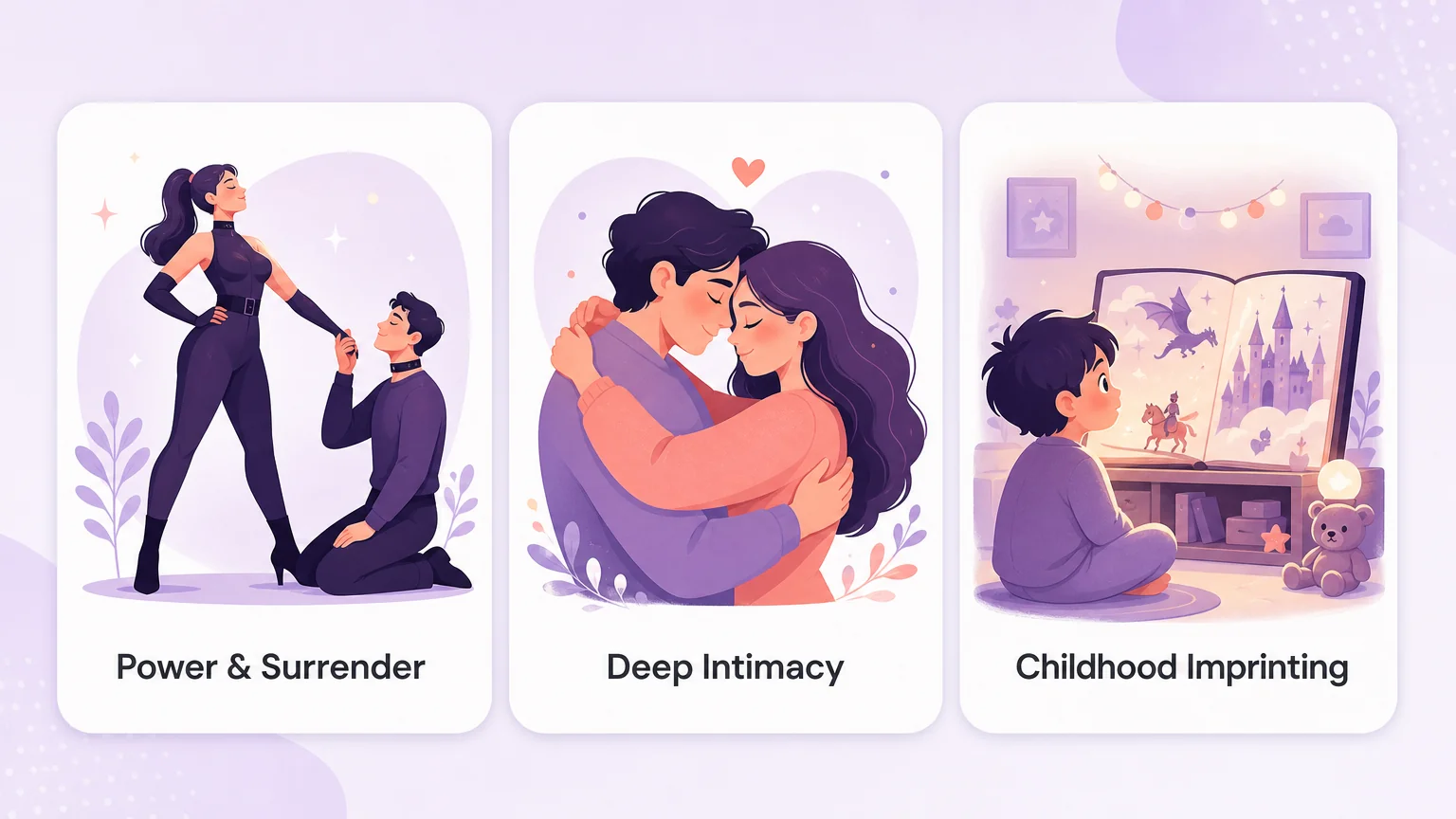
So why would anyone find this arousing? The answer is more relatable than you might expect. Underneath a fantasy that sounds extreme sit three psychological drives that most people recognize, just expressed through an unusual lens.
Power and surrender. Being consumed is the ultimate submission. No greater physical surrender exists than allowing yourself to be taken entirely inside another being. Consuming is the ultimate dominance: you hold someone within you, entirely in your control. This maps directly onto BDSM psychology that plenty of people already understand. The pred/prey dynamic is a Dom/sub power exchange pushed to its imaginative limit. Dr. Nazanin Moali, a clinical psychologist and host of the Sexology podcast, puts it plainly: “At the heart of these fantasies is the erotic yearning for an intimate connection, epitomized by the act of either consuming or being consumed.”
Deep intimacy and merger. Being inside someone, or holding someone inside you, represents the most complete form of closeness imaginable. You cannot get any closer than that. One community member described it as feeling even more intimate than sex. This is about dissolving boundaries, escaping the loneliness of being a separate person, and experiencing total union with another being. Sex coach Celina Criss, PhD, notes that in vore, the focus is “more like a way of possessing or being possessed” than anything to do with food. The swallowing is a metaphor for merger.
Childhood media imprinting. Many vorarephiles trace their interest to cartoons, fairy tales, and movies they encountered as children. Little Red Riding Hood swallowed by the wolf. Jonah and the Whale. Tom and Jerry swallowing gags. Scenes from The Brothers Grimm where a horse swallows a girl whole. These images create a fascination that sticks, and around puberty, that fascination can sexualize.
Sex therapist Lee Phillips, Ed.D, confirms this pattern: early exposure to consumption imagery in media can later become eroticized. It is not that a kid watching cartoons becomes a vorarephile. It is that certain brains latch onto certain images and, years later, those images resurface with a different charge.
Dr. Shannon Chavez, a clinical psychologist and sex therapist, frames it in terms anyone can understand: vore gives language to “the longing to be loved completely, the thrill of power or surrender, and the fantasy of intimacy without boundaries.” These are universal human desires. The packaging is unusual. The needs underneath are not.
Vore vs. Cannibalism: No, They Are Not the Same Thing
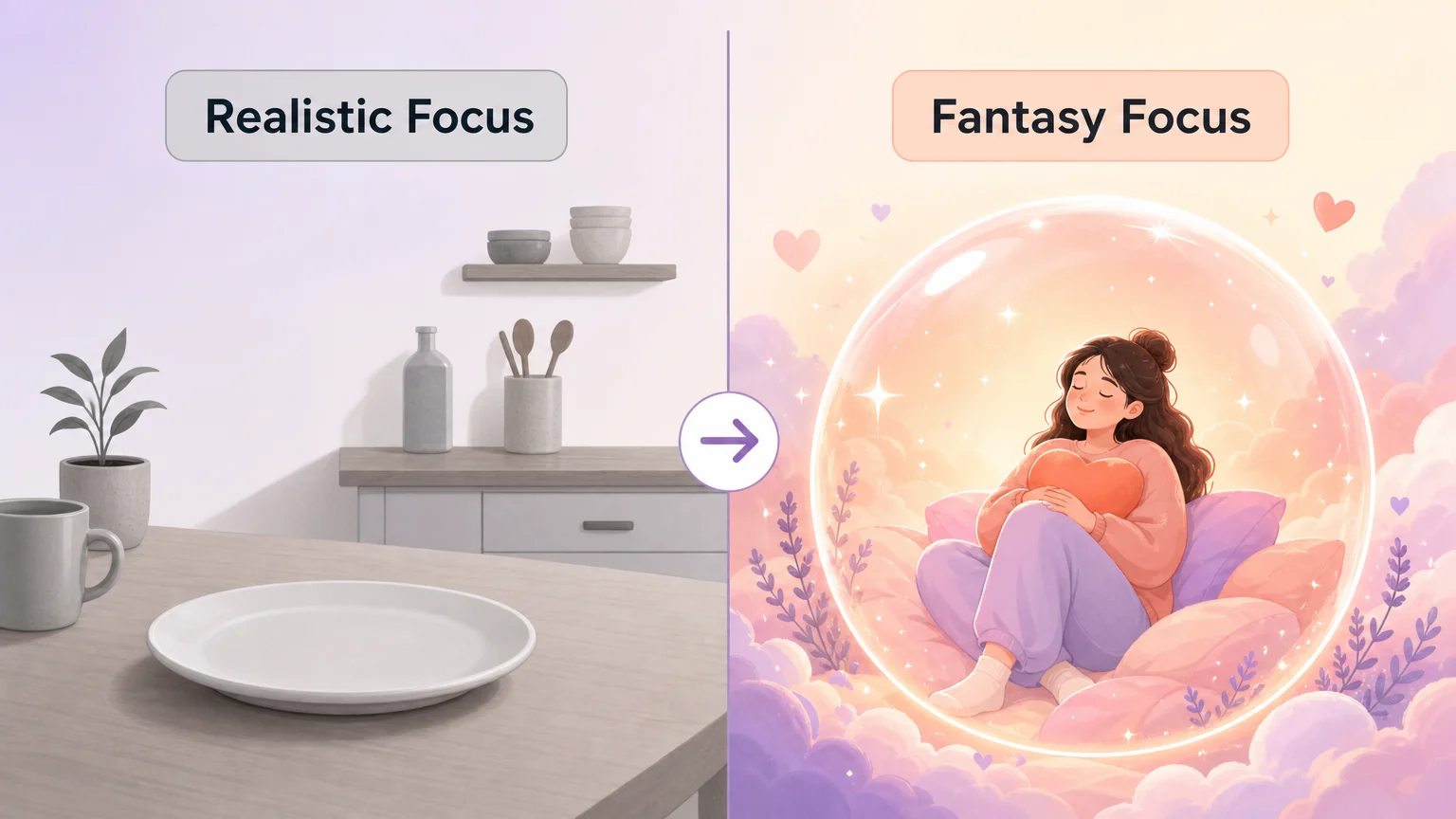
Let us address the thing everyone thinks but hesitates to ask: is this not just cannibalism?
No. The two are fundamentally different, and understanding the distinction is the difference between getting what vore is and misunderstanding it entirely.
Cannibalism fetishes center on realistic scenarios. The fantasy involves butchering, cooking, and preparing a person as food. The person becomes meat. The erotic charge comes from the preparation, the consumption as food, and the realism of the act.
Vore is fantasy-forward in a way cannibalism fetishes are not. The prey is swallowed whole and alive. The emphasis lands on the act of swallowing and being held inside, not on the person as food. The swallowed person is not meat. They are a guest. Fetish performer Codi Vore explains the split: “Cannibal fetish is much more realistic, with a focus on butchering and cooking, while vore is more fantasy-based, with a focus on swallowing and digesting.” Sex coach Celina Criss reinforces the point: in vore, the person is not food. The swallowing represents possession, merger, and intense intimacy.
The criminal case of Armin Meiwes is the extreme outlier that proves the rule. Meiwes acted on cannibalistic fantasies with a consenting victim in 2001. That case involved actual harm, actual death, and a clear break from fantasy into reality. It stands as a grim reminder of what happens when someone cannot keep fantasy and reality separate. The vast majority of vorarephiles want nothing remotely resembling that. Their fantasy stays in art, stories, and roleplay, where it belongs.
If you are trying to wrap your head around vore, this distinction is the foundation. Vore is not about food. It is about possession, surrender, closeness, and power.
Where Vore Lives: The Online Community and Furry Connection

If you think vore is an obscure corner of the internet occupied by a handful of people, here is a number: the main subreddit alone has around 40,000 members. That is one platform. The community is larger, older, and more organized than most outsiders realize.
Vor-Com launched in 1997 as one of the earliest dedicated vore websites, back when the internet still whispered through dial-up modems. Then came Eka’s Portal, founded in May 2005 by two community members, Eka and Leshana, after Yahoo deleted earlier vore groups. Eka’s Portal became the dominant hub: artist galleries, author sections, discussion forums, roleplay chat rooms, and a detailed wiki. It is still active today, two decades later. Around 2015, the community figure SOYA emerged as a touchstone, further cementing the culture’s shared identity. For a niche interest, that kind of longevity says something about how much the community values having a home.
The furry connection runs deep and makes intuitive sense once you see it. An estimated 2 to 5 percent of furries share vorarephilic interests. Anthropomorphic animal characters with built-in predator and prey dynamics are a natural fit for vore themes. A wolf swallowing a rabbit whole reads differently in furry art than it would with human figures. The animal framing creates distance from reality and makes the fantasy feel safer to explore. Vore panels exist at furry conventions. Many community members discovered one subculture through the other, and the two communities have overlapped for decades.
Community norms are clear and consistently enforced. Fantasy stays separate from reality. Content carries detailed tagging systems so people can find what they want and avoid what they do not. Consent frameworks govern roleplay interactions. Discord servers and private forums add layers of moderated, age-gated spaces where members can talk freely without the noise of open platforms. For many vorarephiles, finding this community is not just about access to content. It is relief. Proof they are not alone. A space where an unusual interest is just normal.
How to Explore Vore Fantasies, With or Without a Partner

You know what vore is and why people are drawn to it. Deciding what to do with that knowledge is the next step. Whether you explore solo or share this with a partner, a path forward exists that does not require anyone to get hurt, judged, or pressured.
Starting solo. Most people begin alone, and that is the right place. Before involving anyone else, understand your own fantasy. What specifically appeals to you? The power dynamic? The sensation of enclosure? The intimacy of merger? Are you drawn to soft vore or hard vore? Predator or prey? Which variants resonate?
Explore art and stories on platforms like Eka’s Portal, DeviantArt, and Fur Affinity. Read community discussions on forums and subreddits. Journal about what you notice. Naming the underlying need makes everything that follows easier, because you cannot explain something to a partner until you can explain it to yourself.
Bringing it to a partner. This is the part that makes palms sweat. Sex therapist Jaime Bronstein’s framework is the cleanest place to start: lead with vulnerability, explain the “why” not just the “what,” and frame the conversation as deepening intimacy rather than making a demand.
Pick the right moment. Private, relaxed, unhurried, and definitely not during sex. Open softly. Something like: “I want to share something personal that I have been wary of sharing. I am telling you because I want us to feel more connected, not because I need you to do anything.” Then share the feelings behind the fantasy: closeness, surrender, excitement, trust. Do not lead with the most graphic details. Start small and let the conversation breathe.
If your partner is open to exploring, practical options exist. A weighted blanket simulates the pressure and enclosure of being swallowed. A hood mimics the darkness of being inside someone. ASMR audio of stomach sounds amplifies the sensory experience. Gummy bears make effective stand-ins for tiny prey in macro/micro scenarios. If you already practice BDSM power exchange, vore themes integrate naturally: the pred/prey dynamic maps cleanly onto Dom/sub roles. Establish safewords and aftercare, same as any fetish scene. Check in during and after. Discuss what worked and what did not.
If your partner is not interested, respect it fully. A no is not a rejection of you. It is a boundary, and honoring it is part of being a trustworthy partner. Solo exploration and community participation remain valid, fulfilling paths. The disclosure itself builds trust regardless of the outcome. The goal is not to convert anyone. The goal is to be known.
When Fantasy Crosses a Line: Healthy vs. Unhealthy
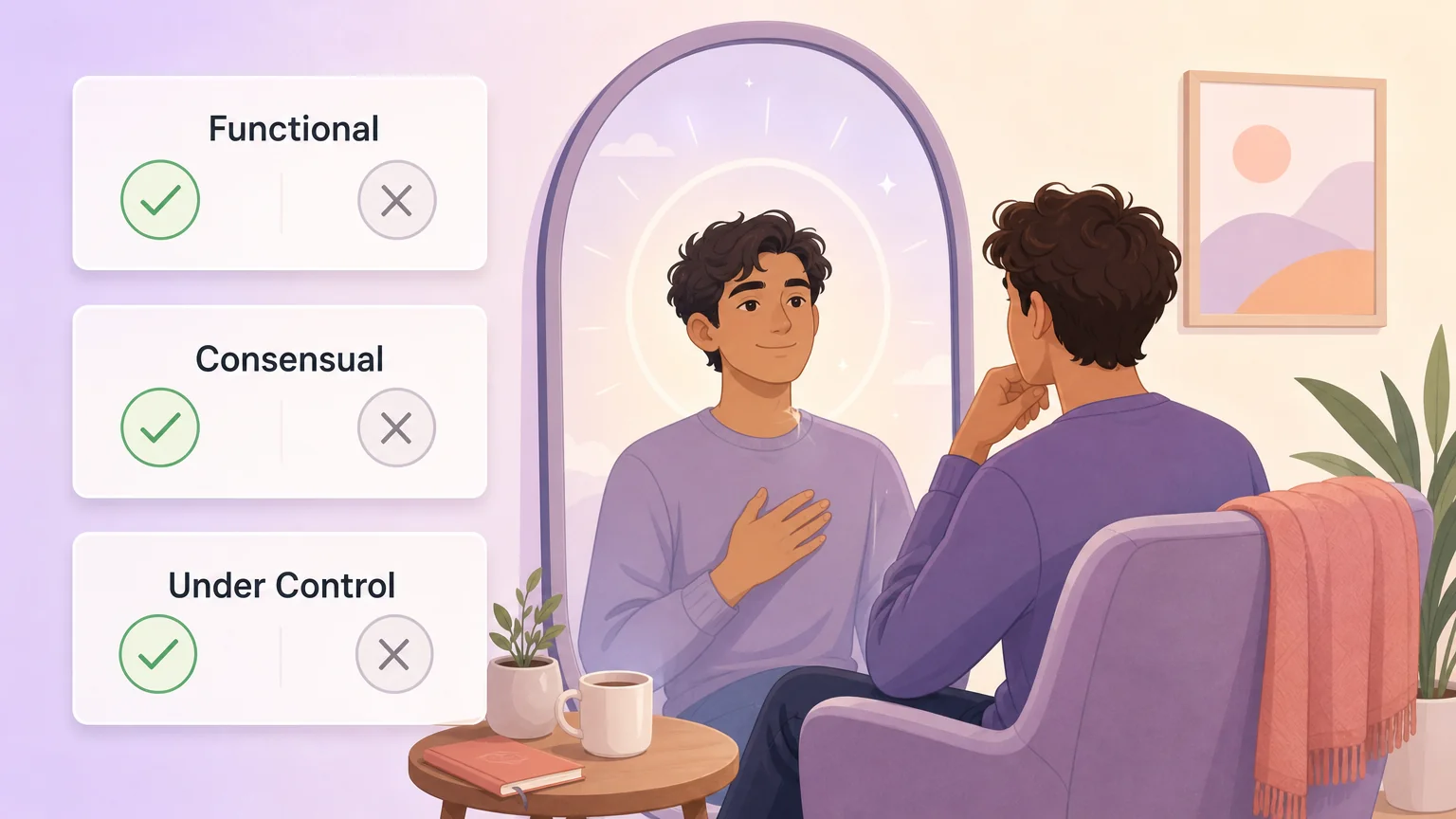
Most vorarephiles have a stable, healthy relationship with their fantasy. It is a private part of their sexuality that causes no distress, harms no one, and does not disrupt their life. But knowing where the line sits matters, because when a fantasy starts driving the person instead of the other way around, support becomes necessary.
The DSM-5 makes a critical distinction, and it cuts through a lot of unnecessary shame. Having a paraphilia, meaning an atypical sexual interest, is not a mental disorder. It only becomes a paraphilic disorder when it meets specific criteria: the interest causes clinically significant distress, or it leads to functional impairment or harm, including involving non-consenting others. Plain terms: liking something unusual is fine. Suffering because of it, or hurting someone because of it, is not.
Here is a practical self-check. Does this fantasy cause you persistent shame, anxiety, or depression? Does it feel compulsive, like something you cannot choose to step away from? Is it interfering with your work, your relationships, or your ability to function day to day? Are your urges escalating toward self-harm or thoughts of non-consensual acts? Has the fantasy stopped feeling like play and started feeling like something that owns you rather than something you enjoy?
If you answered yes to any of these, a fetish-aware therapist can help. You do not need to explain vorarephilia from scratch; a competent sex therapist will meet you where you are. This is not about moral judgment. It is about making sure the fantasy serves you rather than consumes you.
If the fantasy is privately enjoyed, causes no distress, involves no harm, and does not disrupt your life, it is a valid expression of your sexuality. The question is not “is my fantasy weird.” The question is “is my behavior functional, consensual, and under my control.”
FAQ
Is vore the same as cannibalism?
No. Cannibalism fetishes center on realistic butchering and cooking. Vore is fantasy-based: the prey is swallowed whole and alive. The focus is on swallowing and being held inside, not on the person as food. Most vorarephiles have zero interest in actual cannibalism.
Is it normal to be into vore?
It is uncommon, estimated at 0.2 to 5 percent depending on the population. Uncommon does not mean abnormal. The DSM-5 distinguishes between having a paraphilia, which is not a disorder, and a paraphilic disorder, which requires distress or harm. A consensual fantasy is a valid expression of sexuality.
Why are people into vore?
Three drivers. Power: being consumed is ultimate submission, consuming is ultimate dominance. Intimacy: being inside someone represents the most complete closeness imaginable. Childhood imprinting: many trace the interest to cartoons and fairy tales that later sexualized around puberty.
Can you actually act out vore in real life?
No. Swallowing a person whole is physically impossible. Vore lives in fantasy, art, stories, and roleplay. Safe sensory simulation exists: weighted blankets for enclosure, hoods for darkness, ASMR stomach sounds, and gummy bears as symbolic stand-ins.
What is soft vore versus hard vore?
Soft vore, roughly 90 percent of community content, involves being swallowed whole, alive, and unharmed, emphasizing comfort and sensual intimacy. Hard vore involves graphic violence: chewing, blood, and gore. It is a smaller, more extreme niche. Most community content centers on soft vore.
What is the connection between vore and the furry fandom?
An estimated 2 to 5 percent of furries share vorarephilic interests. The connection stems from natural predator-prey dynamics in anthropomorphic animal characters. Eka’s Portal, the main vore hub, hosts substantial furry art. Vore panels run at furry conventions. Many discover one subculture through the other.
How do I tell my partner I am into vore?
Understand your own interest first. Pick a private, relaxed moment, not during sex. Lead with vulnerability. Frame the feelings behind the fantasy, such as closeness or surrender, rather than graphic details. Start small. Give them time. Respect their answer. The goal is connection, not participation.
When should I be concerned about vore fantasies?
When the fantasy causes persistent shame, anxiety, or depression. When it interferes with work, relationships, or daily functioning. When it feels compulsive rather than chosen. When urges escalate toward self-harm or non-consensual thoughts. If any apply, a fetish-aware therapist can help. Otherwise, it is not a problem.