Every time you think about bringing the word, threesome, out loud, a knot forms in your stomach. You have held this fantasy, turned it over in your mind, rehearsed it silently, and swallowed it back down. What if they take it as a sign that something is broken? What if the ask itself does the damage?
Here is what the research says: 95% of men and 87% of women have fantasized about intimacy with multiple partners. Your desire is not a pathology. It is statistically ordinary. The problem has never been the fantasy. It is that nobody teaches you how to say the words out loud.
The outcome of this conversation is not determined by whether your partner shares the fantasy. It is determined by how to ask for a threesome with clarity, respect, and zero pressure, the kind of conversation that strengthens your relationship regardless of the answer.
Sex educator Annette puts it directly: the fantasy is common. The execution is where people fail. This is not about convincing anyone. It is a map, walking you through every phase: checking your motivations, making sure your relationship is ready, picking the moment, the actual words, and what happens after you hear the answer, whatever that answer turns out to be.
Desire does not require an apology. This is not a permission slip for a guilty couple. This is a map for an adventurous team.
Step 1: Know Your Why Before You Say a Word
You cannot have this conversation honestly with your partner until you have had it honestly with yourself. The question is not just “do I want a threesome?” It is “why do I want one, and does that reason hold up under scrutiny?”
Good reasons versus red-flag reasons.
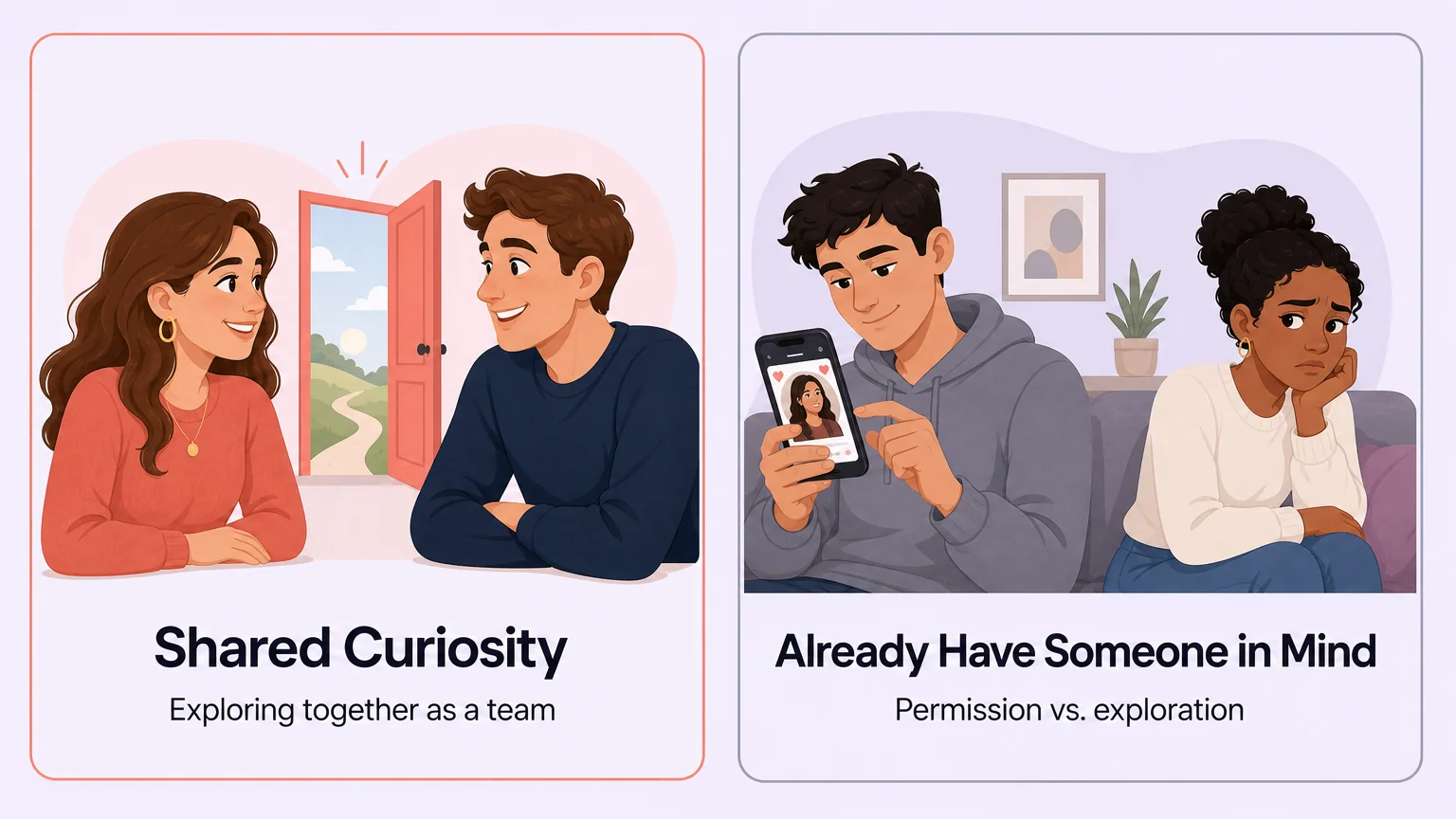
Annette’s framework draws a clear line. Good reasons: both of you are genuinely curious, craving a shared adventure, and already have strong communication and emotional security. Bad reasons: trying to fix a struggling sex life (the single worst motivation, per multiple experts), trying to prevent cheating by making it sanctioned, or one partner already having a specific person in mind.
Sex therapist David Ortmann puts it directly: “If you’re having a threesome because sex has become routine, you need to address why before you bring in the third. When the third leaves, your intimacy issues will still be there.”
The critical distinction: curiosity versus having someone in mind.
If you are genuinely curious about exploring together, the conversation is about shared adventure. If you already have a specific person in mind (especially someone you have been flirting with), you need to examine whether you are asking for a threesome or asking for permission to sleep with someone specific. Your partner will sense the difference immediately.
The fantasy-versus-reality gap.
A 2020 study in the Archives of Sexual Behavior found that people who skipped emotional prep were far more likely to regret their threesome. In fantasy, nobody catches feelings. In reality, the moment your partner makes more eye contact with the third than with you, you are spiraling. The fantasy is the highlight reel. The reality includes awkward moments, unexpected emotions, and three bodies that do not naturally choreograph themselves.
If your why is solid and you have passed your own honesty test, you are ready for the next question: whether your relationship is ready, too.
Step 2: Make Sure Your Relationship Is Ready for This Conversation
The single biggest predictor of how this conversation goes is not the words you choose. It is the relationship you are bringing those words into. A secure relationship can absorb an awkward conversation. A fragile one cannot.
If your relationship has existing cracks, a threesome conversation will split them wide open. Sex therapist Desiree Spierings puts it bluntly: “If you already have trust issues, a threesome isn’t going to solve it, but will just exacerbate it.”
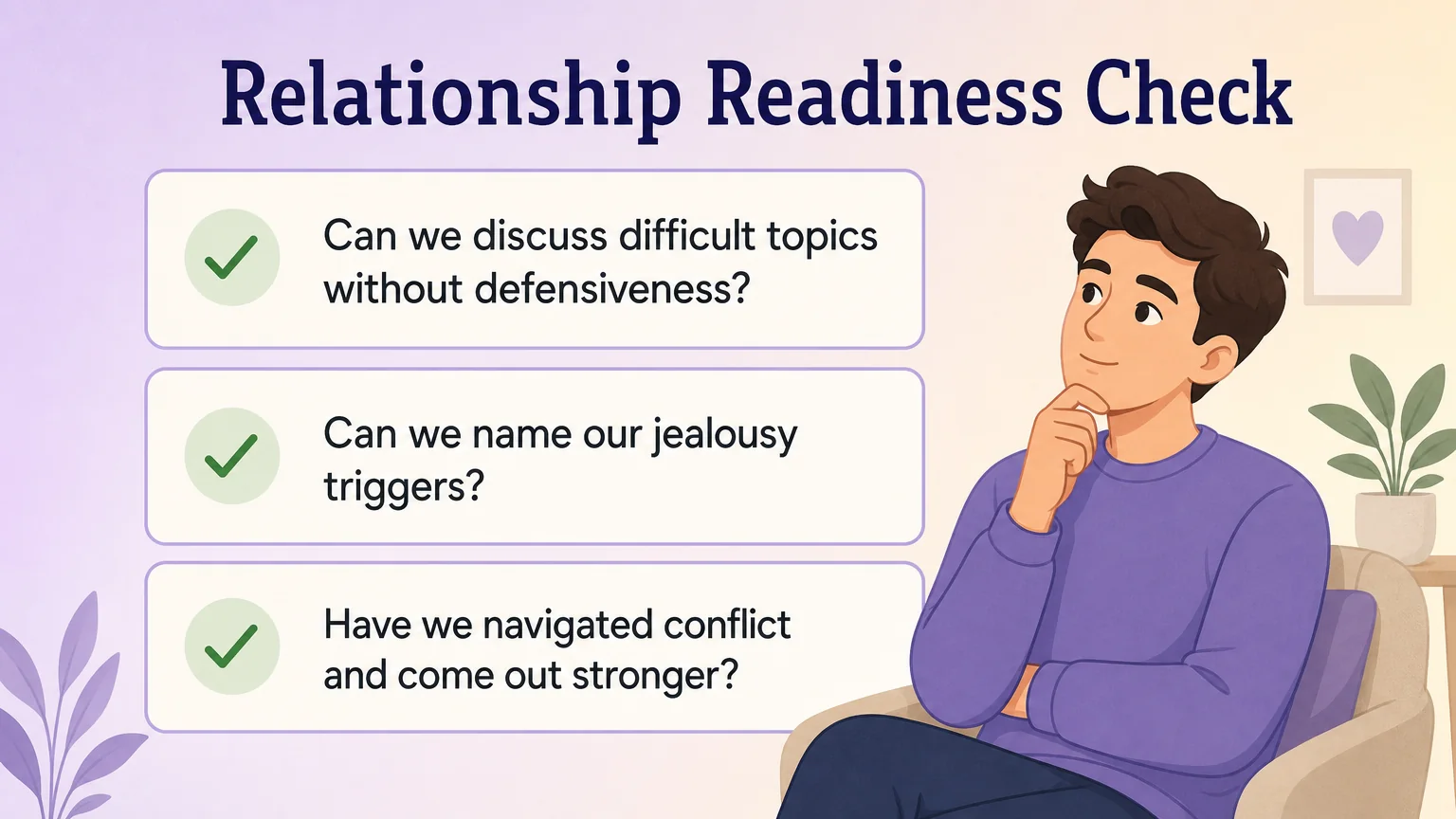
The readiness checklist.
Licensed sexologist Sofie Roos identifies the biggest readiness indicator: you can talk about needs, doubts, jealousy, and boundaries without fighting. Sex therapist Joe Kort adds: if you and your partner are not in a good place, this is probably not the best time. Can you discuss difficult topics without defensiveness? Can you name your jealousy triggers without shutting down? Have you navigated conflict recently and come out stronger? If any answer is no, work on your communication foundation first.
Relationship stage matters.
A couple dating for six months is in a different position than a couple married for ten years with kids. For newer relationships: do you have enough trust history to survive a destabilizing conversation? For long-term committed couples: has your communication become routine or avoidant? For couples with children: logistics and privacy are entirely different. For same-sex couples: dynamics vary by gender composition, with less cultural scripting to default to. A 2026 study by Thompson et al. identified navigating jealousy and developing boundaries as the primary challenge across all mixed-sex threesome configurations.
The communication test.
Before you bring up a threesome, try bringing up something smaller but similarly vulnerable: a different fantasy, a concern about your sex life, an insecurity. How your partner responds is your preview of how the bigger conversation will go.
This is not a flaw in your foundation; it is an extension of your adventure. But foundations need to be solid before you build extensions.
Step 3: Pick the Right Time and Place
The exact same words, said at the wrong time, land like a grenade. Said at the right time, they land like an invitation. Timing is not a footnote. It is half the message your partner receives.
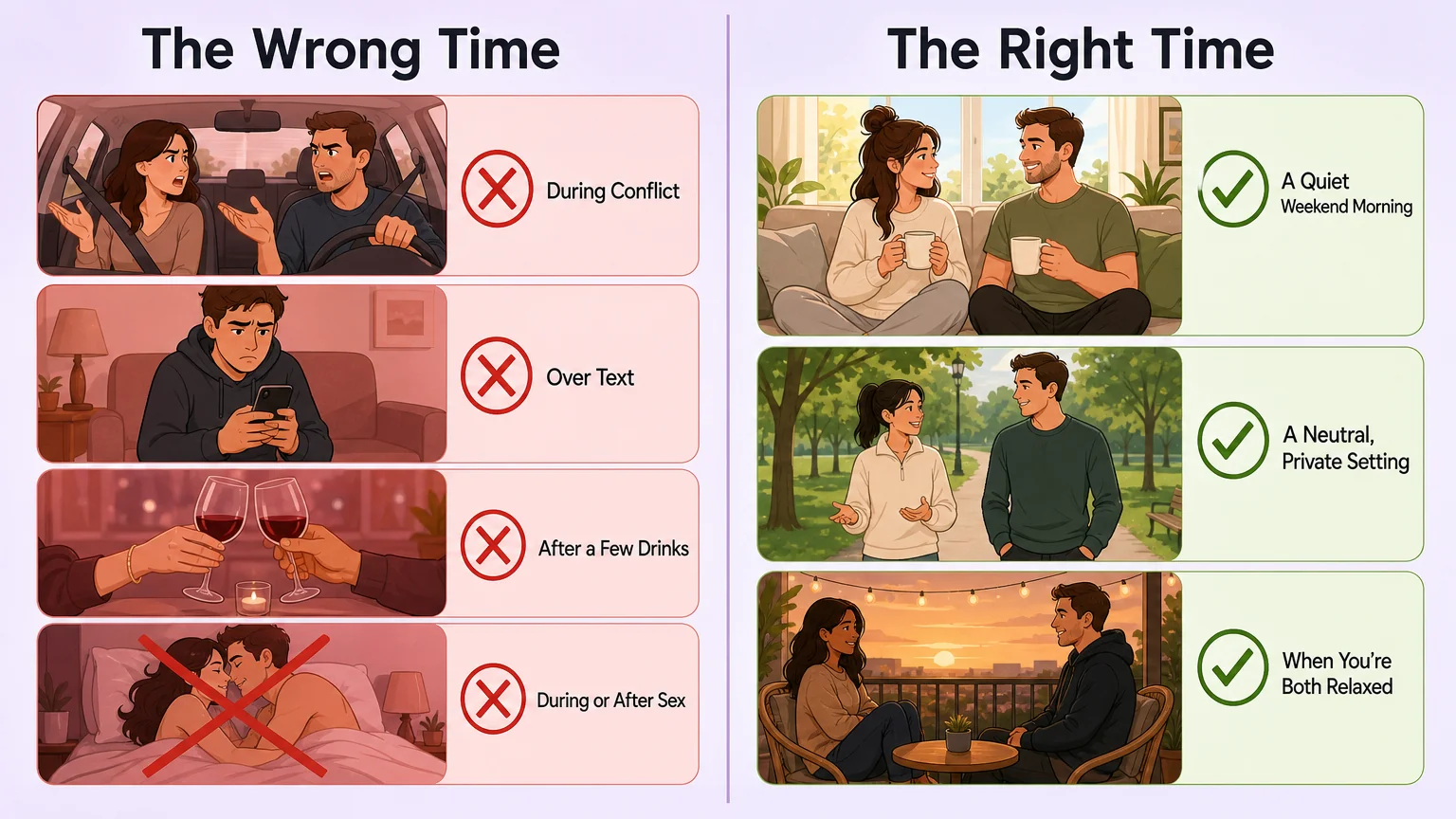
Never here.
Do not bring this up during sex or immediately after. Your partner will associate the idea with being ambushed at their most vulnerable. Do not bring it up during an argument or as a response to relationship tension. It will read as “I want to sleep with other people because I am unhappy with you.” Do not bring it up after a few drinks. You need sobriety and clarity, not liquid courage. Do not bring it up via text, during a busy weekday morning, or in any rushed context.
Always here.
Choose a neutral, private, unrushed setting. A weekend morning when you are both relaxed. A quiet evening with no plans. A moment when you are both emotionally connected and neither of you is stressed, tired, or distracted. The setting should communicate: this matters, and I have thought about it carefully.
Psycho-sexologist Chantelle Otten says the goal is to make your partner feel safe enough to give an honest answer, not cornered into giving the answer you want.
A note on gender dynamics.
A woman asking her male partner may face cultural scripts around possessiveness. A man asking his female partner faces the weight of every message she has absorbed about not being “enough.” A same-sex couple navigates community-specific dynamics. The universal principle: pick a moment where your partner feels secure and seen.
Step 4: What to Actually Say: Scripts for Bringing It Up
Abstract advice like “use I statements” is not enough when you are sitting across from your partner with your heart in your throat. Here are the actual words.
The universal rule: lead with reassurance.
Before you say anything about a threesome, your partner needs to hear that you are happy, satisfied, and not trying to fix anything. Licensed sexologist Sofie Roos explains: “Asking for a threesome often signals dissatisfaction, so you need to be explicit that this isn’t the case.” LMFT Kayla Crane reinforces: frame it as “our sex life is already great, so exploring could be exciting.”
Script 1: The gentle curiosity opener (Chantelle Otten).
“Hey, I’ve been thinking about what it might be like to have another person in the bedroom with us at some point. Is that something you’ve ever thought about?” This is open-ended. It gives your partner maximum room to respond honestly without assuming desire or enthusiasm.
Script 2: Tracey Cox’s five-step approach.
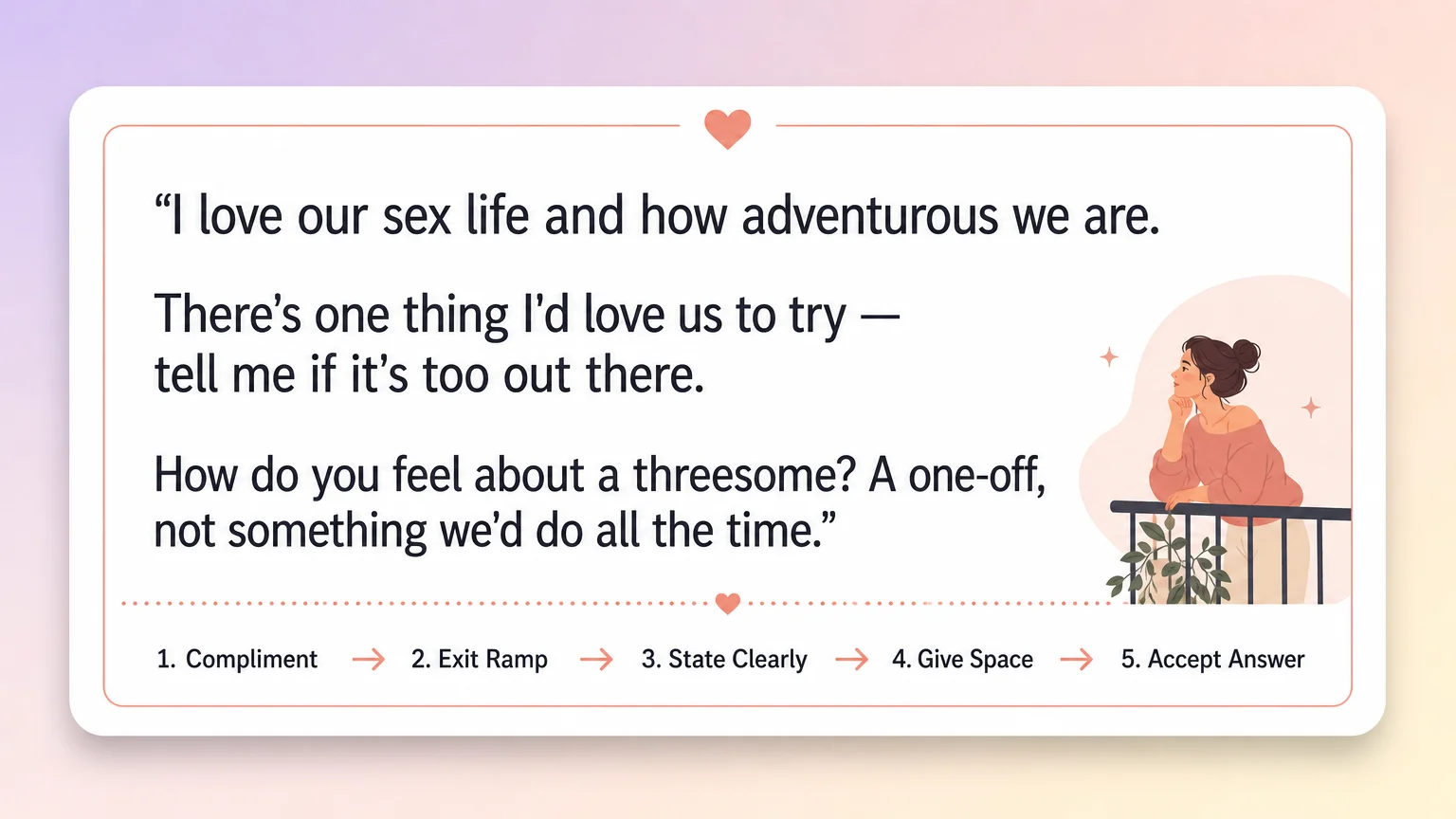
Start with a compliment: “I love our sex life and how adventurous we are.” Introduce the idea with an exit ramp: “There’s one thing I’d love us to try but tell me if it’s too out there.” State it clearly: “How do you feel about a threesome? A one-off, not something we’d do all the time.” Give them space. Accept their answer.
Script 3: The “I want to explore with you” approach.
“I’ve been thinking about what it means to really explore our connection. One idea that keeps coming up is maybe trying a threesome together. No pressure, no timeline. Just something I wanted to share because I feel safe with you.” This frames the ask as trust, not dissatisfaction.
Script 4: The nervous opener.
“Okay, this is a little awkward, and I don’t want to make it weird. But I’ve had a fantasy come up a few times, and I wanted to share it with you because we promised we’d be honest with each other.” Vulnerability is context, not weakness.
Script 5: The media conversation starter.
“I came across this podcast where a couple talked about trying a threesome. It made me wonder how we would feel about something like that someday.” A temperature check, not a request. It lets you gauge their reaction without committing to anything.
These are blueprints, not a script to read robotically. Adjust the tone to your own dynamic. The principles (reassure first, use curiosity language, give an exit ramp, accept the answer) are universal. If you are pushing your partner toward an answer they are not ready to give, pause. You are not ready. That is not judgment. That is protection.
Step 5: When They Say No: Handling Rejection Without Resentment

A “no” is not a failure. It is a valid, common answer. The stats tell the story: 95% of men and 87% of women fantasize, but roughly 24% have had a threesome. The vast majority who think about it never do it. That is not a tragedy. It is the gap between fantasy and action.
What to say in the moment.
Thank them immediately for their honesty. “I really appreciate you being honest, and I don’t want to push anything you’re not comfortable with.” Reinforce that sharing was about trust: “I just wanted to share because I feel safe with you.” Do not argue. Do not persuade. Do not show visible disappointment. Your reaction in this moment becomes evidence of whether you are safe to be honest with.
The door-closing question.
Chantelle Otten suggests you can add once: “If you ever feel differently, I’d be open to talking again.” Then drop it permanently. Bringing it up again without a clear invitation from your partner is not patience. It is pressure. One person’s account captures the consequence: “Someone pushing so hard against my no would be losing my trust with every try.”
Processing your own disappointment.
You may feel rejected, embarrassed, or sexually shut down. Those feelings are real, but they are yours to process, not your partner’s to fix. Their “no” to a threesome is not a “no” to you, and not a referendum on your desirability. If you are struggling, consider a solo session with a sex-positive therapist. Not to change your partner’s mind, but to understand your own feelings.
Simply having this conversation: sharing something vulnerable, listening to your partner’s honest response, and handling it with grace, can bring you closer even when the answer is no. The conversation itself builds intimacy, independent of outcome.
If it is not an enthusiastic yes from everyone in the room, it is a hard no. That includes your partner’s answer right now.
Step 6: When They Say Maybe: Giving Space Without Pressure
“Maybe” is the most delicate answer. It is not a soft no, and it is not a yes. It is an invitation to go slow. How you handle this middle ground determines whether “maybe” becomes “let’s talk more” or hardens into “actually, no.”
A “maybe” can mean: “I’m curious but scared.” “I need time to process.” “I’m not sure if you’re serious.” “I’m leaning no but don’t want to hurt you.” Your job is not to decode or accelerate it. Your job is to create space.
What to say.
“Take all the time you need. There’s no clock on this, and no pressure. I’m not going to bring it up again. Whenever you want to talk more, I’m here.” Then keep that promise. Do not nudge. Do not “just check in.” Somatic sexologist Alice Child explains: “When people are able to go slow and reflect on it, that’s often when they start to become more curious.”
Low-stakes ways to explore while they think.
One couple waited two full years from first suggestion to actually doing it, spending that time having conversations, not campaigns. Suggest shared-fantasy exploration: dirty talk, role-play, watching ethical porn together. No third person involved. This lets your partner explore the idea in a safe container. Some couples find the shared fantasy is satisfying enough on its own.
What not to do.
Do not send them articles. Do not show them profiles on apps. Do not bring it up during sex to “test the waters.” Do not use silence as punishment. Every one of these actions turns “maybe” into pressure, and pressure turns “maybe” into resentment.
If they never bring it up again.
That is your answer. A genuinely curious partner will circle back when ready. A partner who does not bring it up has given you a soft no. Accept it as final.
Green lights only require green lights from both of you.
Step 7: They Said Yes: The Conversation That Comes Next
A “yes” feels like the finish line, but it is the starting gun. The conversation that follows is longer, more detailed, and more important than the one that got you there.
David Ortmann sets the benchmark: “Before you have a threesome, you should have talked about it so much that you’re tired of talking about it.” If you have not reached that point, you are not ready to act.
The pre-action strategy session.
Sit down together (not in a sexual context) and walk through every detail. What is on the menu and what is completely off limits? What is your safe word or pause signal? Where: neutral territory or your home? What are the overnight arrangements? How will you reconnect afterward, just the two of you? The 2020 Archives of Sexual Behavior study confirms: people who skipped clear boundaries and emotional prep were far more likely to regret it.
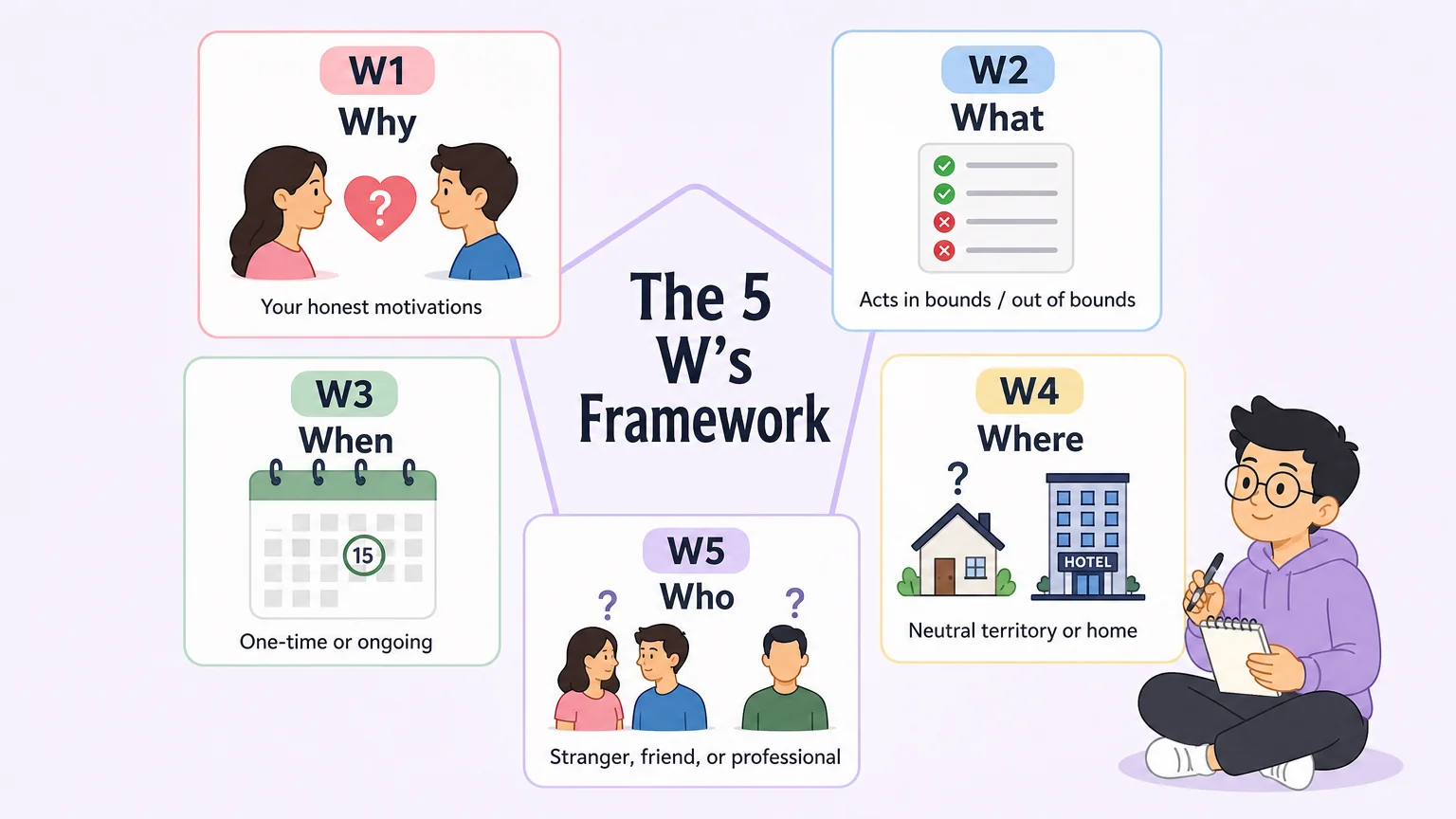
Desiree Spierings’ five W’s framework.
Why: have you both articulated your motivations honestly? What: which specific acts are in bounds and out of bounds? When: one-time or something you would consider repeating? Where: neutral territory can eliminate territorial feelings. Who: stranger, friend, or sex worker? Many therapists recommend against friends. Research includes multiple accounts of friendships ending. Apps like 3Fun let you find strangers without risking existing relationships. Some experts consider sex workers the safest option because professionalism and clear boundaries are built in.
The third person: ethics over convenience.
Research from the Sexuality and Cultural Journal found that couples with high post-threesome satisfaction had one thing in common: a third who respected the couple’s dynamic and honored all discussed boundaries.
Green flags: they ask about boundaries, are experienced or educated, attracted to both partners, prioritize communication and consent. Red flags: only interested in one partner, say “I’m just down for whatever” with no boundaries, or a friend with unresolved feelings.
They are a guest in your playground, not a toy in your toybox.
Red flags that mean “pause” even after a yes.
If your partner’s enthusiasm feels performative. If they are saying yes to make you happy while body language says otherwise. If a specific person is already waiting and you suspect this was the plan all along. If you cannot discuss specific sexual acts without one of you shutting down. Pause means pause. Not cancel, but table action until the communication catches up.
Step 8: When Your Partner Asks You: The Other Side of the Question

Half the people who need this article are the ones being asked. Being on the receiving end comes with its own emotional terrain.
Being asked out of nowhere can feel destabilizing, triggering every insecurity about your body, your relationship, and whether you are “enough.” Those feelings do not mean you are closed-minded. They mean you are human.
Your first move: buy yourself time.
You do not owe an immediate answer. Say: “Thank you for being honest with me. I need some time to think about this. Can we revisit in a few days?” This honors their vulnerability, prevents a reactive answer you might regret, and signals this deserves real reflection.
Questions to ask them, and yourself.
To your partner: “What specifically appeals to you about this?” “How long have you been thinking about it?” “Is this about exploring together, or is there someone specific?” These distinguish shared-adventure curiosity from a disguised request for permission to sleep with someone else.
To yourself: “Would this genuinely excite me, or would I be saying yes under pressure?” “What specific scenarios make me anxious, and can I name why?” “What would I need to feel safe?”
Separating their desire from your insecurity.
Their curiosity does not mean you are not enough. The desire for variety and the desire for you are not competing impulses. Many people experience both. Let that distinction land emotionally.
How to say no clearly and kindly.
“I appreciate you being honest, but it’s not something I’m interested in or comfortable with, now or in the future.” Ambiguity invites renegotiation. Clarity is a gift to both of you.
Warning signs of pressure versus genuine curiosity.
A healthy partner respects your boundary the first time. Warning signs: ongoing pressure, guilt-tripping, threats, withdrawal of affection, bringing it up during sex, comparing you to “more adventurous” people. These are not about threesomes. They are about control. If you are experiencing pressure, the threesome is not the issue. The relationship dynamic is.
Exploring middle ground.
If you are not a hard no but not a yes, suggest keeping it as shared fantasy: role-play, dirty talk, watching ethical porn together. Some couples find this satisfies the curiosity without real-world risks. It also lets you see how you both feel in a low-stakes container before deciding whether to go further.
Whether your answer is yes, no, or somewhere in between, having this conversation with honesty and care is a sign of a relationship strong enough to hold big feelings.
FAQ
Is it normal to fantasize about threesomes even if I never want to actually do it?
Yes. 95% of men and 87% of women have fantasized about multiple partners. Fantasy and the desire to act are completely separate. Many people enjoy it as exactly that: a fantasy, with no intention of making it real. Exploring through dirty talk, role-play, or watching ethical porn together can be satisfying without involving a third person.
Should the third person be a friend, a stranger, or a sex worker?
Friends risk the friendship and your relationship. Multiple therapists recommend against it, and research includes accounts of friendships ending. Strangers found through apps like 3Fun carry less emotional baggage but require vetting. Sex workers offer professionalism, clear boundaries, and experience. Some experts consider this the safest option. The universal rule: all three people must respect boundaries and communicate clearly.
How do we handle jealousy during or after?
Jealousy is normal, not a sign of failure. Sexologist Lauren French: “Everyone gets jealous. It’s about how you deal with it.” Beforehand: discuss trigger scenarios and agree on a safe word. During: check in with your partner frequently. After: plan reconnection time: shower together, cuddle, talk through feelings. Debrief within a day or two. If jealousy persists, take a break and work through it. The Jealousy Workbook by Kathy Labriola is widely recommended.
What if I am a man asking my female partner for FMF and she is not bisexual?
Do not assume orientation. A threesome does not require the two women to interact sexually. Many FMF experiences involve the women focusing on the man or interacting only as far as everyone is comfortable. If your partner is heterosexual with no interest in sexual contact with another woman, be clear about what you are actually inviting her into. Some configurations, like MFM, might be more comfortable for her. Let her define her own boundaries.
How long should we talk about it before actually doing it?
There is no universal timeline. One couple waited two full years from first suggestion to action. David Ortmann’s benchmark: talk until you are tired of talking about it. Some couples find the talking satisfies the curiosity and never need to act. Go slower than you think you need to.
What safer sex precautions do we need?
Use condoms and change them between partners and between different types of contact. Research found some first-timers did not realize this was necessary. Discuss STI testing openly with all three people beforehand. Consider PrEP if relevant. Have supplies ready: condoms, lube, towels. Discuss birth control if pregnancy is a possibility. This conversation is the foundation of a safe experience for everyone involved.